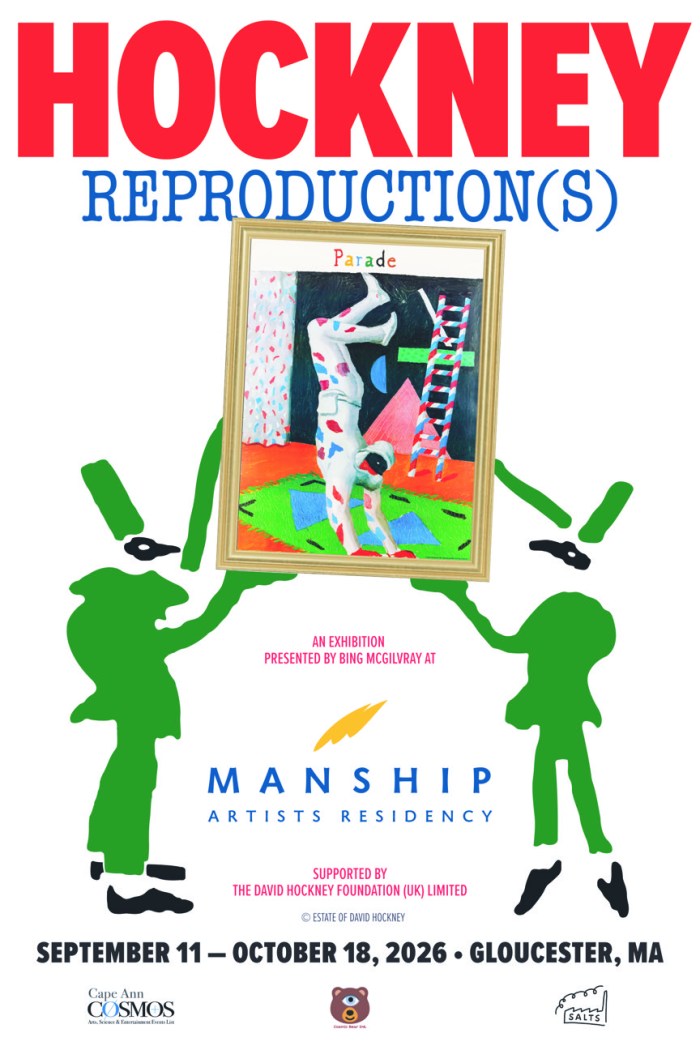
Expecting this to be a life changing look at the art of David Hockney, and Bing McGilvray, with revelations big and small, rare and personal, shedding light on artist friendships, critical art history and core themes of both artists, especially Hockney’s ways to create, share and distribute art.
And two more shows not to miss right here right now:
On view now–not overlapping with the above show) Jeff Weaver at North Shore Art Association (thru Aug 30)
and
Cape Ann Museum’s –overlapping a few days!–Avery, Gottlieb & Rothko (thru Sept. 27th)
RIP David Hockney 1937-June 2026. June! 😦
and big sympathy to Bing 🍒 who has also written a three part series ahead of the exhibition, “Hockney Reproduction(s): A Celebration of the Life and Art of David Hockney (1937–2026)”, and published on Cape Ann Cosmos, Part 1, 2, and 3.Read Part 1. The 1980s: A life in pictures by Bing here
THROWBACK. A selection from a piece I wrote about David Hockney and shared on GMG back in 2013:
“…DC, NYC, and more: Armory Centennial shows from New York Historical Society’s Armory Show at 100 and Washington DC’s Phillips and on line too for the Archives of American Art; do yourself a favor as they are worth engagement. Many of the artists had Gloucester ties. I always paused whatever I was doing for any of Sarah Fishko’s analysis on WNYC, usually Morning Edition or All Things Considered, and syndicated through other outlets now, too (Studio 360 and On the Media). Her extended radio documentary for the Armory anniversary, Culture Shock 1913, continues to be re-broadcast through outlets. Like a painter using color to move our eyes across a surface, Fishko’s pieces are brushed with pauses and impeccable ambient sound and audio moments–mini Lubitsch sound banquets. Art to savor.
San Francisco, de Young Museum, 2013: A major retrospective of David Hockney’s work completed over the last decade, A Bigger Exhibition (closing this month), has generated voluminous press and praise, mostly for his legacy of embracing new technology. Oh, and how old he is now, somehow compelling him to create before time runs out. The latter opinion grates and not just because of repetition. (See a good overview of the de Young exhibit on Newshour but listen at 4:24 dispensing this cliché while introducing another. When hasn’t Hockney investigated any series, media or pursuit without daunting and constant focus? He’s always testing and the mastery and means to do so, and often exuberant.) It’s also in the news because of Vermeer, but more on that below. Reactions to this Hockney exhibit are reminiscent of a 1980s traveling retrospective for his earlier work, not regarded universally with favor, but ample discussion. I recall moving along that crowded exhibit, a chronological layout with each room different series, artistic intentions, styles & techniques– and a log jam most at the space featuring his monumental collaged Polaroids (1988 at the MET). Hockney print shows were also traveling (for MA both the MFA and the DeCordova). I didn’t think about Hockney then as a trailblazer for artistic pluralism. Lightbulb memory next: I do remember the Hockney New Yorker article everyone was talking about in January 2000, The Looking Glass, by Lawrence Wechsler. I remember where I was when I first read it, the first contemporary artists who spoke with me and who I turned to for opinions, curators and friends. “Vermeer and the Delft School” at the MET was coming up; it had been since the 1995 National Gallery/Hague exhibit when we last had a fresh chance to see Vermeer paintings en masse. Not to be overly dramatic but it continued as a white hot ‘what is art topic’; enjoy a dishy 2001 New York Times article covering one charged symposium filled with memorable quotes by curators, Susan Sontag, and Chuck Close (”some scientists are just as annoying as some art historians”) maybe on the same day you listen to that Fishko audio doc,
Culture Shock 1913 (the near riot at the premier for 1913 Ballet Russes Stravinsky’s Rights of Spring). An optical debate symposium 15 years later might be worth an anniversary, current thoughts from Close, Hockney, and others involved and so much that has happened since. Photographer Joseph Pennell is thought to be the first to write (1890s) about optical lenses and Vermeer. There are many others but I’ll just list one because of the Gloucester connection. A. Mayor Hyatt, the eminent print curator for the Metropolitan Museum of Art, wrote The Photographic Eye in 1946. (Gloucester’s Joan of Arc WW1 memorial was created by his “favorite person in the world”, his aunt, Anna Hyatt Huntington. This brilliant family spent summers in Annisquam for nearly 100 years.) People will always be fascinated by virtuoso technique, the ultra exceptional DIY. Artists I’ve worked with consider tools of the trade in myriad ways: inspiring, a challenge, filtering, but decidedly unfixed as they’re about process and exploration of ideas throughout all iterations of their art. Art and magic–themes of mastery, obsession, even “it’s all done with smoke and mirrors”—seems fittingly matched in the Penn & Teller documentary, Tim’s Vermeer …and a visit with Hockney is included…”


