PEREGRINE FALCON DEVOURING A BIRD

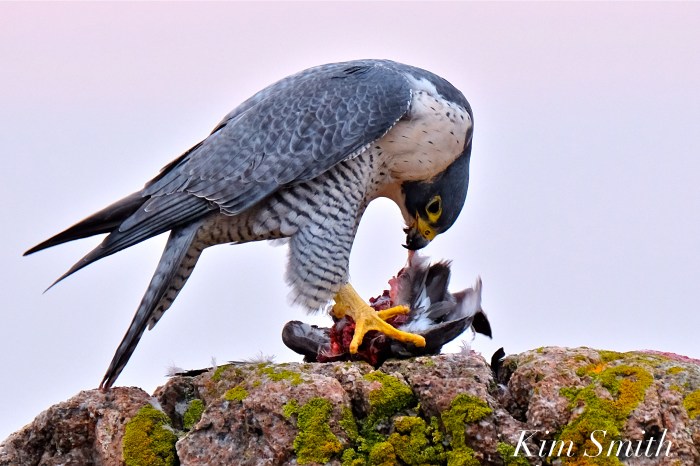
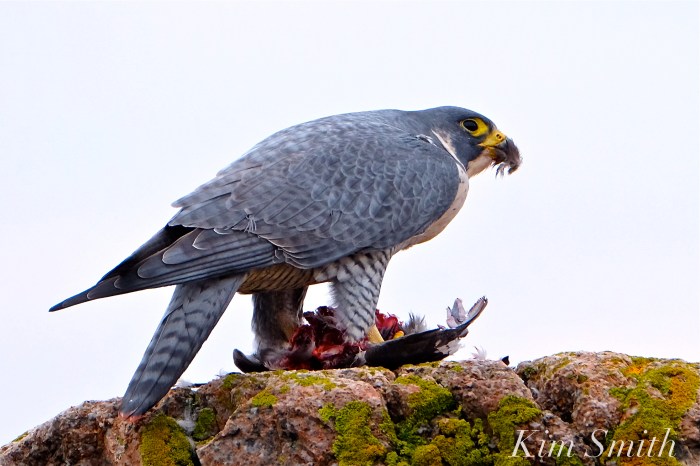
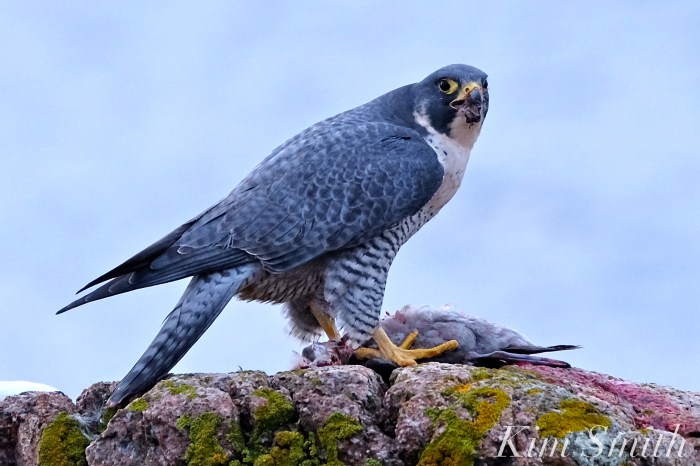
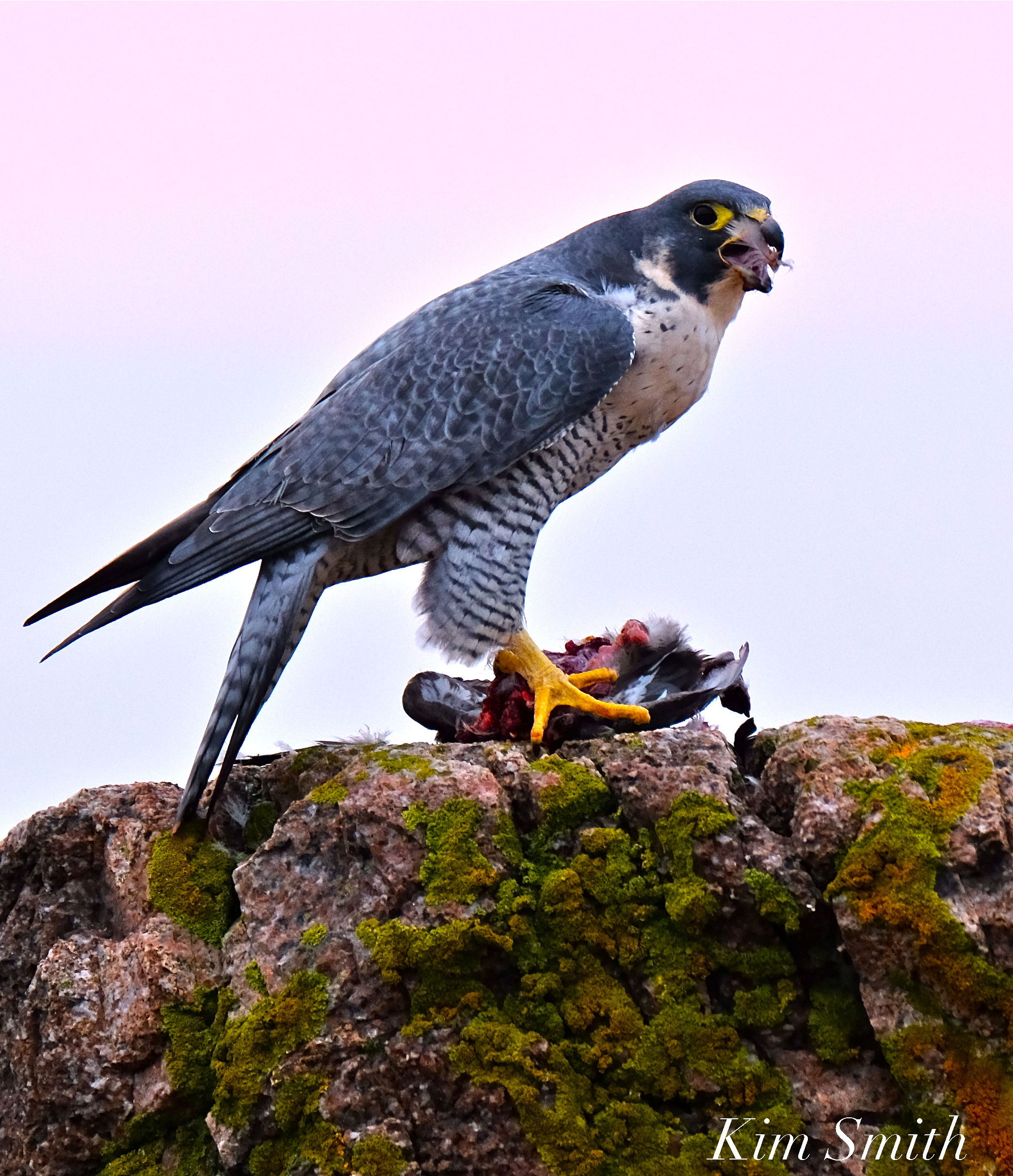
On the lookout for Snowy Owls, I instead encountered this scene of a Peregrine Falcon eating a freshly killed bird. At one point I caught a quick glimpse of what I think was a webbed duck foot, but could possibly also have been a cormorant. Despite all the gore, the Falcon was exquisite to observe. Especially beautiful were the hues of its slate blue wings in the early morning light.

Peregrine Falcons eat mostly birds. Over 450 species of bird prey have been documented in North America alone. From the tinniest Ruby-throated Hummingbird to the enormous Sand Hill Crane, few birds are safe from the talons of the Peregrine Falcon.
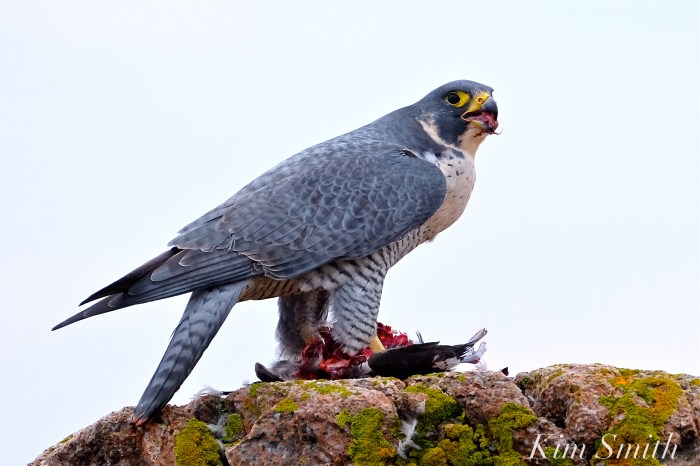
The Falcon methodically eviscerated its prey, all the while watching gulls, crows, me, and any other potential thief.
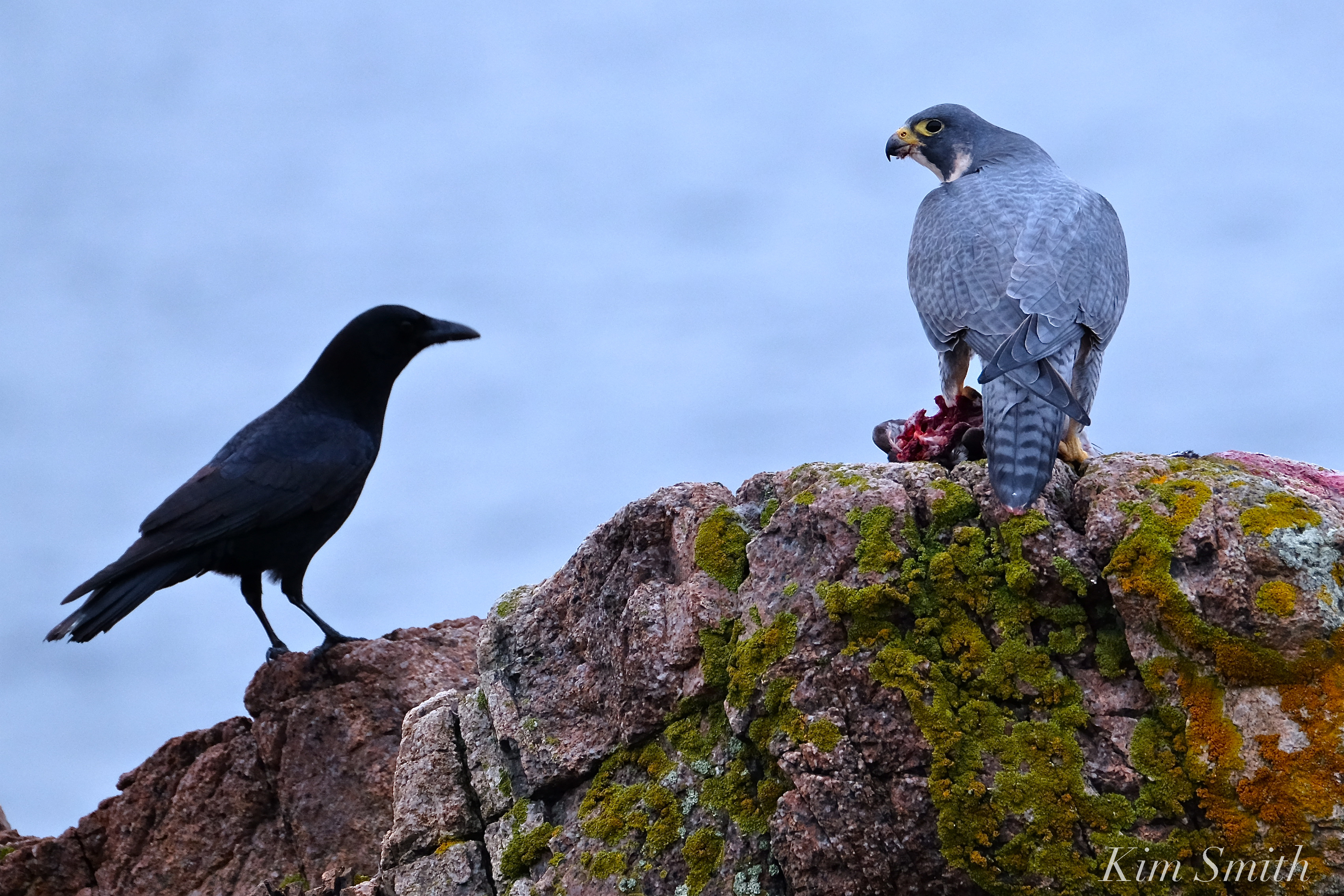
Robber crows stopped by to see what they could snatch and one brazen fellow made off with a gizzard dangling from its mouth.
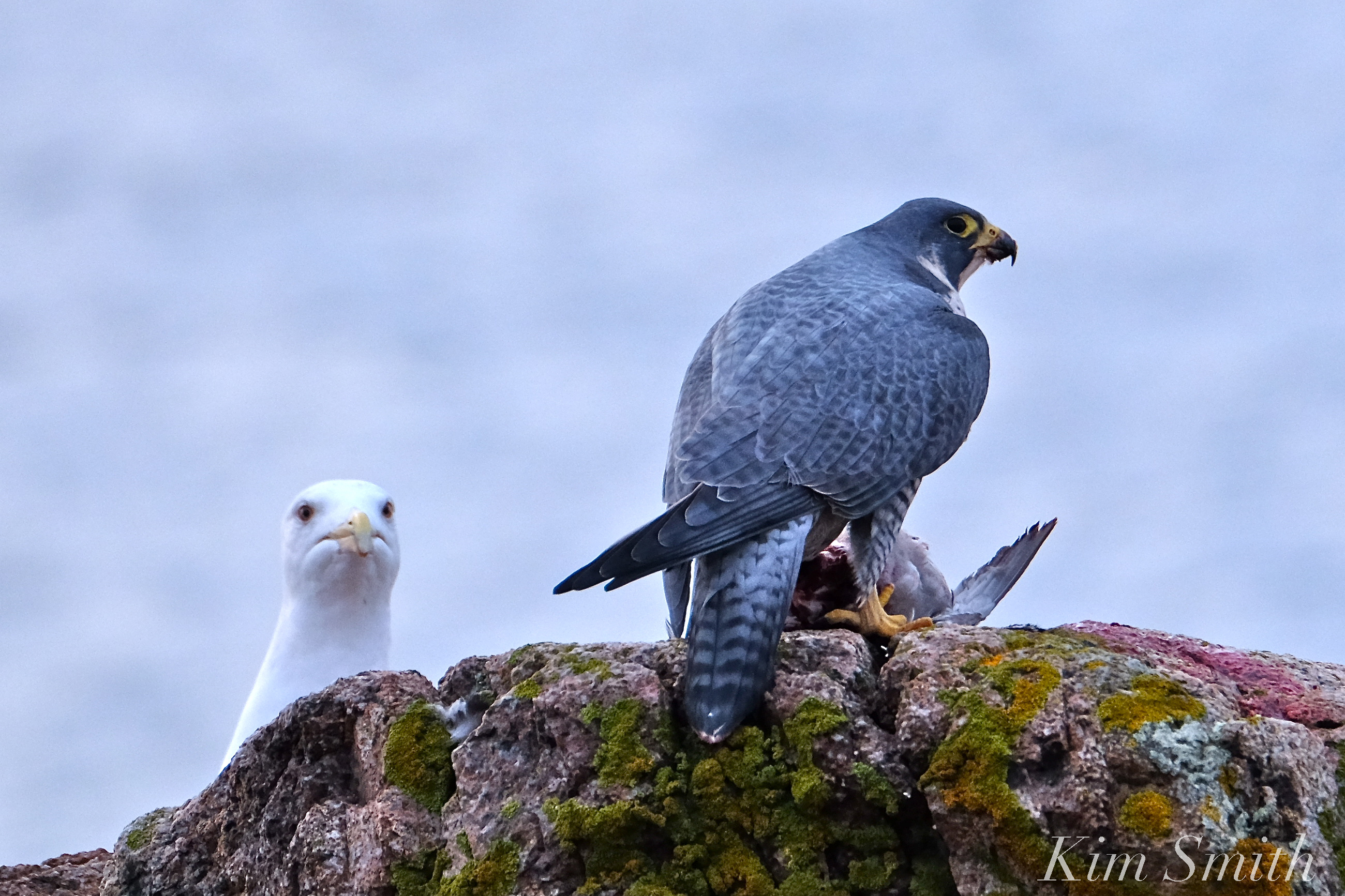
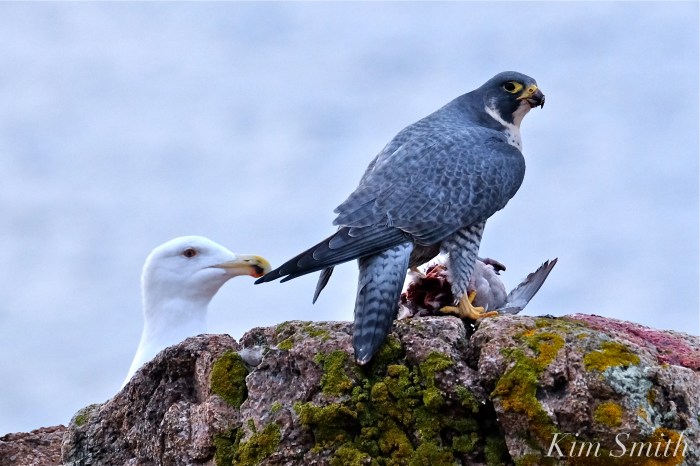
A gull popped its head up from a lower rock outcropping to see what he could steal and after taking a quick look at the Peregrine Powerhouse, thought better of attempting robbery.
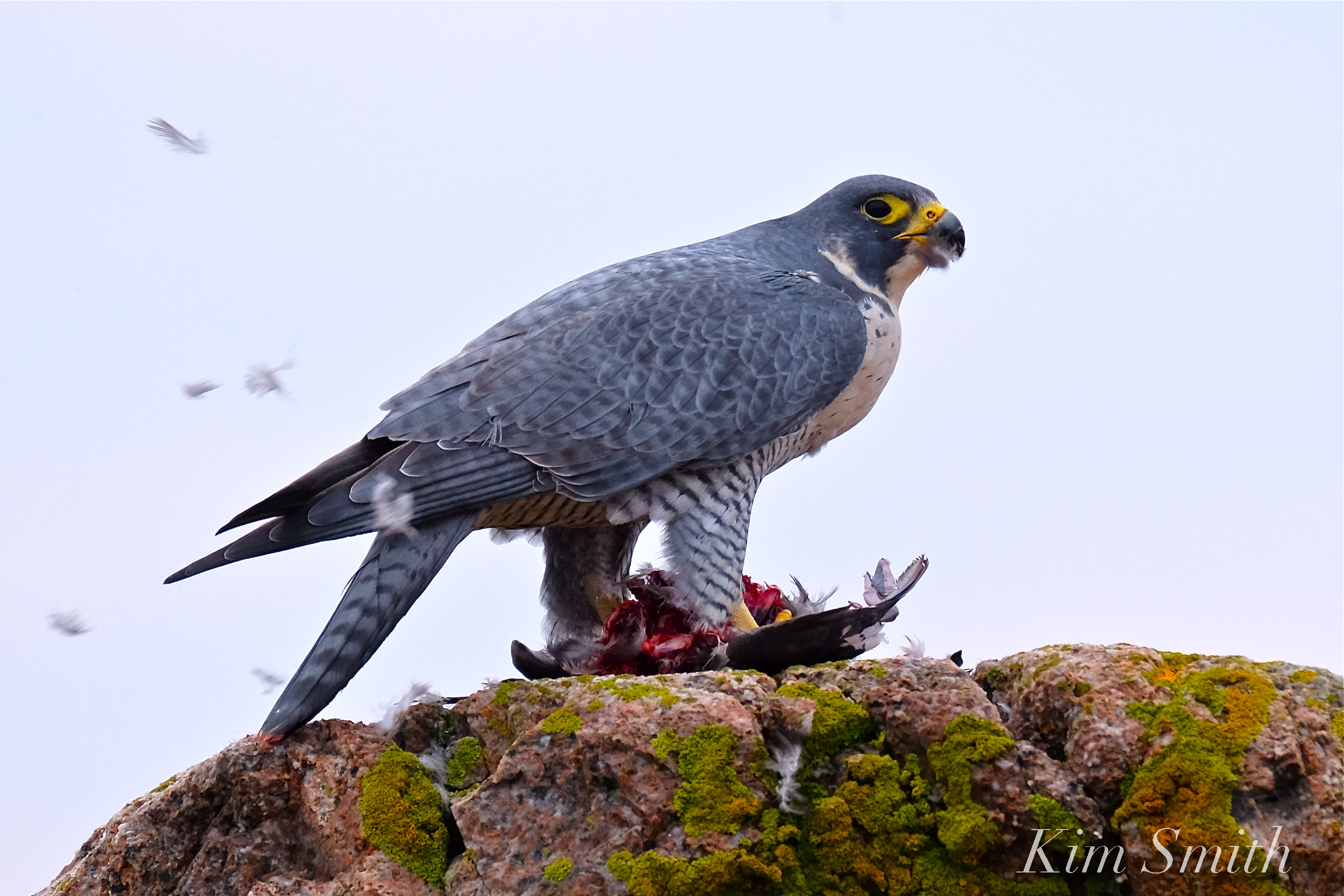
 

Nature’s Finest Flyer

Did you know that the Peregrine Falcon is the world’s fastest bird? A bird’s airspeed velocity is variable. During a hunting dive the Peregrine Falcon will average about 200 miles per hour; 242 miles per hour is the maximum speed recorded. The Golden Eagle is the second fastest bird, with an average diving speed of 150 miles per hour and a maximum speed of 200 mph.

Saved from the Brink of Extinction

Excerpted from The Nature Conservancy

Peregrines are fast, aggressive creatures and are on top of their food chain. While young Peregrines are preyed upon by Golden Eagle and Great Horned Owls there are few threats towards the adults other than man.

By the mid 1960’s, there were NO Peregrines in the eastern United States and the decline spread westwards so that by the mid-70’s western populations had declined by up to 90 percent. It was estimated that 3,875 nesting pairs were found in North America prior to the 40’s; by 1975, only 324 pair existed in the US. Loss of habitat, shootings, egg collecting and other human disturbances had weakened North American populations for decades but drastic declines didn’t occur until after the widespread use of a popular insecticide – DDT. Like the canary in the coalmine, the Peregrine Falcon provided humans a warning as how chemical pollution can disrupt the environment and the life around it.

The use of dichlorodiphenyltrichloroethane, or DDT, began during World War II as an extremely effective pesticide. Its use continued after the war as a way to control agricultural pests and in killing malaria-carrying mosquitoes. Unfortunately it would be years later before it was understood that DDT would have adverse effects on a variety of ecologically important insects, birds, and the environment. Bats, Fireflies and Peregrine Falcons were just a few species that were greatly affected. Editor’s note: In the United States, DDT was manufactured by some 15 companies, including Monsanto, Ciba, Montrose Chemical Company, Pennwalt, and Velsicol Chemical Corporation.

For the Peregrine Falcon, DDT poisoning was due to its being on top of the food chain. After consuming other birds that fed on seeds, insects and fish contaminated with DDT, the poison eventually accumulated in its system. High concentrations of a DDT metabolite called DDE prevented normal calcium production causing thin, frail eggshells that would break under the weight of the parent during incubation. Because of the toxic contaminant, many eggs did not hatch and the populations precipitously dropped until a mere 12% of normal peregrine falcon populations remained in the United States.

In 1970, the American Peregrine Falcon was listed as endangered under the Endangered Species Conservation Act of 1969 (and then again in 1973 when the Endangered Species Act passed). Encouraged by the EPA’s banning of DDT in 1972, recovery projects began to take shape. Beginning in 1974, The Peregrine Fund, along with various national and state agencies in both the United States and Canada, embarked on a reintroduction program for the peregrine falcon.

Thanks to the scientists and researchers at Cornell University, adult birds were successfully bred in captivity. After the eggs hatched, they were raised in the labs until three weeks old. They were then placed in hack sites (artificial nesting sites) where they were fed and cared for by unseen benefactors until flight and hunting skills were developed enough for them to become independent. More than 6,000 American Peregrine Falcons have been released in North America since 1974 due to the cooperative efforts among federal and state Fish & Wildlife Services, The Peregrine Fund, Midwestern Peregrine Falcon Restoration Project and the Santa Cruz Predatory Bird Research Group.

The success of these recovery programs allowed the declassification of the Peregrine Falcon as a federally endangered species in 1999. Although the bird of prey remains federally protected under the Migratory Bird Treaty Act and will be monitored until 2015, the survival of the Peregrine Falcon marked the most dramatic success of the Endangered Species Act.

https://www.instagram.com/p/Bc8V39PFTvQ/
THE YOUNG SWAN GETS A SANCTUARY FIT FOR A PRINCESS (Or Prince?)

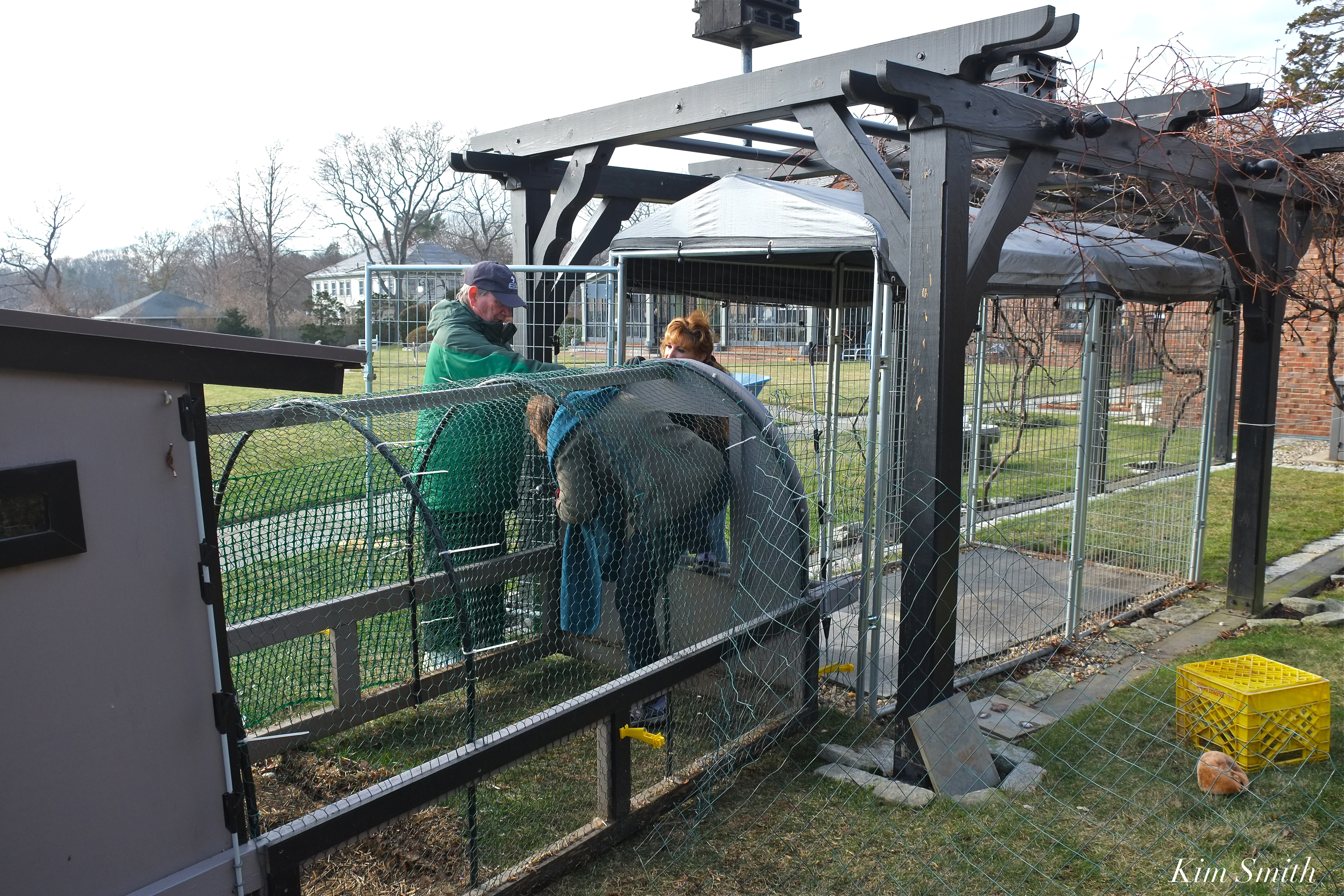
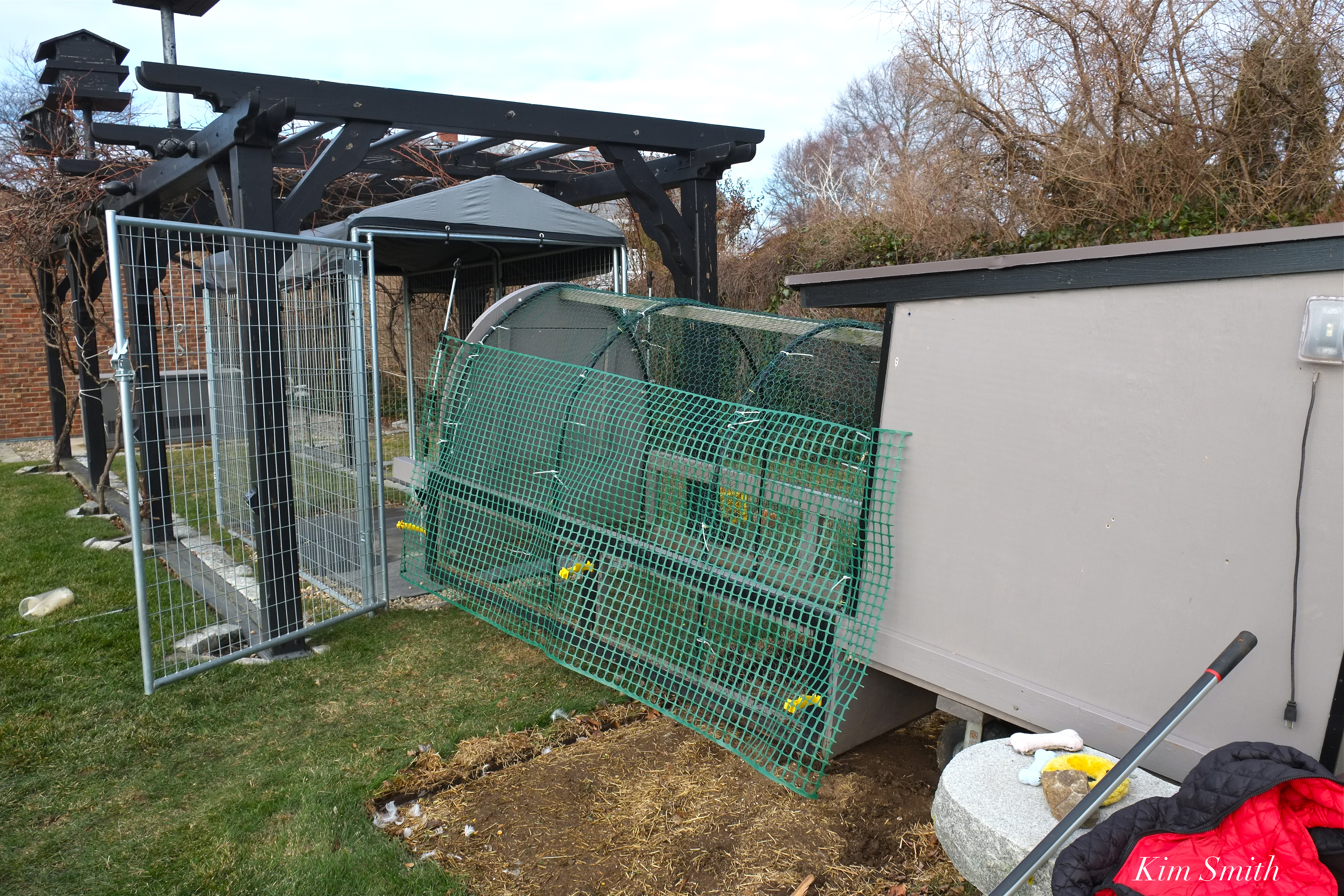
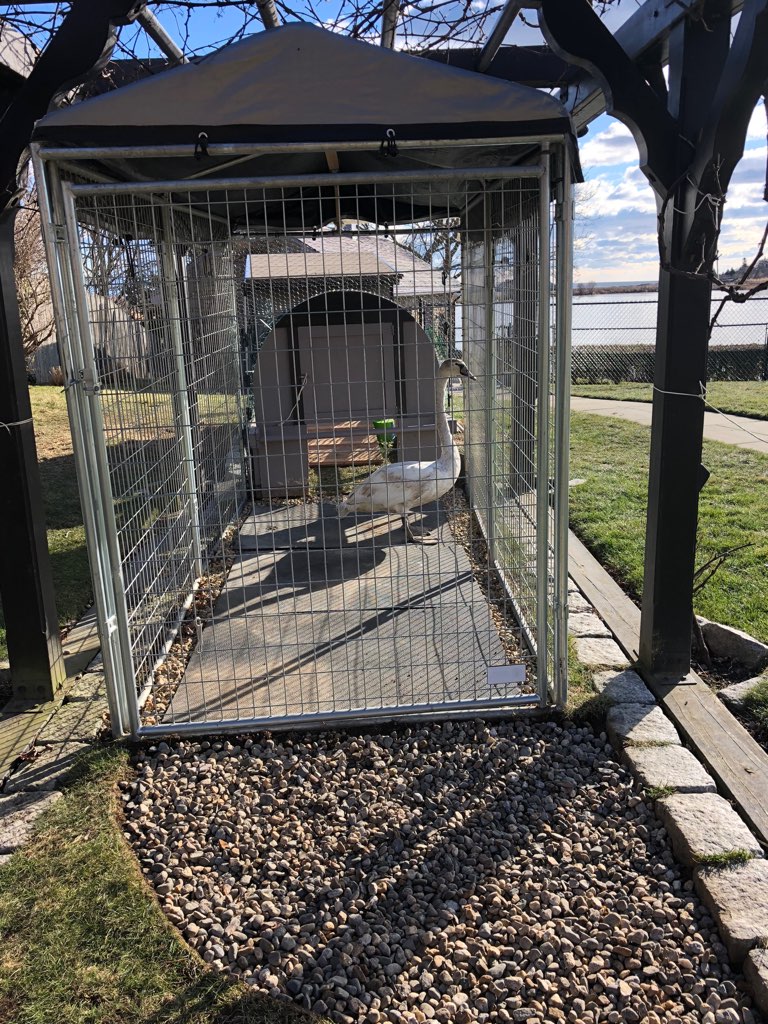
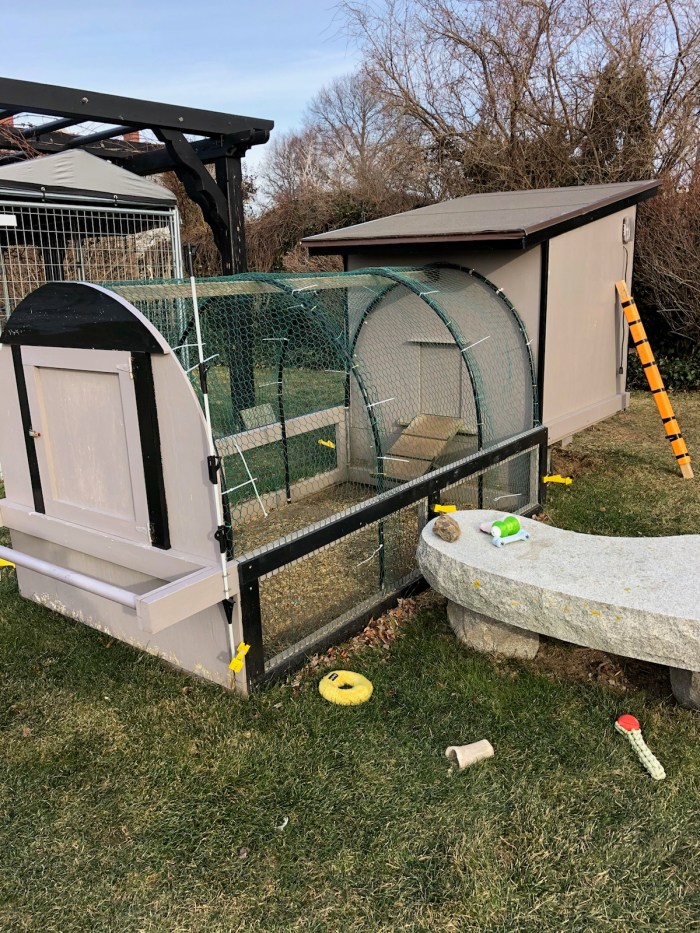
Joel and Skip Munroe arrived yesterday morning at Lyn’s home and the three spent the day continuing to modify the chicken coop-turned swan house-turned fantastic sanctuary (Joel is one of Mr. Swan’s caregivers and a carpenter). Lyn has generously added her dog’s run to extend the swan’s home, providing room enough for the Young Swan to stretch her wings and walk around within the enclosure.

Increasing the size of the enclosure. 

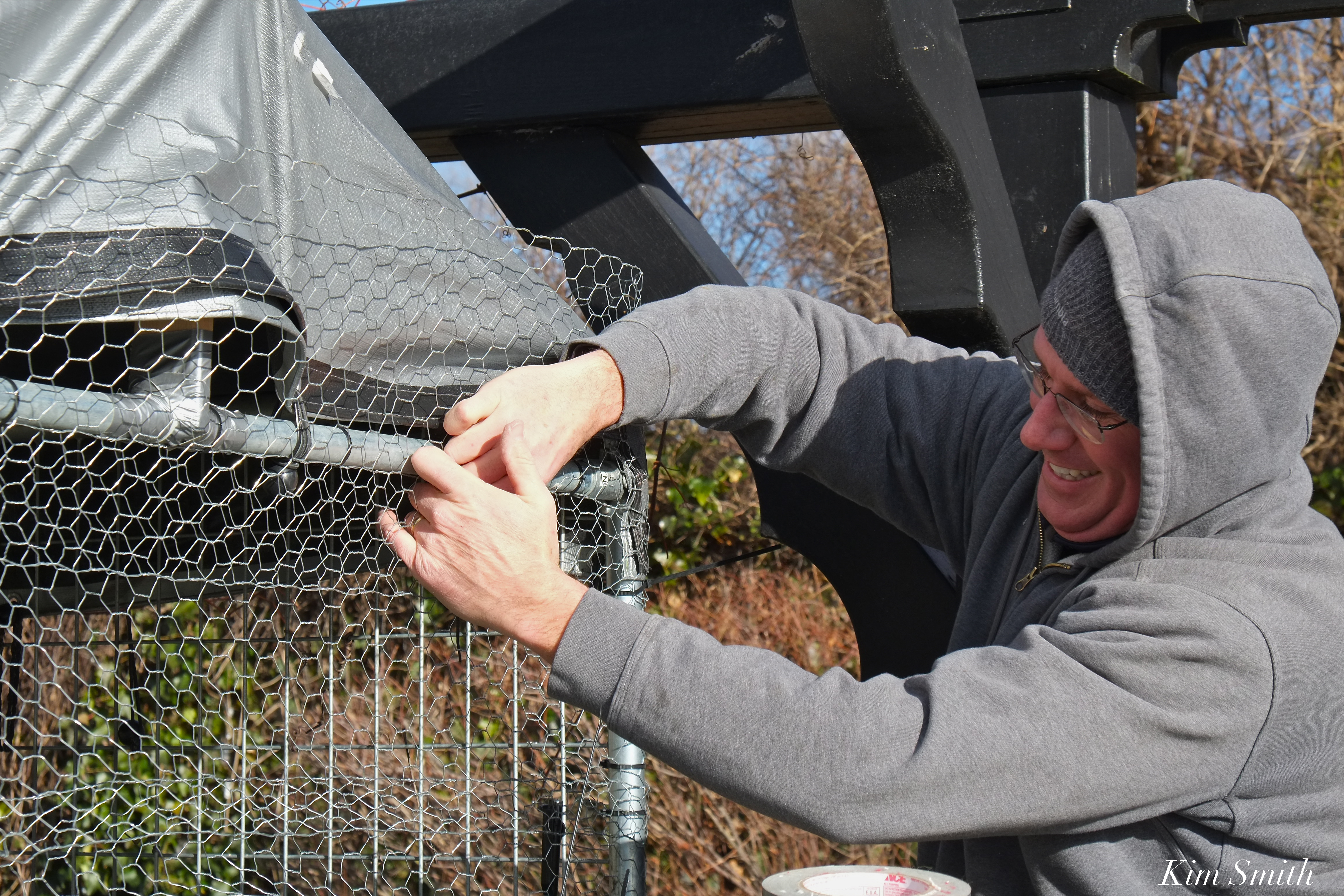
Today, the very awesome landscaper Patrick Low, owner of JPL Landscape Solutions spent the morning modifying and attaching the (former) dog run to the chicken coop and securing the entire structure from predators such as coyotes and racoons. Pat, Joel, and Skip have very generously donated their time and services to creating the winter swan sanctuary.

Pat Low, creatively solving potential predator issues.

A friend of Lyn’s is donating three bales of hay. To supplement the pellets and corn Lyn has been feeding the swan, yesterday she purchased collard greens (which the Young Swan loved), spinach, and kale (yet to try).

We still do not know whether the Young Swan is male or female. Jodi Swenson kindly paid for the swan’s checkup at Dr. Cahill’s (with funds provided from her recent fundraiser) and Lyn has volunteered to pay for the DNA test. We should have the results back from the DNA test in several weeks. The Young Swan has a temporary name, TOS, an acronym for The Other Swan, but perhaps when we determine whether male or female we can give her a gender specific name, and possibly tie in a naming contest with a mini-fundraiser, to help defray the unexpected cost of taking care of her for the winter.

Success! Photo courtesy Lyn Fonzo

$34,900.00 RAISED FOR BEAUTY ON THE WING DOCUMENTARY! AND MONARCH BUTTERFLY MIGRATION UPDATE

$34,900.00!!! RAISED FOR BEAUTY ON THE WING DOCUMENTARY! THANK YOU GENEROUS DONORS!!!!!!!!!!!
WITH THE GREATEST APPRECIATION FOR OUR COMMUNITY OF FRIENDS AND SPONSORS, I AM OVERJOYED TO SHARE THAT TO DATE WE HAVE RAISED $34,900.00 FOR THE DOCUMENTARY FILM “BEAUTY ON THE WING” ONLINE FUNDRAISER, with a recent grant awarded in the amount of $10,000.00.

Friends of the Monarch Butterfly: If you would like to help towards the completion of the documentary film Beauty on the Wing: Life Story of the Monarch Butterfly, please consider making a tax deductible donation here:

DONATE HERE

Donors contributing over $5,000. will be listed in the credits as a film producer.

For more information, visit the film’s website here: Monarch Butterfly Film

For an overview of the film’s budget, please go here: Budget

Thank you so very much for your help.

With gratitude,

Kim

MY DEEPEST THANKS AND APPRECIATION TO LAUREN MERCADANTE (PRODUCER), SUSAN FREY (PRODUCER), NEW ENGLAND BIOLABS FOUNDATION, JOHN HAUCK FOUNDATION, BOB AND JAN CRANDALL, MARY WEISSBLUM, SHERMAN MORSS, PETE AND BOBBI KOVNER (ANNISQUAM AND LEXINGTON), CLAUDIA BERMUDEZ (LEXINGTON), JAY FEATHERSTONE, MIA NEHME (BEVERLY), CHICKI HOLLET, JUNI VANDYKE, ERIC HUTCHINSE, KAREN MASLOW, MARION F. (IPSWICH), ELAINE M., KIMBERLY MCGOVERN, MEGAN HOUSER (PRIDES CROSSING), JIM VANBUSKIRK (PITTSBURGH), NANCY MATTERN (ALBUQUERQUE), DONNA STOMAN, PEGGY O’MALLEY, JOEY C., CATHERINE RYAN, JOEANN HART, JANE PAZNIK BONDARIN (NEW YORK), ROBERT REDIS (NEW YORK), NUBAR ALEXANIAN, PETER VAN DEMARK, PATRICIA VAN DERPOOL, FRED FREDERICKS (CHELMSFORD), LESLIE HEFFRON, JIM MASCIARELLI, DAVE MOORE (KOREA), LILIAN AND CRAIG OLMSTEAD, JOHN STEIGER, PAT DALPIAZ, AMY KERR, BARBARA T. (JEWETT, NY), ROBERTA C. ((NY), MARIANNE G. (WINDHAM, NY), PAULA RYAN O’BRIEN (WALTON, NY), MARTHA SWANSON, KIM TEIGER, JUDITH FOLEY (WOBURN), PATTI SULLIVAN, RONN FARREN, SUSAN NADWORNY (MELROSE), DIANE LINDQUIST (MANCHESTER), HEIDI SHRIVER (PENNSYLVANIA), JENNIFER CULLEN, HOLLY NIPPERUS (BROOKLYN), HILDA SANTOS (SAUGUS), TOM HAUCK, AND ANONYMOUS PERSONS FOR THEIR GENEROUS HELP.

https://www.instagram.com/p/Bc5cXVcF2oA/
MONARCH MIGRATION UPDATE

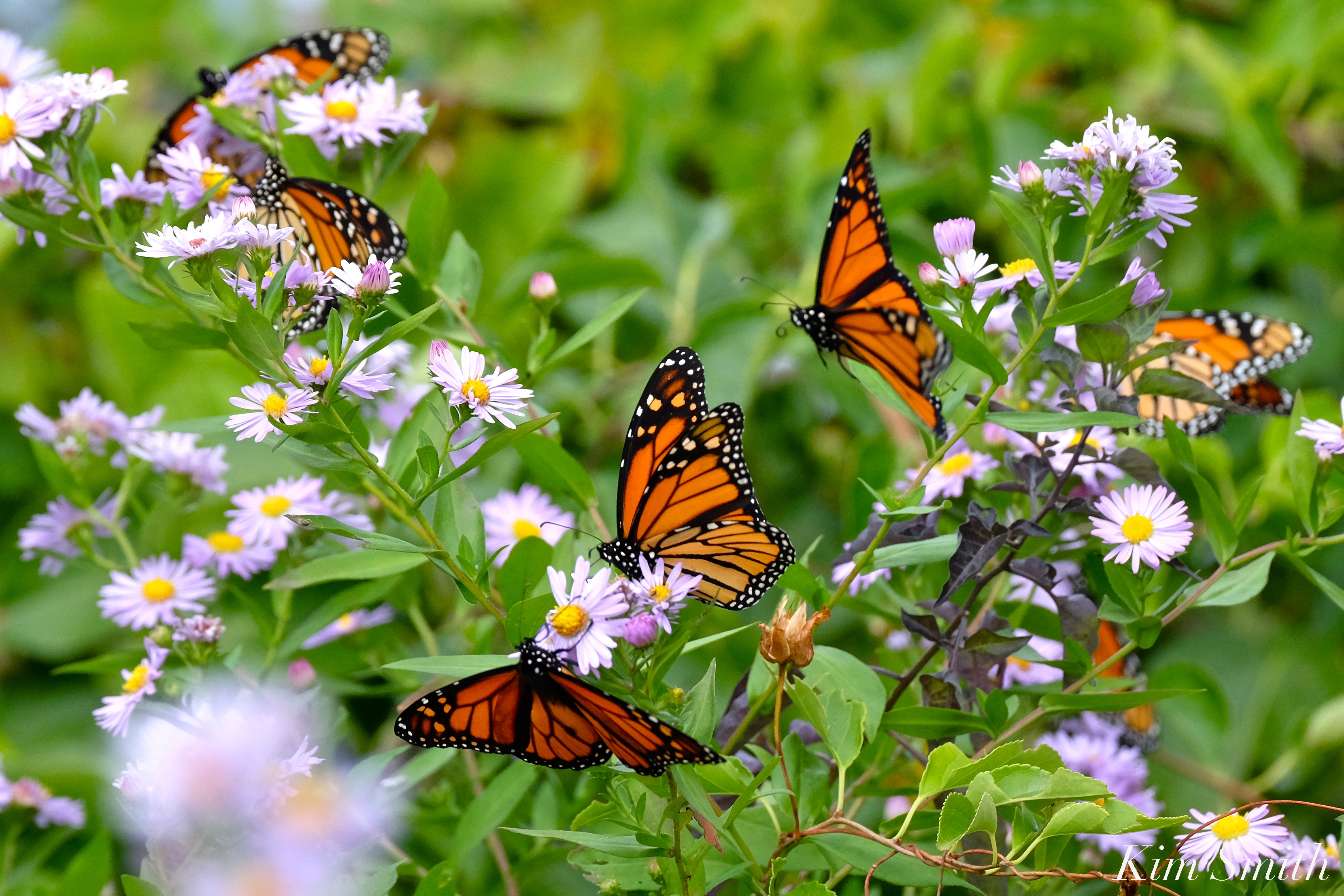
The Monarch migration of 2017 was the latest ever recorded and the butterflies are continuing to arrive!

The region where the Monarchs spend the winter is confined to a narrow altitudinal band across twelve trans-volcanic mountaintops in central Mexico. This narrowest of overwintering habitat is only 73 miles wide. What allows the Monarchs to survive in these these twelve habitats? The sites are at a high elevation of 10,000 to 11,000 feet, where the temperature hovers around freezing at night and warms during the day to about 50 to 60 degrees. The towering cathedral-like Oyamel Pine Trees contribute to creating the perfect microclimate to meet the butterflies needs by providing shelter from harsh winds and when the Monarchs cluster together high up on the Oyamel boughs they maintain a cool temperature, which conserves the fat that they stored on their southward migration.

During the month of December, the all important work of counting the butterflies takes place. Several years ago a late migration occurred (not as late as this year’s) and the scientists counted the butterflies a bit too early. I hope they wait until much later in the month to begin the count.

If you would like to learn more about how to count Monarchs, go to this to link to an interview that I conducted with Thomas Emmel, the Director of the McGuire Center for Lepidoptera and Biodiversity at the Museum of Natural History of the University of Florida, Gainesville. Dr. Emmel is a butterfly population specialist and has been counting the Monarchs since 1980. The interview took place at Sierra Chincua Monarch Butterfly Biosphere Reserve in Angangueo, Mexico.

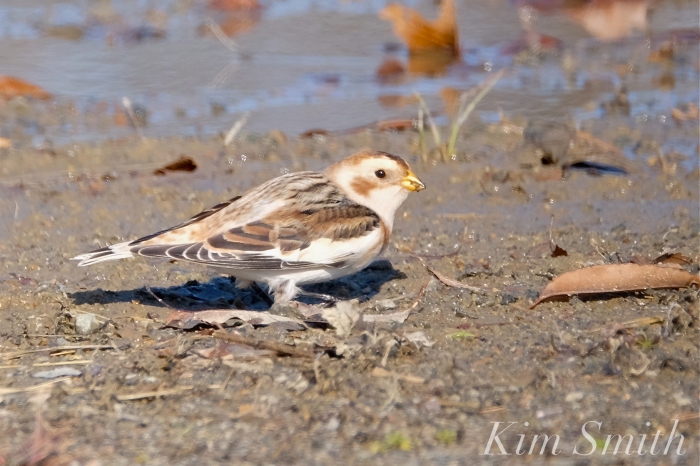
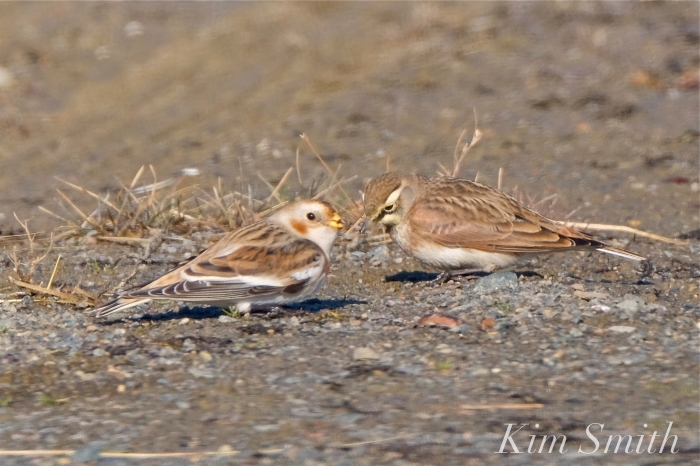
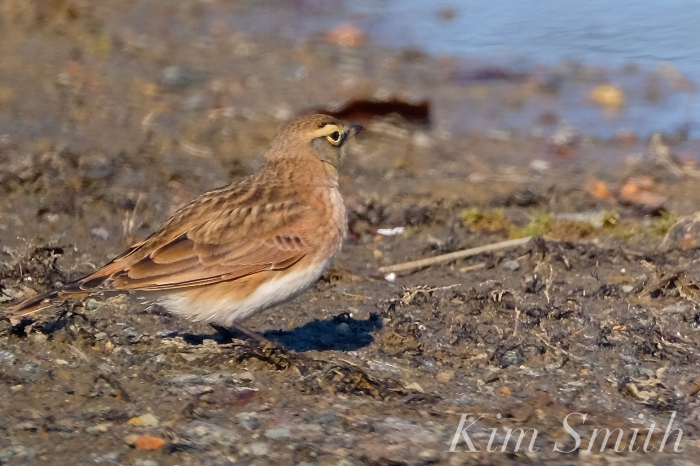
BEAUTY ABOUNDS WITH SNOWY OWLS, HORNED LARK, SNOW BUNTINGS, YELLOW-RUMPED WARBLERS, DUNLINS AND MORE!

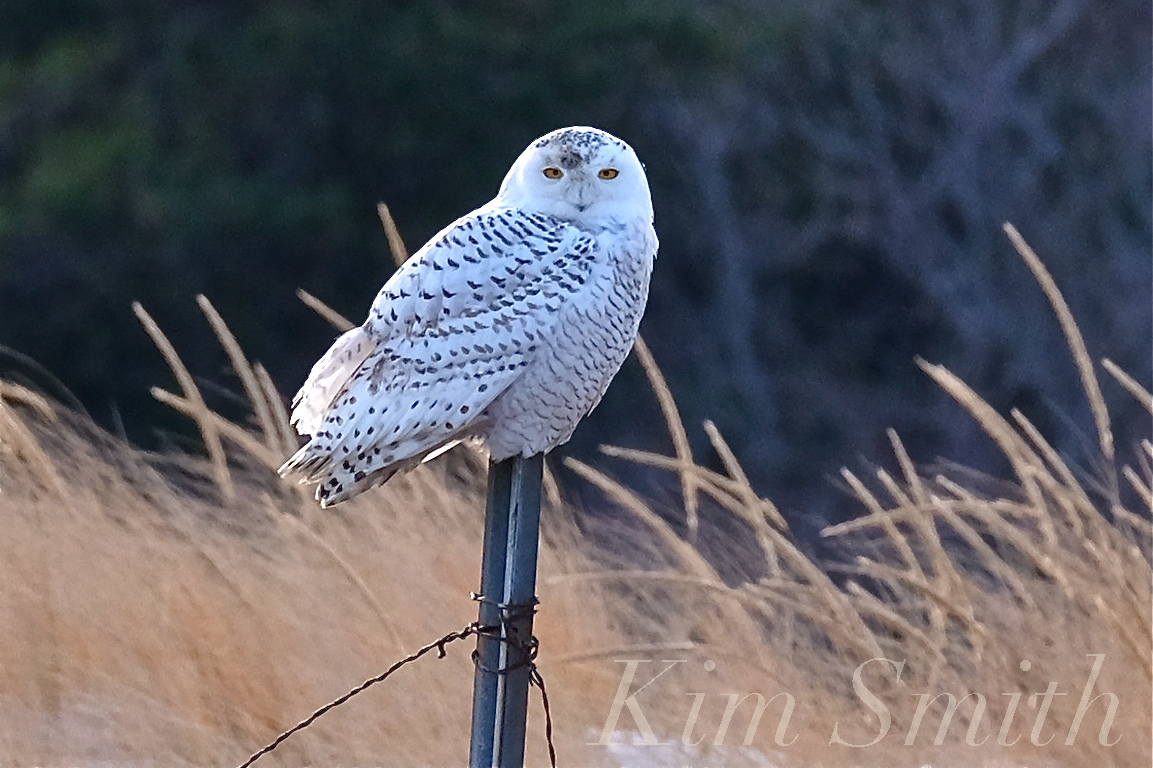
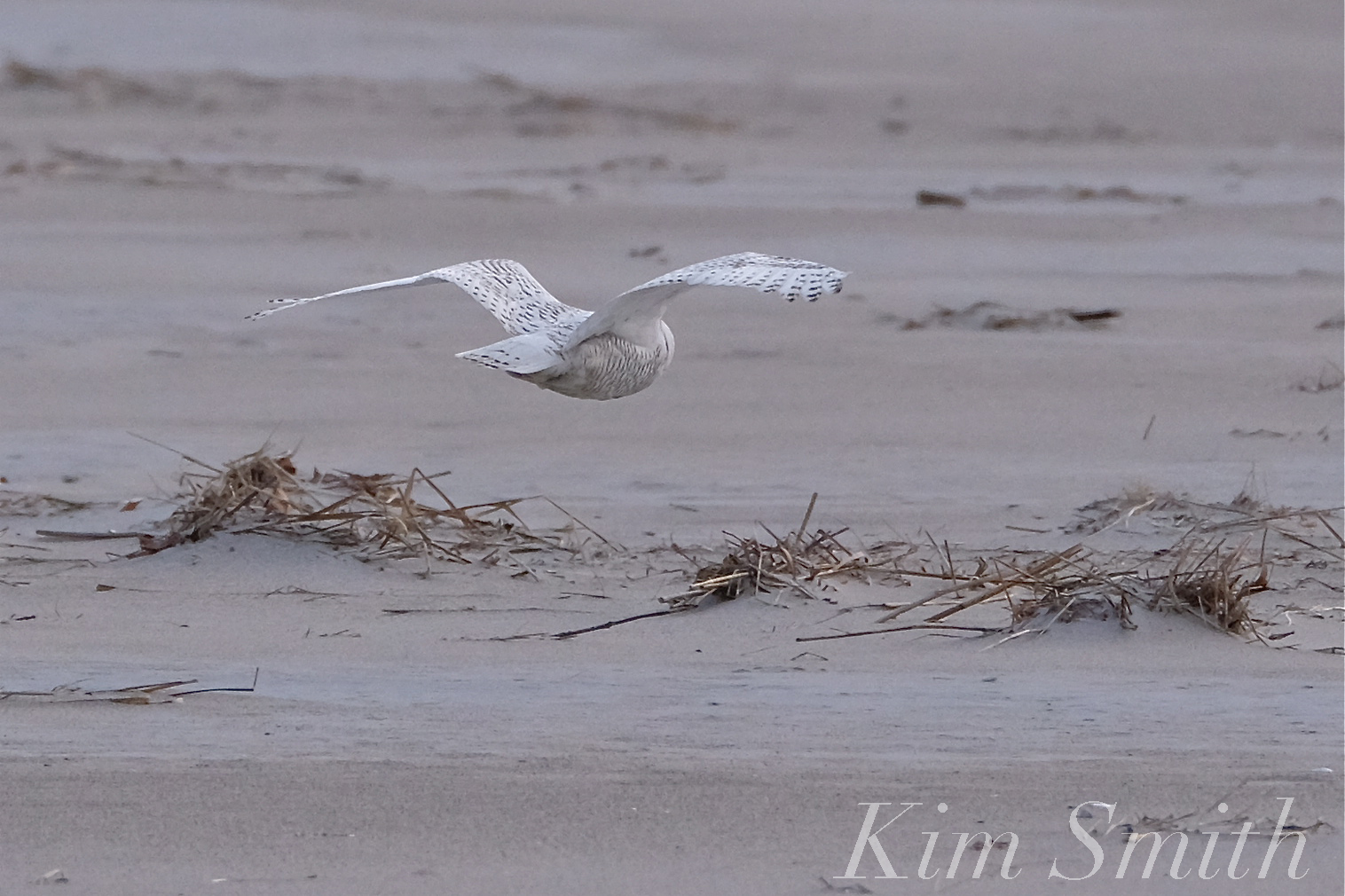
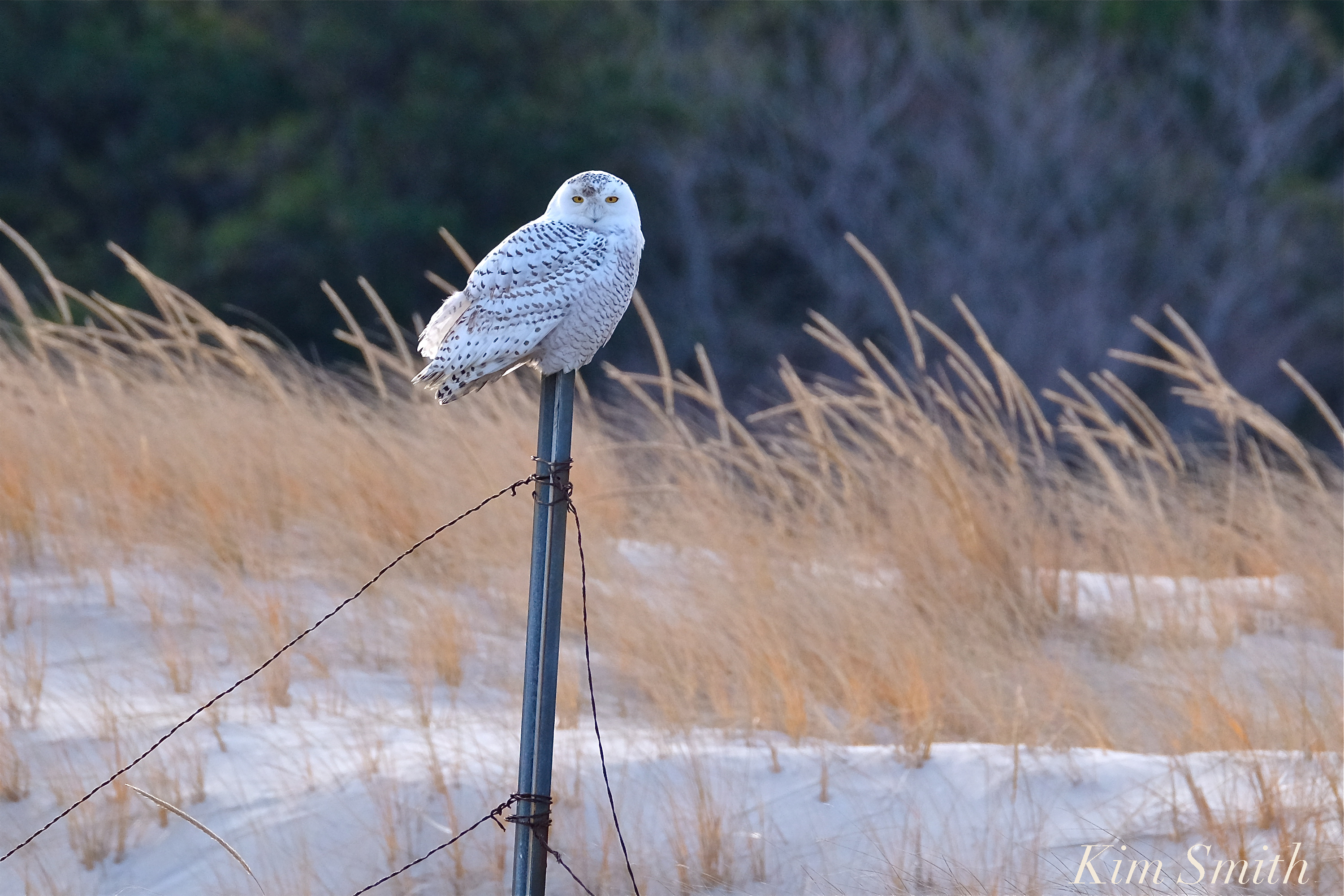
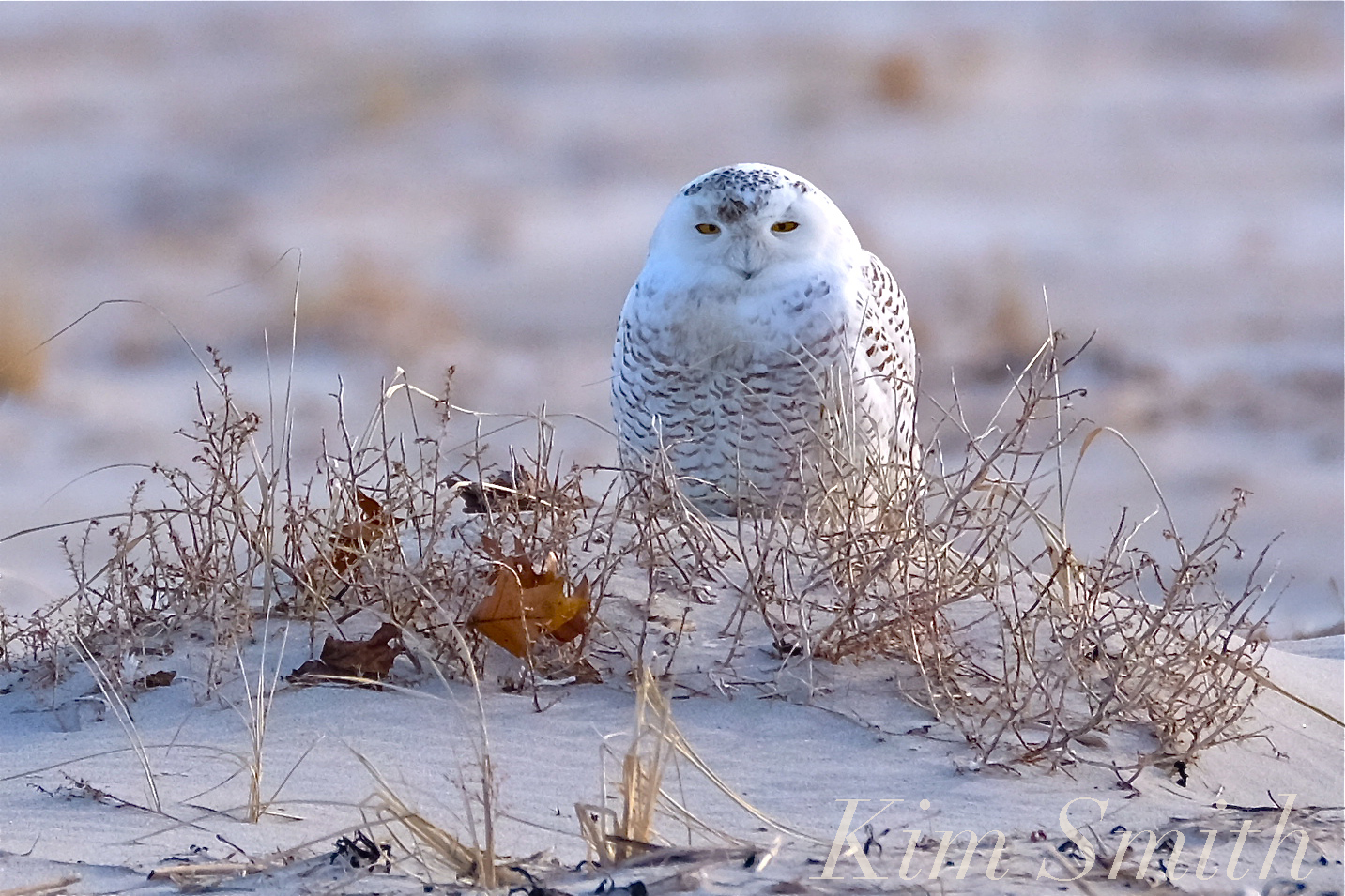
With early predictions of a Snowy Owl irruption heading our way and several sightings in Gloucester, I have been periodically popping over to Cranes Beach in Ipswich. Thanks to Bill Foley, Cranes Chief of Police (and Kate’s awesome Dad!), who showed me around and provided some great tips on locating the Snowies, I was able to find one second time out. The first day was a bust because a dog owner had allowed his dog off leash. I watched the dog chase the Snowy, who then headed far and away over the dunes. This made me so very sad for myriad reasons, but especially so at Cranes Beach because there is a fabulously huge area that dogs are allowed off leash. Anyhow, seeing the Snowy that first day, and knowing he was there, was all I needed to keep trying.

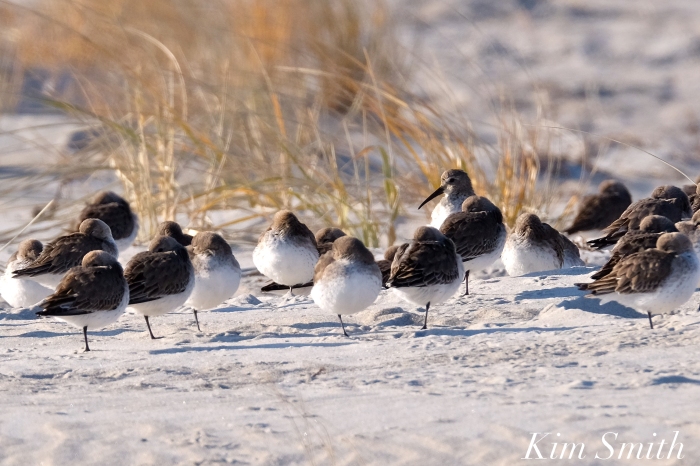
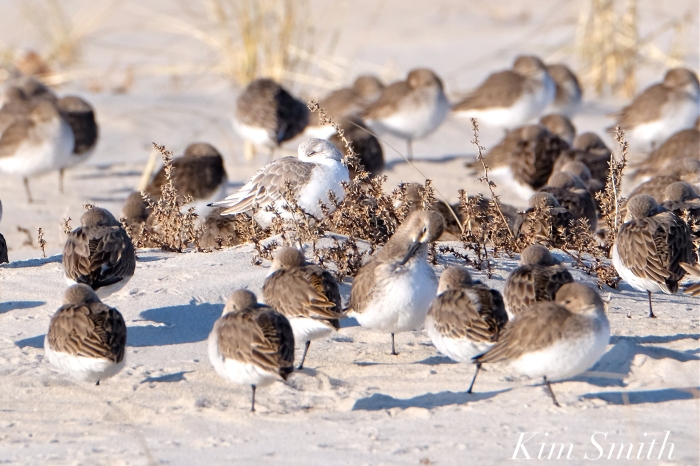
Dunlins, Sanderlings, Snow Buntings, and Horned Lark

That day, a flock of Dunlins was resting in the sand, with one lone Sanderling, and there was a small flock of Snow Buntings in the parking lot. Feeding amongst the flock was, what I believe to be, a female Horned Lark!Second day out was wonderfully rewarding. Approaching the stairs to descend to the beach, I inadvertently startled a Snowy and he flew from the area, way, way down the beach, perching on one of the poles that mark the access to the Green Trail. Off I trudged in 15 degree weather, keeping my eyes peeled on where he was resting. He stayed for quite some time while I stood back at a great distance, not wanting to disrupt his hunting. Suddenly, and with what I thought, great bravery, he flew quite close and past me, heading over to the sandy beach. I wasn’t anticipating his flight and didn’t get much of a photo, but it was exquisite to see.The temperature had climbed to twenty, but I was getting worried about exposed photo fingers and frostbite. After taking a few more photos and some footage of the Snowy in the sand, I very reluctantly headed home.

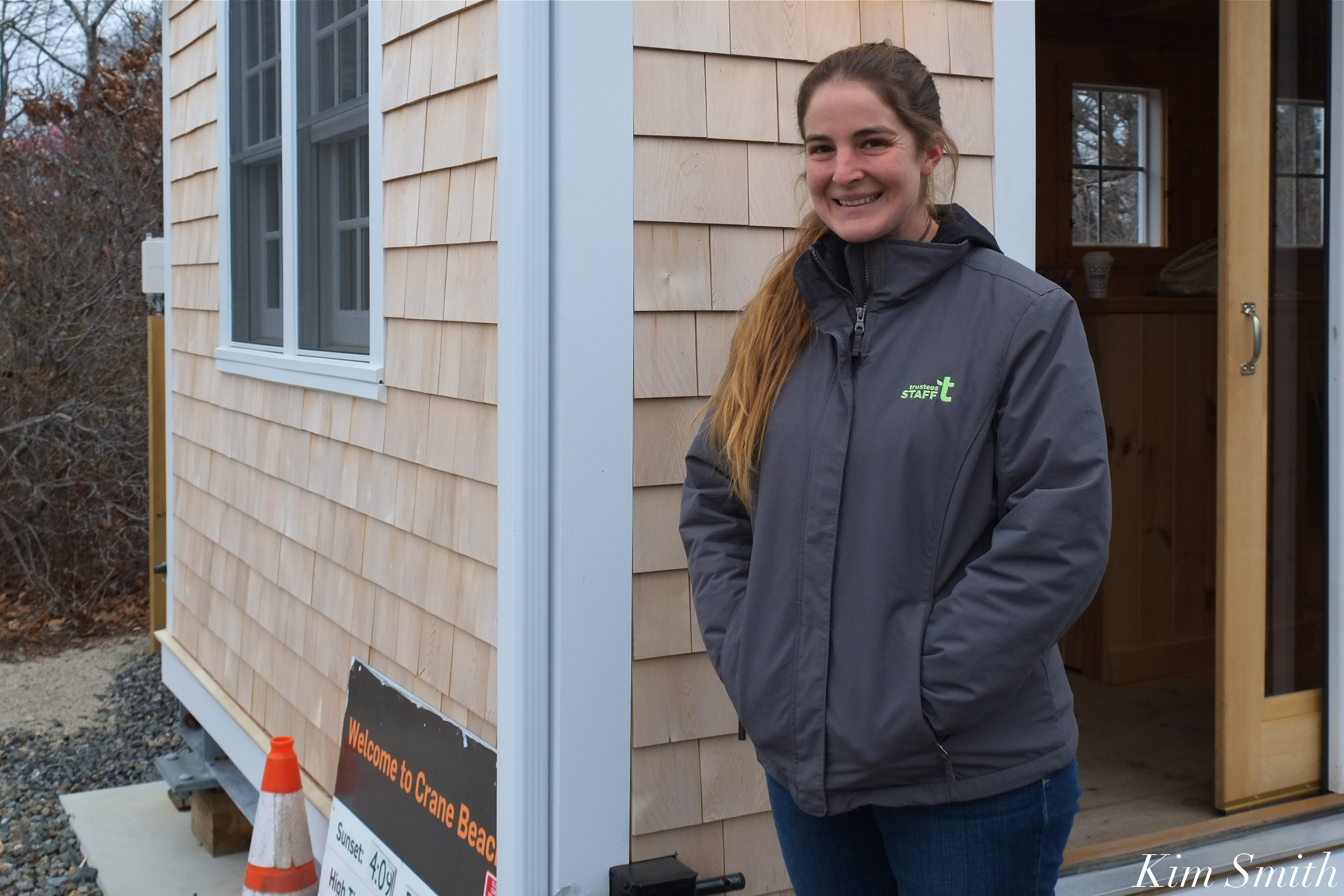
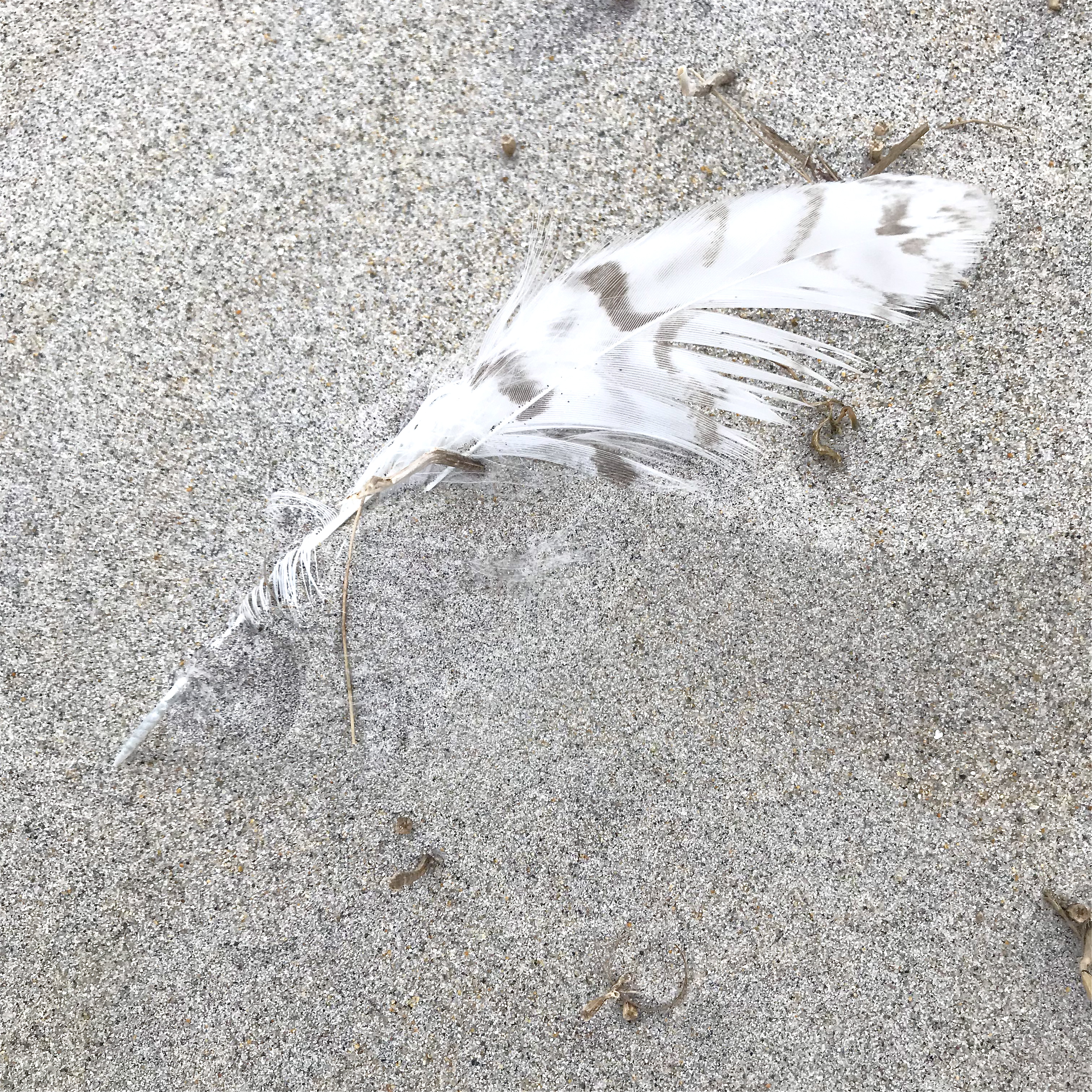
Today I didn’t see the Snowy Owl, but did find a scattering of Snowy feathers in the sand, in the same area where one had been hunting the previous week. I showed the ranger at the gate, Emily White, the feathers and she confirmed they were from a Snowy. She said that hawks and falcons will attack Snowies. I didn’t see any bones or body parts, so hopefully it wasn’t a fight to the death. Emily was super helpful and shared lots of useful information. This year’s Audubon Christmas Bird Count at Cranes was relatively uneventful, with fewer numbers counted than usual. Many more beautiful birds will be arriving to our shores in the coming weeks, foraging in the dunes and shrubby habitat, and hopefully, there will be lots more Snowy Owl sightings!Emily White, Cranes Ranger

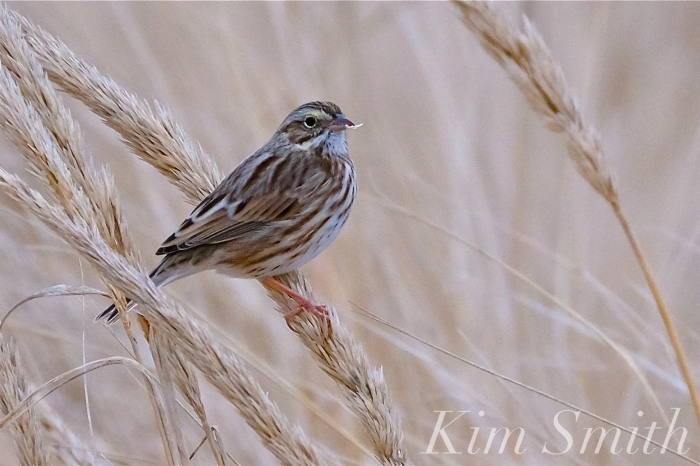
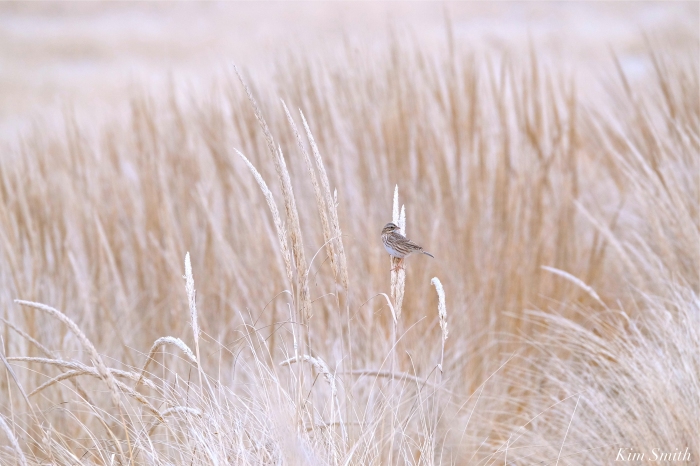
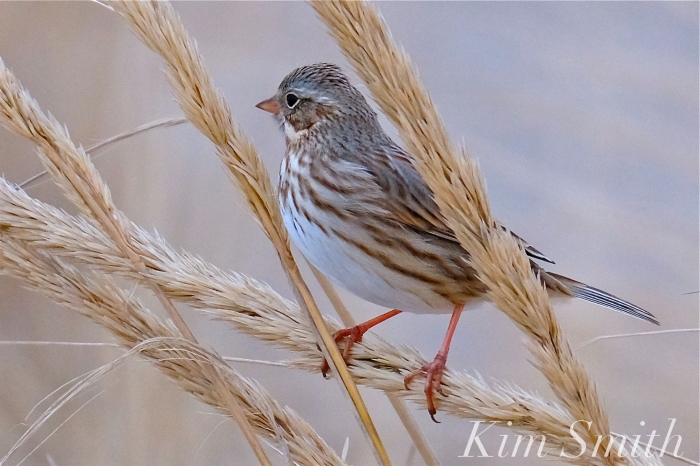
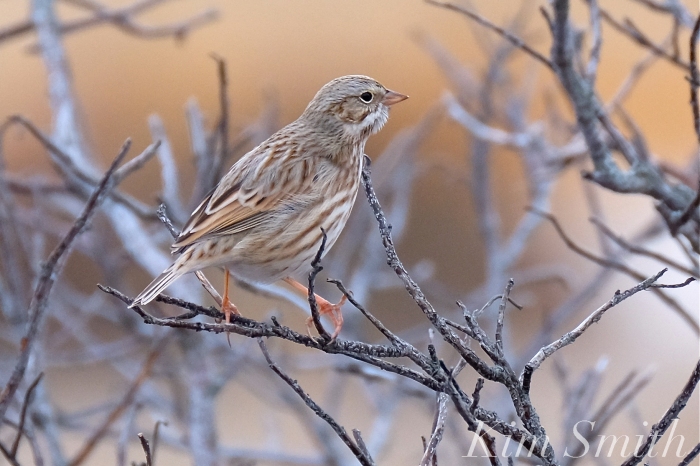
Song Sparrow eating ripe beach grass seed heads.

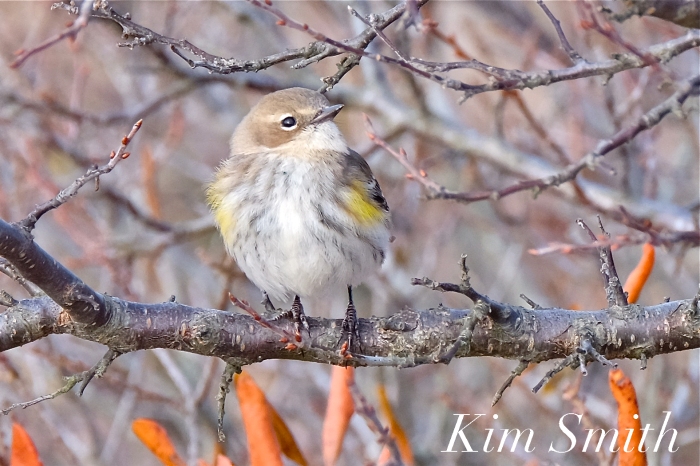
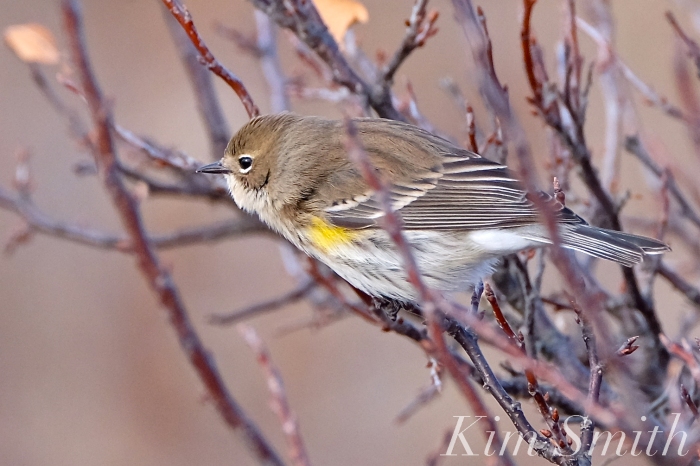
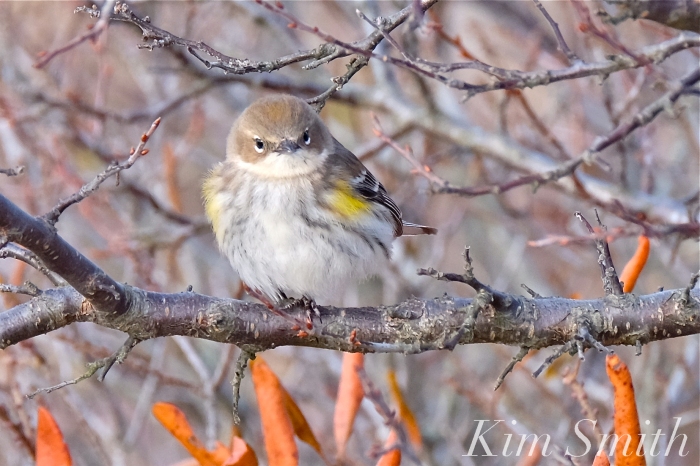
Yellow-rumped Warbler winter plumage.

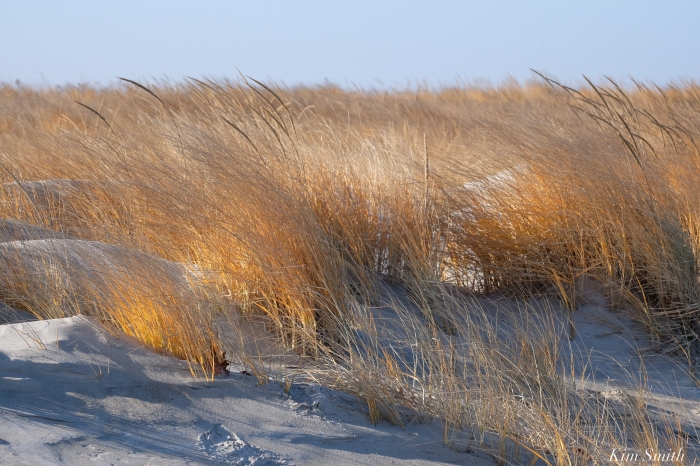
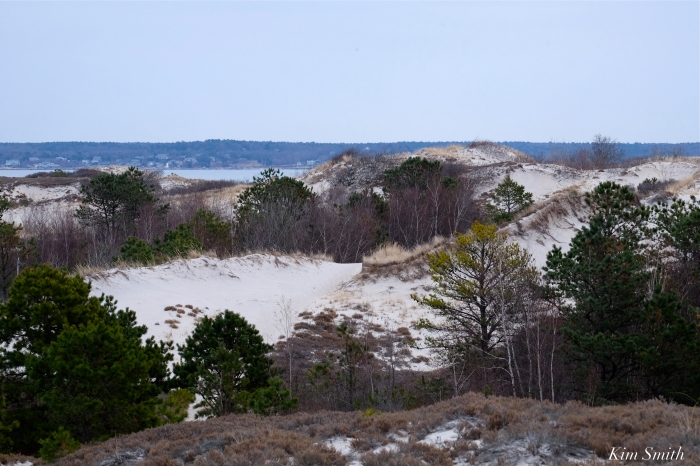
More scenes from the Green Trail

Scofflaw dog owner

SNOWY OWL FEATHERS IN THE SAND

Early morning, with snow-laden skies and Snowy Owl feathers in the sand. More on Snowies tomorrow, when I have time to write a longer post.

https://www.instagram.com/p/Bc2n_ZtlBIS/

SUPER SLICK AMAZON PHISHING SCAMS

Jus saying, please be careful friends ~

Especially during the holiday gift giving season, you may find in your inbox some pretty slick looking scams. This last one came from “AS – Amazon Support” after a recent order was placed, claiming my payment method had been declined. AS is also the initials of the scammer, Andre Shamido, who wanted an updated payment method provided.  

It didn’t come through when I converted the following scam email to a jpg, but the scammers “Update your payment method” was displayed within a gold-colored box, similar to the gold Amazon uses to highlight ordering information when Amazon wants you to click on a link.

Amazon will never send an unsolicited e-mail that asks you to provide sensitive information. 


THE YOUNG SWAN GOES TO SEAPORT VETERINARY HOSPITAL

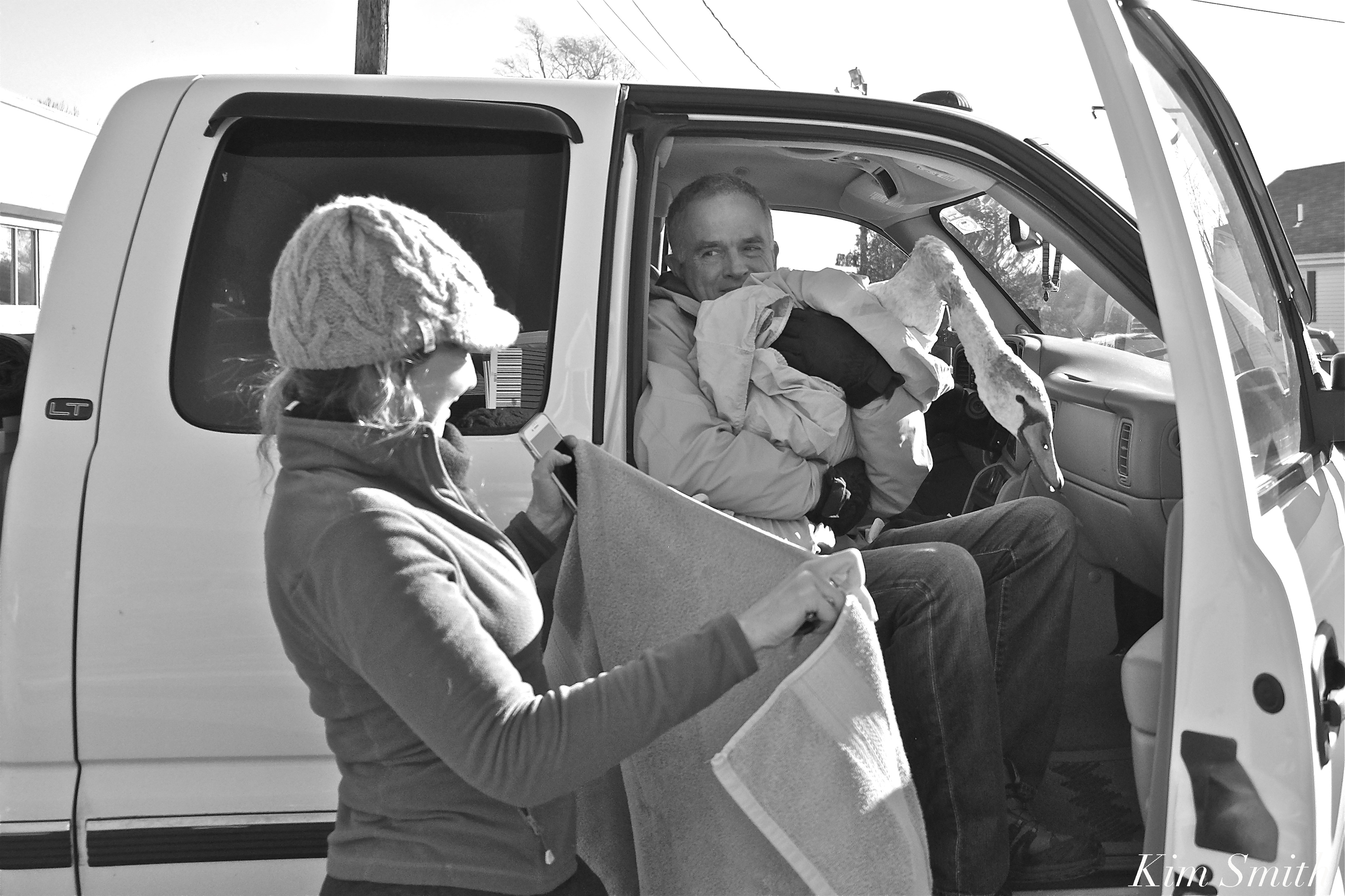
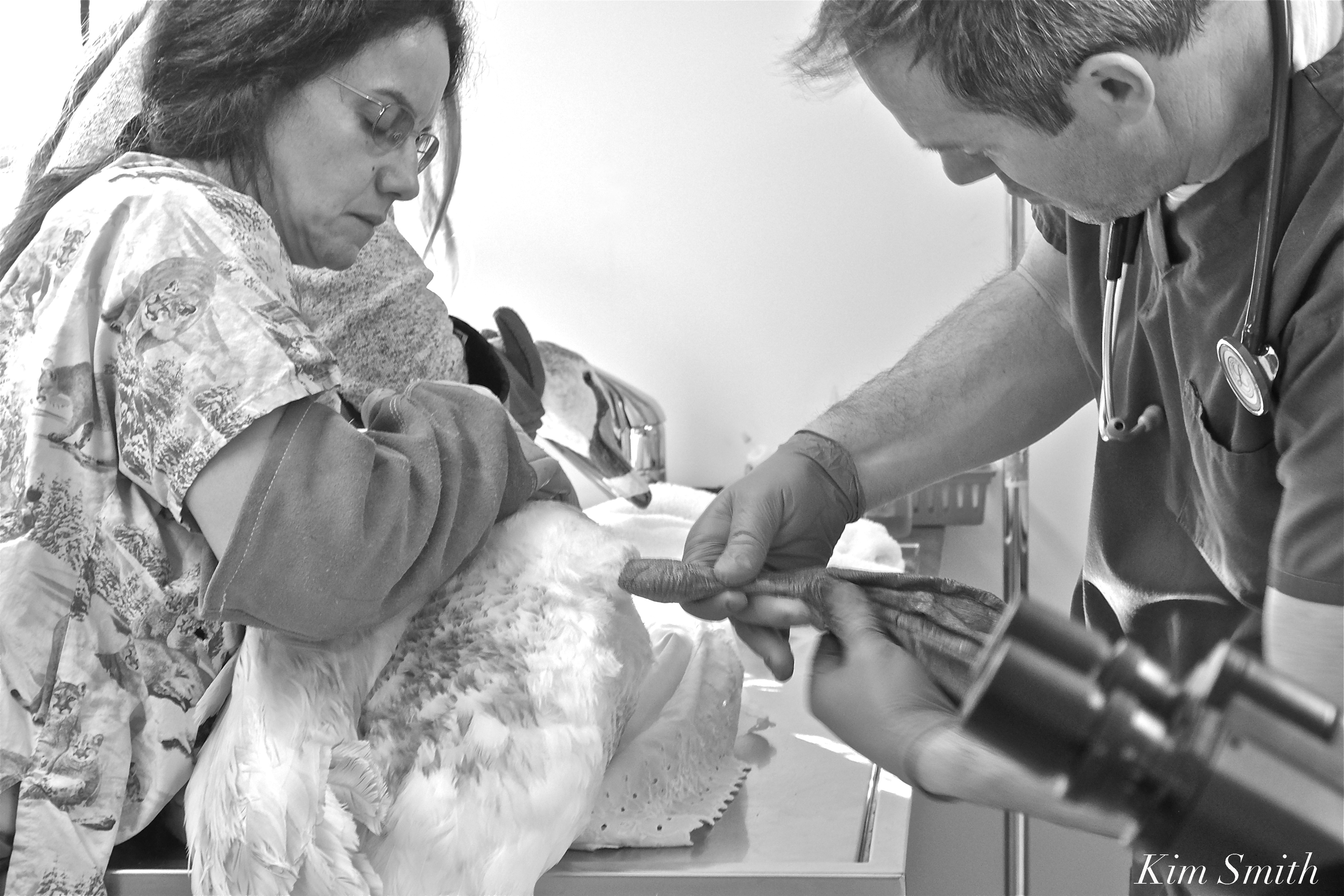
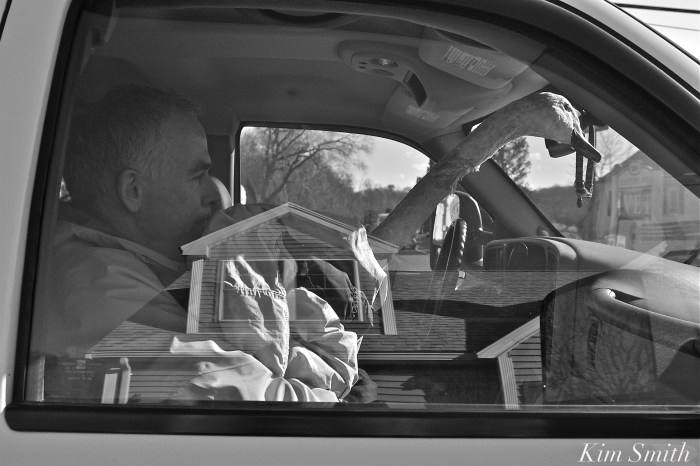
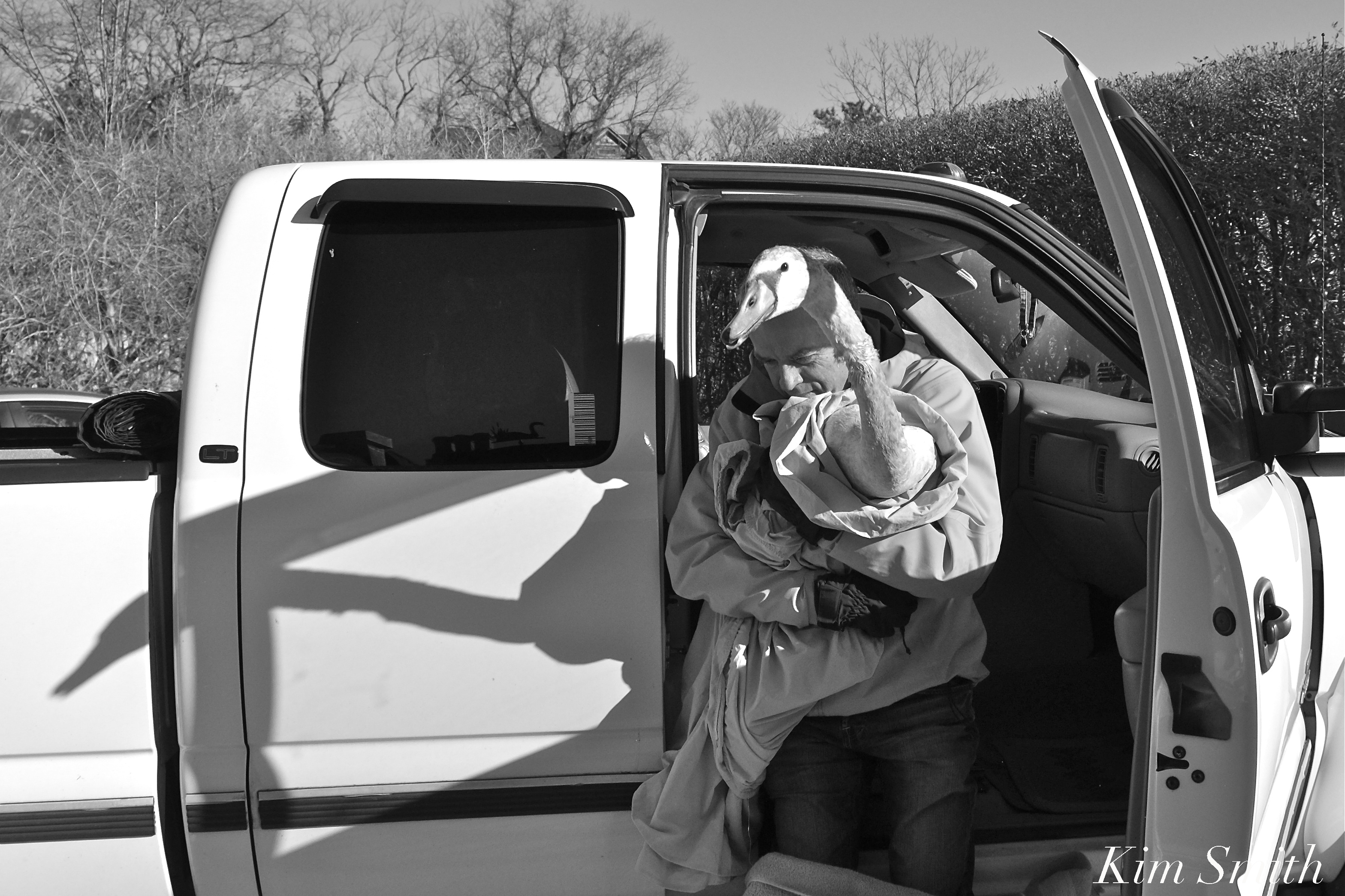
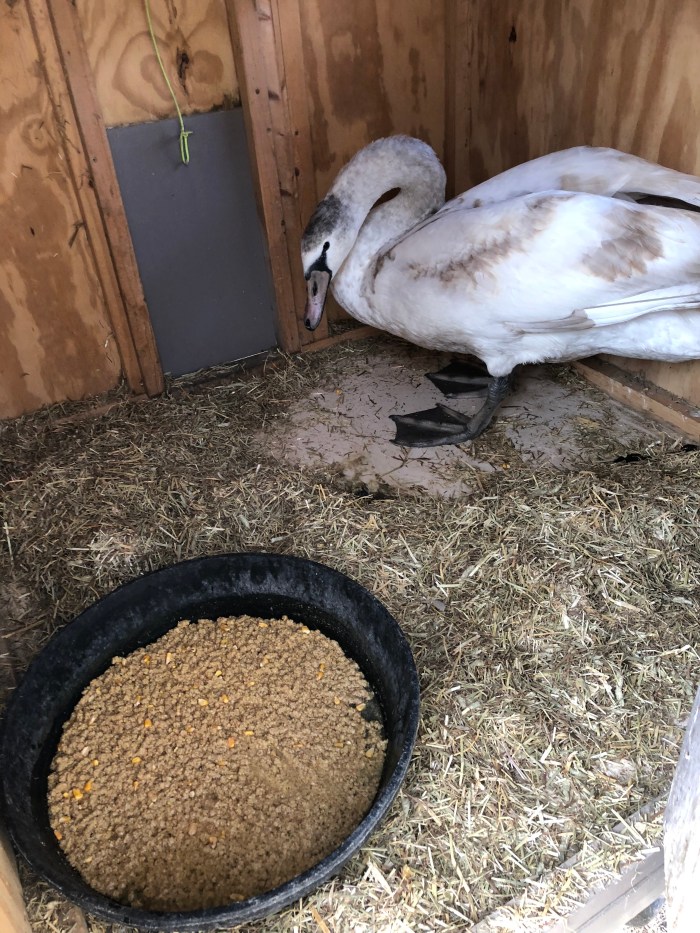
The Niles Pond Young Swan, rescued by Lyn Fonzo and Dan Harris on Friday, was taken to SeaPort Veterinary Hospital Saturday morning for a wellness checkup and because it is thought she may have contracted round worm at the shelter from where she originated. Dr. Cahill gave her a complete physical, checking on wings, feet, degree of fat on her bones, took an xray, and drew blood for a blood work up. His assistant also plucked a few feathers to send off to a lab to determine the sex of the young Mute Swan. It will take several weeks for the results of the tests, but based on Dr. Cahill’s visual assessment, she appears to be in excellent health!!

Swans can become very defensive when they feel threatened however, the Young Swan has a relatively speaking mild temperament. Lyn and Dan handled her with lots of tender care and caution and no one was bit during during transport and during the exam.

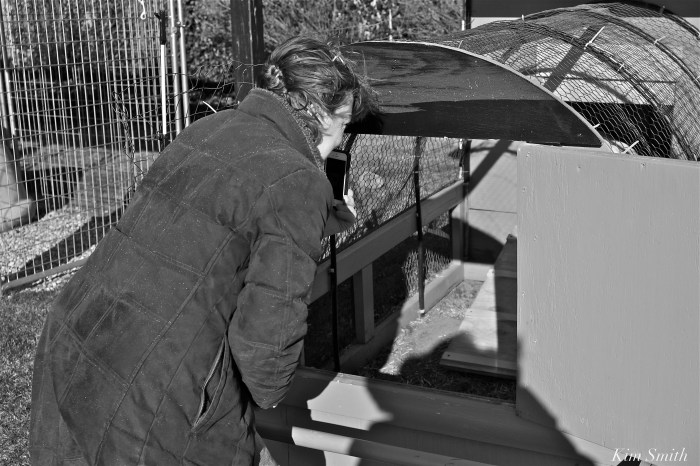
While we were at the vets, Joel Murnroe, one of Mr. Swan’s loyal caregivers and a fine carpenter, was back at Lyn’s home modifying Lyn’s chicken coop, with a larger entryway door and swan-sized rebuilt ramp.

The Young Swan has had an eventful and productive first day in captivity. With much gratitude and thanks to Lyn for taking on the tremendous responsibility of caring for a wild swan for the winter. Our hope is that the Young Swan is a she, and that she will be re-released to Niles Pond this coming spring.

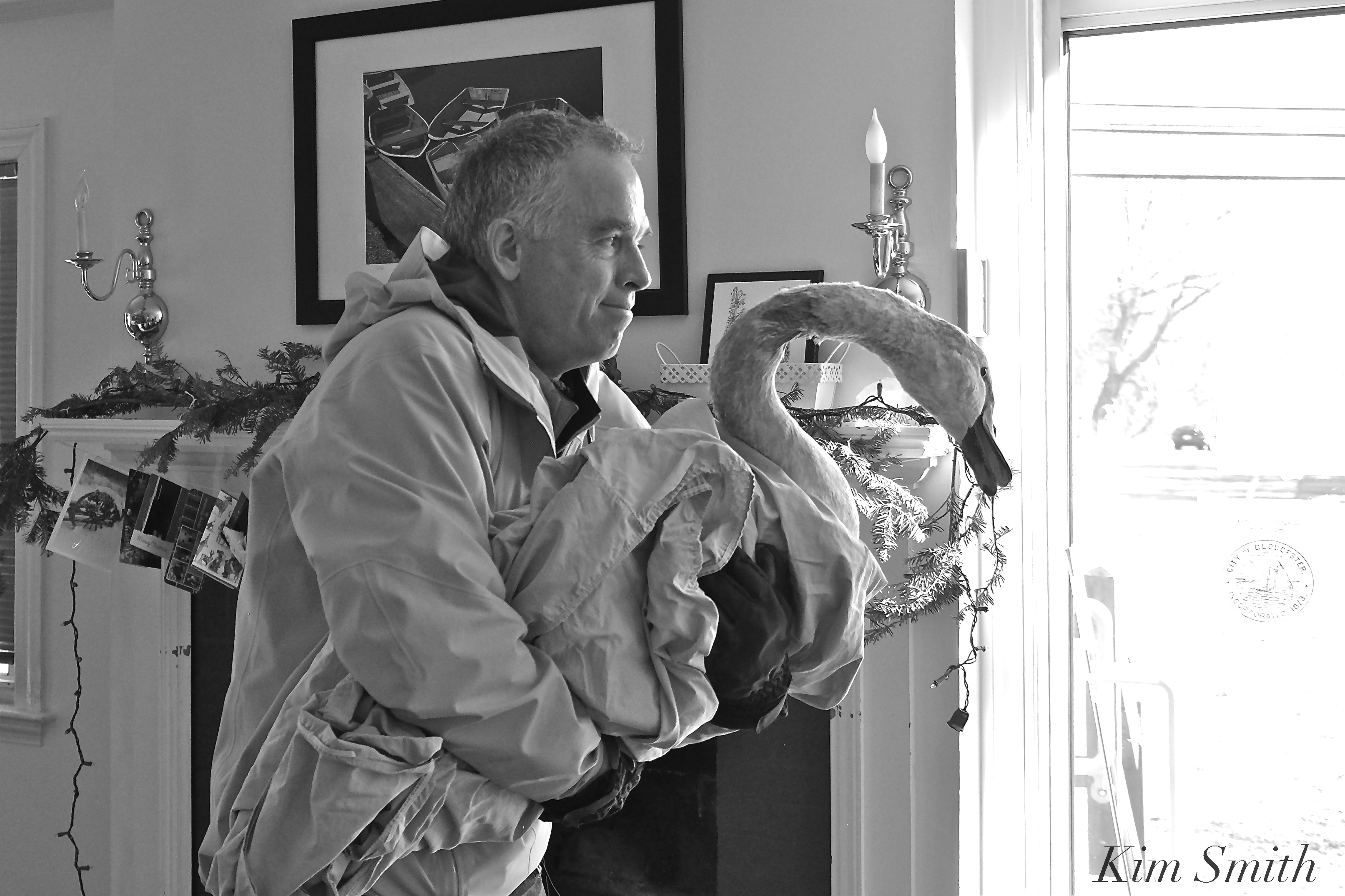
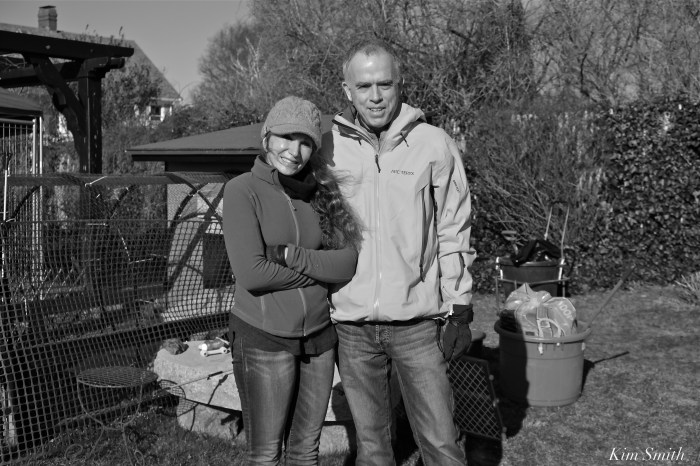
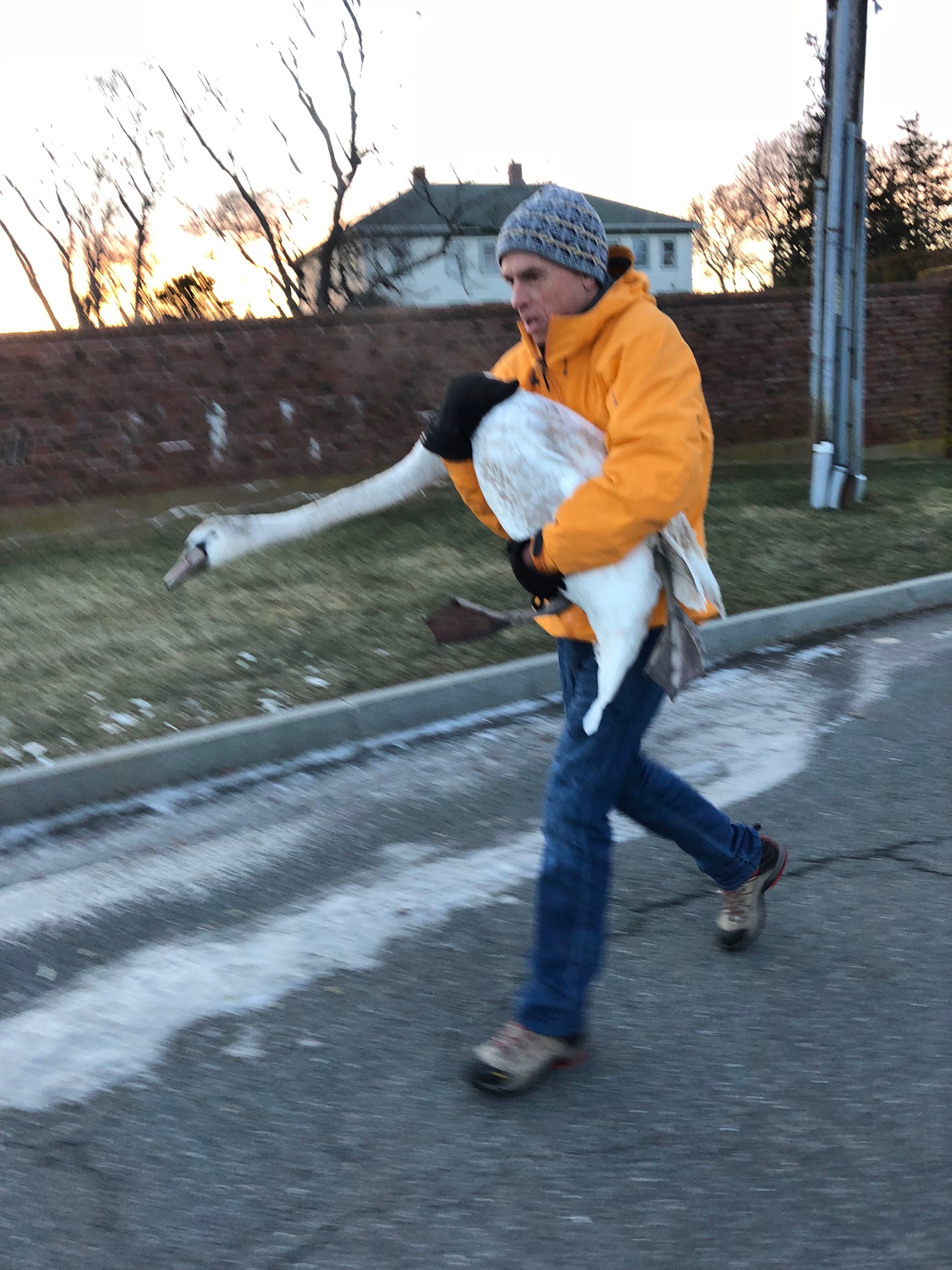
1) Lyn Fonzo and Dan Harris, 2) Joel Munroe, 3) Dan Harris and the Young Swan

BREAKING: THE NILES POND YOUNG SWAN RESCUED BY LYN FONZO AND DAN HARRIS

Eastern Point residents Lyn Fonzo and Dan Harris discovered the Young Swan frozen in the ice at Niles Pond early this morning. Dan reached into the water and scooped her up. She seemed relatively tame and did not try to bite Dan as we had imagined would happen. Dan and Lyn carried her to Lyn’s home, where she is currently living in one of Lyn’s chicken coops. Plans are underway to modify the chicken house to make it a bit more swan friendly. Joel Munroe, one of several of Mr. Swan’s caregivers, is also a carpenter and she is planning to help Lyn.

Tremendous shout outs to Lyn Fonzo, Dan Harris, Skip and Joel Munroe, and to Michelle Smith. West Gloucester resident Michelle formerly raised swans and emus on the family farm and she is providing excellent advice on how to care for swans in our New England climate.

Photos and video courtesy of Lyn Fonzo.

New digs for the Young Swan

Frozen!


IS MR. SWAN TRYING TO SCARE THE BEJESUS OUT OF THE YOUNG SWAN?

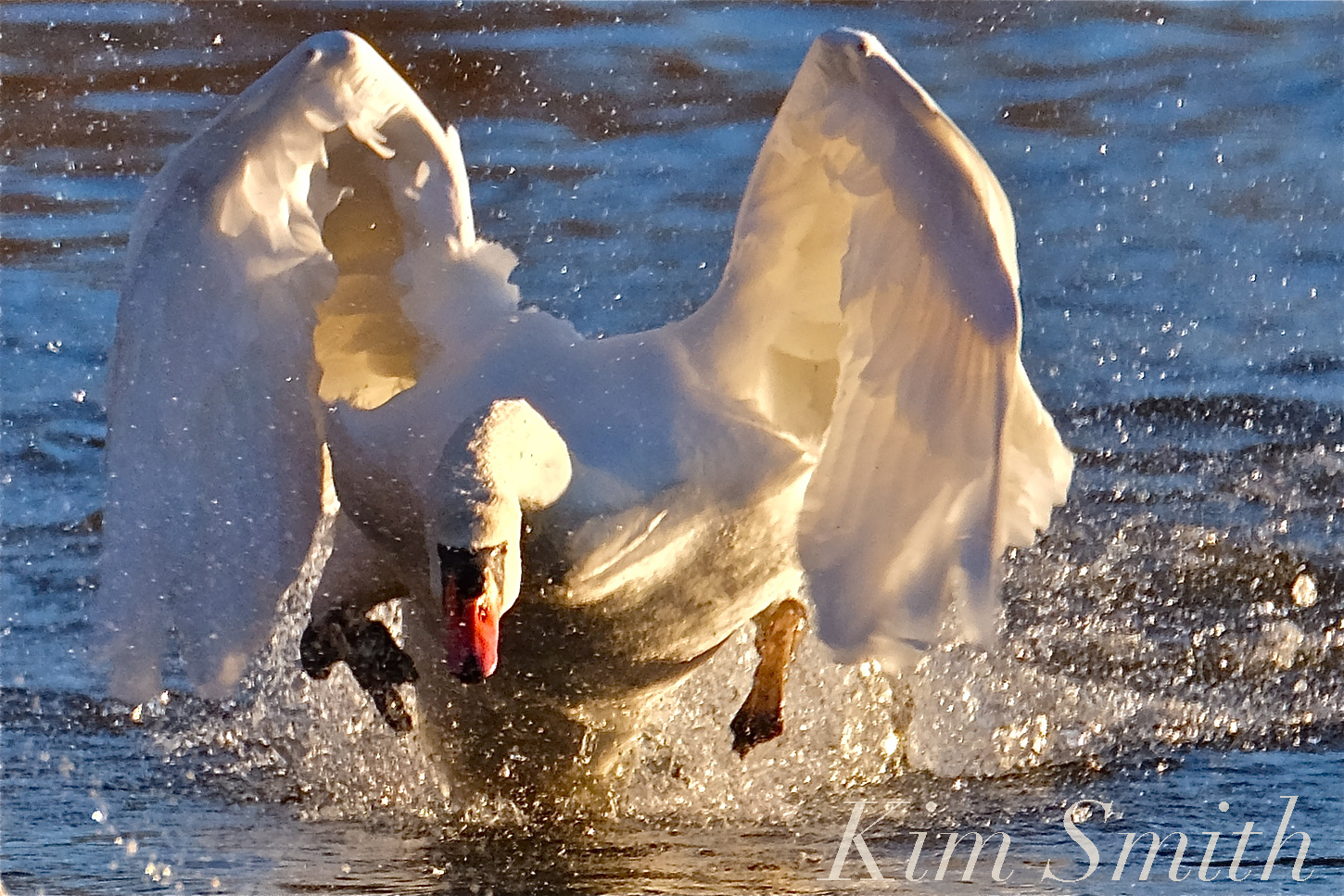
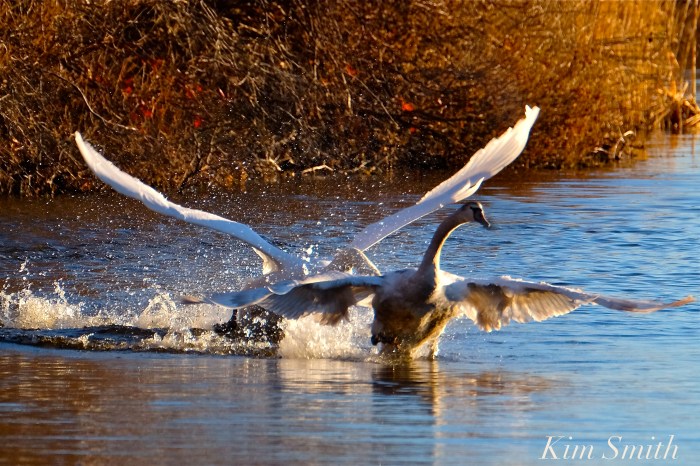
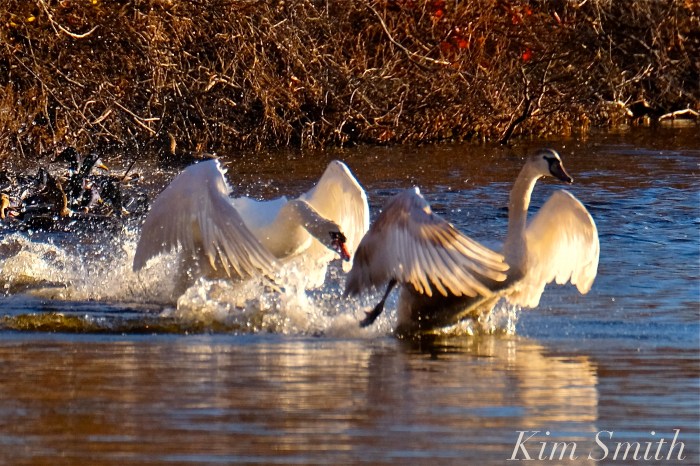
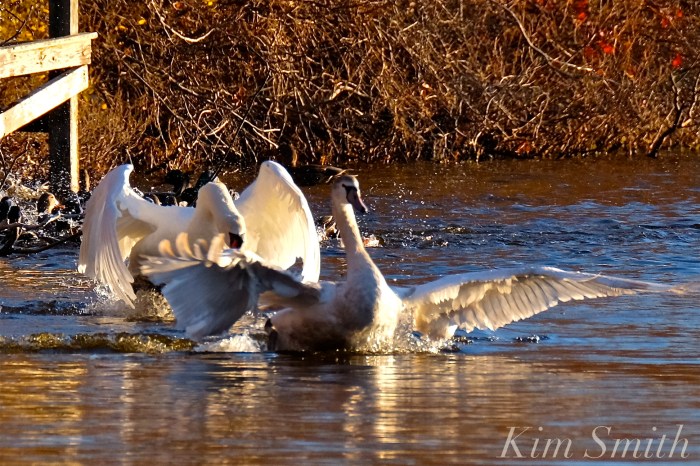
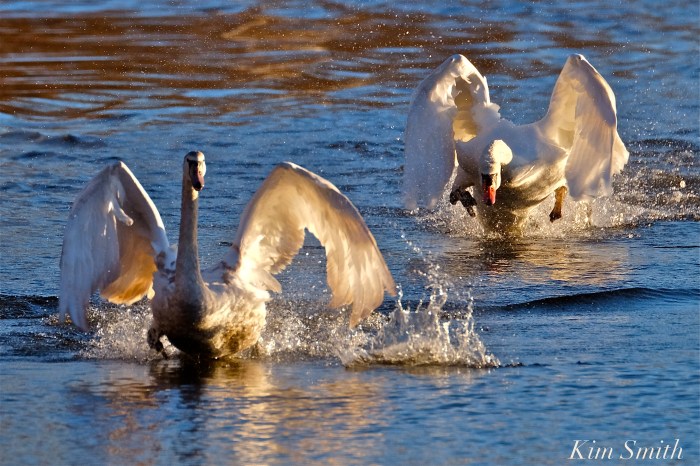
Doesn’t this scene look deadly brutal? It is a photo of Mr. Swan chasing the Young Swan.

The thing is, we think that this may be Mr. Swan’s way of encouraging the Young Swan to fly. If she is going to survive a New England winter in the wild, she has to move to saltwater coves and harbors. Niles Pond resident Skip Hadden has seen her fly but she seems to have no interest in leaving the Pond. Niles Pond is freezing over, and unless the Young Swan follows Mr. Swan’s lead, she will have to be relocated.

https://www.instagram.com/p/Bcr8NKXFjNZ/

LOCAL RESIDENT DAVID ROBINSON -DRUMMER FOR THE CARS- INDUCTED INTO THE ROCK & ROLL HALL OF FAME!

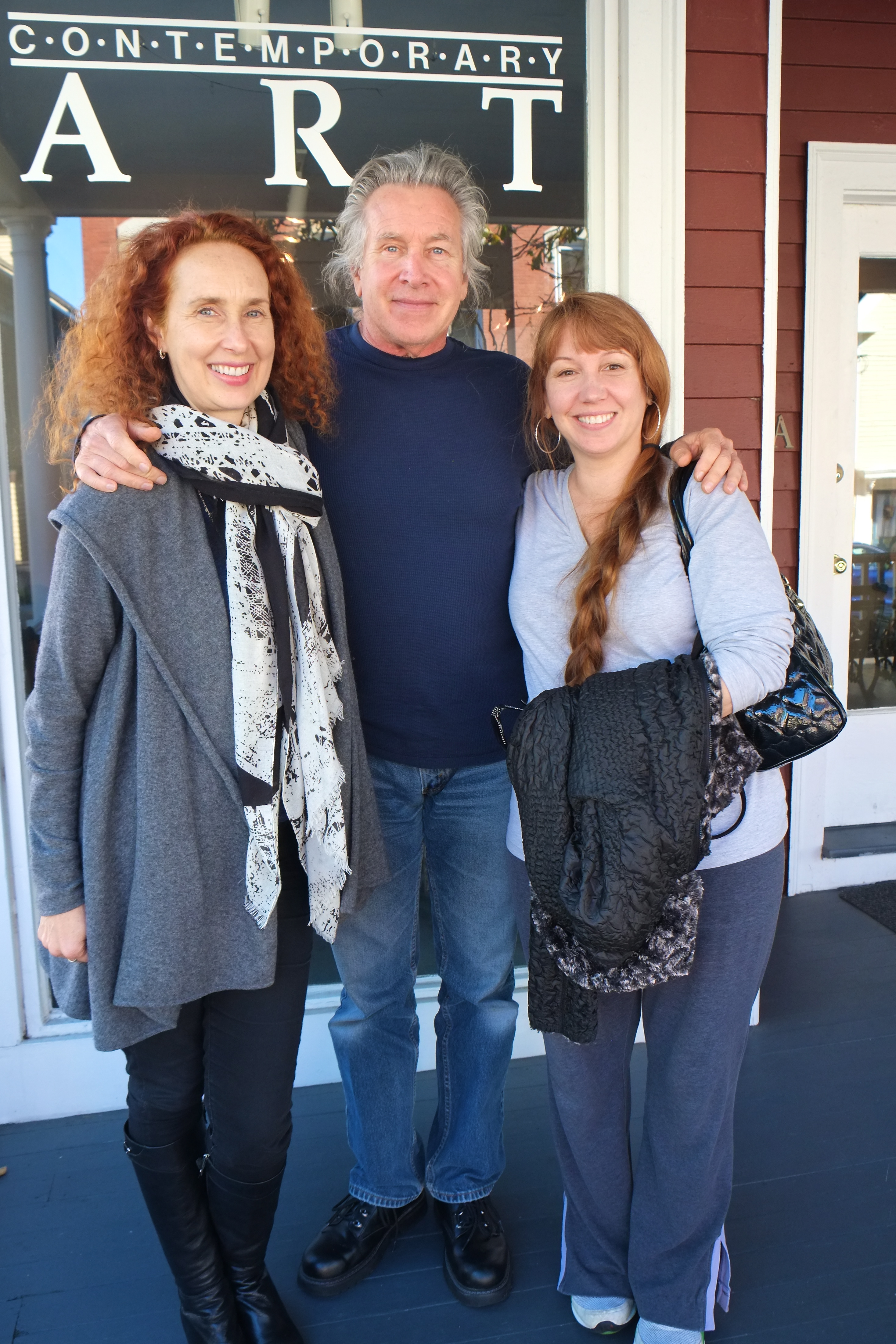
David Robinson, owner of the beautiful local gallery Windemere Art and Antiques, and drummer for the rock band The Cars, has been inducted into the Rock and Roll Hall of Fame. Rock on David!

You can read the full story here in today’s Gloucester Times.

My friends Donna, David, and Lisa in front of David’s shop Windemere, located on Main Street Rockport

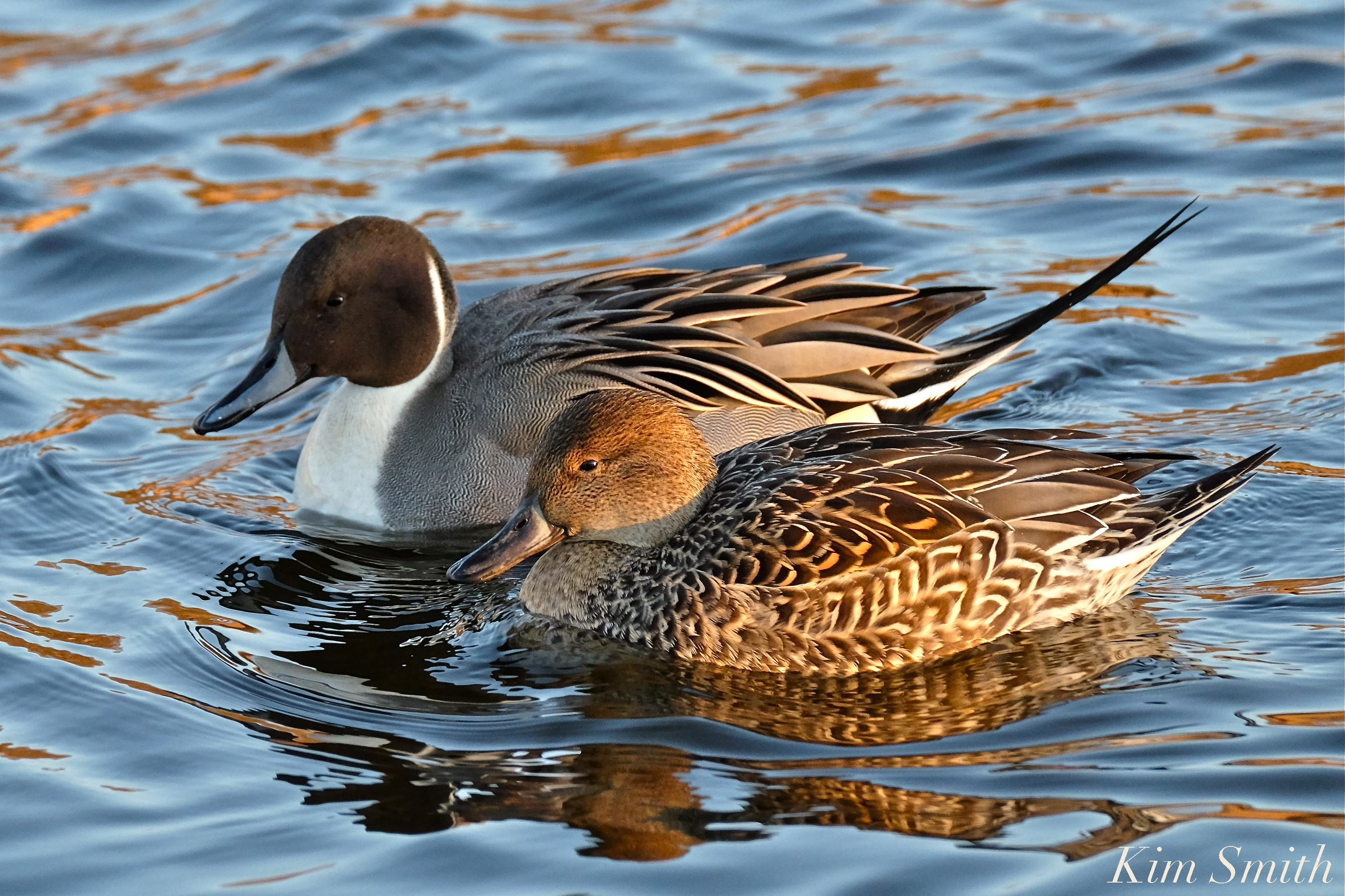
WELCOME TO CAPE ANN MAMA AND PAPA PINTAIL!

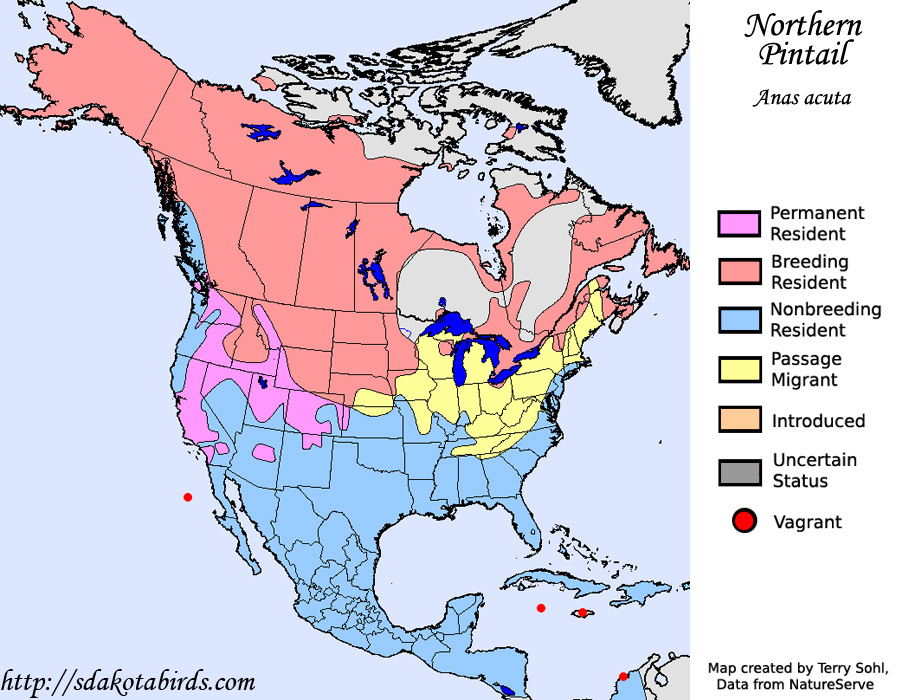
For over a month our shores have been graced with a pair of Northern Pintails. These beautiful dabbling ducks aren’t extremely rare, but we are at the very northern edge of their winter grounds. And, too, they are a bird listed as in sharp decline by the North American Breeding Bird Survey. 

The little duo are tremendously fun to watch. They are exhibiting very different behaviors, in large part I think because the male and female wing patterns are distinctly different from each other.

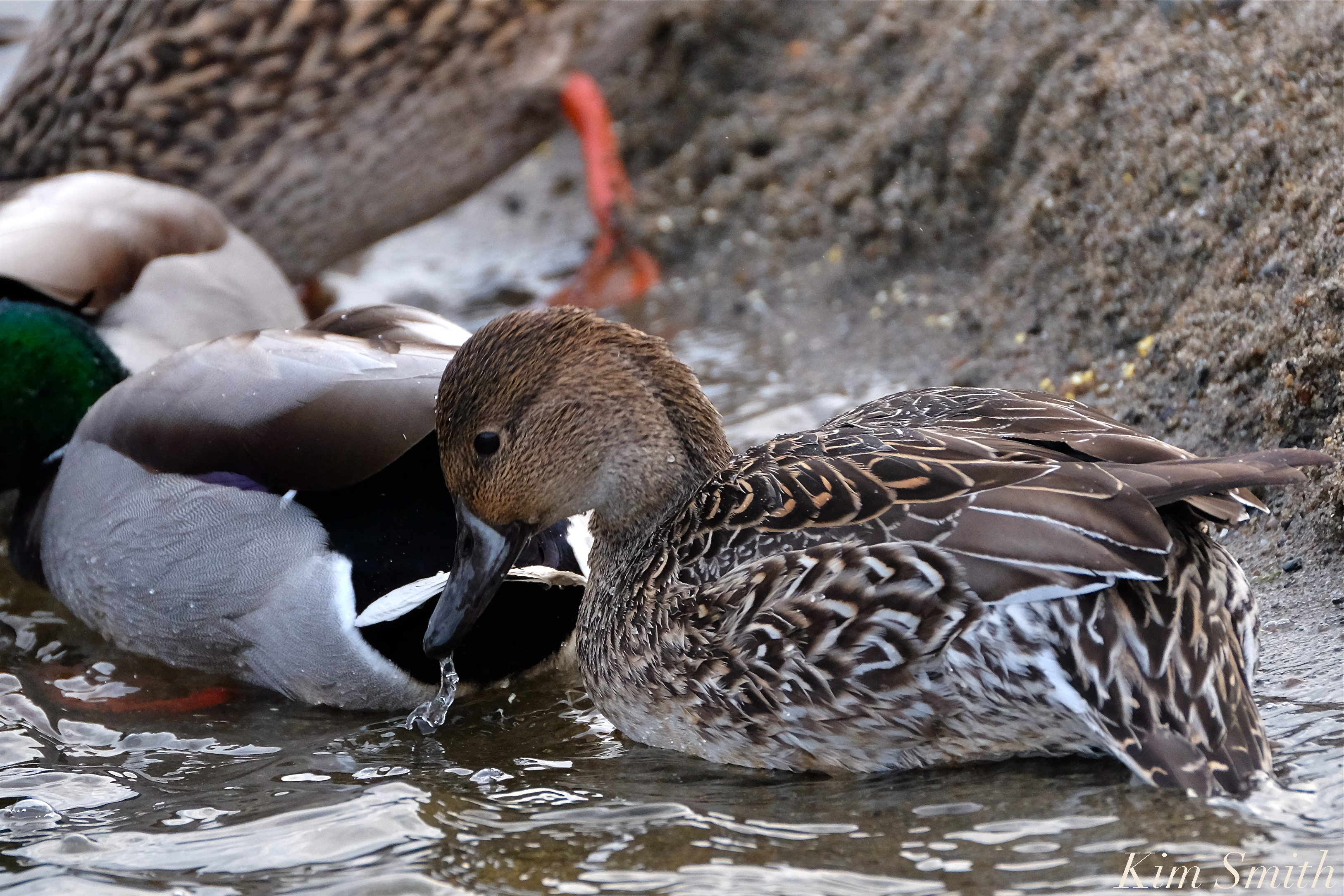
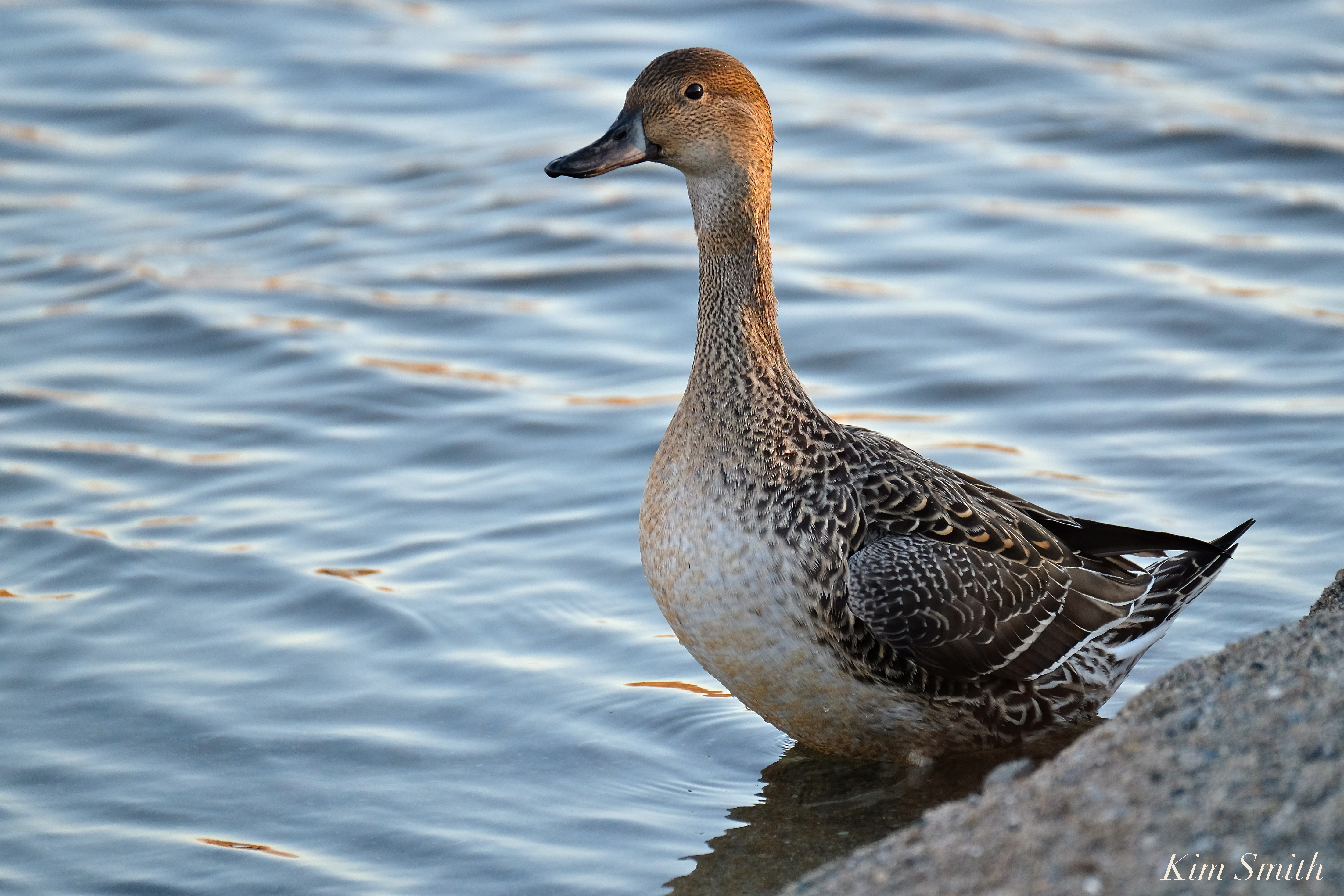
The female is super spunky. Her coloration is similar to a female Mallards, which makes her easily camouflaged amongst a mixed flock of ducks. She’s not intimidated by territorial behavior on the part of the Mallards and forages alongside the Mallards and American Black Ducks.

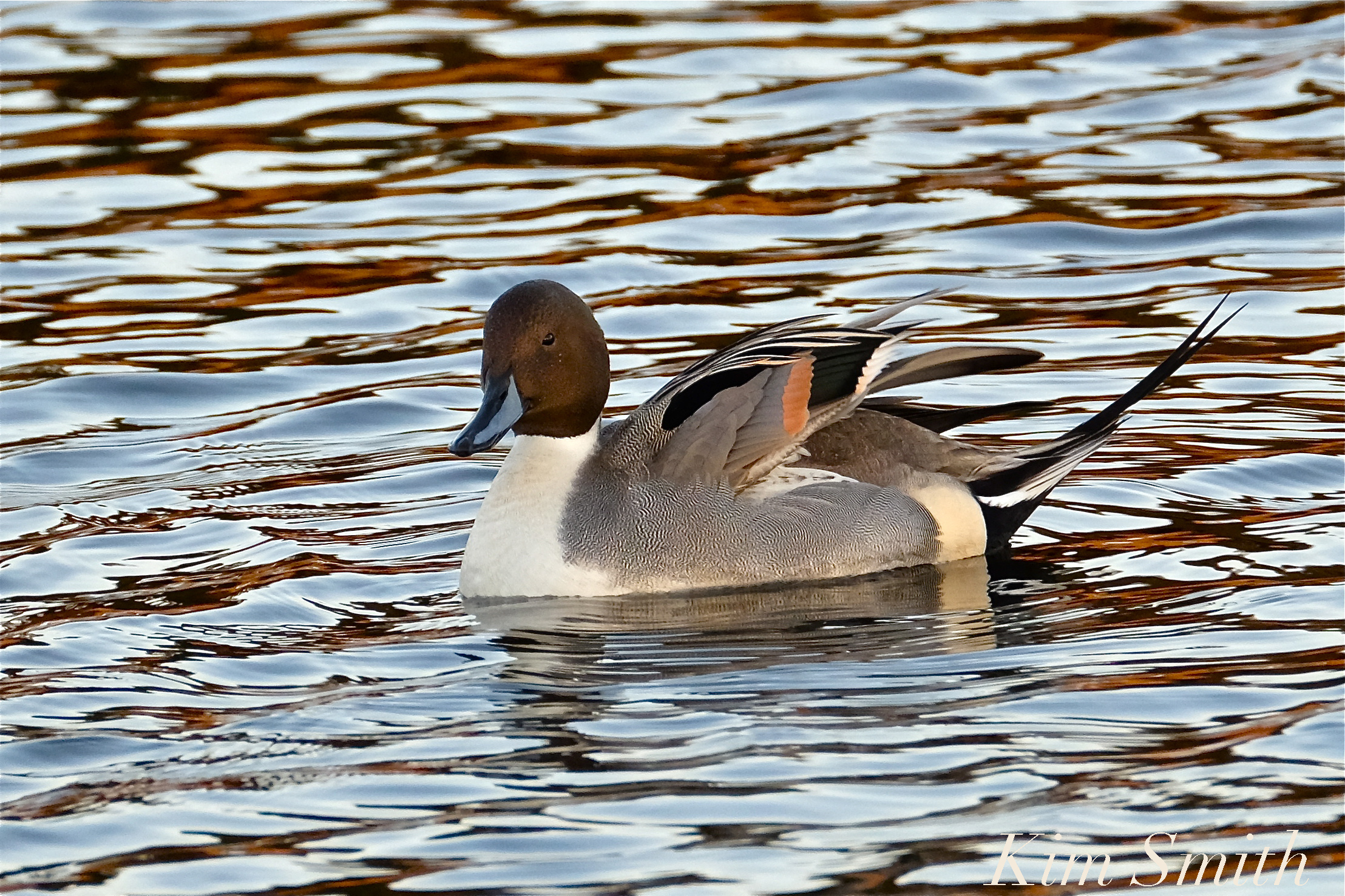
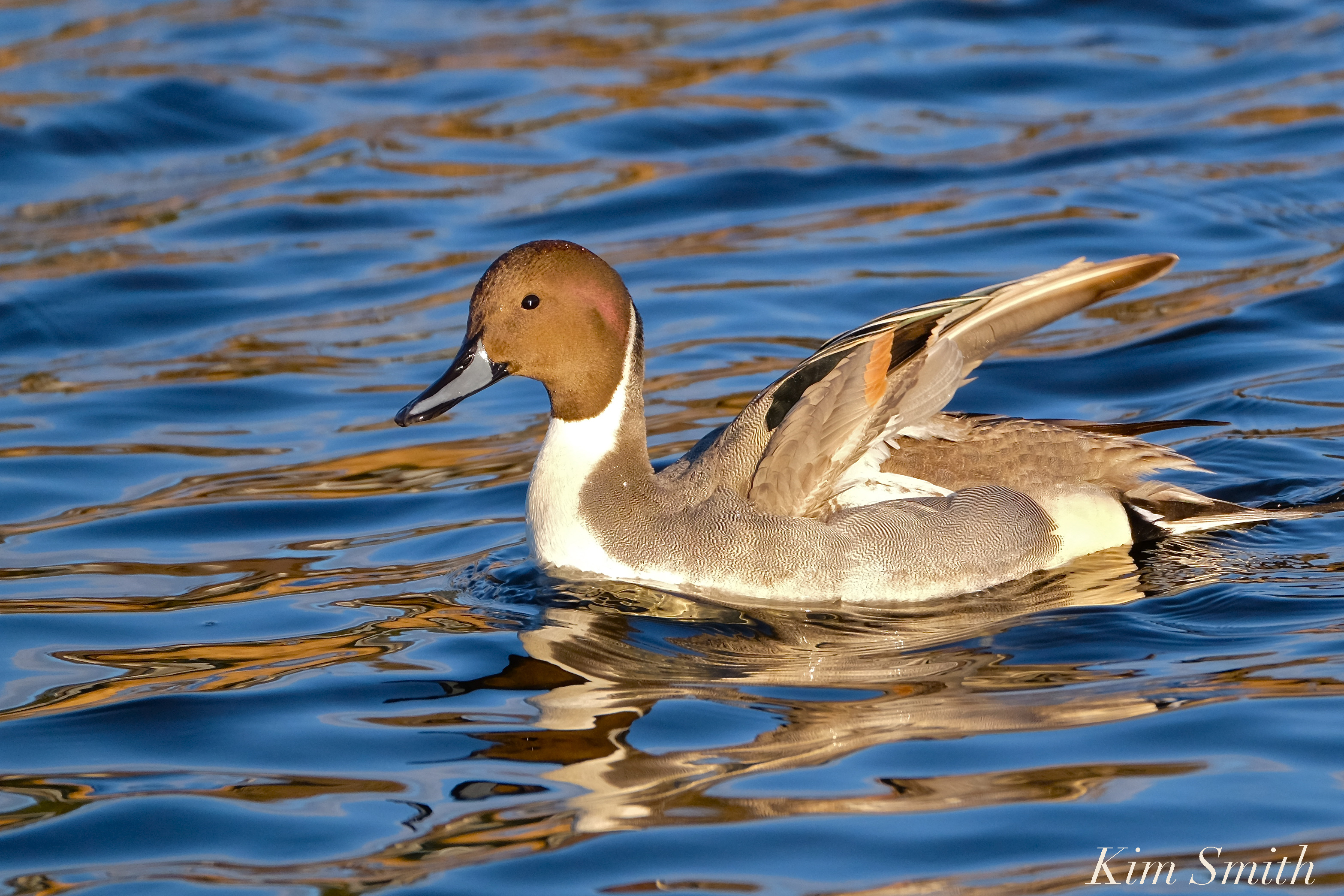
On the other hand, the male’s strikingly beautiful and unmistakable wing pattern sets him apart and at risk amongst the flock. He is elusive and if catches sight of a human, he makes a fast beeline to the opposite side of the pond. When feeding in a group, the Mallards and gulls attack him, easily able to latch onto his long elegant pintail and pull him down underwater (very disturbing to observe).

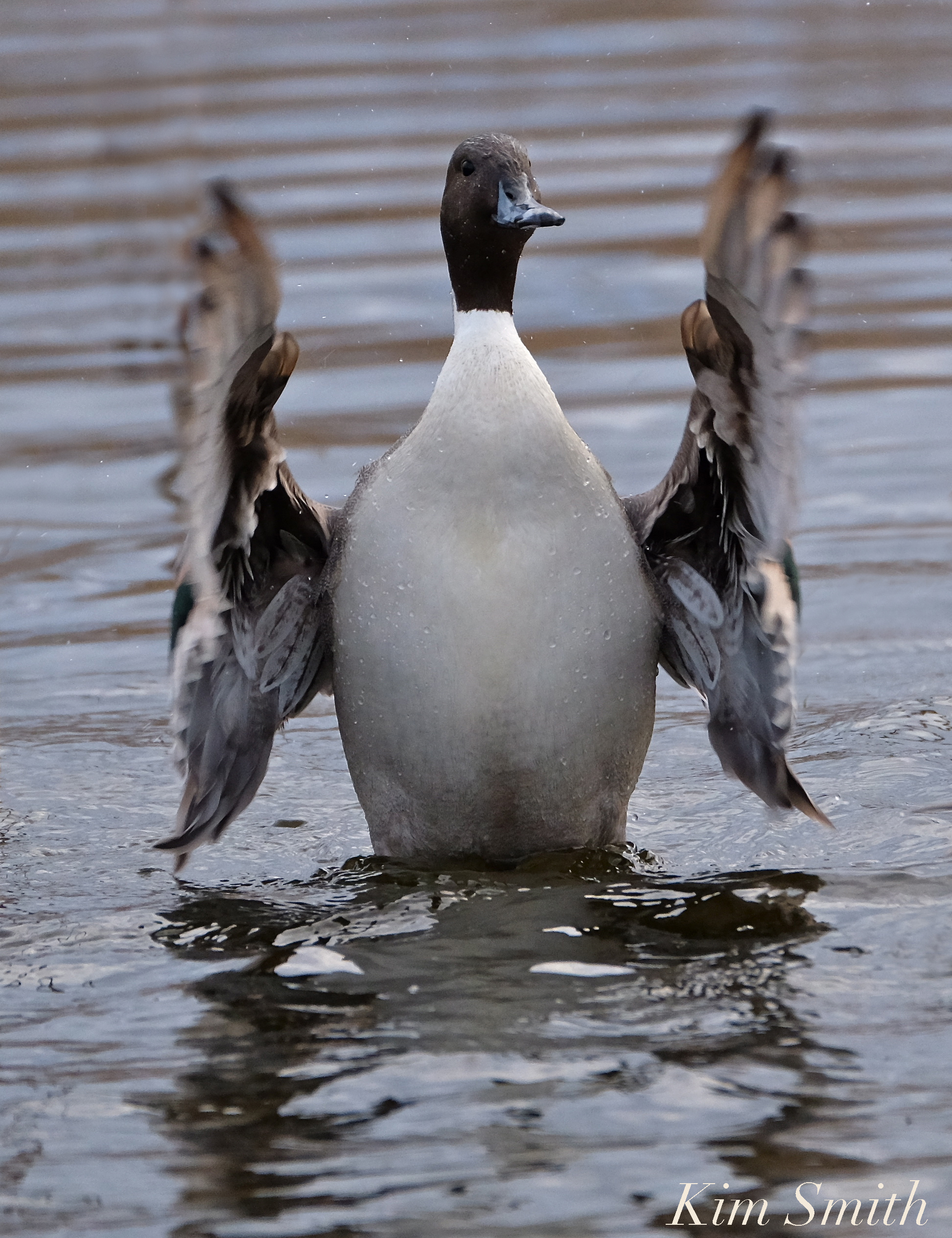
Papa Pintail’s morning stretches.

The female spends alternating time between foraging with the flock at the shoreline edge and dip dabbling with the male in the shallow water. Northern Pintails eat seeds, water bugs, crustaceans, snails, and grains, feeding in a variety of manners, dabbling, filter feeding, eating from the ground surface, and tipping-up in shallow water.

Female Pintail foreground, female Mallard Background

Female Mallards and female Northern Pintails are similar in appearance and it may be difficult to distinguish between the two. Here are some clues to look for:

1) Female Mallards have light orange feet and legs. Northern Pintails feet and legs are gray.

2) The female Pintail has a longer neck.

3) A female Pintail’s bill is solid gray, whereas a female Mallards bill is mottled brown and orange.

4) The female Mallard has a blue stripe on her wing, the Pintail does not.

Notice the beautiful long neck of the female Pintail.

The female Northern Pintail’s bill, legs, and feet are gray in color.

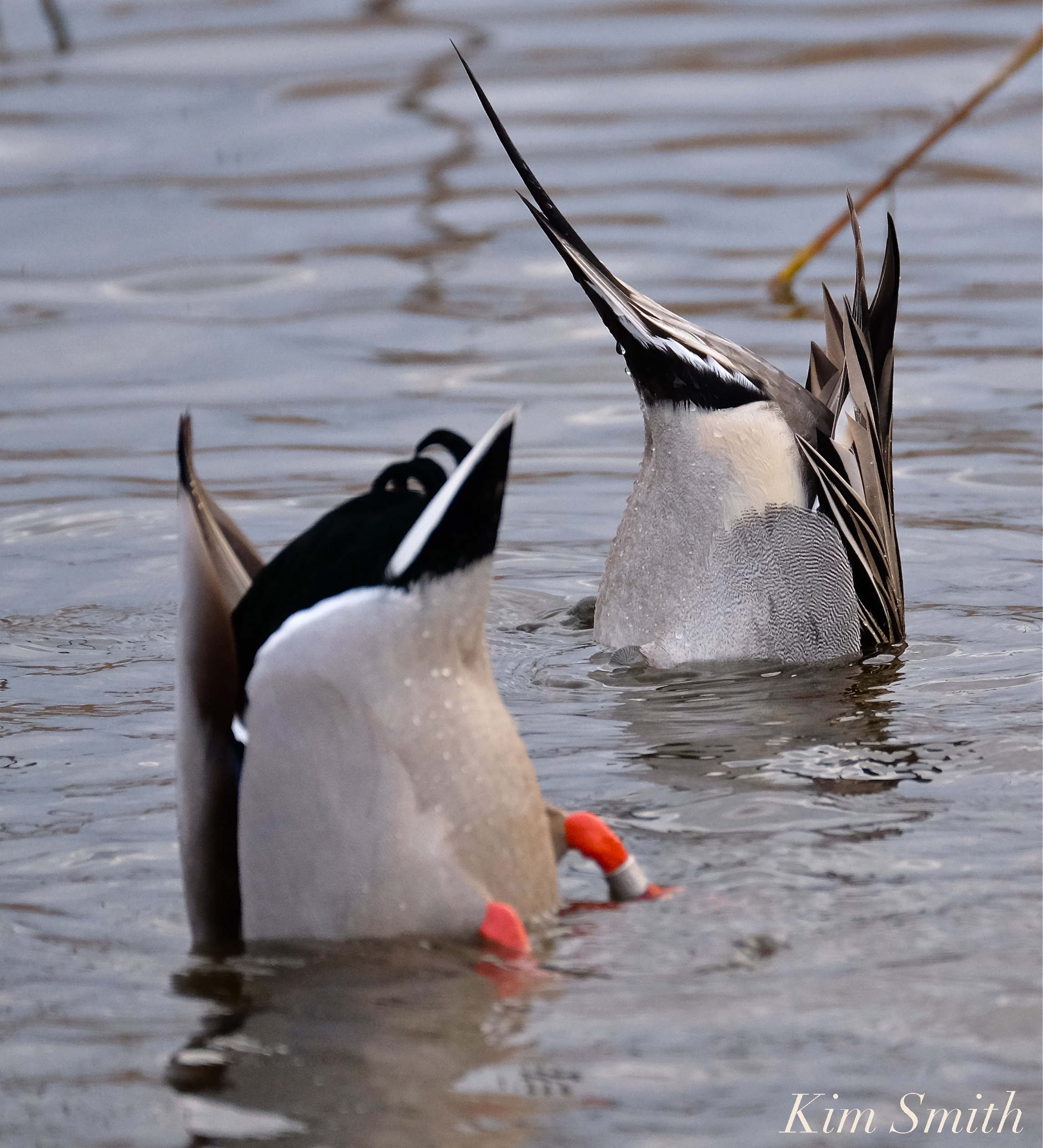
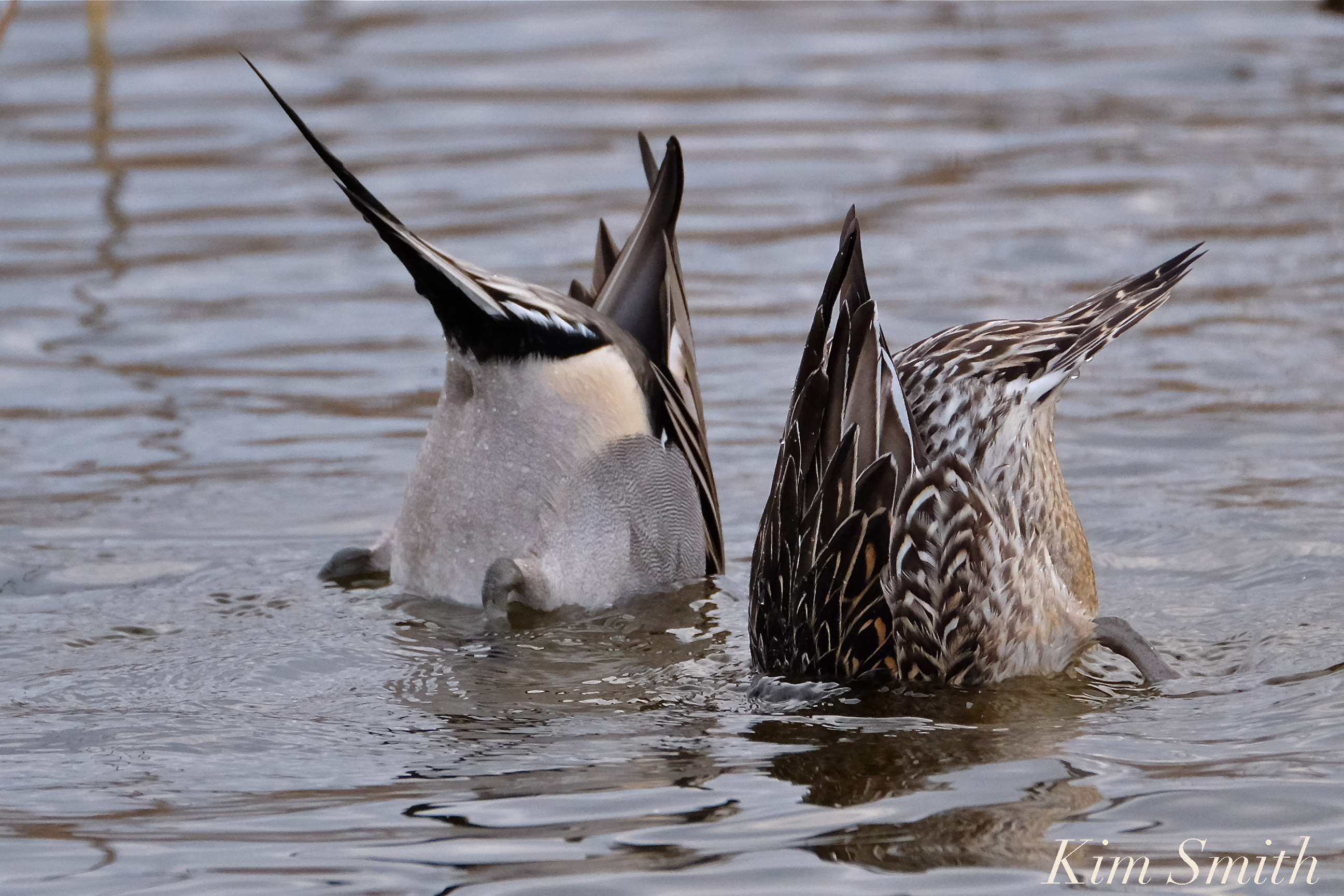
Comparing Duck Butts ~

Note the short stubby tail of the male Mallard in the foreground versus the Pintails long, thin elegant black tail feathers.

Male and female Northern Pintail buttsPapa Pintail has a beautiful buffy orange stripe and below that a forest green bar. 

I hope so much the Pintail pair have chosen Cape Ann for their winter home. More photos to come!


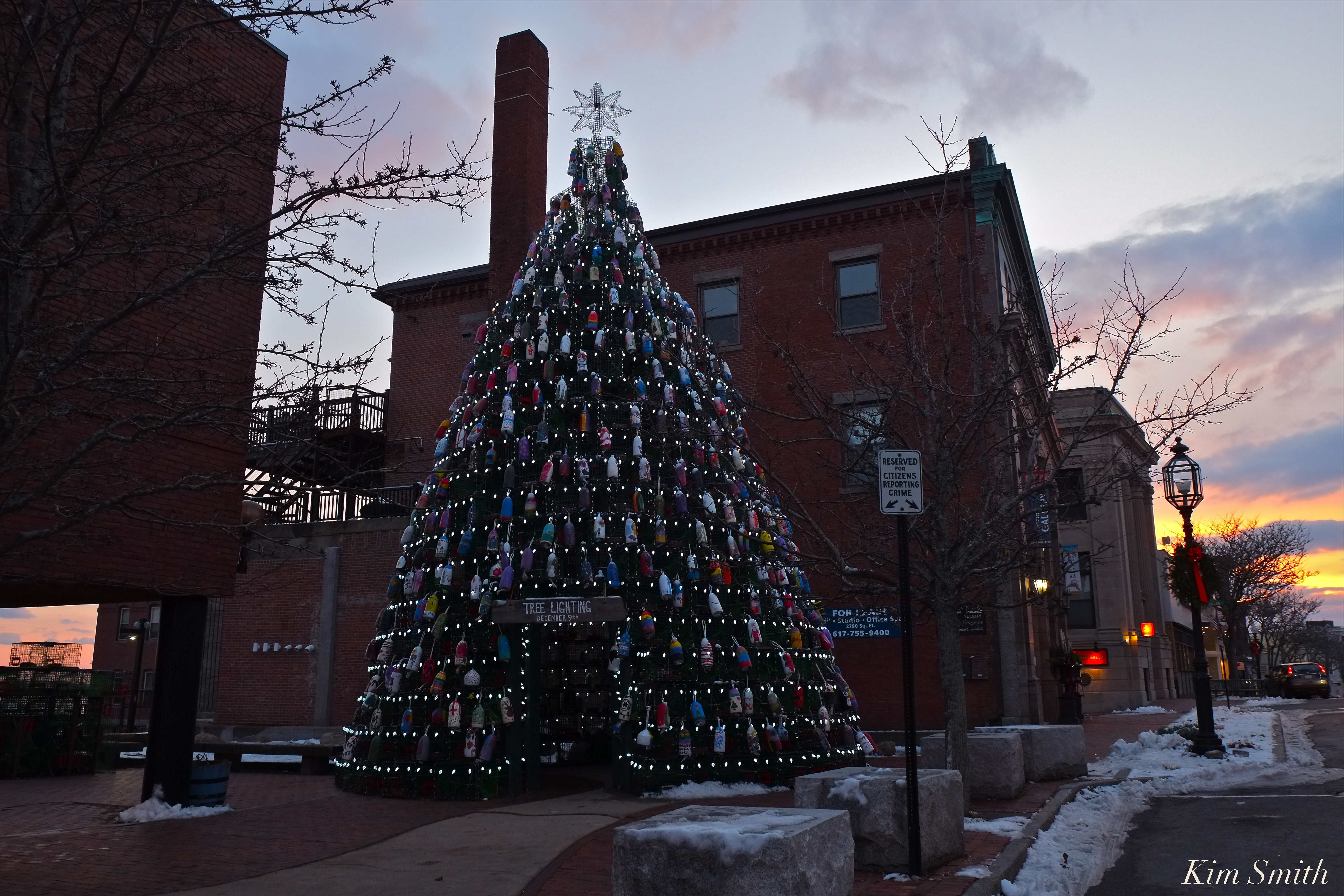
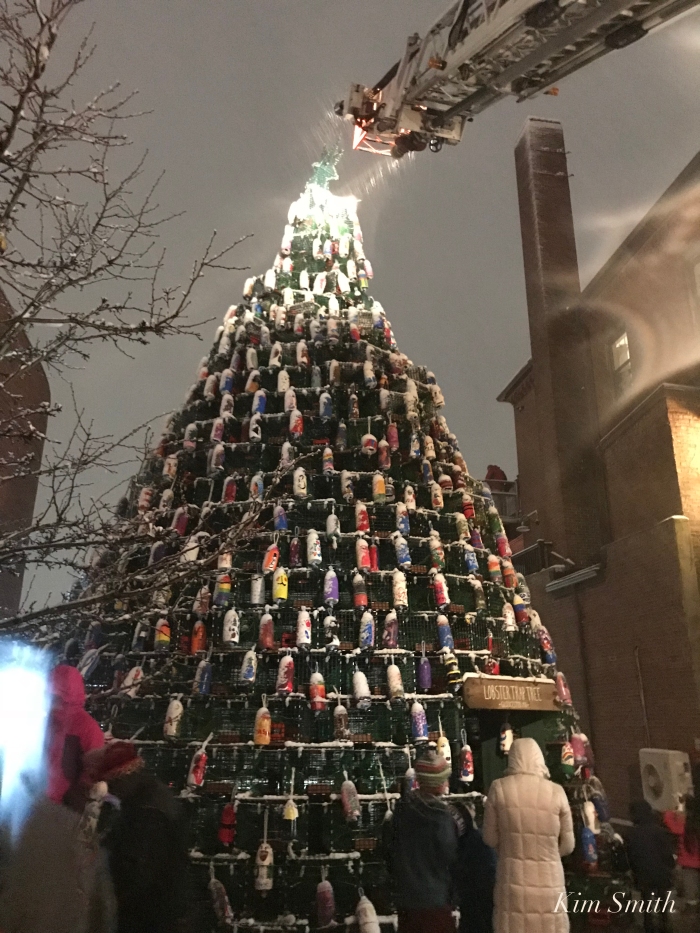
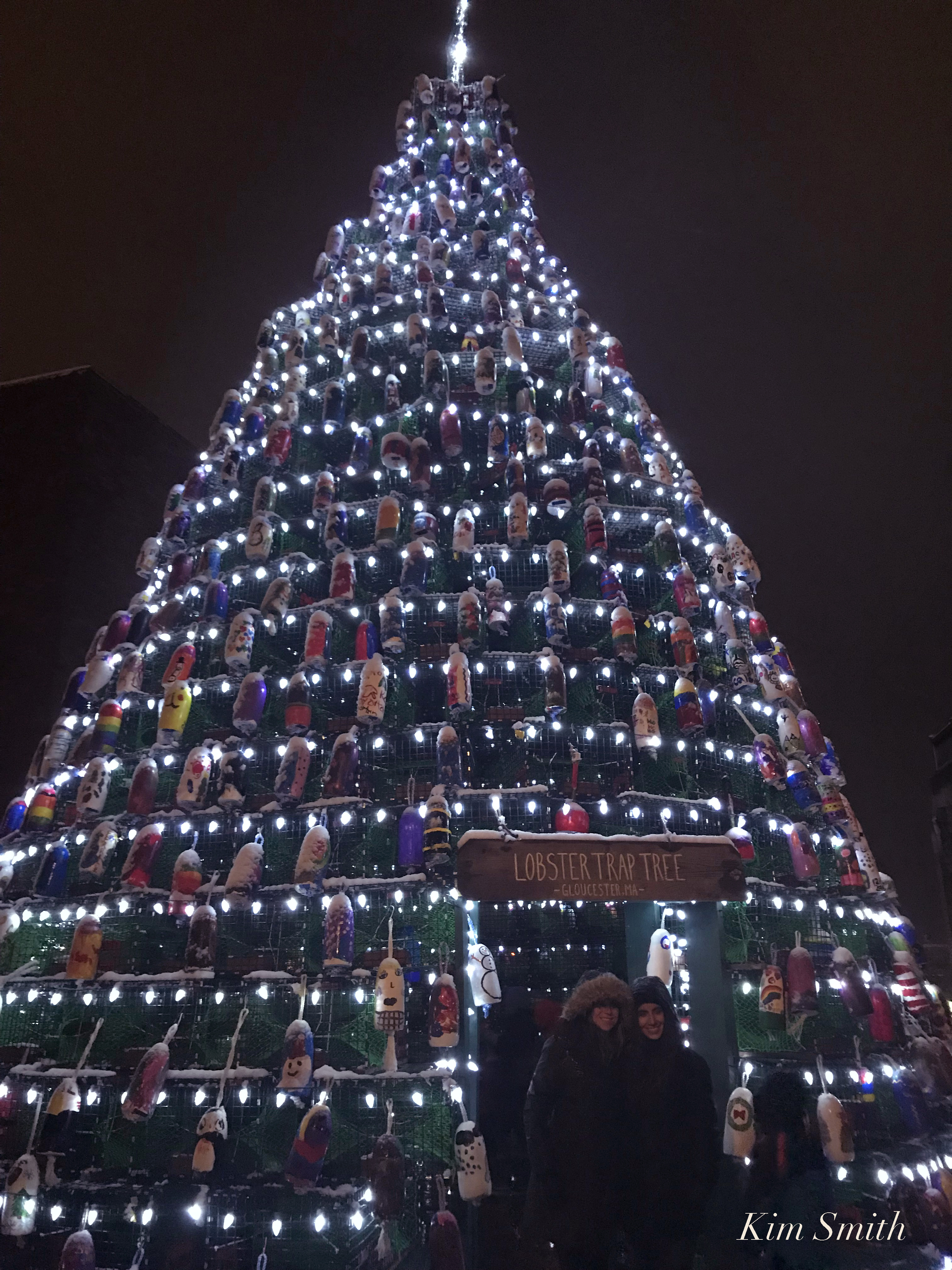
#GLOUCESTERMA LOBSTER TRAP TREE AT TWILIGHT

Our one of a kind Lobster Trap Tree at twilight on Monday evening.

“HOLIDAY DELIGHTS” SNEAK PEAK!

Holiday Delights promotion created by Lisa Smith, with Gary Ng photos.

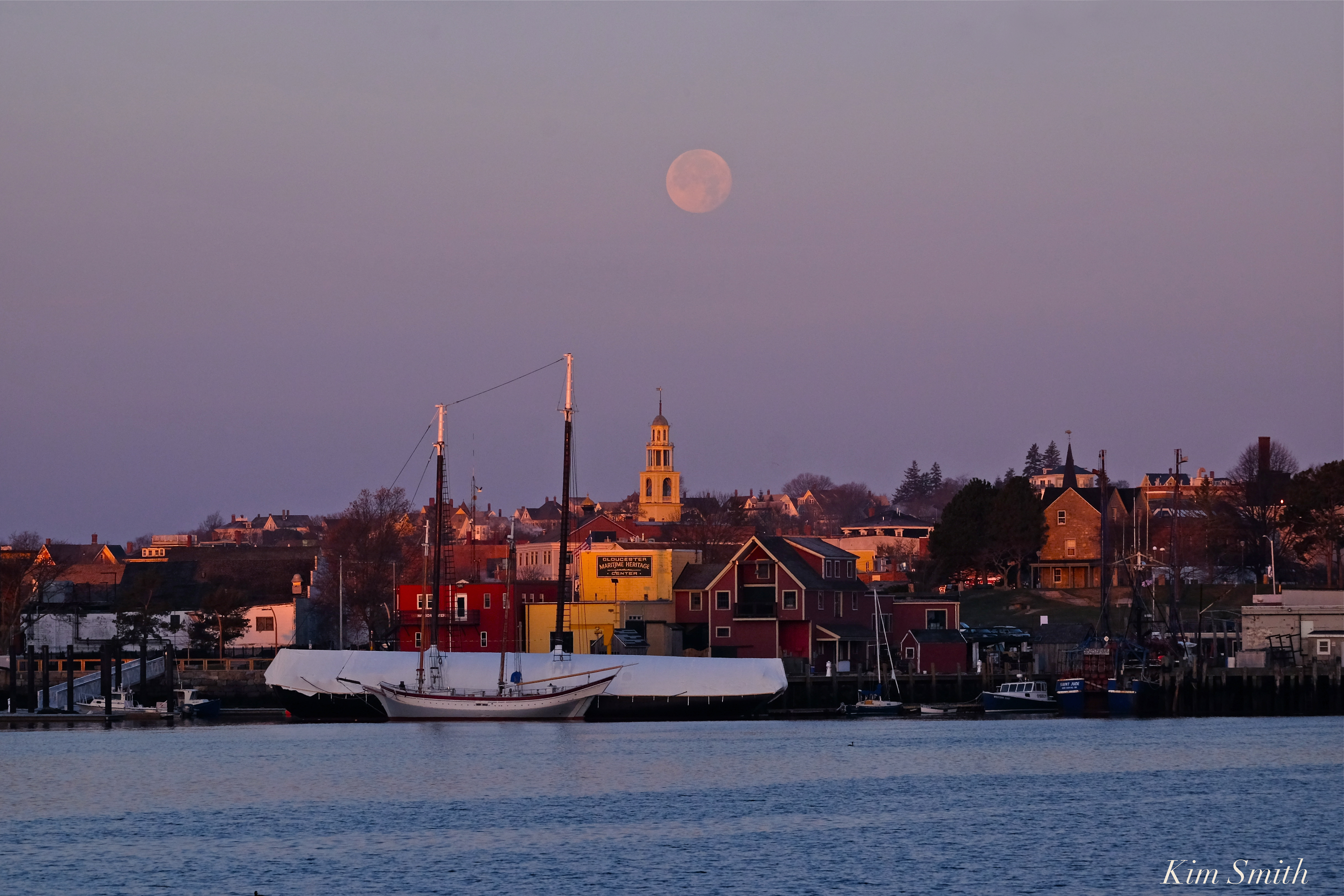
DECEMBER FROST MOON OVER GLOUCESTER HARBOR

One more photo from December’s Frost Moon at dawn. The moon was rapidly loosing color in the sun’s first light, but still beautiful I think.

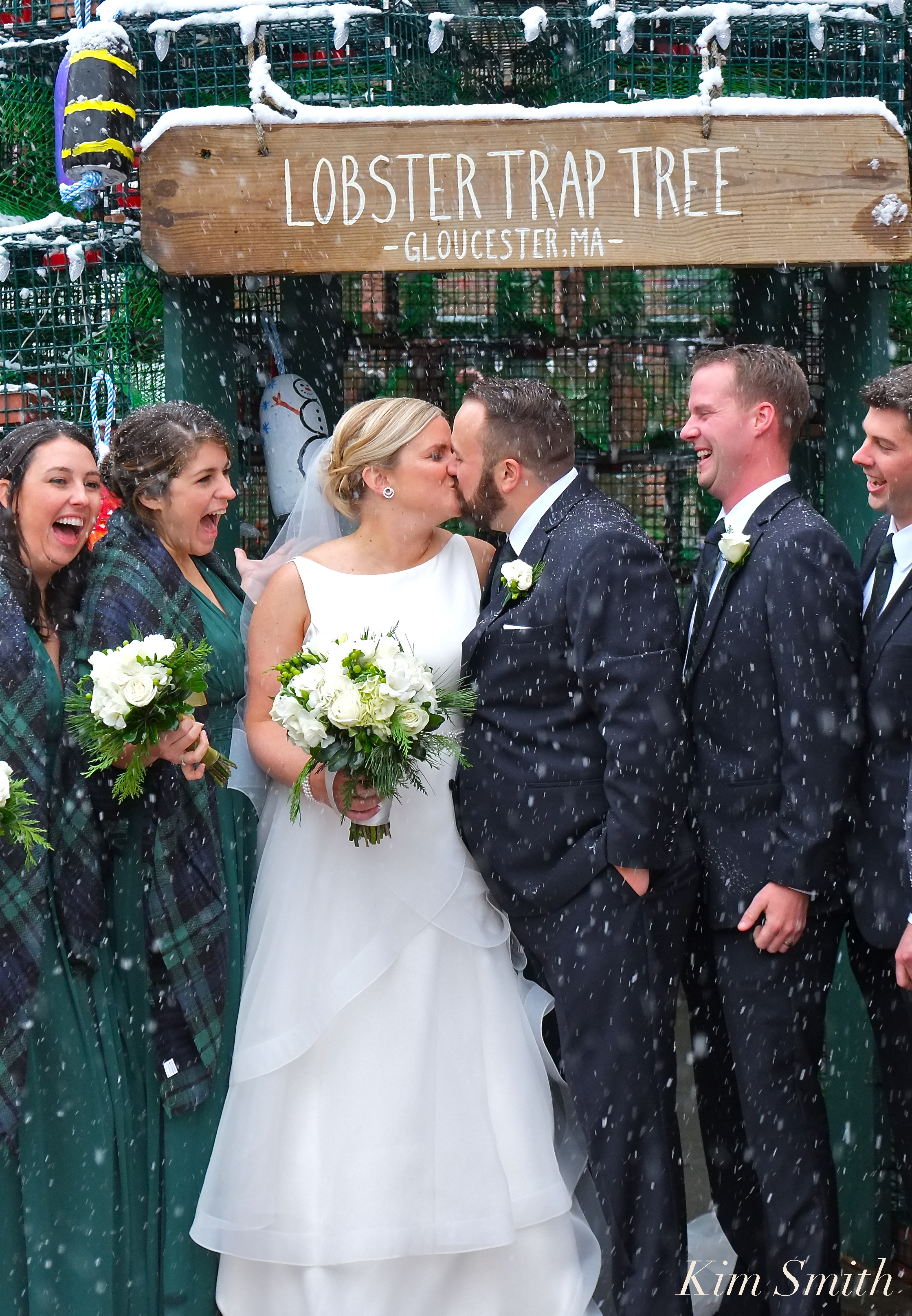
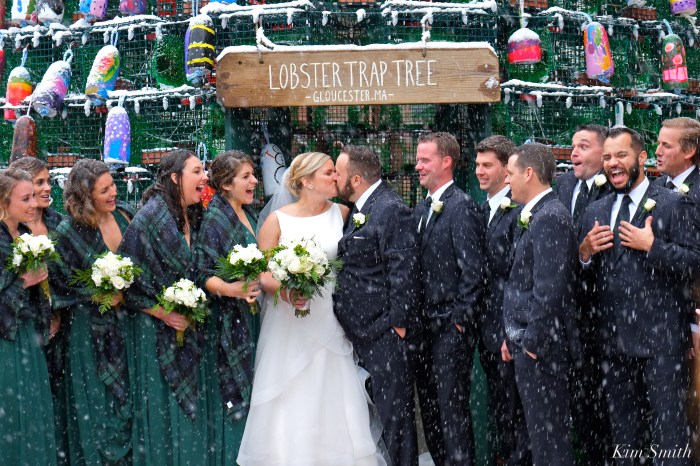
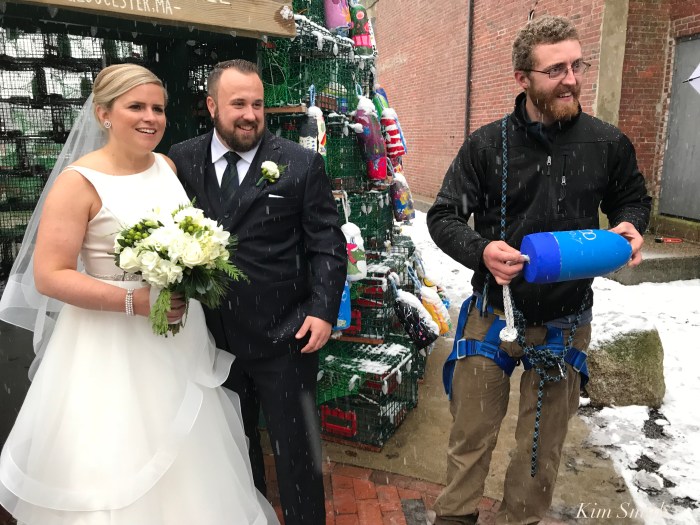
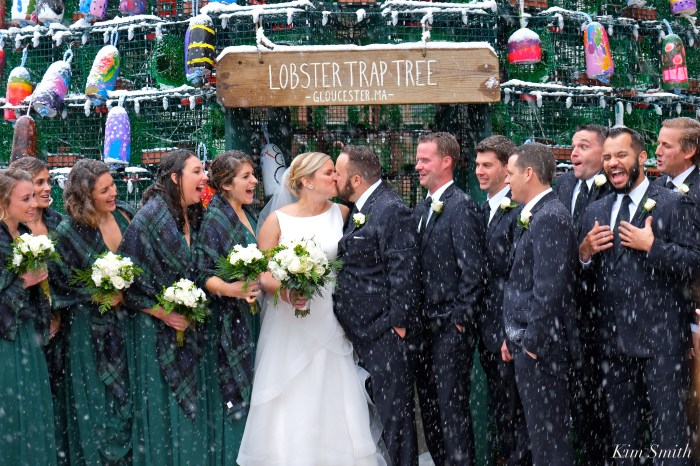
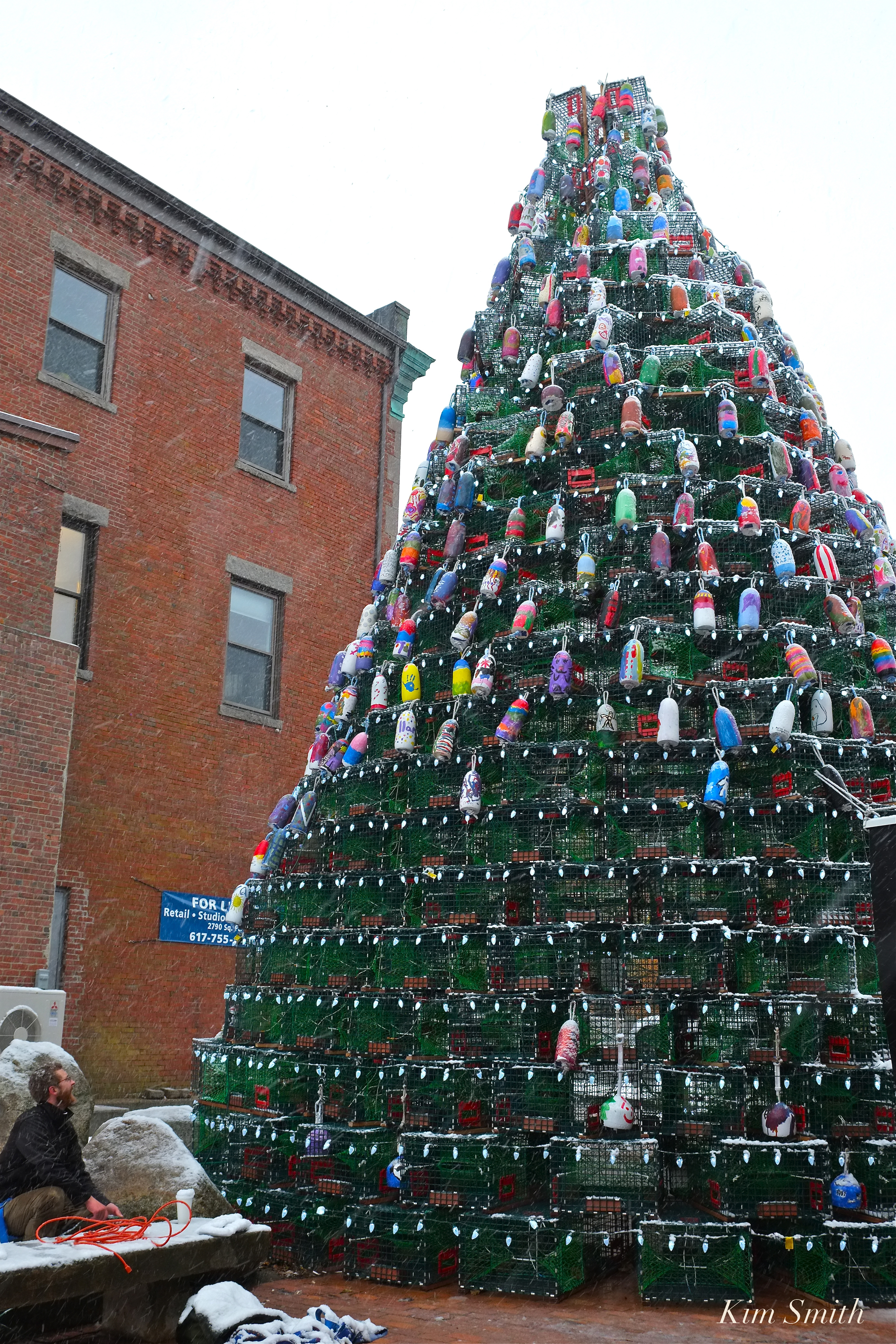
WEDDING BELLS FOR MOLLY ROSS AND RYAN STOKES AT THE LOBSTER TRAP TREE

Thank you to Sheree Zizak, owner of the Beauport Hotel, who shared that the bride and groom that braved Saturday’s snowstorm to have photos taken in front of Lobster Trap Tree are Molly Ross and Ryan Stokes. Molly and Ryan held their reception at the beautiful Beauport Hotel.

Many of us marveled at how relaxed were the wedding party, especially the bride and bridesmaids, wearing sleeveless dresses and gold heels in the slush and freezing snow. Art Haven’s program director Cathy Kelley, on the spur of the moment, quickly painted a buoy with wedding rings and the date, and David Brooks presented the buoy to the happy couple. Congratulations Molly and Ryan!

MORE PICS FROM #GLOUCESTERMA LOBSTER TRAP TREE LIGHTING FESTIVITIES!

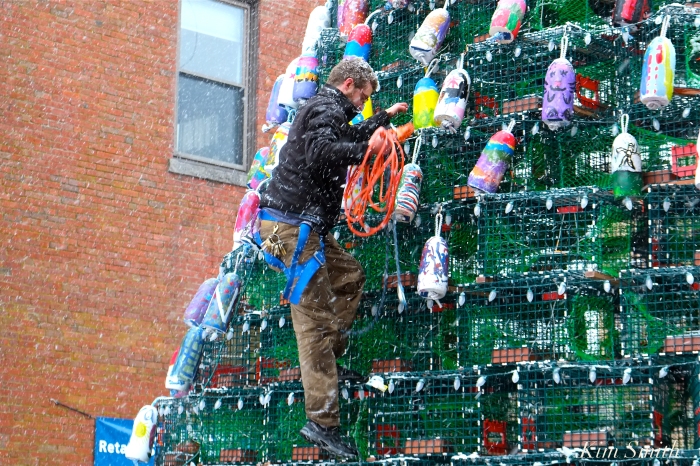
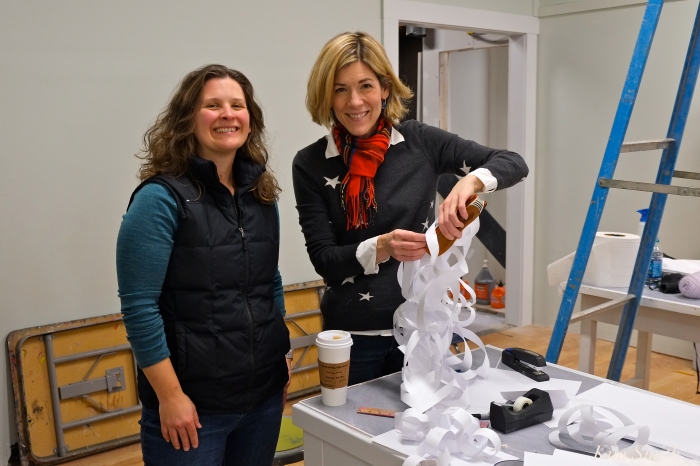
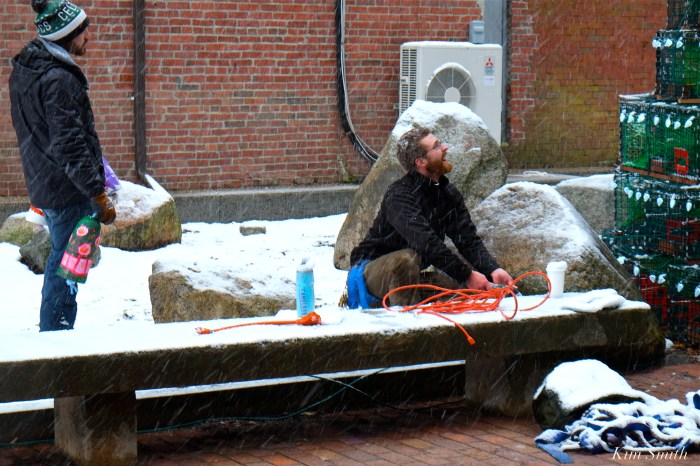
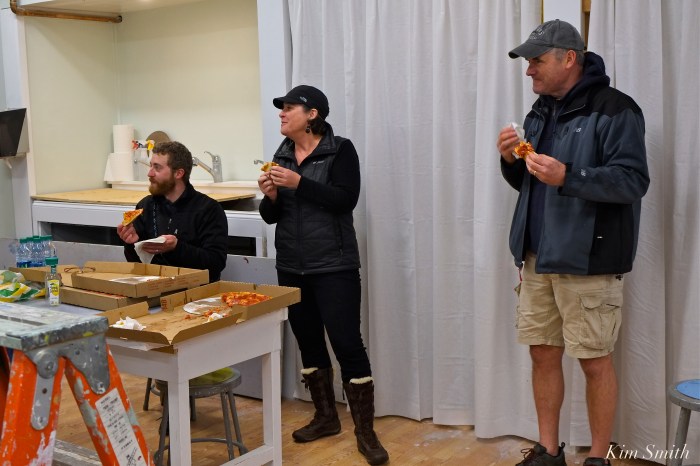
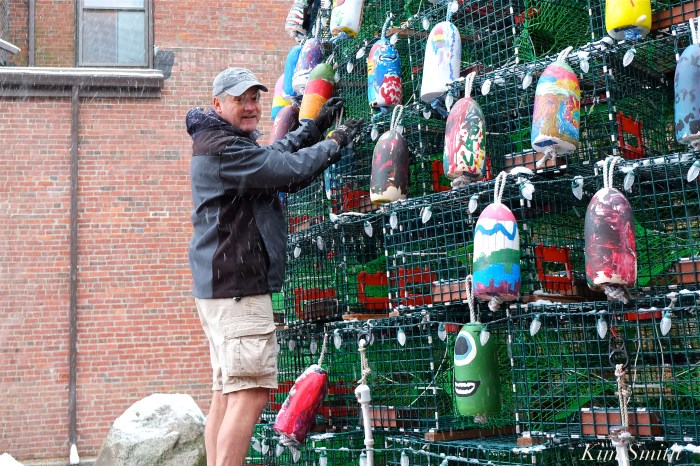
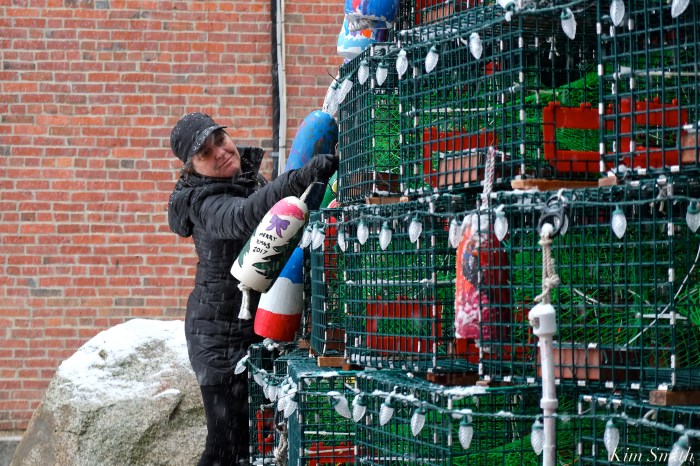
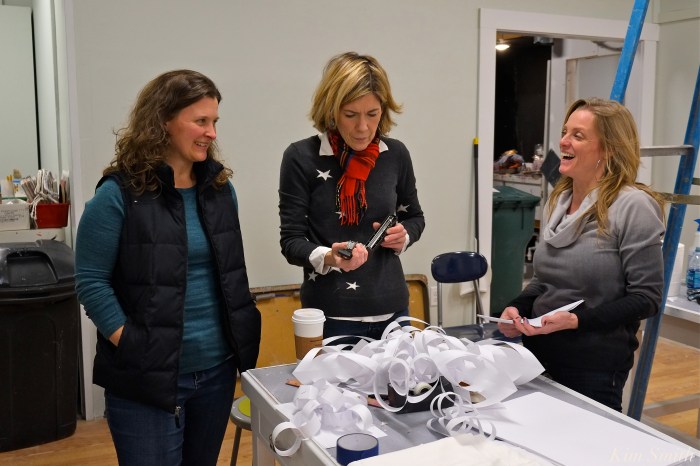
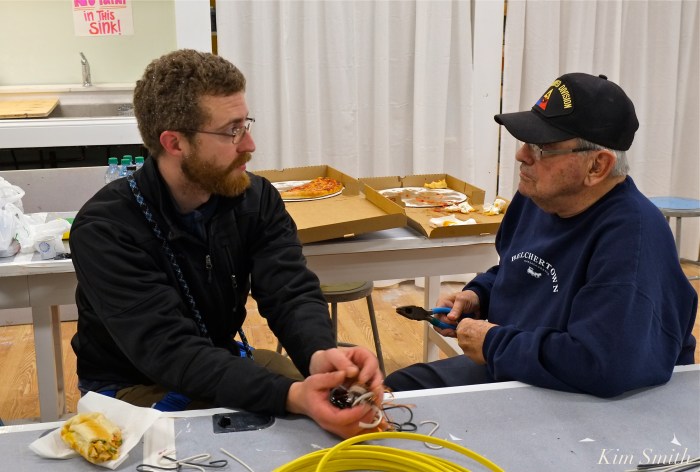
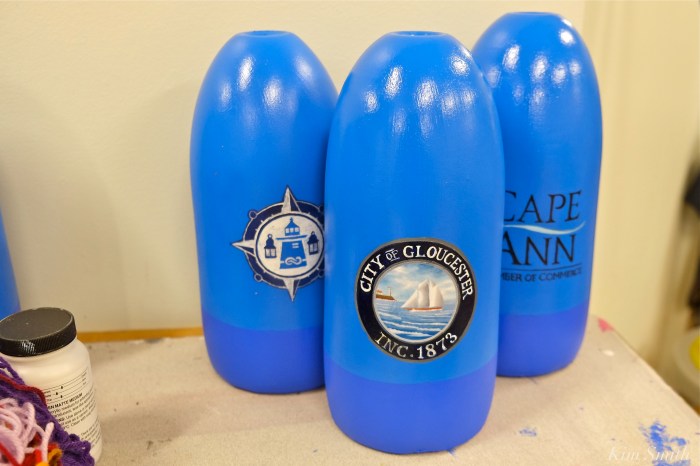
Last batch of photos from the festive and fabulous Lobster Trap Tree preparations, lighting, and party. Go see–the tree looks beautiful day or night. Hats off and thank you to David Brooks, Shawn Henry, Traci Thayne Corbett, Cathy Kelley, and every one of the volunteers who have created this wonderful holiday tradition for all to enjoy! See you at the Buoy Auction at Cruiseport on January 26th!

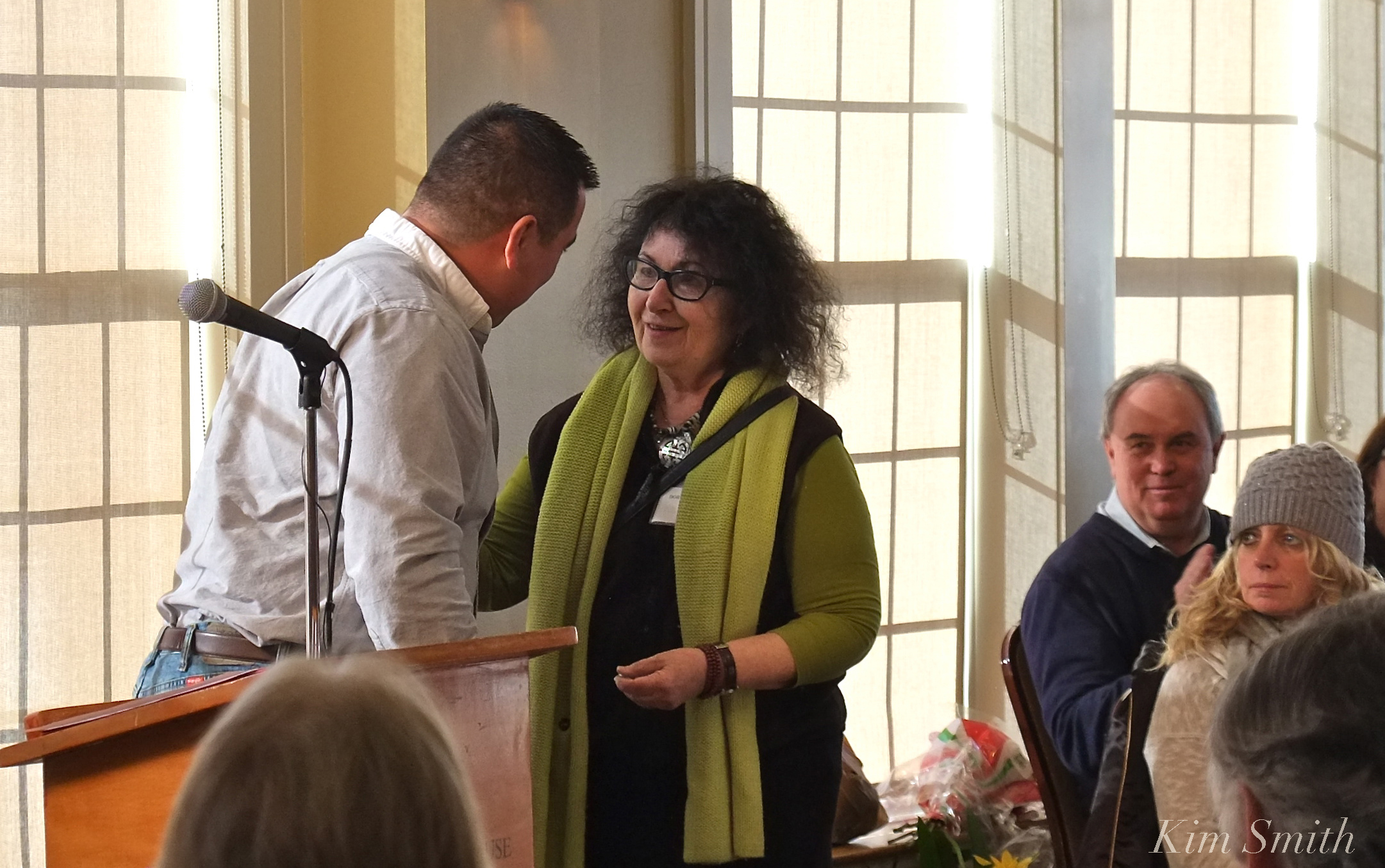
TRMENDOUS TURNOUT AT THE GLOUCESTER HOUSE FOR “THE INNVER VOICE AND THE OUTER WORLD”

“There is a great need for veterans and the families of veterans to tell their own stories to audiences who are receptive and willing to listen.” Dorothy Nelson, from the book’s introduction.

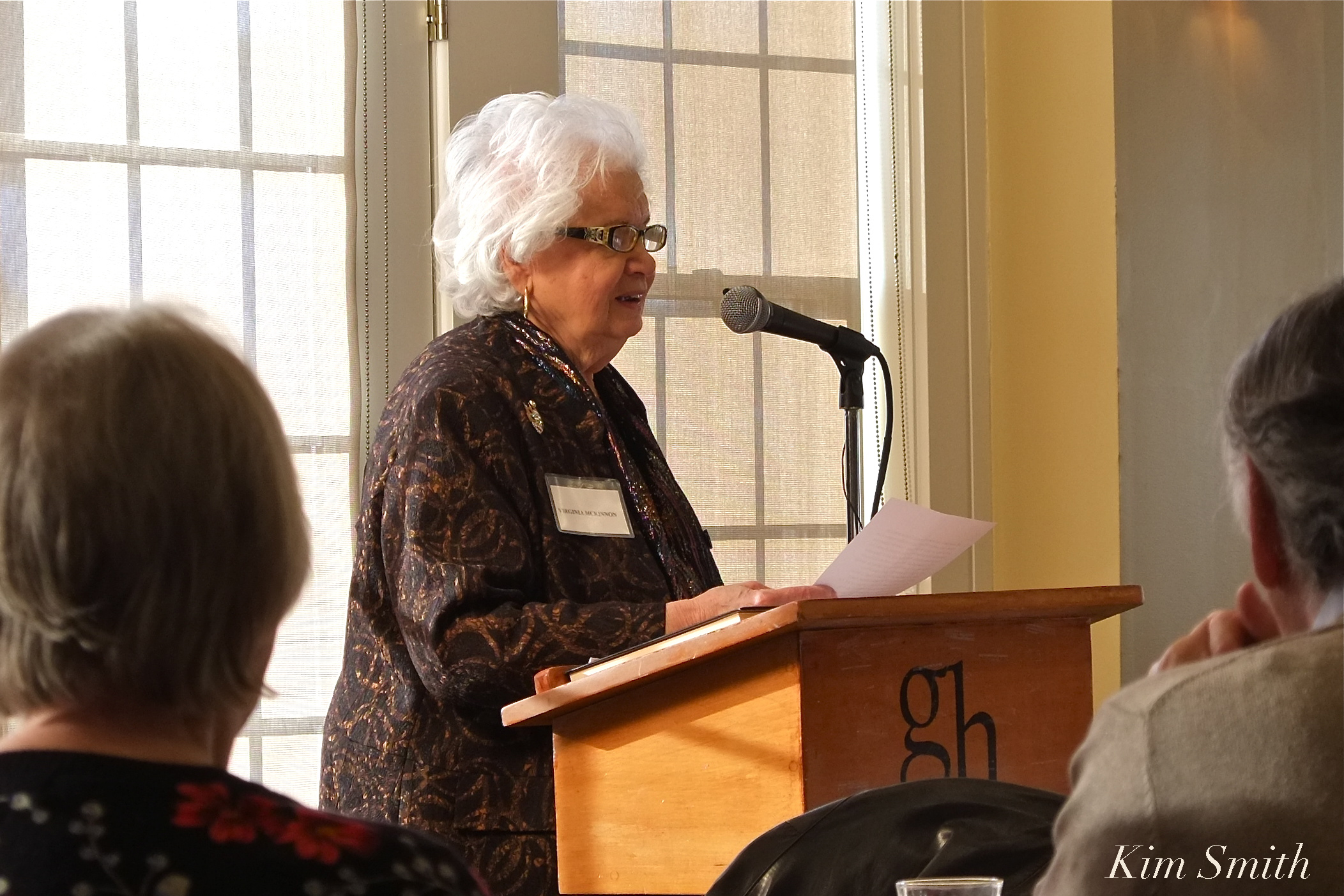
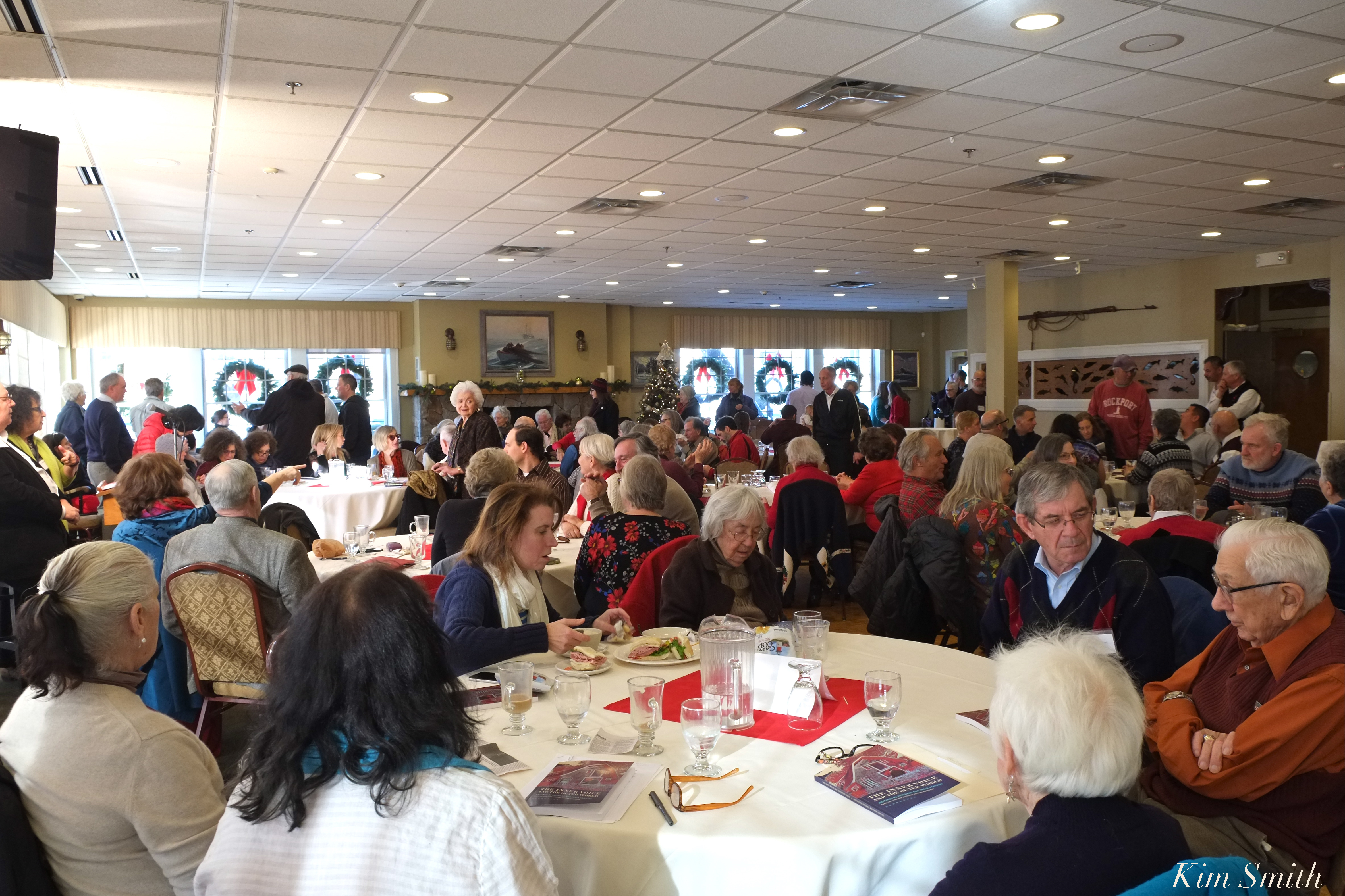
Today’s book launch of The Inner Voice and the Outer World was a resounding success. The book is a compilation of writings by veterans and their families from the Gloucester Writer’s Center “Cape Ann Veterans Writing Workshop” (2013 -2017), which was taught by the book’s editor, Dorothy Nelson. Many of the contributors were at the event to read excerpts of their poems and stories and to sign books. Shaped by the author’s experiences in 20th and 21st century wars, the stories shared were deeply moving. Readers and audience were in many instances moved to tears.

Virginia Frontiero McKinnon

The Gloucester House was packed, so much so, that Lenny opened up the adjoining second function room to accommodate the overflow of people.

Best wishes and congratulations to the Writer’s Center, Ms. Nelson, and the contributors for sharing the stories of our local veterans and their loved ones.

The contributors are:

ALMA HART

JAMES GRIGG

HEATHER DUPONT

EDWARD KAZNOCHA

STAN FEENER

SUSAN FREY

FRANCIS J. SULLIVAN

MARTIN RAY

MARC LEVY

MELVIN P. OLSON

MARIA LANE

MARY CONNELLY

VIRGINIA FRONTIERO MCKINNON

CONNIE CONDON

LINDA NILES NX

TOM SAROFEEN

CHARLES STEINER

To purchase The Inner Voice and the Outer World, mail a check to the Gloucester Writers Center at 126 East Main Street, Gloucester MA 01930. Please make the check to the Gloucester Writers Center and at the bottom of the envelope write: re: Veterans Book. The book costs $15.00. plus mailing. 


EIGHT, SEVEN, SIX… LIVE FROM #GLOUCESTERMA LOBSTER TRAP BEST EVER TREE LIGHTING

Simply Beautiful!

https://www.instagram.com/p/Bcf6EYeF-aM/