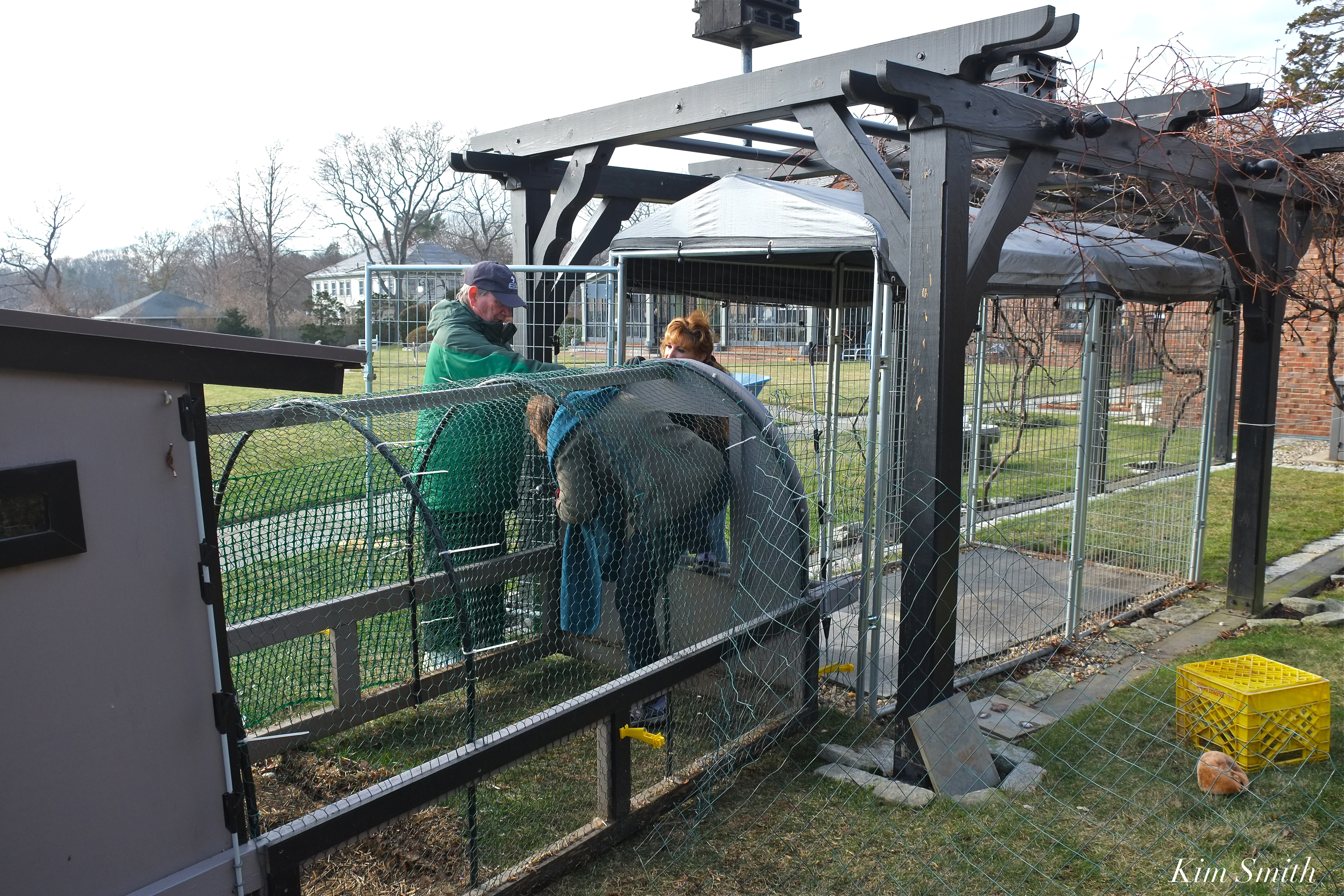
 Joel and Skip Munroe arrived yesterday morning at Lyn’s home and the three spent the day continuing to modify the chicken coop-turned swan house-turned fantastic sanctuary (Joel is one of Mr. Swan’s caregivers and a carpenter). Lyn has generously added her dog’s run to extend the swan’s home, providing room enough for the Young Swan to stretch her wings and walk around within the enclosure.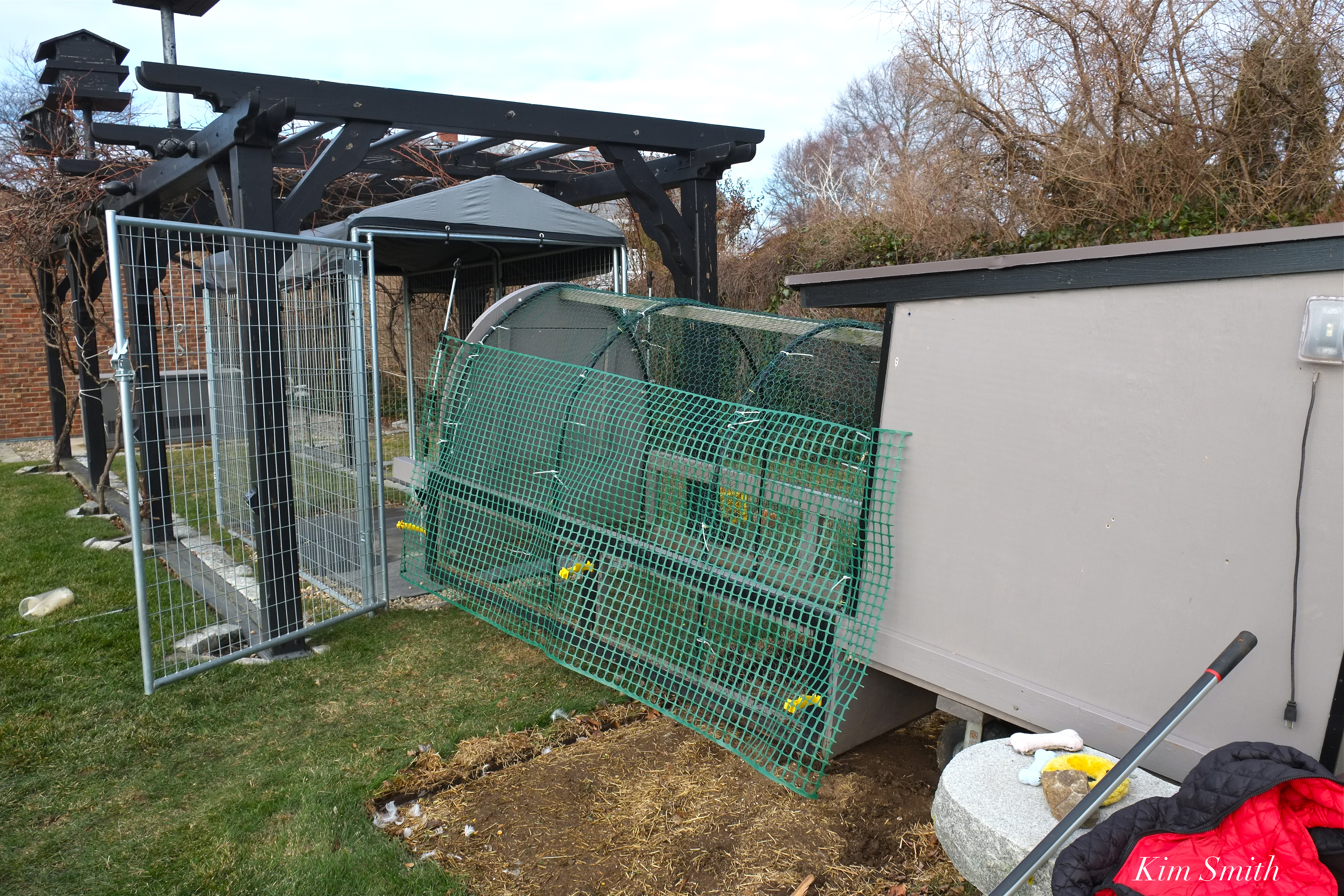
Increasing the size of the enclosure.
Today, the very awesome landscaper Patrick Low, owner of JPL Landscape Solutions spent the morning modifying and attaching the (former) dog run to the chicken coop and securing the entire structure from predators such as coyotes and racoons. Pat, Joel, and Skip have very generously donated their time and services to creating the winter swan sanctuary.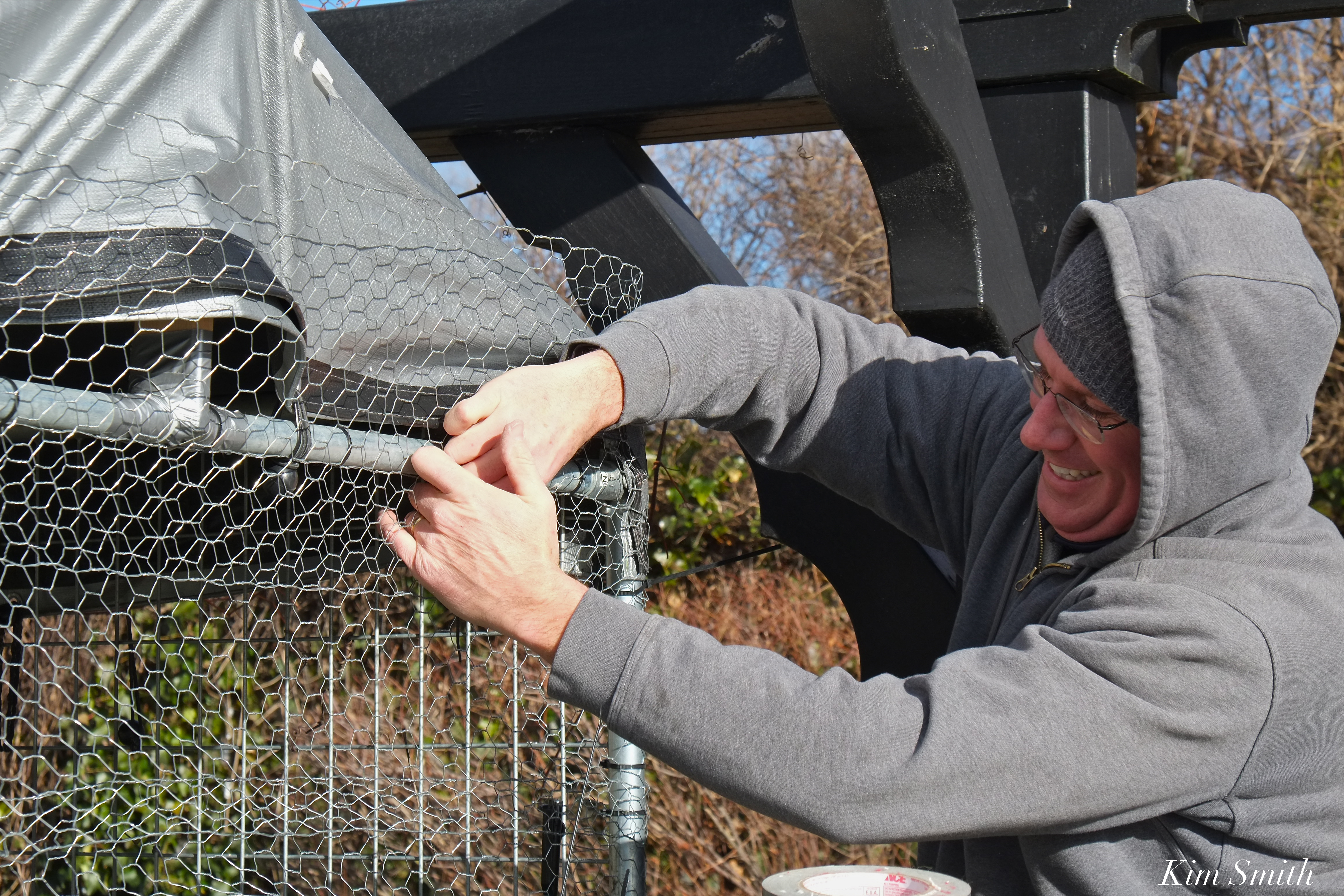
Pat Low, creatively solving potential predator issues.
A friend of Lyn’s is donating three bales of hay. To supplement the pellets and corn Lyn has been feeding the swan, yesterday she purchased collard greens (which the Young Swan loved), spinach, and kale (yet to try).
We still do not know whether the Young Swan is male or female. Jodi Swenson kindly paid for the swan’s checkup at Dr. Cahill’s (with funds provided from her recent fundraiser) and Lyn has volunteered to pay for the DNA test. We should have the results back from the DNA test in several weeks. The Young Swan has a temporary name, TOS, an acronym for The Other Swan, but perhaps when we determine whether male or female we can give her a gender specific name, and possibly tie in a naming contest with a mini-fundraiser, to help defray the unexpected cost of taking care of her for the winter.
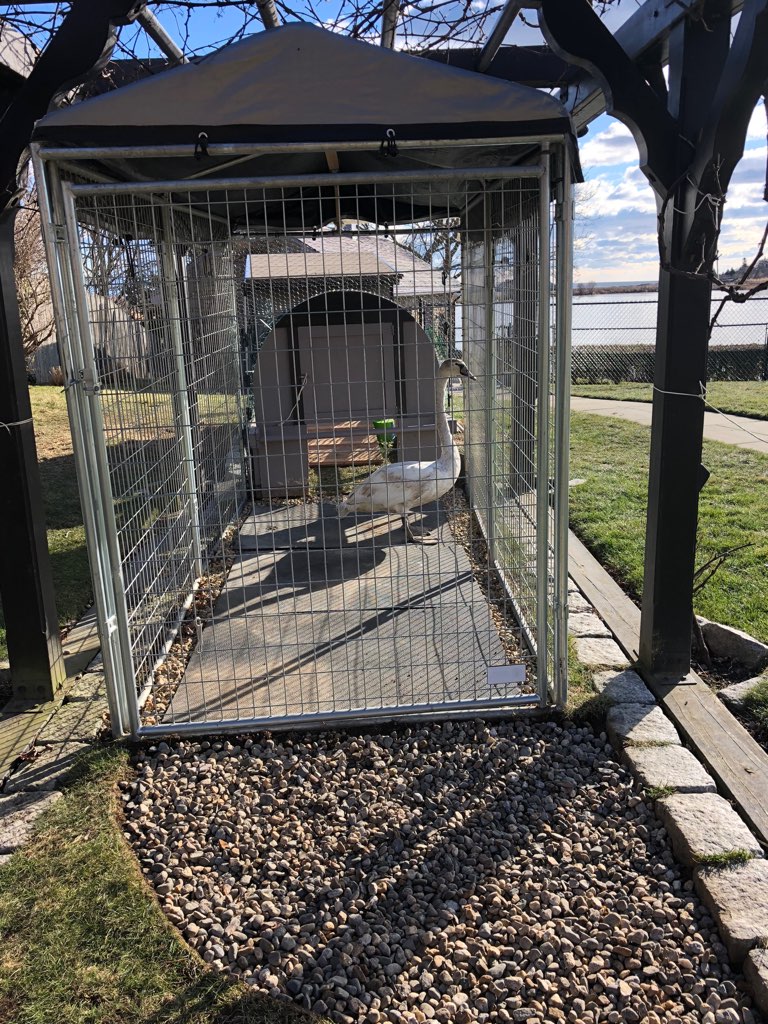 Success! Photo courtesy Lyn Fonzo


love seeing the progress in the care of TOS. thank you all so much for making the best for tos to spread wings and be safe for the winter. ❤️
LikeLiked by 1 person
Thank you for writing Barbara. Lyn and friends are giving her the best possible care ❤
LikeLike
Taking care of the most vulnerable amongst us….A Wonderful uplifting story for this season of giving. Thanks to every one. Well done!
LikeLiked by 1 person
Thank you Deborah, she is doing beautifully and has good friends! ❤
LikeLike
Thank you all for keeping her/him safe! I’m so happy!
LikeLiked by 1 person
Her enclosure is super fortified Paula, built to be coyote-racoon-rat proof!
LikeLike
Dr. Cahill at Seaport vet did the exam free of charge because he’s great that way when it comes to wildlife! Only thing Cape Ann Wildlife had to pay for was the lead test.
I can’t wait to hear results of the dna test!
Jodi
Cape Ann Wildlife
LikeLiked by 1 person
That makes lots of us Jodi! Thank you for all that you are doing to help the Young Swan, and huge shout out to Dr. Cahill!!!
LikeLike
It takes a village!
LikeLiked by 1 person
So glad to see that TOS is being cared for in such thoughtful ways. With all of the turmoil in the world it is a relief to read this good news. Thank you.
LikeLiked by 1 person
Yes, she sure is Anita 🙂
LikeLike
Kim, Is this Mr Swan’s friend?
LikeLiked by 1 person
Yes, she/he is the swan rescue Jodi brought to Niles Pond during the summer 🙂
LikeLiked by 1 person
Why don’t you include info on how to make donations to help with expenses?
LikeLiked by 1 person
Did you see the information Anonymous in a followup post?
LikeLike
Looks like this swan has an awesome set up to spend the winter in but why did she need to be taken in? I was unaware you could keep wild swans as pets, and if she is to be released in spring hopefully she realizes how to winter on her own and remembers how to find her own food.
LikeLiked by 1 person
She is a mute swan which is a non native species, people brought them here from the up because you could release them in a pond and they would stay put, obviously some escaped and bred in the wild.
She wasn’t leaving the pond and it was freezing over, she only had a tiny open spot near a dock so she was a sitting duck for coyotes.
Trumpeter swans are native to our country but I have never seen them in our area.
LikeLiked by 1 person
From the *UK (not up)
LikeLike
Adding to Jodi’s comment — Mute Swans do not migrate great distances, but move from body of water to body of water within a region. Swans in New England need to be able to fly to saltwater harbors and cove during the winter months to eat becasue freshwater ponds freeze. The Young Swan did not show any interest in leaving Niles Pond. We were hopeful that she would follow Mr. Swan to his winter homes at Rockport and Gloucester Harbors, waiting until the last possible moment, when she actually froze in the pond.
Trumpeter and Tundra swans are native to North America. Very rarely, Tundra Swans are seen in Massachusetts.
LikeLike
And since they are a non native species/invasive species it is interesting that we would take such measures to ensure the survival when they displace native species and have the potential to disturb local ecosystems.
LikeLike
Hello Molly J. Kelleher,
Mute Swans are not native to North America, that is true. In some areas of the country such as the mid-Atlantic states, there is an ongoing debate as to the actual damage caused by Mute Swans. I can only speak to the fact that I have been filming, photographing, observing, and learning about Mr. Swan and his family since 2006. One gentleman has been keeping an eye out on him since 1992. In all these years the only time I have ever seen Mr. Swan go after a Canada Goose was when he was nesting. For most of the year, he is followed by an entourage of native ducks who benefit greatly from his foraging habits, especially during the winter months when pond vegetation is difficult to reach. With his long neck, Mr. Swan pulls up some greens and all the dabbling ducks who can’t dive very deeply eat the vegetation he has pulled up as well.
Mute Swans survive in this region by a thread. Snapping Turtles eat the cygnets, the non-native coyote eat the adults, and the experts at Parker River addle their eggs.
Today we have a plethora of Canada Geese, caused by the fact that the US Fish and Wildlife experts planted millions upon millions of acres of rye grass (a Canada Goose’s favorite food) along the Atlantic Flyway to encourage geese to live here the year round. The point is, there are all kinds of “experts,” but I find the best way to learn about wildlife is to constantly experience first hand and to read voraciously from a wide range of sources.
LikeLike
I hear ya, luckily we don’t seem to have that many in Massachusetts, some states have tons of them, the small amount we have I don’t think has much of an impact. We certainly have no shortage of ducks and geese.
Like many introducted species they are part of the environment now, just isn’t anyway to eradicate them at this point.
LikeLike
I hear you and it’s defiantly something I think about being a wildlife Rehabber.
I always try to find homes for these guys.
Thankfully we don’t have a large pop of mutes in our state and we def don’t have shortage of native ducks and geese.
LikeLike