Katsushika Hokusai (1760-1849) was a famous Japanese artist who came from humble beginnings and was active in the Edo period. He was an influential and revered artist and fine arts professor in his own lifetime. Hokusai eked out a living as a printmaker and illustrator, setting off on his own after years with the prestigious Katsukawa School, a premiere teaching and publishing powerhouse specializing in the ukiyo-e style color woodblock prints. A life in art and print publishing is tough going now and it was then. To supplement his income, Hokusai changed his name some 20 times, selling his surname or ‘brand’ to select pupils. He produced three of his most popular bodies of work when he was in his seventies. Hokusai died at 90 impoverished financially though not in obscurity. Students and friends paid for his funeral.
Hokusai: Inspiration and Influence at the MFA, lays out 100 examples of Katsushika Hokusai’s lifework in every period, genre, and medium, his famous woodblock series, new discoveries and rarities, and the Japanese and Western cultural exchanges that impacted his own practice. About 200 works of art by other artists spanning 200+ years demonstrate a sample of Hokusai’s relevance and inspiration to artists he knew or taught, and to artists and movements, generation by generation and around the globe, since his death.
The Museum of Fine Arts in Boston established one of the largest and finest Asian art departments in the world in the 1890s thanks to art historian curators, collectors, and benefactors. Highlights are featured with great care because of their fragility and easy rotation because of the depth of the museum’s holdings. The collection was amassed early and driven by four scholars. The inventory acquired by Ernest Fenollosa, an art historian, educator, and later, curator. was eventually purchased by Charles Weld, Boston physician and collector, with the stipulation that it be given to the MFA. The bulk of the MFA’s Hokusai trove were collected by Dr. William Bigelow.
Thanks to the MFA collections, its acquisitions and gifts, and great temporary loans, this exhibition celebrates Japanese art, especially Hokusai, emanating from his most iconic and lasting image, Under the Wave off Kanagawa (Kanagawa oki nami ura), 1830-32. Also known as The Great Wave ( an abbreviated and generalized title that amplified sales) the woodblock print is from Thirty-six Views of Mt. Fuji, a series so popular the artist increased it to Forty-six. You might not know the man but you likely know that surf.
MFA’s installation–loosely chronological
Japanese artist Katsukawa Shunshō operated the most popular ukiyo-e studio and Hokusai was employed there for over a decade until Shunsho’s death. Eventually Hokusai became an independent artist & teacher. The exhibition unfolds with masterpieces by both Hokusai and Katsukawa Shunshō and with exceptional work by their students and peers. After this introduction to the ‘lineage’ years, the installation is grouped by themes dear to Hokusai juxtaposed with work by artists in the decades following his death in 1849. The broad survey is an introduction to how the Japanese woodblock industry and ukiyo-e art and culture influenced French fashion, design, and the art movements which inspired modern art (and vice versa).
By the time of the Great Wave, Hokusai maximized landscapes which was novel at the time. With so much sea and sky, the color blue in every hue and tone is everywhere. Imported and available by the 1820s in Japan and cheap (unlike ultramarine), the synthetic dark blue pigment known as ‘Prussian blue’ was stable and could be used to create deep, rich velvety blue and great transparency—a game changer for artists and woodblock prints.
installation photos below: Catherine Ryan. Hokusai: Inspiration and Influence. MFA, Boston. March 30, 2023. Pinch and zoom to enlarge. Right click or select “i” for information for captions.
Floating the idea of the floating world
Ukiyo-e prints (images of the floating world) were invented when demand became so great a mass marketing innovation was required. Sellers could not afford to nor fill the orders which became too time consuming and limited by labor costs and pool of artisans. Although woodblock prints were original and labor intensive in other ways, hundreds of single sheets could be pulled in a day. Bright and colorful art for all, disseminated worldwide, ukiyo-e art was an early format example of mass media.
Shunsho | hokusai
Two Shunsho immersive six panel screens
Early Hokusai
fellow ARTISTS
Some students, some famous, some rediscovered- Hokusai II, Hiroshige, Kuniyoshi, Katsushika Taito II. Hokusai’s daughter signed her work Katsushika Ōi
LATE HOKUSAI and prussian blue
Mostly examples from series after 1830s on when he was in his 70s: 36 Views of Mt. Fuji, Large Flowers, Small Flowers, Waterfalls, Remarkable Views of Bridges, Fifty-three Stations on the Tokaido Road. (The far younger Hiroshige born in 1790 produced 10 prints of famous places in 1825 before Hokusai, 69 Stations Kiso Road in 1835, and 100 Views of Edo in 1856 two years before he died in the cholera epidemic.)
japonisme. Impressionism. Post-Impressionism. Art NOUVEAU. late 19th C
Ipswich icon Arthur Wesley Dow
Like Hokusai, Dow (1857-1922) was an artist and influential teacher. He spread the gospel of composition and design, Japanese culture and ukiyo-e art, in America. And similarly to Hokusai, fine arts students gravitated to his own wildly influential instruction book. A Dow woodcut and dory were grouped with Ushibori by Hokusai, from the Mt. Fuji series. See the blue!
20th C
Color woodblock prints by Edna Boies Hopkins, an American artist active in the early 20th C who lived in Japan and France, studied with Dow, and was an influential member of the Provincetown Printmakers are on view. I am proud to write that back in 1986, I co-curated the first Hopkins solo exhibition retrospective since the 1920s and authored the essay and catalogue. The research for the project meant time spent in Ipswich and the Ipswich Historical Society for a close study of Arthur Wesley Dow.
21st C – MITSUI’s lego gREAT wAVE
Christiane Baumgartner’s 2017 monumental woodblock print on Kozo paper, The Wave
RIP Yvonne Jacquette, so glad to see her complex work included, a fittingly zig zag aerial nocturne view of famous NYC bridges no less, Two Bridges III, 2008 woodcut printed in dark ink on Okawara paper and acquired by the MFA before her passing at the end of April.
People were thrilled to encounter Hokusai’s The Great Wave in person and waited in line because of its scale and beauty. Multi-generational families shared the experience and wanted to take pictures which moved me tremendously. Hokusai and his peers, and artists influenced by them, produced series of cherished vistas and visual poems and legends for all price points. The LEGO installation helped ground the show and bring the joy, humor and blockbuster awe that ukiyo-e genre and series did in its time–before movies, photography, animation, easy travel, etc..
The LEGO commission by master builder Jumpei Mitsui riveted visitors of all ages on the days I visited the exhibition (if not in the art press I’ve read since). When you know the price point and target audience for the ukiyo-e art, i.e. the commoner and its arduous, technical process, the LEGO Great Wave homage– colossal, blue, and an exacting marvel of another sort– was a great fit to underscore connections to the past and engage audiences. Its scale and drama heightened the perspective of the crews and the boats in a way that other selections did not.
People looking at art
on view at the MFA, Boston: Hokusai: Inspiration and Influence
On the nose pairings
Spread The GMG Love By Sharing With These Buttons:
I have a dream that one day every valley shall be exalted, every hill and mountain shall be made low, the rough places will be made plain, and the crooked places will be made straight, and the glory of the Lord shall be revealed, and all flesh shall see it together.
This is our hope. This is the faith that I go back to the South with. With this faith, we will be able to hew out of the mountain of despair a stone of hope. With this faith we will be able to transform the jangling discords of our nation into a beautiful symphony of brotherhood. With this faith we will be able to work together, to pray together, to struggle together, to go to jail together, to stand up for freedom together, knowing that we will be free one day.
Dr. Martin Luther King, Jr. “I Have a Dream” speech March On Washington Lincoln Memorial 1963.
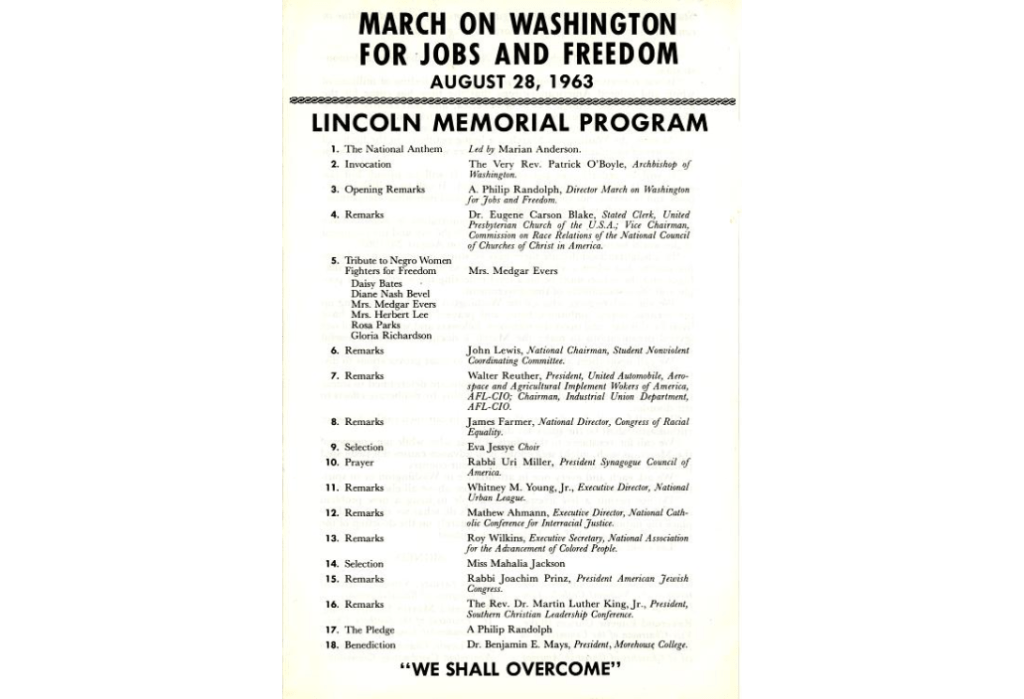
Asa Philip Randolph introduced MLK: “the moral leader of our nation”, “campaign against the citadel of racism”, “Martin Luther King”, “J.” “R.”– you can listen below in rare film clips shot on that day
1963
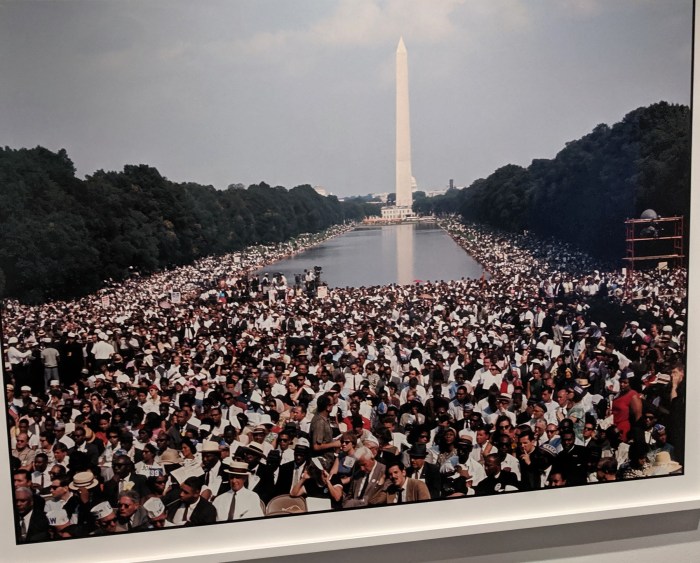
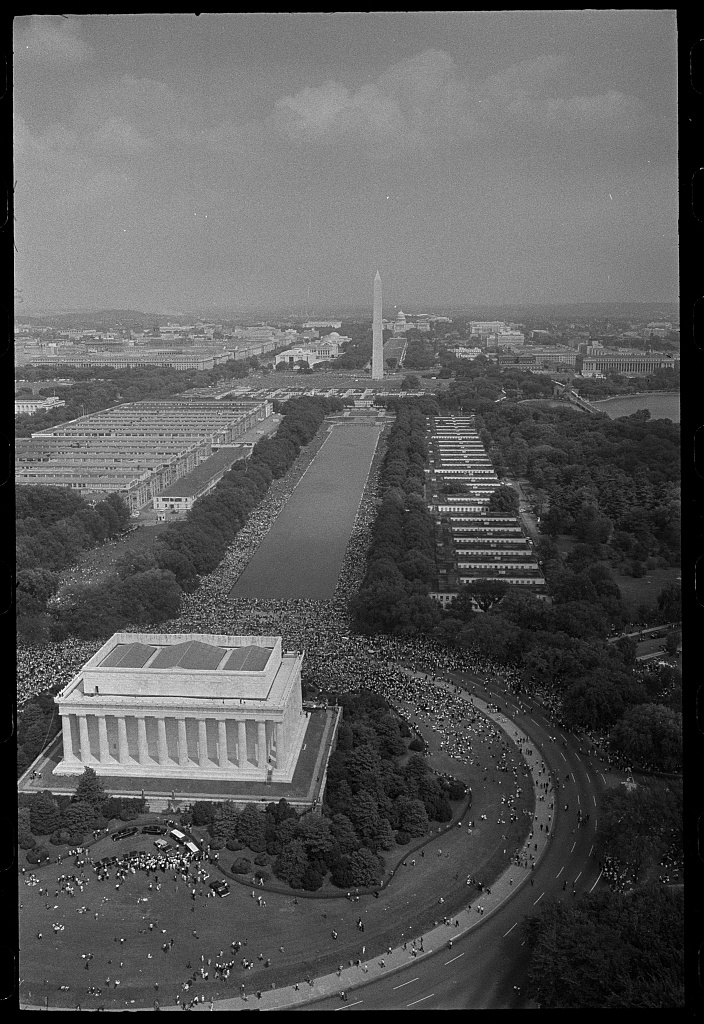
photo: installation view at The Cooper Gallery Harvard, Gordon Parks exhibition 2019 by C. Ryan — Parks’ photo journalist and cinematic chops in this sea of us momentous moment, March on Washington, 1963, view from Lincoln Memorial to Washington Monument. [*Lincoln designed by Daniel Chester French unveiled 1922; Washington Monument designed by Robert Mills; completed by Thomas Casey and the U.S. Army Corps of Engineers, dedicated 1884.] For more about Gordon Parks work in Gloucester, Mass. see my series 2012-14 here
The March on Washington, 1964 film by the US Information Agency compilation for overseas from the National Archives and Records Administration collection (20 min)
Among the speakers and performers (* appear in film clip): Marian Anderson, Josephine Baker, Joan Baez* (audio early, then w/video 9:38-10:26), Harry Belafonte, Dr. Eugene Carson Blake* (16:59-17:28), Bobby Darin, Ossie Davis* (but only when he introduces Burt Lancaster 10:27), Ruby Dee (co-emcee with Ossie Davis), Bob Dylan, Freedom Singers* with choir (We shall not be moved 7:14 – 9:06), Dick Gregory, Martin Luther King Jr.* (18:18 – 18:59 press conference), Lena Horne, Mahalia Jackson, Eva Jessye Choir* (12:41 Freedom is the thing we’re talking about – Yolanda Clarke on organ), Burt Lancaster* (traveled from Paris to speak, 10:35-12:02), John Lewis* (video only – standing behind Reuther 17:29), Dr. Benjamin Mays* ( 14:34-15:36 benediction), Odetta, Peter Paul & Mary* (clips & audio of Blowin in the wind and If I had a hammer 3:18-4:33 first set), Asa Philip Randolph* (16:16-16:57 and again intro MLK 18:18), Bayard Rustin* (12:11 video only); Rev. Fred Shuttlesworth* (9:08- 9:27), Walter Reuther* (17:29-18:16), Camilla Williams (stepped up for the National Anthem; with the big crowds, Marian Anderson was too late, and would sing later in program. Williams famous, too, and worked with Jessye on Porgy & Bess.), Roy Wilkins* (13:41-14:28) and Josh White.
Opens with crowd walking and singing “we stay home and you’ll be gone…jail for more than a week, all I had was beans to eat…because my home is Danville”; do you know the song?
Parade and marching band 4:34-5:40.
Eva Jessye Choir at 7:14-9:06 with Freedom singers “We shall not be moved” and later “Freedom is the thing we’re talking about” where Eva Jessye herself can be seen directing from back. I don’t know the soloists- the gorgeous baritone, Robeson-esque at 12:36, and at 18:69 a stunning soprano soaring “We shall overcome” choir version, with crowd. The Eva Jessye Choir was the official choir for the March on Washington. Her long and storied career took off as chorus director for the Virgil Thomson and Gertrude Stein opera, “Four Saints in Three Acts” in 1934 and Gershwin’s “Porgy and Bess” the following year. She worked with Marian Anderson, Paul Robeson and more.
We’re going to march. We’re going to walk together. We’re going to stand together. We’re going to sing together. We’re going to stay together. We’re going to moan together. We’re going to groan together and after a while, we will have freedom, freedom, and freedom now. And we all shall be free
Rev. Fred Shuttlesworth not formally asked for the program but asked to speak that day, one of many adjustments on the fly, rose to the occasion, primed the crowd
Notables marching with the crowd and/or mingling with dignitaries and speakers included: Faye Anderson, Josephine Baker, James Baldwin, Leon Bibb, Marlon Brando, Diahann Carroll, Tony Curtis, Bobby Darin, Sammy Davis Jr., Tony Franciosa, James Garner, Charlton Heston, Kiyoshi Kuromiya, Joseph Mankiewicz, Rita Moreno, Gordon Parks, Paul Newman, Rosa Parks, Gregory Peck, Sam Peckinpah, Sidney Poitier, Jackie Robinson, Bill Russell, Robert Ryan, and Joanne Woodward. Senators present: Phillip Hart (D-Mich), Wayne Morse (D-OR), and William Proxmire (D-WI), and Mayor Wagner (NYC).
During the march, news spread that W. E. B. DuBois died the previous night in Ghana. King delivered an earlier iteration of the sermon in Detroit, orchestrated by Rev. C.L. Franklin, Aretha Franklin’s father.
So much hope and progress, and mere weeks later, retaliation. The Birmingham Baptist church bombing was on September 15, 1963. Within five years of the March on Washington, Malcolm X and King were killed.
archival description of the film: “ARC Identifier 49737 / Local Identifier 306.3394. Scenes from Civil Rights March in Washington, D.C., August 1963. People walking up sidewalk; gathering on Mall, standing, singing. Lincoln Memorial, Washington Monument, crowd gathered on the Mall. People marching with signs, many men wearing UAW hats. People at speakers podium, men with guitars. Crowds outside of the White House, sign: The Catholic University of America. Band, people marching down street. Many signs, including All D.C. wants to vote! Home Rule for DC; Alpha Phi Alpha; and Woodstock Catholic Seminary for Equal Rights. Lincoln Memorial with crowds gathered around reflecting pool. People singing and clapping at speakers platform. Signs, people clapping. Man speaking, woman playing guitar and singing at podium. More speakers and shots of the crowd. A chorus, NAACP men in crowd. Close-ups of people in crowd with bowed heads. Shots taken from above of White House. More speakers, including Rev. Martin Luther King, Jr. Women at podium singing We Shall Overcome. Crowd swaying, singing, holding hands.”
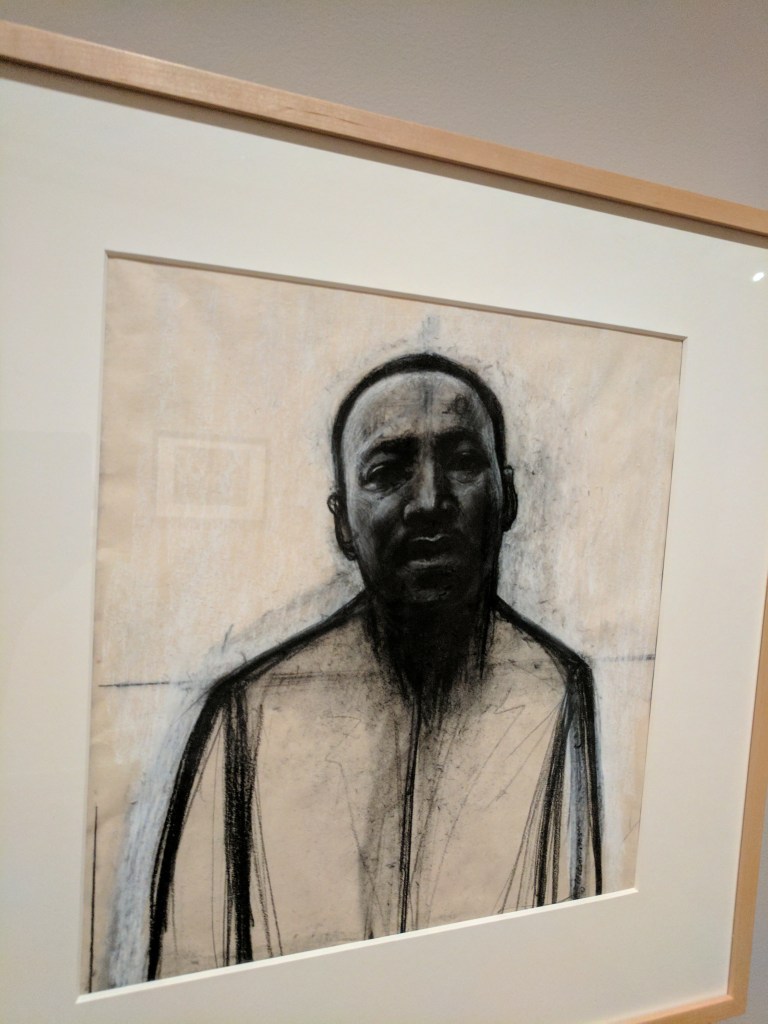
2013 MFA, Boston John Wilson exhibition of his many MLK studies
Spread The GMG Love By Sharing With These Buttons:
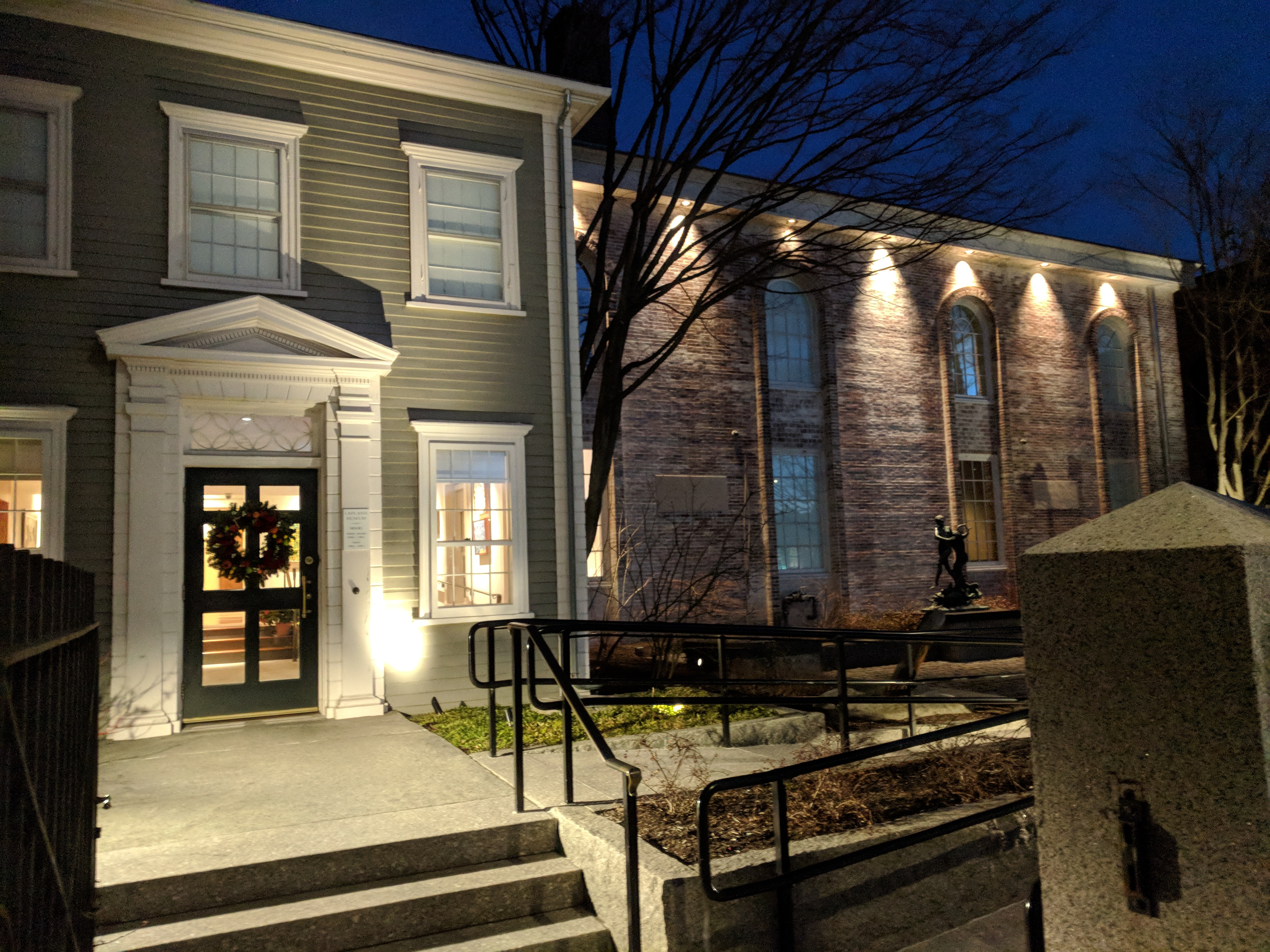
For the past 17 years, Ronda Faloon has been a constant champion for the Cape Ann Museum. During her tenure as Executive Director she has guided us through a period of tremendous growth. She has expanded our facilities, grown our visitation and membership and elevated the role that the Cape Ann Museum plays within our community. She has advanced our mission and made the Cape Ann Museum a truly special place.
When Ronda first announced that she would retire in the spring of 2019, the Board of Directors formed a Search Committee, co-chaired by Board members Henrietta Gates and Suzi Natti. The Board also engaged the services of a nationally recognized firm that specializes in museum related executive searches. The Search Committee was focused on identifying an individual who would understand and appreciate who we are as an organization and would have the ability to guide us through the implementation of our Strategic Plan 2018-2023.
Inquiries and applications were received from all over the country. The Search Committee met and reviewed many candidates who were evaluated based on their ability to serve the needs of the Museum, our membership and our community.
I am pleased to announce that the search has been successful.
Effective April 1, 2019 Oliver Barker will become Director of the Cape Ann Museum.
Oliver joins us from the Museum of Fine Arts, Boston where he supervises a portfolio of fundraising and international engagements and is responsible for developing partnerships with foundations, corporations and governments. Prior to joining the MFA, Oliver worked as Curator & Project Director for the Josef and Anni Albers Foundation. He began his career as the Director of Education & Visitor Services for the Peggy Guggenheim Collection in Venice, Italy where he lived for nearly a decade. Oliver holds a master’s degree in Arts and Cultural Management from the University of Melbourne and an Honors Degree in Fine Arts, Painting and Printmaking from the Royal Melbourne Institute of Technology (RMIT), in Melbourne, Australia.
Oliver has deep family ties in Gloucester* and has been a frequent visitor to the Cape Ann Museum for 20 years. He lives in Wenham with his wife and children.
I am confident that you will enjoy meeting Oliver and getting to know him. He is a thoughtful, respectful and charismatic leader who has the ability and perspective required to guide us through the next chapter of our own story.
Thank you for your continued support of the Museum. I look forward to seeing you at one of the Museum’s many great events this year, including Homer at the Beach: A Marine Painter’s Journey, 1869-1880, opening in August.
Sincere regards,
Charles D. Esdaile
President, Board of Directors
*Lundbergs
Spread The GMG Love By Sharing With These Buttons:
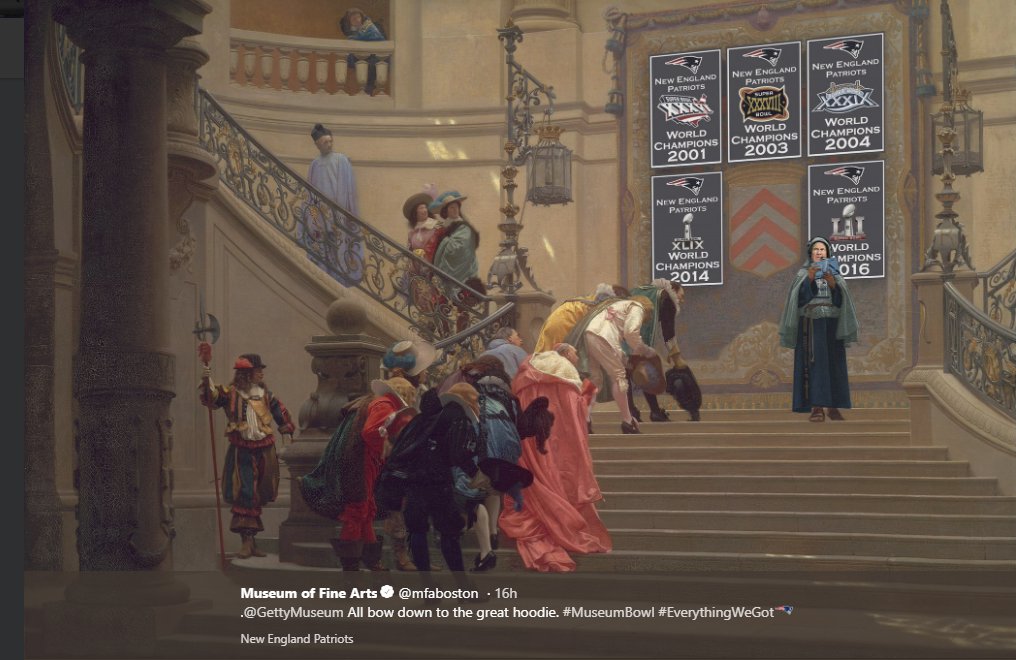
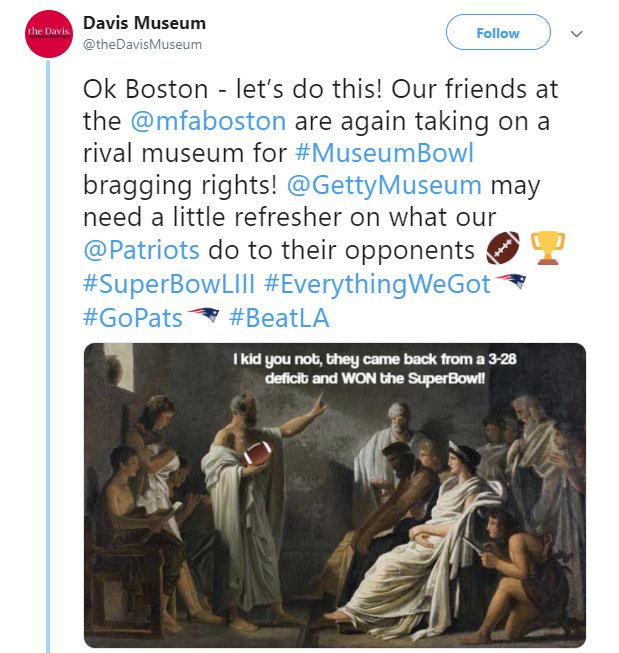
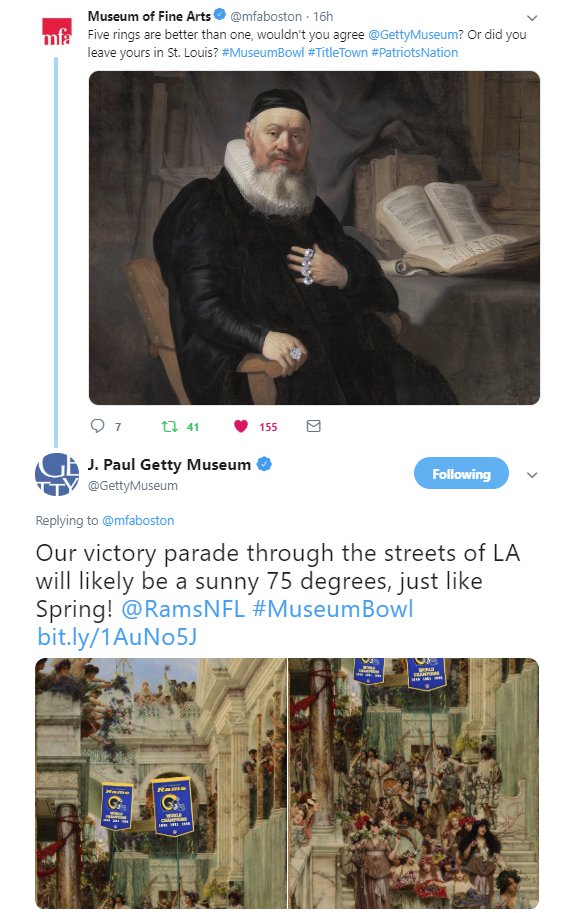
The Museum of Fine Arts and J Paul Getty Museum faced off for #MuseumBowl 2019 ahead of the Superbowl for a quick game of twitter trash talk. The MFA served up plenty of fun Patriot hype zingers. The Getty managed a couple retorts. The MFA was bolstered by tremendous support from #PatriotNation New England museums.
t-shirt worthy “I kid you not” from the Davis Museum






 News from Cape Ann Museum:

 Good Morning Gloucester