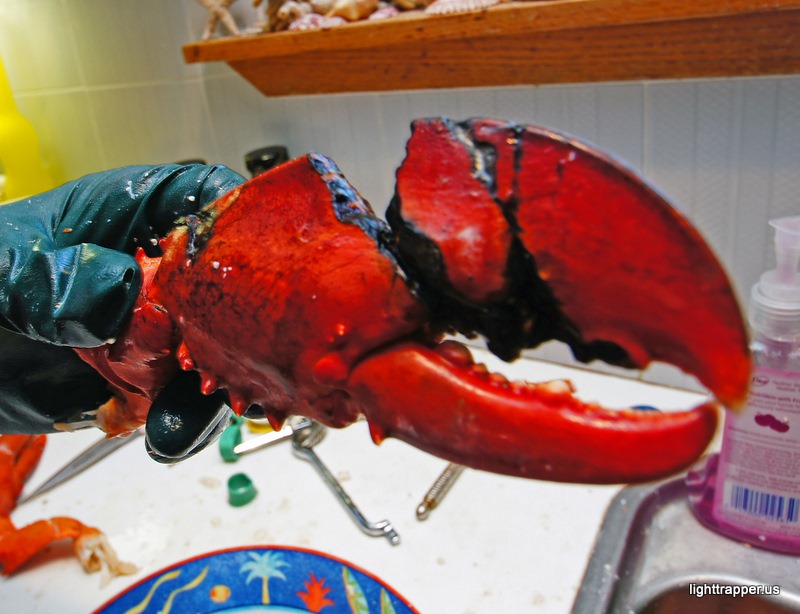
Here’s the first of some pictures I took of a lobster with a newly regenerating claw.
From The Gulf of Maine Research Institute–
“Armored Arthropod
(External anatomy)
 The first thing you notice about Homarus americanus, the “Maine” or “American” lobster, is its two strong claws: a big-toothed crusher claw for pulverizing shells and a finer-edged ripper claw resembling a steak knife, for tearing soft flesh. The lobster uses these claws, as well as smaller appendages around its mouth (mandibles and maxillipeds), for gripping and shredding its food. Besides its formidable front claws, the lobster also has eight walking legs, giving it ten legs altogether, which is why people who classify things call it a decapod.
The lobster usually crawls forward on its walking legs, but if it needs to make a quick exit, it contracts its tail forcefully and scoots backwards. When you first pick up a lobster, it frequently exhibits that flight response. Lobstermen call young lobsters, who do this a lot, “snappers.” Under stress, a lobster may also “throw” a claw or a walking leg, but it will eventualy regenerate a new, fleshy, “limb bud.” At the next molt, the lobster deposits a skeleton on the new limb.”
Spread The GMG Love By Sharing With These Buttons:


 Good Morning Gloucester