Native Flowering Dogwood from Kim Smith

Kim Smith writes-

Is there a tree more lovely than the North American dogwood (Cornus florida)? Whether flowering with the classic white bracts, the stunning rubra bracts, or the less often seen pale, creamy rose-tinted bracts, our native dogwood never ceases to give pause for it’s beauty given.
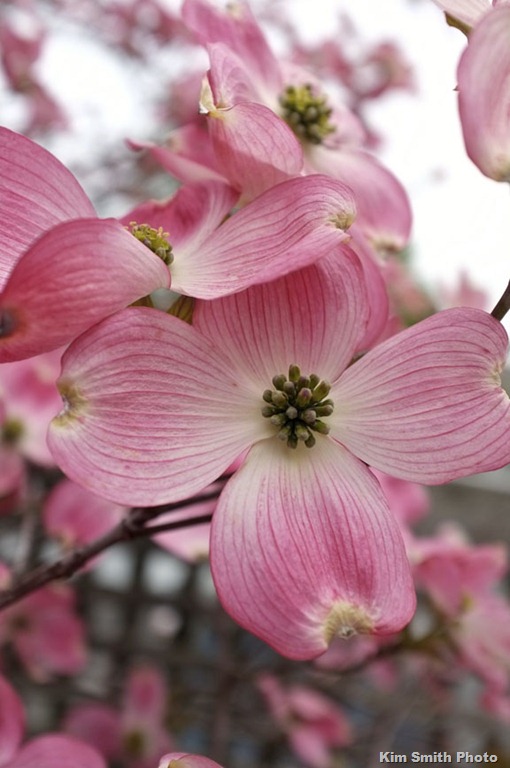

Cornus florida rubra-2 Fujifilm x100.

At this time of year when traveling along southern New England roadways we are graced by the beauty of the dogwood, dotting sunny roadside borders where meets the woodland edge.  The bracts and flowers emerge before the leaves, serving only to heighten their loveliness. The fresh beauty of the bract-clad boughs is offset by the impressionistic symphony of neighboring tree foliage unfurling, shimmering in hues of apple green, chartruese, moss, and lime peel.

Unfortunately, many dogwoods in our region are inflicted with the lethal dogwood anthracnose. I believe the problem is exacerbated by the vast majority of information regarding growing flowering dogwoods, which suggests planting in part shade, and does not differentiate between gardening in the north versus gardening in the Midwest or northern Florida for that matter. If one lives in warmer regions south of New England, yes, perhaps it is possible to grow a healthy C. florida in partial shade.

Dogwood anthracnose is caused by the aptly named fungus Discula destructiva. It will typically kill an untreated Cornus florida within two to three years. As we look to nature for an answer, the native flowering dogwoods growing in the fertile, moist, friable soil of the Northeastern woodlands, as under story trees, are the trees most affected by anthracnose. Cornus florida growing in an open, sunny location are far less afflicted. What we learn from this lesson is to choose a location that has good air circulation and full sun. What we know is thatDiscula destructiva requires high humidity for infection; therefore trees planted in mesic sites in the shade are more susceptible than trees growing in xeric sites.

Discula destructiva is a soil born disease. Dogwood trees inflicted with anthracnose will begin to show signs of infection by dying from the bottom up. The lower branches will become twiggy and will not flower or leaf-out. This is the opposite of what you may see if a tree is losing foliage along the upper branches because of drought stress, for example.  A tree that is stressed from lack of water or nutrients will, generally speaking, begin to show signs of trouble from the top down.

Our lovely Cornus florida var. rubra (my second go around with this species; the first was killed by anthracnose) shows signs of drought stress every year, usually during the dog days of late summer. I place the hose at the base of the tree, allowing water to gently flow overnight (never wet the foliage of a dogwood). Visibly, the tree will perk up. Typically this will need to be done every few days, until the next soaking rain. Any tree that is stressed from lack of water is more susceptible to disease. Along with monitoring our tree for drought stress, and because we plant densely beneath the tree’s boughs, I have found these measures, thus far, have served to prevent an outbreak of anthracnose.

Note how beautifully grows this dogwood. Despite the rain-soaked droopy bracts, you can see its gorgeous overall form. The level branches grow horizontally and there are no bald twiggy areas

Click here for the rest of the post at Kim’s Blog

Kim Smith’s Butterfly Garden Workshop at Tower Hill Botanic Garden this Sunday, May Day

Join Kim Smith this Sunday at 1:00 at the Tower Hill Botanic Garden in Worcester for the perfect May Day event–How to Create a Butterfly Garden. Pre-registration is required: Creating Summer Magic.

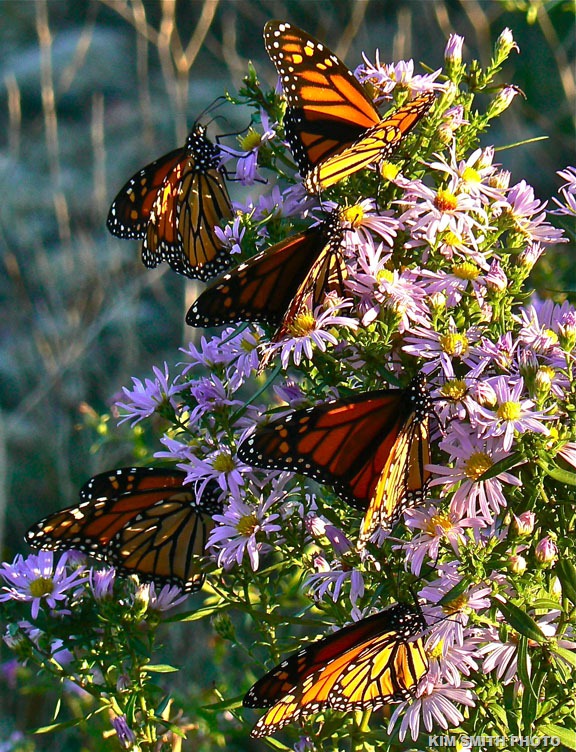
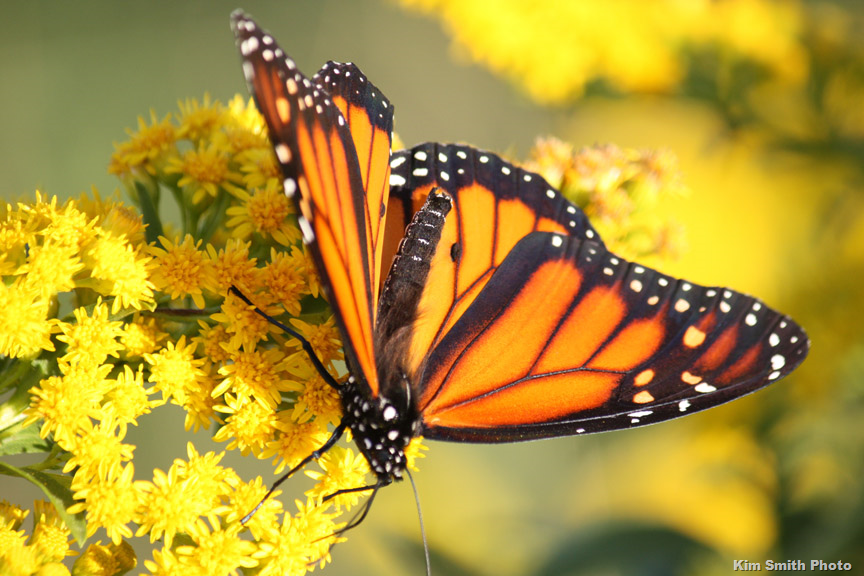
Monarch Butterflies Nectaring at Smooth Asters

Monarch Butterflies Nectaring at Smooth Aster

I will be presenting the necessary elements to help you create a beautiful and welcoming haven for butterflies. Once you begin to think about your garden as food source and shelter, it will influence all your horticultural decisions. Native and well-behaved non-native plants, along with examples of architectural features, will be discussed based on their value to attracting specific butterflies. This lecture and slide presentation will help you gain a deeper understanding of the interconnected world that we human beings share with plants and butterflies and how to translate that information to your own garden. Butterfly gardening plant list included with workshop.

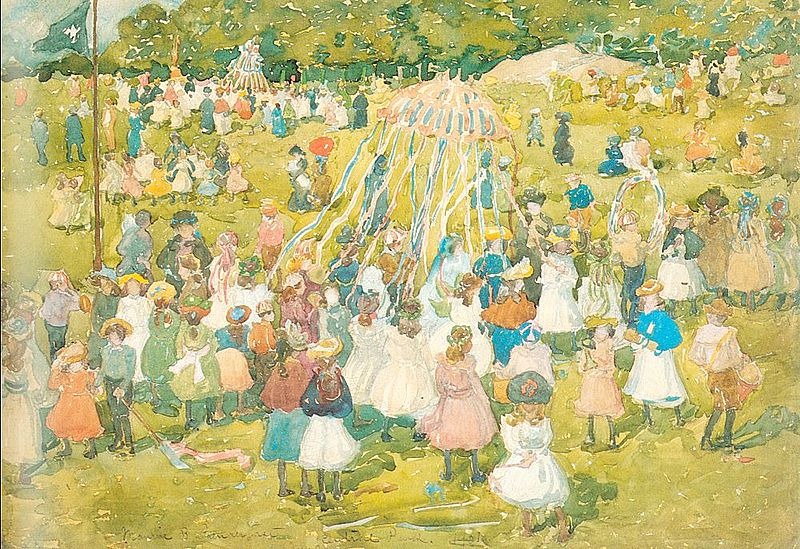
From wiki: The Floralia, also known as the Florifertum, was an ancient Roman Festival dedicated to Flora the goddess of flowers and vegetation. It was held on the IV Calends of May, April 27 to May 3, and symbolized the renewal of the cycle of life, marked with dancing, drinking, and flowers. While flowers decked the temples, Roman citizens wore colorful clothing instead of the usual white, and offerings were made of milk and honey to Flora.

Maurice Prendergast May Day Central Park 1901

Maurice Prendergast May Day Celebration Central Park 1901

Kim Smith Says To Get Out Those Hummingbird Feeders ASAP!

Dear Gardening Friends, In a future post I plan to bring you more about the Ruby-throated Hummingbird, today however I will be brief. This is a reminder to set your hummingbird feeders out as soon as possible. This past week, sightings of the Ruby-throated Hummingbird have been reported as far north as Maine–the northward hummingbird migration is full underway!

A hummingbird’s diet is 90 percent insect. Just the same, we can lure them to our gardens by providing nectar-rich tubular-shaped flora in shades of red and orange, along with flowers comprised of small florets that attract small insects. At this time of year there isn’t much to offer in the way of flowering sustenance for the hummingbirds. Several weeks ago I took our feeders out of storage, gave them a good wash with vinegar, soap, and water, filled them with a sugar and water mixture, and hung them throughout the garden.

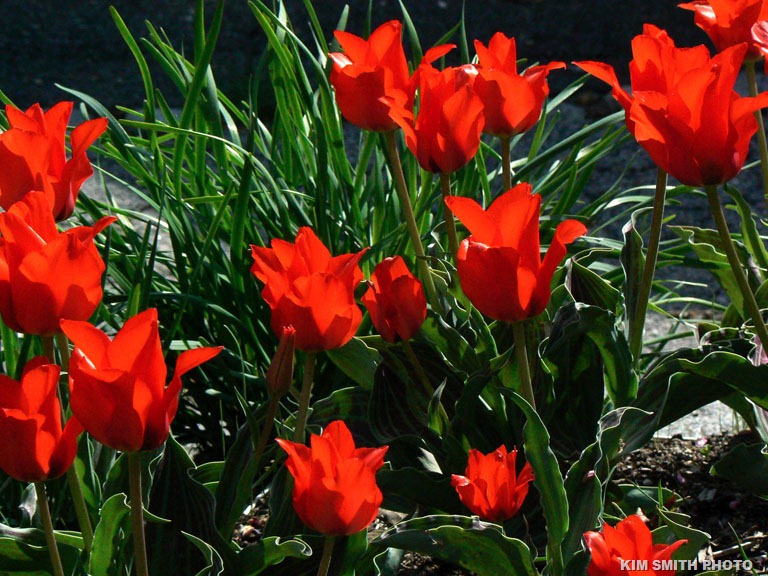
The eye-cathing Red Riding Hood tulips (although not a particularly good source of nectar, will attract by the sheer brilliance of their color) are a wonderful species tulip that reliably returns year after year, and multiplies. The tulips are planted beneath the boughs of flowering and fruiting trees and shrubs, in hopes, that they too will lure the hummingbirds to our garden during their northward migration. And then, again with high hopes, that the hummingbirds will nest in our garden. For the past five years or so, it has been our great good fortune to host throughout the nesting season female Ruby-throated Hummingbirds and offspring.

Hummingbirds, along with bats and certain species of moths, have an unusual method of drinking nectar called swing-hovering, which allows them to nectar while in mid-air. Ruby-throated hummingbirds expend vast amounts of energy during their migration–averaging approximately 52 wingbeats per minute. For this reason, I find the best hummingbird feeders are those that also offer a a place to perch while feeding (see photo and videoclip).

Sugar water recipe: 4 parts water to 1 part sugar. Stir to dissolve thoroughly. Never add red dye or replace the sugar with honey. Provide fresh sugar/water every 4 – 5 days.

tulips

The eye-cathing Red Riding Hood tulips (although not a particularly good source of nectar, will attract by the sheer brilliance of their color) are a wonderful species tulip that reliably returns year after year, and multiplies. The tulips are planted beneath the boughs of flowering and fruiting trees and shrubs, in hopes, that they too will lure the hummingbirds to our garden during their northward migration. And then, again with high hopes, that the hummingbirds will nest here in our garden. For the past five years or so, it has been our great good fortune to host throughout the nesting season female Ruby-throated Hummingbirds and offspring.

For More From Kim Smith Check Out Her Blog Here-

http://kimsmithdesigns.wordpress.com/

The Latest From Kim Smith- Butterflies of Massachusetts

I wanted to share with you a fabulous new resource—the Butterflies of Massachusetts website. Created by Sharon Stichter, Butterflies of Massachusetts “offers a comprehensive review of the current status of butterflies in the state. It is designed as a resource for all those interested in these charismatic insects, including butterfly enthusiasts, conservationists, biologists, land managers, and wildlife professionals.”  I find the Species List particularly useful for learning more about the earliest recorded sightings of Massachusetts’s butterflies, frequency and distribution, and caterpillar hostplants. My readers residing outside of Massachusetts but along the East Coast will find the information on the Butterflies of Massachusetts website nearly equally as valuable. Ecologically speaking, the Appalachian Mountains and Atlantic coastal plain are largely self-contained, allowing unrestricted north-south movement of individual butterflies and migratory populations. The information found on the new Butterflies of Massachusetts website represents many years of data compiled by Sharon Stichter and the Massachusetts Butterfly Club.

Check Out Kim’s Blog Here For The Full Post
Kim Smith Has Some Nice Things To Say

Thanks Good Morning Gloucester!

March 21st, 2011

Every morning after our son heads off to school I finish my cup of tea in front of the computer with my favorite blog, Good Morning Gloucester. I love this blog, not only because of the terrific content created by first-rate contributors Joey, EJ, Manny, Felicia, Kathleen, Laurie, et al., but because Joey, the creator of GMG, is truly a genius when it comes to using social media for what I believe to be it’s intended and very best purpose.

To read the rest of the post and check out Kim’s excellent blog click here-

http://kimsmithdesigns.wordpress.com/

Kim Smith To Talk About Creating The Pollinator Garden for the Garden Club Federation of Massachusetts Monday February 28th

The Pollinator Garden and Redpolls Return!

Kim Smith Writes-

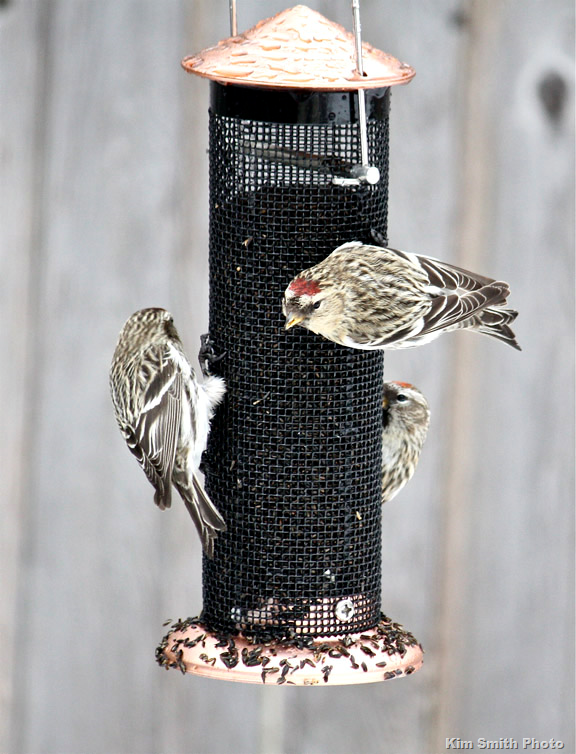
The redpolls return, with friends in tow! Two weeks ago we were visited by a half dozen or so Common Redpolls; yesterday and today we have a troupe of thirty. Goldfinch-sized, with crisp white and brown patterned tail feathers and velvety crimson caps, they have the winsome habit of cocking their heads and looking straight at you, as if to say (in the most conversational manner), “I am very photogenic; won’t you concur?”

Come join me Monday morning, February 28th, from 10:00 to 12:00 at the Espousal Center in Waltham,where I will be giving a talk and photo presentation about creating The Pollinator Garden for the Garden Club Federation of Massachusetts. Although this is a state Garden Club Federation event, everyone is welcome. Cost is free for members and $5. for non-members. My extensive pollinator planting list is provided with lecture.

image

Check Out Kim’s Blog Here for more of her fantastic photos and birds and butterfly stuff
Kim Smith Talks About Redpolls

image

Kim Smith Writes-

How lovely to receive a visit from this charming flock of redpolls. I knew it to be a new-to-our garden species, but did not realize visits were so much more uncommon than common. Oh how I wish I had taken more snapshots! Common Redpolls are another "irruptive species" from the boreal forests of North American (see Pine Siskins archived on blog), and the winter of 2010-2011 has proven to be an irruptive year for both Common Redpoll and White-winged Crossbill, with many sightings reported in Massachusetts. To learn whether we had Hoary Redpolls or Common Redpolls I emailed Chris Leahy, Mass Audubon’s Chair of Field Ornithology:

Hi Chris–Last week I found this inexpensive Nyjer seed bird feeder at Whole Foods, hung it in the garden next to the finch feeder, and was immediately visited by what I think are redpolls. They stayed for a few days and have not been seen again. It was dreary and rainy, so my photos are gray, not crispy. Do you think they are Common Redpolls or Hoary Redpolls or are the photos not clear enough?

I posted a link on my blog regarding your talk at the Sawyer Free and was disappointed it was cancelled because of the weather. Click on the photo–Chris Leahy and the Birds of Cape Ann--I think it looks like the three sparrows on the right are listening to a talk given by the sparrow on the left–please forgive the "bird" humor. Let me know when you are giving the talk and I will repost.

From Chris– Great, Kim! Send some over to my side of the harbor please! They are Common Redpolls – which are by no means common most winters. There’s a lot of plumage variation in both species and several races of Common Redpolls.  Hoary’s are much rarer of course and tend to hang out in flocks of Commons. Their best marks are a very tiny bill and pure white (or nearly so) under tail coverts (not always easy to see). Sometimes they appear much whiter, but not always and Commons can get very pale especially late in the year as the brown tips of the feathers wear. Chris adds the following important note:

Keep your eyes on your fruiting shrubs for Bohemian Waxwings. We had a flock of 5 (with Cedars) at Halibut Point during the Birding Weekend on Saturday. And Mary in East Gloucester found a dead one on her deck. I’ve had Cedars in my privet hedge during the last 10 days but no Bohemians (yet!?).

Check out the rest at her blog here

Chickity Check It! Snow Birds From Kim Smith

Dear Gardening Friends,

As we are nestling in and readying ourselves for yet another snowstorm I am writing to you about the winsome Dark-eyed Junco that has become increasingly more prevalent in our winter garden. Dark-eyed Juncos are commonly referred to in the East as “snowbirds,’ not only because they arrive to their winter feeding grounds oftentimes at the first snow fall, but because of their distinctive coloring—gray skies above (top feathers) and snow below (breast and belly feathers). In a typical winter we see singular juncos at the Nyjer feeders and on the ground below, at the most, two to four. During this snowiest of winters, we have a larger than usual mixed-flock of small seed-eating songbirds, with many more juncos feeding alongside the finches, sparrows, nuthatches, and chickadees. Quite timorous of people and sudden noise, they dart in and out of the dense shrubbery surrounding our little garden, and seem to find the greatest security in the low-lying branches of the ‘Blue Prince’ holly bushes.

Click here for the rest of the post at Kim’s blog

Songbirds in Winter ~ Sharing Recent Letters from Readers from Kim Smith

image

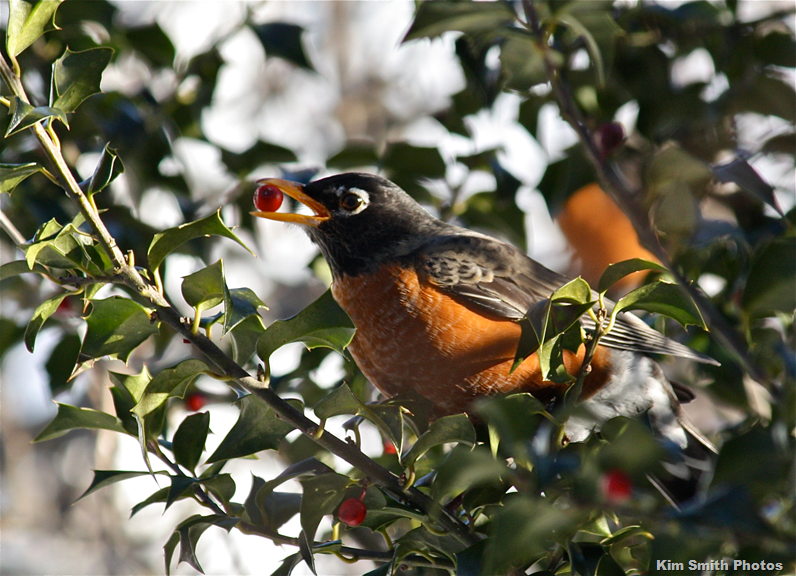
American Robin (Turdus migratorius)

"Hope" is the thing with feathers –

That perches in the soul –

And sings the tune without the words –

And never stops – at all –

And sweetest – in the Gale – is heard –

And sore must be the storm –

That could abash the little bird

That kept so many warm –

I’ve heard it in the chillest land –

And on the strangest Sea –

Yet, never, in Extremity,

It asked a crumb – of Me    -  Emily Dickinson

Dear Gardening Friends,  Please forgive when I am slow to answer your kind and thoughtful letters. I am struggling with an elbow injury and have had to limit my writing and photography somewhat (with extreme reluctance!!!). I love to hear about your bird and butterfly encounters, so please, keep your letters coming–just know that I am slow! Please see my blog for more photos of the beautiful flock of American Robins that arrived in our garden yesterday, as well as information about the upcoming Cape Ann Winter Birding Weekend. Warmest wishes, Kim

For the rest of Kim’s post check out her blog here

Pine Siskin ~ Carduelis pinus From Kim Smith

Kim Smith writes-

We certainly weren’t expecting to see and hear a new-to-our garden species of birds flocking to the Nyjer seed feeder on a frigid mid-January day. American goldfinch in size, the richly mottled plumage resembled something closer to a sparrow. Their delightful birdsong was new and fresh to my ears and sweetly cheering. Currently in residence is a flock of House Sparrows, with several Song and Savannah Sparrows tagging along, but I had no success with identifying this new entourage when thumbing through the sparrow section of Audubon’s books. Returning to the goldfinch pages, Pine Siskins are closely related to American Goldfinches (the two species comprise the subgenus Spinus), and information was readily available, once on the right track.

To be sure, I emailed a snapshot to Chris Leahy at Mass Audubon and he confirmed that this was indeed a flock of Pine Siskins and that they are having an “irruptive” year. In ecological terms, irrupt is defined as “to increase rapidly and irregularly in number.”

To read the rest of Kim’s post check out her site here

Chickity Check It! Feathered Friends From Kim Smith

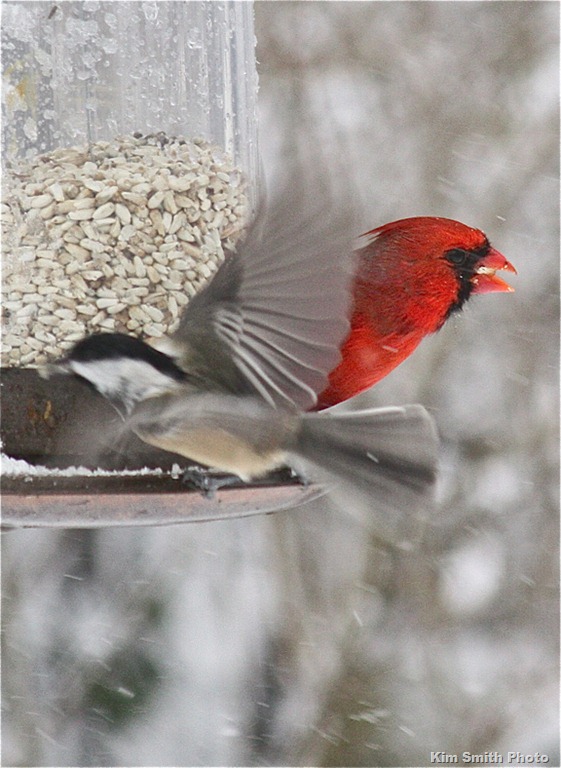
Black-capped Chicadee and Cardinal hungry at the feeder during blizzard

Kim Smith writes-

Dear Gardening Friends,

During inclement weather, particularly when it is blizzarding, please don’t forget to knock the snow off, and clear the base around, your feeders. This afternoon while working on a drawing and looking out onto the snowy backyard scene I observed a half dozen species of our feathered friends searching for food at the bird feeders and in the fruit-bearing shrubs. The fearless Black-capped Chicadees, with cheery birdsong chic-a-dee-dee-dee, have their amusing habit of darting in for a seed and skedaddling away as quick as can be to crack it open against a firm surface. Particularly sweet was a cardinal pair. They took turns at the feeder; while one was eating, the other was always close by and at the ready with a warning cry.

A question from one of my dear readers:

Dear Kim, Last summer a male cardinal sang his heart out every day from the tree tops around our house. I thought he must be calling for a mate, but I never saw him with a female at all. Then the most curious thing happened: he began to perch on either my or my husband’s side mirror on our cars. He would peck away at the mirror and flap his wings. It was then that I concluded that he was desperate for a mate. This fall and winter, a male and female have appeared. There is a male (maybe the same one) that has started perching on my car mirror again. Since it is December/January, and if it is the same cardinal who now has a mate, it may have nothing to do with trying to find a mate. If you have any ideas, let me know.

Kim’s answer at her blog here

White-throated Sparrow and Winter Moth Post From Kim Smith

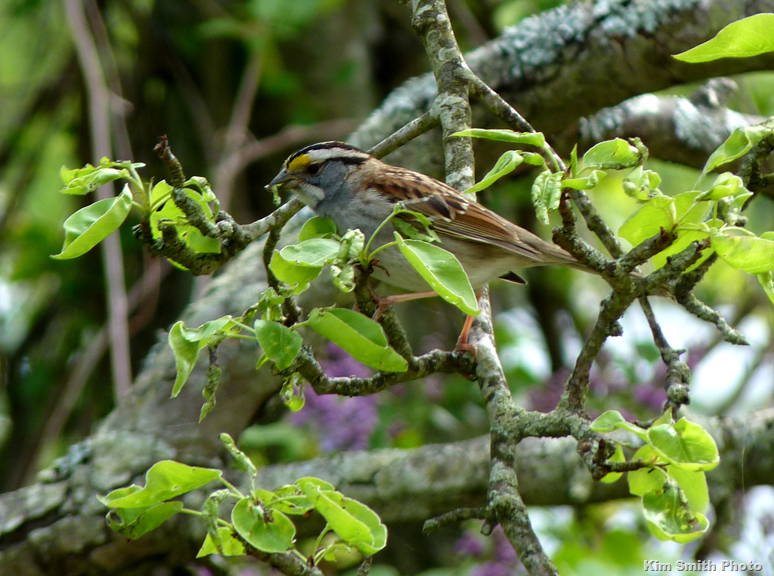
White-throated Sparrow and Winter Moth

image

White-throated Sparrow Dining on Winter Moth Larvae

Last May my husband and I were delighted to discover a large flock of White-throated Sparrows (Zonotrichia albicolli) rumpusing about our garden. A chorus of choristers chortling My Sweet Canada, Canada, Canada or alternatively Old Sam Peabody, Peabody, Peabody, their clear, elegant notes were heard for several days and they were easily spotted rustling about the hedge, dining on safflower seeds from the ground below the bird feeder, and feasting on winter moth caterpillars in the trees. I believe it to be a fairly rare occurrence to observe a flock migrating this far east through Cape Ann. My East Gloucester neighbor Jen, who has a lovely garden even closer to the easternmost edges of the peninsula, reported same. Her flock also stayed for several days enjoying the winter moth caterpillar banquet found in her yard. Rather than walk or run, White-throated Sparrows hop, and we delighted in our all too brief encounter with this beautiful and entertaining “Whistler of the North.”

Click here to Check out the rest of the entry at Kim’s Blog- http://kimsmithdesigns.wordpress.com/

A Note About Amaryllis From Kim Smith

image

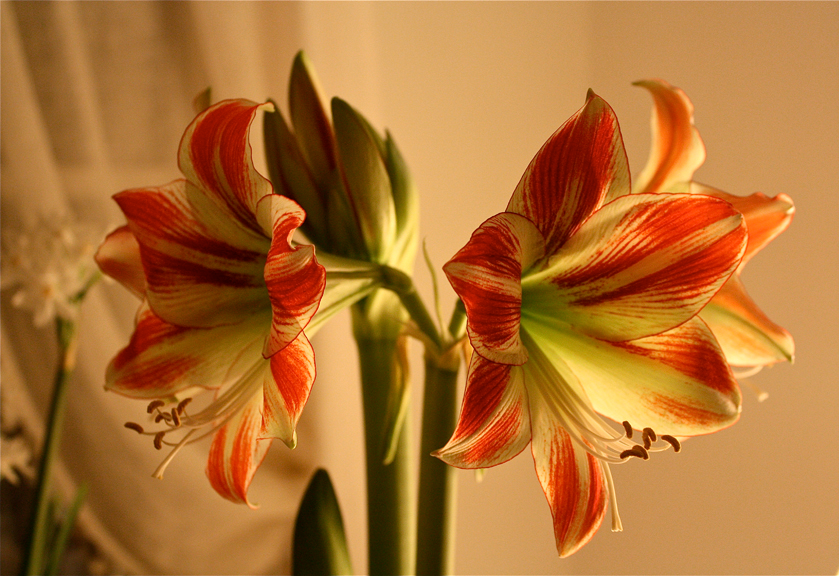
                                                                                 Amaryllis ‘Ambiance’

Dear Gardening Friends,

We have been blessed with a delightfully warm autumn, which has made these last few weeks in the garden a delight. As I am preparing gardens for their winter rest, my thoughts turn to the upcoming holidays and the winter blooms that will make the season all that much brighter. I hope you don’t mind—the following is from the chapter on Coaxing Winter Blooms, excerpted from Oh Garden of Fresh Possibilities! With our son’s soccer team headed to the state finals, I haven’t had the ability to focus, spare time to write, or accomplish much of anything besides work. We’re all on pins and needles in anticipation of the Big Game Sunday night!

Warmest wishes and Season’s Greetings, Kim

P.S. Results of Sunday night’s game: CONGRATULATIONS VIKINGS, the new Division Three North Massachusetts State Champions!!!!!!!!!!!!!!!!!!! Rockport Vikings 1, St.Mary’s, Lynn 0. Wednesday’s game against the winning southern region state champs will be held in Quincy at 5:00 pm. GO VIKINGS!

A Note About Amaryllis

Living in New England the year round, with our tiresomely long winter stretching miles before us, and then a typically late and fugitive, fleeting spring, we can become easily wrapped in those winter-blues. Fortunately for garden-makers, our thoughts give way to winter scapes of bare limbs and berries, Gold Finches and Cardinals, and plant cat-alogues to peruse. If you love to paint and write about flowers as do I, winter is a splendid time of year for both, as there is hardly any time devoted to the garden during colder months. I believe if we cared for a garden very much larger than ours, I would accomplish little of either writing or painting, for maintaining it would require just that much more time and energy.

Coaxing winter blooms is yet another way to circumvent those late winter doldrums. Most of us are familiar with the ease in which amaryllis (Hippeastrum) bulbs will bloom indoors. Placed in a pot with enough soil to come to the halfway point of the bulb, and set on a warm radiator, in several week’s time one will be cheered by the sight of a spring-green, pointed-tipped flower stalk poking through the inner layers of the plump brown bulbs. The emerging scapes provide a welcome promise with their warm-hued blossoms, a striking contrast against the cool light of winter.

Perhaps the popularity of the amaryllis is due both to their ease in cultivation and also for their ability to dazzle with colors of sizzling orange, clear reds and apple blossom pink. My aunt has a friend whose family has successfully cultivated the same bulb for decades. For continued success with an amaryllis, place the pot in the garden as soon as the weather is steadily warm. Allow the plant to grow through the summer, watering and fertilizing regularly. In the late summer or early fall and before the first frost, separate the bulb from the soil and store the bulb, on its side, in a cool dry spot—an unheated basement for example. The bulb should feel firm and fat again, not at all mushy. After a six-week rest, the amaryllis bulb is ready to re-pot and begin its blooming cycle again.  Excerpt Oh Garden of Fresh Possibilities! ~ Coaxing Winter Blooms.

image

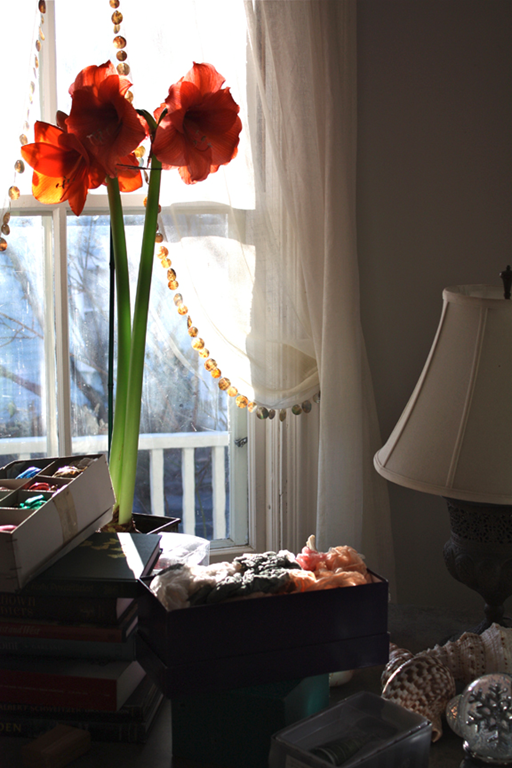
                                            Amaryllis ‘Orange Sovereign

Check Out Kim Smith’s Blog Here

Exquisite Flora in Autumn From Kim Smith

Kim Smith Writes-

Dear Gardening Friends,

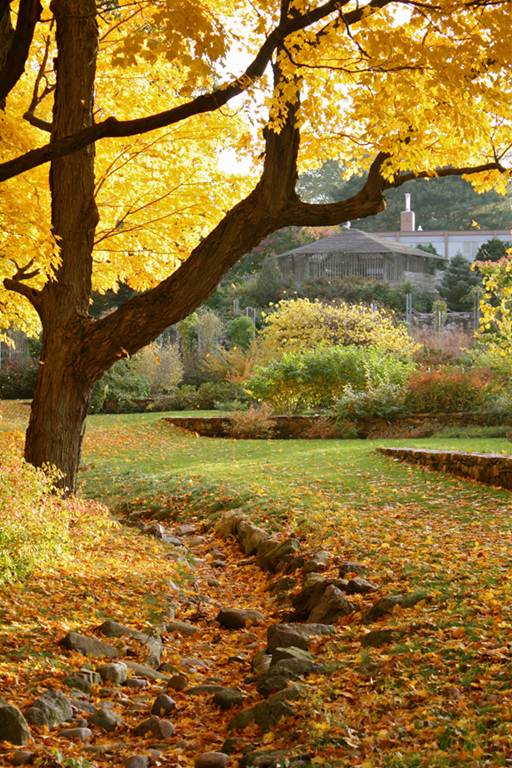
Last Tuesday I had the joy to attend the New England Landscape Design and History Association’s (NELDHA) October get-together, which is held annually at the beautiful Arnold Arboretum in Boston. The refreshments provided by Jon Hogan were simply delicious and the special guest lecturer Alan Banks gave an absorbing and informative presentation on "The Olmstead Legacy and its influence on today’s landscape design professionals." Alan Banks is the supervisory park ranger at "Fairstead," which is the Frederick Law Olmstead National Historic Site, located in Brookline, Massachusetts. Banks has extensively researched the Olmsted firm’s involvement in over 1,200 projects throughout Massachusetts, ranging from expansive parks to intimate private gardens. Among Olmsted’s greatest achievements is the Boston area’s six-mile Emerald Necklace (Including the Arnold Arboretum) that became a nationally acclaimed landscape masterpiece (Olmstead and his partner Vaux famously designed Central Park, NYC). Olmsted’s humanitarian philosophy and theories for land use are persuasive arguments for today’s landscape designers. To learn more about NELDHA and the manifold benefits of becoming a member, visit their new website New England Landscape Design and History Association’s.

I left Cape Ann several hours earlier than the scheduled event hoping to arrive at the Arnold in time to photograph, but as is typical, the traffic was dreadful and, regretfully, I was only able to take a few shots.

image

On another note, our daughter Liv is singing every Sunday at the lovely St. Johns’ Episcopal Church in Beverly Farms. The music program, under the direction of organist and choirmaster Nicholas White, is divine. This coming Sunday afternoon (November 7th) at 4:00 pm is a special concert of Requiem ~ Gabriel Faure, with chamber orchestra and soloists, featuring the combined choirs of St. John’s Church, Beverly Farms, and Christ Church, Andover. The program will also include Felix Mendelssohn’s Hear My Prayer, as well as his Organ Sonata III in A Major. Barbara Bruns is the organist, with Nicholas White conducting. I hope you will come hear this gorgeous music, with Liv singing.

Click here to read the rest of
Kim’s Entry

Chickity Check It!- Kim Smith Monarch Butterfly Migration Late Summer 2010

Monarch Butterfly Migration Late Summer 2010

image

Magical Seaside Goldenrod

image

Dear Gardening Friends,

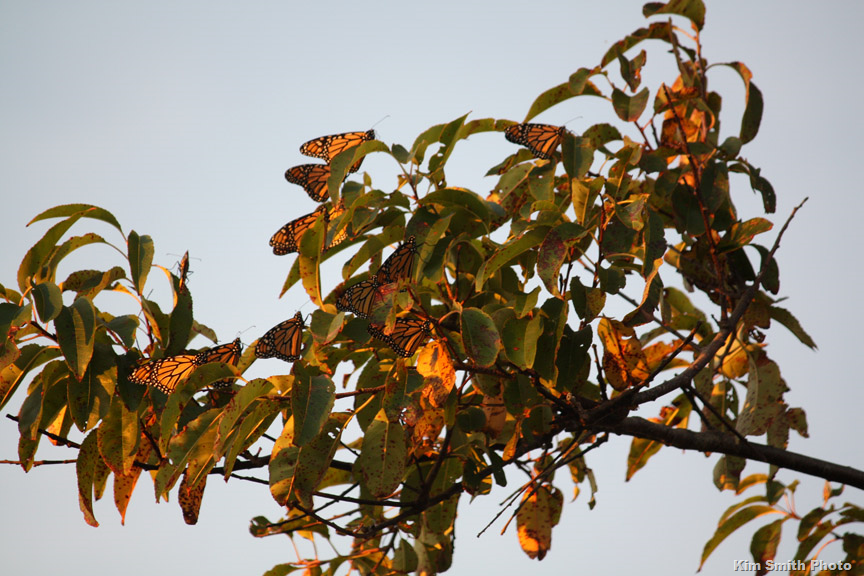
So many have telephoned or emailed inquiring about the status of the annual Monarch butterfly migration through our region. This past summer I have observed umpteen Monarch butterflies and caterpillars in cultivated gardens, wildflower meadows, and along the shoreline; however, I did not see the great numbers in great heaps roosting in any one particular place that I have observed in some years past. Rather I would find a small passel here and a small passel there—perhaps several dozen at a time—roosting in the wild black cherry trees (Prunus serotina) at Eastern Point, awakening in the early morning and nectaring at the Seaside Goldenrod in the meadow below.

image

Monarchs Mimic Withering foliage of Black Cherry Tree

Although the Monarchs are guided genetically, using their internal sun-compass navigation and circadian clock, each year the annual southward migration takes a different form that depends on many other variables, primarily the weather conditions in their overwintering site in Michoacán, Mexico as well as weather patterns in their US and Canadian breeding grounds. Because Cape Ann is located at approximately 43 degrees latitude north, our peak migration pattern is estimated at around September 11, but I modify this pattern because of the strong winds and storms we often experience in the late summer living along the coastline.

Check Out Kim Smith’s Website for The Rest Of Her Post Here

What Up Homie?

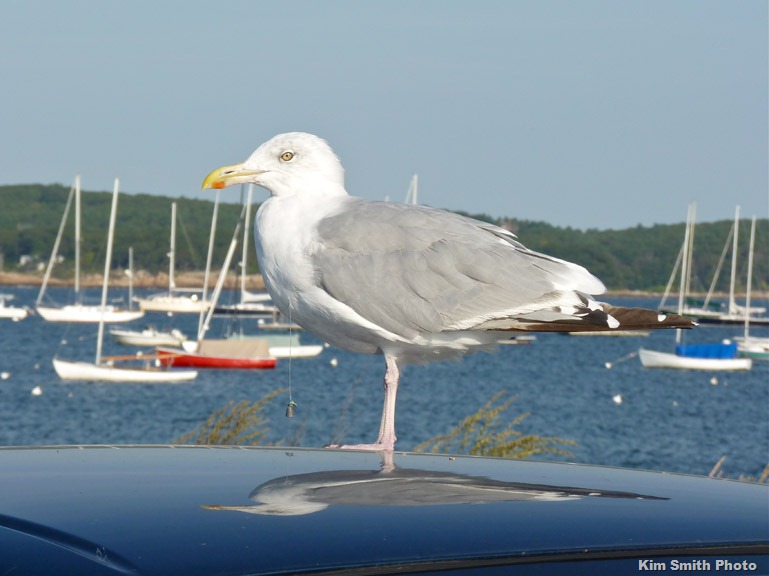
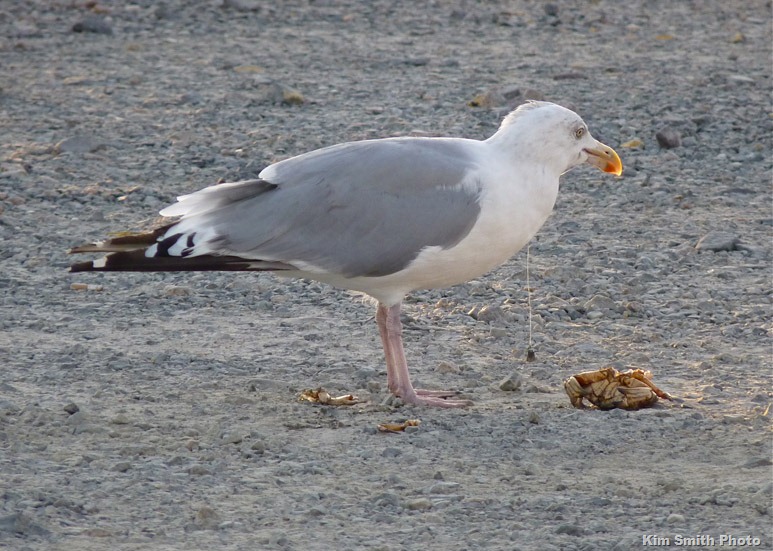
Kim Smith Submits these pictures of a Homie with a hook stuck in it.

Hi Joey,

Your posting about Richie Cassola reminded me to send these photos of a Homie that has been hanging out at the Eastern Point Lighthouse this past week. Despite the hook, he is managing to find sustenance. I just hope the fishing line doesn’t get caught on anything!

Homie with fish hook-1

Homie with fish hook-2

Chickity Check It! Kim Smith Updates With The Great Spangled Fritillary

Dear Gardening Friends,

Events and projects have kept me from writing these past few weeks. Design work and the start of the new school year have played a part, however, what has really kept me away is that I am working like mad to complete the Monarch book illustrations. The glorious weather and warmth, light and air have exhilarated and inspired (along with the caterpillars and butterflies that have taken over our kitchen!). With writing and photographing, I can work around design projects and my family’s schedule, but with painting I need long stretches of time. As soon as the illustrations are completed i will turn my full attention to the tv show. I take breaks from painting at around the peak time of day when the pollinators are on the wing and have been gathering tons and tons of footage.

Renovating our little apartment has kept me away as well. Our wonderful tenant of ten years purchased her own home and moved out this past month. Ten years is a long time and we miss her terribly. My husband and i have been scouring and scrubbing and painting, and with several fresh coats, the place is sparkling. The apartment is charming and sunny, with hardwood floors, private entrance through the garden, and would make a great artist’s or writer’s studio, office space, pied-à-terre, or modest home. It is within walking distance of Good Harbor Beach, Niles Beach, Rocky Neck, Gloucester Stage Company, and several fabulous restaurants (Duckworth’s Bistro!). Please pass along this information if you know of an interested person.

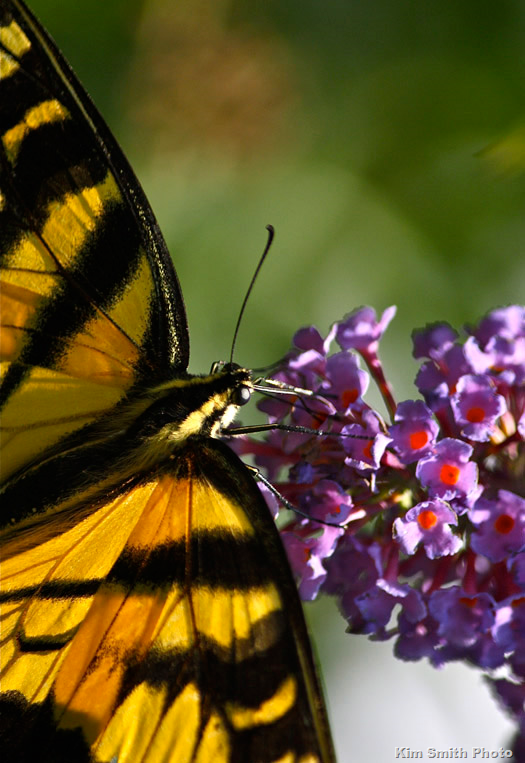
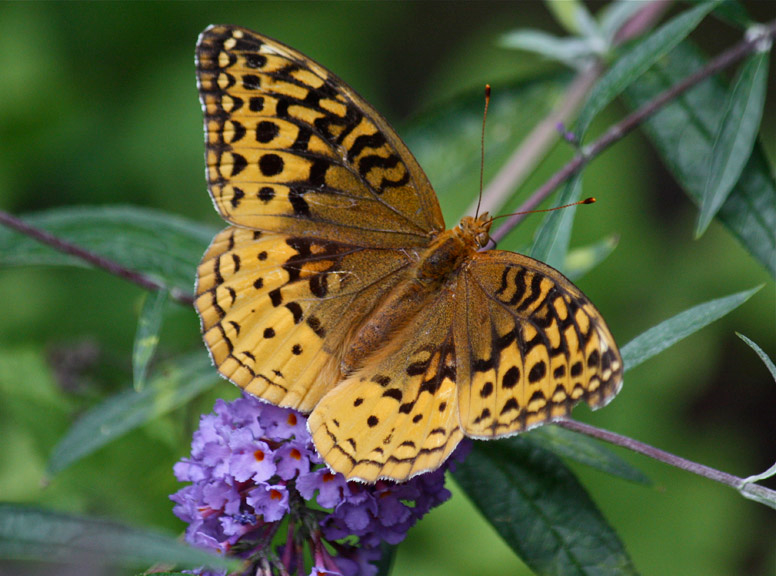
Great Spangleds are on the wing at this time of year. They adore fresh blossoms of butterfly bushes. With this year’s drought I realize it has been particularly difficult, but try to keep your butterfly bushes well-hydrated so that they will continue to produce new blossoms during the remaining weeks of late summer, while there are still myriad species of pollinators needing fortification. Additional photos of Great Spangled Fritillaries and Monarchs are on the blog at www.kimsmithdesigns.wordpress.com.

Warmest wishes,

Kim

Welcome Oh Great Spangled Fritillary!

image

Singularly beautiful—large and rounded with tawny orange wings checkered with black dots and dashes—when observed from above. When wings are folded, this fritillary shows a striking underwing pattern of spangled spots, bordered by a wide yellow band and outlined in iridescent crescents. Perhaps the Great Spangled Fritillary has graced your garden. I had never encountered this creature of extraordinary beauty until the summer after we planted violets dug from a wildly unkempt cemetery. They were common violets (Viola sororia). I don’t recommend the common violet for a small garden, unless you desire a garden composed entirely of common violets. Please don’t misunderstand; I do not regret planting V. sororia because otherwise I may never have encountered the Great Spangled Fritillary (Speyeria cybele). No, I am glad to have welcomed this beauty to our garden. There are, however, far better behaved violets that are of equal importance to the fritillary caterpillars and they would be a far better choice for the garden. Both native wildflowers Labrador violet (Viola labradorica) and Canada violet (Viola canadensis) naturalize readily, making rulier groundcovers than common violets, and are lovely when in bloom and when not in flower.

For the Rest Of Kim’s Post Including Her Fantastic Butterfly Photos Click Here!

Red-spotted Admiral Butterflies

Kim Smith Writes In-

Kim Smith must have the patience of an angel because her butterfly photos are astounding and beautiful.

She writes and has many more pictures of the current butterflies chilling in her garden at her blog- http://kimsmithdesigns.wordpress.com/

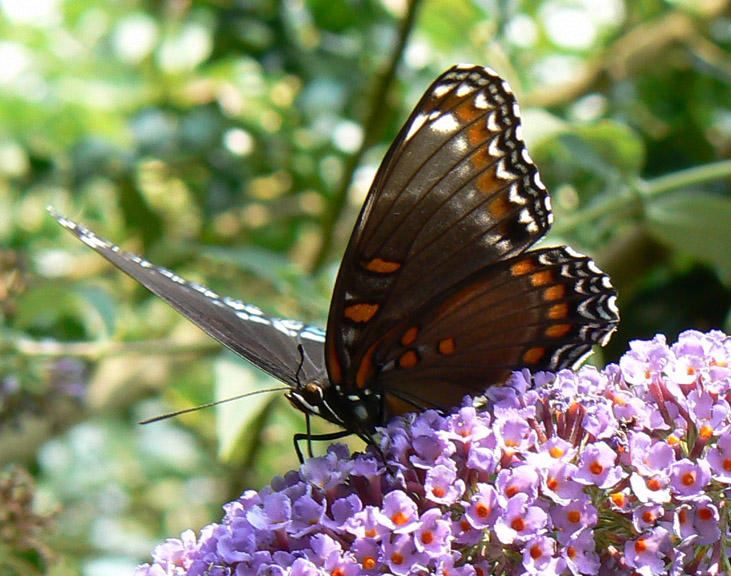
Here is just a sample- Red-spotted Purple (Ventral)

The average wingspan of the Red-spotted Admiral is approximately three inches. The White Admiral has a distinctive wide white band on both the forward and hind wings, and on both the dorsal (upperwing) and ventral (underwing) surface. In the Red-spotted Purple, the white band is replaced with a band of iridescent lapis lazuli blue scales. It has evolved to mimic the highly distasteful Pipevine Swallowtail. Red-spotted Purples are found in greater numbers than White Admirals in the eastern part of Massachusetts. The opposite holds true for the western part of the state.

Purportedly, Red-spotted Purples are seen feeding primarily on rotting fruit, sap, and dung— infrequently at flowers—however, I see them nectaring often, and for long periods of time, at flowers. They are particularly fond of butterfly bushes, meadowsweet, Marsh Milkweed (Asclepias incarnata), and Joe Pye-weed.

Hostplants for the Red-spotted Admirals are extremely varied. Both races use cherries, including Chokecherry (Prunus virginiaina), Wild Black Cherry (Prunus serotina), Pin Cherry (Prunus pennsylvanica), plum (Prunus), apple (Malus), poplars, cottonwood, aspens, willows (Salix), birches, (Betula), hawthorn (Cratageous), basswood (Tilia), Deerberry (Vaccinium stamineum), and serviceberry (Amelanchier). The female oviposits a single egg on the upper surface at the tip of a fresh hostplant leaf. Our postage-tamp of a garden is much too small for the aforementioned larger trees, and too shady to grow healthy Prunus and Malus, so I am experimenting with a multi-stemmed Shadbush (Amelanchier canadensis), which I plan to keep pruned to a manageable shrub-size.

Here is one of her videos

Be sure to check out Cape Ann TV where Kim will be appearing on the Cape Ann Report with Heidi Dallin on Wednesday, August 4th at 6:00 pm to talk about her garden and design firm.

Musings on the Fearless Little Wood-Satyr From Kim Smith

 Check out her blog here
picture kim smith-

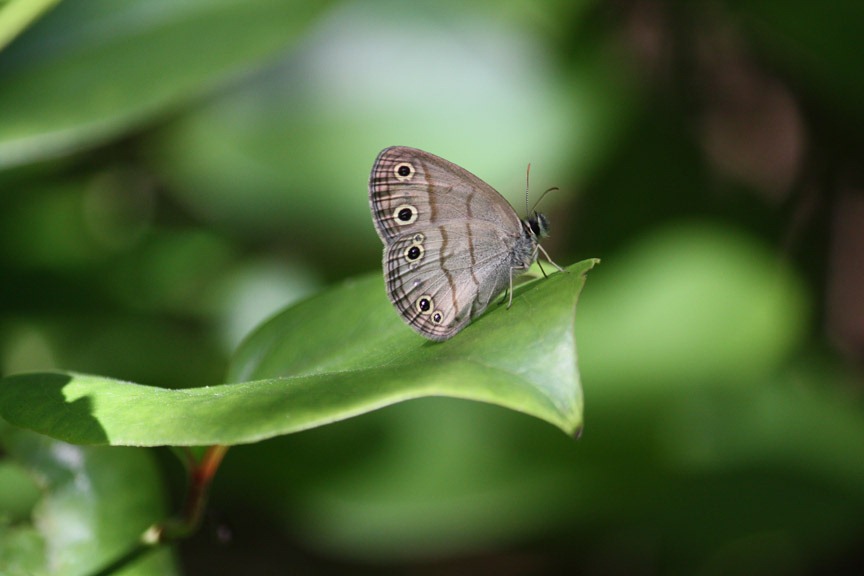
Little Wood-satyr (ventral)

Dear Gardening Friends,

Although it may seem as though I have been unplugged as of late, I am actually becoming more plugged-in than ever (is this a good thing?) as I am in the process of teaching myself how to edit and combine my video clips and photos. To be sure, editing is easy for my techno savvy friends, but I find it time consuming beyond measure. The net result is that I will be able to passalong more good information. For example, the latest video posted on my blog shows the ventral (underside) and dorsal (topside) of the Little Wood-satyr, as well as its light brown and tan forms. Hopefully, this will help us to better identify, and provide sustenance for, the beautiful pollinators that are attracted to our habitat gardens.

The fearless Little Wood-satyr (Megisto cymela cymela) stayed for several days. While photographing, he alighted on my camera and then onto my hand. As you can see, there wasn’t much remaining of his left wing.

Little Wood-satrys are found throughout the eastern United States (except northern New England) and southeastern Canada, Nova Scotia to Florida, west to Texas and eastern Wyoming, and north to Saskatchewan. The first of its kind to arrive in our garden, we more typically observe the Little Wood-satyr along the wooded edge of clearings and quarries. The body color varies from light brown to tan. The following photos show the light brown version and were taken at a quarry in Rockport where I noticed both tan and light brown forms. Little Wood-satrys are on the wing in the northeast from May through July. The females land on a blade of grass and walk down to the base where she deposits a single egg. The caterpillars feed at night on various grasses including Orchard Grass (Dactylis glomerata), Kentucky Bluegrass (Poa pratensis), Centipede Grass (Eremochloa ophiuroides), and St. Augustine Grass (Stenotaphrum secundatum) (Cech and Tudor).

Happy Butterfly Days!

Warmest wishes, Kim

Kingdom: Anilmalia (Animal)

  Phylum: Arthropoda (Arthropods)

    Class: Insecta (Insects)

      Order: Lepidoptera (Butteflies, skippers, and moths)

        Superfamily: Papilionoidea (Butterflies, excluding skippers)

          Family: Nymphalidae (Brush-footed butterflies)

            Subfamily: Satryinae (Nymphs, Satyrs, and Arctic butterflies)

              Genus: Megisto

                Species: cymela