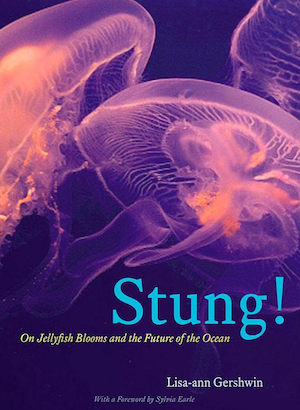
 Stung! On Jellyfish Blooms and the Future of the Ocean, by Lisa-ann Gershwin (The University of Chicago Press, 2013)
JoeAnn Hart Submits her book review for Stung!, published December 30, 2013.
I read an entire book on jellyfish, and it was worth every gelatinous minute. Here is my review, originally published on ecolitbooks.com.
They’re here, and we’ve not just cleared out the guest room for them, we’re opened up the front parlor, the master bedroom, rumpus room, and kitchen. Soon we’ll be barricaded in the basement with a stinging, gelatinous substance dripping on us through the cracks in the ceiling. I’m talking about jellyfish. Our relationship with them has changed for the worse. As they fill our fishing nets and clog our nuclear plant intake valves around the world, they reflect our relationship with the entire eco-system. And now it’s time to say goodnight. DNA research has recently stripped the title of First Multi-Cellular Animal from the sponge and handed it to the jellyfish, and they might very well turn out to be the Last.
When I wrote jellyfish into the plot of Float, which was released in early 2013, I could not have imagined how dire the situation would get in such a short period of time. I was still thinking that if we could find a use for them — like turning them into a true bio-plastic — there might be hope. After reading Stung! by Lisa-ann Gershwin, I am not so sure about that anymore. No matter how many we harvest, more jellyfish will just bloom in their place, because the problem isn’t just that there are too many of them, it’s that they are the bellwether for a very sick ocean. As oceanographer Sylvia Earle writes in the intro, As seas become stressed, the jellyfish are there, like an eagle to an injured lamb or golden staph to a postoperative patient – more than just a symptom of weakness, more like the angel of death.

Gershwin puts jellies in the greater perspective of the general ocean health, discussing at length how jellyfish blooms (population explosions) are the result of degraded ecosystems as well as the driver of further decline. So a large part of the book is spent explaining, in layperson’s language but with the fastidiousness of a researcher, how, exactly, jellies are able to take advantage of even the smallest anthropogenic perturbation, the fancy word for manmade disturbances. These include the usual culprits of ocean acidification and warming climates from our carbon waste, pesticides, herbicides, fungicides, oil spills, leaching plastics, and radioactive material.
Read the full review here: Stung!
Spread The GMG Love By Sharing With These Buttons:


 Good Morning Gloucester