Collaboration Between Adam Bolonsky, Joey Ciaramitaro and Sam Hartson
All taken from the video footage taken by our man Adam Bolonsky in the 4 part rough cut 2011 Saturday Greasy Pole video series-
Part II The Blessing Of The Feet
My View of Life on the Dock
Collaboration Between Adam Bolonsky, Joey Ciaramitaro and Sam Hartson
All taken from the video footage taken by our man Adam Bolonsky in the 4 part rough cut 2011 Saturday Greasy Pole video series-
Part II The Blessing Of The Feet
Filmed By Adam Bolonsky For Good Morning Gloucester
All taken from the video footage taken by our man Adam Bolonsky in the 4 part rough cut 2011 Saturday Greasy Pole video series-
Part II The Blessing Of The Feet
Part III The Arrival at The Pole
Part IV The Final Greasy Pole Round and Your Champ
Filmed By Adam Bolonsky For Good Morning Gloucester
All taken from the video footage taken by our man Adam Bolonsky in the 4 part rough cut 2011 Saturday Greasy Pole video series-
Part II The Blessing Of The Feet
Researchers from the wolffish tagging project are around and about the waterfront these days.
Look for the researchers and their interns offloading from commercial fishing boats chartered for the day to haul and tag wolves at Stellwaggen Bank.
Here’s their research link: http://www.wolffishtagging.org/
If you land a tagged wolffish, let them know:
http://www.wolffishtagging.org/
They’re landing in Gloucester with their two partner commercial captains
Carl Bouchard
F/V Stormy Weather Exeter, NH
and
Jim Ford F/V Lisa Ann II Kingston, NH
—
I keep a sea kayaking blog at paddlingtravelers.blogspot.com. Come on by and have a look. There’s something new there most days of the week.
ReplyReply All Move…Drafts
Adam Writes-
Time for a throwdown!
Who says bluefish are oily? Not me! Gut and bleed blues in the boat and you’ve got the best-tasting fillets ever.
Check out the red and pink dots and lateral line in this one-day old catch ready for the grill
I don’t know about the best tasting fillets ever. I can name about 5 fish fillets off the top of my head I’d rather eat.
My top 5-
Adam Bolonsky reports-
$60 a year gets you access to the racing dories docked seven days a week, 24 hours a day, 365 days a year at St. Peter’s Square. Join this great organization at internationaldories.com. After you build yourself seat and buy a pair of oars, you’re good to go!
Here’s a look at the club’s three newest dories, built by Geno Mondello at Harbor Loop:
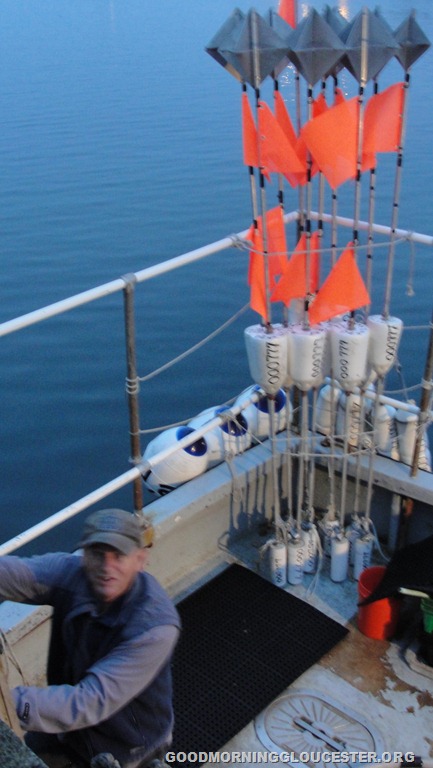
Many lobster boats have been installing these”fences” along the side of the boat where that is opposite the hauling station.
The fence has several purposes. Real estate on a lobster boat is valuable, especially if the lobsterman is a real fisherman and not just a “pot hauler”. A pot hauler is a lobsterman who simply sets his traps out in the same spots and doesn’t take the time to figure out what exactly the lobsters are doing and more importantly where they will show up next. So the “pot hauler” sets his traps and goes back to the same spots over and over and doesn’t move the lobster traps around to try to be where the lobsters will show up next to be caught.
Lugging 100 traps from one area to another and resetting them and adjusting the lengths of the trawl lines for different fathoms is a lot of work and some “pot haulers” would just assume keep to a simple routine even though it doesn’t yield the best results. To be fair, to move lots of traps from one area to a whole different area forces a lobsterman to either have a very large boat in which they can stack a ton of traps on and get lots of traps moved at one time or if they have smaller boats they have to make multiple trips because you just can’t put that many traps aboard due to a shortage of space.
This is where a fence can be beneficial in two ways. All of the buoys and high-flyers and even barrels can be lashed on to the fence to save deck space for work.
Secondly when stacking traps high on the deck of the boat to get as many on as possible for moving them to a different area the fence helps to secure the traps. So if the lobsterman feels that his catch has dropped off and he can catch more lobsters by moving to a different area he can move a bunch at one time and not worry about losing them overboard in windy or rough conditions.
TUFFY!
SEAN!
The Can-Do, a pilot ship based in Gloucester, Ma., set out during the blizzard of ’78 to aid a floundering Coast Guard ship trying to rescue the crew of the oil tanker Global Hope.
Credit: Lobsterman Mike/Adam Bolonsky
Copyright: Lobsterman Mike/Adam Bolonsky
Djahlmer Ray, first-generation Finnish immigrant who lived in Lanesville during the Great Depression, filed this patent for a fishing reel in 1938. His brief for the patent sums it all up: he wanted a reel that was durable, inexpensive to manufacture, and simple to repair. In other words, a Lanesville man through and through.
More important, RAY wanted a reel whose drag was easy to control when landing large fish!
Ray was interviewed in 1978 for the Gloucester Oral History project. By then he had moved to Fairhaven.
His and other residents’ interviews can be checked out on CD from the Sawyer Free Library.
Link to his patent’s images:
http://www.associatedcontent.com/slideshow/84081/hjalmer_ray_fishing_reel_patent_lanesville.html?cat=37
Thanks To Adam Bolonsky For forwarding this
Hi Joey,
I just posted a short video of Marvin Tighe (Rocky Neck) striper fishing off Flat Rocks at Rockport.
He lands a schoolie and gives some commentary on bait.
Hi kayak fishermen. Adam Bolonsky here at North American Kayak Fishing. Welcome to another installment of NAKF‘s fence post navigation series, your online resource for tips, tools and pointers useful to kayak fishermen around the world.
East Coast kayak fishermen from Maine to the Carolinas interested in catching their first bluefin tuna will do well to take trip to the North Shore Massachusetts towns of Gloucester and Rockport.
An hour north of Boston, Gloucester and Rockport, set on Cape Ann’s rocky granite outcropping, are a unique world unto themselves, not only for their variety of groundfish, such as pollock, cod and haddock, but also for the yearly arrival of three coveted pelagics: the heavily-targeted striped bass, the under-rated but truly delicious bluefish and, finally, that perhaps most coveted of sportfish, bluefin tuna.
For the full story Click Here-
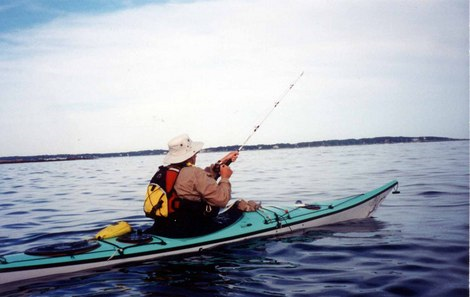
Launching from Freshwater Cover in Magnolia, Massachusetts, a local kayak angler sets up to troll for striped bass during the fall run.
Credit: northamericankayakfishing.blogspot.com
© Adam Bolonsky
Adam Bolonsky covers Kayak Fishing better than anyone with his-
A how-to and where-to blog for kayak fishermen around the world. Whether you fish from a sit-on-top or sit-in, set your hook here! Chickity Check it!
(Paul Morrison I figured you would like this piece)