Hawaiian Quilts

Antennae for Design The Descendants

Saturday night we went to see The Descendants and I found this movie enjoyable on many levels. The cinematography, of lush Hawaiian landscapes, was gorgeous. Lingering close-up shots of the actors and dreamy transitions added to the telling of story. Interesting, too, were the clips of suburban Honolulu neighborhoods. Never having been to Hawaii, the film was an eye opener—I don’t imagine Honolulu neighborhoods as a typical L.A. hillside suburb, nor downtown Honolulu with eight lane highways jammed with choking traffic.

Vintage Hawaiian Quilt

The set designs by Matt Callahan mirrored the story beautifully, and I found much inspiration in the furnishings and fabrics, including vintage rattan furniture, appliqué pillows, and bark cloth curtains. Several authentic Hawaiian quilts added a unique touch, and one quilt in particular played a leading role in the telling of the story. The main characters comprise a modern day family descended from a Hawaiian princess. Early in the film, we see a sunny golden yellow and white, slightly tattered and homey, quilt arrayed over the mom, who is lying in a hospital bed, in a coma and dying. The quilt has been brought from the family home to the hospital to provide comfort. In the final scene, the father and children make their way one by one to the family sofa, and eventually all are cozy under the same Hawaiian quilt, watching television together, and sharing bowls ice cream.
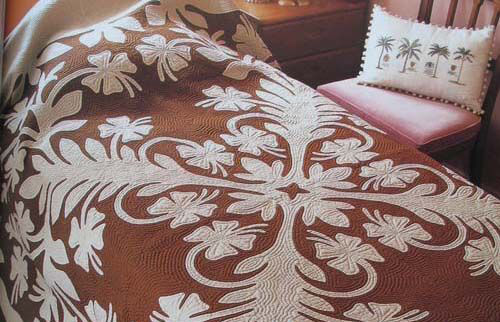
What we think of as the classic Hawaiian quilt is characterized by a bold, radial symmetric design (similar to that of a snowflake) or bold, stylized design drawn from nature. The motifs are often times cut from one piece of cloth, unlike patchwork quilts, which are assembled from many smaller pieces of fabric. The design motif is then appliquĂ©d to a contrasting background. And, unlike patchwork quilts, with quilting stitches worked in parallel diagonal, straight, or circular lines, Hawaiian quilters practice “echo” or outline quilting. The stitches follow the inner and outer contours of the design motif.

Much information can be found on Goolge about the history of Hawaiian quilts. Images courtesy of Google search.

The Descendants is based on the book of the same name, written by Kaui Hart Hemmings.

Antennae for Design

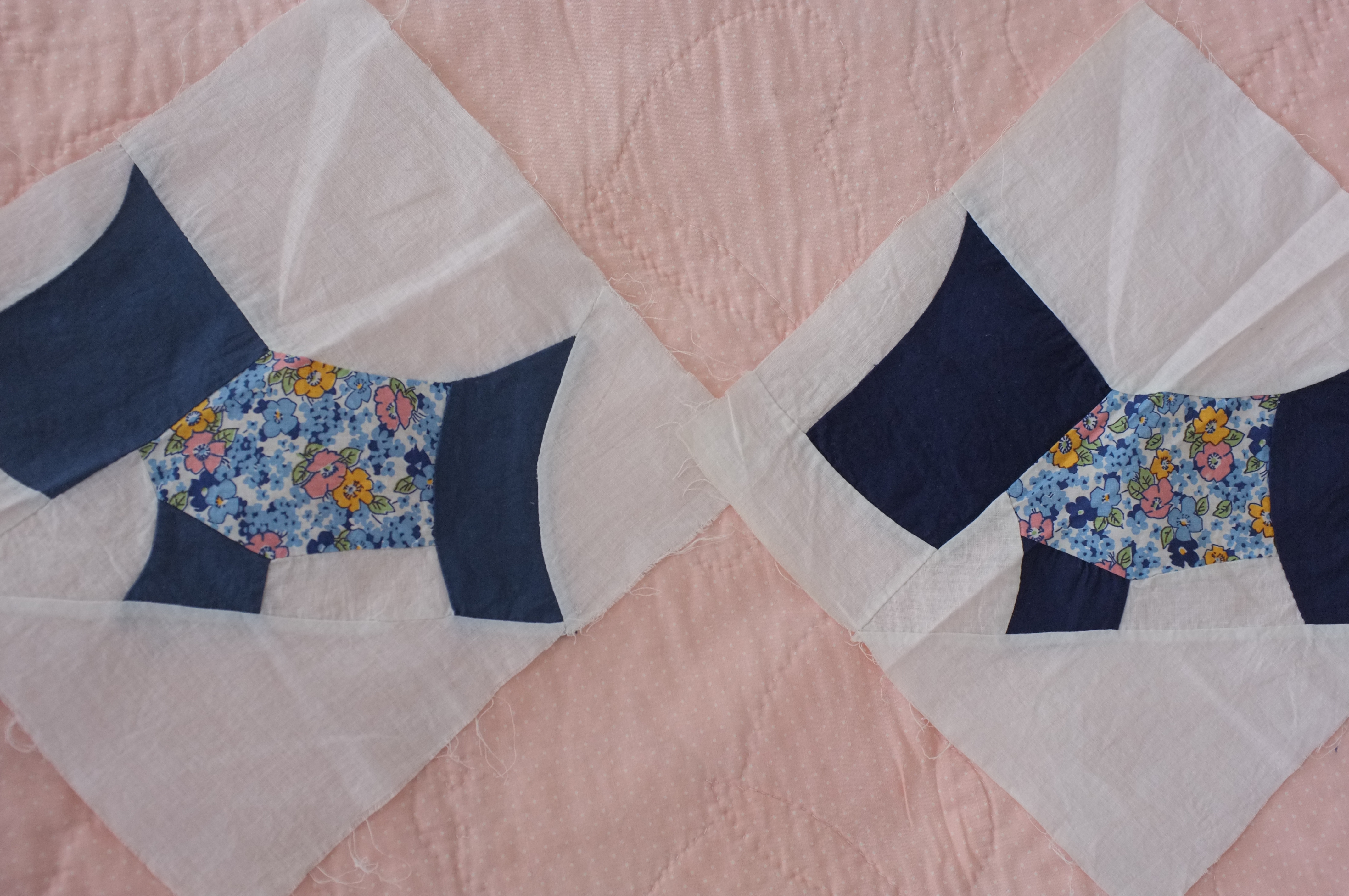
Depression Era Quilts

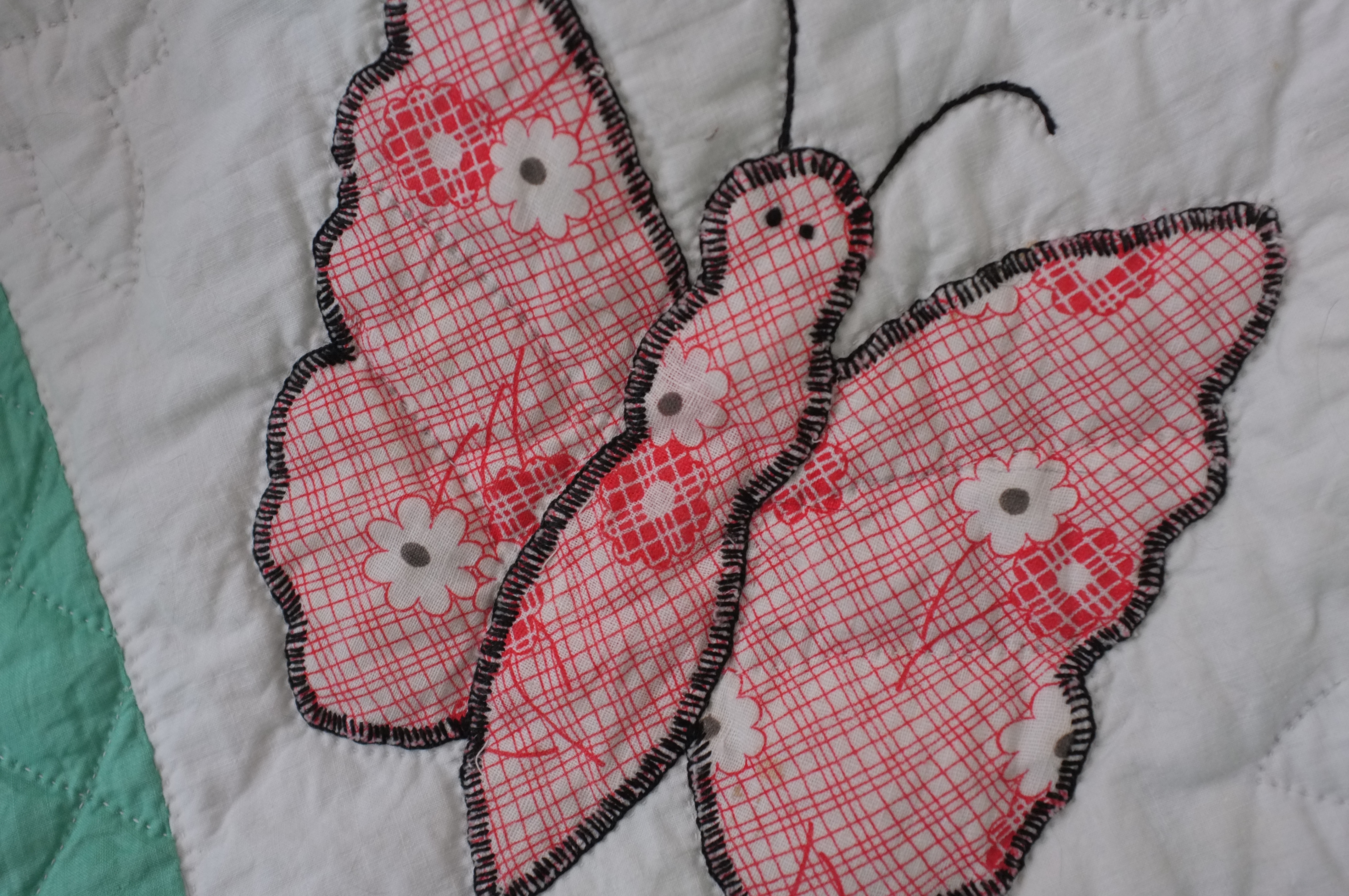
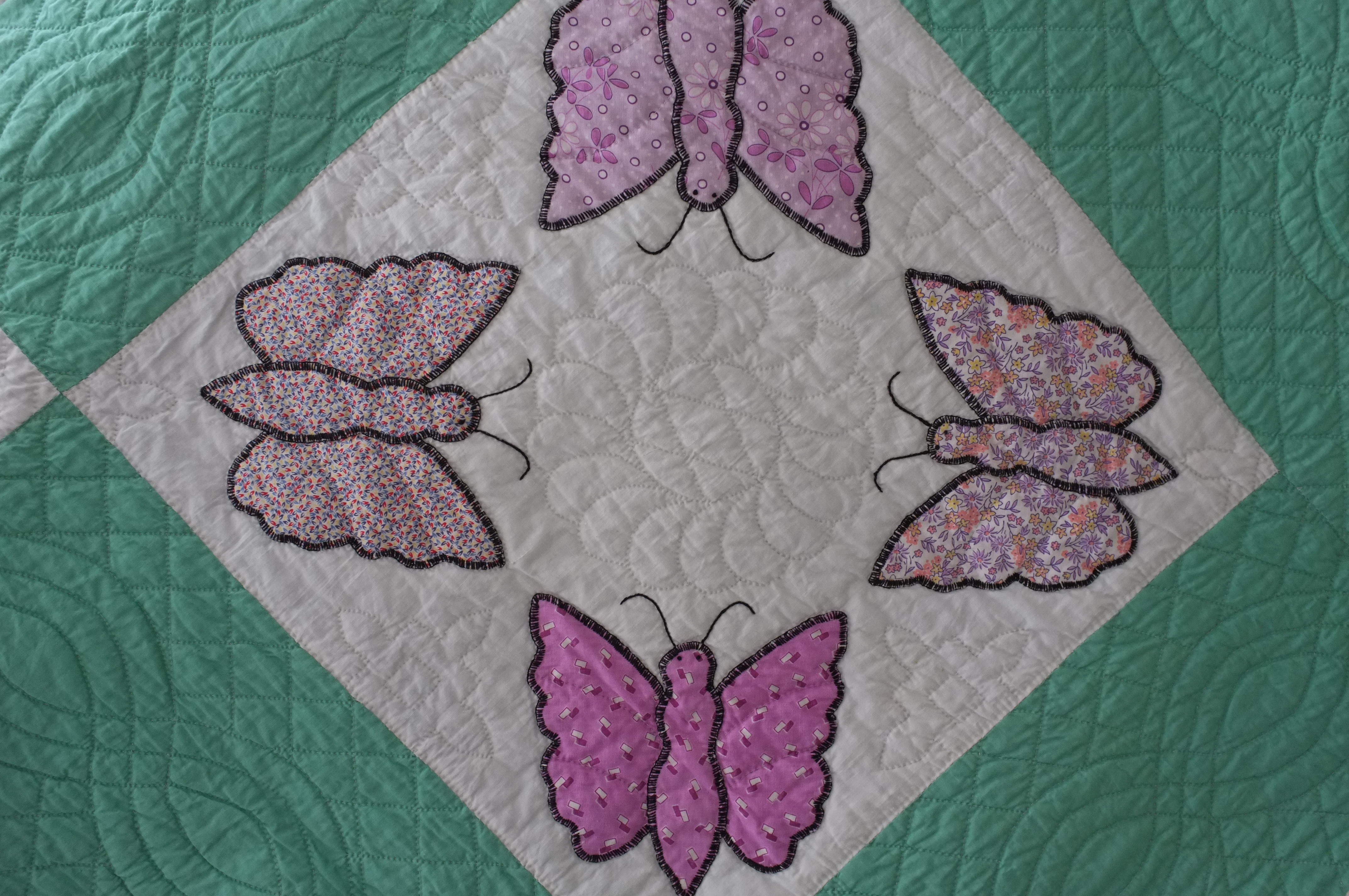
For the first installment of Antennae for Design I wanted to share with you a very special gift that my mother- and father-in-law gave me this Christmas past. My husband’s family lives in Cincinnati, Ohio, a beautiful city sited along the Ohio River. The landscape so reminded early German settlers of the Rhine River and valley, that to this day there is an area of the city still referred to as ‘Over the Rhine.’ The above butterfly buttonhole appliqué quilt was made in Fostoria, Ohio. Ohio’s long quilt-making heritage is similar to that of many states throughout America.

Quilts and quilt-making techniques are a reflection of the life and times of the women who made the quilts. The technique of quilting (encasing an insulating fabric between two layers of an outer fabric and stitching firmly in place) has existed throughout history. Quilted garments have been discovered in ancient Egyptian tombs and quilted garments and bedding began to appear in Europe after the return of the Crusaders from the Middle East. The medieval quilted gambeson and aketon were garments worn under, or instead of, armor of maille or plate armor. The oldest American quilts in the Smithsonian date from approximately 1780.
Thinking about the fascinating history of quilts and quilt making in this country, one of my very favorite periods of quilt making was after WWI and through the early 1940’s. Quilts made during this period are commonly referred to as Depression Era quilts; although to look at their cheery colors and patterns, you would never know the women who created them were living in the midst of a depression. Magazines needed to be resourceful during this period of extreme economic hardship, and they were, by selling fashion and optimism. Another way to survive was by including quilt patterns and tips in their publications. Quilting was an activity that women could do to fulfill their creativity while still making something practical for their families. The quilts were typically made from sewing scraps, out-grown clothing, and feed sacks. Part of the war reparations with Germany after the First World War included their formulas for aniline dyes, which allowed for an explosion in color depth and hues, as well as stability in dyes; purple finally became reliable, as did black.  Charming and sweet prints along with lovely pastels served in stark contrast to the depressive economy. A particular shade of green, now referred to as “thirties green,” was so popular amongst quilters, that the strips that were used to bind the quilt edges came packaged in a can!

Depression Era Butterfly Quilt

Dating quilts is fascinating. If you have a question about a quilt or would like to share information about a family heirloom, please write.

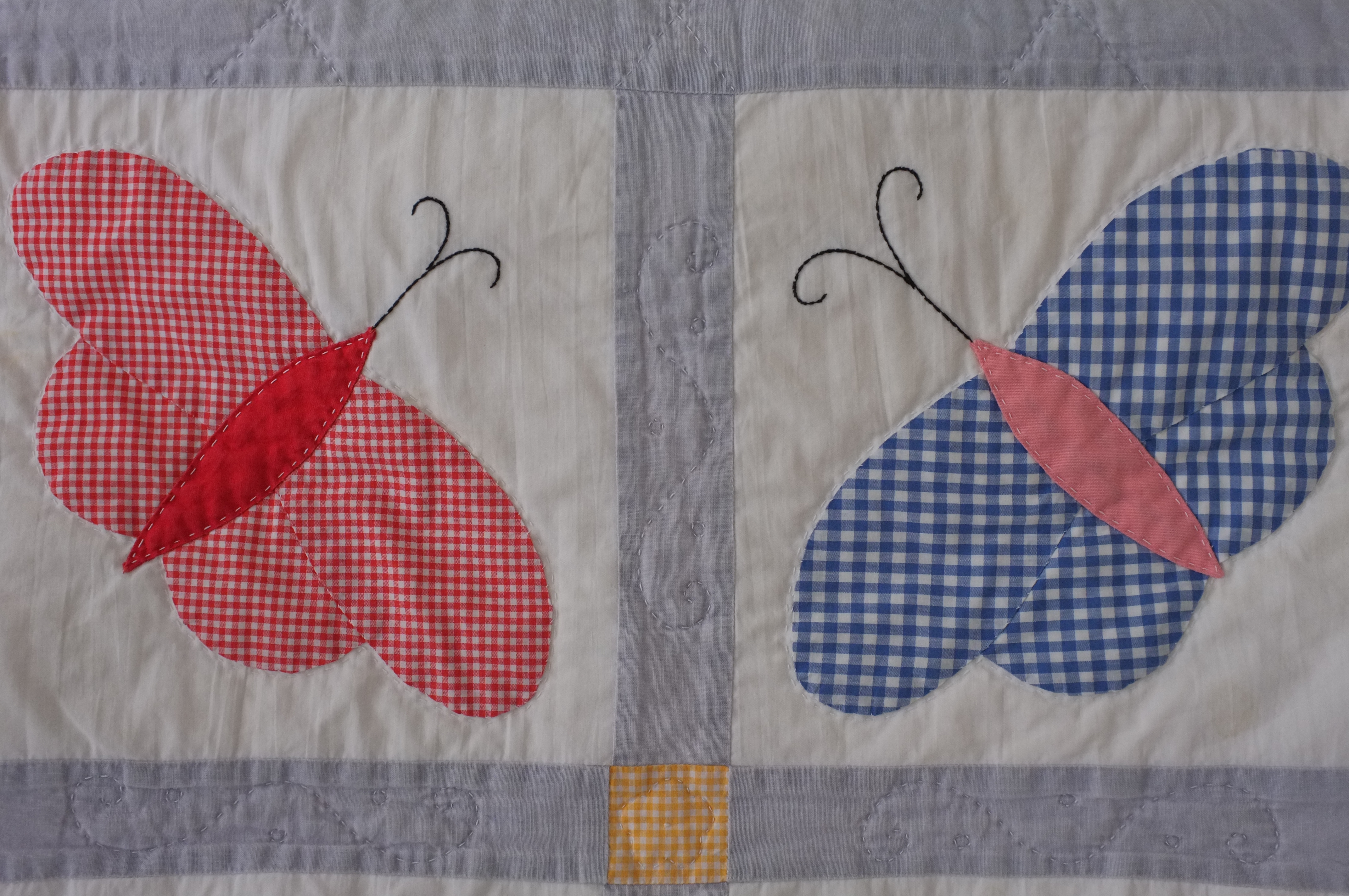
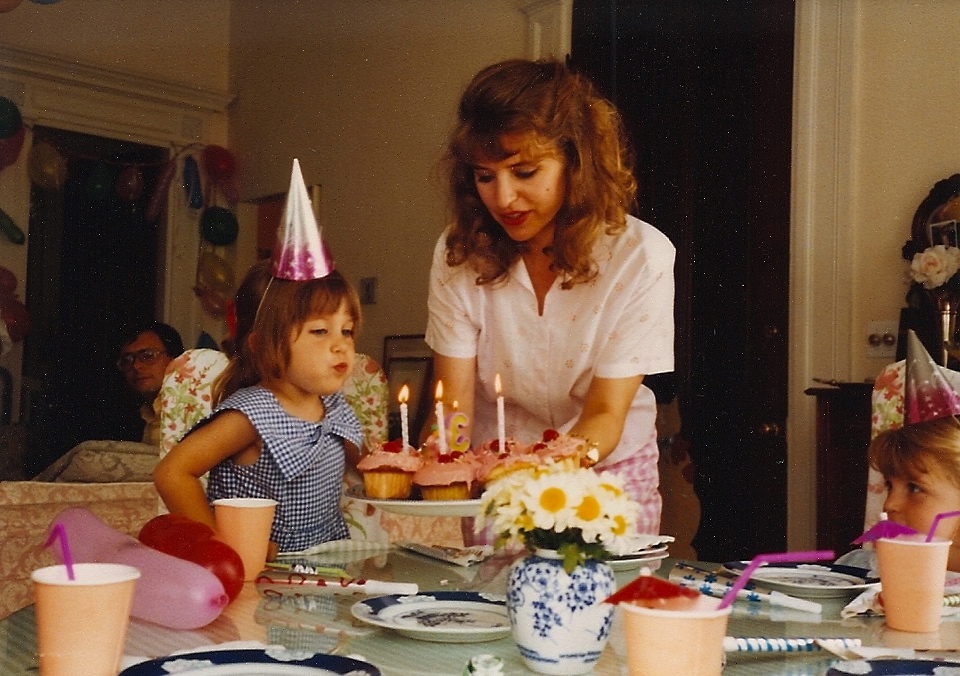
The above quilt was my interpretation of a 1930’s butterfly quilt, which I made for our daughter when she was five. Following in the depression era method of using what was on hand, you can see the dress scraps from which the quilt was made in her blue gingham dress in the old photo below.

I found a basket full of Scotty dog squares at a yard sale last summer. Scotty dogs were a popular design motif during the first half of the 20th century and this particular Scotty pattern was created in 1940. When I have some spare moments, I’ll look for fabric to back the quilt. Purchasing quilt squares or an unfinished quilt top is a great way to acquire a depression era quilt because, if the squares or top have been properly stored, the fabrics will come back to life with cleaning and pressing, and will not have been used.

Antennae for Design

January, February, March, and for we who dwell in New England, oftentimes well into April, are ideal months for interior home improvements. During these more homebound months I am actively seeking home and garden design inspiration. And, too, with projects that were shelved during the summer months because of seasonal work and summer guests, winter is a great time of year to focus on home improvements. I was inspired to write this weekly series after a recent visit to our home from Joey, Jill, and their two darling daughters. The family stopped by for hot chocolate and story time. Joey was non-stop with investigative questions and curiosity, reminding me of the impetus for writing my book, Oh Garden of Fresh Possibilities!, which was originally conceived as a guide for young couples and new home owners (and someday, hopefully, for my children when they will one day have gardens of their own). My book grew to be more than that, but I am again thinking of the couples with young children that have recently moved to our East Gloucester neighborhood.

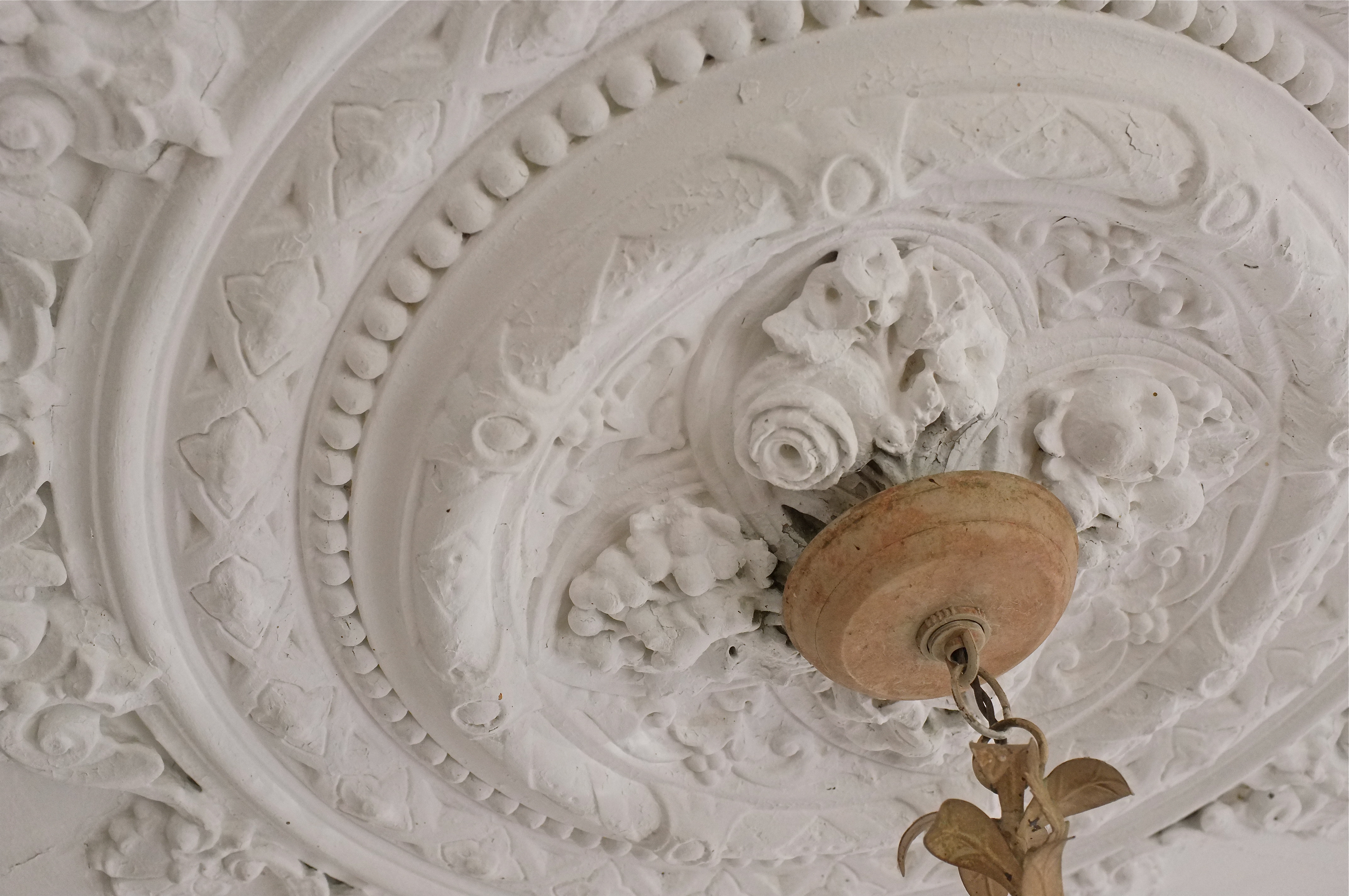
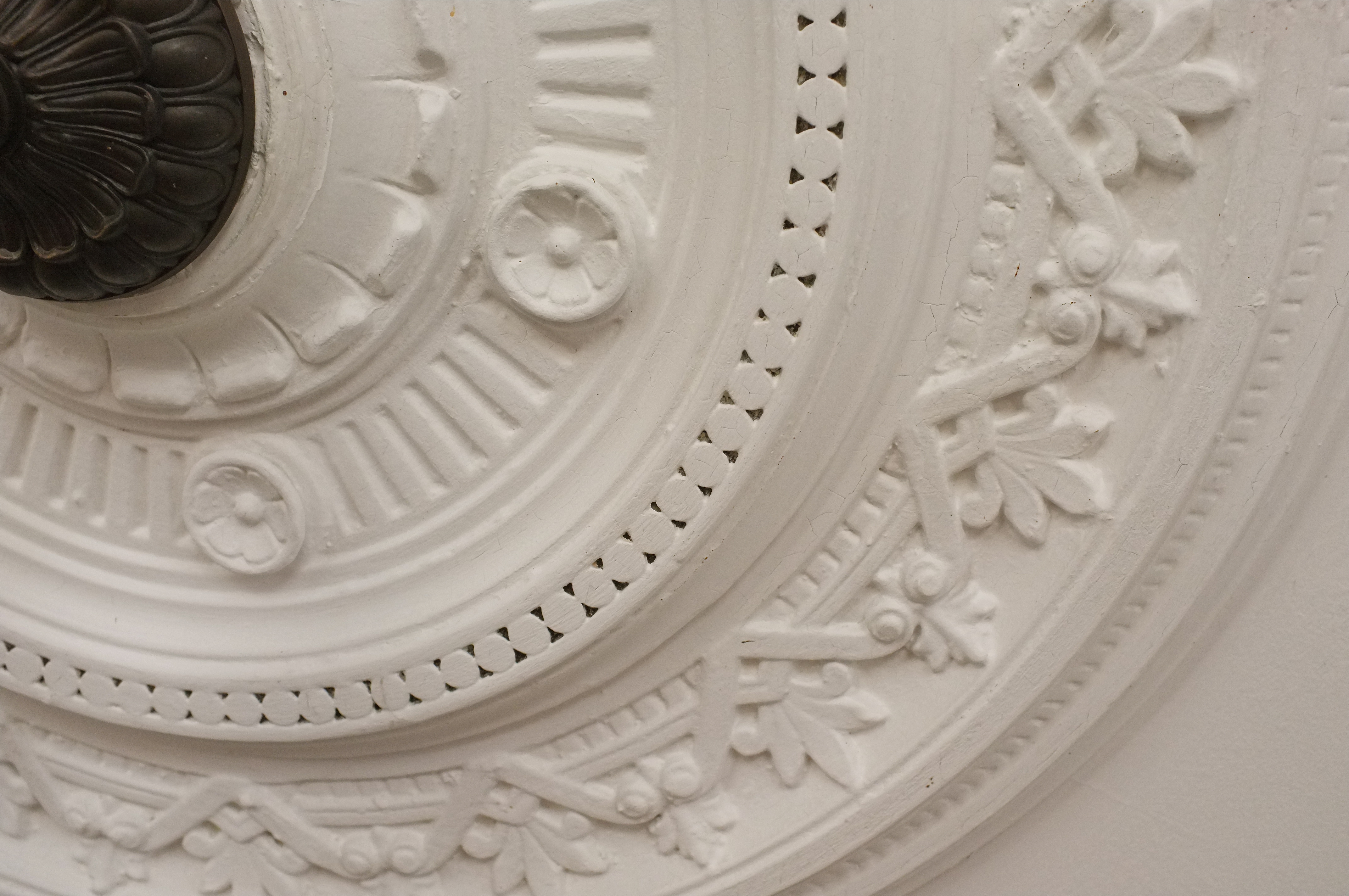
Plaster Ceiling Medallion

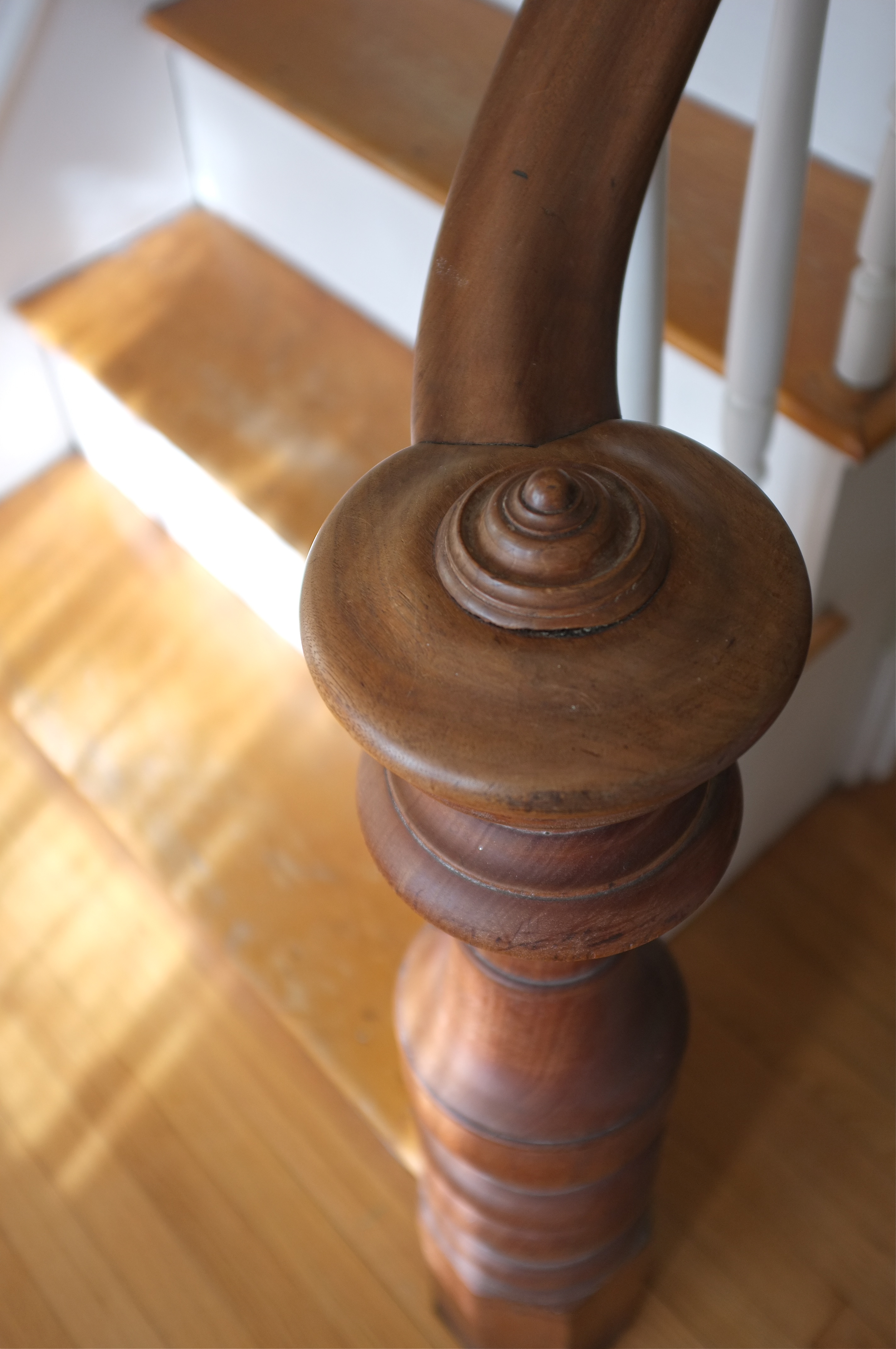
To think of it, we are following in an old Gloucester and northern seacoast tradition by tending to the interior of our homes during these winter months, in that of “house-pride.” The town’s carpenters, many of whom were master shipbuilders and shipwrights, would have had more free time during the winter months. Fine carpentry details are evident throughout our house, which was built in 1851. And, like many of Gloucester’s older houses, our home is graced with details created by the skilled plasterers that emigrated from Italy and settled on Cape Ann. Although a modest house, certainly by today’s “starter castle” standards, I wouldn’t trade our lovely 19th century home, with its quirky and elegant details (along with its all its foibles) for all the world’s McMansions.

Hand Carved Newel Post

I propose Antennae for Design will encompass home and garden design inspiration, home improvement tips, feature interviews with local business owners who specialize in art and design, and after visiting local, well-tended homes and gardens, sharing information found there.  Let me know through the comment section or by emailing at kimsmithdesigns@hotmail.com of your thoughts and any topic that you may find particularly relevant or of interest.

A Second Go-around with Hippeastrum (Amaryllis)

Round Two with Hippeastrum

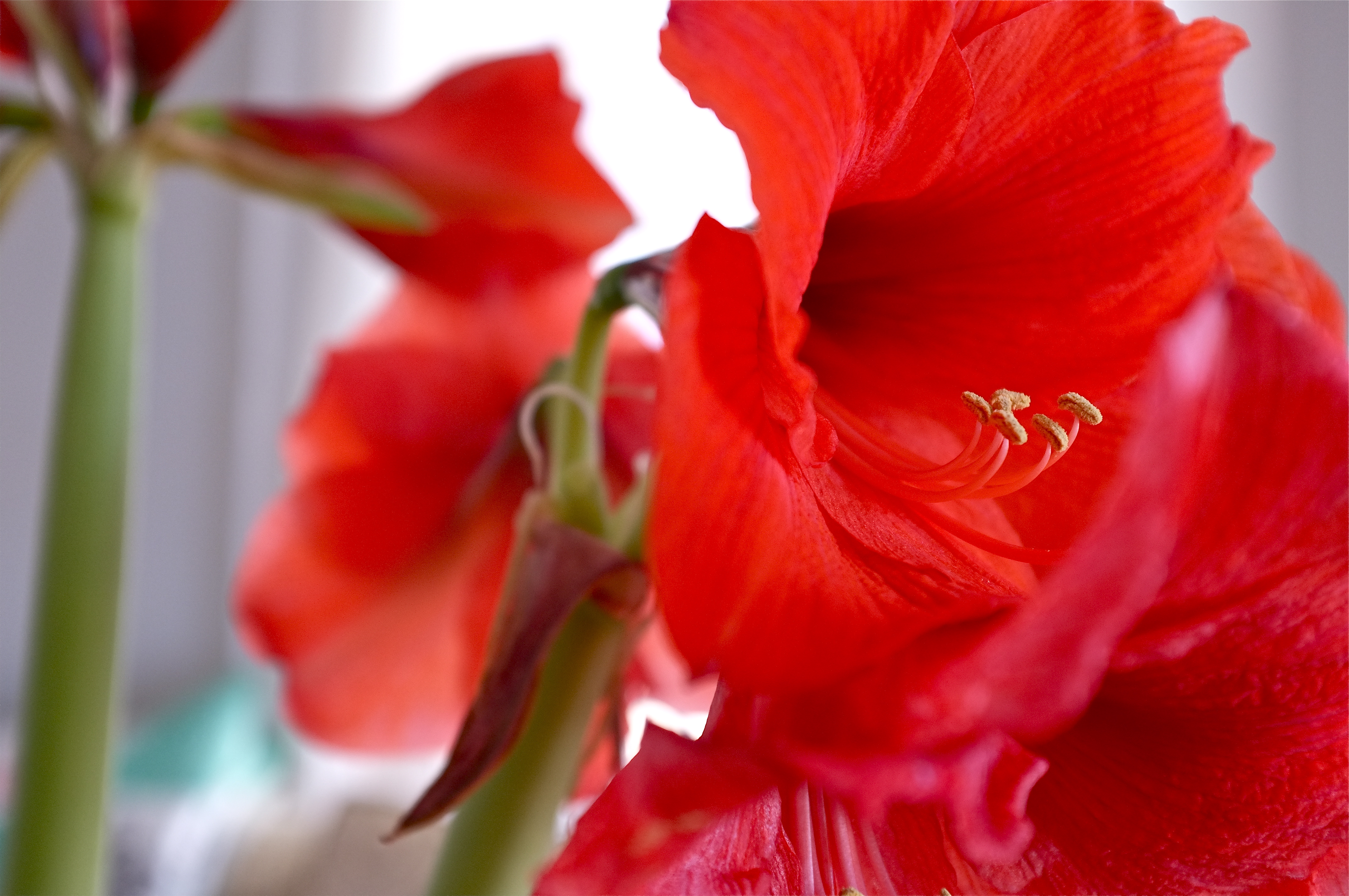
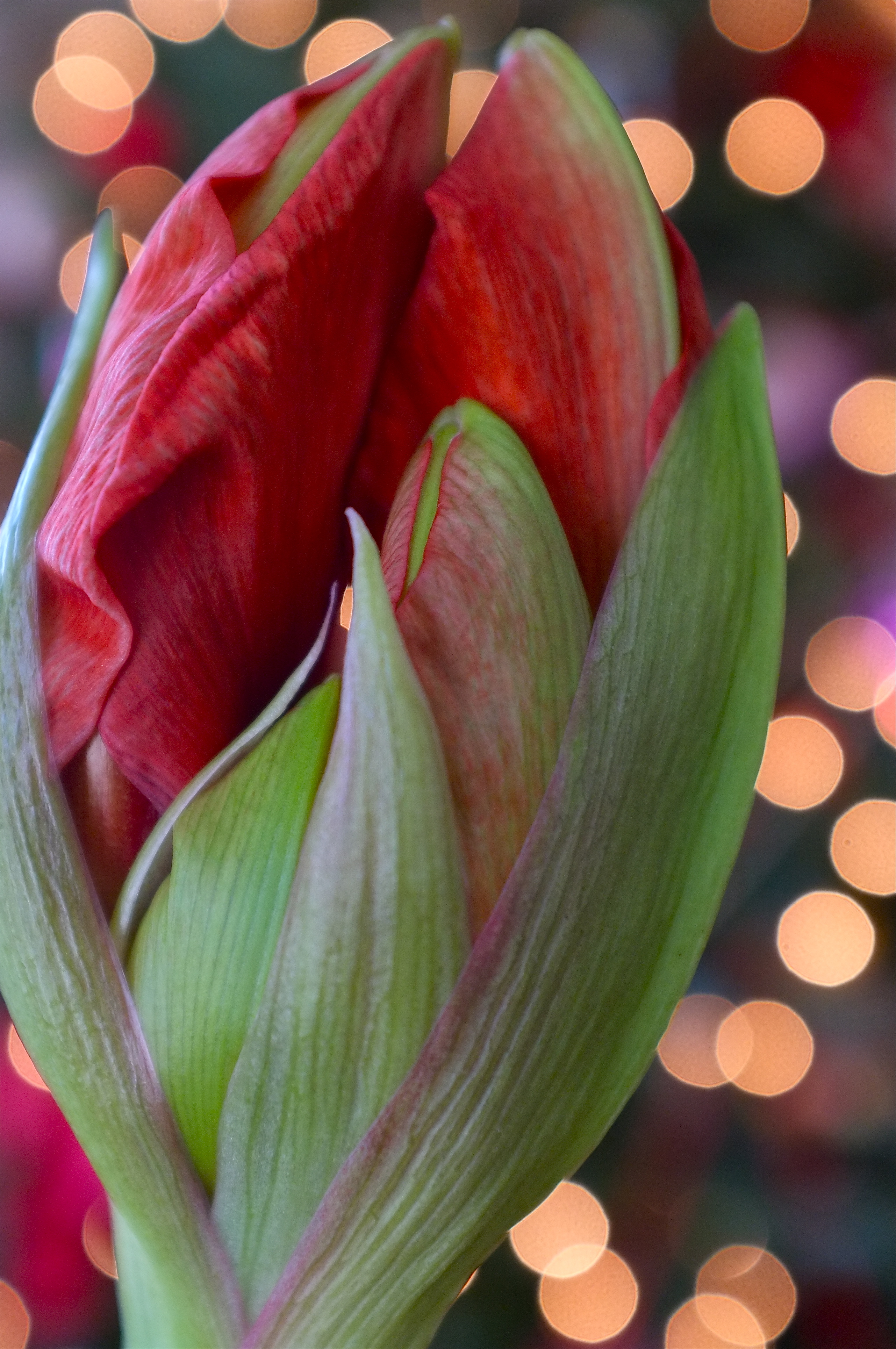
‘Orange Sovereign’  has given us a second stalk, and it too, is laden with gorgeous, satiny buds.

Bulb-buying tip: Upon seeing the second stalk, a friend visiting our home last week remarked that the amaryllis she purchases at the supermarket typically only have a few flowerheads and rarely a second stalk. I recommend purchasing Hippeastrum (amaryllis) bulbs in the fall, through local nurseries and bulb suppliers. Select the plumpest and firmest bulb available. The supermarket bulbs are usually boxed and pre-packaged, which doesn’t allow the opportunity to inspect the bulb.  Both Corliss Bros. and Wolf Hill carry a great selection of Hippeastrum bulbs.

Treasures found locally ~ a pair of hand-painted Czechoslovakian lamps

A recent find for one of my design clients is this pair of sweetly hand-painted Czechoslovakian lamps, with coordinating shades trimmed in blue silk cord, discovered at a local vintage shop.

Forget-me-nots and Roses

I love the challenge of searching for and finding one of a kind (or in this case, a pair of) treasures for my design clients. And I partuclarly love one of my ongoing design jobs for a simply delightful family, with three lovely and lively daughters, each with their own very distinct personality and style preference. The eldest daughter is zippy and lighthearted with a definite flair for the modern; the second daughter is gently refined and ethereal (I think of watercolor hues for her); and the third daughter is possessed of a warm and sunny character—a radiant sunflower. The pair of Czechoslovakian lamps will add a charming touch to the middle daughter’s bedroom. Whether you are searching for special plants for the garden (the most highly scented specimens, for example) or rare and/or out-of-the-ordinary objects of art and decoration for the home, thoughtfully selected accents create the most welcoming sort of home.

Important Safety Note: Although these lamp bases are in near-perfect vintage condition, the cords are not. Judging from the overall poor condition of the cords, I would guess they were last wired in the late 1950’s or 1960’s. We will re-wire the lamps with soft gold-colored cord, which will better blend with the dĂ©cor, as opposed to the dark brown or stark white wire. Always, and always very thoroughly, check the wiring when purchasing vintage lighting—for obvious reasons, I cannot stress this enough.

Hippeastrum

A Note about Hippeastrum 

Living in New England the year round, with our tiresomely long winter stretching miles before us, followed by a typically late and fugitive spring, we can become easily wrapped in those winter-blues. Fortunately for garden-makers, our thoughts give way to winter scapes of bare limbs and berries, Gold Finches and Cardinals, and plant catalogues to peruse. If you love to paint and write about flowers as do I, winter is a splendid time of year for both, as there is hardly any time devoted to the garden during colder months. I believe if we cared for a garden very much larger than ours, I would accomplish little of either writing or painting, for maintaining it would require just that much more time and energy.

Coaxing winter blooms is yet another way to circumvent those late winter doldrums. Most of us are familiar with the ease in which amaryllis (Hippeastrum) bulbs will bloom indoors. Placed in a pot with enough soil to come to the halfway point of the bulb, and set on a warm radiator, in several week’s time one will be cheered by the sight of a spring-green, pointed-tipped flower stalk poking through the inner layers of the plump brown bulbs. The emerging scapes provide a welcome promise with their warm-hued blossoms, a striking contrast against the cool light of winter.

Perhaps the popularity of the amaryllis is due both to their ease in cultivation and also for their ability to dazzle with colors of sizzling orange, clear reds and apple blossom pink. My aunt has a friend whose family has successfully cultivated the same bulb for decades. For continued success with an amaryllis, place the pot in the garden as soon as the weather is steadily warm. Allow the plant to grow through the summer, watering and fertilizing regularly. In the late summer or early fall and before the first frost, separate the bulb from the soil and store the bulb, on its side, in a cool dry spot—an unheated basement for example. The bulb should feel firm and fat again, not at all mushy. After a six-week rest, the amaryllis bulb is ready to re-pot and begin its blooming cycle again. Excerpt from Oh Garden of Fresh Possibilities! ~ Coaxing Winter Blooms

Click last photo to see slideshow

The taxonomy of the genus Hippeastrum is complicated. Hippeastrum is a genus of about 90 species and over 600 hybrids and cultivars, native to topical and subtropical regions of the Americas from Argentina north to Mexico and the Caribbean. For some time there was confusion amongst botanists over the generic names Hippeastrum and Amaryllis, which led to the application of the common name “amaryllis” when referring to Hippeastrum. The genera Amaryllis refers to bulbs from South Africa.

My Interview with Isabelle Lafleche on Pink Lemonade

My friend and fellow author Isabelle Lafleche has posted her interview with me on her always super fun and chic blog Pink Lemonade. Isabelle posts the most wonderful high-style photos, garnered from fashion and style publications from all around the globe.

Isabelle’s first novel J’adore New York (Harper Collins) has been published in French, English, and German and is now available in paperback. Isabelle and her fiancĂ©  simply love Cape Ann and are looking to, in the very near future, move from Montreal and Paris to our community! More on Isabelle in a future post.

Isabelle’s Upcoming Novel

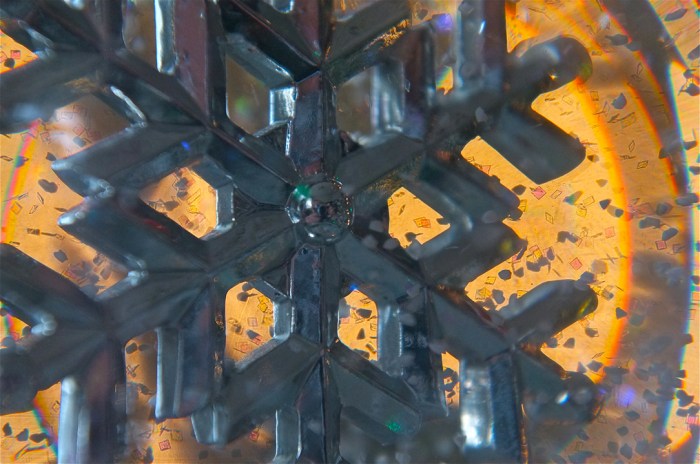
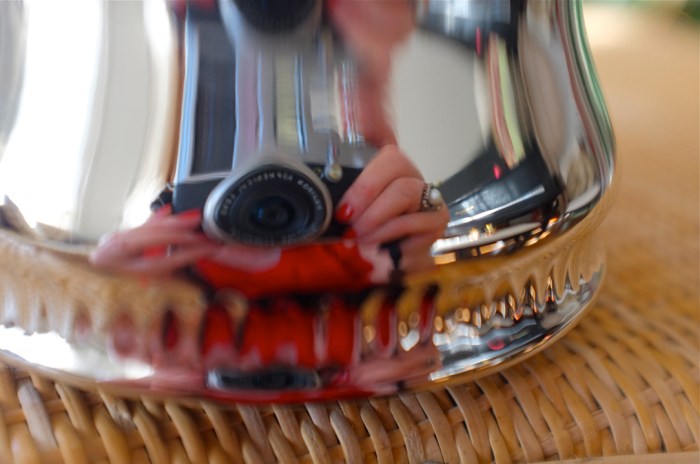
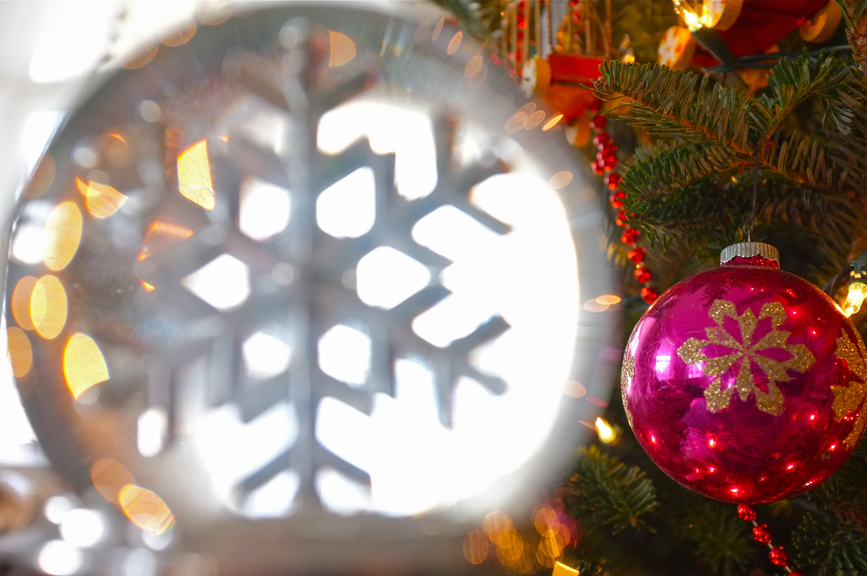
Snow Dome Series

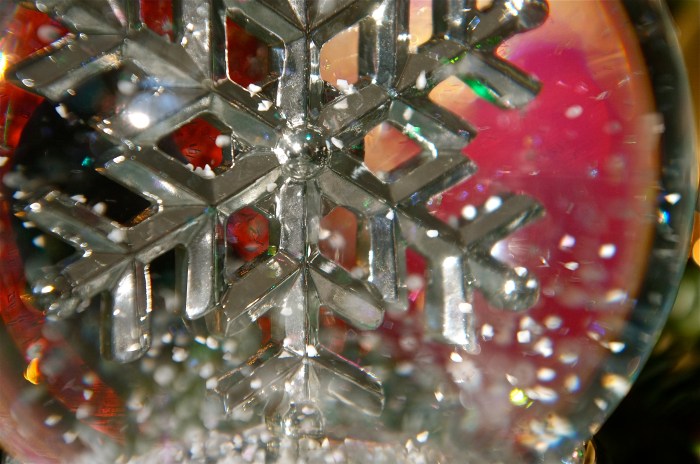
For the past week, while at home and in between holiday baking, at different times throughout the day under varying degrees of low winter light, I’ve been taking photos of this snowiest of “snow storms.” The light coming through the living room windows coupled with the Christmas tree lights created myriad fascinating effects, making it difficult to chose which photos to post. Click any photo to see the complete slideshow.

From wiki: Precisely when the first snow globe (also called a” water globe,” “snow storm,” or “snow dome”) was made remains unclear, but they appear to date from France during the early 19th century. They may have developed as a successor to the glass paperweight, which had become popular a few years earlier. Snow globes appeared at the Paris Universal Expo of 1878, and by 1879 at least five companies were producing snow globes and selling them throughout Europe.

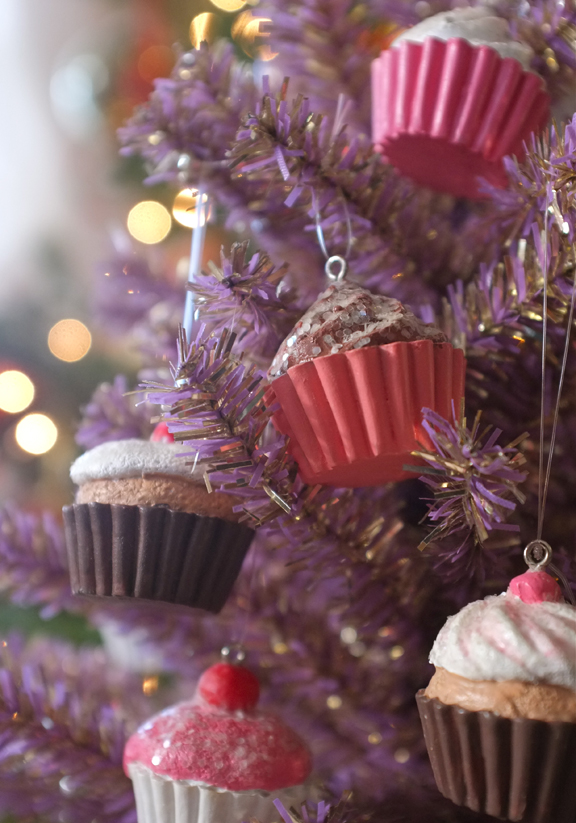
Christmas Whimsy

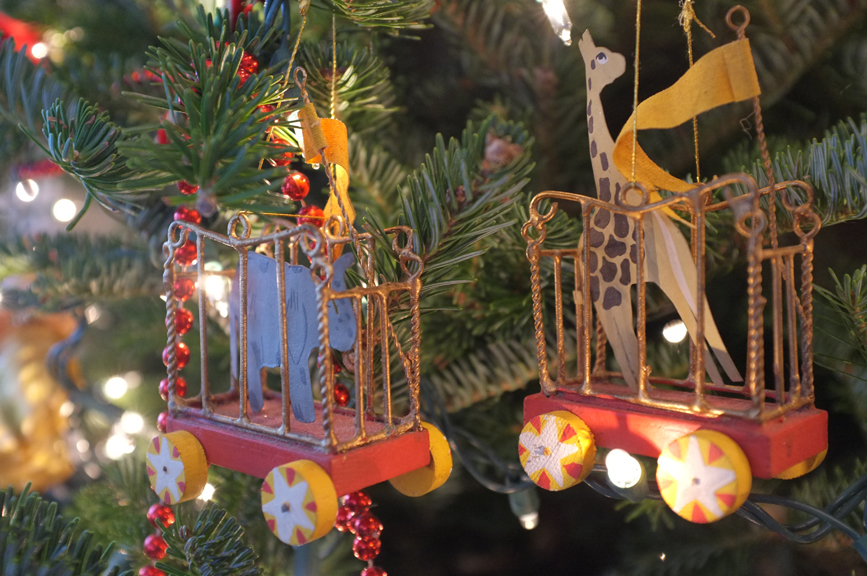
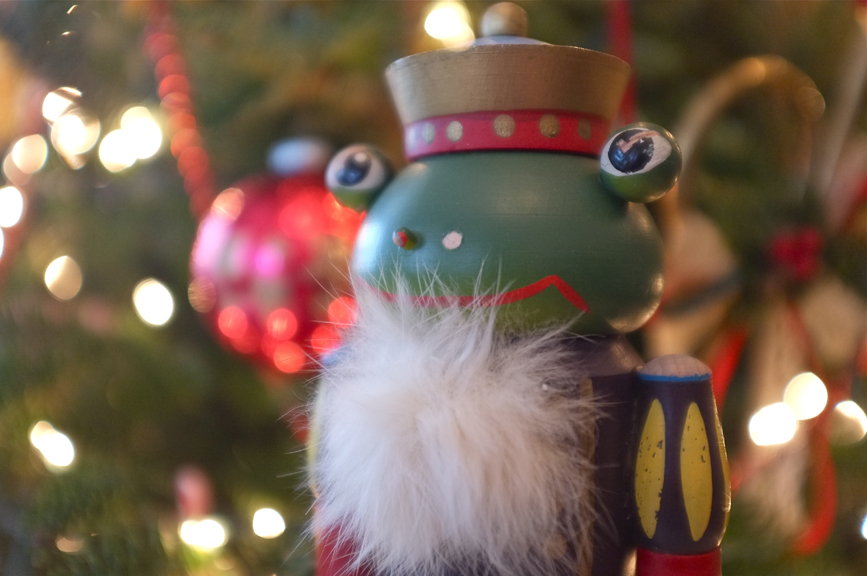
Vintage Christmas Decorations ~ snowflake, cupcake tree, circus Noël , nutcracker frog prince, and music box Santa

Happy Holidays!

Santa Baby


Having fun photographing Christmas decorations around the house. My husband Tom made this cardboard Santa for me –that year Santa was bearing a jewelry box with a very pretty ring…

Santa Baby, slip a sable under the tree, For me.
been an awful good girl, Santa baby,
so hurry down the chimney tonight.

Santa baby, a 54 convertible too,
Light blue.
I’ll wait up for you dear,
Santa baby, so hurry down the chimney tonight.

Think of all the fun I’ve missed,
Think of all the fellas that I haven’t kissed,
Next year I could be just as good,
If you’ll check off my Christmas list,

Santa baby, I wanna yacht,
And really that’s not a lot,
Been an angel all year,
Santa baby, so hurry down the chimney tonight.

Santa honey, there’s one thing I really do need,
The deed
To a platinum mine,
Santa honey, so hurry down the chimney tonight.

Santa cutie, and fill my stocking with a duplex,
And checks.
Sign your ‘X’ on the line,
Santa cutie, and hurry down the chimney tonight.

Come and trim my Christmas tree,
With some decorations bought at Tiffany’s,
I really do believe in you,
Let’s see if you believe in me,

Santa baby, forgot to mention one little thing,
A ring.
I don’t mean on the phone,
Santa baby, so hurry down the chimney tonight,
Hurry down the chimney tonight,
Hurry, tonight.                                     Joan Javits and Philip Springer

“Santa Baby” was originally recorded by Eartha Kit with Henri Rene and his orchestra in New York City, 1953.

Orange Wine

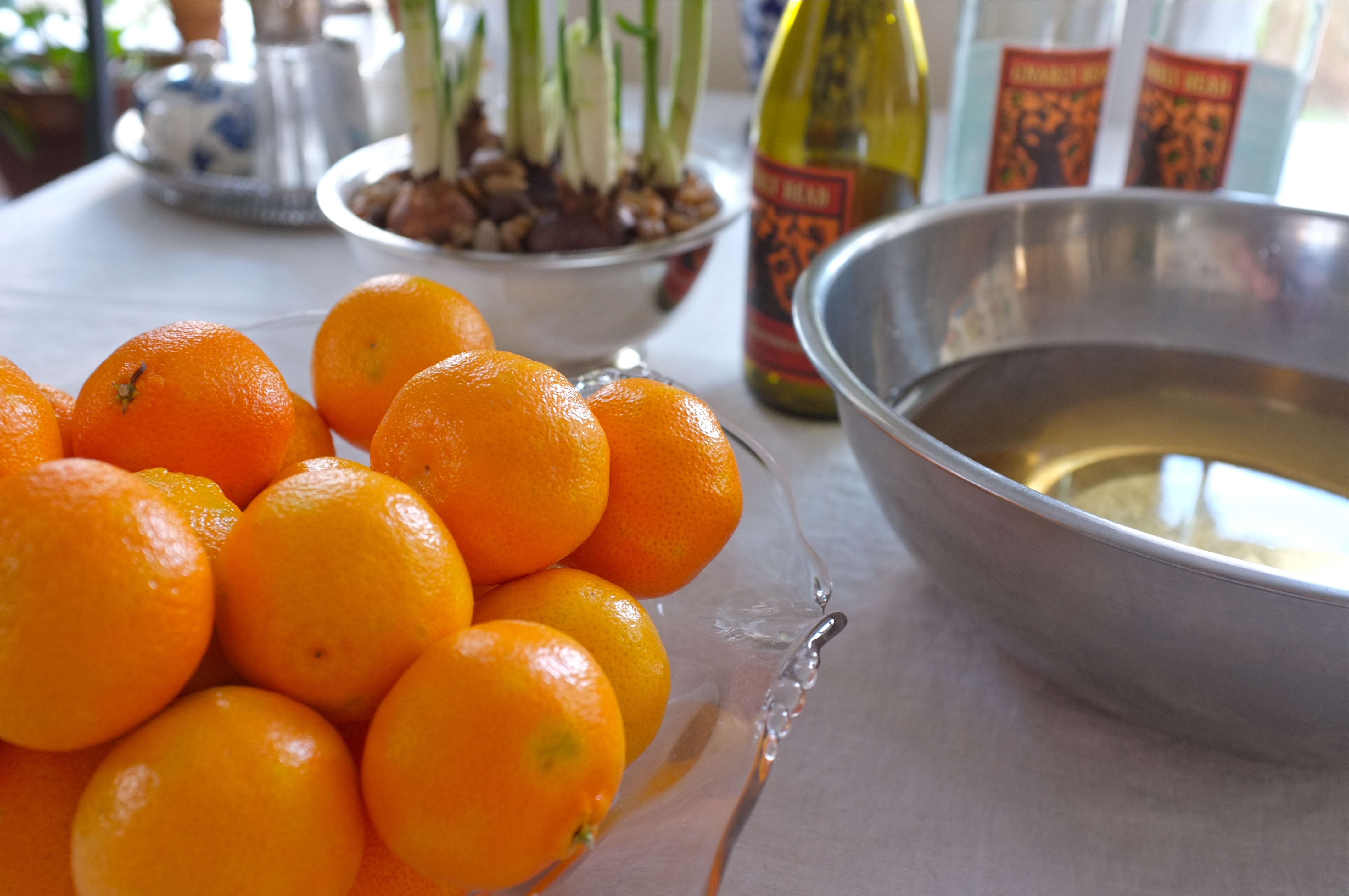
Orange infused wine, or vin d’orange, is a warm weather Provençal aperitif, but I never remember to make it during the summer months, only during the holidays. Although, when drinking it, I like to imagine sipping orange wine from a garden somewhere (anywhere!) along the CĂŽte-d’Azure. Vin d’orange is marvelously easy to prepare and makes a much appreciated holiday host/hostess gift.

Over the years I’ve experimented with the original recipe, which was, to my way of thinking, much too sweet—add more sugar if you like a sweeter aperitif. I think you will find this concoction intoxicatingly fun, light, and aromatic. I hope your family and friends enjoy as much as do mine!

12-15 Clementines thoroughly washed and cut in half

3 bottles modestly priced dry white wine

1 Cup sugar

œ Cup Courvoisier

Long strips of orange zest

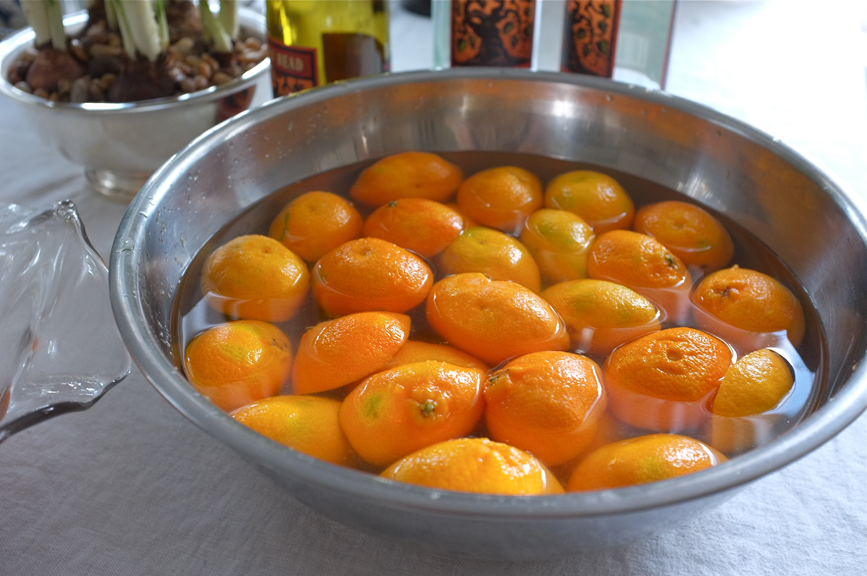
In a large glass or stainless steel bowl combine the wine and Clementines, gently squeezing each half to release some of the juice. Cover tightly and refrigerate for 5 days. Save the empty wine bottles and corks; wash and remove labels. You will need a fourth empty bottle.

Remove orange infused wine from the refrigerator and squeeze any liquid remaining in the orange halves into the large bowl. Discard oranges. Add the sugar and cognac, stirring until the sugar is dissolved. Strain through a sieve lined with cheesecloth. Pour wine concoction into wine bottles. Insert a strip of the zest into each bottle and cork. Chill the wine for one week. Serve neat or over ice. The vin d’orange will keep for 6 months when chilled. Makes approximately 4 bottles.

Dear Readers, There must be a southern Italian equivalent to vin d’orange? In Italy they make something entirely different, also called orange wine. Italian orange wine is made from white grapes that have been left to ferment with their skins, treated in essence like red wines. These wines may macerate for days or even months, which gives the wine color shades varying from rosy pink  to amber cider to vivid orange, however this is a different process than wine infused with oranges. Please write if you know of an Italian version of the Provençal aperitif or some similar deliciously fun fruit infused wine recipe.

Christmas Tree for Liv

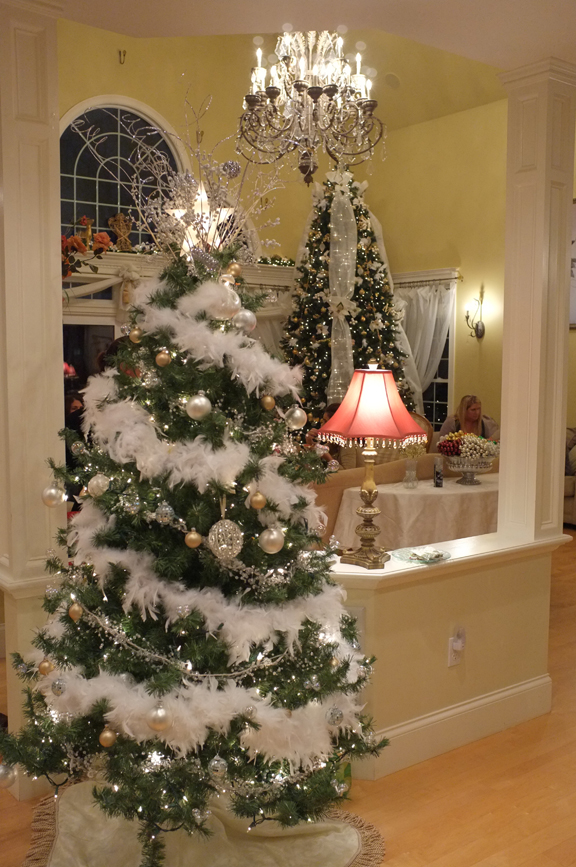
My darling daughter, away at graduate school, is missing home and missing especially Christmas-making. She called last night to request a snapshot of our Christmas tree. My wish for Christmas was that both Liv and Alex could come home for Christmas.  Alex we knew for sure would be home (if for no other reason than he misses home cooked dinners) but Liv started a brand new job with a crazy schedule and is mired in papers and finals.  I learned yesterday that she will be traveling home on the 21st and son will be home Thursday of this week. Happiest of moms am I!

Click any photo for slideshow.

Felcia’s Beautiful Christmas Party

Felcia’s Christmas Party (Ladies Only!) -with a brief appearance by son BJ and husband

Warm and welcoming ~ beautiful home, beautiful decor and decorations, wonderful company, and fabulous refreshments ~ The wine glasses (see photo below) were given to each guest and were hand painted by Felicia and Joey’s mom, Pat.

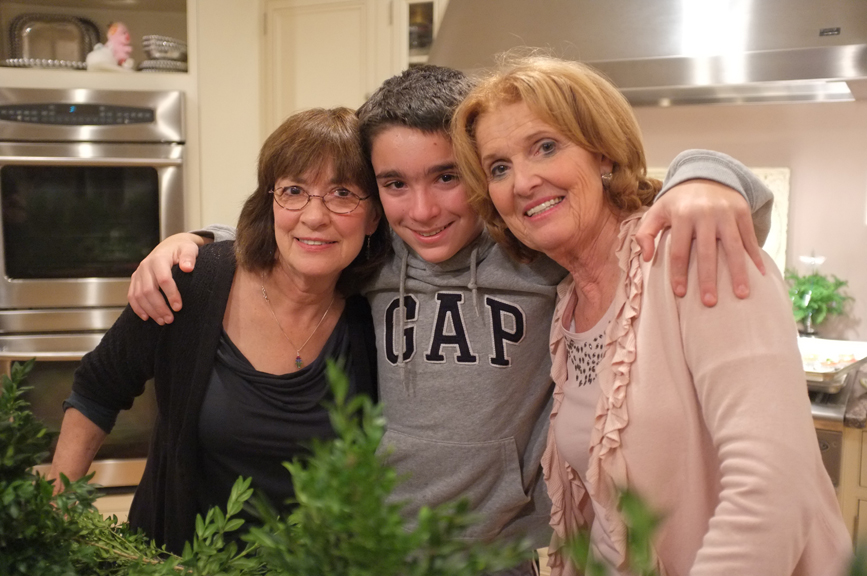
The guests included family and friends and it was wonderful to meet several mother-daughter pairs and mother-in-law and daughter-in-law pairs. Next year Felicia is planning to combine her annual Christmas ladies only party with creating boxwood trees with a fundraiser. I am sure she will pull it off beautifully and with great style!  Click the last photo to see a slide show.

Click the last photo to see a slideshow.

Chocolate Amaretto Truffle Recipe

Mini baking cups

2 ounces Baker’s sweet German chocolate, broken into small bits

6 ounces Ghiradelli semi-sweet chocolate chips

Œ C. Disaronno Amaretto liqueur

2 Tbs. strong coffee

Few drops almond extract

2 ounces (1/2 stick) unsalted butter, softened

1 Tbs. vanilla extract

œ C. pulverized Jules Destrooper almond thins (or Anna’s, or any super fine, thin cookie)

Confectioner’s sugar to taste (approx. ÂŒ cup)

œ C. Ghiradelli unsweetened cocoa powder for final powdering

Melt sweet chocolate bits and semi-sweet chocolate chips over a gently simmering double boiler.

Whisk in liqueur, coffee, almond extract, and vanilla. Whisk vigorously, over gentle heat, a few minutes more until mixture is shiny and smooth. Gradually add the butter by tablespoons. With a wooden spoon, beat in the pulverized cookies. Beat in sifted confectioner’s sugar, to taste. Remove the pan from the double boiler and place in a bowl of ice with water. Stir until well chilled and firm enough to form into balls.

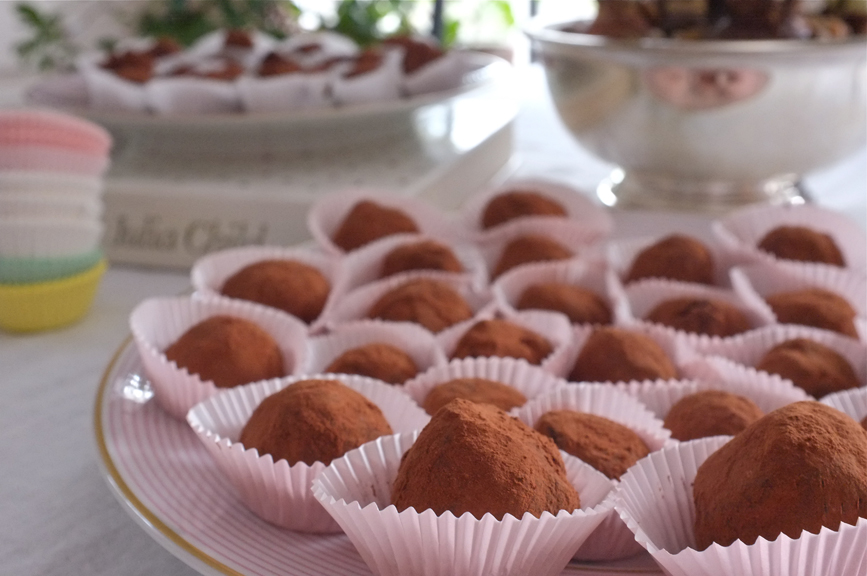
By teaspoonful, gather up a gob and form into a rough, truffle-like shape. Roll in cocoa powder and drop into frilled paper cup.

Makes about 22, depending on size. Refrigerate in an airtight container. They will keep for several weeks or they may be frozen. (Very) loosely adapted from Julia Child’s Chocolate Amaretti Truffles The Way to Cook Page 485.

Let me know if you try this recipe. I think you will find it super easy and very worth your while.

Amaretto Truffles

Decadence!

I tried several truffle recipes this morning–this adaption of Julia Child’s Amaretto Truffles were clearly the best! Let me know if you’d like the recipe.

Oh Garden of Fresh Possibilities!

Dear Friends,

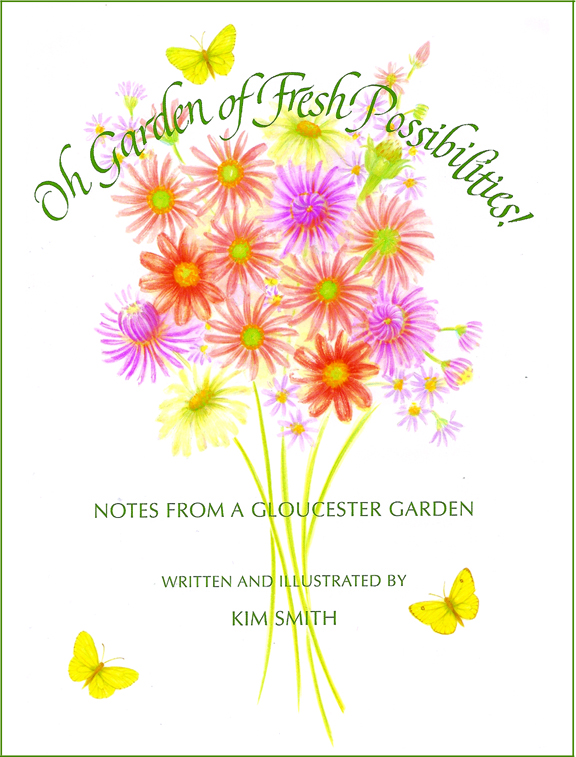
It’s that time of year again for holiday gift making and gift giving. Possibly you are one of those fantastically super organized holiday spirits finished with your holiday shopping, or even more probably, you’re not in the mood to hear another holiday commercial. If so, please forgive, but I am writing to suggest that my book Oh Garden of Fresh Possibilities! ~ Notes from a Gloucester Garden, which I wrote and illustrated, makes a wonderful holiday gift. If you already own a copy, perhaps you will agree that it would make a thoughtful gift for that someone on your list who loves to garden, or a young couple who may have recently purchased a home and needs sound advice, or someone who simply likes to read about flowers, butterflies, garden lore, and garden-making.

Oh Garden of Fresh Possibilities! Front Cover 

This is a link to the Press Page of my blog, where you can read excerpts of reviews by The Boston Globe’s Carol Stocker, Bloomsbury Review, Patriot Ledger, North American Butterfly Association, and more. With spending any spare hours blogging and my video projects and garden design newsletter, I am embarrassed to say that my website has not been updated in over a year, however, both the Book Page and Story Page on my website provide more information about Oh Garden. 

Oh Garden of Fresh Possibilities! is available at Toad Hall, and wherever fine books are sold.

Excerpt from the introduction ~

We all carry within us the image of a home to create and a garden to tend. Perhaps you dream as I do of a welcoming haven to foster family bonds and friendships and to rejoice in life’s journey. The garden and the home to which it belongs becomes a memory catcher to weave a life’s tapestry.  To read more 

Aloha

Rosa ‘Aloha’

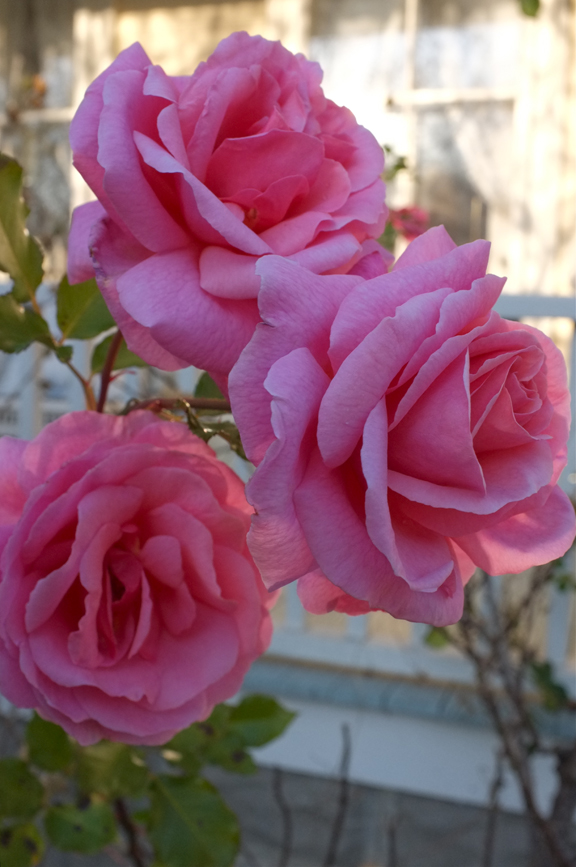
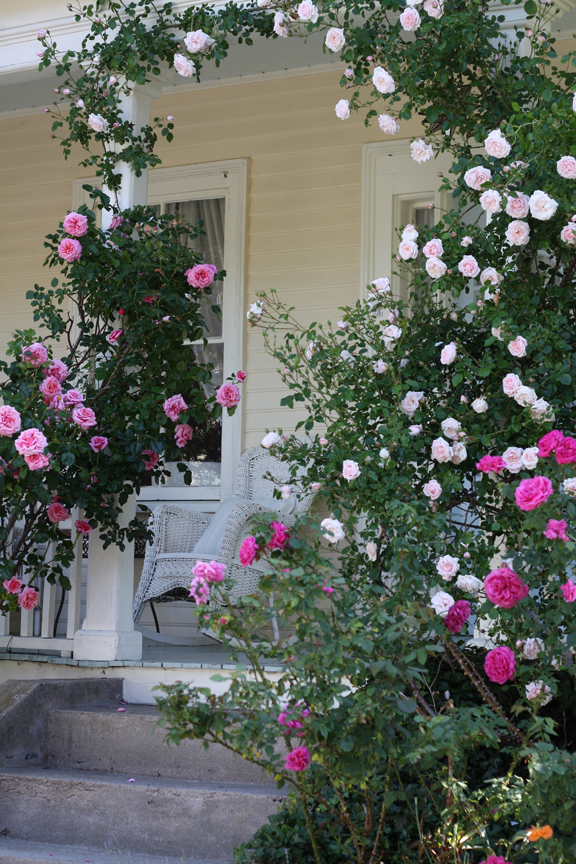
The French have a beautiful sounding word for a repeat flowering rose and, without doubt, the most remontant rose that we grow is ‘Aloha.’ Embowering our front porch pillars, she welcomes with her fresh-hued beauty. ‘Aloha’ begins the season in a great flush, followed by a brief rest, and then continues non-stop, typically through November, and in one recent, relatively mild autumn, into December. With one bud yet to open, I imagine this year will be another where I can claim she bloomed into December. I like her so very much that I planted a second and then third and they are all three sited where we can enjoy her great gifts daily.

‘Aloha’ Blooming in Mid-Novmeber

‘Aloha’s’ buds are full and shapely, and colored carmine rose with vermilion undertones, giving us a preview of nuanced shades to come. She unfurls to form large, quartered, and subtly two-toned blossoms, initially opening in shades of clear rose-pink with a deeper carmine pink on the reverse, or underside of the petals. The blossoms are long lasting, fading to a lovely shade of  pale coral pink. And the petals fall loosely, never becoming balled clumps. With luxuriously long stems and shiny emerald foliage, ‘Aloha’ also makes a divine cut flower.

Oh, and I can’t believe I am several paragraphs in and haven’t yet mentioned her fragrance. She not only welcomes with her great beauty, but also with her potent and dreamy scent. I have often heard ‘Aloha’ described as having a green apple fragrance, but find that description only partially accurate; the scent is really much more sophisticated, with notes not only of fresh Granny Smith apple, but also the warm sensuous undertones of the old Damask and Bourbon roses.

‘Aloha’ (Left Pillar) Blooming in Early June

For more photos and to read the full article visit Kim Smith’s blog