American Marine Model Gallery

The challenge for anyone trying to take a picture of a schooner or any other masted vessel is getting up close for all the detail while keeping the mast and or bowsprit in the frame.  You can elect to take a picture of the entire boat or you can take portions, leaving out the bowsprit and/or mast.  For our purposes here I wanted to take you in  close so you could see just how detailed these ship models are.  If this picture was taken of the entire boat you wouldn’t get the up close details.

As always you can click on the picture and select “all sizes” to see the larger version of this picture.

American Marine Model Gallery, originally uploaded by captjoe06.

18th Century French Bomb Catch Model At The American Marine Model Gallery

This 18th century French bomb catch is an example of a natural wood ship model versus one that would be painted, copper sheathed or other type of model.  This type of ship model shows shows the wood on wood construction.

American Marine Model Gallery, originally uploaded by captjoe06.

Michael Wall At The American Ship Model Gallery Part II

Michael Wall Displays Different Styles Of Ship Models In This Second Installment Of Our Video Interview

Gloucester’s Poet Laureate John Ronan Part I

John Ronan tells us what it means to be Gloucester’s Poet Laureate, the responsibilities that come with the title and more.

You can visit his website- TheRonan.org by clicking this text

Michael Wall At The American Ship Model Gallery Video

Click The Picture To View The Video

American Marine Model Gallery

Behind these doors lay a vast collection of beautiful ship models, collected and for sale by Michael Wall.  The first installment of our four part video series starts today at 8AM.

Also on tap for today is the first part of my interview with Gloucester’s Poet Laureate, John Ronan.

Sharon’s “Where Zat?”  location guessing game will be posted at her normal time of 12PM today, Monday.  There’s a lot to look forward to this week, check back, every hour on the hour for a new fresh slice of Gloucester.  We have Gloucester restaurant food pics, some new construction updates, derby pictures and interviews.   There’s just a ton.  Hope you all are enjoying this stuff as much as we’re enjoying bringing it to you.

American Marine Model Gallery, originally uploaded by captjoe06.

Michael Wall’s American Marine Model Gallery

Are you one of those people like me that have walked past the portholes at the American Ship Model Gallery at 20 Pleasant St and wondered what it was like in there?

Well wonder no more my friends because once again your good pal Joey gets inside to bring you behind the scenes and informs you what the heck is going on like no one else.

Look for the first of a four part video series of interviews with Michael Wall starting Monday.

Dory Buff Dory Paint

This is the paint that is used on all the topsides of the International Dory Race Boats.  Some pics down below-

Dory Buff Dory Paint, originally uploaded by captjoe06.


Geno Mondello’s Dory Shop-The Knees Of The Dory

Inside the dory the knees are placed as a frame.  It is interesting to note as Geno told me in the first part of our video interview that the knees are made from the tree trunk.  The tree trunk has a natural bend when it enters the earth which lends strength to where the curve is going to be on the inside of the boat.

Geno Mondello’s Dory Shop, originally uploaded by captjoe06.

Dory Racing History With Geno Mondello

Click The picture To View The Video-

Dragger Pamet Door

This is one door out of a set of two which separate the net when it is set off of the stern of the trawler(dragger).  The chains you see are attached to the cable wire which is released from the winch.  Then the net is attached to the doors to get the spread needed to maximize the area of open net and snare as much fish as possible.

Dragger Pamet Door, originally uploaded by captjoe06.

Geno Mondello Dory Shop Video Part I

Click The Picture To View The Video-

Geno Mondello’s Dory Shop

Here’s Geno working away in the Dory shop.  I wonder if he considers it work when you do something you obviously love.  I’ll have to ask him next time I see him.

Look for the first part of our interview today at 2:00PM

Geno Mondello’s Dory Shop, originally uploaded by captjoe06.

Ron Gilson- Gloucester Fishing Historian Video Interview Part III

Gloucester’s True Fishing Industry Historian, Ron Gilson Talks About Gloucester’s Fishing Past In This Third Part Of Our Video Interview-

Geno Mondello’s Dory Shop

I stopped by Geno’s Dory Shop at The Gloucester Maritime Heritage Center yesterday.  Geno is currently working on a 17 foot hand line dory which will be auctioned off to benefit the Gloucester International Dory Race Organization.  The money raised through the raffle will be used to build more dorys.  Last year there were four dories and by the end of this year there will be eight.  The sport is just taking off thanks to the likes of Jimmy Tarantino, Glen Harrington, Katherine Richmond, Skip Levielle, and Kirk Dombrowski along with many other volunteers..

Look for my three part video series with Geno starting tomorrow which talks about the origins of dory racing, different types of dorys and how they are built and other surprises.

Geno Mondello’s Dory Shop, originally uploaded by captjoe06.

Trawling (Dragging) Explained Aboard The F/V Pamet

Trawler Pamet, originally uploaded by captjoe06.

The following text is about the best explanation of how Dragging or “Trawling” works in layman’s terms that I’ve run across. It comes from Oregon State University and the credits to the writers will be included at the bottom of the post.  Read the explanation of trawling and then look at the pictures I took this morning with the titles of each thing they are talking about so you can visualize what they are saying. Even though this is from Oregon, our fishermen fish the same way only for different species.

A trawler is a vessel that drags a funnel-shaped net through water to harvest fish or shrimp. The net is wide at the mouth and tapers back to a narrow cod end that collects the catch. The average bottom trawl opening is 40 to 60 feet wide and 8 to 10 feet tall. Bottom trawlers usually tow their nets at 1 to 2 knots on or above the ocean floor. Fishermen might tow midwater trawls faster to catch faster-swimming schooling fish.
Trawlers have a large metal trawl door that is attached to each side, or wing, on the front of the net. The water hits the doors and the pressure of the water passing over the door spreads the net open. The doors are flat, oval, or slightly v-shaped. A steel cable extends from the door to a winch just behind the pilot house. Most large trawlers have square sterns with inclined ramps and are referred to as stern trawlers. The nets are hauled aboard up the inclined Boom Bottom ramp on the stern. Older trawlers without inclined ramps haul their nets over the sides using a haul line and a block on an overhead boom to bring in the cod end of the net.

BOTTOM TRAWLERS

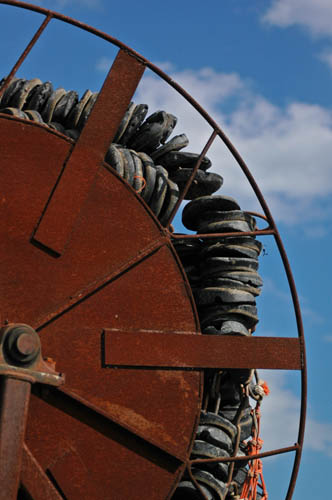
Bottom trawlers tow the net along the ocean floor to catch fish that live on or just off the bottom. These fish include rockfish, cod, sablefish (black cod), ocean perch, flounder, and sole. Trawls can be designed to catch particular groups of fish. A large mesh net (4 1/2 inches to 5 inches) is kept on a stern-mounted reel. The two doors are stored along the rails near the reel.

The net is set off the stern by unwinding the reel so that the cod end is put into the water first. The rest of the net is unrolled from the reel, and then the doors are placed in the water. Water pressure on the doors causes the doors to separate and open the net. Enough cable is then released to place the net at the desired depth. The upper lip of the net is lifted up by floats on the headrope while the lower lip of the net is pulled down by a weighted footrope. This action opens the net vertically.

Rubber discs may be attached to the net to hold it down. There are now restrictions on the size of the rubber discs that can be used on footropes when trawling on the Oregon continental shelf. These restrictions confine trawling to mostly smooth bottoms, such as sand and mud. Tow times can last from 30 minutes to several hours. Depths can range from 5 to 700 fathoms (a fathom equals six feet). Bottom trawlers typically fish from 1 to 40 miles offshore.

The crew hauls in the net by winching in the cables until the doors are back in place and most of the net is on the reel. Once the catch is on board, the net is reset for another tow. Then the fish are separated into deck bins (checkers) and put in the hold, where they are iced or refrigerated.

The Oregon State Research Report Can Be Found Here

Writers: Ginny Goblirsch and Steve Theberge
Consultant: Scott McMullen
Artist: Herb Goblirsch
Editor: Sandy Ridlington
Design: Rick Cooper

Ron Gilson- Gloucester Fishing Historian Part II

Gloucester’s True Fishing Industry Historian, Ron Gilson Talks About Gloucester’s Fishing Past In This Second Part Of Our Video Interview-

Ron Gilson- Gloucester Fishing Historian Video Interview

Gloucester’s True Fishing Industry Historian, Ron Talks About Gloucester’s Fishing Past

Lovely Bones- Leon Poindexter’s Labor Of Love

I’m really looking forward to seeing this boat take progress.

Here’s the Boston Tea Party Ships and Museum website where Leon is credited.