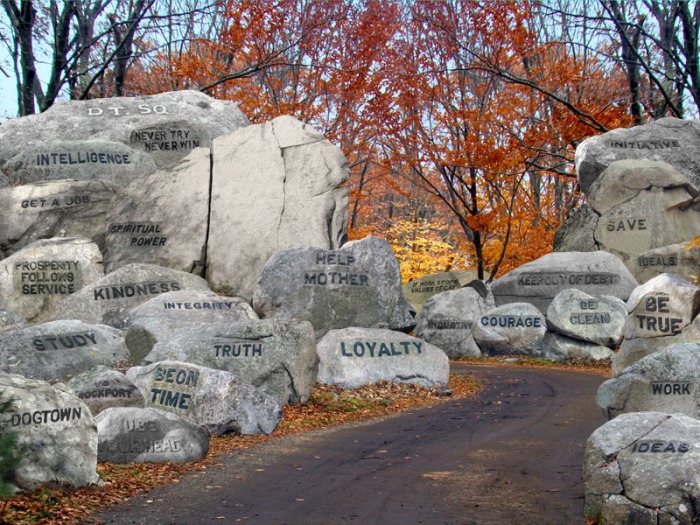
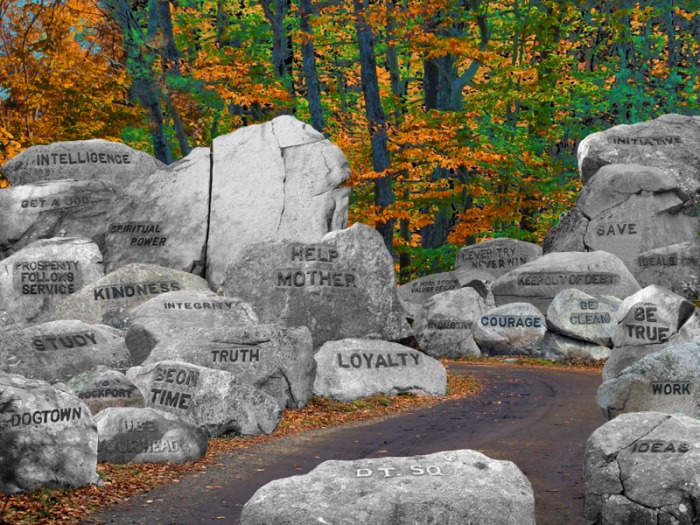
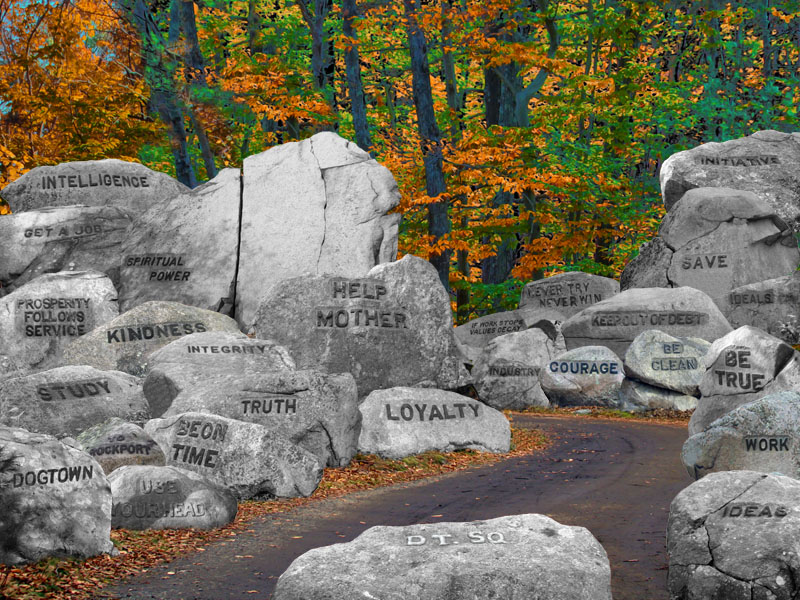
I’ve never built a stone wall, but creating this montage gave me an idea what it is like, without the heavy lifting. The boulders have been placed along the road leading from the Cherry Street entrance to Dogtown Road. There is one I couldn’t fit in – as with all stone walls, some rocks just don’t fit, and there is one I created which is not a Babson boulder. Can anyone identify the missing boulder, and which one doesn’t belong? Also, I did two versions and would be interested in knowing which one people like better, assuming you like them. The second version has the denser woods of Ravenswood in the background. They both contain the same boulders, but are placed a little differently in the 2nd version.
In case you didn’t know, Millionaire philanthropist, Roger Ward Babson (1875-1967), provided charitable assistance to unemployed stonecutters in Gloucester during the Great Depression, by commissioing them to carve these inspirational inscriptions on two dozen boulders in the area surrounding Dogtown Common. While the inscriptions are clearly visible, the boulders are scattered, not all are on the trail, and not all of the inscriptions face the trail, making finding them something of a challenge. There are an additional three boulders which are location or direction markers and are informational, not inspirational.
Babson was interested in the history of the abandoned settlement in Gloucester known as Dogtown. Dogtown (also Dogtown Commons or Dogtown Village) is located in a densely
wooded area of about five square miles, or 3,600 acres, in central Gloucester stretching from the Riverdale section of the city, north of Route 128, into Rockport, and includes
Goose Cove and the Babson Reservoir. Once known as the Common Settlement and populated by respectable citizens, it was for a century the most prosperous part of Gloucester.
Dogtown’s development and prosperity lasted from about 1650 until 1750. During this time, the area was home to many of Gloucester’s most prominent families, and since it was directly connected by road to all of Cape Ann’s seashore communities, the Commons Settlement, as it was called, was a thriving and successful hub of agriculture, timbering, and transportation. The peak of its population has been estimated at around one hundred families.
After new coastal roads were opened, and especially after the conclusion of the War of 1812 and its attendant risk of coastal bombardment, most farmers moved away from Dogtown. Their abandoned houses were for a few decades occupied by itinerants and vagabonds, giving the area its bad reputation. Many of the widows of sea-goers and soldiers
who never returned kept dogs for protection and company. As these last inhabitants died, their pets became feral and wild, roaming the moors and howling, possibly giving rise to
the nickname “Dogtown”.
Most of the area of Dogtown is now a dense woodland, peppered with house-sized boulders, criss-crossed and bisected by trails and old roads. The area is held in trust by
Gloucester and Rockport and therefore protected in perpetuity. Dogtown Road off of Cherry Street in the western section (the Gloucester side) is lined with the remains of the
cellar holes of the settlers. Babson also mapped and numbered the cellar holes left from the homes of Dogtown’s former residents.
(Excerpts taken from Babson College Archives – “Biography of Roger Ward Babson” and Wikipedia)
If you decide to go on a search for the Babson boulders, Eric Bickernicks has created a wonderful map with GPS coordinates for all the boulders, which was how my sister and I found some of the more hidden ones. You can find the map at http://www.bostonico.org/Babson_Boulder_Trail_Map.pdf. There is one small error on the map, which caused us some confusion. There is a boulder identified as “First at Tasks” which we thought an odd saying, and couldn’t find. In fact it is “First Attacked” and marks the spot where Jas Merry was first attacked by his bull. There is another marker nearby which identifies the spot where he died in 1892 from injuries sustained when the sport of wrestling his bull went bad.
E.J. Lefavour
http://www.khanstudiointernational.com/galleryphotomontage2013.htm
Spread The GMG Love By Sharing With These Buttons:























 Good Morning Gloucester