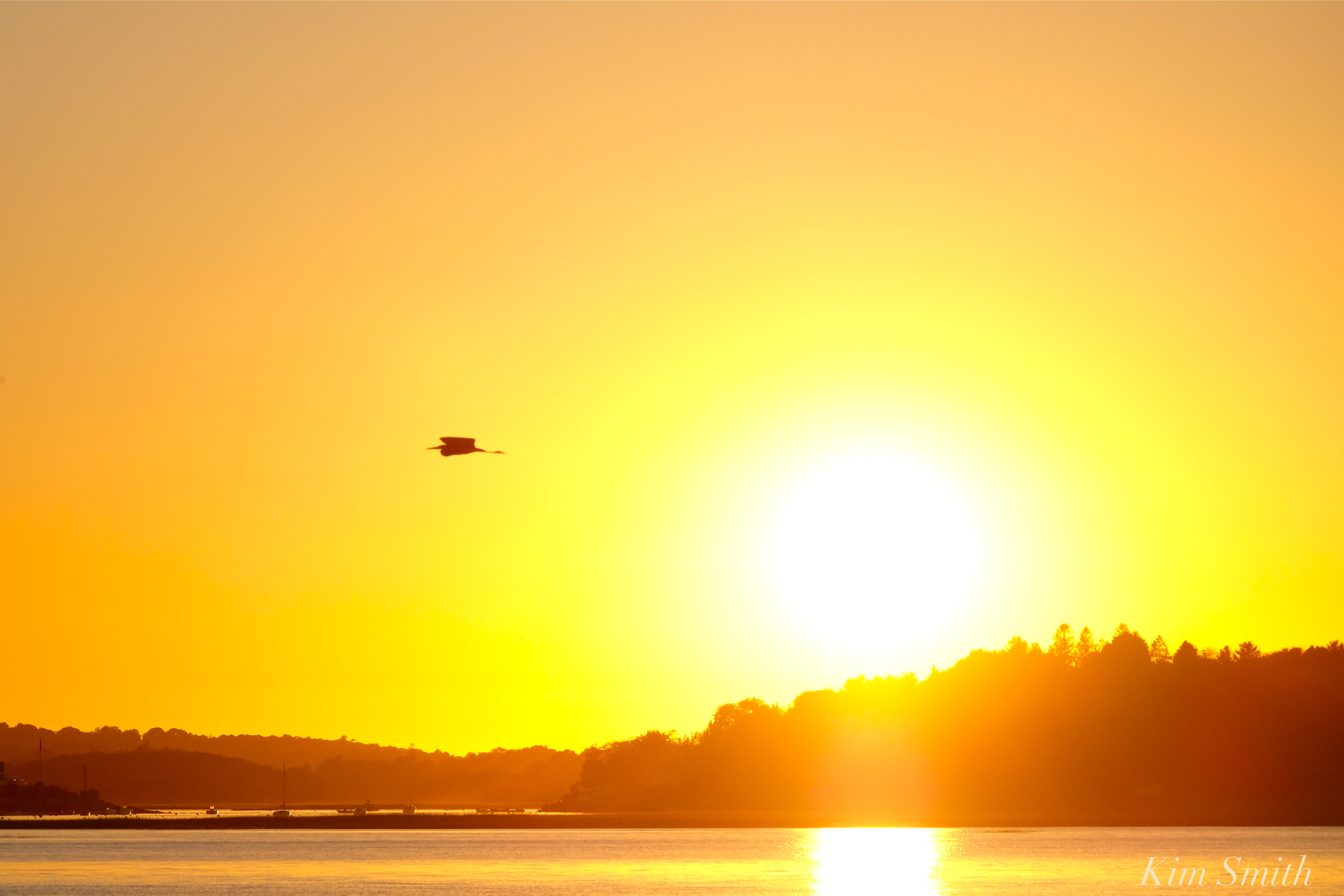
Essex River Sunset and Great Blue Heron
Readers, what do you think?
December 27th Gloucester Daily Times letter to the editor from Elizabeth and Brad Story.
“To the editor:
Cape Ann folks should be aware of the fact that there is significant opposition to dredging the Essex River in town and it comes from local people who know the river best. Rather than celebrating a boondoggle like dredging, we ought to be mourning a body blow to an incredible local natural resource.
The reason the Essex River hasn’t been dredged since the ‘90s is that dredging:
— actually causes the river to fill in more quickly;
— is terrible environmentally, no matter where the dredge spoils are dumped;
— is a waste of money.
When the channel is dredged, the banks are steeper. More boats use the river at higher speeds and the wakes and turbulence from the boats causes the steeper banks to collapse. The collapsed bank material fills in the channel. Now the river is spread out over the tops of the old banks and more filling in occurs.
We have seen this over and over again. If you look at the time period between dredging projects in the 20th century you will see that the time gets shorter and shorter. This is because the dredging makes the river less deep over time.
In the 19th century hundreds of huge Gloucester fishing schooners, steamers and other large vessels were built and launched on the banks of the river and were brought downriver on successive tides. There was plenty of water for them in the basin where they were launched and the trip down river just had to be guided by someone who knew the river. Once steam tugs were available they didn’t even have to necessarily wait for more than one tide.
Harold Burnham, who brings the Schooner Ardelle up the river to his boatyard, and has brought other large vessels up the river many times, uses the same method today. It is not a problem. My family operated the Story Shipyard, where the Essex Shipbuilding Museum is now, for many generations and I did business there until 1985. I built and launched many boats there and sailed from there downriver to Ipswich Bay hundreds of times.
The only people who have a problem are people who want to zoom up the river to the restaurants or marinas, and don’t want to deal with the state of the tide or the shoal areas. The police chief/harbormaster, who has so far refused to dock his boat at Conomo Point where there is deep water on all tides, also wants dredging. Maybe we need a harbormaster who doesn’t have to do double duty as police chief and therefore doesn’t need to be close to his office in the center of town? Might this work better without spending hundreds of thousands of dollars on harmful dredging?
The Coast Guard has always had a problem getting in the lower Essex River but dredging won’t affect that. The problem is the sandbars shifting across the mouth of the river and between the ends of Crane Beach and Coffin’s Beach each year. No amount of dredging will ever change that, nor is it intended to.
The main problem in the Essex River is not its shallow draft. It is people going way too fast in big, powerful boats. This is our public safety problem. We face it every time we try to go boating, especially on summer weekends.”
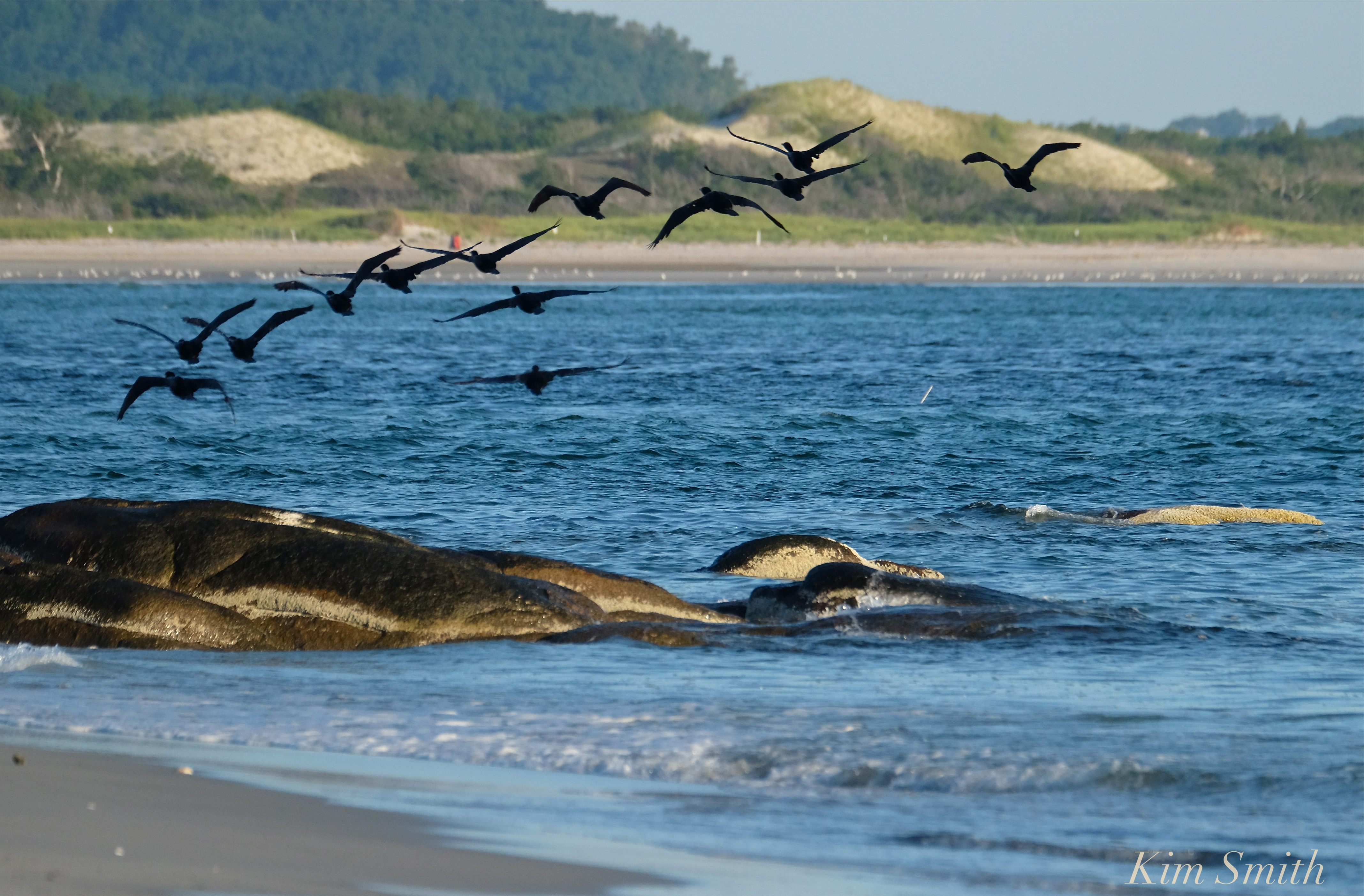 Mouth of the Essex River, looking towards Cranes Beach, and Double-crested Cormorants


 Good Morning Gloucester
Mother nature wins…eventually…but always. Thanks for sharing this.
LikeLiked by 1 person
I would like to elaborate on the thoughts expressed by both Brad Story and Bob above. Sorry if I bore some of you but so be it.
When you go up a narrow estuary like the Essex River (or the Annisquam), you generally find areas where the water spreads out at high tide, marshes or ponds or big wide spots. Every twelve hours the water goes up eight to twelve feet out in Ipswich Bay. Up in those marshes, the water goes up about the same amount as you can see on the far side of the 128 bridge or at the Essex Shipbuilding Museum. The volume of water required depends only on the area of the marshes and the rise out in the bay.
That water flows in and out through the rivers. The amount that comes out in six hours and flows in in six hours is the same, shallow or deep. If it is shallow the water runs fast. If it is deep, the water can slow down a little.
If it is shallow and the water runs fast, it will scour sand or mud off the bottom and carry it to quieter places. If it is deep, like recently dredged, the water is slower and sand and mud settle out. It does not remain deep.
In other words in these conditions there is an equilibrium depth to the channel. If deeper it gets shallower, if shallow, it is gouged out by the faster flow. I guess that is just a longer way to say what Bob said but anyway;
In a wide spot like Lobster Cove or Gloucester Harbor for example, the flow is not strong and if you dredge it can stay deep for many years. However the game is stacked against you in a tidal river as I described above.
You dredge the channel out after twenty years of screaming at the Army and the politicians and after a few years it fills back in to equilibrium depth. Then you spend the next twenty years screaming at the Army and the politicians to bring the dredge back. Those channels were there long before we were, and they will return to equilibrium depth no matter what we do.
LikeLiked by 1 person
Thanks so much for taking the time to write Damon. I was hoping persons such as yourself would share their insights.
LikeLike
Growing up on Farm and Walker’s Creek in West Gloucester I remember when the river was dredged a couple of times. Brad is 100% correct. The effects “appear” to be positive but in reality dredging is simply a movement of rich fertile river bed material to be replaced by erosion from the adjacent salt marshes. The Great Essex Salt Marsh stretches from Rust Island to Odione Point in Portsmouth, NH. It’s one of the great food chain engines that ultimately feeds the fish of the grand banks of all time on the east coast of the US. The late Charlie Anderson did a significant study on the relevance to the Great Essex Salt Marsh and its influence on feeding the North Atlantic fish population back in the early 70’s. Very interesting reading. The plankton produced in this great area feeds everything from minnows to whales and a whole lot in between up and down the food chain. Today there are many impacts to this wonderful marsh from encroachment to pollution to global warming to name a few. Helping it erode faster is not what is a desired outcome.
The marsh has a greater impact on our natural resources than it will ever have on recreational boaters and the “convenience” of going “down river” quicker. Since the river has a “Make No Wake” speed limit for most of it there’s no need to dredge so that boaters can conveniently ignore the already established law. At head away speed almost any size boat can navigate its channel and if not perhaps the skipper should learn how to navigate and steer a bout at the “Make No Wake” speed.
In the end we have learned over and over that the more we try to mess with Mother Nature the more Mother Nature messes with us. Let’s leave the Essex River alone and enjoy it just the way it is.
By the way I’m not an “Out of Towner”. One grandfather worked in the Essex Boatyards building the Roseway at the Tarr and James Shipyard (now Perkins Marina) and another grandfather fished on the Elsie and Esperanto (both built in Essex). I’m thinking that makes me a local though I currently live on the ocean in New Hampshire about 25 yards from the Great Essex Salt Marsh.
LikeLiked by 1 person
Terrific input, thank you for writing Bob.
LikeLike
Great post and great info, Kim. Thank you!
LikeLiked by 1 person
Great letter from the Storys, and comments from Bob and Damon, very informative.
LikeLike
Great responses I listen and I learn a great deal thanks for share! 🙂 Dave & Kim :_) Happy New Year!
LikeLiked by 1 person