I found Catherine’s post very interesting. The 1954 article includes some very alluring descriptions of the locations of two old military training or muster fields in West Gloucester.
The first is south of Concord St and in 1954 was known as the Currier Pasture. Does anyone know where that is located? According to the article, there are carvings in the granite that memorialize the use of the field by the Danvers Light Infantry in 1861. The carvings were in good condition in 1954 and might remain so today.
The second location said to have been used by the militia in 1776. Its location is obscure, said to be “somewhere off of Thompson street.” There is supposed to be an inscription on a granite boulder at that location as well.
Well, Thompson Street is easy enough to find. It connects with Concord St. just north of the Rte 128 underpass. Follow the road a few hundred yards and you come upon a City of Gloucester sign marking “The Old Thompson Street Historic Walking Path.” The path (which I have not yet trod) meets Bray Street where the Essex County Greenway has established the Thompson Street Reservation that contains a network of trails. Old Thompson continues across Bray St., through the woods, to the Walker Creek vicinity where I believe I once saw a sign marking its terminus.
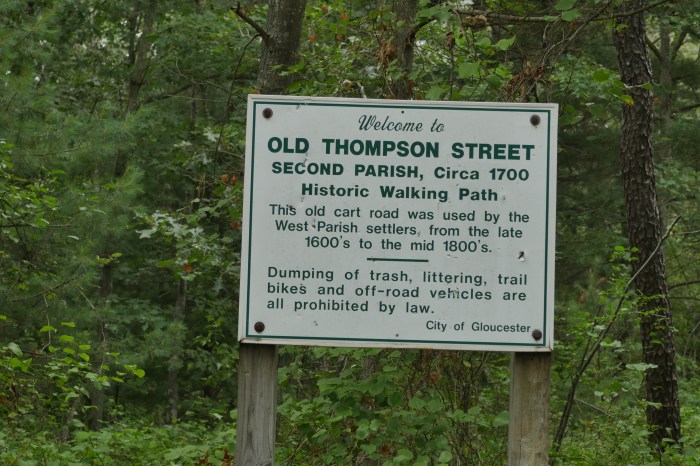
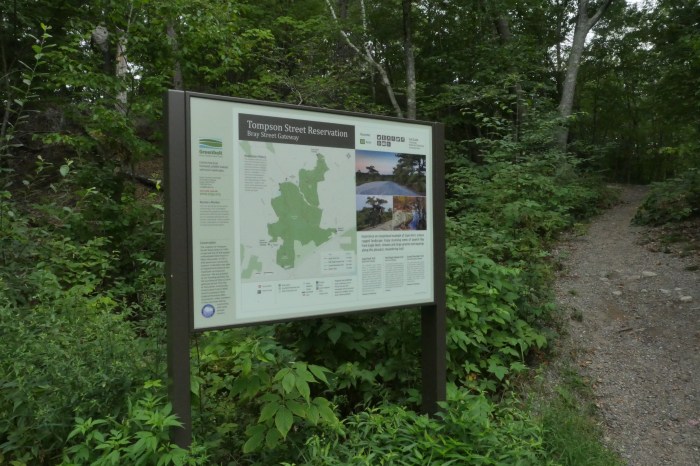
Somewhere along Thompson St., there might exist a flat area that contains an inscribed boulder that would be an awesome Revolutionary War relic.
Does anyone have any information that might be useful in finding either of these two fields? Please share your knowledge in a posted comment.
Thanks.


 Good Morning Gloucester
Love it
LikeLike
My guess on the Civil War era muster field location based on description (looks like city may own this parcel):
https://www.google.com/maps/place/314+Concord+St,+Gloucester,+MA+01930/@42.637779,-70.7355696,17z/data=!3m1!4b1!4m5!3m4!1s0x89e3239dfa671d99:0x9034274a42781ae2!8m2!3d42.637779!4d-70.734027
LikeLike
Marty,
Thanks I love the history both written and oral as children your wide-eyed but not until later in life does the true appreciation set in! 🙂 Dave & Kim 🙂
Remember this one?
“I want my children to have all the things I couldn’t afford. Then I want to move in with them, -Phyllis Diller 🙂
LikeLike
Marty, I have noticed, on the Thompson Street walk to the old burying ground, that there are at least a couple of what appear to be old farmstead driveways, with large granite stones to the sides. Possibly one of these is not an old farm but instead a public common with the boulder you seek. I look forward to your pictures if you find it.
LikeLike
Hi Marty,
I have been to the “muster field” in West Gloucester. It is currently on private property. I have a few photos of the inscriptions on the stones, which are difficult to make out as they’ve been eroding for the past 150 years.
For the past few years I have been exploring the Second Parish woods to get an idea where the early settlers’ homes and businesses (taverns, mills, etc.) were. That includes looking for the colonial-era field. (Unlike Dogtown, many of the features are harder to discern in West Parish, and most are likely on private property). My belief is that the field was near to the meeting house on Tompson St. south of Bray St.:
From the town records of June 3, 1727 — “The commoners vote that the common land near the meeting house, or Meeting House Green, so called, shall be in common for the use of the town forever for a training field. They also vote that one and a half or two acres near the second parish meeting house shall be reserved for the same purpose.”
The Civil War field on Currier’s Pasture, then, couldn’t be the colonial era ground, as it is quite a distance from the site of the Second Parish Church.
When I have a free moment, I’ll try to find those photos and go through my West Gloucester notes for more information.
LikeLike
Thank you all for your useful thoughts. I believe I now know the location of the Civil War era muster field. It is indeed on private property and I hesitate to bother the owners to view it. However, I know there are at least a few people, like Jude, who have seen and photographed the inscription. If any of these folks care to share their photos with me, I’ll be happy to post them on GMG without disclosing the precise location.
As for the colonial era field, I’d love to tag along with Jude and search for that site.
LikeLike