Second round of cities and towns named clean energy leaders; now eligible for municipal renewable power and energy efficiency grants

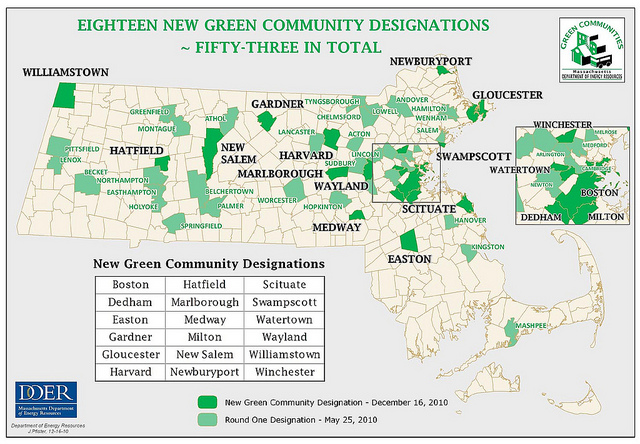
Green Communities Map
BOSTON – December 16, 2010 – The Patrick-Murray Administration today named 18 cities and towns from Boston to the Berkshires as “Green Communities,” making these communities eligible for over $3.6 million in grants for local renewable power and energy efficiency projects that will advance both municipal and state clean energy goals.
Boston, Dedham, Easton, Gardner, Gloucester, Harvard, Hatfield, Marlborough, Medway, Milton, Newburyport, New Salem, Scituate, Swampscott, Watertown, Wayland, Williamstown, and Winchester join 35 other cities and towns named in the inaugural round of Green Communities designations last May – bringing the total number of official Green Communities to 53.
“I applaud these 18 communities – and the 35 that came before them – for the critical role they are playing in creating a clean energy future for the Commonwealth,” said Governor Deval Patrick. “Across the Commonwealth, cities and towns are eager to make clean energy choices that are already benefiting our economy, environment and quality of life.”
“As our Administration continues to invest in clean energy, it is encouraging to see so many cities and towns across the Commonwealth realize the value of renewable energy and energy efficiency,” said Lieutenant Governor Timothy Murray. “I’d like to congratulate our second group of Green Communities and hope their leadership inspires other communities as we work together to promote a stronger and more sustainable future for Massachusetts.”
The Department of Energy Resources’ (DOER) Green Communities Grant Program uses funding from auctions of carbon emissions permits under the Regional Greenhouse Gas Initiative to reward communities that win Green Communities designation by meeting five clean energy benchmarks:
- Adopting local zoning bylaw or ordinance that allows “as-of-right siting” for renewable and/or alternative energy R & D facilities, manufacturing facilities or generation units;
- Adopting an expedited permitting process related to the as-of-right facilities;
- Establishing a municipal energy use baseline and a program to reduce use by 20 percent within five years;
- Purchasing only fuel-efficient vehicles for municipal use, whenever such vehicles are commercially available and practicable; and
- Requiring all new residential construction over 3,000 square feet and all new commercial and industrial real estate construction to reduce lifecycle energy costs (i.e., adoption of an energy-saving building “stretch code”).
“As the signature initiative of the Green Communities Act signed by Governor Patrick in 2008, the Green Communities program challenges cities and towns to go greener than ever before and then rewards that hard work with resources that enable them to go even further – saving energy costs for their residents and reducing the environmental impact of municipal operations,” Energy and Environmental Affairs Secretary Ian Bowles said.
November 19 was the deadline for municipalities to apply for Green Community designation in order to qualify for approximately $3.6 million in Green Communities grants. Communities designated today have until January 21 to submit applications for grants that will be awarded later this winter.
“In the first round of Green Communities grants, my office was pleased to award funding for an array of innovative and practical projects – from buying down the cost of municipal energy management contracts and purchasing hybrid vehicles for municipal fleets to installing solar power and high efficiency street lights,” DOER Commissioner Phil Giudice said. “I look forward to seeing these 18 new Green Communities come forward with equally compelling projects in our next grant round.”
Using a formula that caps awards at $1 million and provides each community with a $125,000 base grant – plus additional amounts based on per capita income and population, and for municipalities that meet Green Communities Criterion 1 for energy generation, DOER notified the selected communities of their eligibility for the following funding:
Boston $1,000,000
Dedham $ 179,800
Easton $ 168,300
Gardner $ 206,100
Gloucester $ 198,200
Hatfield $ 130,725
Harvard $ 141,200
Marlborough $ 217,125
Medway $ 158,450
Milton $ 157,100
New Salem $ 138,100
Newburyport $ 155,000
Scituate $ 163,025
Swampscott $ 143,800
Watertown $ 192,825
Wayland $ 131,775
Williamstown $ 142,000
Winchester $ 151,475
Spread The GMG Love By Sharing With These Buttons:




 Good Morning Gloucester