First Civilian State Emergency Hospital Post and angel nurses from Ontario helped Gloucester fight back | 1918 influenza pandemic part 5

The United States reached a devastating milestone of 512,000 deaths claimed by Covid-19 on February 28, 2021. A year ago when I wrote about the impact of the 1918 Flu Pandemic through a Gloucester lens, the potential lethality of Covid-19 was sobering and hard to fathom. In modern times, deaths caused by Covid-19 in the United State could never climb as high as the 1918 Pandemic, right? Wrong. In this year of living grievously, 500,000 deaths is a grim new record. We are so deeply sorry to all who endure the loss of someone close, to long haulers struggling to heal, and to caregivers who face so much.


This excerpt has been adapted from The 1918 Pandemic: Reconstructing How the Flu Raged Then Flattened in Gloucester, Massachusetts when 183 Died in 6 weeks, by Catherine Ryan, March 2020. Posts like this one, Part 5, offer select weeks during the outbreak as serialized chapters.


September 20, 1918
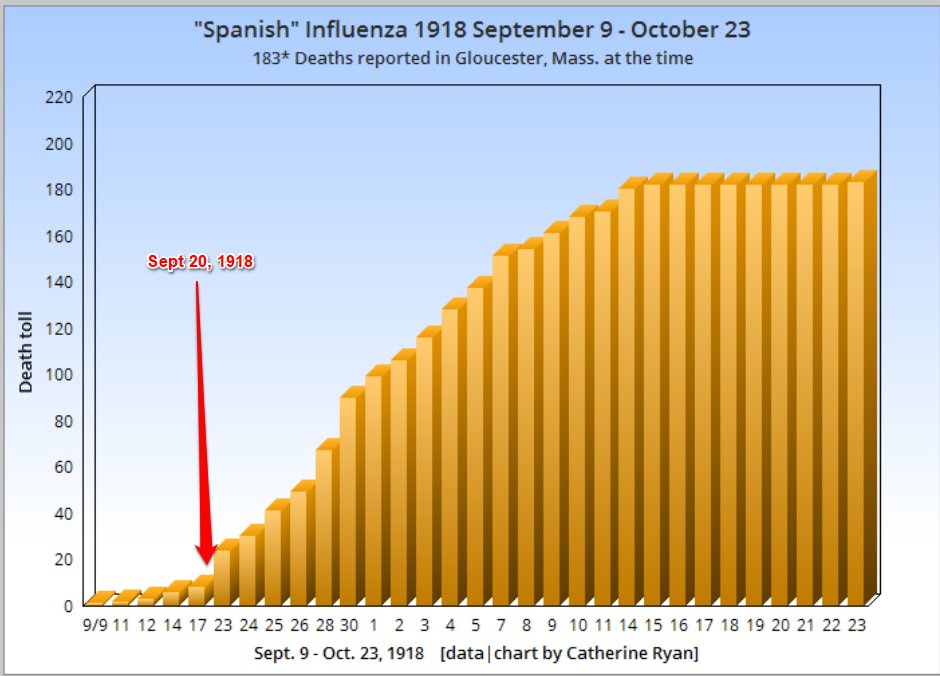
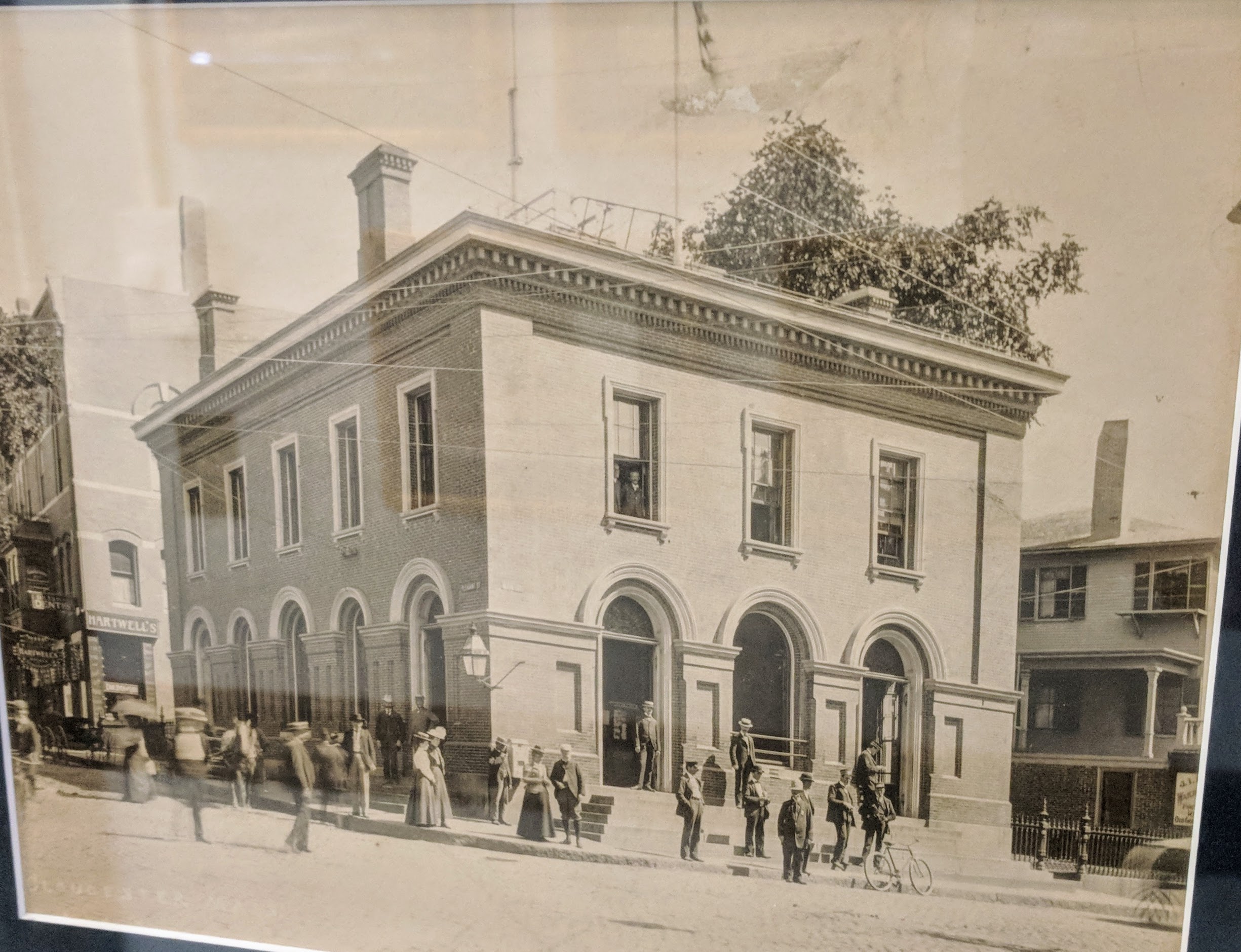
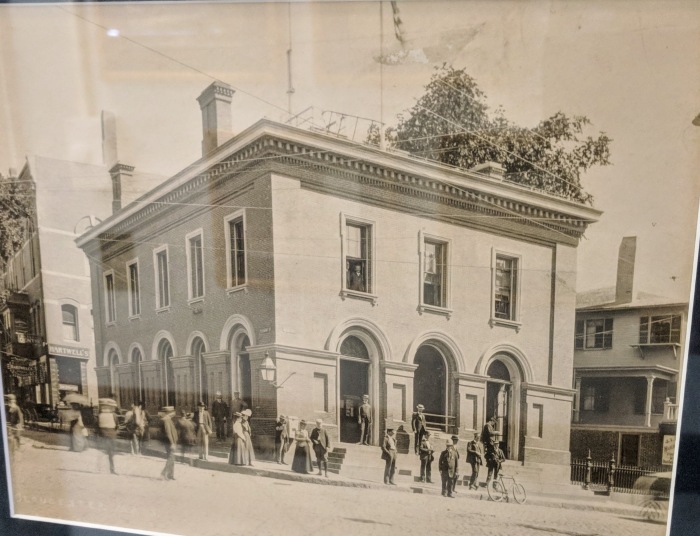
As the death toll doubled, the local paper tried to keep pace with death notices and tributes. One week after an outbreak at the post office, the paper published an obituary for William L. Jeffery, the first local shop owner to die from influenza. His stationery store was located on Pleasant street, same as the Post Office. Another man known to many in town, George Goldthwaite, a salesman for the Gloucester Gaslight Company who acted in community theater, succumbed. “Only last July he took part in the play “Two Burglars and a Lady” at the Playhouse-on-the-Moors.”

Mr. and Mrs. Martin on Fort Square died from influenza within three days of each other. “The family came to this city a few years ago when the gill netter fishermen from Michigan took up their residence here.”

“The couple are survived by four children Violet, aged 9 years, Gladys, aged 7; Lilian, aged 5, and Delores, 3 years of age.”

Four orphans- sad death notice for Mr. and Mrs. Martin – September 20, 1918

September 23, 1918

On September 23, 1918 Boston reported 23 new deaths from influenza; Gloucester, 11.

At the post office where the disease had surged, nine staff still struggled. While letter carrier Hodsdon recovered from the malady, his wife Ethel (Wheeler) Hodsdon died at home.


September 24, 1918

Cases in East Gloucester ramped up September 24th. A few vessels returned with sick crew. Sawyer Free Public library closed. Physicians and nurses from other towns arrived to help. Polling locations were open for the primary, but voter turnout was the smallest on record. Church attendance was small, “on account of the large number of persons afflicted and those who kept away.”

There were so many new cases in Gloucester, officials enlarged the temporary Red Cross emergency hospital at the police station (and would again), clearing out the District Court floor.
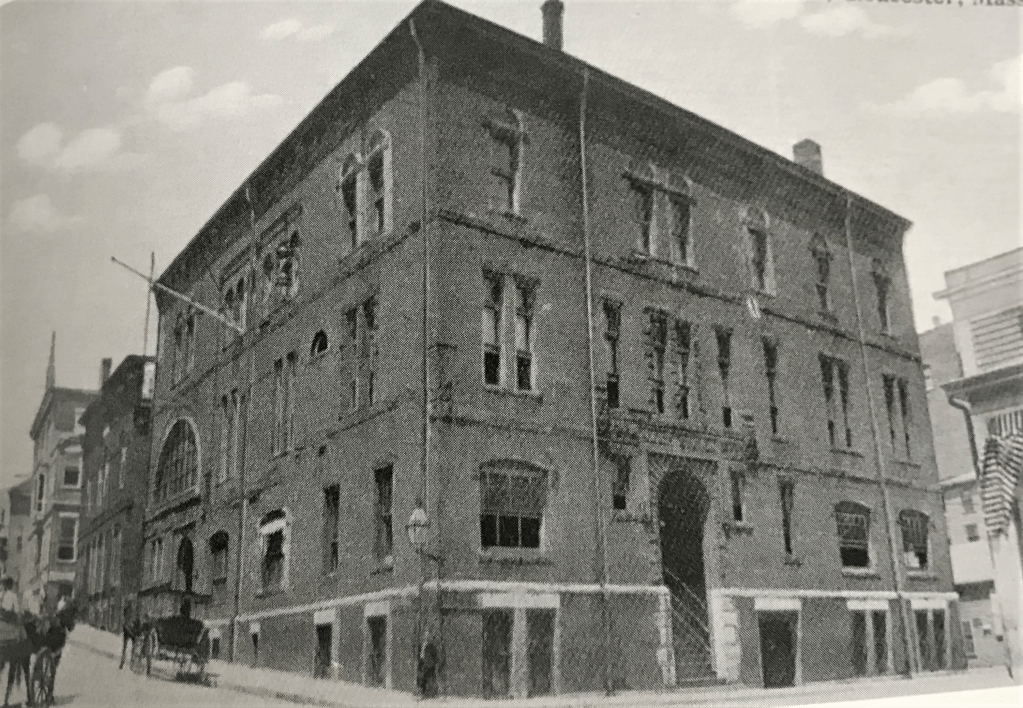
Still, more hospital beds were necessary. The State Armory on Prospect Street seemed the ideal site to ready, however the State refused the request.
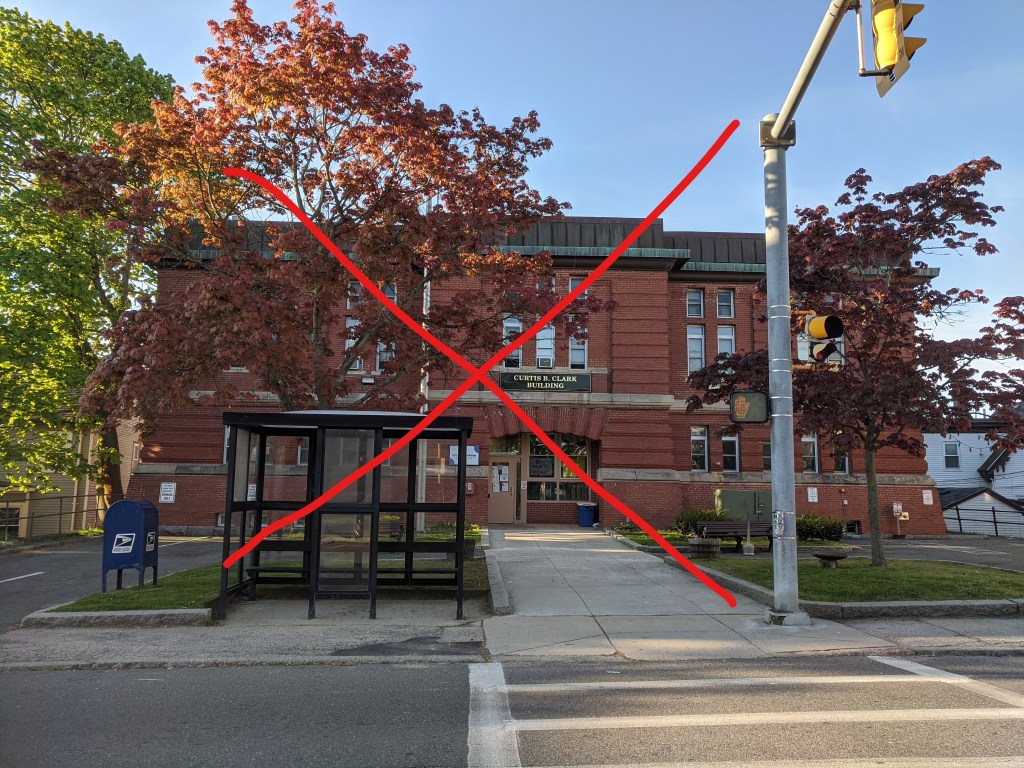
Alderman (City Councilor) Poole headed to Boston with Osborne Knowles, Christian Saunders and John Radcliffe, representatives from Gloucesterโ€™s Board of Health and Public Safety, to negotiate with state and federal officials in person.

โ€œThat the authorities were fully cognizant of conditions in Gloucester was evident from the statement of Mr. Long, who said that Revere, Quincy and Gloucester were the most infected of any in the state. Mr. Long offered the committee every assistance and relief that could be given to handle the situationโ€ฆIn the opinion of state officials and leading physicians the out-door method of treating the disease is the most effective and successful. So interested were the officials in the local situation that the surgeon-generalโ€™s department yesterday afternoon notified Capt. Carleton H. Parsons, senior officer of the local state guard units; instructing him to present to the local authorities the offer of the state to send to Gloucester a military hospital unit to cope with the situation.โ€

Lieut. John A. Radcliffe, State Guard, resident, and veteran Gloucester Daily Times (GDT) reporter of nearly 20 years & volunteer on the Board of Health for 15 prior to the pandemic

The state discussions prompted additional protective measures, informed by the best doctors in the armed services. There were more cases in Massachusetts by then than all the other states combined. Influenza cases at Camp Devens had already climbed to 11,000.

The Gloucester contingent left the Boston conference armed with a state of the art plan for a crisis team to be deployed in Gloucester: a military unit of doctors, nurses and multiple local State Guard companies. It would be the first one established for care of civilians.

All necessary presentations and votes were sorted by nightfall.

โ€œThe adjutant generalโ€™s department in Boston was immediately communicated with, and arrangements made to send tents, physicians, nursesโ€™ field kitchen, military equipment and supplies to this city.โ€

John Radcliffe, Gloucester Daily Times

Meanwhile, another floor was added to the Red Cross Emergency Hospital, State Guard called out, and police instructed to enforce any Board of Health recommendations such as the anti-spitting rule and fruit stand closures. Various strict fumigation requirements were put into immediate effect and there would be no crowding on street cars. Police officers were dispatched to The Fort and to investigate sanitation conditions.

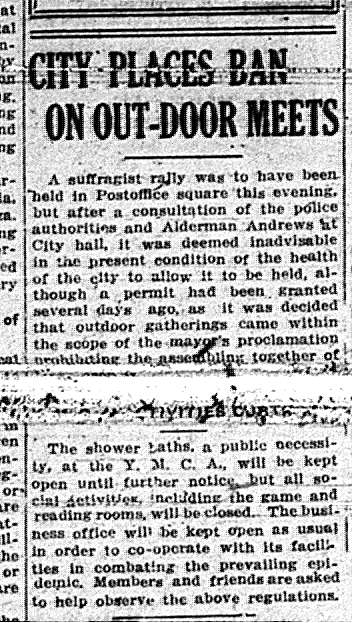
Without calling it a quarantine, mighty efforts to effectively shut Gloucester down ensued. Cancellation and support notices landed on the front page.
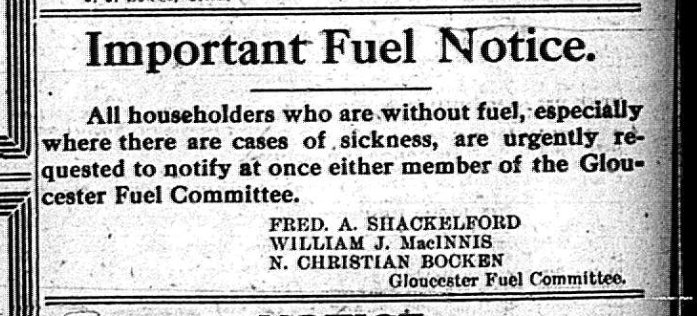
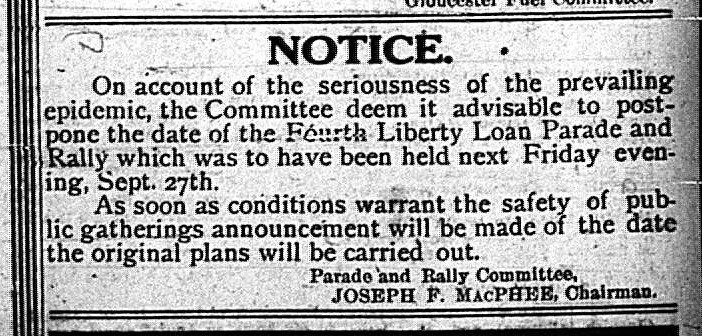
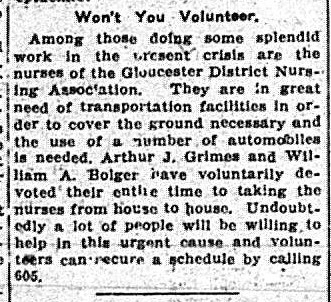
The City banned outdoor gatherings now, too. A womenโ€™s suffragist meeting and Liberty Loan rallies were among the first cancellations. Gloucester District Nursing Association sought volunteer drivers.  

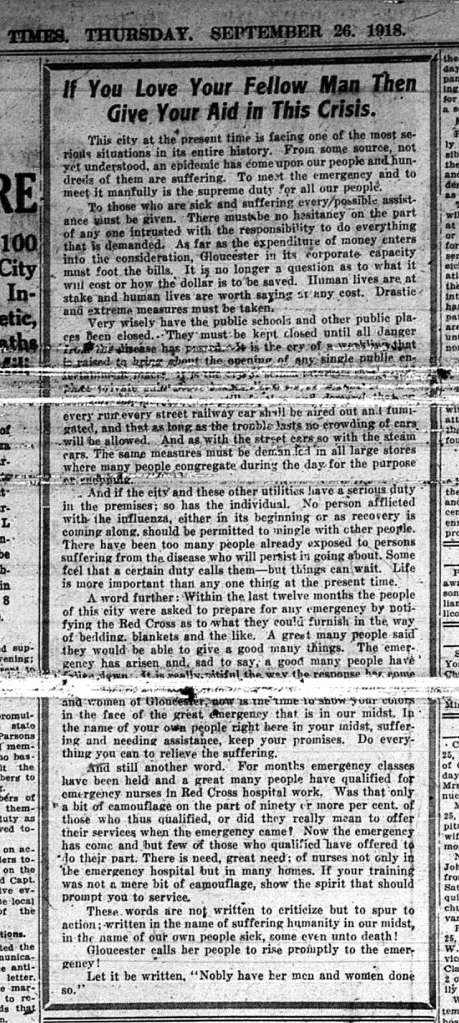
โ€œGloucester calls her people to rise promptly to the emergency!โ€ urged the Gloucester Daily Times Op Ed.
In local war news at this time, Gloucester advocates were seeking reimbursement from the federal government for vessels sunk by submarineโ€“ while pressing for flu support.

Statewide the precise number of infected cases was a guess at best. It would be a week before reporting deaths was required by state law, ten days after Gloucester so ordered.

September 25, 1918

Massachusetts established an Emergency Public Health Committee on September 25, 1918. Their first order of business was to ban all public gatherings especially in light of the upcoming liberty loan rallies and parades. It was suggested that the Federal Government was likely to take charge in Massachusetts as a war measure.

The State Board of Health published treatment guidelines the next day because of the scarcity of physicians and nurses, and push back after bans and restrictions, which Henry Endicott defended mightily:

โ€œโ€ฆThere are undoubtedly towns and cities in the Commonwealth from which the influenza has not been reported, but of course we must face the fact that the chances are very much in favor of the spread of the disease. I urge such communities to assume their part of the common responsibility, and to act as if they were already in the midst of the epidemic.

The doctors and nurses of Massachusetts who are devoting themselves to the care of the sick in this emergency are all heroes and heroines, and many of them have paid the penalty. Not one of them, as far as I am aware, has shirked in any way; they have overworked; they are without sleepโ€”yet, still they go on. Massachusetts can never repay its debt to this noble band of men and women. We are using every effort, both through the government and outside the State to get additional help for these peopleโ€ฆ (Regarding) Cancellation of the Liberty loan meetingsโ€ฆ It will never be said of Massachusetts that she was so immersed in her own private troubles that she for one moment failed to heed the Nationโ€™s call to practical service. Massachusetts must and will do her part.โ€

Henry B. Endicott, Chairman Massachusetts Emergency Public Health Committee, established Sept. 25, 1918

Dr. Kelley, Massachusetts Commissioner of Health and a member of the stateโ€™s Emergency Public Health Committee, reached out to U.S. Surgeon General Blue. The Federal government lent army and navy doctors to take over doctor assignments. Kelley appointed a nursing Commission and assigned Miss Billings from his department as chairman. They hired 100 nurses to serve in case of emergency in the Massachusetts State Guard. Fifteen were deployed to Gloucester.

โ€œThese nurses were given the rank and pay of Lieutenant. It is believed that this is the first time such rank and pay have been given to women in the United Statesโ€ฆโ€ 

The state assigned about 10 more registered nurses to Gloucester as well.

September 26, 1918

The federal government released a detailed โ€œInfluenzaโ€ circular September 26. By then forty percent of Gloucesterโ€™s telephone company were absent โ€œon account of sickness either of themselves or relatives whose care is devolving upon them.โ€ The Gloucester Manufacturing Company โ€œclosed their plant indefinitely,โ€ and the Ipswich mills announced a shut down. There were 49 deaths in the city, up from 11 three days prior, among them Laura Silva, Alderman Silvaโ€™s sister, who died that morning from โ€œpneumonia following an attack of the prevailing influenza.โ€

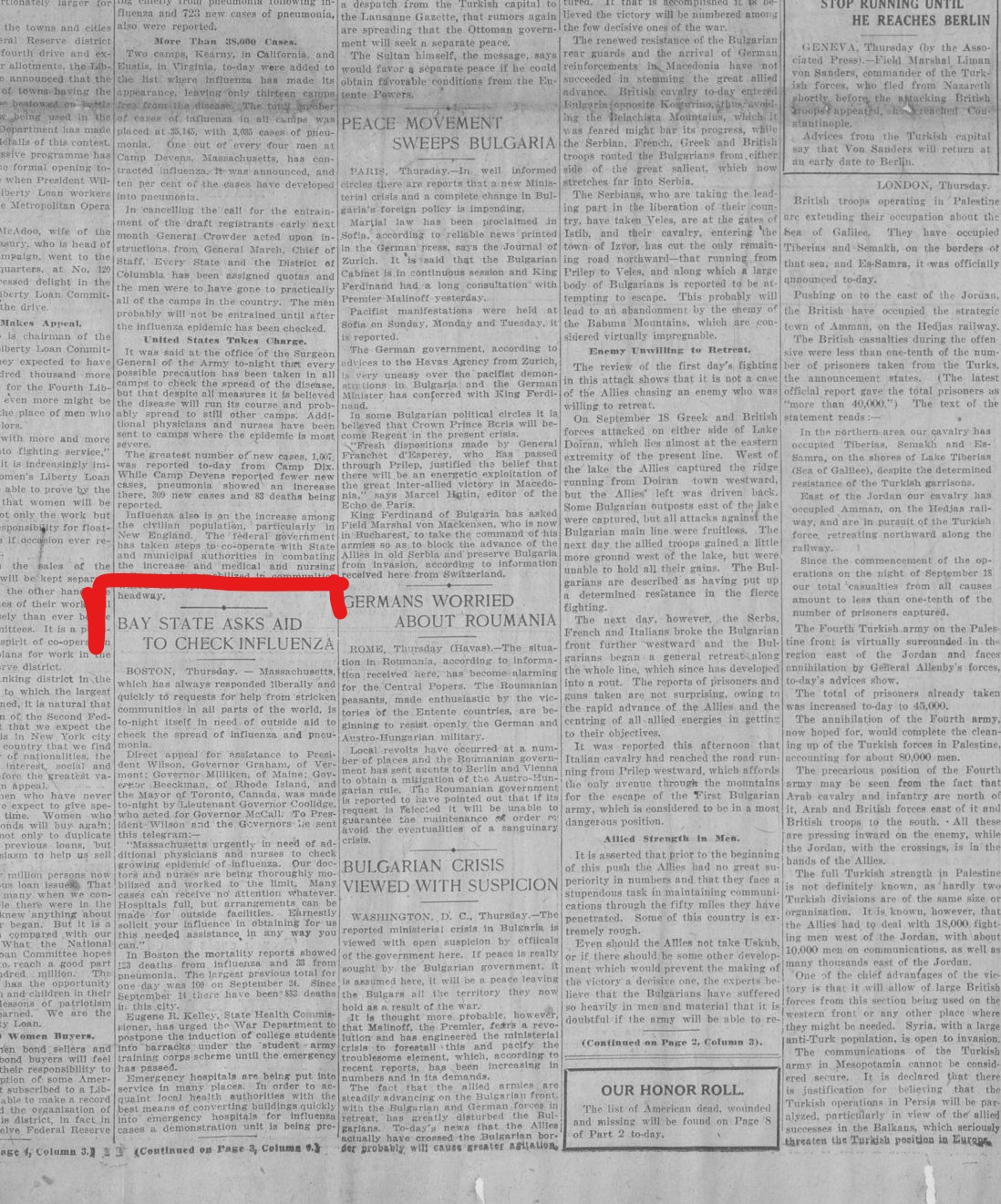
Acting Governor Coolidge appealed to the President, select neighboring states, and the Mayor of Toronto for physicians and nurses:

โ€œMassachusetts urgently in need of additional doctors and nurses to check growing epidemic of influenza. Our doctors and nurses are being thoroughly mobilized and worked to the limit. Many cases can receive no attention whatever. Hospitals are full, but arrangements can be made for outside facilities. Earnestly solicit your influence in obtaining for us this needed assistance in any way you can.โ€

Governor urgent telegrams disseminated 9/26/1918

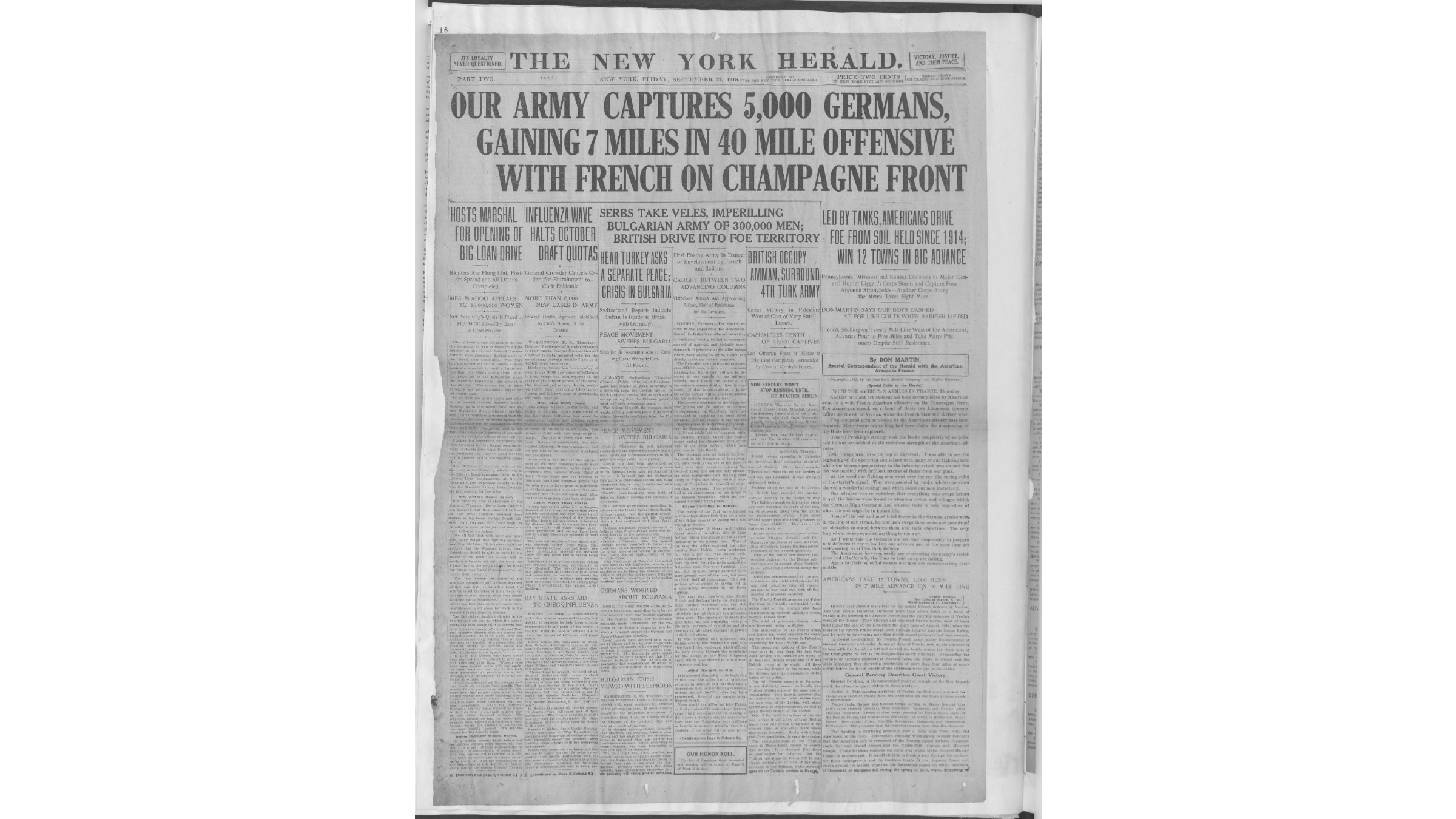
The notice was carried in the Gloucester Daily Times and national papers the following day. New York Herald led with the capture of 5000 Germans and Bay State Governor asking for help on the front page; the New York Times published a notice on page 6.
The local paper featured its editorial: If You Love Your Fellow Man Then Give Your Aid in this Crisis;
September 27, 1918

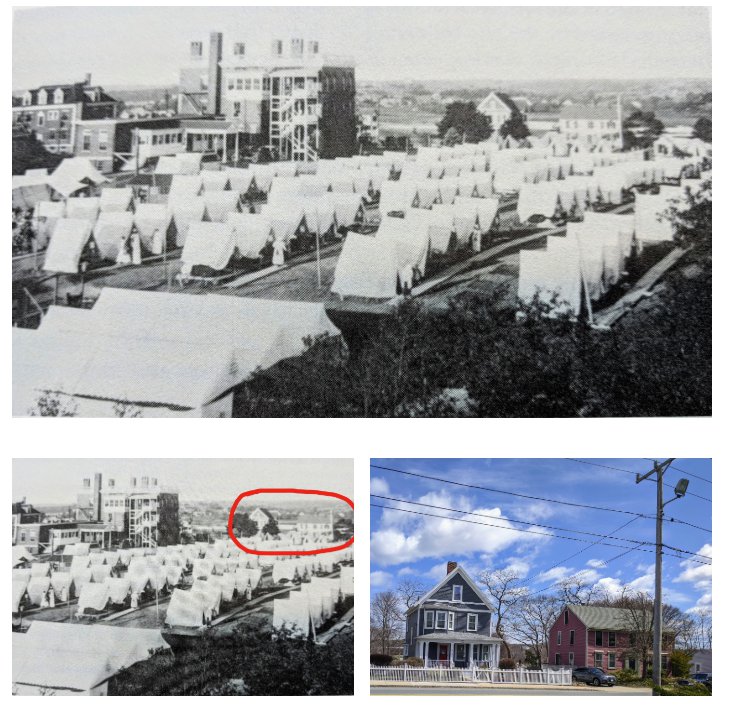
With no time to spare, the State Military Unit was installed on the grounds of Addison Gilbert Hospital Friday September 27, 1918, and completed before sundown Saturday.
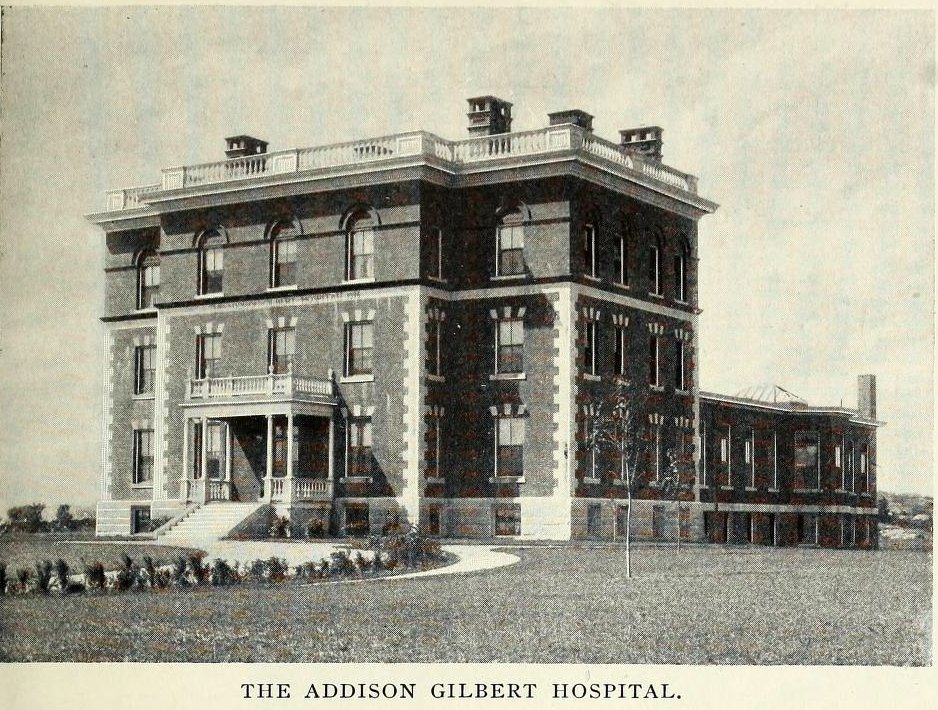
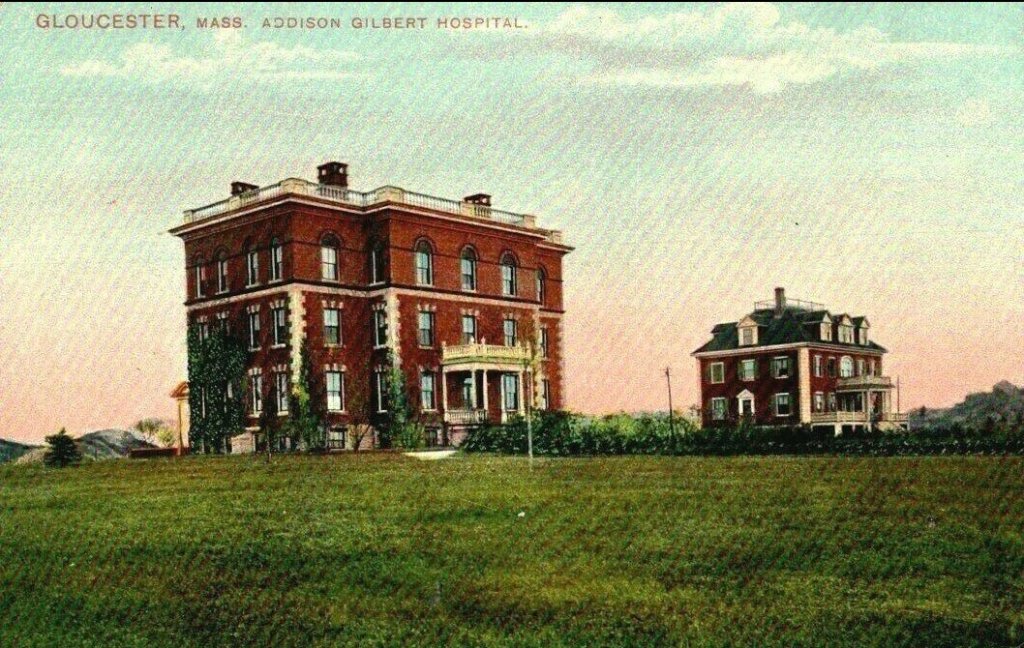
โ€œIn a remarkably short space of time the tents were up and the unit well established, so that this afternoon it will be ready for patients. There are 100 tents for patients, each waterproof, provided with board floor, cot and other essentials for the proper care of the sickโ€ฆThe field hospital is a wonderful institution and shows in a large measure what the State Guard can be depended upon to bring about. Day and night the men have worked to put the hospital in shape and to look out for the sick ones. It is simply remarkable the way the many details have been arranged to establish such a wonderful institution well worthy of the name. Electric lights, water, sewerage and floors in the tents have all been put in, chiefly through the efforts of the fine types of men that compose the State Guard.โ€

John Radcliffe, GDT

Another 100 tents for the state guard, plus any necessary for administration and operations, were installed as well.

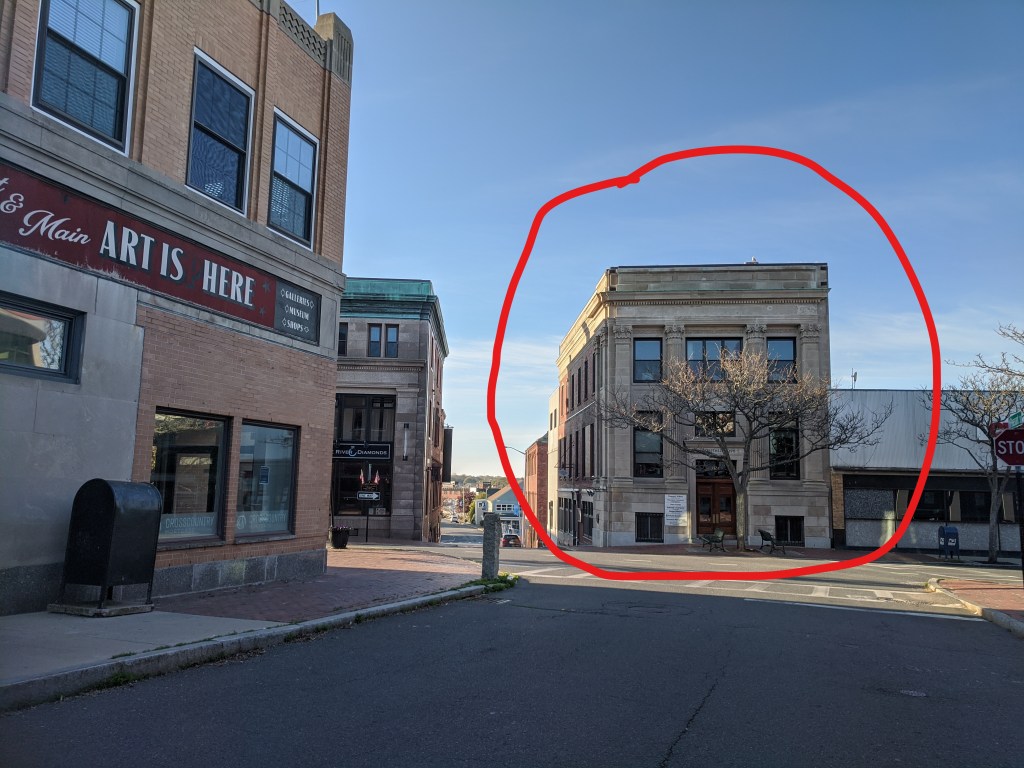
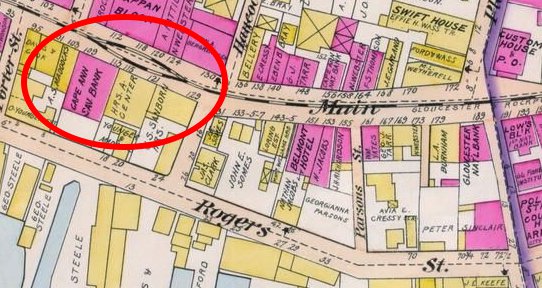
Over on Main Street, the Red Cross established a childrenโ€™s hospital in the Girlโ€™s Club over Gloucester National Bank.

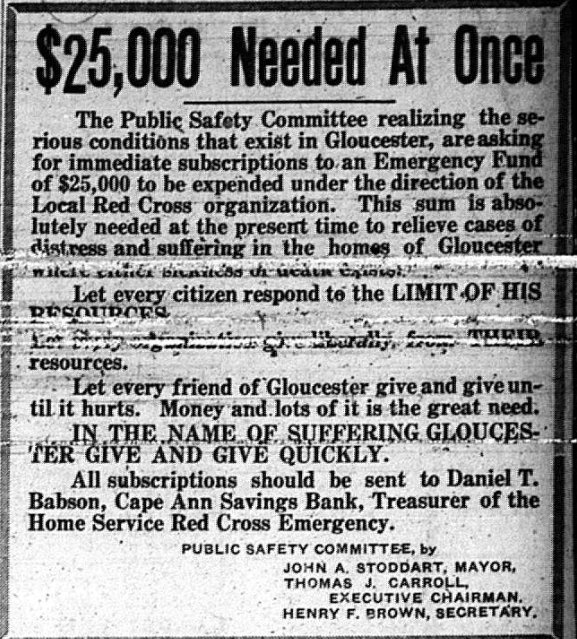
Anticipating great need, the public safety committee announced an Emergency Fundraising drive for the Local Red Cross administered by Cape Ann Savings Bank.
The Mayor and all but one Alderman were struck by fluโ€”all those meetings! โ€” and still that Monday they brought forth more precautions, seizing any and all educational opportunities and community measures possible to halt the spread. Public funerals were banned and soda fountains closed, though the latter was rescinded in one day.

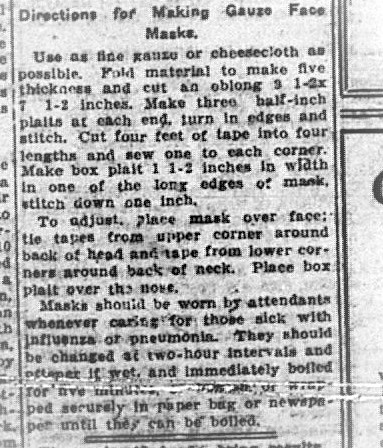
Detailed flu mask (face masks) instructions were published as part of optimum patient care and prevention.

Mayor Stoddart urged fresh air and ventilation.

โ€œEvery house whether a case of disease has existed or not, should be thoroughly aired during the dayโ€ฆClean up the back yards, dumps and filthy places. If your neighbor will not act, consult the Board of Health or its emergency agents and prompt action will be taken. Let everyone co-operate and assist our health officials in the excellent work they are doing.โ€

Mayor Stoddardt, September 30, 1918
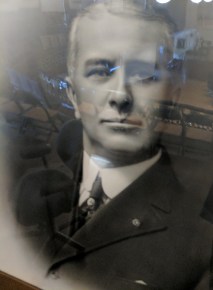
Mayor John Stoddart served 1917-19

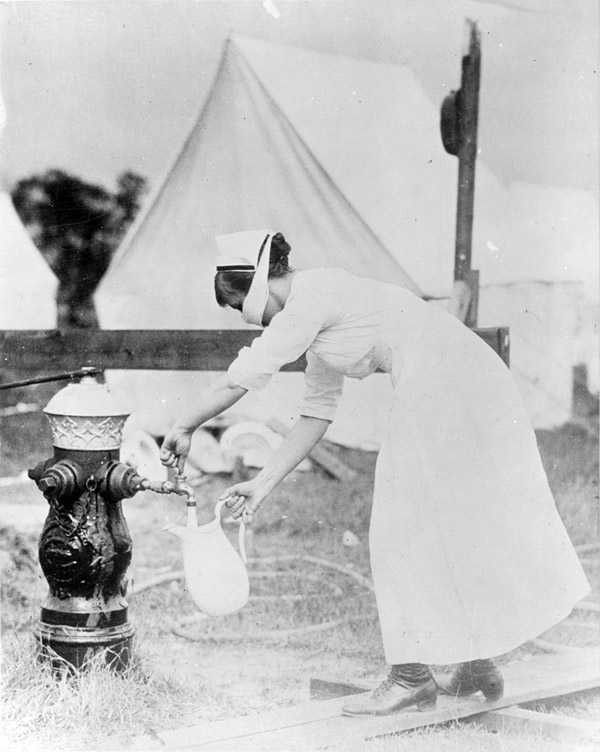
The deadline for the Draft Registration questionnaire was postponed until a future time when influenza was vanquished. One bright note that bleak weekend: ten “angel” nurses arrived from Ontario, Canada, and five from the state thanks to the commonwealthโ€™s plea and Gloucesterโ€™s hustle. Unlike other locations during the 1918 Flu Pandemic, folks rushed here to help rather than away.

Continue reading “First Civilian State Emergency Hospital Post and angel nurses from Ontario helped Gloucester fight back | 1918 influenza pandemic part 5”
Outbreak at the post office among the first hot zones: Gloucester Flu Pandemic 1918 part 4

This excerpt has been adapted from 1918 Pandemic: Reconstructing How the Flu Raged Then Flattened in Gloucester, Massachusetts when 183 Died in 6 weeks, HERE by Catherine Ryan. Mini posts like this one highlight select weeks during the outbreak as serialized quick reads about this Gloucester history.


DRAFT REGISTRATION DAY & FIRST PUBLISHED STORY OF A GLOUCESTER FLU OUTBREAK

10 Days after Labor Day weekend. 5 Days after a public Community Sing rally at City Hall. Couple of days after reported flu deaths and cases of infection.

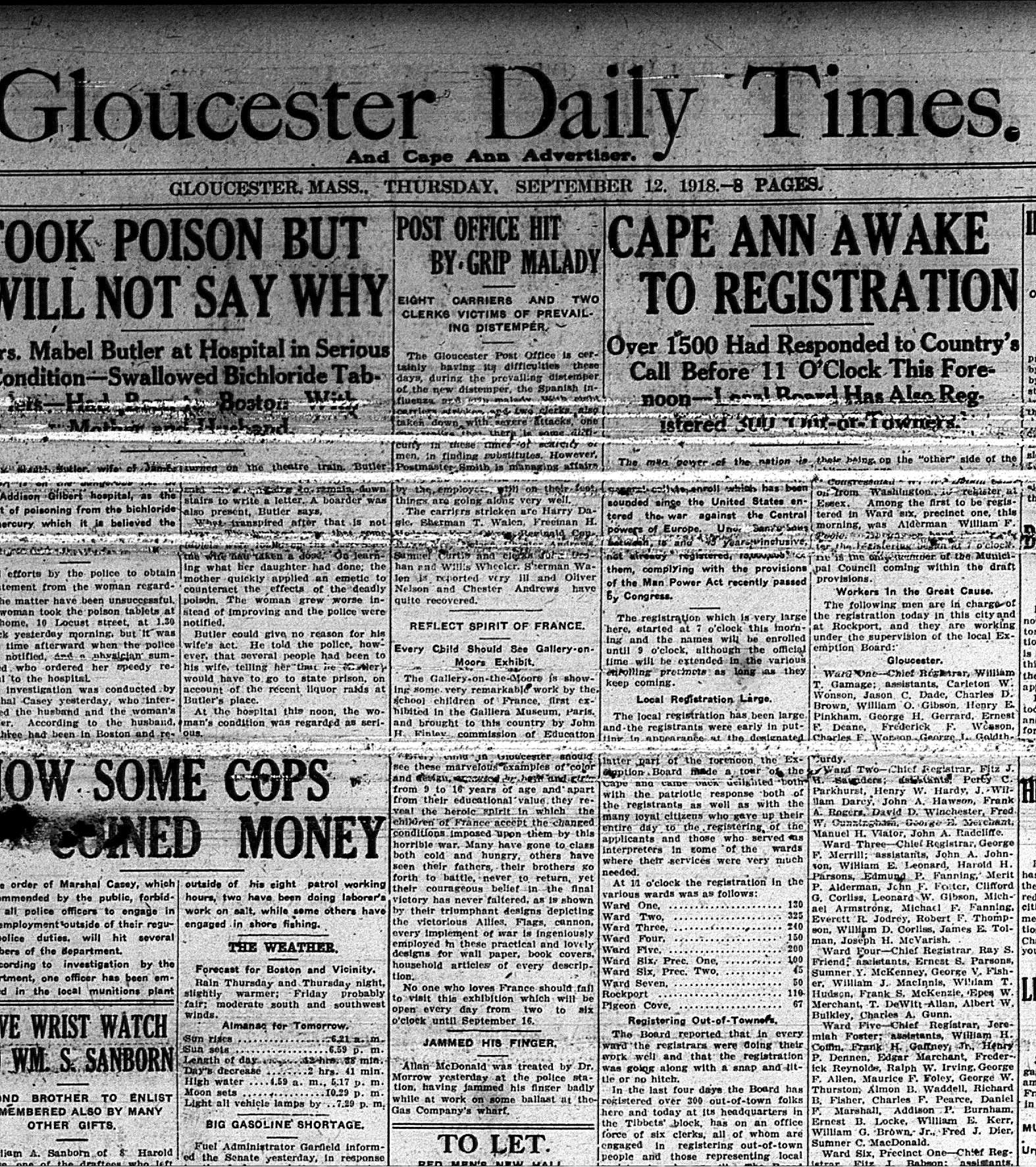
There was a massive turnout on draft registration day, September 12, 1918. โ€œCape Ann Awake to Registration: Over 1500 Had Respond to Countryโ€™s Call Before 11โ€™ O’clock This Forenoonโ€ was the headline, and after all the registrants were counted,

โ€œThe Total registration in the entire country is expected to pass the estimated 13,000,000 mark. Massachusetts has contributed 472,000, it is estimated and Boston has listed 102,867. Total registrations here yesterday were 3024 including 321 at Rockport and Pigeon Cove and 145 received by mail. Today 14 more have come in, making the grand total 3038…โ€52

Gloucester Daily Times, 9/12/1918

Enlisted immigrants comprised nearly 20% of the US Army during WWI. The draft in Gloucester indicates a comparable percentage of declared and non-declared registrations on September 12th. Volunteers helped with in-person interpretation and written translation in multiple languages, especially Italian and Portuguese.

A second, smaller headline was startling: โ€œPost Office Hit By Grip Malady: Eight Carriers and Two Clerks Victims of Prevailing Distemper,โ€ 54  the first article reporting a flu outbreak in Gloucester, published 10 days after Labor Day, a week after the community sing, and two days after Letter Carrier Sherman T. Walenโ€™s failing health was listed in the East Gloucester column. [A little over a week after Registration day, William Francis Murray, the Postmaster in Boston, died from the flu on September 21, 1918.]

City Directory “subcarriers” – William W. Collins, Austin W. Connors; Willis P. Cressy; Henry F. Dagle, and Elliott Grimes
Post Office Hit by Grip Malady: Eight Carriers and Two Clerks Victims of Prevailing Distemper
The Gloucester Post Office is certainly having its difficulties these days during the prevailing distemper of the new distemper the Spanish influenza (illegible) taken down with severe attacks, one (illegible) there is some difficulty in these times of scarcity of men in finding substitutes. However Postmaster Smith is managing affairs (illegible) by the employee will on their feet things are going along very well. The carriers stricken are Harry Dagle, Sherman T. Walen, Freeman Hodson, (illegible), Reginald (illegible) Chester Andrews, Samuel Curtis and clerks John Drohan and Willis Wheeler. Sherman Walen is reported very ill and Oliver Nelson and Chester Andrews have quite recovered.

Front page Gloucester Daily Times 9/12/1918

Inside the community pages, two enlisted Ehler brothers are mentioned in the East Gloucester column, and a brother-in-law visiting on leave; a third brother had visited from Camp Devens over Labor Day. With so many ill neighbors, the column required a sub-heading:  โ€œSpanish Influenza Prevalent Hereโ€ and included the first obituary to mention Spanish Influenza as the cause of death. Bertram Goodwin of 16 Highland Street fell sick September 5th and was dead within a week, among the first victims of the flu in Gloucester and the first to be public.

โ€œMrs. Carrie Hamsdell of Winchester is the guest of Mrs. Nellie M. Parsons of Highland street. Mrs. Parsons has just returned from a visit (illegible) the guest of Mrs. Jewell , of Boston, in Stratham, N.H. The Ladiesโ€™ Aid of the Methodist Episcopal church will hold a business meeting in the vestry this evening. Mr. and Mrs. J.H. Mason of Fall River, spent the week end with Mrs. Masonโ€™s mother, Mrs. James Ehler of 51 Mt. Pleasant avenue. Mr. Mason is stationed as first class cook in naval service at Newport and he was here on two days leave of absence. Mr. and Mrs. Victor D. Ehler and family the former who is stationed at Bumpkin Island and Walter A. Ehler who is stationed at Camp Devens were (โ€ฆillegibleโ€ฆ).

Spanish Influenza Prevalent Here

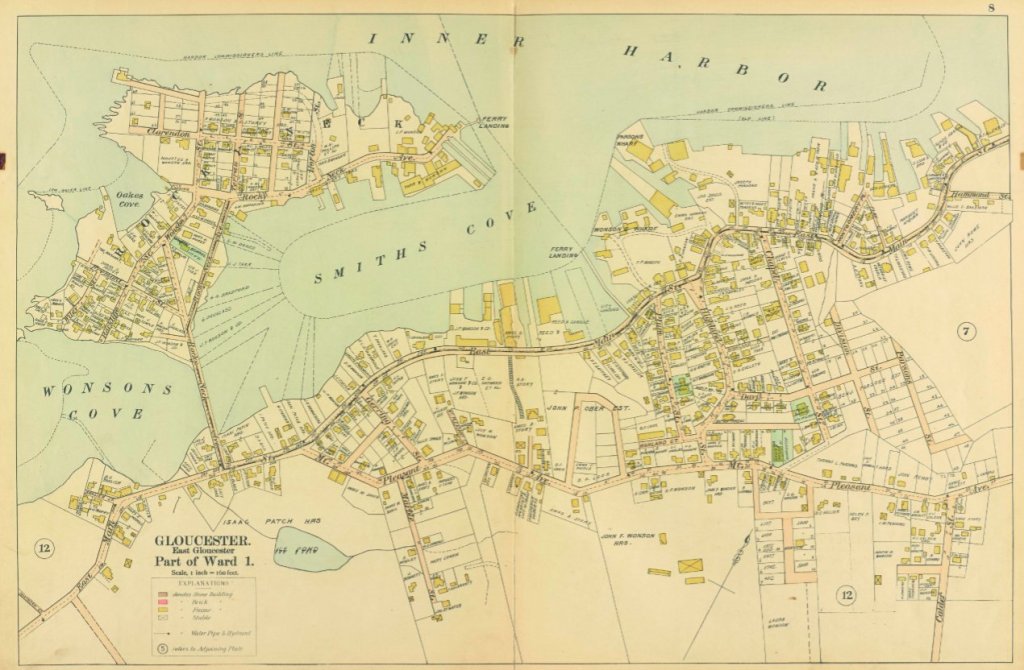
The prevailing distemper of grip and Spanish influenza is felt much in this ward. Harry Dagle of the U.S. Mail Force is ill at home on Highland Place. Sherman T. Walen also of the U.S. Mail Force is very ill at his home on Rocky Neck. Freeman Hodson, a native of this place and letter carrier in the Mt. Pleasant Avenue lower district route of ward one, is confined to his home on Essex Avenue. Stanton and Eleanor Farrell, both children of Mr. and Mrs. Frank Farrell of East Main Street are ill with the malady. Agnes Ryan, the young daughter of Mrs. Alice Ryan is confined to her home on East Main Street. Fletcher Wonson, the young son of Mr. and Mrs. Frank P. Wonson has been ill for several days. Chester Brigham of Haskell Street, agent for the Metropolitan Insurance Company, was out yesterday, after a severe attack of the grip. Ida Gerring, the little daughter of Mr. and Mrs. Herbert Gerring of Avon Court is a late victim of the distemper. Mrs. Joseph T. Moulton was stricken on Tuesday, at her home on Highland Street. Miss Blanch Gilbert of East Main Street was stricken Tuesday and Dr. Arthur S. Torrey took to his bed today with the same trouble that has stricken a large number of his patients.

Sudden Death of Bertram R. Goodwin Bertram R. Goodwin a well-known citizen of this ward, died at his home on Highland Street yesterday morning resulting from the effects of the prevailing disease, grip or Spanish influenza, which is broadcast at this time. The deceased was taken ill last Thursdayโ€ฆseven years ago he married Miss Della E. Frost of this ward. The funeral will be strictly private, owing to illness in the family.โ€57 

Gloucester Daily Times, East Gloucester column, Sept. 12

On September 13th a tiny notice was released nationally, prompted by complaints from colleges. The War Department cancelled football for โ€œcolleges and universities with Studentsโ€™ Army Training Corps,โ€ surely a preventative flu measure based on so many military outbreaks, but not stated directly.

Letter Carrier Samuel Curtis died Saturday, September 14th, at his parentsโ€™ home, two of his siblings still sick. That same day, the first guidelines from the U.S. Surgeon General were published nationally, very likely ready to go, but held back until after the draft registration.

Message from the U.S. Surgeon General to physicians

โ€œBecause the pandemic of influenza occurred more than 25 years ago, physicians who began to practice medicine since 1892 have not had personal experience in handling a situation now spreading through considerable part of the foreign world, and already appearing to some extent, in the United States. For that reason Dr. Blue is issuing a special bulletin for all medical men who send for it. In order to reach physicians of the country without a day’s delay, however, Dr. Blue has provided for transmission through the Associated Press the following summary of methods for control of the disease:

Methods of Control

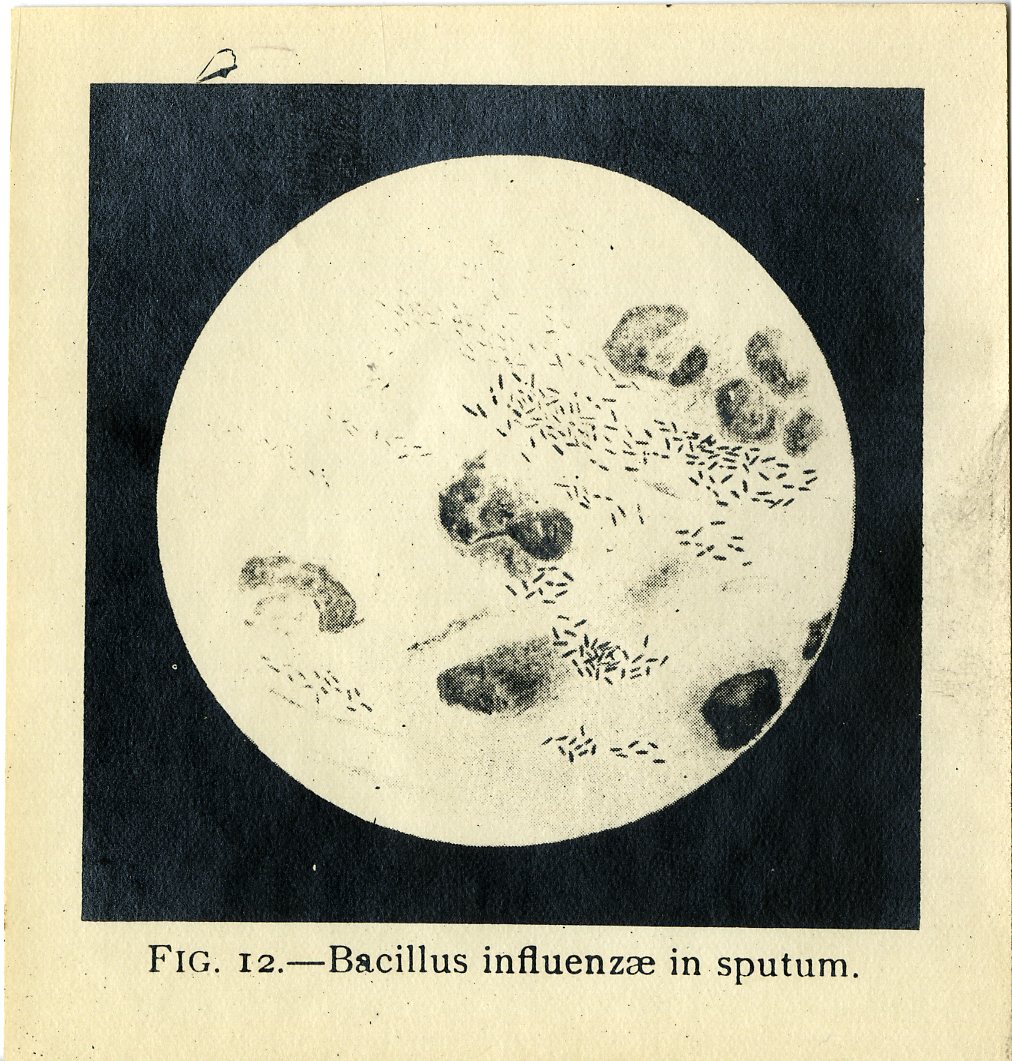
Infectious Agent – The bacillus influence of pfeefifer [sic]. (Illegible) secretions from the nose, throat and respiratory passages or (illegible)

Incubation period: one to four days, generally two.

Mode of transmission – by direct contact or indirect contact through use of handkerchief, common towels, cups, mess gear, or other objects contaminated with fresh secretions. (illegible)

Period of communicability as long as the person harbors the causative organism in the respiration tract.

Method of control

(A)
The infected individual and his environment.
“Recognition of the disease- By clinical manifestations and bacteriological findings.

Isolation- Bed isolation of infected individuals during the course of the disease. Screens between beds are to be recommended.

Immunization- Vaccines are used with only partial success.

Quarantine- None; impracticable.

Concurrent disinfection- The discharges from the mouth, throat, nose (illegible)causative organism is short-lived outside of the host.

(B)General measure-
The attend of the case should wear a gauze mask. During epidemics persons should avoid crowded assemblages, street cars and the like. Education as regards the danger of promiscuous coughing and pitting. Patients, because of the tendency to the development of broncho-pneumonia should be treated in well ventilated, warm rooms. The present outbreak of influenza may be controlled more or less extent only by intelligent action on the part of the public. “There is no such thing as an effective quarantine in the case of pandemic influenza,” Dr. Blue adds, “but precautionary measures may be taken and should be taken. Thus far we have little information as to the susceptibility of children, but it is fair to assume this type of Influenza might spread through a school as easily and rapidly as measles for example.”

โ€“ End of U.S. Surgeon General Notification, published in the Gloucester Daily Times 9/14/1918

By Monday three more deaths were reported and at least 300 cases of flu in town.

A second letter carrier, Sherman T. Walen, succumbed.

Not surprisingly, 600 students and 10 teachers skipped school, maybe sick or helping at home, or too scared to attend. Before the next school bell rang, Mayor Stoddart issued the first flu proclamation closing schools and banning all indoor gatherings. (The exemptions? Bars and churches were the last to close, and only after guidelines and state mandates.) The school board had to scramble and assemble to vote for closure as the action preceded procedure. Addison Gilbert Hospital was closed to visitors to prevent contagion. A Red Cross Emergency relief hospital was readied for patients, installed within the Spanish War Memorial Hall of the police station.

This strong roll-out happened within the first five or six days of Gloucesterโ€™s outbreak!

Clearly, city officials and various movers and shakers must have already sprang into action based on how fast they moved. Gloucester had the courage and foresight to get out ahead of the epidemic as much as possible, and far too much experience with the enormous sense of urgency and resolve required to handle a crisis after so many thousands of fishermen lost at sea. (From 1900 – 1918 nearly 800 Gloucester fishermen died at sea. A single February storm in 1879 claimed 143.) The devastating influenza deaths that would climb to 183 in the next few weeks added to a legacy of loss and coping.

Next installment- Gloucester fights back 


Follow along-

East Gloucester art exhibit and funeral announcement on the eve of WWI draft registration: Gloucester during the 1918 Pandemic Part 3

This excerpt has been adapted from 1918 Pandemic: Reconstructing How the Flu Raged Then Flattened in Gloucester, Massachusetts when 183 Died in 6 weeks, HERE by Catherine Ryan. Mini posts like this one highlight select weeks during the outbreak as serialized quick reads about this Gloucester history.


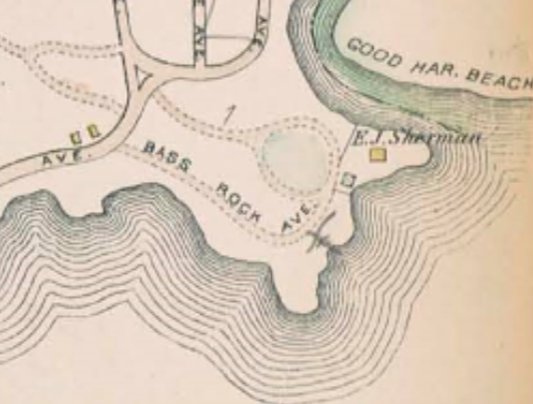
The funeral announcement for young mother Mrs. Margaret E. Miller of Bass Avenue (see maps)48 who died September 9th, 1918, โ€œafter an illness of only a weekโ€, was one of the first published flu deaths in Gloucester, Massachusetts. Millerโ€™s funeral was held at home, which was common, at her in-laws on Traverse Street in East Gloucester. She left behind a husband and their three month old daughter. 

The first civilian flu death reported in Boston was just one day earlier. Quincy came 6 days later. Worcester ten.

As the first major American offensives in France were underway, the Massachusetts battle of the flu turned into a public health crisis.

There were more visitors and announcements for special singing programs in East Gloucester that September 10th. Were the Gloucester residents among the carriers or those exposed to the virus?

โ€œMrs. John Brainerd Wilson has been entertaining her sister, Miss Hildreth of Everett, who is supervisor in the public schools of that city. Mrs. Fred Pierson and Mr. and Mrs. Winthrop C. Sherman and child, all of Quincy, are spending a week at 62 Mt. Pleasant avenue. Letter Carrier Sherman T. Walen is indisposed at his home on Rocky Neck…The Ladiesโ€™ Society of the Chapel Street Church will hold a basket picnic in West Gloucester tomorrowโ€ฆThe Chapel Street Baptist church school gathered on Sunday noon, for the first time after the summer adjournmentโ€ฆThere were 140 members of the church school presentโ€ฆโ€50

Gloucester Daily Times- East Gloucester column 9/10/1918

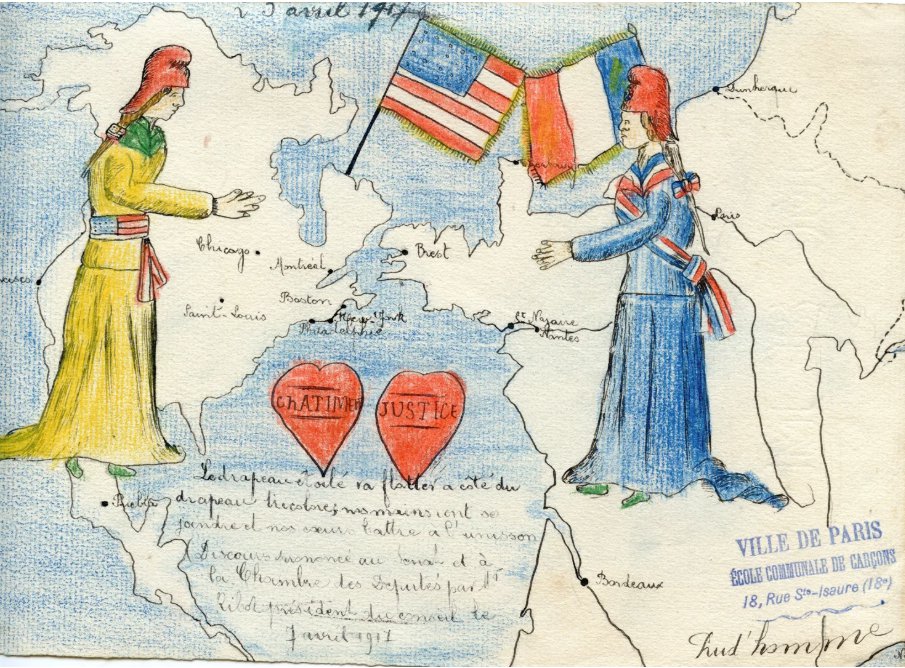
The School Committee convened that evening and voted to uphold the marriage bar for female teachers*, unless the husband was deployed. Duncan Wright of Annisquam was brought to Court by the Board of Health for “collecting swill without permit”. Gloucester’s “most prominent resident artist”, noted American painter, Cecilia Beaux, facilitated and underwrote the last exhibit of the 1918 season at the Gallery on the Moors: a national touring show featuring drawings and war posters created by children from France. The arts community hoped school groups would visit this very special art show near Rocky Neck. Beaux offered a gallery talk to encourage art fans.

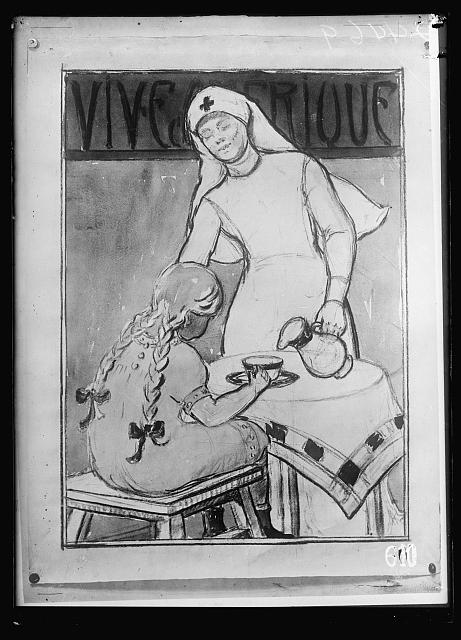
[In lieu of installation shots from that exhibit at any venue, I’ve included 1)art by children from France created at Red Cross programs during WWI, and 2)a video of Vive L’amerique: French Children Welcome Their American Ally for a commemorative exhibit at The National WWI Museum and Memorial in 2017 that featured drawings by French schoolchildren from an art teacher’s class at the start of the war.]

Sometime that week the Schooners Natalie Hammond and Athlete left Gloucester Harbor. On September 11, 1918, the headline on the front page of the local paper was a strong reminder about the draft Registration opening at all the voting places the very next day:

All are Urged to Register Early: All Flags to Fly and Bands to Play tomorrow

From 7 oโ€™clock tomorrow morning until 8 oโ€™clock tomorrow evening the voting places in this city and Rockport will be open for the enrollment of those coming within the new draft every man between the ages of 18 to 45 years both inclusive not already registered must register tomorrow for the Selective Service Draft.โ€51

Gloucester Daily Times draft registration reminder 9/11/1918

โ€œTomorrow our streets will be thronged with men,โ€ Massachusetts Governor McCall’s proclamation urging liquor stores to close began. โ€œThe day should be devoted entirely to such activities as will best expedite the enrollment of such a large number of men as are required by the National Government to enroll for military service.โ€  Gloucester was prepared. A corps of volunteers, registrars and interpreters for those unable to speak English all readied.

Though undoubtedly effective in generating support for the war and community, the local notices, meetings and community events predate the coming calamity September 12. With hindsight they make for a wincing read.  Unlike the general population in those days, contemporary readers know how each of these gatherings, little or small, ordinary or special, might spread the deadly contagion and end.

Badly.

Burn the peach stone barrel

Avoid committee meetings!

Steer clear of the crowdsโ€”especially singing ones!

Stay home! 

*author note: There were of course exceptions, however nursing and teaching jobs were targeted to all the single ladies, by law. Some who argued in defense of the policy expressed how limiting one job per household helped those who needed it most to earn a living. (One way to skirt that rule was to use the “maiden” name and keep mum about the marriage.) The teaching bar began in the late 1800s in the U.S. and lasted until the Civil Rights act in 1964.


Follow along-

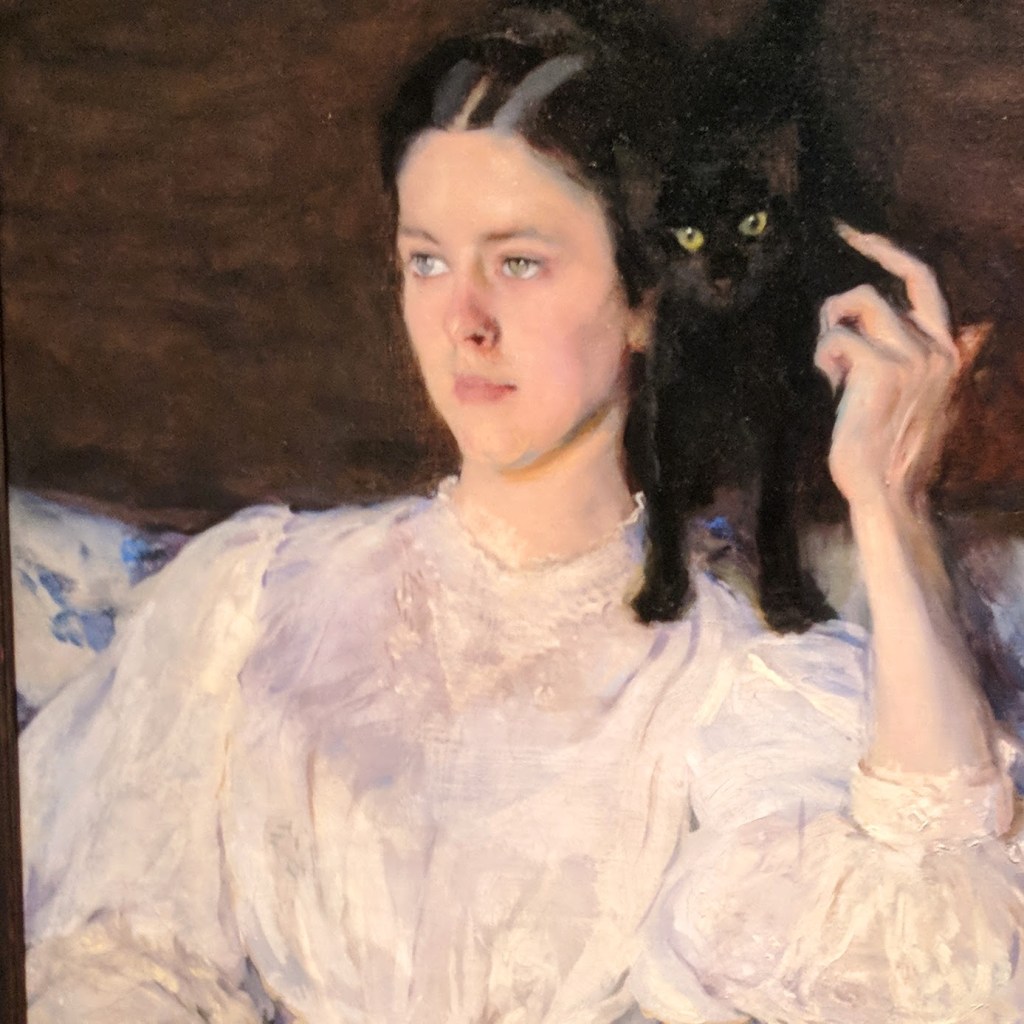
**detail from a dynamite painting, one of the great portraits– and cat depictions ever– for Joey DC

Fierce contagion fast deaths Boston Navy Yards and Fort Devens: Gloucester during the flu Pandemic 1918 part 2

This excerpt has been adapted from 1918 Pandemic: Reconstructing How the Flu Raged Then Flattened in Gloucester, Massachusetts when 183 Died in 6 weeks, HERE by Catherine Ryan. Mini posts like this one highlight select weeks during the outbreak as serialized quick reads about this Gloucester history.

The flu’s arrival in Gloucester during the second wave was more or less timed with Massachusetts outbreaks at military installations and Labor Day.

Boston Navy Yards

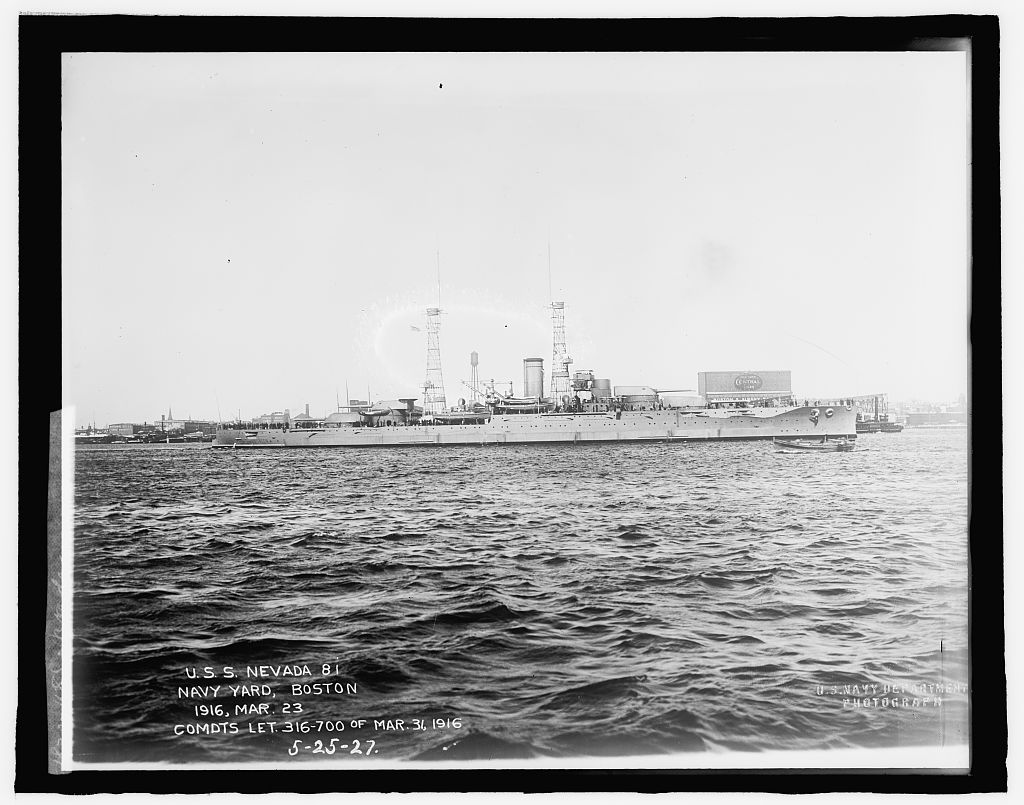
Densely populated bases and transports werenโ€™t ideal sanitary environments. The Navy yards in Boston and vicinity were among Americaโ€™s busiest for transportation of troops and supplies during WWI.

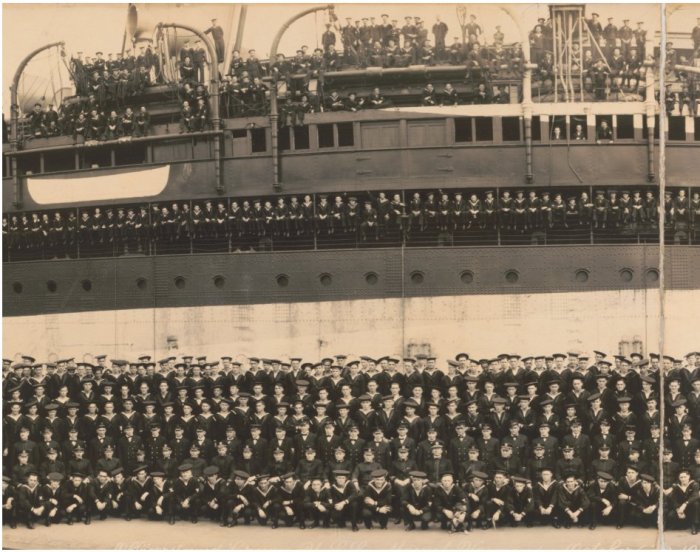
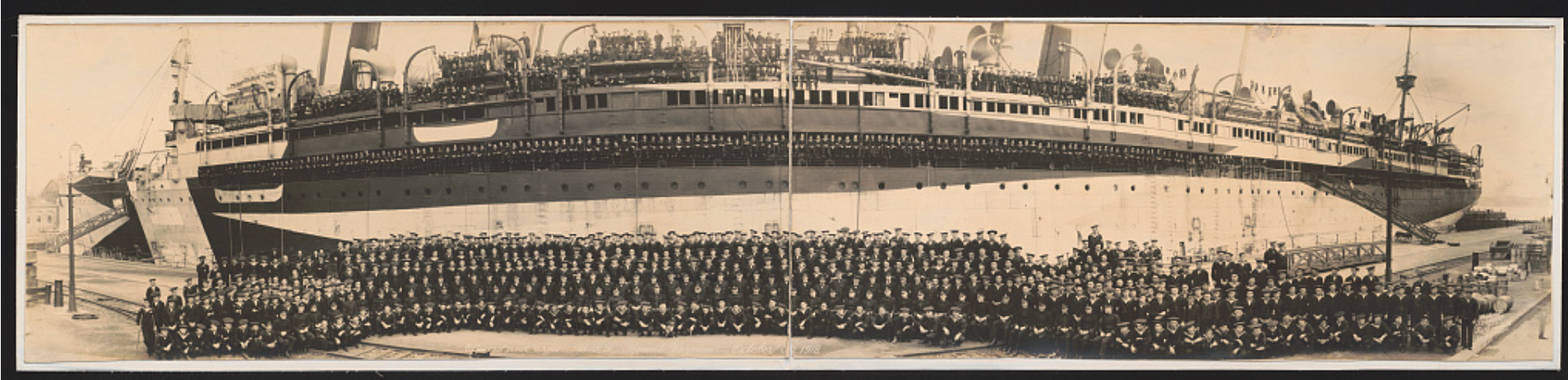
Vintage WWI embarkation and return photographs give a better idea of the scale of the operation of war: vessels are teeming with enlisted men squeezed shoulder to shoulder, potential carriers.

Library of Congress 15

In August of 1918, Navy sailors shoreside were hospitalized in Boston with a flu so contagious that dozens at a time were admitted, and 1200 died by early October. The following brief account about the Boston outbreak was written in 1920 by Warren T. Vaughan, Preventative Medicine and Hygiene Department of the Harvard Medical School. His book, Influenza: An Epidemiological Study, was published by the American Journal of Hygiene in 1921. This Pandemic 1918 essential read includes Vaughan’s research investigating an outbreak at Camp Sevier in South Carolina, and a massive civilian census–thanks to a grant from Met Life– in Boston following the 1919 wave. (Vaughan was a physician at Peter Bent Brigham Hospital when he was drafted May 29, 1917; he advanced to lieutenant colonel.)

โ€œAutumn Spread in the United States 1918

By the first of July, 1918, convalescent cases of influenza began to appear among members of the crews of transports and other vessels arriving in Boston from European parts. The number of such cases on each ship was usually not more than four or five, but Woodward records that in one or two instances between twenty and twenty-five individuals were sick on incoming vessels. None of these were seriously ill, none were sent to the hospital, and none died. The disease in this class of persons did not become severe until late August. Woodward has found on inquiry among practicing physicians that typical cases of influenza were seen with notable frequency in private practice in the vicinity of Boston during the month of August, and that they had developed no serious complications, the only after effect being the marked prostration. These mild preliminary cases failed to attract attention; first, because of their relative scarcity, and second because of their benign character. Public attention was first directed to the influenza in Boston by the apparently sudden appearance during the week ending August 28th of about fifty cases at the Naval station at Commonwealth Pier. Within the next two weeks over 2000 cases had occurred in the Naval forces of the First Naval district. One week later there was a similar sudden outbreak in the Aviation School and among the Naval Radio men at the Massachusetts Institute of Technology. The first death in Boston was reported on September 8th. The peak of daily incidence in Boston occurred around the first of October. In the week ending October 5th a total of 1,214 deaths from influenza and pneumonia was reported, while by the third week of October this total had fallen to less than 600, and for the week ending November 9th was down to 47โ€ฆOn or about December 1st the incidence again rose and continued increasing daily, to reach its peak in a severe recrudescence around December 31โ€ฆโ€, and โ€œA sudden and very significant increase was reported during the third week in August in the number of cases of pneumonia occurring in the army cantonment at Camp Devens, seeming to justify the statement that an influenza epidemic may have started among the soldiers there even before it appeared in the naval force…โ€ 16

Warren T. Vaughan

Sea of men [Officers and crew, U.S.S. Mount Vernon, October 30, 1918, Crosby, J. C., photographer. The authorโ€™s grandfather served on this ship. Library of Congress]

Fort Devens

Besides the naval bases in Boston, Fort Devens in Ayer, Massachusetts, was another military epicenter with fierce contagion and fast deaths; an estimated 15,000 men were infected by the flu and more than 800 died. Fort Devens was one of the countryโ€™s largest WW1 military bases, serving tens of thousands of soldiers in transition. According to the War Department research in 1926, โ€œAccommodations were provided for only 36,000 men, but this figure often was exceeded, more especially in August and September 1918 when the strength was approximately 45,000 and 48,000 respectively.โ€ Fort Devens housed the prisoners of war, also.

The base looks nearly a metropolis in vintage photographs. A selection of interior (clean!) and exterior shots were taken before the storm of flu. 18

Barracks at Camp Devens, Ayer, Mass. Camp Devens, near Ayer, Massachusetts, was one of those national army camps that had a miraculous and mushroom growth during the summer of 1917, when everything had to be done with a rush to train our boys for the great combat overseas. In ten weeks time, 5000 men, on a weekly payroll of $100,000, built 1,400 buildings, laid 20 miles of road, 400 miles of electric wiring, 60 miles of heating pipes, and installed 2200 shower baths. All of this work was accomplished in time for the cantonement [sic] to receive 40,000 men early in September, 1917, when the first selective draft men were impressed into service, a service which the patriotism of most led them to embrace willingly and without a murmur. The camp was a veritable city, and a well built one for its purposes. It had a post office, telegraph and telephone service, police station, guard house, fire department and hospital, all directed and manned by service men. The auditorium seated 3000 men, and the base hospital treated at times as many as 800 men in a single day. Bare and uninviting as the camp was to men accustomed to the comforts, and in many instances the luxuries of home, it provided an unusual degree of comfort to men in training for military service. The laundries and central power plant with its great furnaces are installed in the buildings with high chimneys which we see in the distance. The soldiers in the foreground were using a leisure hour to write home, for in the intervals of training it was to home that their thought turned, and at home parents and sweethearts always eagerly awaited letters.

‘Barracks at Camp Devens, Boys on Hillside Writing Letters, Ayer, Mass.’ the  Keystone View Company stereograph card, includes a write up about the barracks verso

As with the navy images, photographs of separate divisions illustrate the density at these camps and impossibility of social distancing in some environments.

Portraits of divisions as thick as forests help to illustrate the shattering descriptions expressed by front line responders confronting so many felled by flu. Camp physician, Roy Grist, related “boys laid out in long rows, ” 20  and Dr. Victor C. Vaughan recounted bodies “stacked like cord wood” in his autobiography published in 1926.

โ€œโ€ฆIn the memory chambers of my brain there hang many pictures. Some are the joy of my life, too sacred and too personal to describe to any save my most intimate friends. But there are also ghastly ones which I would tear down and destroy were I able to do so, but this is beyond my powerโ€ฆWhile I am engaged in describing the horrors of my memory picture gallery I might as well say something of the others, and then I will promise never to touch this gruesome subject againโ€ฆThe fourth canvas is quite as large as the others. I see hundreds of young, stalwart men in the uniform of their country coming into the wards of the hospital in groups of ten or more. They are placed on the cots until every bed is full and yet others crowd in. The faces soon wear a bluish cast; a distressing cough brings up the blood stained sputum. In the morning the dead bodies are stacked about the morgue like cord wood. This picture was painted on my memory cells at the division hospital, Camp Devens, 1918, when the deadly influenza demonstrated the inferiority of human inventions in the destruction of human life.โ€ 21

Victor C. Vaughan

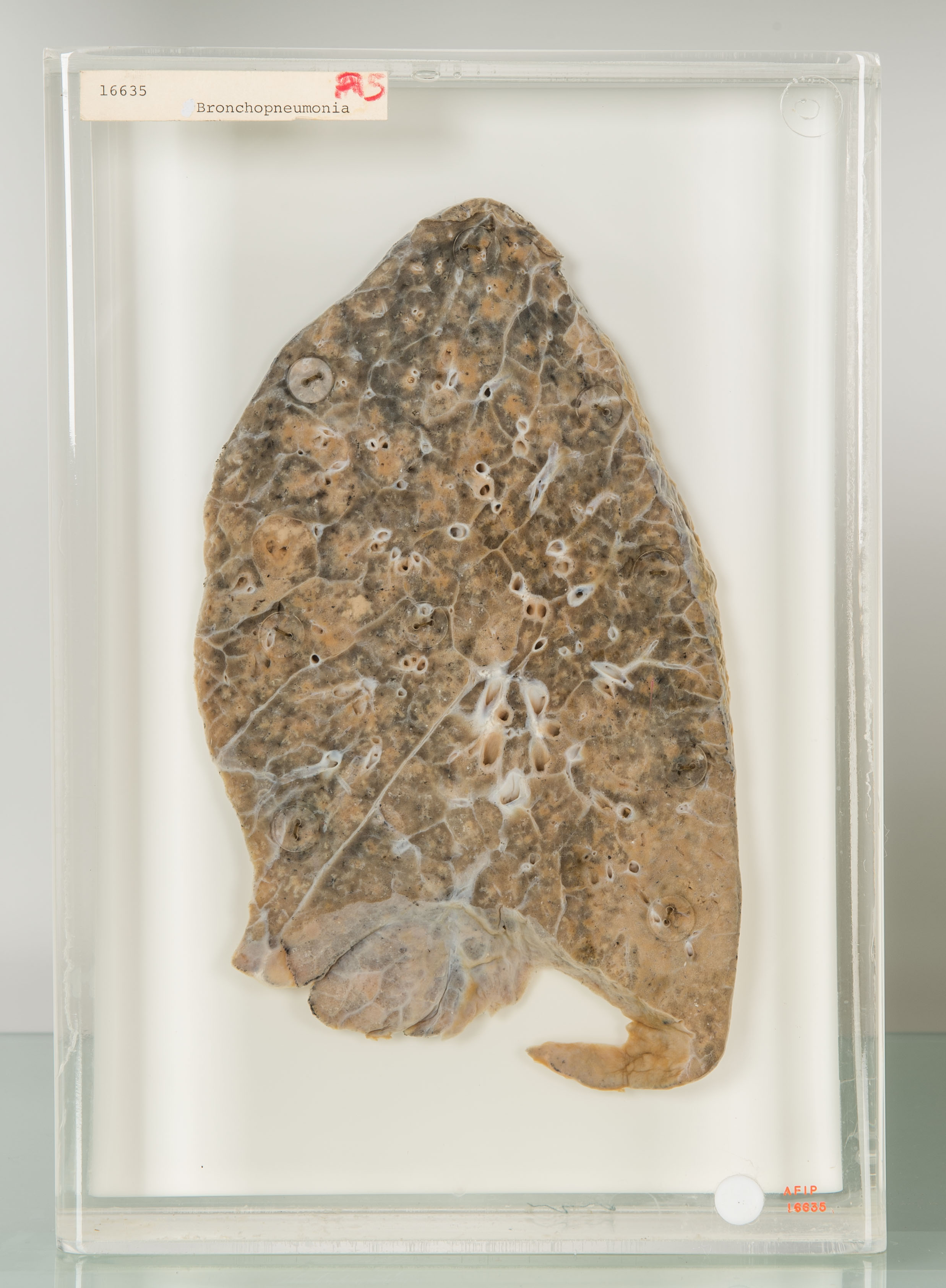
As Dean of the University of Michigan School of Medicine and director of the Surgeon Generalโ€™s Office of Communicable Disease, Vaughan was sent to Camp Devens as part of the federal governmentโ€™s elite assessment team.  Author Carol R. Byerly who wrote The Fever of War in 2005 added in a 2010 journal article how, โ€œCamp Devens physicians performing autopsies described influenza pathology as unique, characterized by โ€œthe intense congestion and hemorrhageโ€ of the lungs. But as Vaughan and [John Hopkins pathologist William Henry] Welch investigated Camp Devens, the virus kept moving. Before any travel ban could be imposed, a contingent of replacement troops departed Devens for Camp Upton, Long Island, the Army’s debarkation point for France, and took influenza with them.โ€ 23

Itโ€™s no wonder Vaughan didnโ€™t dwell on this savage disease.

Another Vaughan, Dr. Warren T. Vaughan– who wrote in 1920 about the Boston outbreak in the Navy mentioned above– was โ€œone of a board of officers appointed to investigateโ€ a milder advent that “had broken out among troops stationedโ€ in the army base at Camp Sevier, South Carolina. He explained how difficult pandemics were to predict.

โ€œSudden onset regimental infirmaryโ€ฆcareful bacteriologic examination was made at that time and predominating organisms were found to be a gram negative coccus resembling micrococcus catarrhalis, and a non-hemolytic streptococcus. They were uncomplicated cases..at the time none of us dreamed of any possible connection with a severe epidemic to occur later (at that wave bacilli werenโ€™t present)โ€ฆโ€

Warren T. Vaughan, 1920

Block of medical images, various collections 24

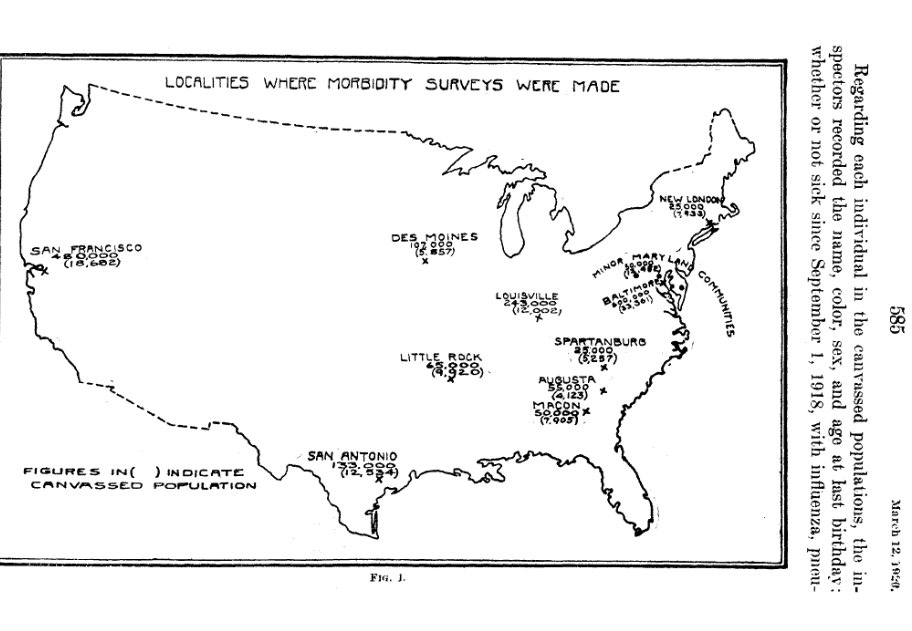
W.T. Vaughan felt not a single community in which there were reported cases reached tallying anywhere near the total of actual cases.   And so he rolled up his sleeves. โ€œToward the end of January 1920 when recurrent epidemic as at its height in Boston,โ€ Vaughn writes, โ€œThe author undertook with the aid of 13 trained social service workers and one physician graduate from the Harvard school of public health to make sickness census of 10,000 individuals,”  in person, in six districts.

His statements from 1920 echo in todayโ€™s news:

On determining first cases of infection

โ€œThere is evidence –the collection of which has not been completed– pointing to the existence of cases of the disease in various centers, probably widely distributed, weeks before they were definitely recognized as influenzaโ€ฆโ€ – Warren T. Vaughan, 1920

On healthy carriers

โ€œYes it does exist.โ€ – Warren T. Vaughan, 1920

On crowd gatherings

โ€œYet another phenomenon which would lead us to conclude that human intercourse is the most potent factor in the transmission of influenza is the fact that there is frequently a high increase in the influenza rate following crowd gatherings. Parkes observed long ago that person in overcrowded habitations, particularly in some epidemic, suffered especially, and several instances are on record of a large school or barracks being first attacked and the disease prevailing there for some days, before it became prevalent in the towns aroundโ€ฆIn discussing the recrudescence of influenza in Boston in November and December, Woodward remarks as follows: โ€œWhether or not it may be more than a succession of coincidences it is certainly of interest to note that the November outbreak of influenza showed itself three days after the Peace Day celebration on November 12th, when the streets, eating places and public conveyances were jammed with crowds; that the December epidemic began to manifest itself after the Thanksgiving holidayโ€ฆand that reported cases mounted rapidly during the period of Christmas shoppingโ€ฆโ€ Warren T. Vaughan, 1920

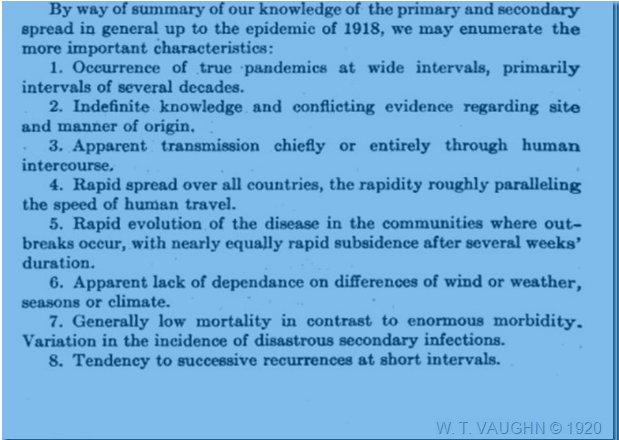
By way of summary

This image has an empty alt attribute; its file name is w.t.-vaughan-1920.jpg

Looking for signposts | on the manner of the flu’s spread

Vaughan looked to the past as he researched the present. He quoted 1847 influenza research by Thomas Watson that resonates poignantly:

โ€œโ€ฆalthough the general descent of the malady is, as I have said, very sudden and diffused, scattered cases of it, like the first droppings of a thunder shower, have usually been remembered as having preceded it.” Thomas Watson on Influenza, 1847 29

Local Enlisted Lads sick/ quarantined before Labor Day

Local enlisted lads wrote about the infamous flu in letters home to Gloucester, Mass., and other Cape Ann towns before Labor Day, although they werenโ€™t read or published until after the disease exploded in Gloucester. Private John J. Smith wrote his mother, Mrs. Charles W. Smith of 5 Center Court, a long letter dated September 1, 1918. At one point he puts it plainly: “I feel better over here than I did in Camp Devens and sure have got that same good old appetiteโ€ฆโ€30 The letter appeared in the Gloucester Daily Times on the last day of September, included as part of the series, “Our Boys Write Bright Letters Home.”

Lt. J. Irving Baker from Manchester-by-the-sea wrote his mother, “Somewhere from France, July 23, 1918.” about how he was, “getting along fine now, you can tell by this paper. I went down the street myself and bought it. I have been moved into another building where I have a room with another officer. It is fine. From the window I can see hills and trees. It is a summer resort in the foothills of the Alps. There is a mineral spring here in which I hope to have a bath before I leave.” He broke off before mailing, and added an update July 31 from an Army base hospital in Allery, France, where he was sent to convalesce. 

โ€œWe just arrived at the convalescent camp and are pretty tired, did not get much chance to sleep on the train. This is a small place called Allery [sic] about 180 miles northeast of Flermont. It looks a good deal like an army cantonment with wooden barracks, partitioned into rooms, tow in a room. The town is only a station, cafe and a few houses…You know I lost nearly all my things when I came to the hospital, I am managing to get a kit together after a fashion. …They raise many geese in this section of France…Aug. 5. I am feeling fine now, only short of breath when I go up stairs or exert myself–as I’m pretty tired just now.”

The letter was published in the Manchester Cricket on September 21, 1918 within a column devoted to “Letters From Our Boys at the Front”.

Allery [sic] photo, WWI Centennial Commission31 

Another soldier from Manchester, Private Wade Revere Brooks, joined the Marines. In a detailed letter from South Carolina, he described multiple quarantines at basic training camp(s) that began for him immediately upon arrival, back in June 1918, and with each new skills rotation until deployment.  His undated letter was featured in the Manchester Cricket on October 26, 1918, long after the crest of the pandemic. From the contents it seems to have been written in September. He signs off:

โ€œโ€ฆAfter coming off the range we were held for the influenza quarantine, and we are now awaiting for shipment to Virginia where we get our overseas training, which consists of gas attack drills, hand grenade throwing and more trench work. I hope we will move soon. There are six thousand trained troops waiting for the quarantine for Flu to be lifted. Well I have told you as much as I can think of just now, so I will close hoping this will interest you some. I am sincerely yours, Pvt. Wade Revere Brooks, Company 332, Battalion O, United States Marine Corps, Paris Island, South Carolina. 32

Acting Mess Sergeant Frank A. McDonald sent a postcard from the hospital at Camp Jackson, Columbia, South Carolina, conveyed in the Gloucester Daily Times October 22, 1918 , โ€œMany Local Boys Had the Influenzaโ€:

โ€œHe is in the base hospital recovering from a three weeksโ€™ serious illness of influenza. He states that Herman Amero* (illegible) is recovering after four weeks siege of pneumonia, Herbert Joyce and Robert Smith, Gloucester boys at the same camp, are also on the mending hand. The other Gloucester boys are all well, he [Frank A. McDonald] says.โ€

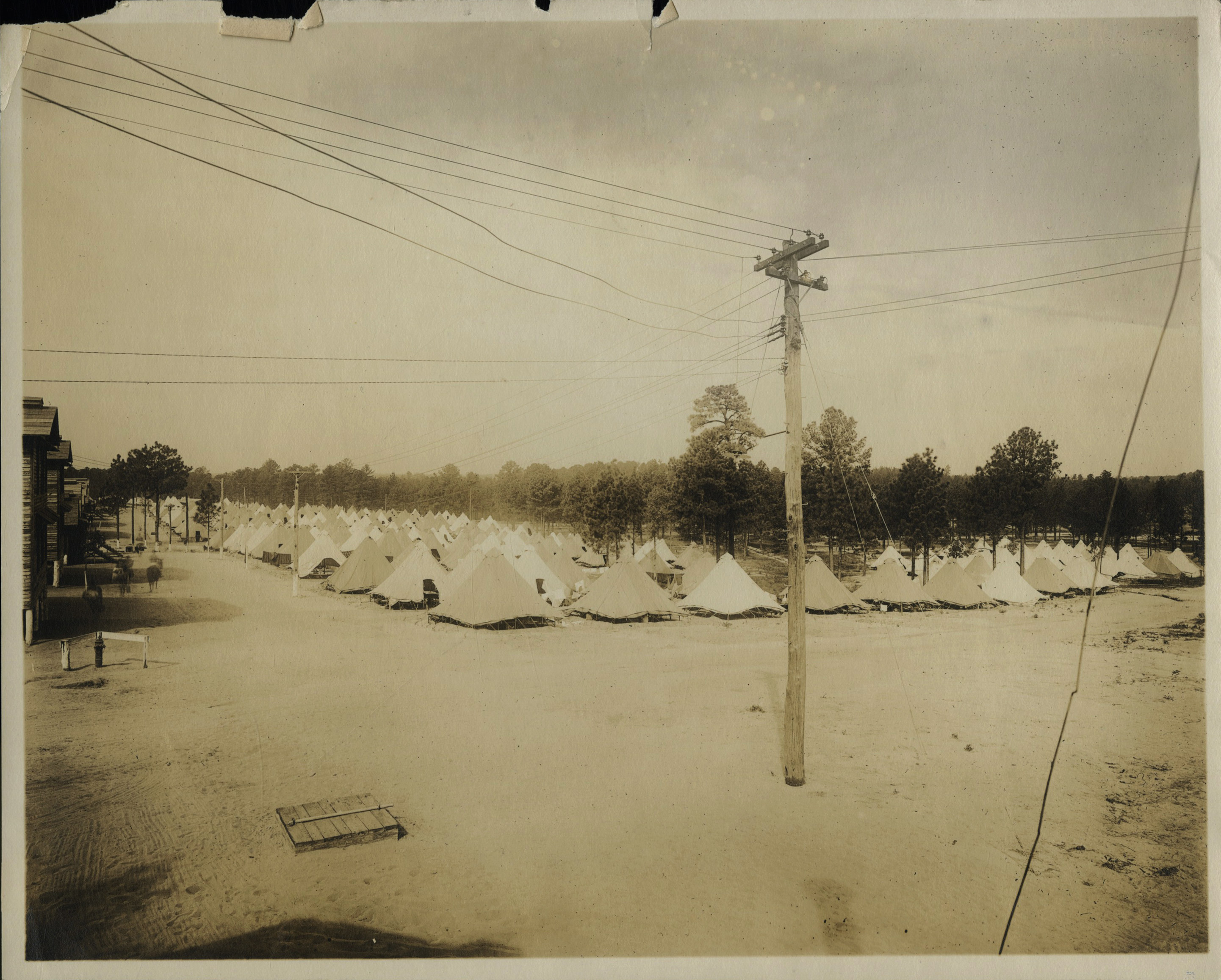
Social distancing is absent in the post office at Camp Jackson when this photograph was taken that September. Camp Jackson utilized tents for its flu management.

War news produced by the military stressed the strength in numbers of Americaโ€™s fighting forces as with this 1917 photograph โ€œEmbarked for Franceโ€.

or this โ€˜We wonโ€™t stop coming till itโ€™s over Over Thereโ€™ image published on the front page of the Tribune Graphic  September 8, 1918.

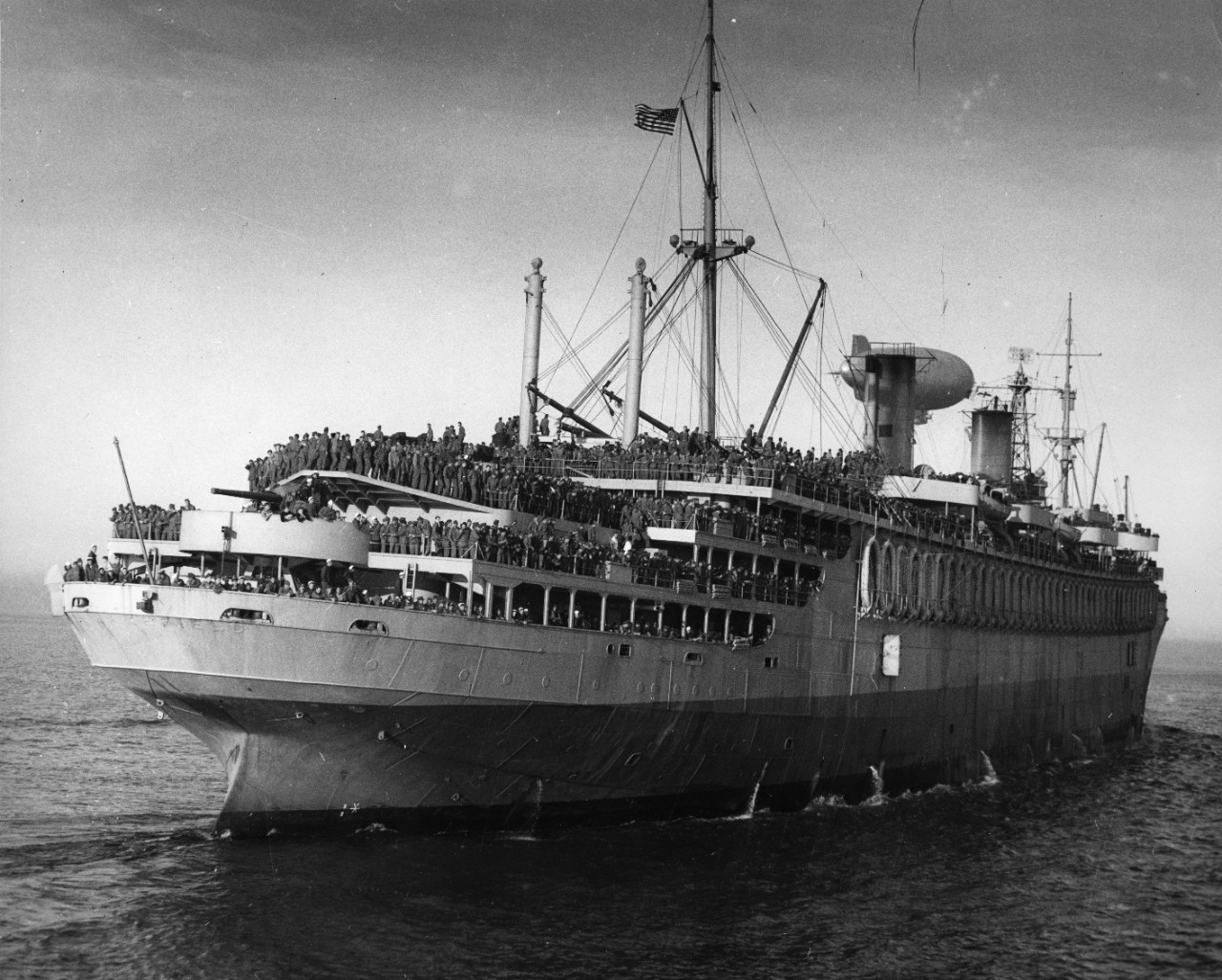
Besides arriving sick, more than 12,000 enlisted died from the flu pandemic on the troop transports heading to France before they landed.35 Men in the September 1918 photograph could very well have been among the afflicted.

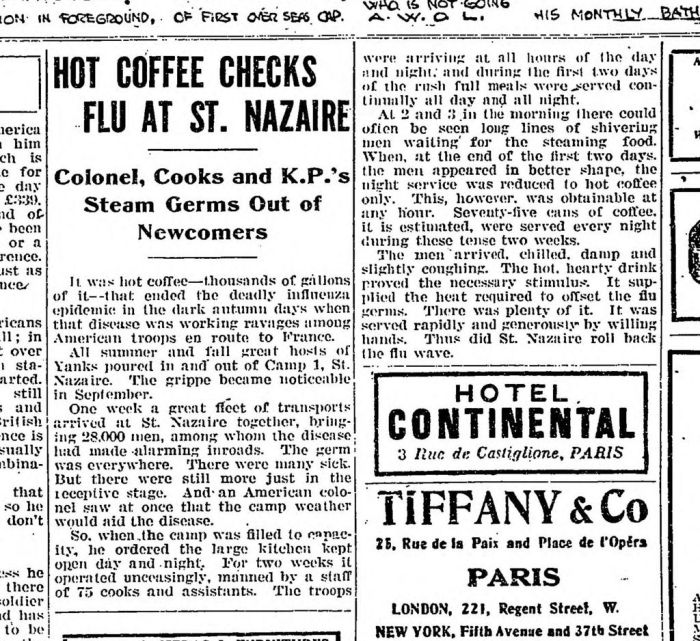
When the flu was mentioned in Stars and Stripes, the newspaper written by American servicemen for soldiers, it was late news and downplayed. This article, โ€œHot Coffee Checks Flu at St. Nazaire: Colonel, Cooks, and K.Pโ€™s Steam Germs Out of Newcomersโ€, published December 13, 1918, claimed that coffee, climate and command vanquished the deadly epidemic. “It was hot coffeeโ€”thousands of gallons of it โ€“that ended the deadly influenza epidemic in the dark autumn days when that disease was working ravages among American troops en route to France.โ€

If the extent of flu deaths within the military that spring and summer were understood, the governmentโ€™s fall conscription push for 15 million registrations may have been impossible. Who among us would knowingly support a draft for our sons and fathers, our brothers and friends, with such a lethal disease out of control at training camps and ships bound for France?

The records do appear to indicate that federal guidelines were mostly held back until after the September 12th national draft registration day (and the preceding parades and rallies that encouraged registration).  By that date, officials including public health and infectious disease experts within the military knew key facts: that the death rate was higher in barracks and cantonments than tent camps; that quarantines were necessary at training camps; that geography was more important than cramped quarters; that healthy carriers exist; and that nurses and non commissioned suffered more than officers and privates. Gloucester would welcome and benefit from this military expertise.

Enlisted men who succumbed during training or transport, died from pneumonia or flu โ€œin the line of duty. โ€37 Still, death in battle was mourned more openly than death by disease, tamping down stories and comparisons about the flu.  Efforts to reduce transmission at a time of heightened engagement in WW1 — whether communication was instantaneous (telegraph) or not; word of mouth or not; censored or not– were next to impossible by Labor Day.


Full article- 1918 Pandemic: Reconstructing How the Flu Raged Then Flattened in Gloucester, Massachusetts when 183 Died in 6 weeks

Flu Masks / Face Masks instructions Gloucester 1918 1918 Directions for sewing face masks and the Mask Factory in #GloucesterMA | plus DIY lost sock mask 2020 โ€“ Good Morning Gloucester

1918 Directions for sewing face masks and the Mask Factory in #GloucesterMA | plus DIY lost sock mask 2020

1918 Influenza pandemic

Directions for making Gauze Face Masks


Use as fine gauze or cheesecloth as possible. Fold material to make five thickness and cut an oblong 3-1/2 x 7-1/2 inches. Make three half-inch plaits at each end, turn in edges and stitch. Cut four feet of tape into four lengths and sew one to each corner. Make box plait 1-1/2 inches in width in one of the long edges of the mask, stitch down one inch. To adjust, place mask over face: tie tapes from upper corner around back of head and tape from lower corners around back of neck. Place box plait over nose. Masks should be worn by attendants whenever caring for those sick with influenza or pneumonia.


They should be changed at two-hour intervals and oftener if wet, and immediately boiled for five minutes, (illegible), or wrapped securely in paper bag or newspaper until they can be boiled

Gloucester Daily Times 9/30/1918 Flu masks / Face masks

Gloucester, Mass.

“The work of the nursing service has been one of the demonstrations which, in a way, can be measured. When it is realized that in response to the advertised and personal requests for volunteer service over 200 responses were received, and that the hours of service were long and the work strenuous, I think everyone must agree that no words can express proper appreciation of the ladies who have given their time and strength to nurse their sick townspeople. To ask a woman to leave her home at 3 oโ€™clock in the morning and have her cheerfully comply shows the material of which the women of your city are made…Classed with nursing service has been a specialized group which has been properly called the Mask Factory. As influenza is a respiratory disease, transmitted almost entirely by close contact with secretions of the nose and mouth from coughing, sneezing and spitting, the protection of the workers depended upon an ample supply of masks. The mask factory worked 24 hours a day until there was an ample supply, and then with the usual enthusiasm of all workers, demanded an additional duty to perform. All such demands were readily granted and in this particular instance warm wraps and bed slippers (for the patients) were made the additional duty.”

Major Alec Thomson, Some Good News about Gloucester, Mass. October 11, 1918

Read more about the Gloucester flu battle during the 1918 Pandemic here, an online resource including day by day archives.

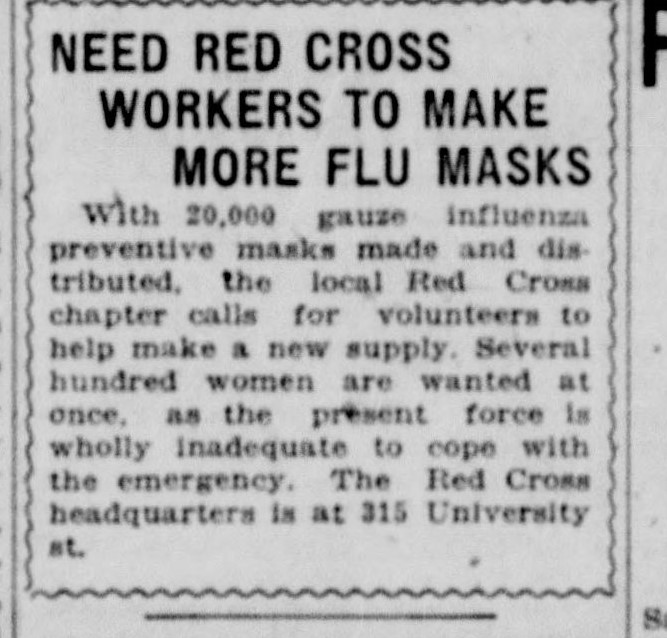
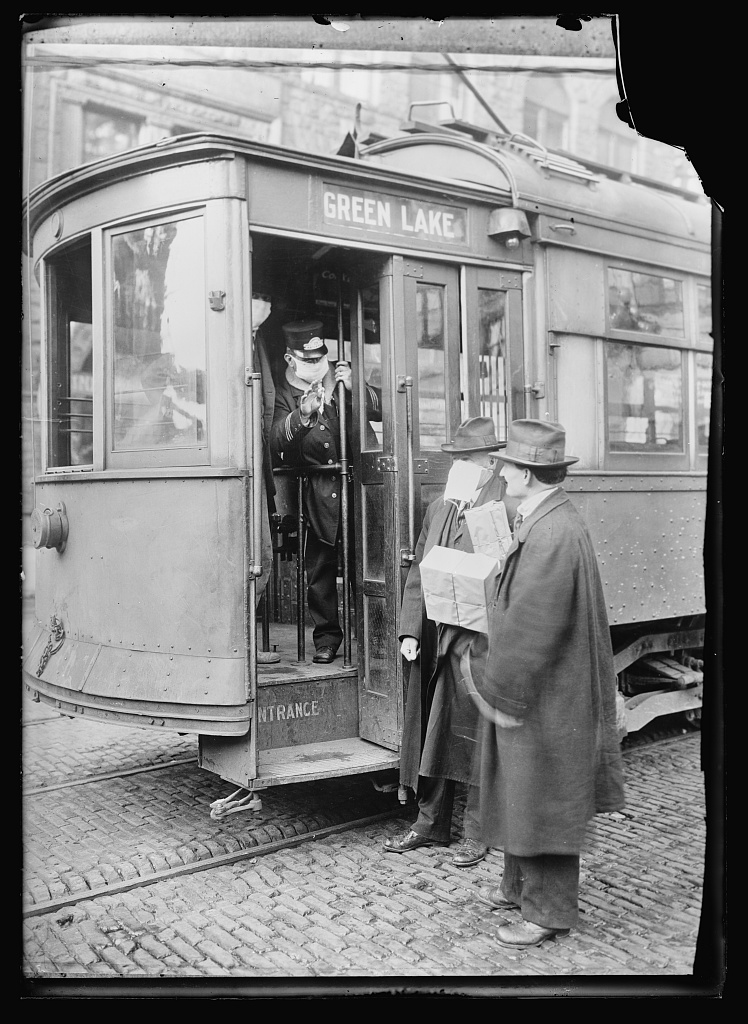
Across the country, Seattle Washington pushed to replenish their stockpile

Lost socks? 2020 Covid-19 easy sock mask version we tried at home