Beautiful Fish: Alewife -By Al Bezanson

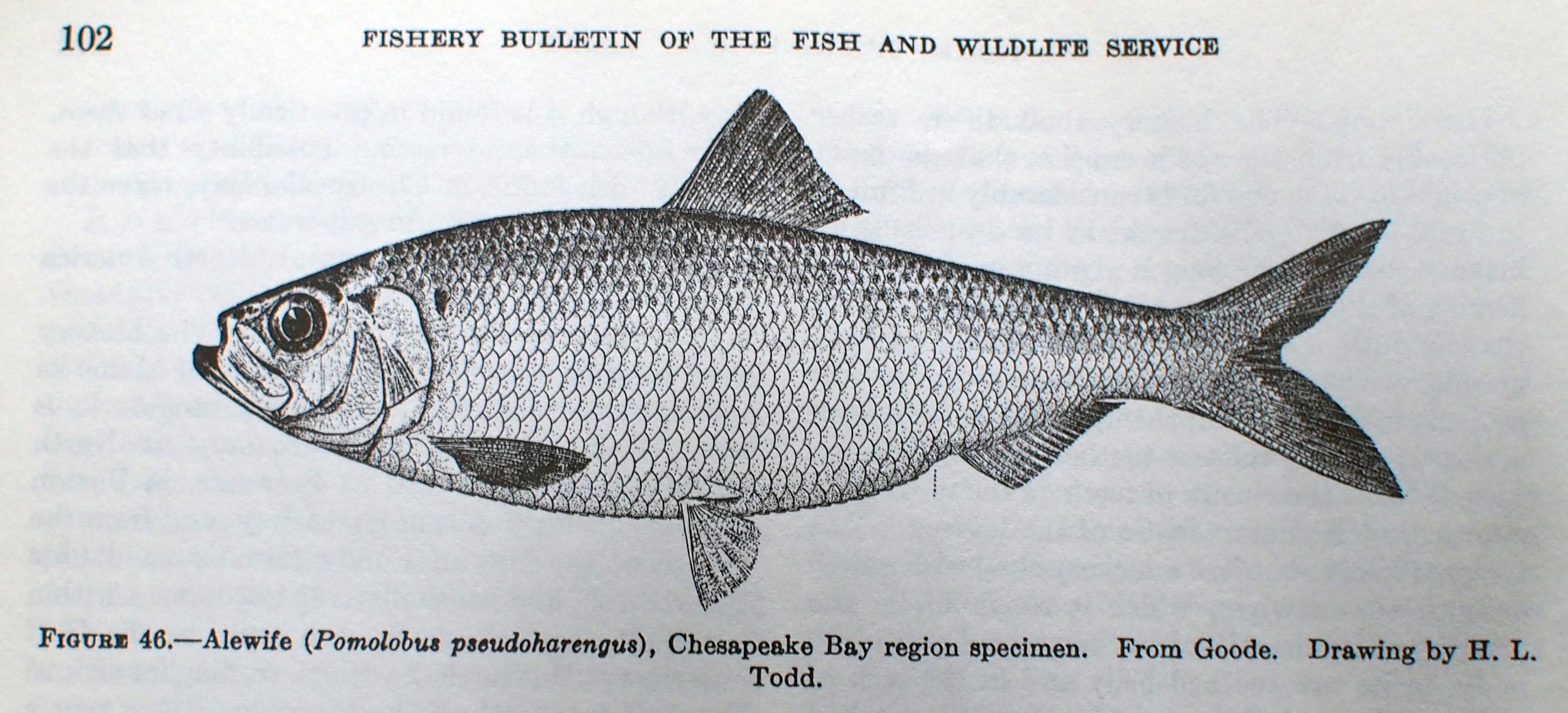
ALEWIFE; GASPEREAU; SAWBELLY; KYAK; BRANCH HERRING; FRESH-WATER HERRING; GRAYBACK

The alewife, like the shad and the salmon makes its growth in the sea, but enters fresh water streams to spawn. This “anadromous” habit, as it is called, forced itself on the attention of the early settlers on our coasts. In the words of an eyewitness, “experience hath taught them at New Plymouth that in April there is a fish much like a herring that comes up into the small brooks to spawn, and when the water is not knee deep they will presse up through your hands, yea, thow you beat at them with cudgels, and in such abundance as is incredible.”  And they are no less persevering in their struggles upstream today. Numbers of them are to be seen in many streams, any spring, alternately swimming ahead; resting in the eddy behind some irregularity of the bottom; then moving ahead again, between one’s feet if one happens to be standing in midstream. And they are much more successful than the shad in surmounting fishways of suitable design.

From Fishes of the Gulf of Maine by Bigelow and Schroeder (1953) online courtesy of MBL/WHOIhttp://www.gma.org/fogm/Pomolobus_pseudoharengus.htm


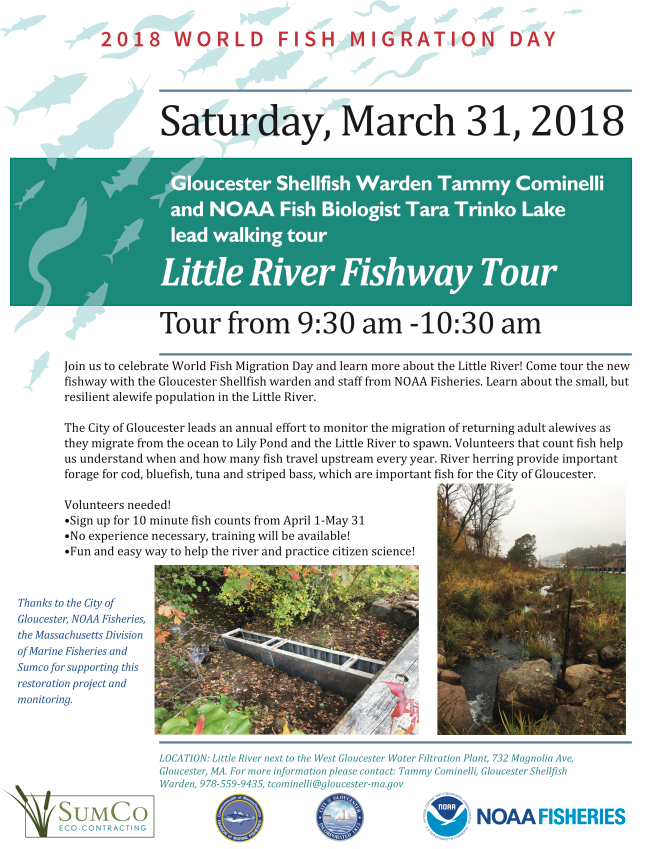
This Saturday, March 31st ,  help out with the alewife count right here in Little River.
 

Beautiful Fish: Chimaera -By Al Bezanson


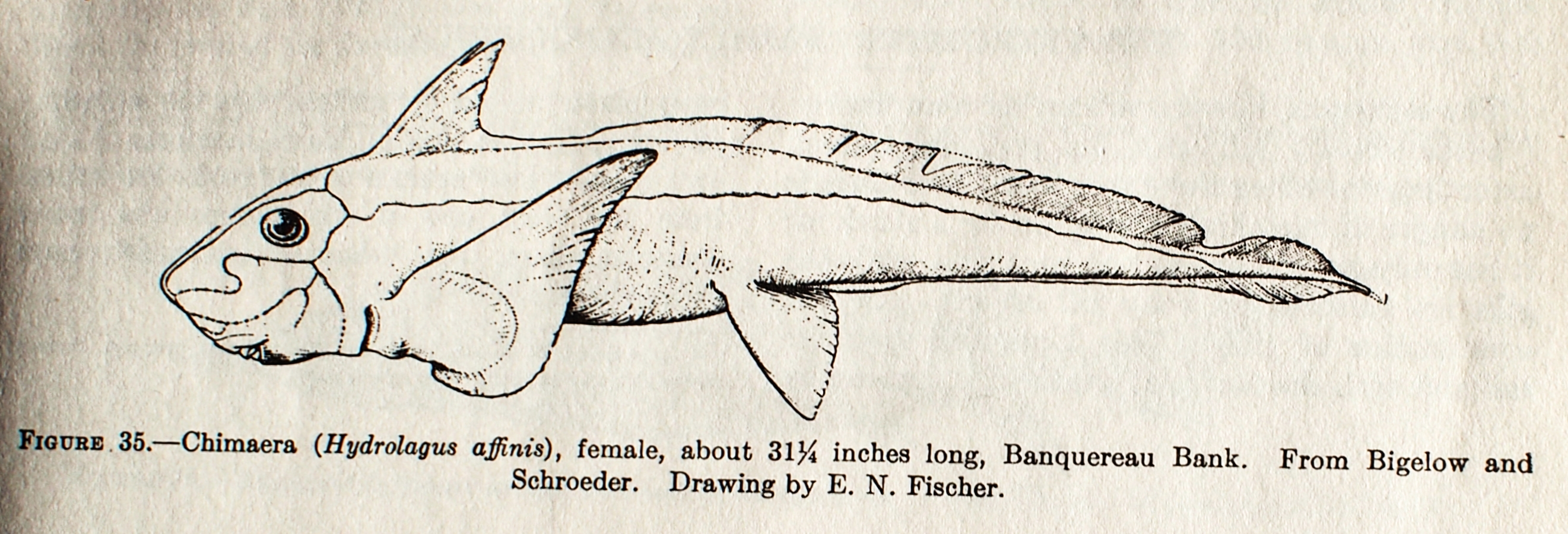
The chimaeroids, being cartilaginous fishes, are allied to the sharks, skates and rays, but are separated from them by many important anatomic characters. Most obvious of these externally are that they have no spiracle; that they have only one external gill opening on either side; that their tails are symmetrical; and that their gill filaments are free at the tips like those of bony fishes. The chimaeroids remotely suggest the grenadiers in general body form, but are easily separable from them at a glance; first of all by the softness of their bodies and by their naked skins, also by the location of the pelvic fins which are set far back under or behind the tips of the pectorals, and by the large size of the pectoral fins, to list only the most obvious differences. There is no danger of confusing them with any other Gulf of Maine fishes, so curious is their appearance.

Occurrence in the Gulf of Maine—

Our only reason for mentioning this chimaera is that it is (or was) so plentiful along the offshore slopes of the Banks off the eastern part of the Gulf and off Nova Scotia that many were brought in for a few years subsequent to 1875, when fishermen long lining for halibut extended their operations down to 300 fathoms or so. Only one seems to have been reported during the past 25 years, caught off Browns Bank, 85 miles southwest of Cape Sable, between 400 and 500 fathoms on October 15, 1930.[85] But perhaps it would be found no less plentiful now than of old, if sought at the proper depth. The shoalest capture of which we found record was at 160 fathoms.

From Fishes of the Gulf of Maine by Bigelow and Schroeder (1953) online courtesy of MBL/WHOI http://www.gma.org/fogm/Hydrolagus_affinis.htm

Beautiful Fish: William C. Schroeder -By Al Bezanson


William C. Schroeder (1895-1977), coauthor Fishes of the Gulf of Maine by Bigelow and Schroeder (1953) online courtesy of MBL/WHOI http://www.gma.org/fogm/Default.htm

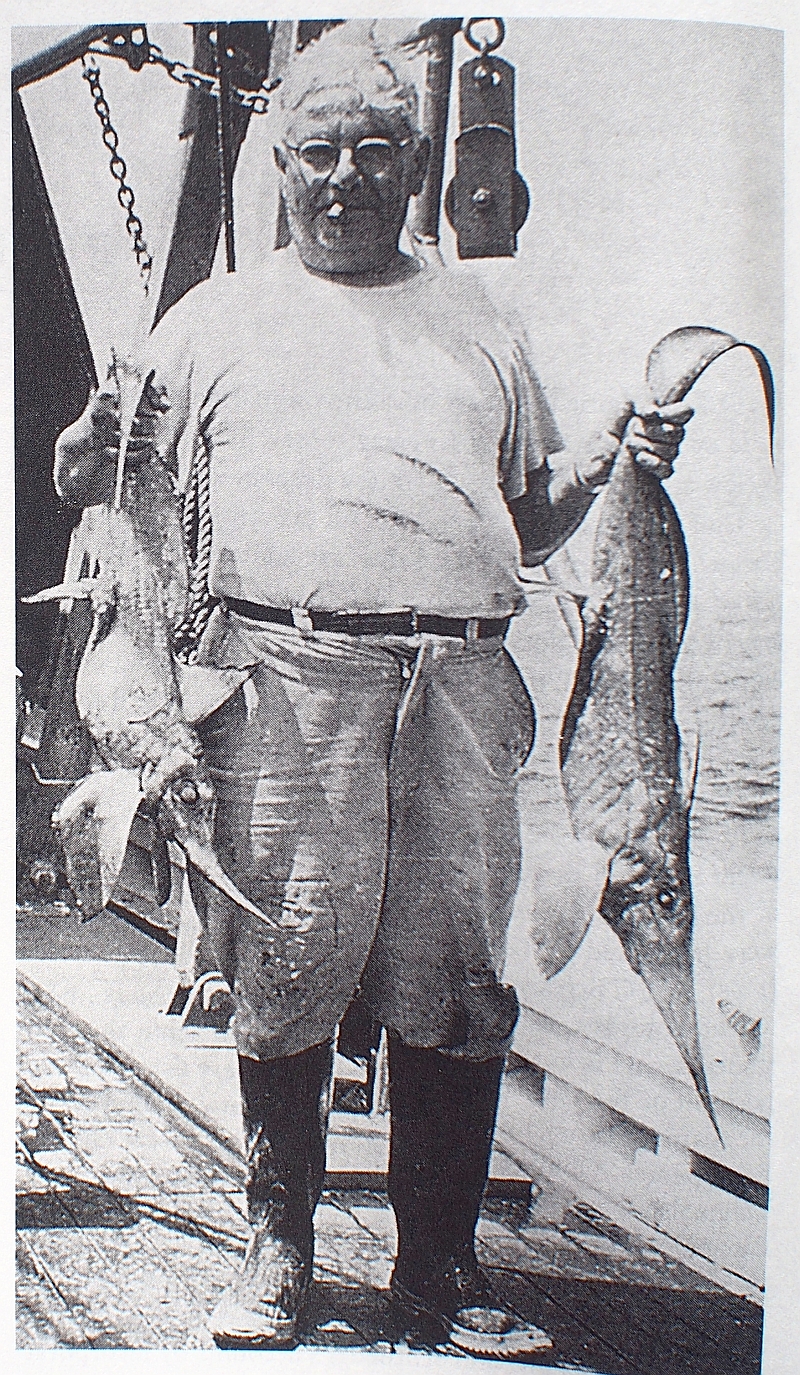
William C. Schroeder was born on Staten Island in 1895. He quit school at age 14 to support his mother after his parents separated and became a professional musician playing various stringed instruments at concerts that included an appearance at Carnegie Hall. He married Adah Jensen when he was twenty-one and enrolled at George Washington University six years later. Schroeder transferred to Harvard in 1924. He remained there until 1931, but started leading the dual existence common at the time as he was identified as an assistant Aquatic Biologist, U.S. Bureau of Fisheries in 1928 when he coauthored Fishes of the Chesapeake Bay with Samuel F. Hildebrand.  This pattern continued when he took the position of business manager at WHOI in 1932.  During the twenty years he maintained that position, he collaborated with Henry B. Bigelow to publish volumes one and two on the sharks and skates for Yale’s Sears Foundation Fishes of the Western North Atlantic, a new edition of Fishes of the Gulf of Maineand five other papers on lampreys, hagfish, sharks, rays and chimaeras.

By 1948 Schroeder was running out of fish to write about. He wanted to get to the edge of the shelf and seek the “little known bottom dwellers” that had not been sampled since the Fish Commission’s Fish Hawk dragged a small beam trawl from 50 to 600 fathoms in 1880. He tried trips on the R/V Caryn and Atlantis with tantalizing results but he craved a little more power and a little more wire. In the summers of 1952-3 Schroeder chartered Henry Klimm’s 83 foot Cap’n Bill II. One hundred and ninety three successful tows from 50 to 730 fathoms between LaHave Bank and Cape Charles produced 75 species of sharks, skates and chimaeras. One major setback was the implosion of the standard aluminum head rope floats that had to be replaced with glass floats. Another difficulty arose when the net would get plugged with big lobsters, ocean perch or red crabs. Bill Schroeder shrugged off these obstacles and brought home a lobster claw to Mary Sears. It fed sixteen people.

(From Woods Hole Historical Museum, “Four Fishermen” by Martin R. Bartlett)

Photograph:  William C. Schroeder on board Cap’n Bill II, with chimaeras Harriotta raleighana in hand.  (Photograph by Jan Hahn, © Sears Foundation for Marine Research)


Beautiful Fish: Dr. Henry Bryant Bigelow -By Al Bezanson
“How much is known about the Gulf of Maine?”

“Practically nothing.”

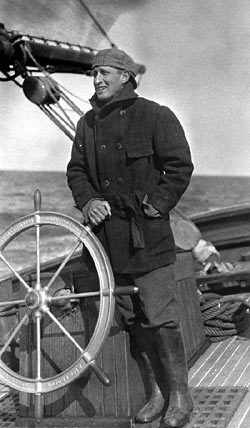
So, according to his memoirs, went the conversation that kicked Henry Bryant Bigelow (Harvard) ’01, Ph.D. ’06, S.D. ’46, out of a rut and onto the Gulf of Maine, which he would transform from a scientific unknown to one of the most thoroughly studied large bodies of water in the world–and in doing so, set modern oceanography on an “interdisciplinary,” “ecosystemic” course before either term existed. Bigelow developed a rigorous, integrative approach to oceanography that he eloquently propagated for decades. Along the way, he served what he reckoned to be the longest tenure in Harvard’s history, working as a researcher, instructor, and professor of zoology from 1906 to 1962–for which he solicited and received, he recalled with typical humor in the memoirs, the only bottle of whiskey ever presented to anyone by the President and Fellows of Harvard College. (By David Dobbs, for Harvard Magazine) https://harvardmagazine.com/1999/01/vita.html

Fishes of the Gulf of Maine by Bigelow and Schroeder has long been known simply as Bigelow and Schroeder.  Dr. Henry Bryant Bigelow (1879-1967) was founding director of Woods Hole Oceanographic Institution.  https://www.whoi.edu/main/profile/henry-bryant-bigelow

Photograph courtesy of WHOI archives:  Dr. Henry Bryant Bigelow at the helm of Grampus in the Gulf of Maine, 1912


Beautiful Fish: Deep Sea Angler -By Al Bezanson

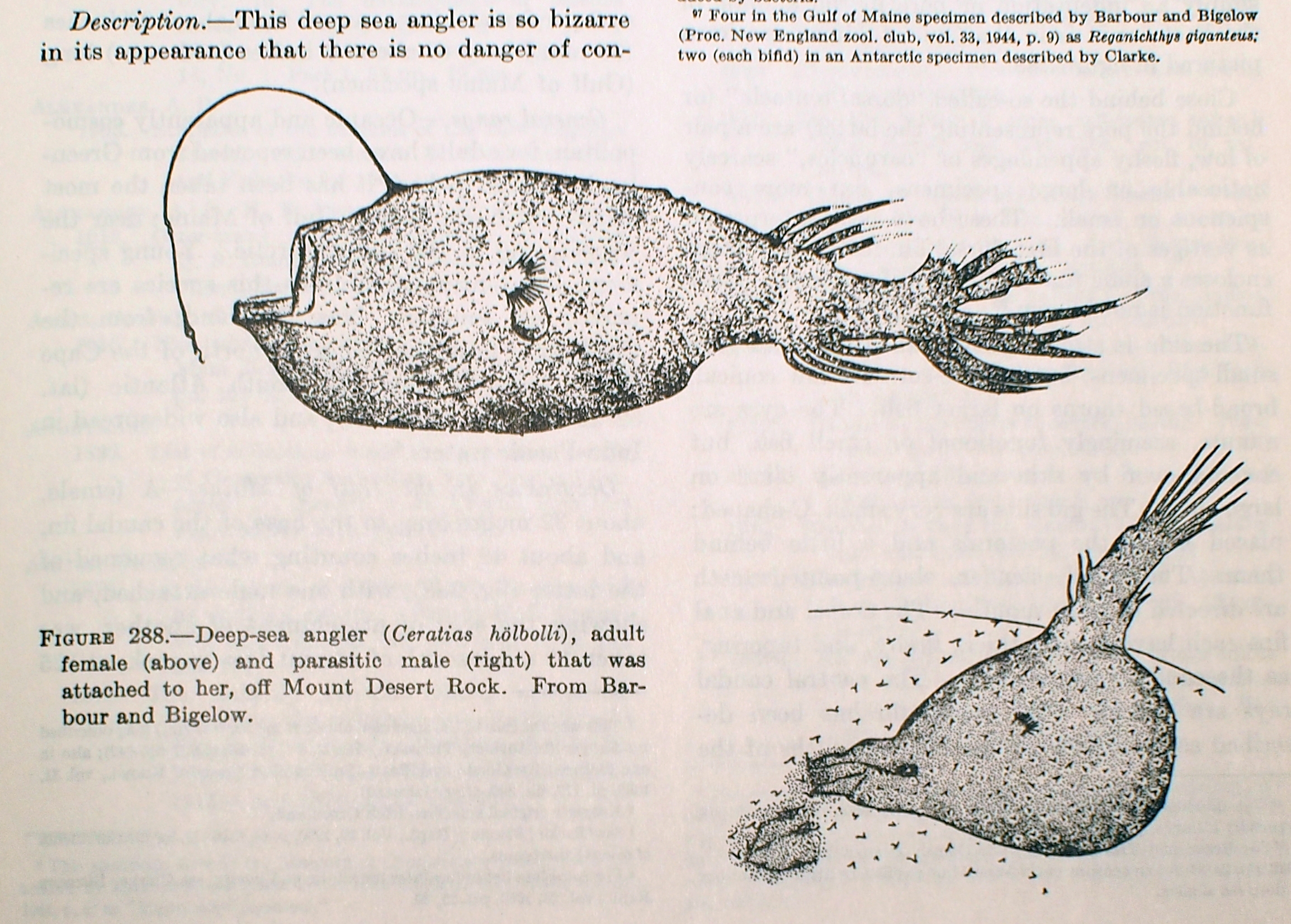
This head tentacle corresponds to the whiplike head spine of the goosefish, but is situated farther back, about abreast of the eyes. It is interpreted as representing a vestige of the first dorsal fin. The basal joint of the head tentacle is provided with retractor muscles by which it can be withdrawn rearward into a tunnel-like sheath along the head and back, bringing the “bait” close to the mouth.

Unique among the vertebrates in the fact that the males of many of them (including those of the Gulf of Maine species) are dwarfs in size as compared with the females, and live parasitic, attached to the females by their heads.

The parasitic males are fastened to the ventral side of the female, by two outgrowths from the front of the head, that are fused at the tip. They have no teeth, no tentacle-like spine and no eyes, and the alimentary canal is vestigial; in fact, about the only important internal organ is a large testis. But their fins resemble those of their mates, as do the gill openings; their skins are prickly; and they are similarly black. Those that have been seen (1 or 2 per female) have ranged from about 33/8 inches (85 mm.) long to about 6 inches (150 mm.) long (Gulf of Maine specimen).

From Fishes of the Gulf of Maine by Bigelow and Schroeder (1953) online courtesy of MBL/WHOI http://www.gma.org/fogm/Ceratias_holbolli.htm


Beautiful Fish: Haddock -By Al Bezanson


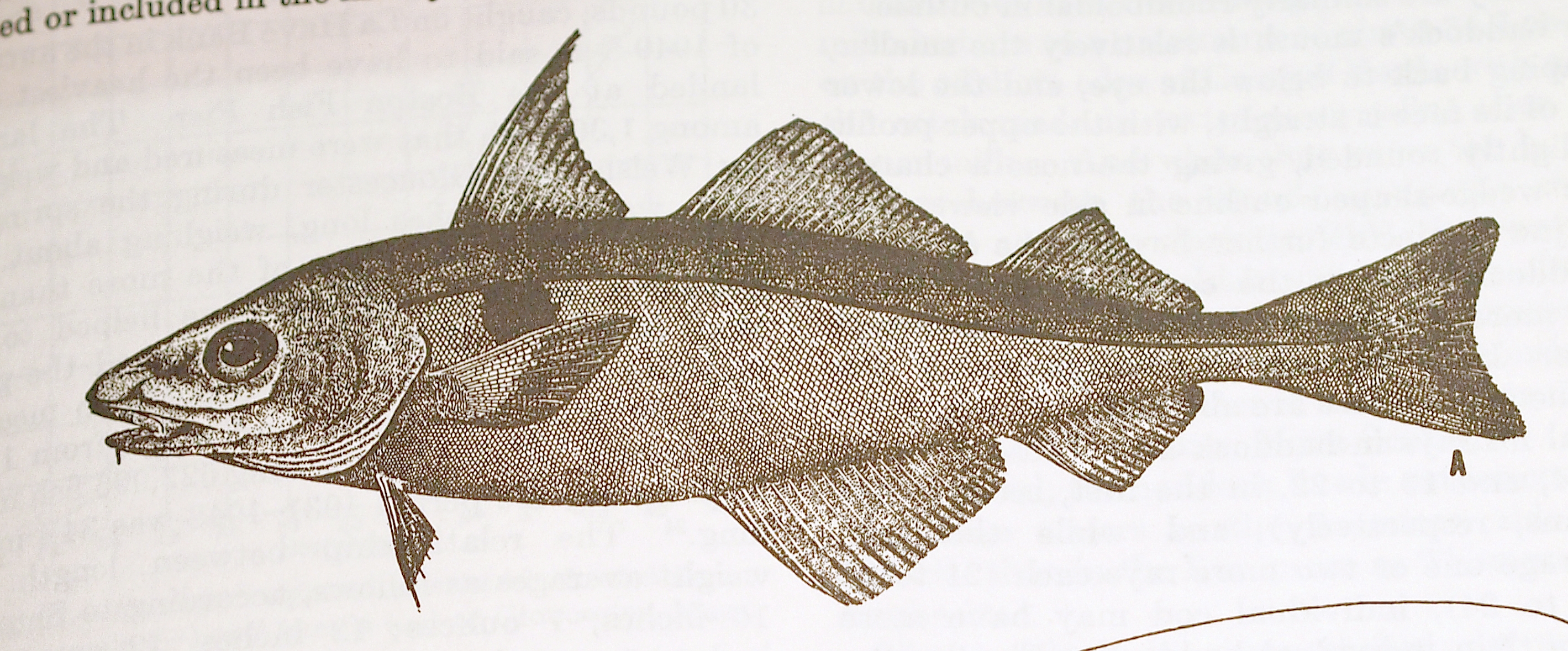
Haddock (Melanogrammus aeglefinus) drawn by H. L. Todd

“Haddock are very plentiful all around the open Gulf (of Maine), as well as on all the offshore banks, especially on Georges where they greatly out-number the cod. This is, in fact, one of the two species that now rank at the top among Gulf of Maine fishes, from the commercial standpoint; the rosefish (Acadian redfish) is the other.”

From Fishes of the Gulf of Maine by Bigelow and Schroeder (1953) online courtesy of MBL/WHOI http://www.gma.org/fogm/Melanogrammus_aeglefinus.htm


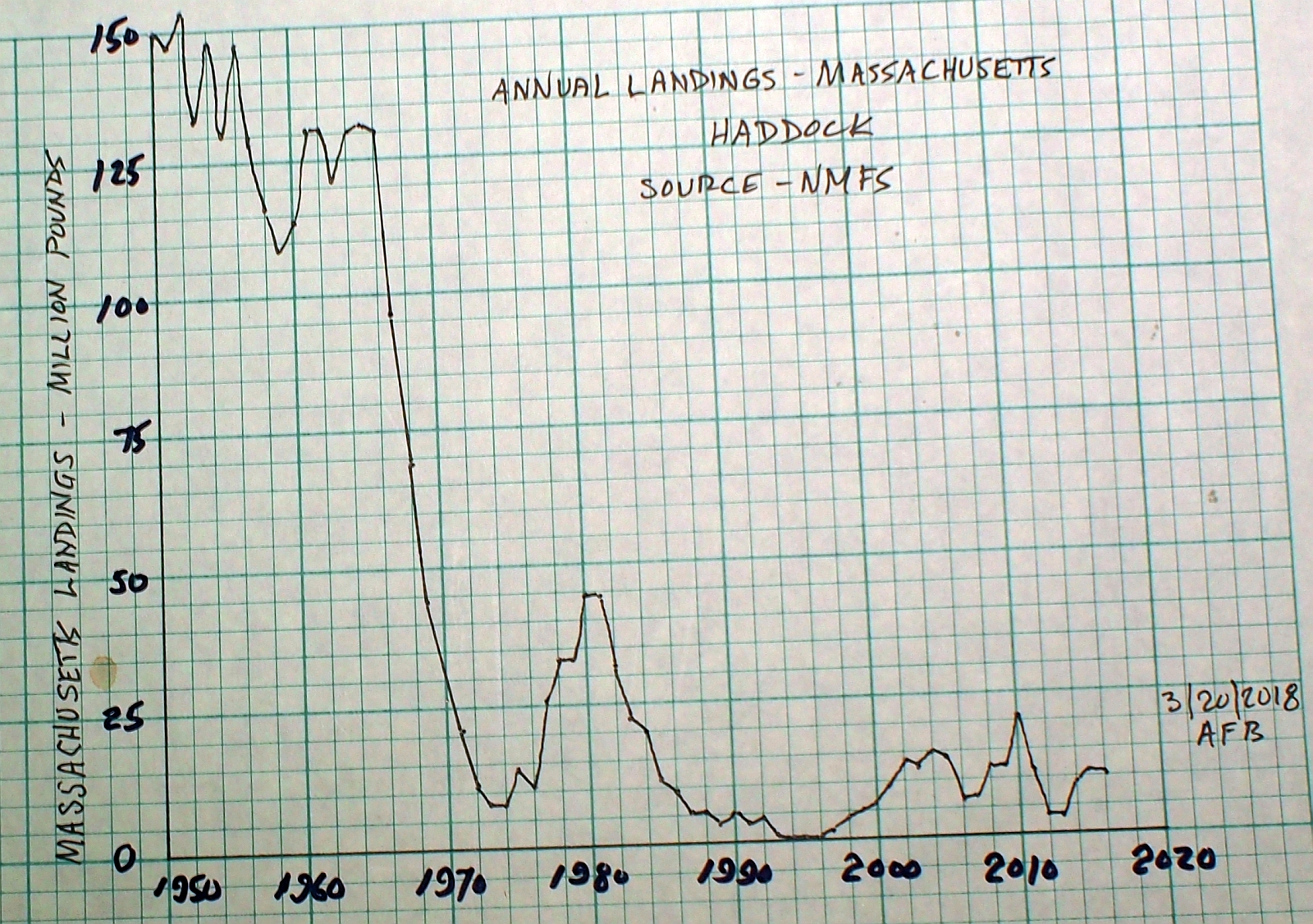
Massachusetts landings declined from 130 million pounds in 1966 to 7.7 million pounds in 1973.  Landings in 2016 were 10.7 million pounds.

Cumulative 1950-2016 reported Massachusetts landings were 3,064,610,662 pounds with a value of $639,412,505  (NOAA)

Acadian redfish in the same period, 1,576,336,078 pounds valued at $128,657,587

The 2002 edition of Fishes of the Gulf of Maine reports that the growth rate of haddock increased within 30 to 40 years, since about 1960 when they were more abundant, reaching an average size of 48-50 cm in 3 years compared to 4 years.

Beautiful Fish: Trumpetfish -By Al Bezanson

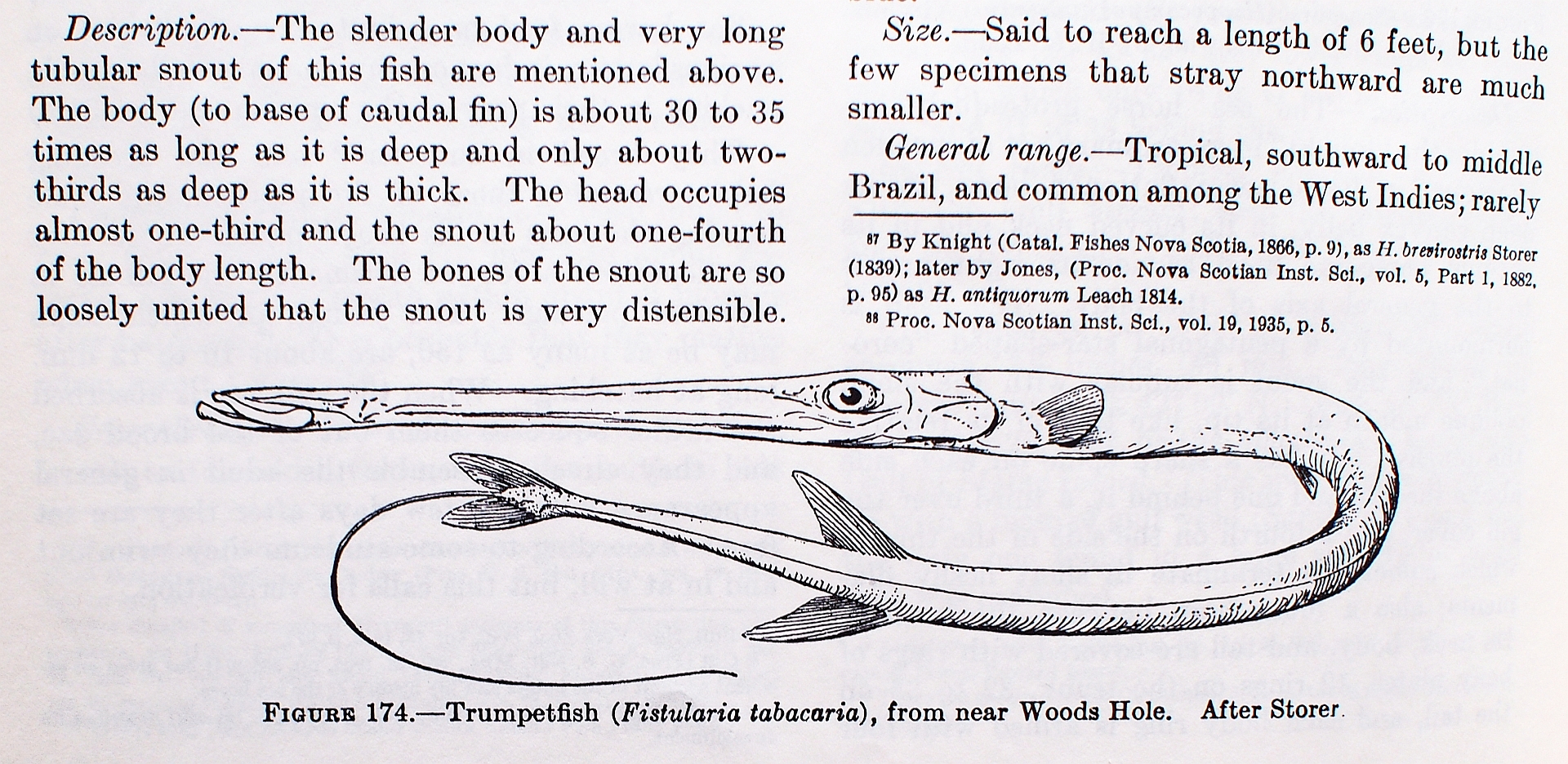
The head occupies almost one-third and the snout about one-fourth of the body length.  The mouth is small, situated somewhat obliquely at the tip of the snout, and the lower jaw projects a little beyond the upper.

There are only two records of the trumpetfish from the Gulf of Maine: a specimen taken at Rockport, Mass. (north side of Cape Ann) in September 1865, preserved in the collection of the Essex Institute, where it was examined and identified by Goode and Bean[90] and a second taken on the northern edge of Georges Bank by the trawler Flying Cloud on October 6, 1947, in a haul at 70 fathoms.[91] Like other tropical fishes, however, it is not so rare west of Cape Cod, and a few small ones are taken at Woods Hole almost every year.

From fishes of the Gulf of Maine by Bigelow and Schroeder (1953) online courtesy of MBL/WHOI http://www.gma.org/fogm/Fistularia_tabacaria.htm

Beautiful Fish: Sea Lamprey -By Al Bezanson


LAMPREY; SPOTTED LAMPREY; LAMPER; EELSUCKER

Lampreys were esteemed a great delicacy in Europe during the middle ages (historians tell us Henry I of England died of a surfeit of them)

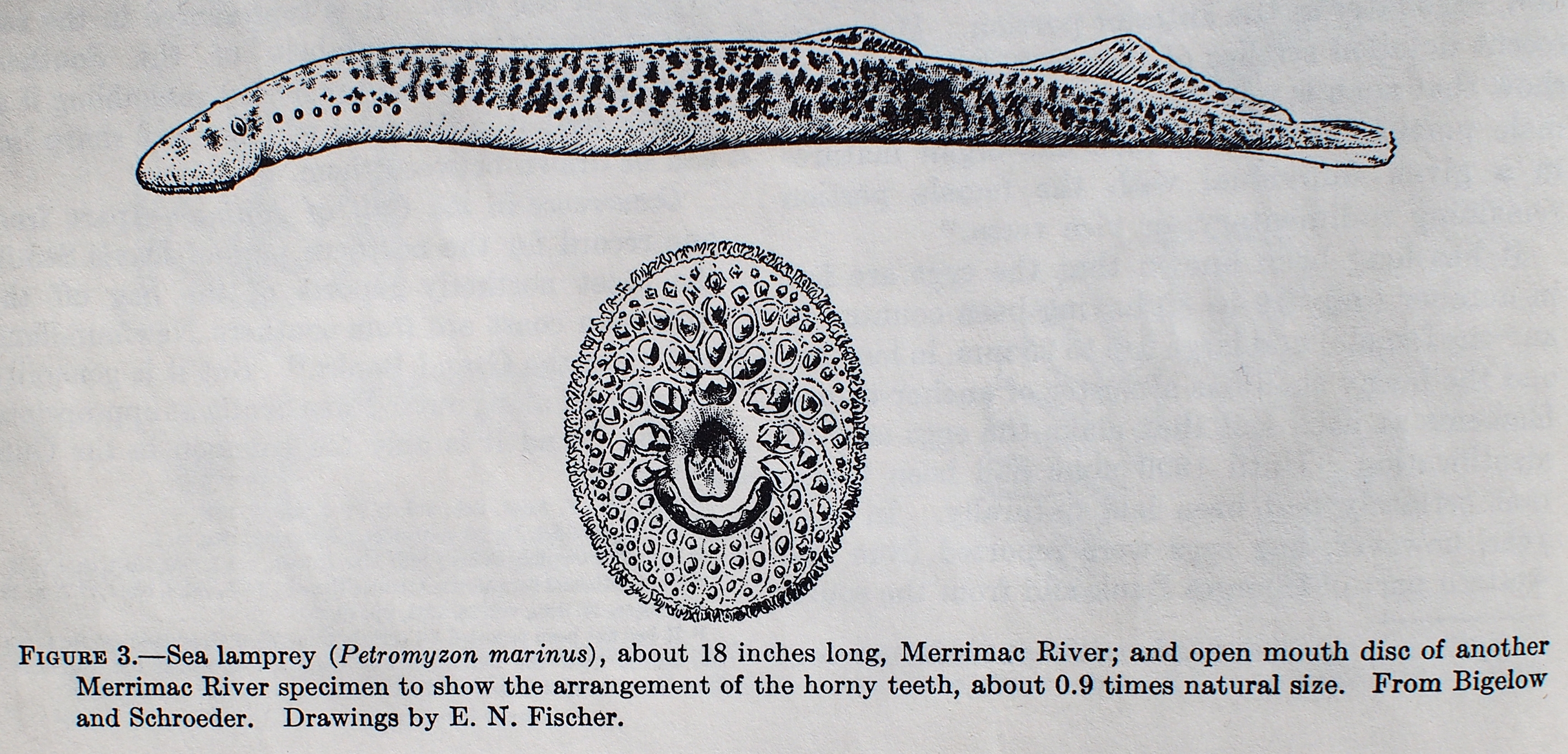
Little is known of the habits of the lampreys while they live in the sea further than that their mode of life centers around a fiercely predaceous nature. Judging from their land-locked relatives and from the occasions on which they have been found fastened to sea fish, they must be extremely destructive to the latter, which they attack by “sucking on” with their wonderfully effective mouths. The lamprey usually fastens to the side of its victim, where it rasps away until it tears through the skin or scales and is able to suck the blood. Its prey sucked dry, it abandons it for another. Probably lampreys are parasites and bloodsuckers pure and simple, for we cannot learn that anything but blood has been found in their stomachs, except fish eggs, of which lampreys are occasionally full.

From Fishes of the Gulf of Maine by  Bigelow and Schroeder (1953) online courtesy of MBL/WHOI http://www.gma.org/fogm/Petromyzon_marinus.htm


Beautiful Fish: Alligator Fish -By Al Bezanson


ALLIGATOR FISH; SEA POACHER

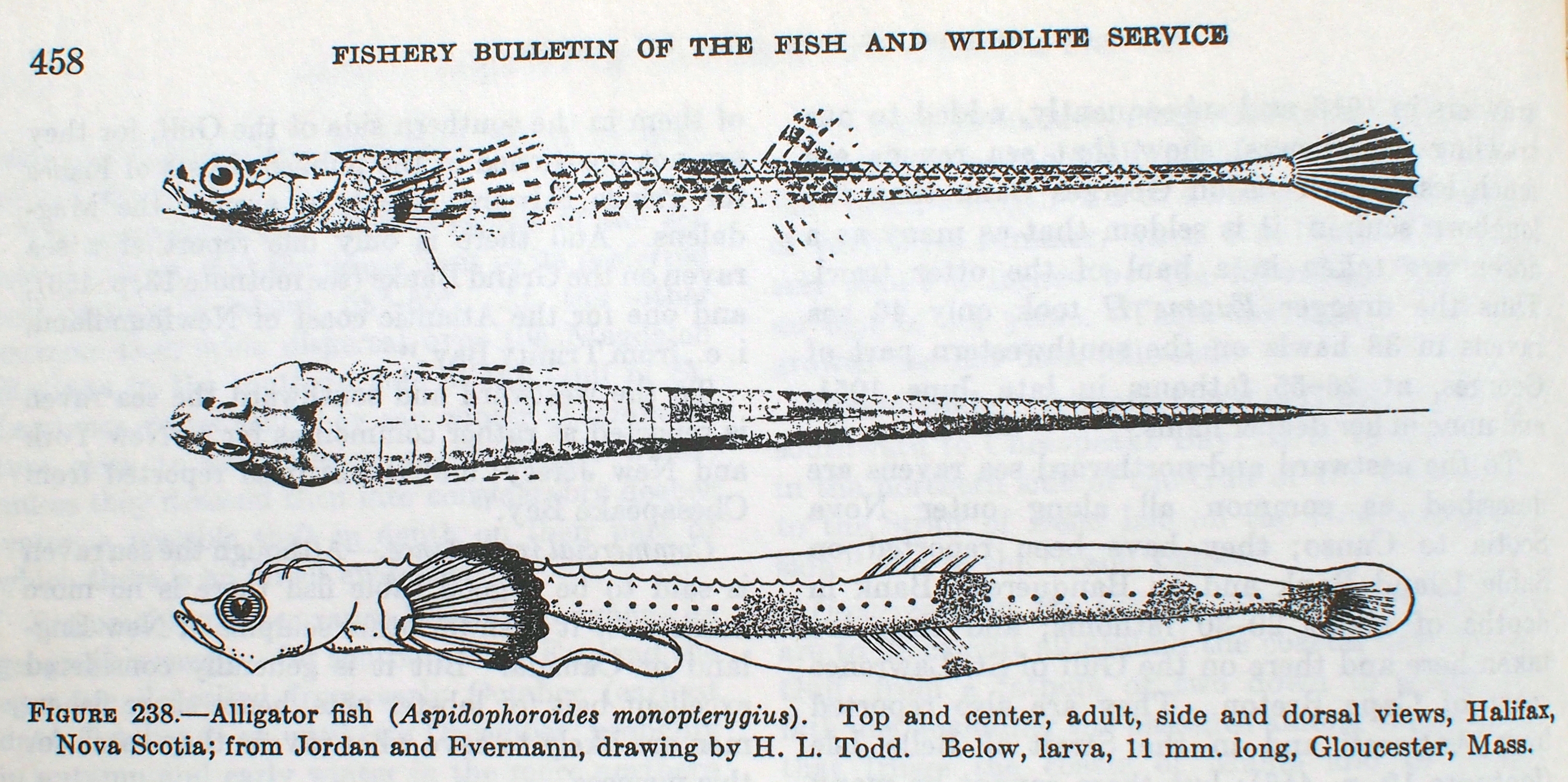
Nothing whatever is known of the life of the alligator fish except that it is a bottom fish and that it has been repeatedly found in the stomachs of cod, haddock, and halibut although it is not “much thicker or softer than an iron spike.”[18] The Grampus and the Albatross II have trawled it both on pebbly bottom, on sand and broken shells, and on soft mud. So far as known adults never stray into water shoaler than 10 to 15 fathoms, and the deepest record for it, with which we are acquainted, is from 104 fathoms.[19] Its range shows that it is a cold water fish. Its upper temperature limit is about 50°-52°; its lower limit close to the freezing point of salt water. Its breeding habits are unknown. Probably its eggs sink like those of sculpins.

Five to seven inches long when full grown.

From Fishes of the Gulf of Maine by Bigelow and Schroeder (1953) online courtesy of MBL/WHOIhttp://www.gma.org/fogm/A_monopterygius.htm

Beautiful Fish: Armored Sea Robin -By Al Bezanson

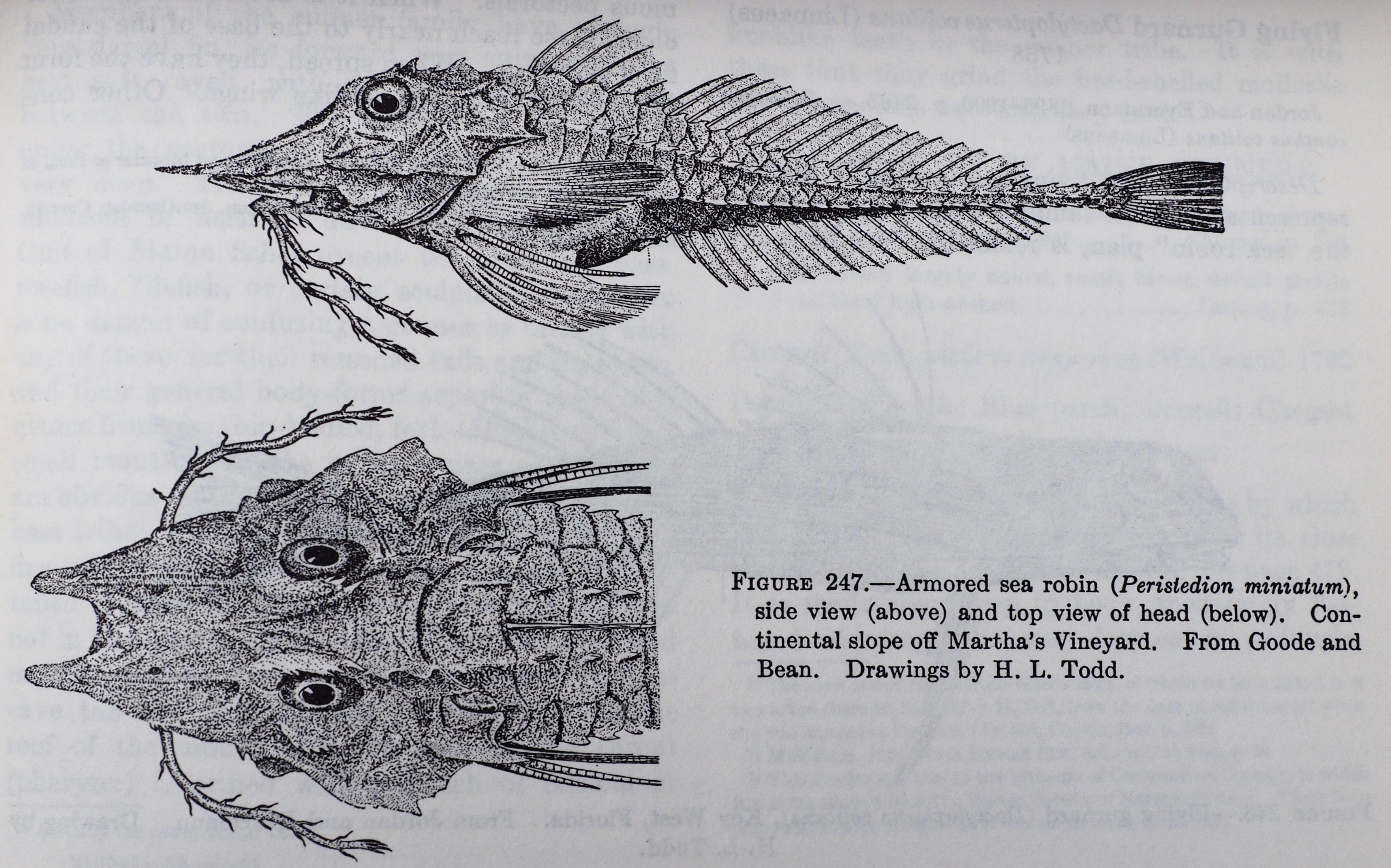
Its body is entirely clothed with bony plates of considerable size.

Occurrence in the Gulf of Maine—

Trawlers tell us they sometimes take these brilliant crimson fishes on the southwestern part of Georges Bank. And they must be rather common outside the 60-fathom contour, for we saw 89 specimens trawled there and south of Nantucket at depths of 66 to more than 185 fathoms, by the Albatross III in May 1950.

From Fishes of the Gulf of Maine by Bigelow and Schroeder (1953) online courtesy of MBL/WHOIhttp://www.gma.org/fogm/Peristedion_miniatum.htm


Beautiful Fish: Rosefish (Acadian Redfish) with Landings -By Al Bezanson


OCEAN PERCH; (ACADIAN) REDFISH; RED SEA PERCH; RED BREAM; NORWAY HADDOCK

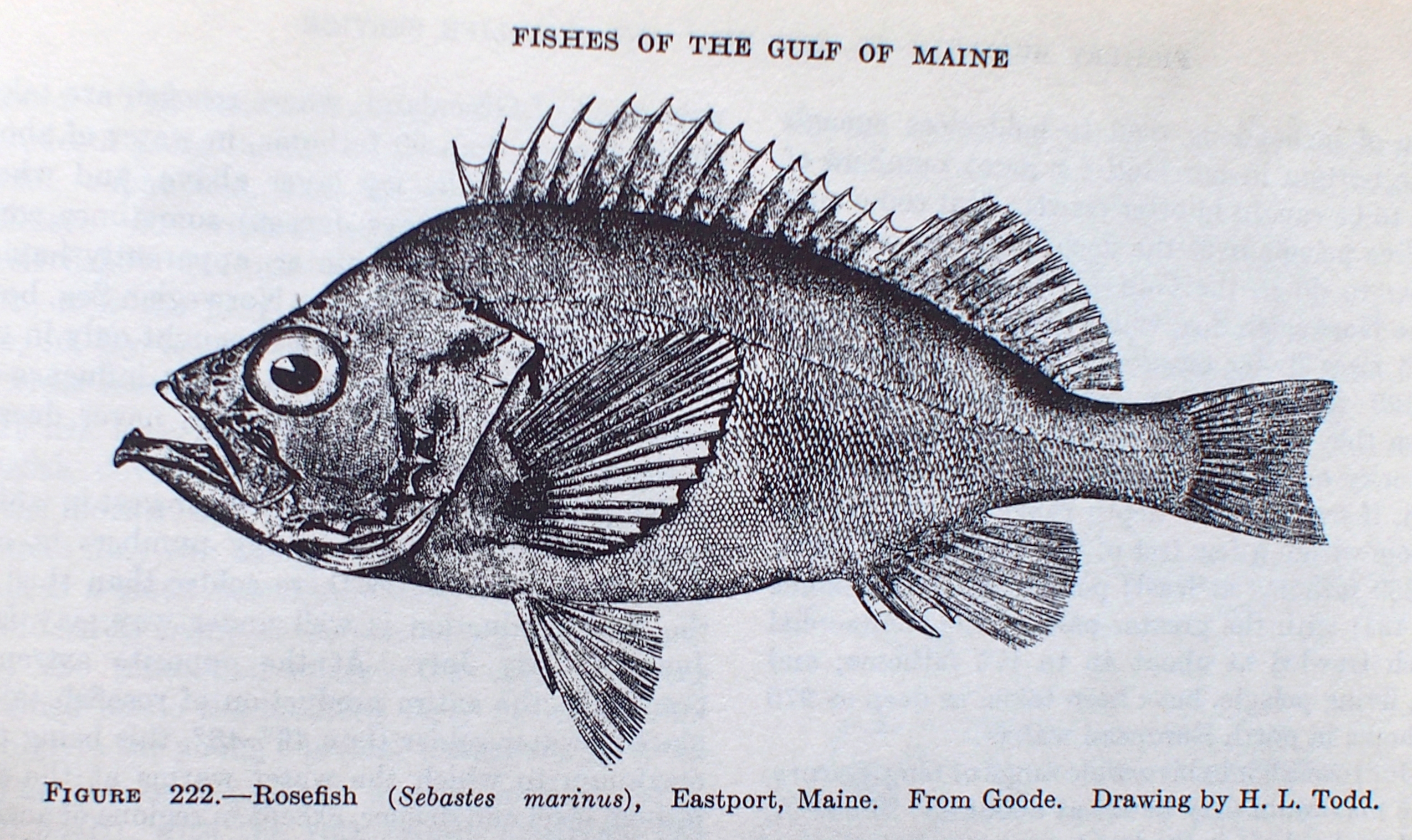
“This is one of the most plentiful of the commercially important fishes in all but the shoalest parts of the Gulf: on the offshore banks, in or over the deep central basin, and along shore.”

From Fishes of the Gulf of Maine by Bigelow and Schroeder (1953) online courtesy of MBL/WHOI http://www.gma.org/fogm/Sebastes_marinus.htm\

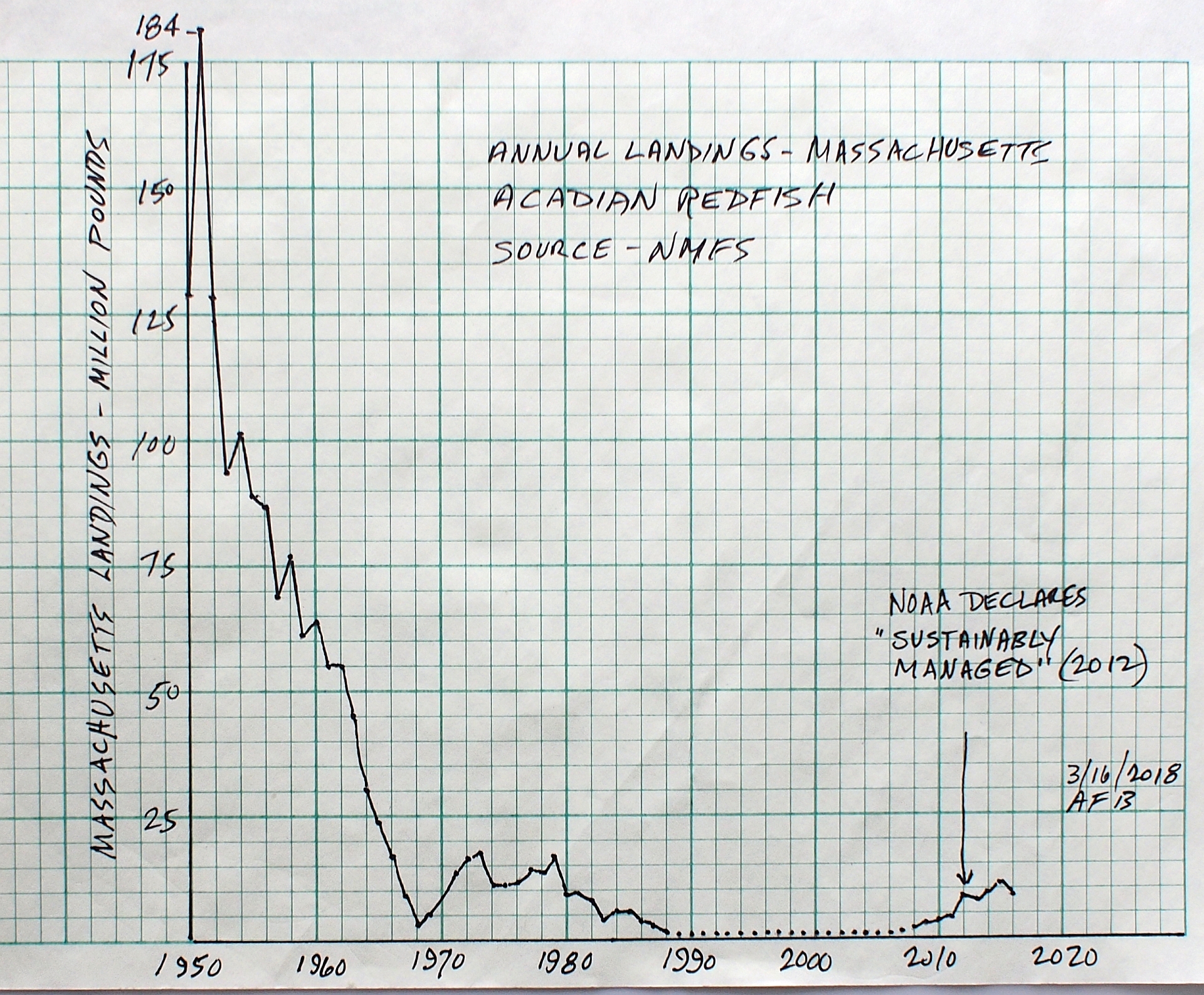
The situation cited in the excerpt above, in a couple decades after this 1953 publication, proved no longer to be the case.  Subsequent data from NOAA shows 184,370,800 pounds landed in 1951 declining to 290,321 pounds in 2000.  This plot is from published NOAA data.

Comments invited.  Surely some readers of GMG were involved in this fishery.


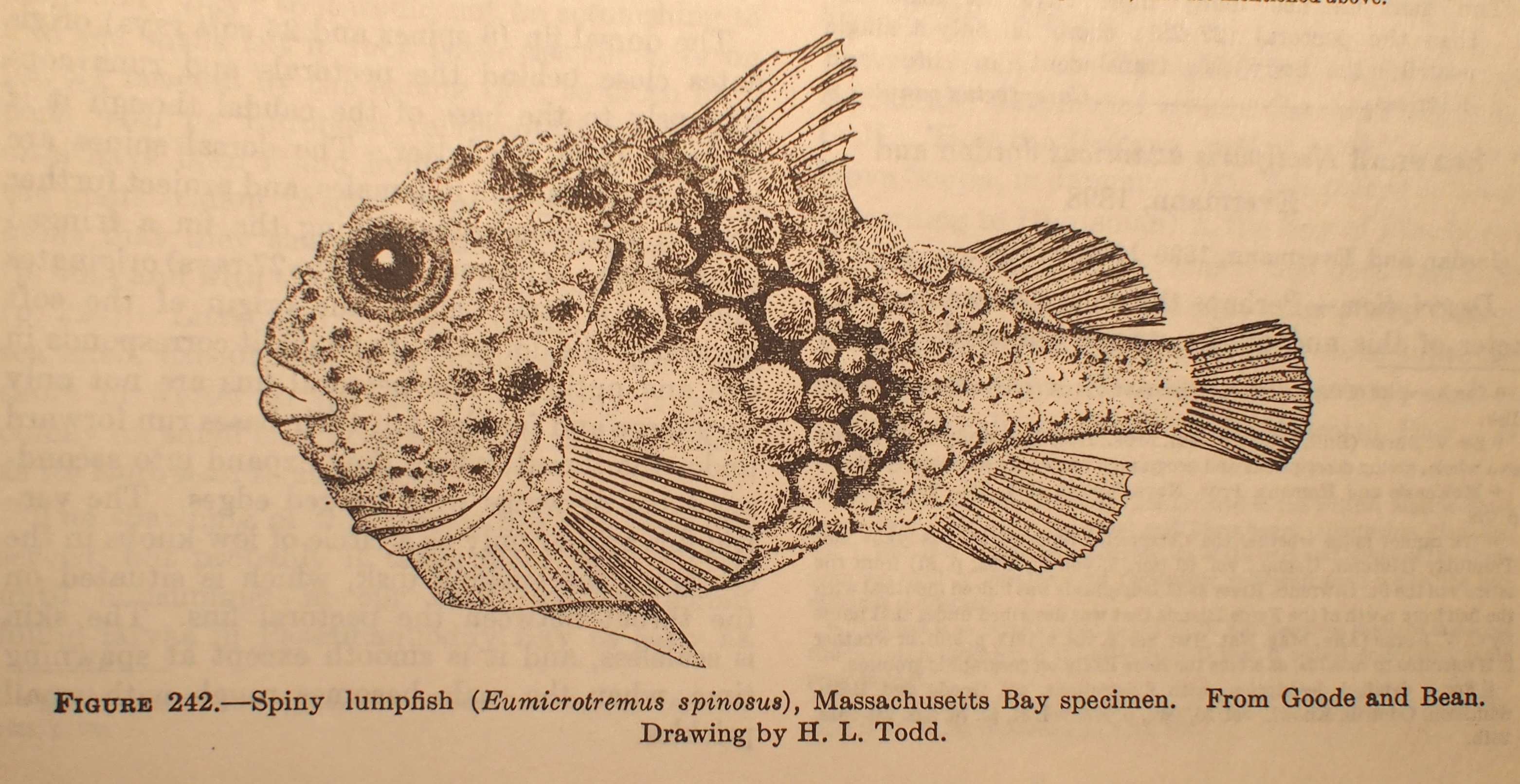
Beautiful Fish: Spiny Lumpfish -By Al Bezanson


General Range—

Arctic and northern parts of the Atlantic Ocean, south to the Gulf of Maine as a stray.

Occurrence in the Gulf of Maine—

Stray specimens of this northern fish have been reported from Eastport, Maine; from off Cape Ann; and from Salem, in the north side of Massachusetts Bay. We have also seen three small specimens, 1-1¼ inches long that were collected about 15 miles southeast of Cape Ann in 23 and 29 fathoms, by the U. S. Fish Commission in 1878 (now in the U. S, National Museum.)


From Fishes of the Gulf of Maine by Bigelow and Schroeder (1953) online courtesy of MBL/WHOI


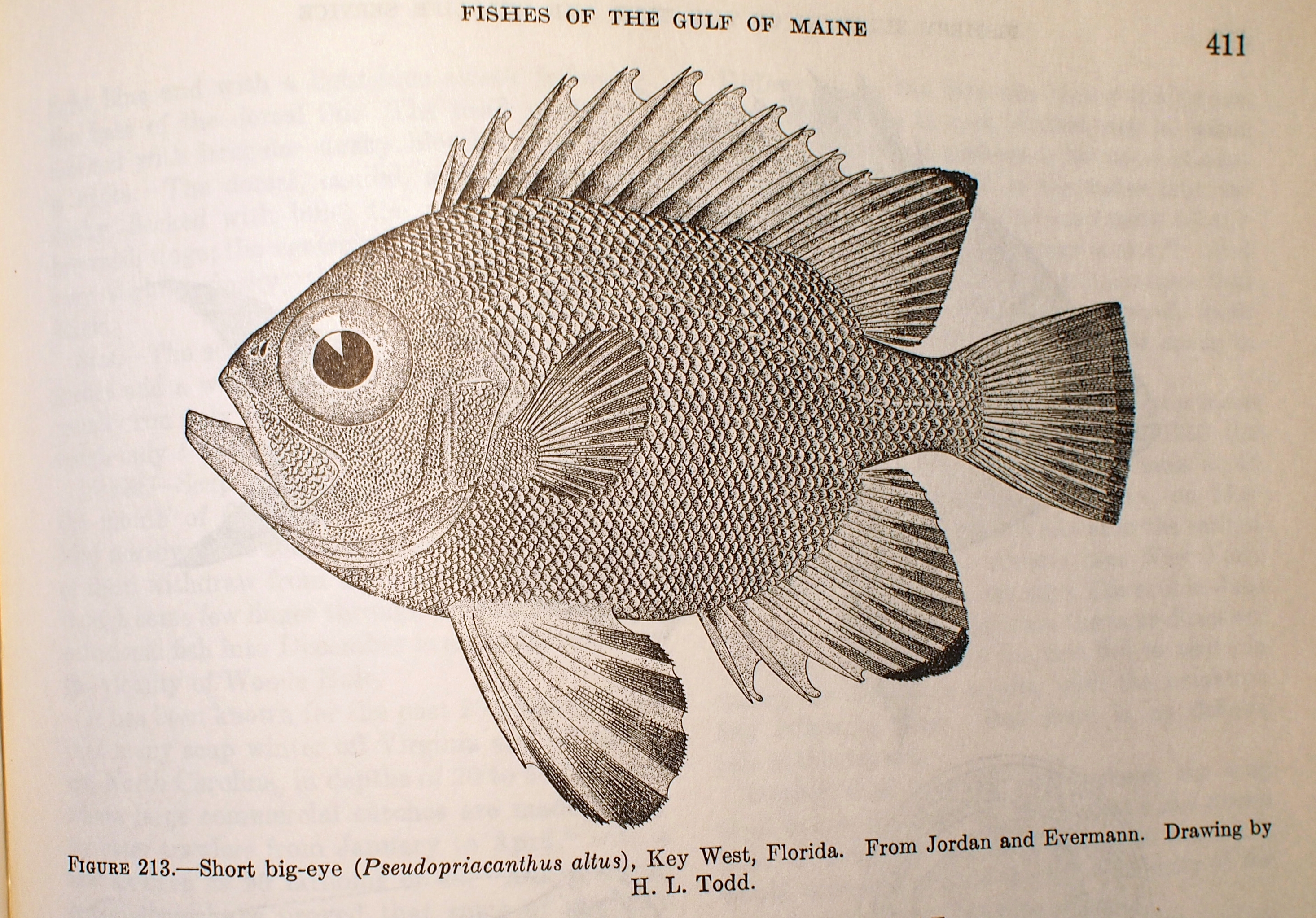
Beautiful Fish: Short Big-eye -By Al Bezanson


The most striking characters of this fish are its very large eyes and its brilliant red color. Apart from these, it is distinguishable from the sea bass tribe by the fact that its whole head, as well as its body, is clothed with rough scales and that the anal fin is longer than the soft-rayed portion of its dorsal fin. Its sidewise flattened body, unusually stout dorsal fin spines, very large ventral fins, and small pectorals, are ready field marks to separate it from the rosefish, the only common Gulf of Maine species of similar appearance that rivals it in color.

Occurrence in the Gulf of Maine—

A big-eye found alive on Marblehead Beach, September 3, 1859; a second, found at Scituate, Mass., in 1932 or 1933;[43] and a third, about 1½ inches (38 mm.) long, picked up in a tide pool at Cohasset, Mass., by F. G. Bemis in September 1937,[44] are the only definite records for this southern fish within the Gulf. But since it occasionally appears in some numbers at Woods Hole in summer, it may round Cape Cod more often than this paucity of actual records suggests.


From Fishes of the Gulf of Maine by Bigelow and Schroeder (1953) online courtesy of MBL/WHOI  http://www.gma.org/fogm/Pseudopriacanthus_altus.htm


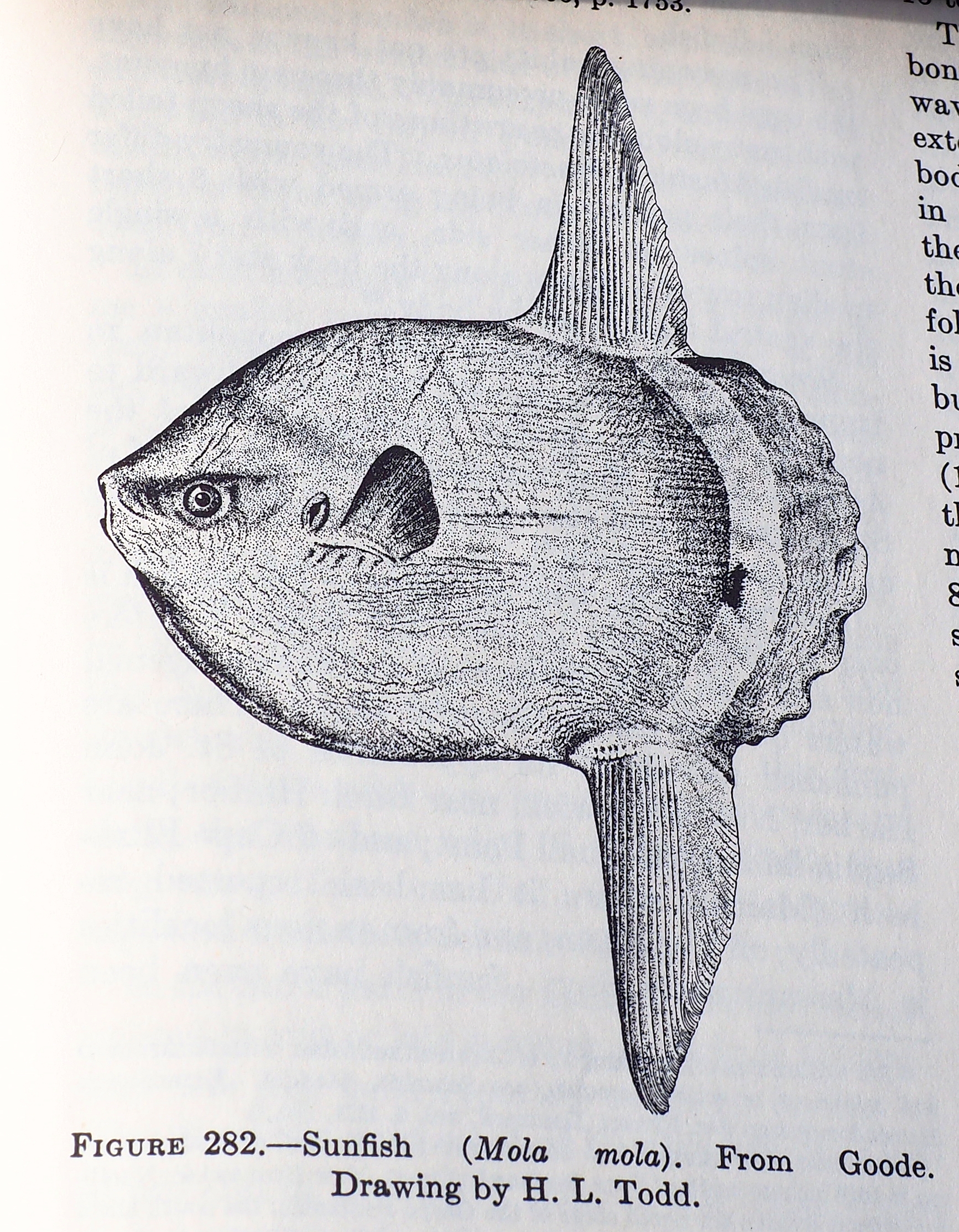
Beautiful Fish: Sunfish -By Al Bezanson


Sunfish; Mola Mola


They appear to consist of nothing but a “huge head to which the fins are attached,” as Jordan and Evermann aptly express it.

When these unlucky vagrants are sighted in our cool northern waters they have usually been chilled into partial insensibility. They float awash on the surface, feebly fanning with one or the other fin, the personification of helplessness. Usually they pay no attention to the approach of a boat, but we have seen one come to life with surprising suddenness and sound swiftly, sculling with strong fin strokes.

The sunfish lives on an unusual diet, for as a rule the contents of the stomach consists either of jellyfish, ctenophores, or salpae

The sunfish grows to a great size. Heilner describes the capture of one 10 feet 11 inches long off Avalon (Calif.), while Jordan and Evermann record another Californian specimen 8 feet 2 inches long, weighing about 1,800 pounds.  A fish 4 feet 1 inch long, caught off Boston Harbor, August 14, 1922, weighed 516 pounds.

From Fishes of the Gulf of Maine by Bigelow and Schroeder (1953) online courtesy of MBL/WHOI  http://www.gma.org/fogm/Mola_mola.htm


Beautiful Fish: Shorthorn Sculpin, Longhorn Sculpin, and Staghorn Sculpin -By Al Bezans

Meet the Horned Sculpins:


Shorthorn Sculpin; Daddy Sculpin; Black Sculpin; Greenland Sculpin

The Shorthorn Sculpin, with its large flat head, vast mouth, weak tapering body, bat-like pectorals, and insatiable appetite, typifies the sculpin race in northern seas.


Longhorn Sculpin; Gray Sculpin; Hacklehead; Toadfish

Everyone who has fished along the shores of our Gulf is more or less familiar with this sculpin, for it is a nuisance to cunner and flounder fishermen. It often is bothersome to the angler to unhook when it spreads its needle-sharp spines and erects its spiny dorsal fin. It grunts when pulled out of the water and bites on any bait.


Staghorn Sculpin

The most southerly record for this Arctic sculpin, and the only one for the Gulf of Maine, is of a specimen caught at Eastport, Maine, in 1872, and now in the United States National Museum. It is only as a very rare stray from colder waters to the north that it ever reaches our Gulf.


From Fishes of the Gulf of Maine by Bigelow and Schoeder (1953)  courtesy of MBL/WHOI

http://www.gma.org/fogm/Myoxocephalus_scorpius.htm

http://www.gma.org/fogm/M_octodecimspinosus.htm

http://www.gma.org/fogm/Gymnocanthus_tricuspis.htm

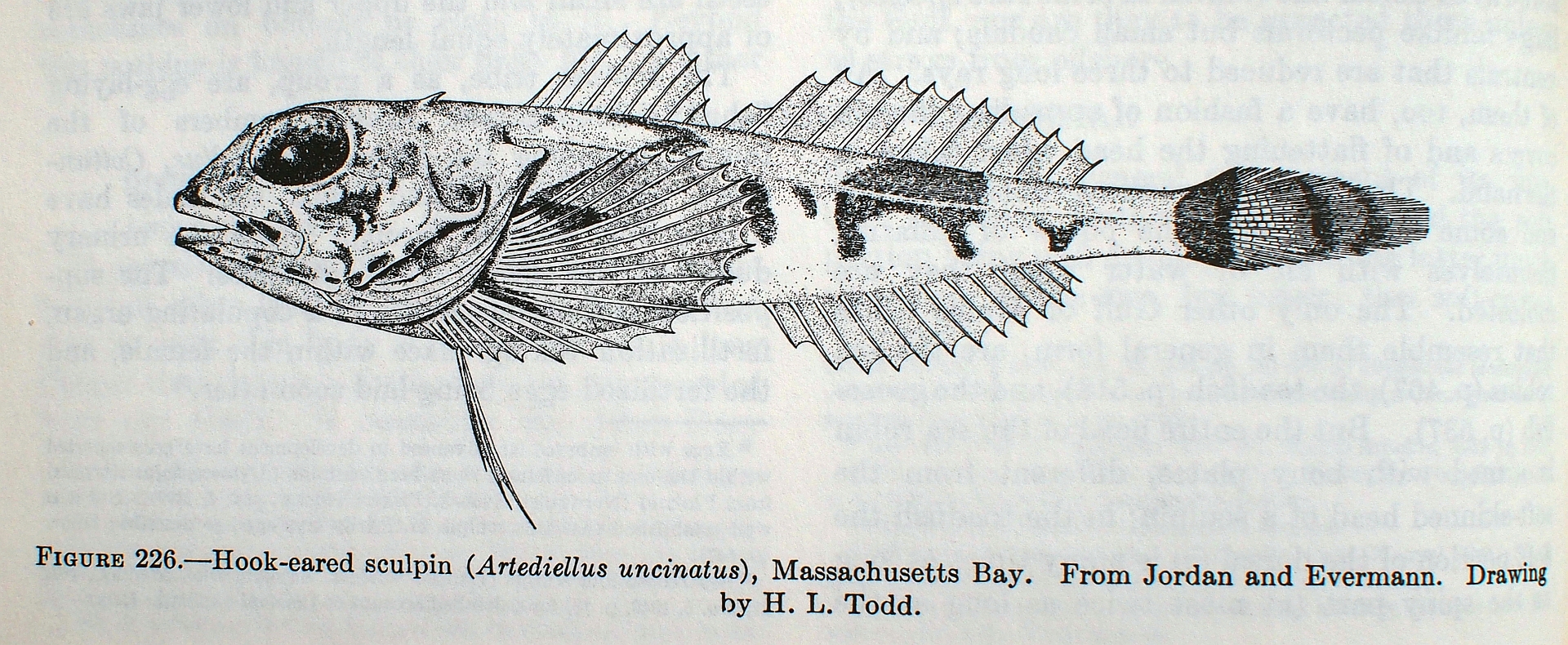
Beautiful fish: Hook-eared sculpin and Mailed sculpin -By Al Bezanson

Meet the sculpins

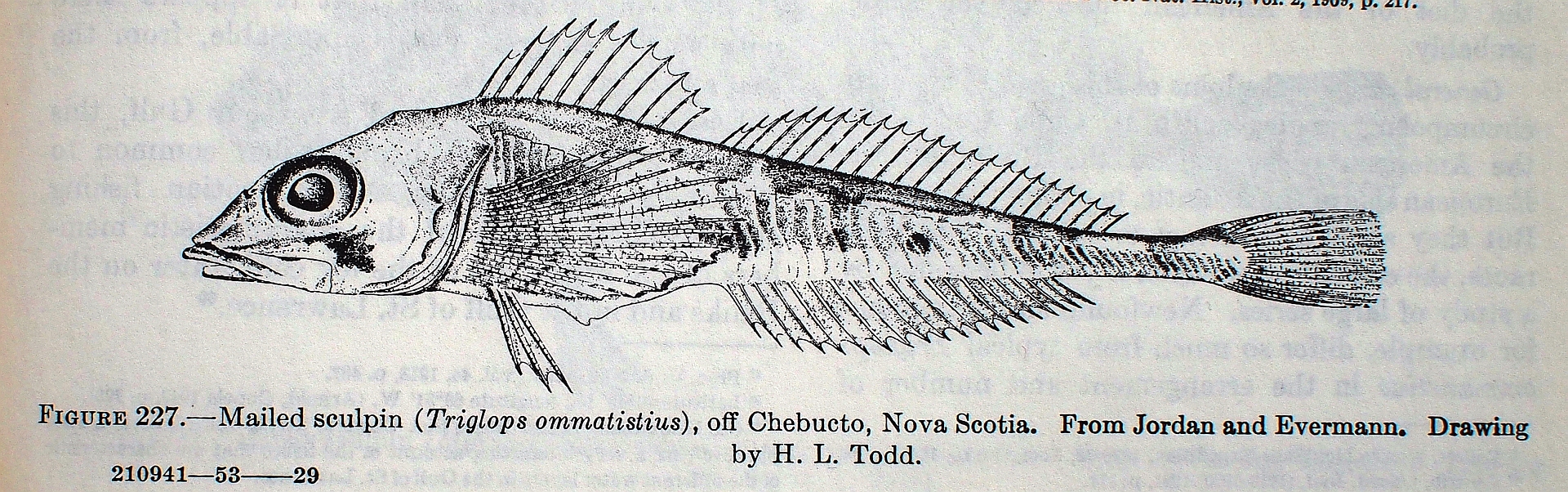
The several members of the sculpin and sea raven tribe that are known from the Gulf of Maine are a homogeneous group, characterized by large spiny heads; very wide gill openings; very broad mouths; slender bodies; separate spiny and soft-rayed dorsal fins (united in some rare species); large fanlike pectorals but small caudals; and by ventrals that are reduced to three long rays. All of them, too, have a fashion of spreading the gill covers and of flattening the head when taken in the hand. They likewise produce grunting sounds, and some of them have the power of inflating themselves with air or water when they are molested.

From Fishes of the Gulf of Maine by Bigelow and Schroeder (1953) courtesy of MBL/WHOI

http://www.gma.org/fogm/Artediellus_uncinatus.htm

http://www.gma.org/fogm/Triglops_ommatistius.htm

Beautiful Fish: Unicornfish -By Al Bezanson


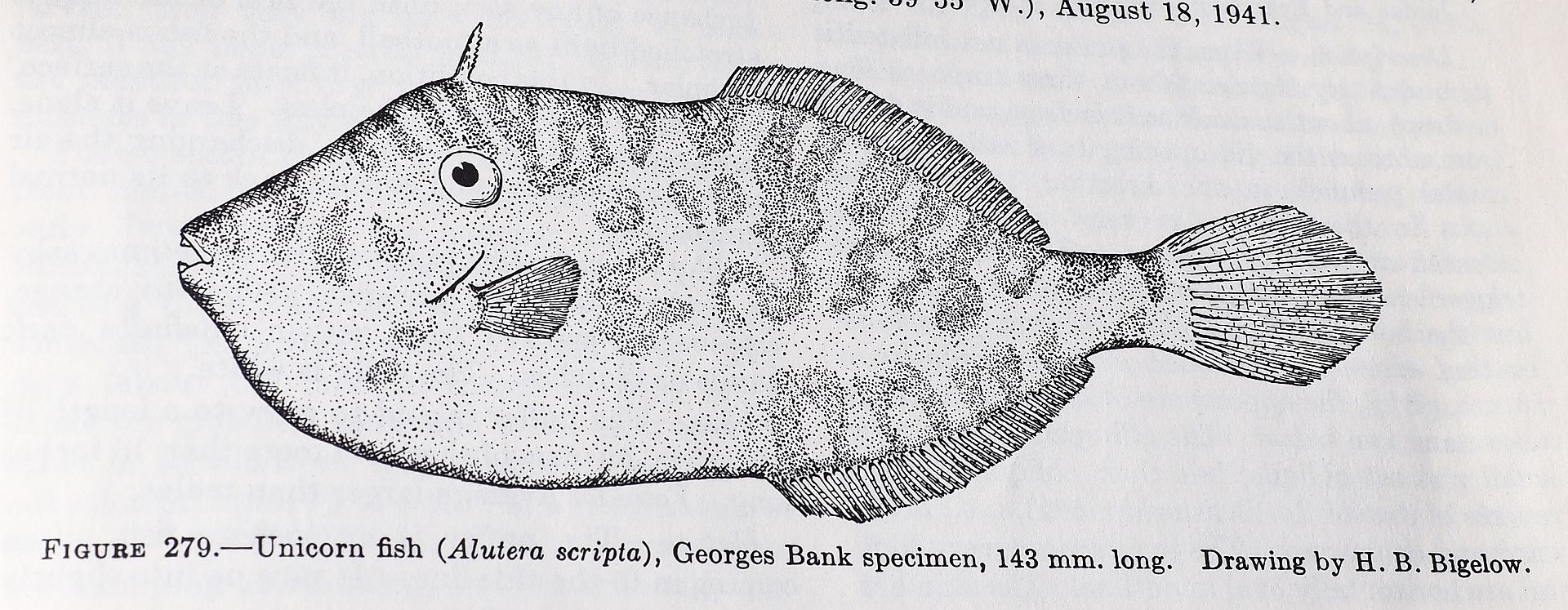
With Gloucester awash from a wicked storm nobody knows what may swim into town.  If you come upon a creature like this please notify NOAA, for the unicornfish is quite rare.   According  to Fishes of the Gulf of Maine by Bigelow and Schroeder (1953) only two specimens have been found, both caught on the western edge of Georges in 1930 by the schooner OLD GLORY.

http://www.gma.org/fogm/Alutera_scripta.htm

Beautiful Fish: Blue Hake -By Al Bezanson

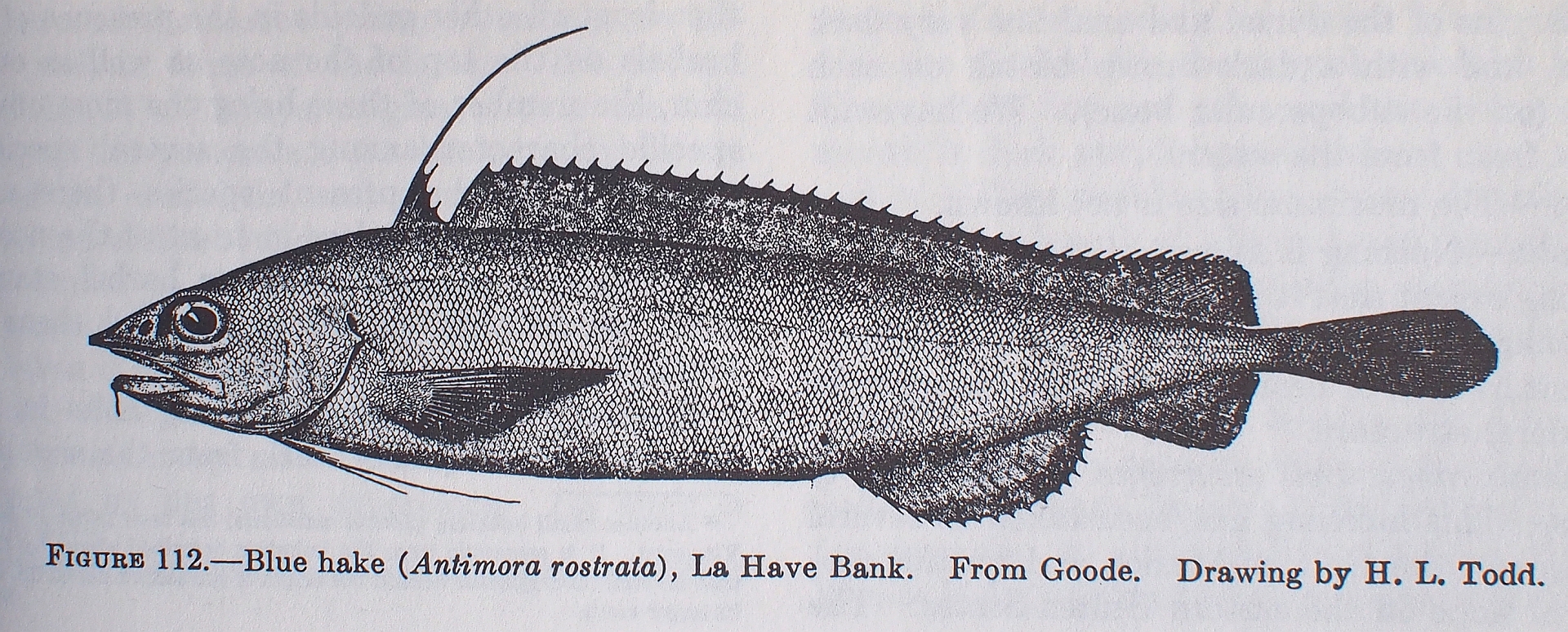
Blue Hake

Our previous post spoke of two members of the hake tribe – WHITE HAKE aka BOSTON HAKE sometimes called BLACK HAKE and sometimes MUD HAKE when they are not simply called HAKE or their other name, LING.  The other mentioned, SQUIRREL HAKE is more commonly known as RED HAKE, except when it is called LING.  Got it?

Today we have another – BLUE HAKE.  It’s rare in the Gulf of Maine but common beyond the slope and has been taken at 1,000 fathoms.  BLUE HAKE look much like WHITE  and RED HAKE and also like BLACK HAKE which are really WHITE HAKE, as explained in the previous paragraph.

Fishes of the Gulf of Maine by Bigelow and Schroeder, 1953.  Courtesy of MBL/WHOI – BLUE HAKE

http://www.gma.org/fogm/Antimora_rostrata.htm

BEAUTIFUL FISH: WHITE HAKE AND SQUIRREL HAKE -By Al Bezanson

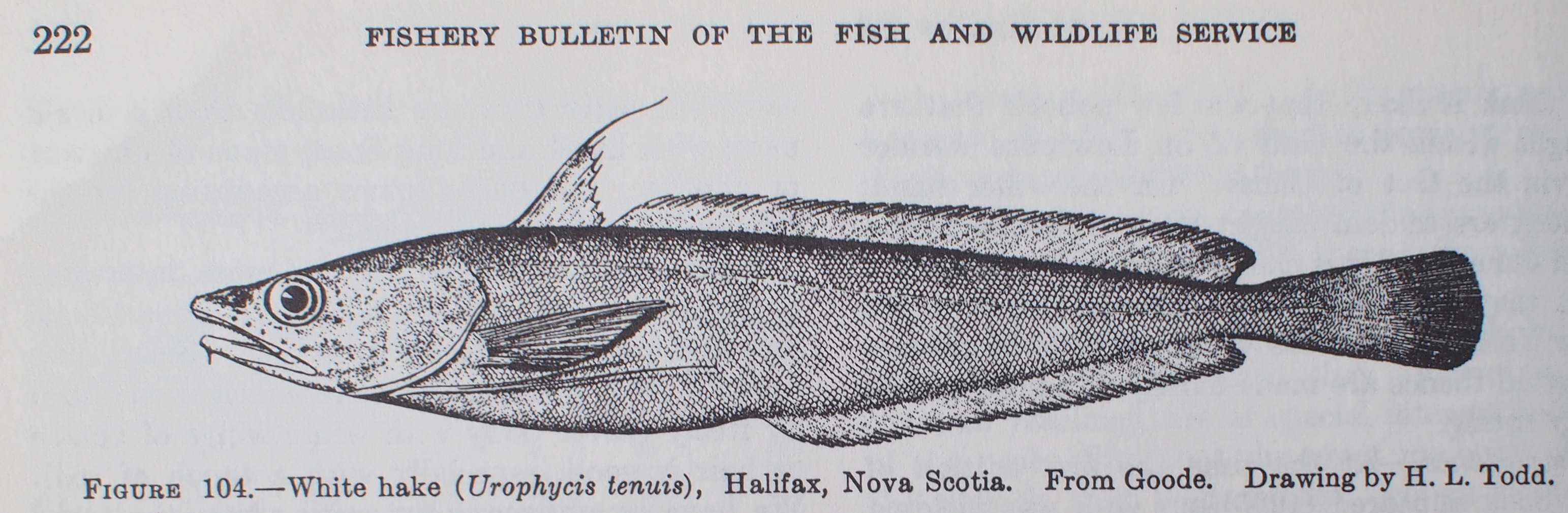
 WHITE HAKE; BOSTON HAKE; BLACK HAKE; MUD HAKE; HAKE; LING
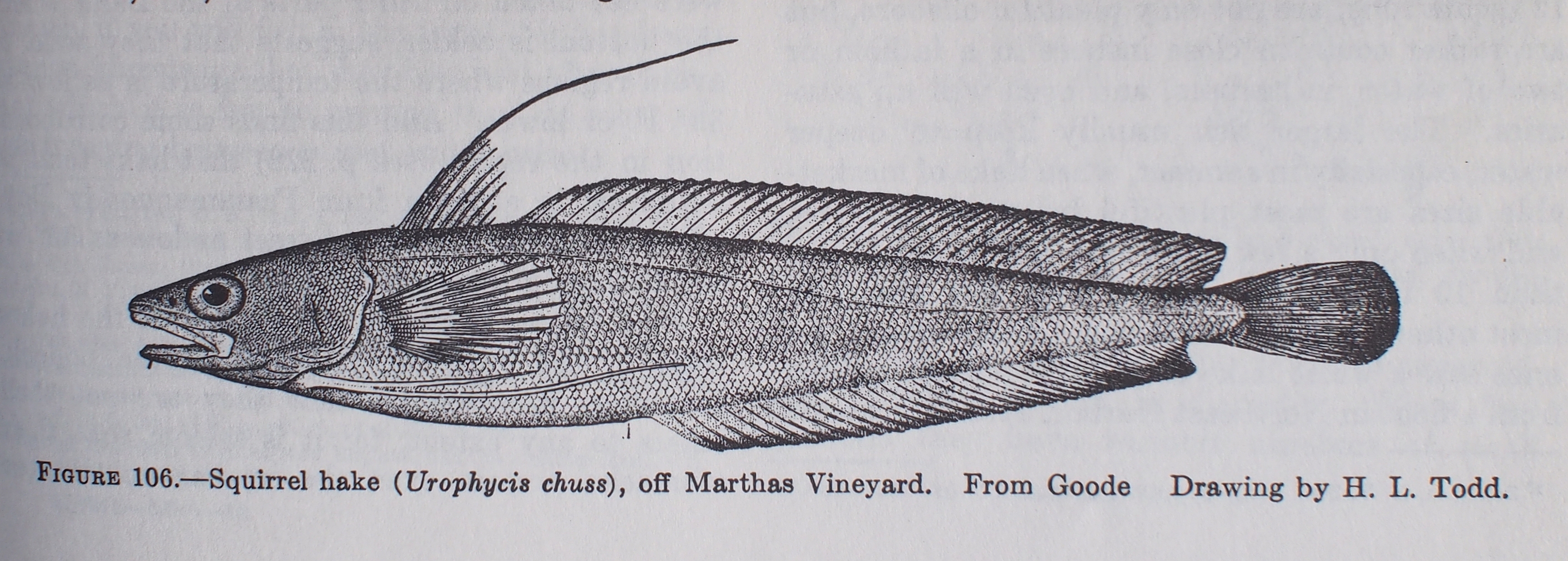
 SQUIRREL HAKE; RED HAKE; LING


Ever since 1616, when Capt. John Smith wrote “Hake you may have when the cod failes in summer, if you will fish in the night,” it has been common knowledge that they bite best after dark, from which it is fair to assume they do most of their foraging between sunset and sunrise.

We are forced to discuss these two hakes together, for they are so hard to tell apart that they are often confused, while they agree so closely in habits and distribution that what is said of one applies equally to the other, except as noted below.

From Fishes of the Gulf of Maine by Bigelow and Schroeder, 1953 _ Courtesy of MBL/WHOI

http://www.gma.org/fogm/Urophycis_tenuis.htm

http://www.gma.org/fogm/Urophycis_chuss.htm

2010 to 2016 Massachusetts landings of white hake have been in the range of 3 to 5 million pounds.  Squirrel (Red) hake landings 197 to 366 thousand pounds.


BEAUTIFUL FISH: SILVER HAKE -By Al Bezanson


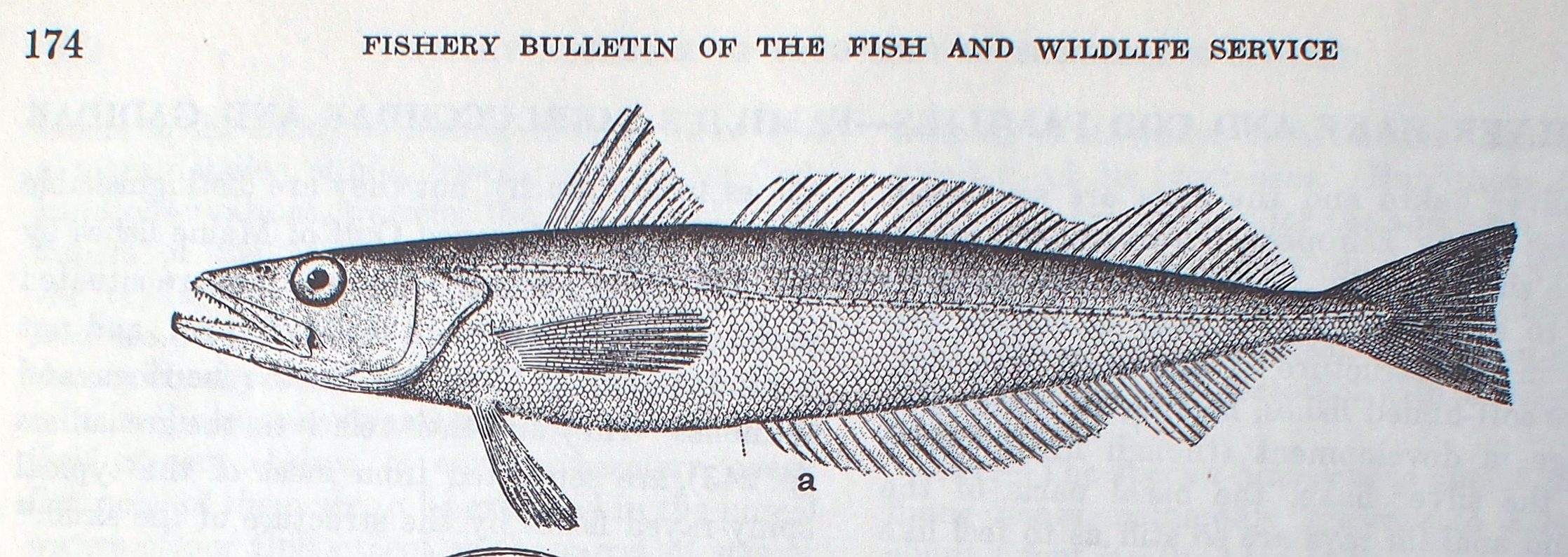
WHITING; NEW ENGLAND HAKE (Merluccius bilinearis).  Differs from true hakes (genus Urophycis)  Drawing by H. L. Todd

Silver hake are strong swift swimmers, well armed and extremely voracious.  Probably a complete diet list would include the young of practically all the Gulf of Maine Fishes. A 23¼ inch silver hake, taken at Orient, N. Y., had 75 herring, 3 inches long, in its stomach. And it is probable that the silver hake that frequent Georges Bank feed chiefly on young haddock.  As sweet a fish as one could ask, if eaten fresh or if slack salted overnight and used for breakfast the next morning.  Soften so fast they must be frozen quickly.

From Fishes of the Gulf of Maine by Bigelow and Schroeder, 1953.  Online courtesy of MBL/WHOI.  http://www.gma.org/fogm/Merluccius_bilinearis.htm


Massachusetts landings of silver hake reached a peak in the 1950s with a high of 108 million pounds in 1957.  From 2010 to 2016 landings have been in the range of 7 to 9 million pounds.  (NOAA)