MONARCH PROTECTOR LINCOLN BROWER DIES

By Matt Schudel WASHINGTON POST JULY 23, 2018
WASHINGTON — Lincoln Brower, one of the foremost experts on the monarch butterfly, who spent six decades studying the life cycle of the delicate orange-and-black insect and later led efforts to preserve its winter habitat in a mountainous region of Mexico, died July 17 at his home in Nelson County, Va. He was 86.

He had Parkinson’s disease, said his wife, Linda Fink.

Dr. Brower, who taught at Amherst College in Massachusetts and the University of Florida before becoming a research professor at Virginia’s Sweet Briar College in 1997, began studying the monarch butterfly in the 1950s.

He made key discoveries about how it protected itself by converting a toxic compound from its sole food source, the milkweed plant, into a chemical compound that sickened its predators, primarily birds.
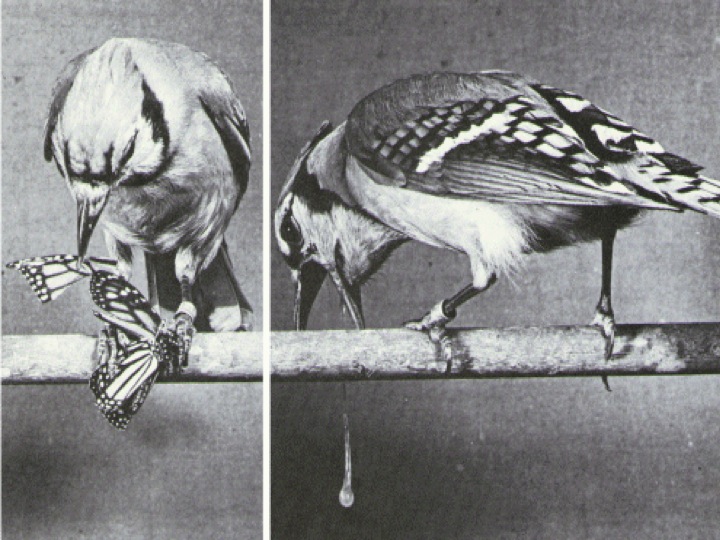
Dr. Brower’s famous “Barfing Bluejay” photo of a bird wretching after eating Monarchs, proved Monarchs don’t tast good. Dr. Lincoln Brower photo.

In the 1970s, other scientists discovered that monarchs had extraordinary migratory powers, more like birds or whales than insects. Each fall, monarchs from east of the Rocky Mountains travel thousands of miles to a Mexican forest, where they spend the winters. Monarchs from western North America migrate to California.

‘‘It has the most complicated migration of any insect known,’’ Dr. Brower told the Chicago Tribune in 1998. ‘‘Somehow they know how to get to the same trees every year. It’s a highly specific behavior that is unique to the monarch butterfly.’’

It takes three to four generations of monarchs to complete the one-year life cycle. After the migration to Mexico, the butterflies begin their return trip to North America, and a new generation is born en route, growing from larvae to caterpillars before taking flight.

With the arrival of cooler weather in the fall, the great-grandchildren of the monarchs that flew south the previous year will make the same trip, returning to the mountainsides visited by their ancestors.

‘‘It’s an inherited pattern of behavior and a system of navigation that we don’t really understand,’’ Dr. Brower said in 2007. ‘‘We don’t know exactly how they find their way. We don’t know how they know where to stop.’’

Dr. Brower first visited the monarchs’ winter quarters in a Mexican forest, about 80 to 100 miles west of Mexico City, in 1977. At an elevation of 9,500 to 11,000 feet, tall fir trees were entirely covered by hundreds of millions of butterflies.

When they stir their wings, ‘‘it sort of sounds like leaves blowing in the fall,’’ said Dr. Brower’s son, Andrew Brower, a biologist and butterfly expert at Middle Tennessee State University, in an interview. ‘‘It’s remarkable. You look up, and the sky is blue, but then it’s orange. It’s like an orange stained-glass window above your head.’’

During more than 50 trips to Mexico to study monarchs, Dr. Brower began to see that their numbers were shrinking.

In North America, Dr. Brower also pointed out, the monarchs face a further problem from the growing use of herbicide, which has eradicated much of their food source, the once-abundant milkweed.

There are still millions of monarchs in North America, but their numbers fluctuate from year to year, in an ever-downward trend. By some counts, the population has fallen by as much as 90 percent since the 1980s.

Dr. Brower joined efforts by environmental groups to have the monarch recognized as a ‘‘threatened’’ species.

Lincoln Pierson Brower was born Sept. 10, 1931, in Madison, N.J. His parents had a nursery and rose-growing business. He was 5 when he took notice of an American copper butterfly landing on a clover bloom. ‘‘I just stared at that tiny butterfly, and it was so beautiful to me,’’ he told NPR. ‘‘And that was the beginning.’’

He graduated from Princeton University in 1952, then received a doctorate in zoology from Yale University in 1957. Some of his early scientific papers were written with his first wife, the former Jane Van Zandt. That marriage ended in divorce, as did a second, to Christine Moffitt.

Mr. Brower leaves his wife of 27 years, Linda Fink, a professor of ecology at Sweet Briar College and a frequent scientific collaborator; two children from his first marriage, Andrew Brower of Christiana, Tenn., and Tamsin Barrett of Salem, N.H.; a brother; and two grandchildren.

With President Jimmy Carter

READ MORE HERE:

https://texasbutterflyranch.com/2015/02/16/q-a-dr-lincoln-brower-talks-ethics-endangered-species-milkweed-and-monarchs/

https://monarchjointventure.org/news-events/news/remembering-lincoln-brower-a-world-renowned-monarch-conservation-leader

Dr. Lincoln

The Year the Monarch Didn’t Appear

Many, many readers have forwarded the following article from the New York Times, “The Year the Monarch Didn’t Appear.” 

Female Monarch Egg Marsh Milkweed ©Kim Smith 2013JPGFemale Monarch Depositing an Egg

In the above photo, the female Monarch Butterfly is curling her abdomen around to the underside of the Marsh Milkweed plant. She chooses the most tender foliage toward the top of the plant on which to deposit her eggs.

Begin New York Times article, published November 22, 2013 ~

ON the first of November, when Mexicans celebrate a holiday called the Day of the Dead, some also celebrate the millions of monarch butterflies that, without fail, fly to the mountainous fir forests of central Mexico on that day. They are believed to be souls of the dead, returned.

This year, for or the first time in memory, the monarch butterflies didn’t come, at least not on the Day of the Dead. They began to straggle in a week later than usual, in record-low numbers. Last year’s low of 60 million now seems great compared with the fewer than three million that have shown up so far this year. Some experts fear that the spectacular migration could be near collapse.

“It does not look good,” said Lincoln P. Brower, a monarch expert at Sweet Briar College.

It is only the latest bad news about the dramatic decline of insect populations.

Another insect in serious trouble is the wild bee, which has thousands of species. Nicotine-based pesticides called neonicotinoids are implicated in their decline, but even if they were no longer used, experts say, bees, monarchs and many other species of insect would still be in serious trouble.

That’s because of another major factor that has not been widely recognized: the precipitous loss of native vegetation across the United States.

“There’s no question that the loss of habitat is huge,” said Douglas Tallamy, a professor of entomology at the University of Delaware, who has long warned of the perils of disappearing insects. “We notice the monarch and bees because they are iconic insects,” he said. “But what do you think is happening to everything else?”

A big part of it is the way the United States farms. As the price of corn has soared in recent years, driven by federal subsidies for biofuels, farmers have expanded their fields. That has meant plowing every scrap of earth that can grow a corn plant, including millions of acres of land once reserved in a federal program for conservation purposes.

Another major cause is farming with Roundup, a herbicide that kills virtually all plants except crops that are genetically modified to survive it.

As a result, millions of acres of native plants, especially milkweed, an important source of nectar for many species, and vital for monarch butterfly larvae, have been wiped out. One study showed that Iowa has lost almost 60 percent of its milkweed, and another found 90 percent was gone. “The agricultural landscape has been sterilized,” said Dr. Brower.

The loss of bugs is no small matter. Insects help stitch together the web of life with essential services, breaking plants down into organic matter, for example, and dispersing seeds. They are a prime source of food for birds. Critically, some 80 percent of our food crops are pollinated by insects, primarily the 4,000 or so species of the flying dust mops called bees. “All of them are in trouble,” said Marla Spivak, a professor of apiculture at the University of Minnesota.

Farm fields are not the only problem. Around the world people have replaced diverse natural habitat with the biological deserts that are roads, parking lots and bluegrass lawns. Meanwhile, the plants people choose for their yards are appealing for showy colors or shapes, not for their ecological role. Studies show that native oak trees in the mid-Atlantic states host as many as 537 species of caterpillars, which are important food for birds and other insects. Willows come in second with 456 species. Ginkgo, on the other hand, which is not native, supports three species, and zelkova, an exotic plant used to replace elm trees that died from disease, supports none. So the shelves are nearly bare for bugs and birds.

Native trees are not only grocery stores, but insect pharmacies as well. Trees and other plants have beneficial chemicals essential to the health of bugs. Some monarchs, when afflicted with parasites, seek out more toxic types of milkweed because they kill the parasites. Bees use medicinal resins from aspen and willow trees that are antifungal, antimicrobial and antiviral, to line their nests and to fight infection and diseases. “Bees scrape off the resins from the leaves, which is kind of awesome, stick them on their back legs and take them home,” said Dr. Spivak.

Besides pesticides and lack of habitat, the other big problem bees face is disease. But these problems are not separate. “Say you have a bee with viruses,” and they are run-down, Dr. Spivak said. “And they are in a food desert and have to fly a long distance, and when you find food it has complicated neurotoxins and the immune system just goes ‘uh-uh.’ Or they become disoriented and can’t find their way home. It’s too many stressors all at once.”

There are numerous organizations and individuals dedicated to rebuilding native plant communities one sterile lawn and farm field at a time. Dr. Tallamy, a longtime evangelizer for native plants, and the author of one of the movement’s manuals, “Bringing Nature Home,” says it’s a cause everyone with a garden or yard can serve. And he says it needs to happen quickly to slow down the worsening crisis in biodiversity.

When the Florida Department of Transportation last year mowed down roadside wildflowers where monarch butterflies fed on their epic migratory journey, “there was a huge outcry,” said Eleanor Dietrich, a wildflower activist in Florida. So much so, transportation officials created a new policy that left critical insect habitat un-mowed.

That means reversing the hegemony of chemically green lawns. “If you’ve got just lawn grass, you’ve got nothing,” said Mace Vaughan of the Xerces Society, a leading organization in insect conservation. “But as soon as you create a front yard wildflower meadow you go from an occasional honeybee to a lawn that might be full of 20 or 30 species of bees and butterflies and monarchs.”

First and foremost, said Dr. Tallamy, a home for bugs is a matter of food security. “If the bees were to truly disappear, we would lose 80 percent of the plants,” he said. “That is not an option. That’s a huge problem for mankind.”

Jim Robbins is a frequent contributor to The New York Times and the author of “The Man Who Planted Trees.”
 *  *  *

My note about milkweeds ~

Common Milkweed (Asclepias syriaca) is the milkweed we see most typically growing in our dunes, meadows, roadsides, and fields. It grows quickly and spreads vigorously by underground runners. This is a great plant if you have an area of your garden that you want to devote entirely to milkweed. It prefers full sun, will tolerate some shade, and will grow in nearly any type of soil. The flowers are dusty mauve pink and have a wonderful honey-hay sweet scent.

Marsh Milkweed (Aclepias incarnata) is more commonly found in marshy areas, but it grows beautifully in gardens. It does not care for dry conditions. These plants are very well-behaved and are more clump forming, rather than spreading by underground roots. The flowers are typically a brighter pink than Common Milkweed.