
The new Pope Francis needed a lot of this, just to step out on that balcony… God bless him!
My View of Life on the Dock
The new Pope Francis needed a lot of this, just to step out on that balcony… God bless him!


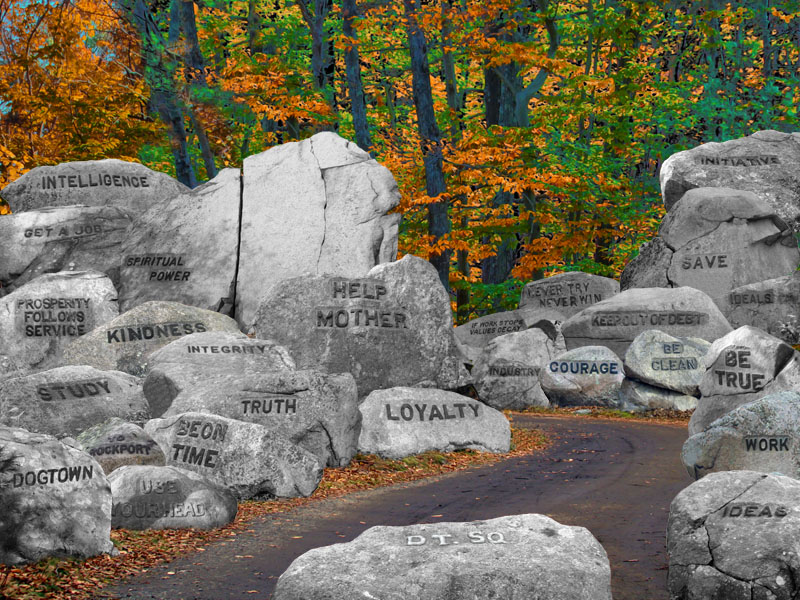
I’ve never built a stone wall, but creating this montage gave me an idea what it is like, without the heavy lifting. The boulders have been placed along the road leading from the Cherry Street entrance to Dogtown Road. There is one I couldn’t fit in – as with all stone walls, some rocks just don’t fit, and there is one I created which is not a Babson boulder. Can anyone identify the missing boulder, and which one doesn’t belong? Also, I did two versions and would be interested in knowing which one people like better, assuming you like them. The second version has the denser woods of Ravenswood in the background. They both contain the same boulders, but are placed a little differently in the 2nd version.
In case you didn’t know, Millionaire philanthropist, Roger Ward Babson (1875-1967), provided charitable assistance to unemployed stonecutters in Gloucester during the Great Depression, by commissioing them to carve these inspirational inscriptions on two dozen boulders in the area surrounding Dogtown Common. While the inscriptions are clearly visible, the boulders are scattered, not all are on the trail, and not all of the inscriptions face the trail, making finding them something of a challenge. There are an additional three boulders which are location or direction markers and are informational, not inspirational.
Babson was interested in the history of the abandoned settlement in Gloucester known as Dogtown. Dogtown (also Dogtown Commons or Dogtown Village) is located in a densely
wooded area of about five square miles, or 3,600 acres, in central Gloucester stretching from the Riverdale section of the city, north of Route 128, into Rockport, and includes
Goose Cove and the Babson Reservoir. Once known as the Common Settlement and populated by respectable citizens, it was for a century the most prosperous part of Gloucester.
Dogtown’s development and prosperity lasted from about 1650 until 1750. During this time, the area was home to many of Gloucester’s most prominent families, and since it was directly connected by road to all of Cape Ann’s seashore communities, the Commons Settlement, as it was called, was a thriving and successful hub of agriculture, timbering, and transportation. The peak of its population has been estimated at around one hundred families.
After new coastal roads were opened, and especially after the conclusion of the War of 1812 and its attendant risk of coastal bombardment, most farmers moved away from Dogtown. Their abandoned houses were for a few decades occupied by itinerants and vagabonds, giving the area its bad reputation. Many of the widows of sea-goers and soldiers
who never returned kept dogs for protection and company. As these last inhabitants died, their pets became feral and wild, roaming the moors and howling, possibly giving rise to
the nickname “Dogtown”.
Most of the area of Dogtown is now a dense woodland, peppered with house-sized boulders, criss-crossed and bisected by trails and old roads. The area is held in trust by
Gloucester and Rockport and therefore protected in perpetuity. Dogtown Road off of Cherry Street in the western section (the Gloucester side) is lined with the remains of the
cellar holes of the settlers. Babson also mapped and numbered the cellar holes left from the homes of Dogtown’s former residents.
(Excerpts taken from Babson College Archives – “Biography of Roger Ward Babson” and Wikipedia)
If you decide to go on a search for the Babson boulders, Eric Bickernicks has created a wonderful map with GPS coordinates for all the boulders, which was how my sister and I found some of the more hidden ones. You can find the map at http://www.bostonico.org/Babson_Boulder_Trail_Map.pdf. There is one small error on the map, which caused us some confusion. There is a boulder identified as “First at Tasks” which we thought an odd saying, and couldn’t find. In fact it is “First Attacked” and marks the spot where Jas Merry was first attacked by his bull. There is another marker nearby which identifies the spot where he died in 1892 from injuries sustained when the sport of wrestling his bull went bad.
E.J. Lefavour
http://www.khanstudiointernational.com/galleryphotomontage2013.htm

I haven’t been out in Dogtown much, but I went for a walk there yesterday with a friend. He took a photo of me next to “Peter’s Pulpit”. I wanted to get on top to strike a preachy pose, but there is no easy access to perch on the peak of Peter’s pulpit. We ended up at Whale’s Jaw:


I hope to get back to hike in Dogtown more regularly! It is a very interesting place.

CALLING ALL DOGTOWN FAMILY PHOTOS!

Collection of the Cape Ann Museum.
In conjunction with its upcoming exhibition of works by 20th century artist Marsden Hartley, the Cape Ann Museum has put out a call for snapshots taken by Cape Ann families in Dogtown over the decades. The images will be used in an installation entitled It’s All About Dogtown to be held at the Museum’s White-Ellery House in September. If you have photographs of your family in Dogtown and are willing to share with us, we would like to speak with you. Images can be dropped off at the Museum’s Front Desk; they should be labeled with your name and your contact information. The Museum will make a copy of your images then return the originals to you. For additional information, please call the Museum at 978-283-0455, ext. 17.

Joey-
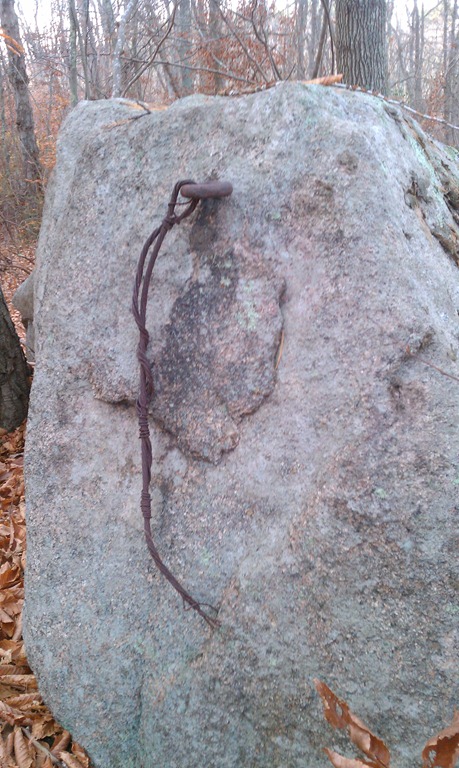
I’ve found dozens of eye bolts set in outcrops or large boulders across Gloucester. This one (see attached) is from Dogtown. There are many throughout the woods of West Gloucester. Typically I find them at the top of the outcrop or rock, often with a piece of wire still attached. They are much smaller than the beefy hardware associated with quarrying.
What were these used for?
Nick

Thomas writes-
Located in Cape Ann Massachusetts there exists a ghost town called “Dog Town”. In that wooded area there exists an unusual hiking trail that includes viewing about 30 boulders that have carved inscriptions.
Roger Babson (1875 – 1967), a descendant of the Dog Town hamlet’s earliest settlers was a founder of three colleges, eccentric and moralizer. He even spent time trying to discover ways to defeat gravity…
Source: Dog Town a Village Lost in Time by Thomas Dresser
As a ‘moralizer’ Babson hired out of work quarry people to carve sayings on boulders in Dog Town. The appearance of the carved boulders seemingly has no pattern. But after some thought we discern three groupings: ideals, ideas to implement them and truths.
As a ‘moralizer’ Babson left us with a riddle. What is he telling us by his legacy of boulder inscriptions in Dog Town (a modern day ghost town)?
During his life he tried to find ways to “defeat gravity”. Hatred is gravity. Hope, faith and love are uplifting or anti-gravity (as are his wonderful sayings)!
What follows is a video that depicts the Babson Boulders:
here is a pdf to go with it-

Hi Joey,
Wondering if you might post this great free Essex County Greenbelt walk on
your blog?
Sunday, March 27, 1 – 3 p.m.
Geology Walk at Dogtown
Carter Reservation, Gloucester
Led by Greenbelt’s Executive Director Ed Becker and Greenbelt staff member
Cathy Lanois
The landscape and legends of Dogtown have inspired naturalists and writers
for centuries. On this walk, we’ll focus on natural history, with an eye to
the many interesting geologic features of this unique area. Registration
required, please email smd@ecga.org
Directions: From Route 128 North, take the third exit off Grant Circle, the
first Gloucester Rotary, onto Washington Street, Route 127. Drive 2.2 miles.
Just after the causeway that crosses the outlet for Goose Cove, turn right
onto Dennison Street. Drive to the end of Dennison Street and park at the
Greenbelt sign.
Thanks, Jill Buchanan
A great Spring day to explore Dogtown and Babson’s Boulders
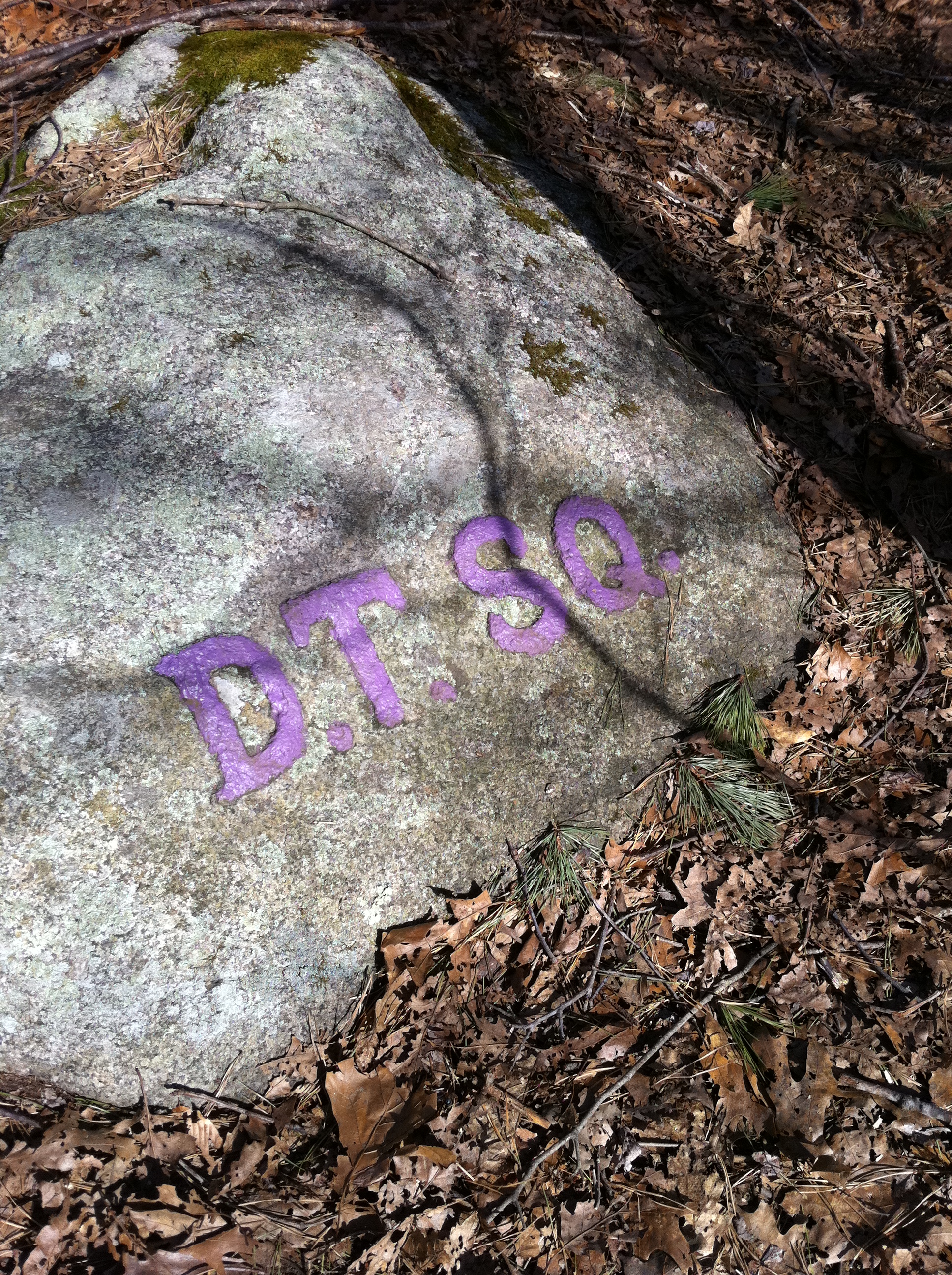
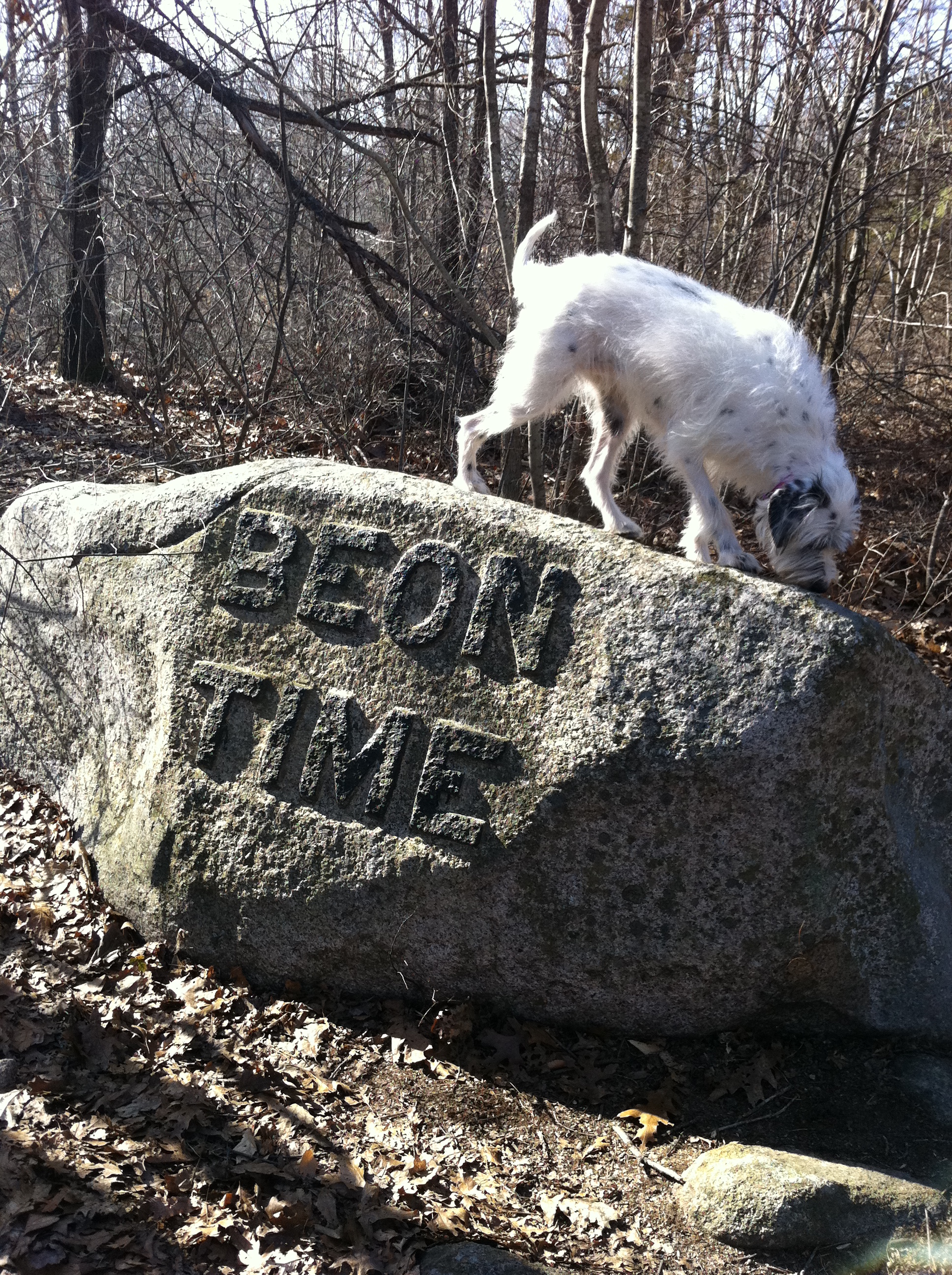
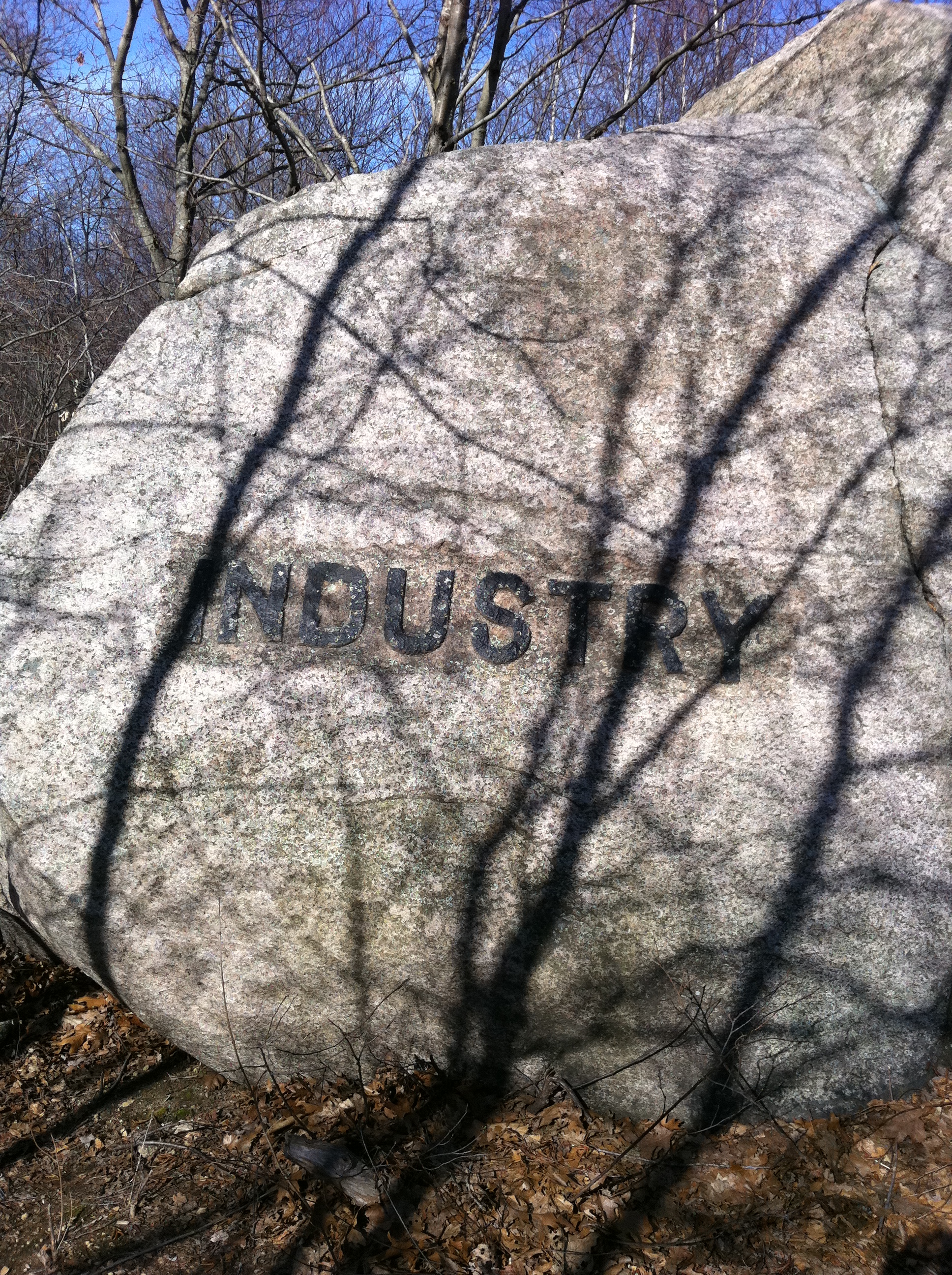
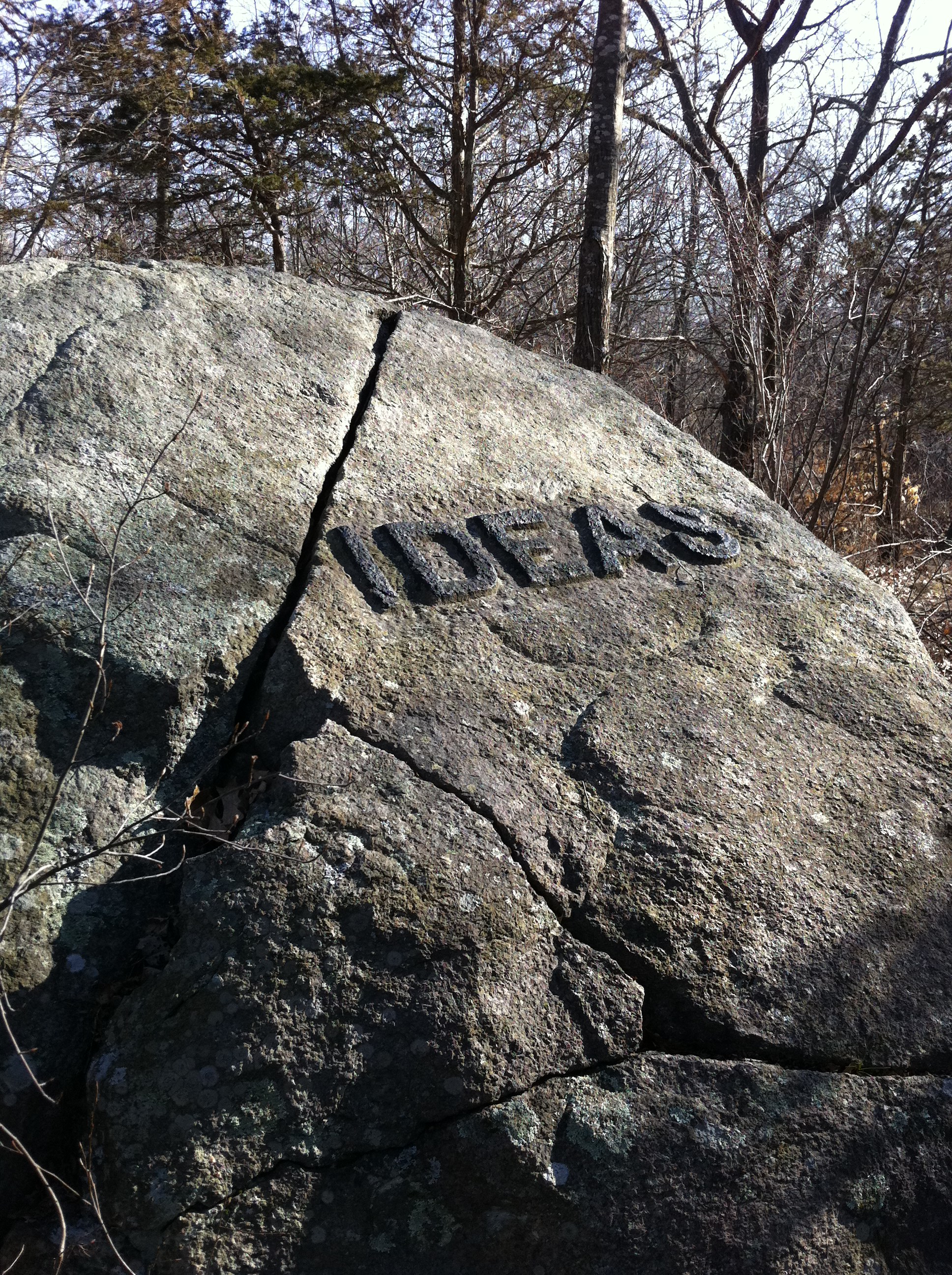

Yesterday was a pristine day to go cross-country skiing. With Dogtown and connections infiltrating out from the center of Cape Ann and throwing in Ravenswood there are very few places on Cape Ann that are not a short walk to a trail that goes on and on.
Evvy, hold on, I want to take a picture …

This is one of those trails that links up quarries down to a cove. There were train tracks here before the quarry bust of 1933. I ski along imagining the train Polyphemus as it lugged 40 ton blocks of granite through the woods to become the great granite bowls which sit in front of Union Station in our nation’s capital. Must have been quite a sight.

Did you know?
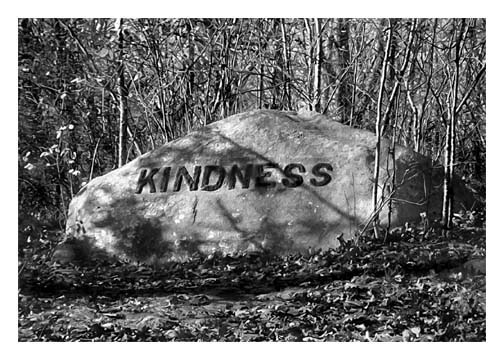
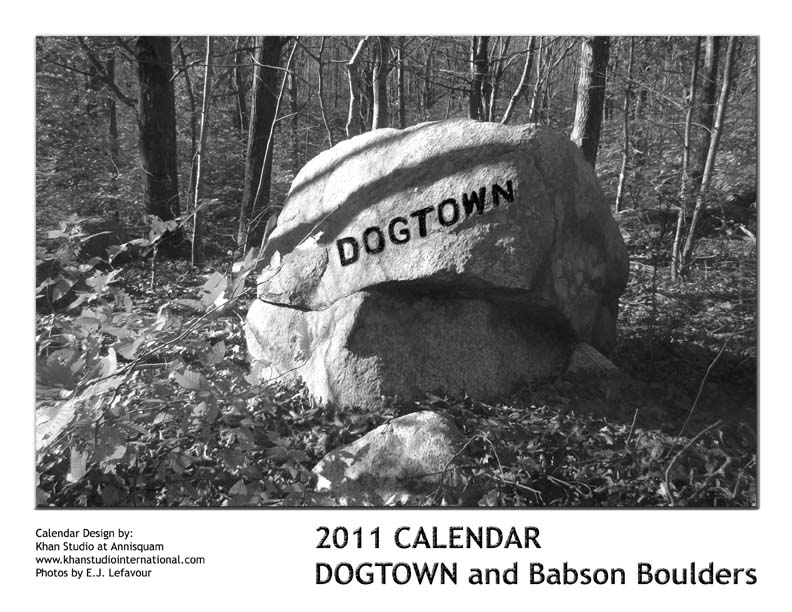
That millionaire philanthropist, and 10th generation Gloucester inhabitant, Roger Ward Babson (1875-1967), provided charitable assistance to unemployed stonecutters in Gloucester during the Great Depression, by commissioning them to carve inspirational inscriptions on approximately two dozen boulders in the area surrounding Dogtown Common. This boulder is the one I chose for January’s image in my 2011 Dogtown and Babson Boulders calendar because I think the message is the most important one to start out any new year with. If we all resolve to spend the New Year performing random acts of kindness, what an amazing year 2011 will be.
E.J. Lefavour
http://www.khanstudiointernational.com/gallery_dogtownandbabsonboulders.htm

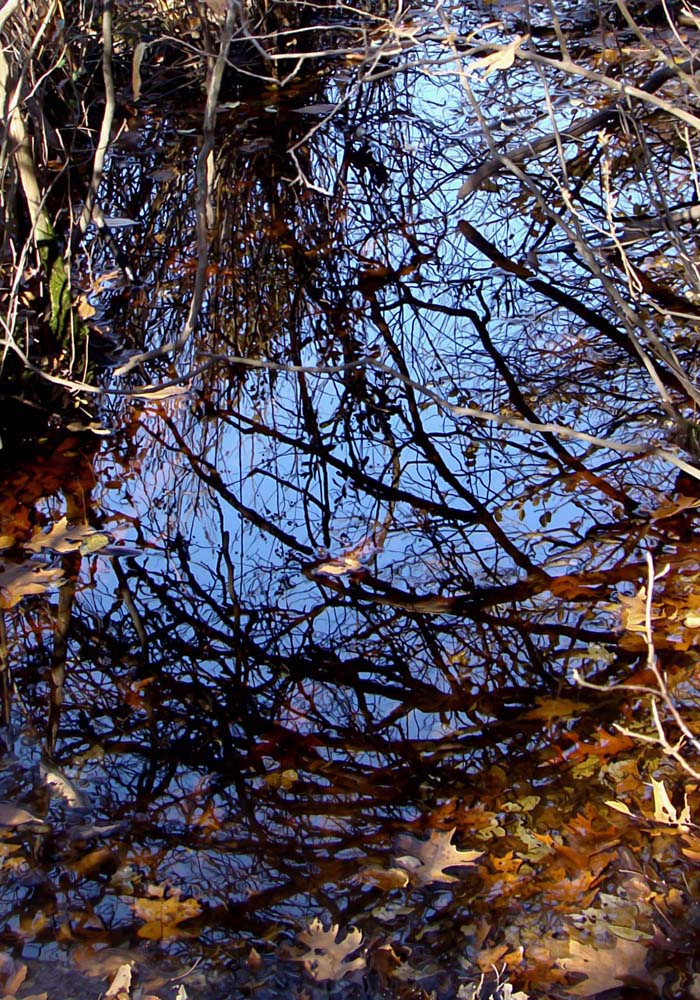
Did you know that Jane “Granny” Day (#20 or #21 Dogtown Road – controversy exists over which was her actual location) was a school teacher, who worked out of the single-room schoolhouse at Dogtown Square, and that her house apparently abutted this swamp, known for swallowing sheep and other careless creatures that wandered too close. She lived to the age of 94 and died in 1814. This is a photograph of Granny Day’s Swamp, or part of it anyway, as it looks today.

 I have been getting calls from people looking for the calendars. I am out of them and won’t have more in until Christmas Eve Day – however, you can still get them at Joncien, 25 Bearskin Neck, Rockport (Leslie 978-546-9161), Dogtown Book Shop, 132 Main Street, Gloucester (Bob 978-281-5599), and at Toad Hall Bookstore, 47 Main Street, Rockport (978-546-7323), Willow Rest is out, but will have more on Friday. To all of you who have purchased the calendar, Thank You, and I hope you enjoy it as much as I enjoyed creating it. E.J.

The Calendars are in! And the printer did a beautiful job on them. This high quality, uniquely Cape Ann, 8.5×11″ (11×17″ open) 12 month calendar is now available to purchase, just in time for that unique last minute gift you were searching for, or that special calendar for yourself. It includes 12 stunning full size black and white photos of Babson Boulders (Kindness, Spiritual Power, Courage, Loyalty, Ideas, Use Your Head, Industry, Be On Time, Study, Work, Truth and Keep Out of Debt), along with a two-page history of Dogtown, Roger Babson and the Babson Boulders. They are available at Joncien, 25 Bearskin Neck, Rockport, Dogtown Book Shop, 132 Main Street, Gloucester, Toad Hall Bookstore, 47 Main Street, Rockport and through Khan Studio in Annisquam Village at a cost of $15 ($20 if you want it shipped). This calendar will make a great gift for anyone who loves Cape Ann, rocks, nature, Dogtown, timeless words of wisdom, history and heritage of this little slice of Heaven we inhabit. You can see it at http://www.khanstudiointernational.com/dogtown%20and%20babson%20boulders%20calendar.htm. Please email me at khanstudio@comcast.net if you would like to order one (or more), or stop by any of the above-mentioned shops. If you don’t happen to live on or near Cape Ann, you can order, pay by credit card and have one shipped to you by Joncien (call Leslie Asare at Joncien 978-546-9161, or if you can’t reach her, call EJ at 857-891-9054). Happy Holidays. EJ
Exciting little newsflash. The Sorenson Center for the Arts at Babson College just ordered 40 Dogtown and Babson Boulders calendars. I am honored to have a bunch of my calendars go to Babson College, probably the most important of the many life projects of
Roger Ward Babson.

E.J. Lefavour writes-
Did you know?
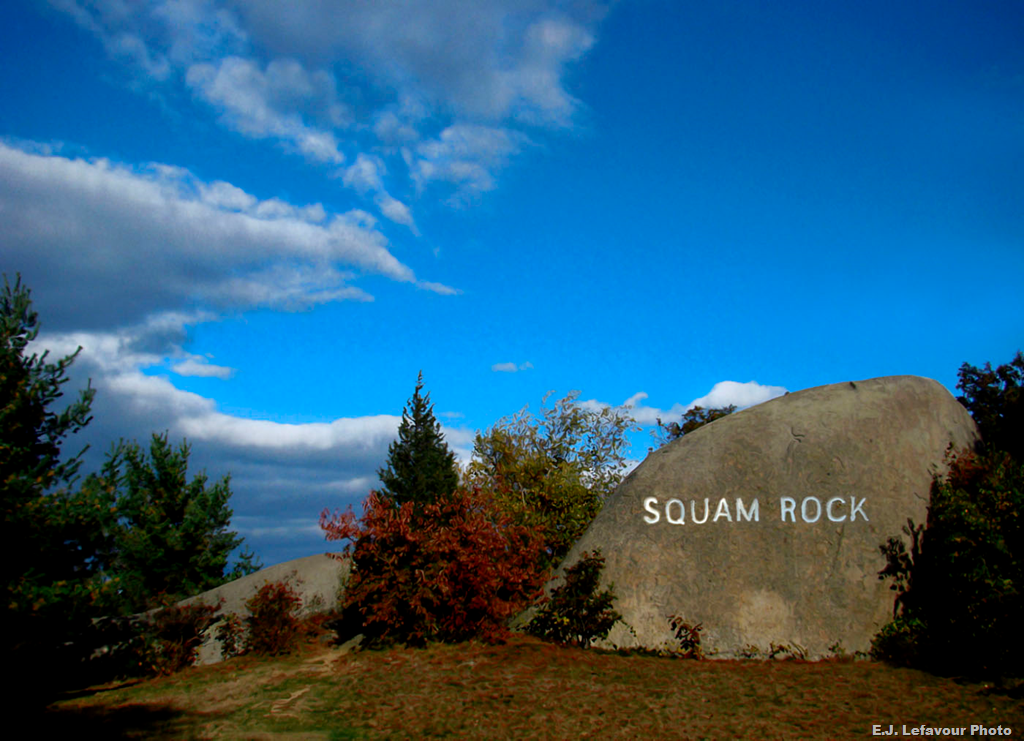
That Roger Babson, founder of Babson College, and the philanthropist millionaire who hired unemployed stonecutters after the Great Depression to carve messages on the boulders scattered throughout Dogtown, was also instrumental in the formation of the Squam Rock Land Trust? This Trust maintains and protects the large tract of rolling meadow, boulders (including Squam Rock) and trails that lead from Walnut Street down to Lighthouse Beach, from development in perpetuity. Sarah Hackett, 84-year-old Annisquam native, remembers when Babson came to her grandfather’s house to impress upon him the importance of protecting this land from the rich who would build their mansions on it and block the village residents’ access. Those of you who know Squam Rock, can you tell what is wrong with this picture?
Answer: (Squam Rock is not actually carved on Squam Rock, but on the granite block at Squam Rock Road and Walnut Street)
E.J. Lefavour Khan Studio www.khanstudiointernational.com

Here is the final installment of the Elyssa East GMG Interview.
In this segment we talk about publishing in 2010- the challenges and opportunities presented with new media distribution.
We also talk about the need for the independent book store and what they offer that digital media can’t.
you can check out The DogtownTheBook website here-
http://www.dogtownthebook.com/
Here is Part II of the Elyssa East Interview
Check back tomorrow for part III
I Interviewed Elyssa East at Pleasant Street Tea and Coffee Company Where She Talked About Her Book In Part I of Our Three Part Interview
Look for part II tomorrow
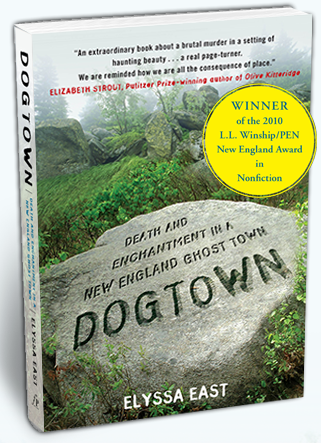
For more info about Dogtown: Death and Enchantment In A New England Ghost Town check out the website here
 part II tomorrow

You can buy Dogtown: Death and Enchantment In A New England Ghost Town at The Bookstore of Gloucester or any of the local bookstores including Toad Hall in Rockport.
From Simon Shuster Videos-
Look for my interview with Elyssa Tomorrow.
From DogtownTheBook website-
The area known as Dogtown—an isolated colonial ruin and surrounding 3,000-acre woodland in storied seaside Gloucester, Massachusetts—has long exerted a powerful influence over artists, writers, eccentrics, and nature lovers. But its history is also woven through with tales of witches, supernatural sightings, pirates, former slaves, drifters, and the many dogs Revolutionary War widows kept for protection and for which the area was named. In 1984, a brutal murder took place there: a mentally disturbed local outcast crushed the skull of a beloved schoolteacher as she walked in the woods. Dogtown’s peculiar atmosphere—it is strewn with giant boulders and has been compared to Stonhenge — and eerie past deepened the pall of this horrific event that continues to haunt Gloucester even today.
In alternating chapters, Elyssa East interlaces the story of this grisly murder with the strange, dark history of this wilderness ghost town and explores the possibility that certain landscapes wield their own unique power.
East knew nothing of Dogtown’s bizarre past when she first became interested in the area. As an art student in the early 1990s, she fell in love with the celebrated Modernist painter Marsden Hartley’s stark and arresting Dogtown landscapes. She also learned that in the 1930s, Dogtown saved Hartley from a paralyzing depression. Years later, struggling in her own life, East set out to find the mysterious setting that had changed Hartley’s life, hoping that she too would find solace and renewal in Dogtown’s odd beauty. Instead, she discovered a landscape steeped in intrigue and a community deeply ambivalent about the place: while many residents declare their passion for this profoundly affecting landscape, others avoid it out of a sense of foreboding.
Throughout this richly braided first-person narrative, East brings Dogtown’s enigmatic past to life. Losses sustained during the American Revolution dealt this once thriving community its final blow. Destitute war widows and former slaves took up shelter in its decaying homes until 1839, when the last inhabitant was taken to the poorhouse. He died seven days later. Dogtown has remained abandoned ever since, but continues to occupy many people’s imaginations. In addition to Marsden Hartley, it inspired a Bible-thumping millionaire who carved the region’s rocks with words to live by; the innovative and influential postmodernist poet Charles Olson, who based much of his epic Maximus Poems on Dogtown; an idiosyncratic octogenarian who vigilantly patrols the land to this day; and a murderer who claimed that the spirit of the woods called out to him.
In luminous, insightful prose, Dogtown takes the reader into an unforgettable place brimming with tragedy, eccentricity, and fascinating lore, and examines the idea that some places can inspire both good and evil, poetry and murder.


 Good Morning Gloucester