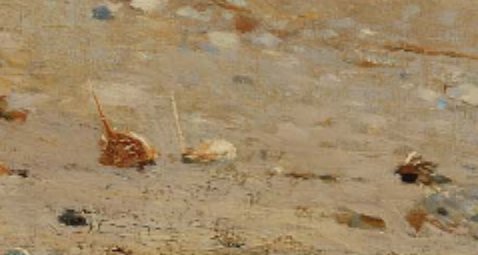
Gloucester portraits: Good Harbor Beach piping plover and David Rimmer Essex County Greenbelt with an Edward Hopper house. And Leon Kroll double bridge.

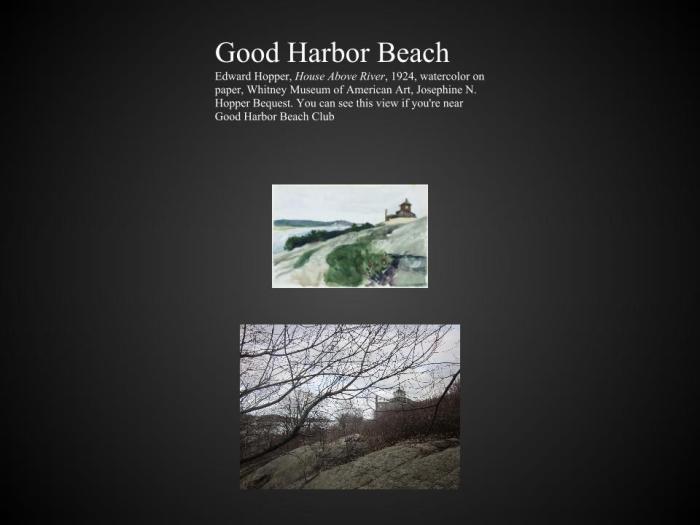
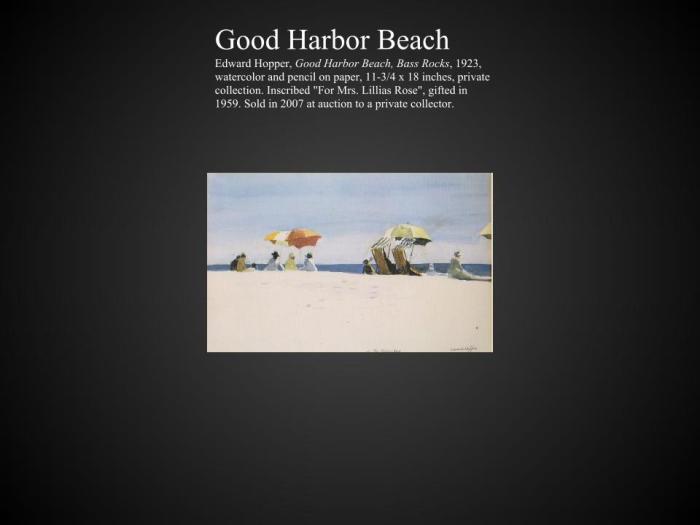
There are more than 110 portraits of the City of Gloucester by the American artist Edward Hopper. There are a few 1923 Good Harbor Beach scenes including one with Jo Nivison seated sketching, and in the distance Bass Rocks and a ‘Hopper’ house. That vista was already a Gloucester motif.

Copy of Edward Hopper all around Gloucester MA (more than 90 works) (73)

piping plover with Hopper house

20160714_070910(0)

Dave with Hopper house

20160714_072617
Dave with Hopper house                                                                                                                                  David Rimmer, Director of Land Stewardship, Essex County Greenbelt monitoring piping plovers 2016, Good Harbor Beach.


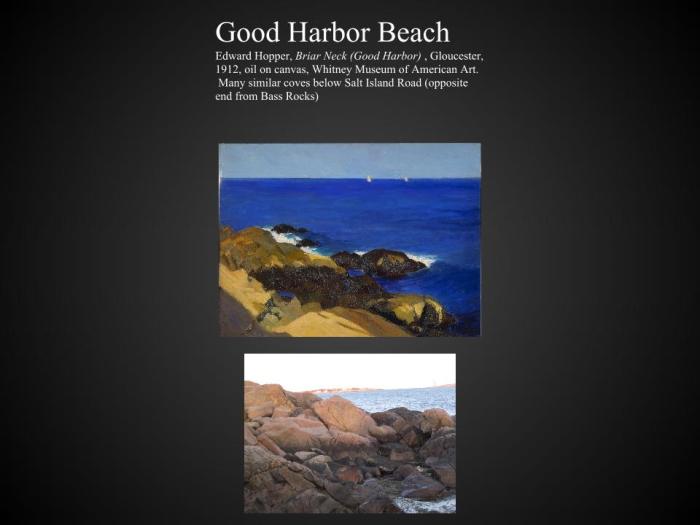
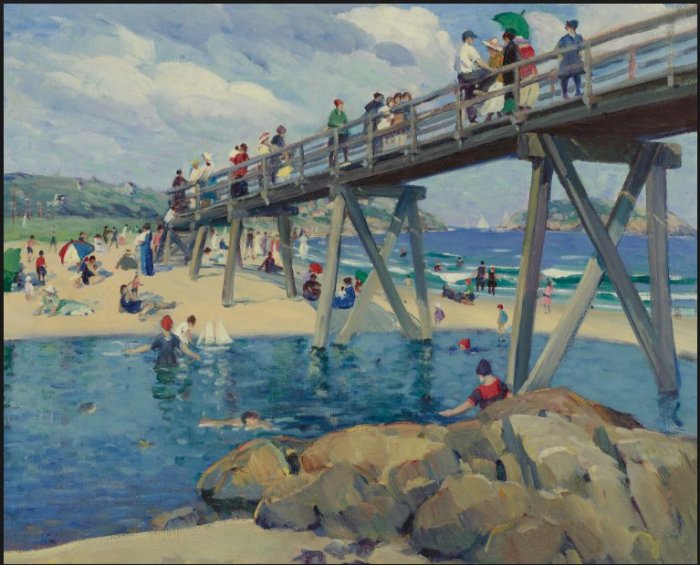
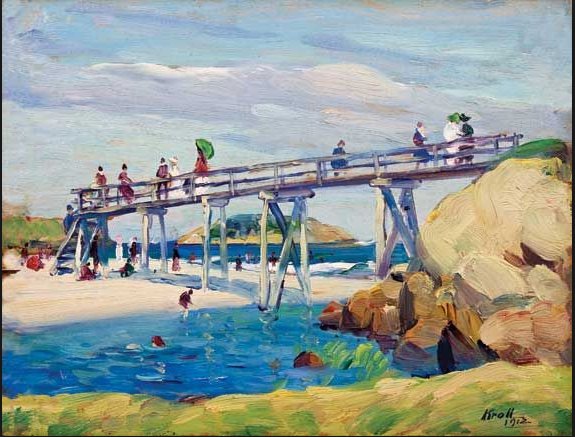
Eleven years before the image of Jo sketching, Hopper painted the other side of Good Harbor (Brier Neck) when he first came to New England. Leon Kroll painted two pedestrian bridges on the Bass Rocks side of the beach that same year.

Copy of Edward Hopper all around Gloucester MA (more than 90 works) (75)

Note the double bridges on Good Harbor.

Leon Kroll 1912 double bride 26 x 32 oil on

Leon Kroll, 1912, oil on canvas, (Good Harbor Beach, Gloucester) 26 x 32


Leon Kroll 1912 oil on canvas 26 x 32  sold at Sothebys 2011 bridge at bass rocks informal title 170,500
Leon Kroll 1911, 26 x 32 oil on canvas (Bridge at Bass Rocks) sold at Sotheby’s auction in 2011 for $115,700
8 point 5 by 10 three quarters 1912 leon kroll
Leon Kroll, 1912 oil on panel, 8.5 x 11-3/4


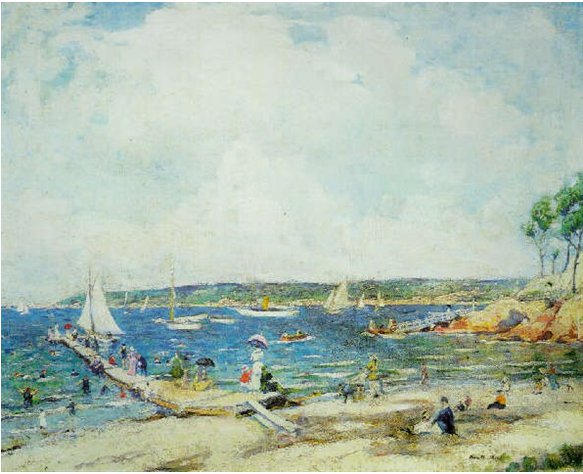
Knoll also painted Niles and Pavilion. He kept returning to Gloucester; eventually his family purchased a home in Folly Cove in 1932. Learn more at Cape Ann Museum and see Kroll works of art on display.

Leon Kroll Niles Beach 26 x 32
Leon Kroll, Niles Beach 1913

Copy of Edward Hopper all around Gloucester MA (more than 90 works) (74)

Copy of Edward Hopper all around Gloucester MA (more than 90 works) (71)

Deborah Cramer bird watch report: Piping plovers, oyster catcher, red knots sandpipers

Deborah Cramer update related to the Narrow Edge GMG post:

“Piping plovers are also on Coffin’s Beach, an oyster catcher has come into Essex Bay, and in a few weeks, and right now the red knots are up in the Arctic nesting.  They’ll be heading back later this summer, and some will pause to refuel in Essex Bay.”


David Eliot Gould’s 1895 entry on piping plovers reads like the summer of 2016:

“From many of its resorts along the Atlantic Coast, where in former days it was most abundant, it has been driven by the advance of fashion and the influx of the summer’s passing population, until it is now found chiefly on the more retired parts of the coast where it is most free from molestation.”  

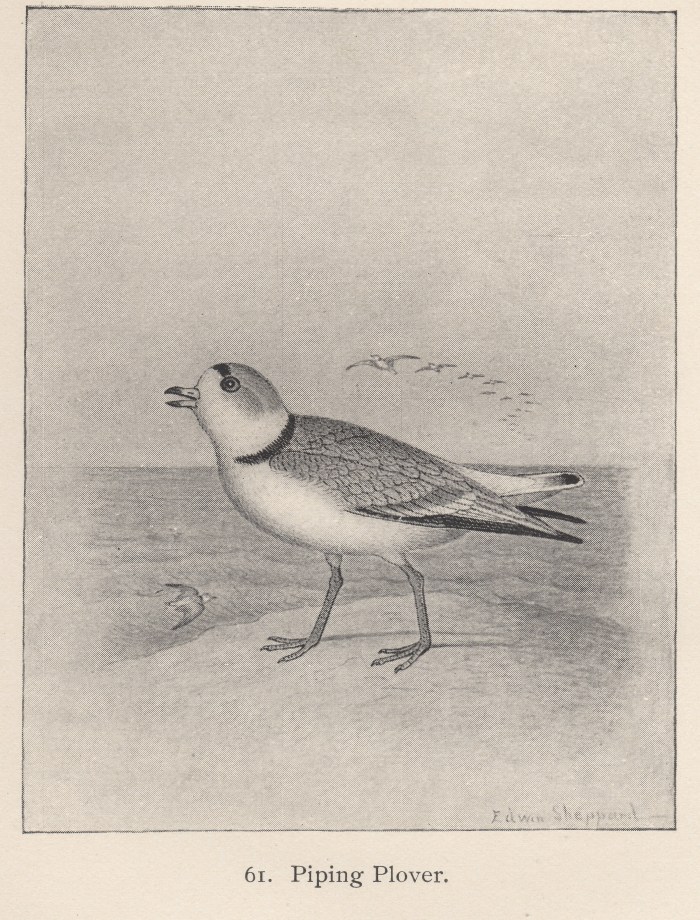
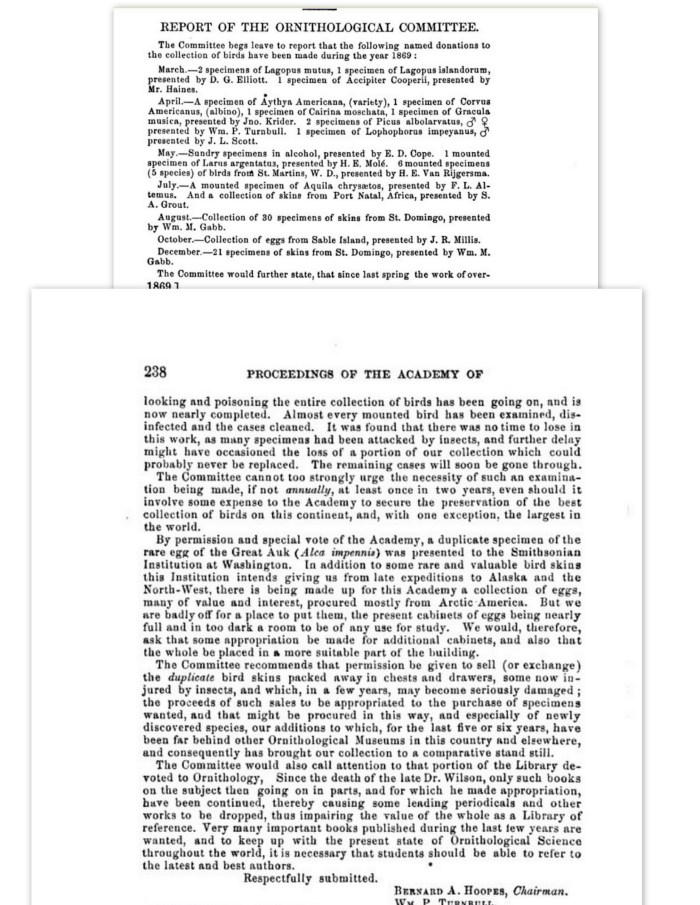
I’ve added the illustration. The artist, “Ernest” Sheppard, illustrated scientific and natural history, primarily birds, including History of North American Birds in 1874.  He was on the staff of the Academy of Natural Sciences in Philadelphia; in 1969 he was one member of the 3 man ornithological committee of the Academy that pleaded for more funding and care in their department. So, what did they ask for “to ensure the preservation of the best collection of birds on the continent, and, with one exception, the largest in the world” ?

First they recounted recent acquisitions such as a rare egg of the Great Auk. Then they explained that the repository required more funding,  space, display,  inventory systems, and conservation (a tricky endeavor with these specimens.) Insects were on the warpath! Poison was effective.

The 2016 restoration of the Civil War coat and display options may resonate.

Sheppard
illustration from the 1895 book by David Eliot Gould, North American Shore Birds; a history of the snipes, sandpipers, plovers and their allies, inhabiting the beaches and marshes, illustration by Edwin Sheppard.


From the ornithological committee’s submission to the annual report, excerpted from Proceedings of the Academy of Natural Sciences of Philadelphia, Volume 21, 1869

1869 PA Academy


Author Deborah Cramer asks were there plentiful horseshoe crabs in Gloucester? Leads to Winslow Homer, John Bell, and Cher Ami

Deborah Cramer thanks Good Morning Gloucester for mentioning her book and asks for photographs and stories about horseshoe crabs, otherwise known as the nearly scene stealing co-stars from her inspiring book on red knots (sandpiper shorebirds), The Narrow Edge.

“I’m in the midst of a project right now trying to uncover the almost forgotten history of the whereabouts of horseshoe crabs in Gloucester.  I’ve heard some fantastic stories, like one from a man who used to go down to Lobster Cove after school and find horseshoe crabs so plentiful he could fill a dory. Do you think there’s a value to putting up a few pictures on GMG and asking people to send in their recollections of beaches, coves where they used to see them in abundance?”

We do. Please send in photos or stories if you have them about horseshoe crabs in Gloucester or the North Shore for Deborah Cramer’s project. Write in comments below and/or email cryan225@gmail.com

Here’s one data point. Look closely at this 1869 Winslow Homer painting. Can you spot the horseshoe crabs? Can you identify the rocks and beach?

Winslow Homer Rocky Coast and Gulls (manchester)
Winslow Homer, Rocky Coast and Gulls, 1869, Museum of Fine Arts Boston, installed in room #234 with so many other Homers (Fog Warning, All’s Well, Driftwood, …)
zoomed into horseshoe crabs (detail )
(zoomed into horseshoe crabs)

cr 2015 mfa


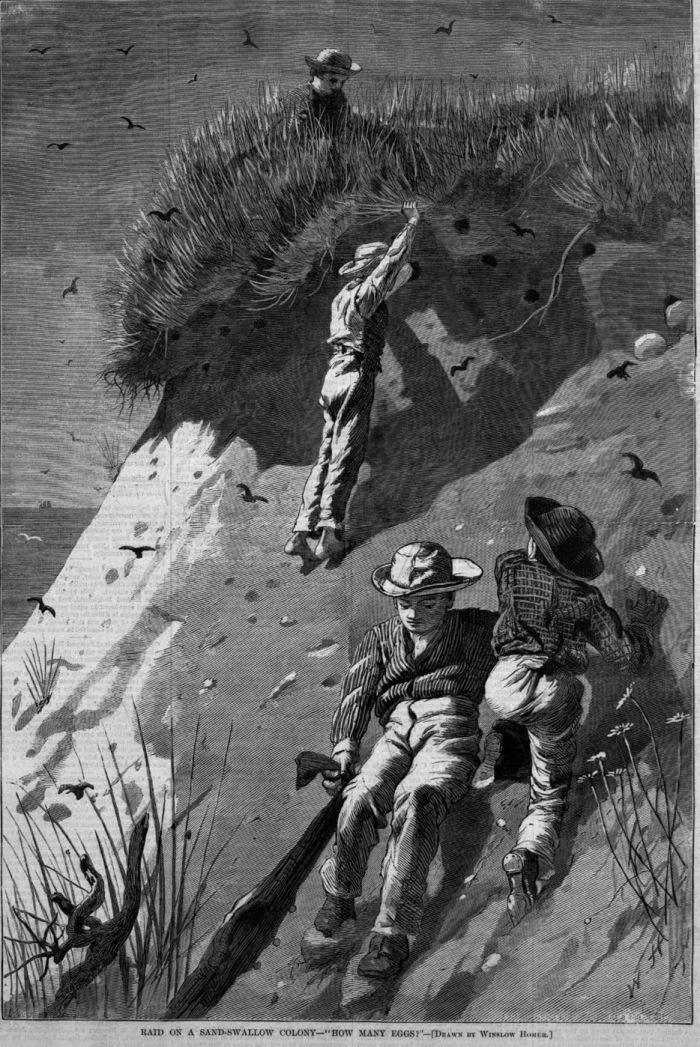
While reading The Narrow Edge, and looking at Kim Smith’s Piping Plover photographs, I thought about Raid on a Sand Swallow Colony (How Many Eggs?) 1873 by Homer and how some things change while much remains the same.When my sons were little, they were thrilled with the first 1/3 or so of Swiss Family Robinson.  As taken as they were with the family’s ingenuity, adventure, and tree house–they recoiled as page after page described a gorgeous new bird, promptly shot. They wouldn’t go for disturbing eggs in a wild habitat. The title ascribed to this Homer, perhaps the eager query from the clambering youngest boy, feels timeless. Was the boys’ precarious gathering sport, study, or food? What was common practice with swallows’ eggs in the 1860s and 70s? Homer’s birds are diminutive and active, but imprecise. Homer sometimes combined place, figures, subject and themes. One thing is clear: the composition, line and shadow are primed and effective for an engraving.


Homer watercolor 1873

Harper’s Weekly published the image on June 13, 1875. Artists often drew directly on the edge grain of boxwood and a master engraver (Lagrade in this case) removed the wood from pencil and wash lines.

Winslow Homer


2016. Wingaersheek dunes and nests 140+ years later.

20160703_053914-002

20160703_054035-001

Continue reading “Author Deborah Cramer asks were there plentiful horseshoe crabs in Gloucester? Leads to Winslow Homer, John Bell, and Cher Ami”

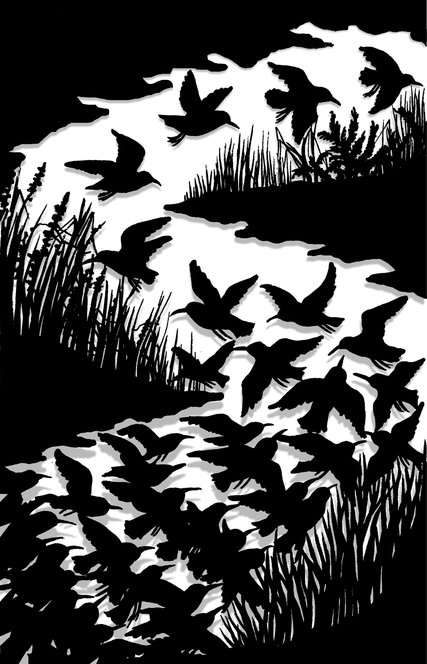
Deborah Cramer’s New York Times Op Ed: “Silent Seashores”

GLOUCESTER, Mass. — As the spring days lengthen, shorebirds have begun their hemispheric migrations from South America to nesting grounds in Canada’s northern spruce and pine forests and the icy Arctic.

They are among Earth’s longest long-distance fliers, traveling thousands of miles back and forth every year. I have watched them at various stops along their routes: calico-patterned ruddy turnstones flipping tiny rocks and seaweed to find periwinkles or mussels; a solitary whimbrel standing in the marsh grass, its long, curved beak poised to snatch a crab; a golden plover pausing on a mud flat, its plumage glowing in the afternoon sun.

I used to think that sandpipers flocking at the sea edge, scurrying before the waves, were an immutable part of the beach. No longer. This year, as the birds come north, one of them, the red knot — Calidris canutus rufa — will have acquired a new status. It is now listed as threatened under the federal Endangered Species Act. It joins four other shorebirds on the government’s list of threatened and endangered species.

Sadly, it is unlikely to be the last.

Read Deborah Cramer’s complete New York Times opinion editorial here: Silent Seahores
02Cramer-blog427

Deborah is the author of The Narrow Edge: A Tiny Bird, an Ancient Crab, and an Epic Journey, Yale University Press, 2015. Visit Deborah Cramer’s website here to order a copy.

TheNarrowEdge

 Advance Praise

“The Narrow Edge is at once an intimate portrait of the small red knot and a much larger exploration of our wondrous, imperiled world.”
Elizabeth Kolbert, author of The Sixth Extinction

“In the face of global warming, is our big brain connected to a big enough heart that we might preserve the beauty of the earth we were given? Heart is no problem for the red knot”
Bill McKibben, author of Eaarth

“I have a compass, GPS, and radio,” [Cramer] writes. “The birds have—what? By the end of this journey I am more in awe than when I began.” Follow her graceful writing for the full 9,500 miles and you will share in that awe.”
Laurence Marschall, Natural History

“A superbly written and gripping account…more thrilling than the Kentucky Derby.”
Thomas E. Lovejoy, National Geographic Conservation Fellow

“A book so multidimensional, yet somehow so admirably succinct, I wish I’d written it…”
Carl Safina, author of Beyond Words: What Animals Think and Feel

“Perhaps the red knot should replace the canary in the mine as the harbinger of impending changes that are good neither for birds or people . . . essential reading for anyone interested in conservation.”
Joel Greenberg, author of A Feathered River Across the Sky

“An eloquent exploration of our relationship to nature.”
Nancy Knowlton, author of Citizens of the Sea

“A remarkable tale of science, nature, and humanity.”
Susan Solomon, author of The Coldest March

“Cramer brilliantly presents us with an ecosystem of many parts.”
Don Kennedy, Pr


Thanks to Lise Breen for mentioning Deborah’s op ed piece and new book!