Quote of The Week- Elvis Costello Sent In By Greg Bover

“Writing about music is like dancing about architecture.”
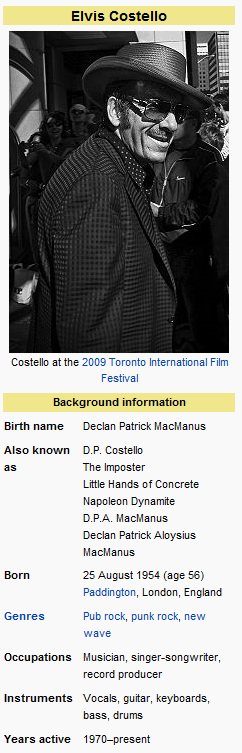
Declan Patrick McManus- aka Elvis Costello (1954-      )

Born in England to parents of Irish descent, Costello is known for the intelligent wordplay in the lyrics of his many hit records in pop and punk genres, such as “Watching the Detectives” and “Pump It Up.”  A musical omnivore, he has collaborated with other performers as diverse as Paul McCartney, George Jones and Burt Bacharach, acted in more than a dozen films, and scored several more.

Greg Bover

Click the picture for the Elvis Costello Wikipedia page

image

Keep Those Tight Calf Muscles Stretched Out!

Harmeling Physical Therapy Tip of the Month From Tom Faulds MSPT

A great way to help prevent many foot injuries is to keep your calf muscles flexible and stretched out. This is especially important for running athletes where you execute thousands of high impact strides in any given workout.

You have two calf muscles, the soleus and the gastrocnemius. These muscles attach to the back of the heel bone (aka the calcaneous) via the achilles tendon. When you walk or run these muscles contract with great power to propel you forward helping you push off on your toes.

Often when these muscles and the achilles tendon are tight, it can put extra stress on other areas of the foot. This can cause painful injuries such as Plantar Fasciitis and Achilles Tendinitis. 

So spend a minute or two twice a day stretching your calf muscles! This is especially important before and after exercise. The common runners stretches most of us know will do the job nicely; below are some pictures.

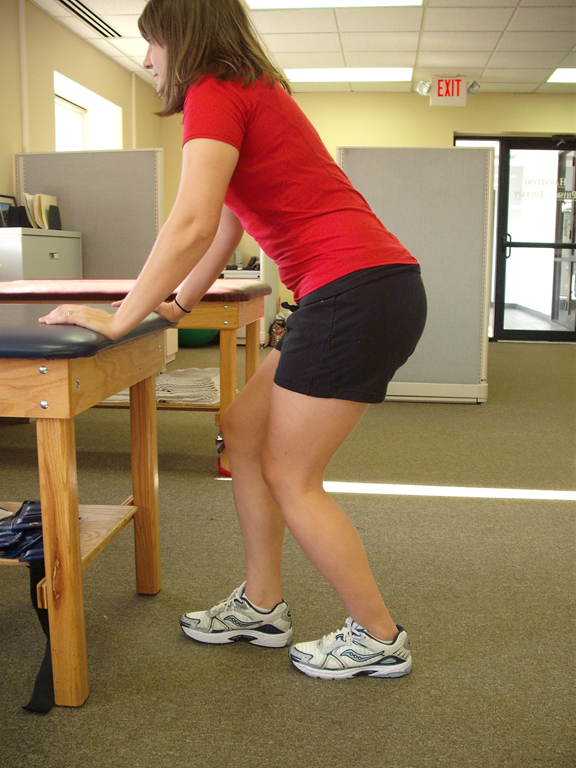
In the first, Kelly is stretching her back leg; her heel stays flat on the ground and her knee and leg are straight. She gently lunges forward until she feels a stretch in the gastrocnemius muscle in the upper calf of the back leg.

The second stretch starts in the same position but this time Nikita bends her knees and drops her butt straight down toward the floor. Keep that heel flat. You should feel this stretch at the base of the calf or in the second of your two calf muscles, the soleus. Hold these stretches for 20 – 30 seconds and repeat it 2 times each side.

To advance these 2 stretches you can put a small folded towel under the toes to create your own stretch board.

Happy Calf Stretching!

image

image

image

Harmeling Physical Therapy Tip of the Month

Now offering Free ACL screenings and Sports Injury Evaluations Every Monday Night in Our Gloucester Office, 8 Blackburn Center @ 6:30 pm. Call 978 283 0888 to find out more.

www.harmelingpt.com

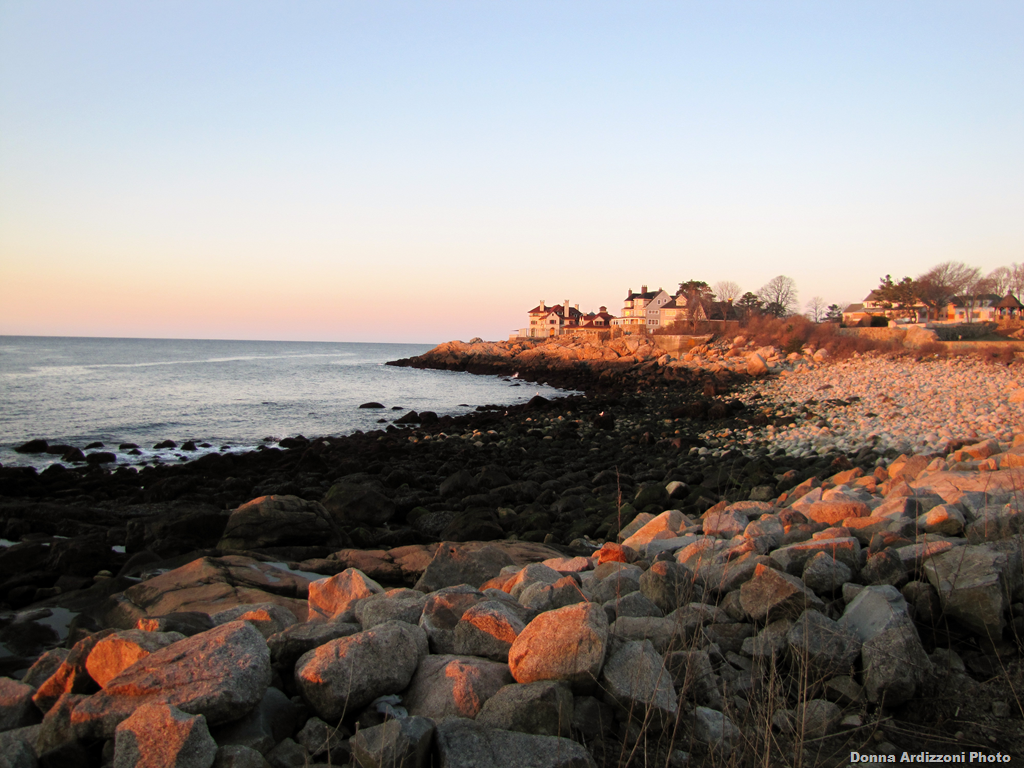
Did You Know? (Eastern Point Light)

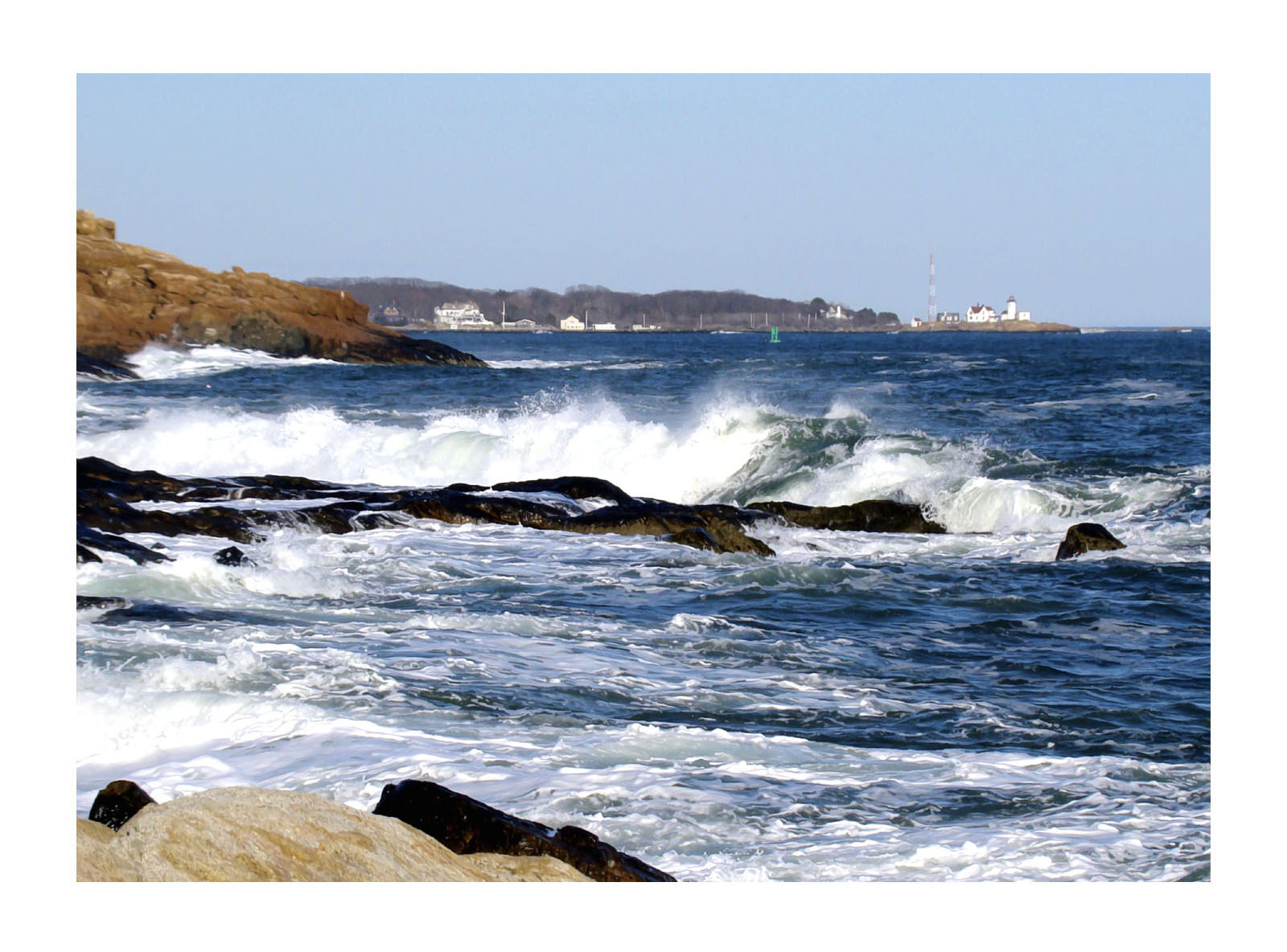
waves crashing on rocks of Magnolia with Eastern Point Light in the distance
Photo by E.J. Lefavour

That Eastern Point Light, a 30 foot high stone lighthouse erected at a cost of $2,450 to help fishermen and others entering Gloucester Harbor, was first lighted on January 1, 1832?  The new lighthouse’s ten lamps showed a fixed white light and were fueled by whale oil. The first keeper was Samuel Wonson, who was paid an annual salary of $400.

With the arrival of the railroad in Gloucester in 1847 the fishing business exploded into one of the world’s largest, and Eastern Point Light assumed new importance.

A whistling buoy was installed near Eastern Point in 1883 to provide additional warning and guidance to the harbor. Some of the summer residents objected to their summer quietude being shattered.

Because of the complaints of Elizabeth Stuart Phelps, a well-known local writer who claimed she suffered from a “nervous ailment,” the United States Secretary of the Navy ordered the buoy removed from May to October. Later Ms. Phelps was married to the Reverend Herbert Ward and the Boston Record reported, “Since her marriage Mrs. Ward is much better, and the officer who had to remove the buoy has put it back with the assurance that next summer he will have no orders to disturb it.”

The third and present Eastern Point Light was built in 1890 on the old foundation of the 1832 tower. The 36-foot brick lighthouse was attached to the keeper’s house by a covered walkway.

The station is closed to the public, but there is a parking lot nearby and the breakwater next to the lighthouse is open all year, with good views of the lighthouse. There are “private road” signs posted in the Eastern Point neighborhood, but visitors are permitted to drive to the lighthouse.  (http://www.lighthouse.cc/easternpoint/index.html)

This photo of Eastern Point Light was taken from the beautiful rocky shoreline of Magnolia.

I want to apologize to Joey and GMG readers for being so sketchy in my posts recently.  I am in the final push to get the Did You Know? book to the printer next week, so have been in the weeds a bit. 

E.J. Lefavour

www.khanstudiointernational.com

Karen Pischke Moonrise Photo 3/21/11

Hey Joey.

Here’s something for GMG.

(I am supposed to travel to Japan next week. If I do, I’ll be sure to take the GMG logo.)

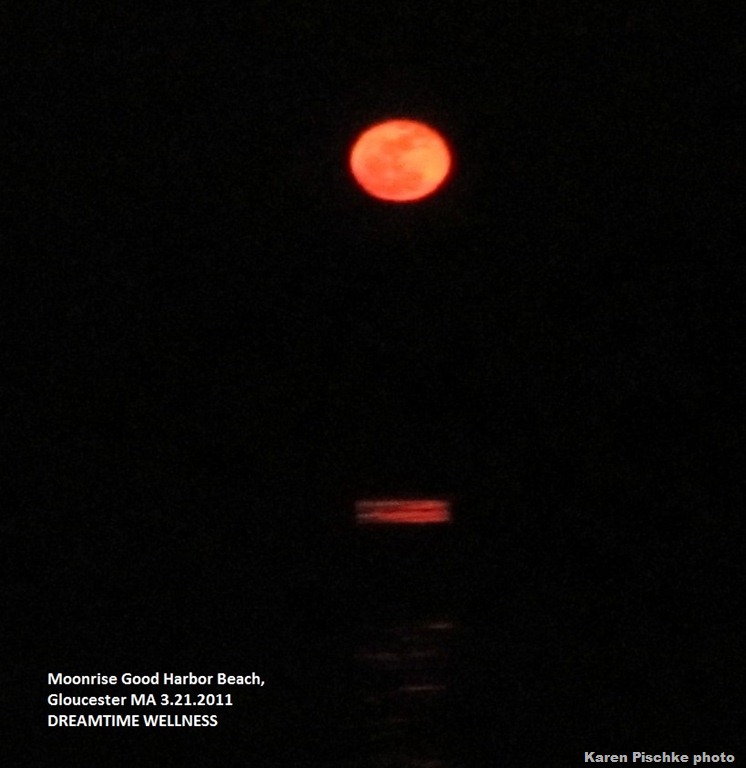
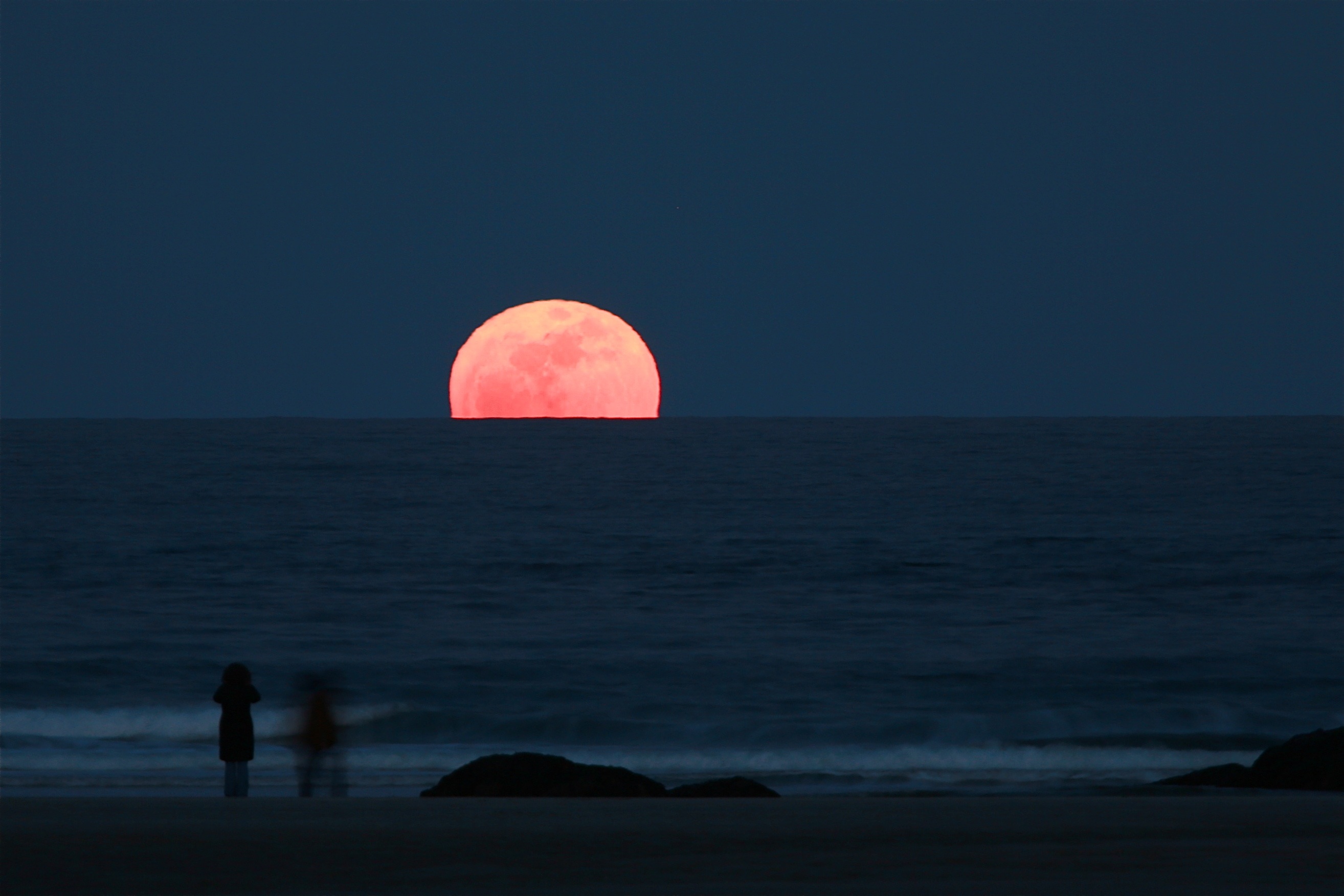
Photo: Moonrise 3.21.2011. As I watched last night’s moonrise I was reminded of a childhood song- “Let There Be Peace.” The lyrics are below. The moon reminded me of Japan’s flag. We ask people to continue to send healing thoughts, prayers, and relief to those affected by the latest natural disasters and political turmoil around the world. Together we can do so much more. Hoping for a more peaceful plant.    ~ Karen Pischke

New iPad Layout For Good Morning Gloucester

For those of you with iPads this is what your browsing experience will be on GMG. If browsing on an iPad, go ahead and click on the menu button in the top right corner and it separates the categories out nicely. It’s more of a magazine style layout. I like it!

http://www.goodmorninggloucester.com Do you get it?

WORM MOON over Good Harbor Beach Photos by David Cox

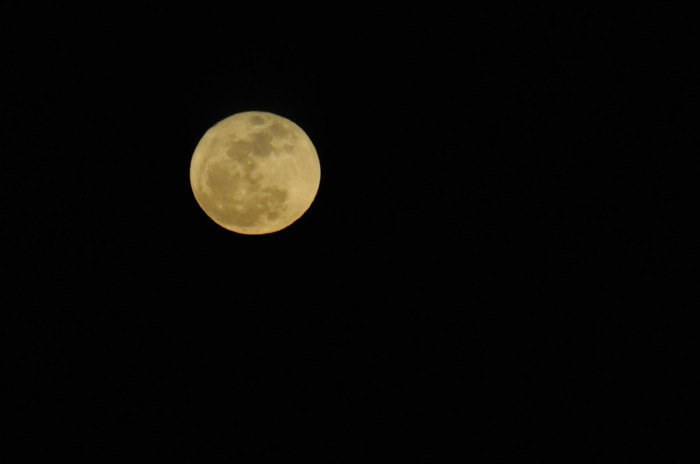
Photos were taken on March 18th and on March 19th – More than Two different Moon Rises.

Click on Photo below for Slide_Show

Click on photo for slide_show


Click on Photo to view slide_show

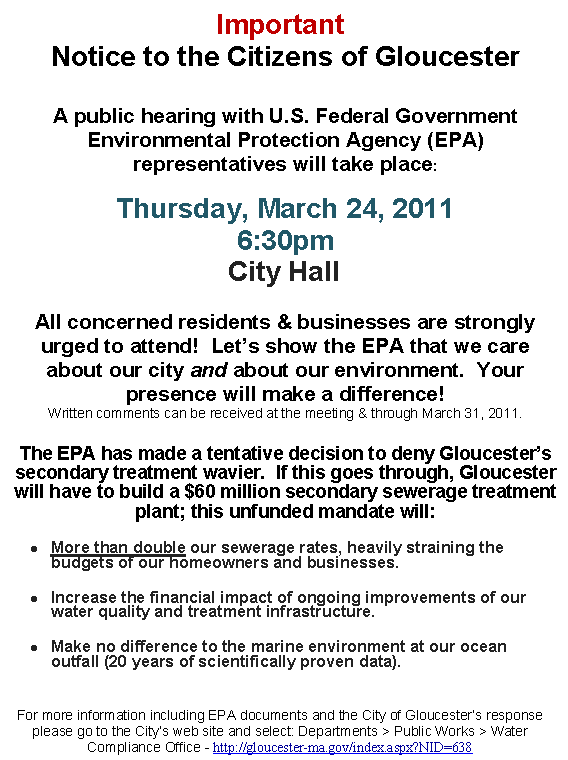
PUBLIC HEARING HOSTED BY THE EPA ON THEIR DENIAL OF A WAIVER FOR A SECONDARY TREATMENT FACILITY MARCH 24th

image

Notice to the Citizens of Gloucester

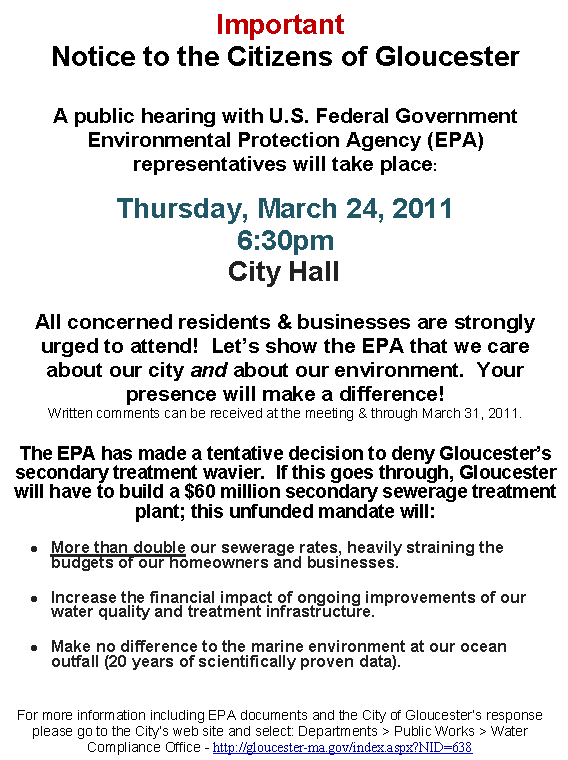
A public hearing with U.S. Federal Government Environmental Protection Agency (EPA) representatives will take place:

Thursday, March 24, 2011 6:30pm City Hall

Written comments can be received at the meeting.

The EPA has made a tentative decision to deny Gloucester’s secondary treatment wavier. If this goes through, Gloucester will have to build a $60 million secondary sewerage treatment plant; this unfunded mandate will:

· More than double our sewerage rates, heavily straining the budgets of our homeowners and businesses.

· Increase the financial impact of ongoing improvements of our water quality and treatment infrastructure.

· Make no difference to the marine environment at our ocean outfall (20 years of scientifically proven data).

For more information including EPA documents and the City of Gloucester’s response please go to the City’s web site and select: Departments > Public Works > Water Compliance Office – http://gloucester-ma.gov/index.aspx?NID=638

Background

Gloucester is one of 16 Cities and Towns in New England with an EPA 301(h) secondary treatment waiver.  Gloucester has been operating under this wavier since 1985.  The EPA has recently tentatively denied Gloucester’s renewal request of this wavier.  This decision has major economic implications for the City.

An explanation of each point follows:

· More than double our sewerage rate, heavily straining the budgets of our homeowners and businesses.

Estimates of the capital and operating expenses of a new secondary waste water treatment plant indicate that the facility will cost at least $60 million, not including land and other additional costs. Annual operations and maintenance will cost an additional $1 million per year.  There are currently no federal grants available for secondary treatment plant construction (as there were for all of the secondary plants built between 1972 and 1990).  The cost burden will, therefore, fall on Gloucester citizens and businesses.

This investment will more than double Gloucester’s sewerage rate (see table).  An increase of this magnitude will impact significantly citizens living on low or fixed incomes, especially those who are still paying betterment fees from previous sewer system upgrades. The average annualized rate will be about 5.4% of the Median Household Income in the City, almost three times the percentage that EPA itself considers a “very high” burden on residential customers in its guidance on affordability of sewer infrastructure improvements.

The current and projected sewerage rates and cost impact to the average homeowner, restaurant, and major water user are as follows:

Such increases could create a Domino effect by incentivizing large businesses (such as our hospital, nursing centers, and fish processors) to close or move away.  This, in turn, could raise our unemployment rate and further increase homeowner rates if the city’s operating and debt service burden is forced to shift from the current balance of commercial-industrial and residential taxpayers towards a higher percentage of the latter.

· Increase the financial impact of ongoing improvements of our water quality and treatment infrastructure.

The city of Gloucester has recently made several large investments to improve the city’s water infrastructure.  These include a total of $35 million on the combined sewerage overflow project (CSO) to separate storm water overflow from the sewer system, $15 million on our drinking water purification and distribution system, and $7 million on Phase I improvements to our waste water treatment plant.  An additional $13 million is already committed for Phase II waste water treatment plant improvements, slated to begin this year. The city is in the process of developing an over-arching Water System Master Plan to prioritize ongoing and planned improvements.

Without ongoing maintenance and investment, our water purification and long-neglected distribution infrastructure will inevitably suffer from continued problems and failures. Urgently needed improvements include: water pipe, pump and valve replacements; critical repairs to the Plum Cove tower and the Lanesville/Annisquam water distribution systems; generator repairs and failsafe mechanisms; dam repairs; reservoir aeration to reduce chemical usage; water conservation by recycling at the purification plants, and green energy investments. These projects will improve the quality of our drinking water and the reliability of our distribution system, but they will also result in higher water rates for our citizens.

Combined water and sewer rates, therefore, will be significantly higher than the basic sewerage rates mentioned above.  While some of these projects could be deferred, most will be unavoidable – and indeed, all are highly desirable.  Additional investments may be necessary if the EPA increases the stringency of regulations on storm water runoff for Massachusetts communities, as currently predicted.

· Make no difference to the marine environment at the ocean outfall.

The city of Gloucester is committed to preserving and protecting the ocean resources that have played a major role in its history, and which are a vital part of Gloucester’s identity.  This can be achieved, however, without the installation of a new secondary sewerage treatment plant. The EPA’s tentative decision to deny the city’s 301(h) wavier is based on sporadic failure to meet permit limits in three areas: oil and grease, fecal coliform bacteria, and effluent toxicity.  The facts are as follows:

For oil and grease, the few times when permit limits were exceeded were tightly correlated with street runoff during major storms.  Since major CSO improvements were completed in 2009, approximately 90% of storm water overflow to the sewers has been eliminated and there have been no further violations in this area.

The few isolated fecal coliform violations that occurred over the past two years were either due to equipment failure or operator errors at the treatment plant.  However, the city has recently made dramatic improvements to operations at the plant (now under operation and management contract with Veolia Water).  In any case, the daily maximum was only exceeded 6 times in the past 3 years and the monthly average limits were never exceeded.  As the ongoing improvements to our waste water treatment system are brought online, the probability of future violations in this area will be reduced significantly.

Gloucester’s primary treatment plant effluent sometimes fails a toxicity test in which juvenile fish and shrimp are exposed to treated water dilutions for a period of 48 hrs.  This test has proven to be very unreliable and is considered by many scientists to be of little value since the test conditions bear no resemblance to conditions in the real world. Furthermore, the results are highly inconsistent between different testing laboratories.

A systematic evaluation of the effluent has shown that ammonia is the primary cause of the toxicity, but secondary treatment does not remove ammonia. What then, is the purpose in building a $60 million secondary treatment plant?

The present ocean outfall for Gloucester’s treated water is located in a high energy marine environment with significant mixing and oxygenation levels.  The outfall is designed to provide instantaneous dilution and rapid diffusion of the treated water.  An extensive 20 year monitoring program (as required by the EPA) has been conducted in the waters and sediments around the outfall, and paid for by Gloucester citizens at $3.5 million. This study showed no change in the natural marine community in terms of species diversity or of accumulations of organics or other pollutants in the sediments. The EPA is implying the existence of damaging effects based on the results of an unreliable and artificial laboratory test.  However, this conclusion ignores 20 years of scientific monitoring involving thousands of individual tests, which show no impact on the marine community around the outfall (see Figures 1-3 below).  In fact, all federal and state water quality standards are met in the marine environment around the outfall.

The Water Advisory Team of Citizens; WATCH2O is a committee of five Gloucester Citizen Volunteers appointed by Mayor Kirk, who meet regularly with the City of Gloucester’s Environmental Engineer/Manager of the Water Compliance Office.  The committee became active in November 2010, and currently has Ad Hoc status.

The Mission of WATCH2O is to help manage, protect, improve and conserve the City of Gloucester’s water, watersheds, storm water, and waste water infrastructure.  WATCH2O works collaboratively with the city and Gloucester citizens to promote responsible stewardship of our water systems through communication, education, development and implementation of best management practices.

Disclaimer:  The information presented here is derived from documents available on the city’s web site or available elsewhere in the public record and do not represent the official position of the City of Gloucester.

Graphs and Pictures are in the Attachment

Fig 1. Effect of primary treatment on sensitive marine communities in terms of species abundance:  A. Improvement at the original Harbor outfall 5 years after initiation of primary treatment in 1985;   B. No change at the current Ocean outfall after 20 years of primary treatment discharge.

Fig 2. Outfall diffuser prior to installation.

Fig 3.  Location of ocean outfall (~1 mile beyond Dog Bar Breakwater).
Devoted Faces – St Joseph Feast 2011

The slideshow contains the many faces I encountered during St Joseph’s Feast.
Viva Jesus Maria and Guiseppe Viva !

Click on Photo below for Slideshow.

Click on Photo for Slide_Show

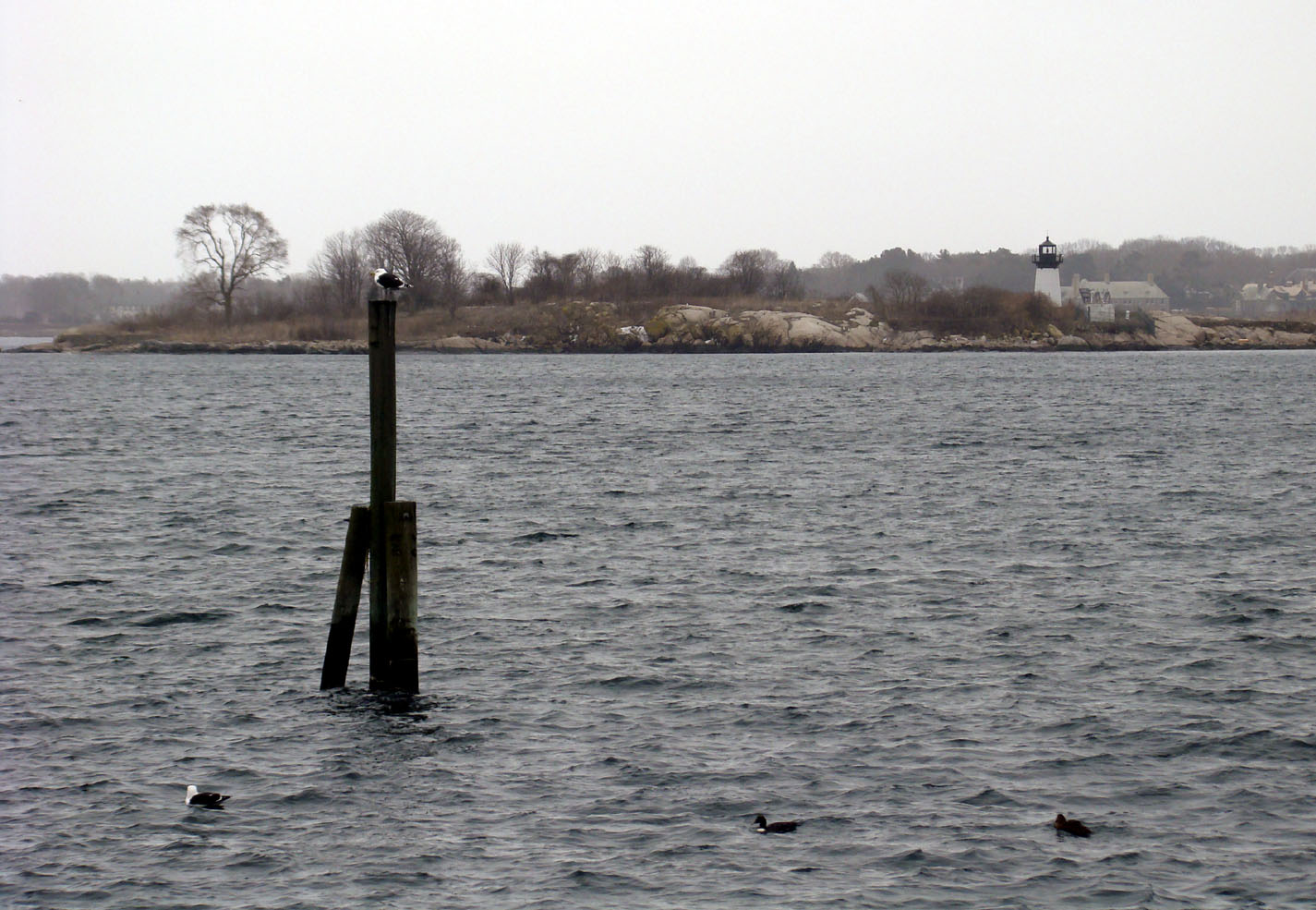
Did You Know? (Ten Pound Island)

Photo by E.J. Lefavour

That Ten Pound Island Light is an historic lighthouse in Gloucester Harbor that was built in 1881 and added to the National Register of Historic Places in 1988?  Common lore says Ten Pound Island got its name from the amount of money the local Indians received from the early settlers for the property. Cape Ann historian, Joseph Garland, believed it was more likely named for the number of sheep pens (also known as pounds) on the island.

The actual light is 30 feet high with a focal plane of 57 feet above Mean High Water.  The island is open to private boaters, but there is no landing facility except a small sandy beach. The lighthouse is not open to the public and is best seen by boat.  It is an active U.S. Coast Guard aid to navigation, with the grounds managed by the City of Gloucester.

E.J. Lefavour

http://www.khanstudiointernational.com/did%20you%20know%20book.htm

Scola Family St Joseph’s Novena 2011

Click the arrow below to play the video and listen to the wonderful stories.

Special Thanks To The Scola Family. Tomorrow’s video and pictures will be from the third stop on The Novena Tour- The Russo Family.

DSC03523DSC03526DSC03530DSC03531DSC03532

Ask Yourself: Is It Facebook-worthy?

Here’s a random post for you that doesn’t involve Rockport, festivals, home design, opossums, or any of my other favorite subjects for posting. It involves a question, one I have been pondering for quite some time now…

Why do so many people post about their family health issues on facebook? I’m not talking about using facebook as a convenient means of updating a whole bunch of people about an illness or accident. I mean updating everyone in your network with general musings about you and your offspring’s general state of health, usually a few minutes into your day.

A typical status update goes something like: “Feeling under the weather today. Hope I can get in to the doctor’s”.  Then, four hours later: “Feeling a little better. Took Tanner to his grandmother’s house and she gave me some Codeine she had left over from her last surgery. Yippee!”. Then, in another four hours: “Too sick to get up from the couch to make supper. Hope it’s just a 24-hour thing. Just grateful I managed to type in this status update with my aching flu-ridden fingers.”

I realize these examples are a little…over the top. And I realize I could just avoid reading these status updates, and I realize that one could question pretty much everything people choose to post on facebook. But — as far as I’m concerned anway — I understand updating people on major events, posting photos from the school concert, a vacation, et cetera. But providing all of your friends, family, colleagues, old boyfriends and that girl you knew for a few months in the 5th grade with a blow-by-blow account of your physical ups and downs — with a brief narration of taking your kids to the doctor thrown in for good measure? This something outside my range of comprehension. Which might speak to my limitations, and, if so, I’m sorry, facebook friends. I will try to be more sympathetic.

And on that note, I thought I’d let all the readers of GMG know that I’m sort of feeling like I have a cold coming on. I’ll let you know how it goes.

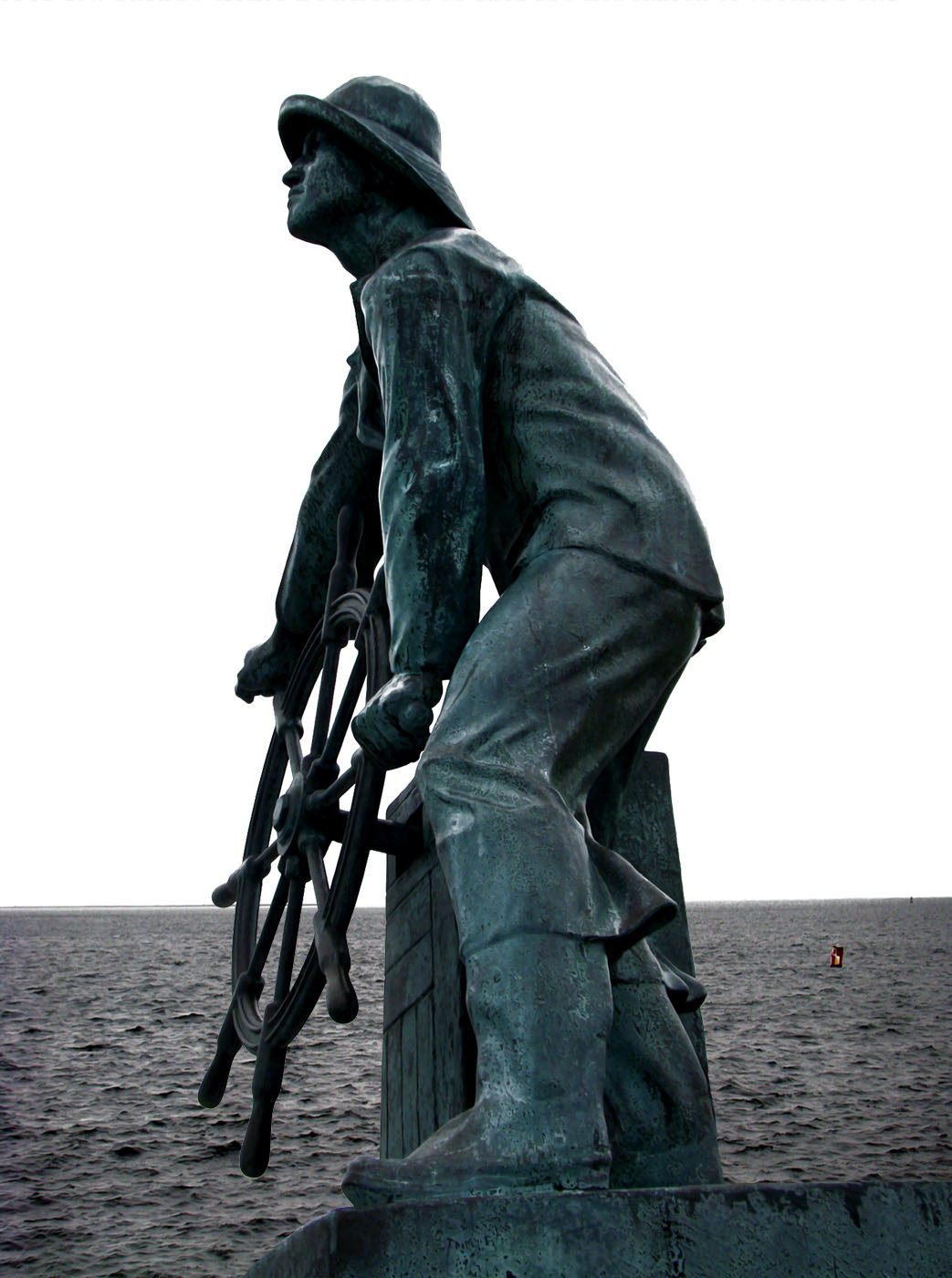
Did You Know? (Gloucester Fisherman’s Memorial)

Gloucester Fishserman's Memorial, also know as the Man at the Wheel
Photo Composite by E.J. Lefavour

That the Gloucester Fisherman’s Memorial (also known as the Man at the Wheel statue) is a tribute to the more than 10,000 Gloucester fishermen who have lost their lives at sea over the centuries and a reminder that fishing is our country’s most dangerous occupation? The statue is the work of sculptor Leonard Craske (1877-1951) and is based on a 1901 painting by Gloucester artist A.W. Buhler.  It is an 8-foot-tall bronze statue positioned so that the fisherman is looking out over Gloucester Harbor. The fisherman in the sculpture was modeled after Capt. Clayton Morrissey, a prominent Gloucester fisherman, once the captain of the Effie M. Morrissey.  A small plaque on the north or street-facing side of the base reads, “Memorial To The Gloucester Fisherman, August 23, 1923.” A larger recessed panel on the harbor-facing side of the base holds an inscription of bronze letters taken from the Bible’s Psalm 107:23, which reads: “They That Go Down To The Sea In Ships 1623-1923.”

I know that everyone in Gloucester knows this, but there may be some GMG readers out there that don’t.

E.J. Lefavour

http://www.khanstudiointernational.com/did%20you%20know%20book.htm

Honky Tonk Women of Gloucester back on stage ~ Saturday ~ March 26, 2011

The Honky Tonk Women of Gloucester will revisit the “golden oldies” era singing the songs of the Shirelles, the Ronettes, the Crystals, the Everly Brothers, the Angels, the Cookies, Brenda Lee, Doris Day, Patsy Cline, Connie Francis, the McGuire Sisters,  Patti Page, the MaMa’s & The PaPa’s, the Fleetwoods and more.

Everyone takes at turn at singing the lead, the back-up and the harmony vocals.  Sheila Schrank is the fingerstyle guitarist and arranger for the group.  Elaine “Patsy Cline” Persons  also stylizes the late Roy Orbison’s works. Barbara Jansson  plays the harmonica on several songs and  Caroline Haines also sings with the popular acappella group, Leven.   Each vocalist crafts their song with harmony and movement to guide you through a  “sentimental journey” in remembering when…..

There is  plenty of seating and every seat is a “good one” with a clear, unobstructed view.  Doors open just before  7:00 pm.  Seating will be on a “first come” basis, however, reservations can be made by contacting 978-281-3451 (days) or 978-337-2568 (eve.)  and by e-mail at dancerecp1@yahoo.com or sheilannjones@hotmail.com.  $12 for adults/$5 for children 11 and under. The First Rockport Unitarian Universalist chuch is located on

Rockport – 4 Cleaves St.


Doo Wop Coffeehouse-1st UU Church.

Johann Wolfgang von Goethe -Quote of The Week From Greg Bover

“Be bold and mighty forces will come to your aid.”
Johann Wolfgang von Goethe  (1749-1832)

Often cited as the one of the most brilliant men of his time, Goethe excelled in literature, philosophy and science. Although best know for his seminal poem “Faust,” which tells the story of a man who sells his soul to the devil, Goethe made significant contributions to the theories of both evolution and the perception of color. Politically conservative in an age of revolution, he was a principal advisor to the Grand Duke of Saxe-Weimar. Goethe’s affect on early Romanticism and Humanism is hard to overstate.  

Click the pic for his wikipedia page-

image

Chickity Check It- Lauren’s Thoughts and Poetry

Our buddy and lobsterman Chris Orsillo AKA “Trapper” asked if I would pass along a link to his friend’s Poetry Blog.

here you go-

Lauren’s Thoughts and Poetry

Just a spot to share my thoughts and some poetry I have written over the years!

Empty Nest Syndrome

Did You Know? (Hasty’s Frogs)

Photo by E.J. Lefavour

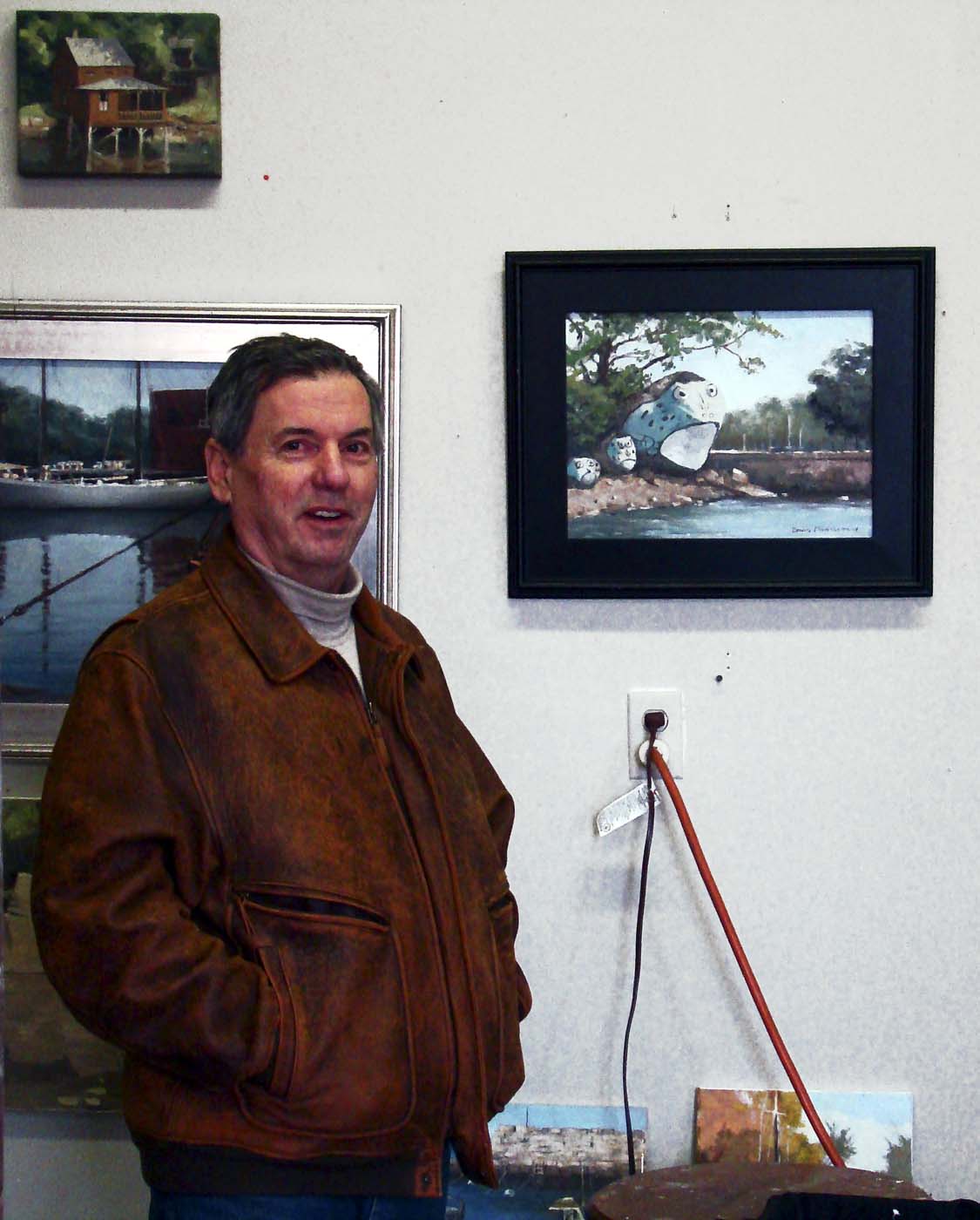
That there are rocks painted to look like frogs in Riverview on the Annisquam River?  They were painted by an unknown artist in the 1930’s on the property of Hasty Gammage, and are still there; but you can only see them by boat.  This is a painting of Hasty’s Frogs by David Montgomery.  Have any of you ever seen them?

E.J. Lefavour

www.khanstudiointernational.com