I pray you are blessed, built up in your faith and Christian walk, and become an interactive participant in God's Morning. We are here as Christ's body, supporting and building each other up in all righteousness, in His name, awaiting His soon return. Maranatha!
That Bearskin Neck was named by fishermen who saw the bearskin Ebenezer Babson had left to dry on the rocks?
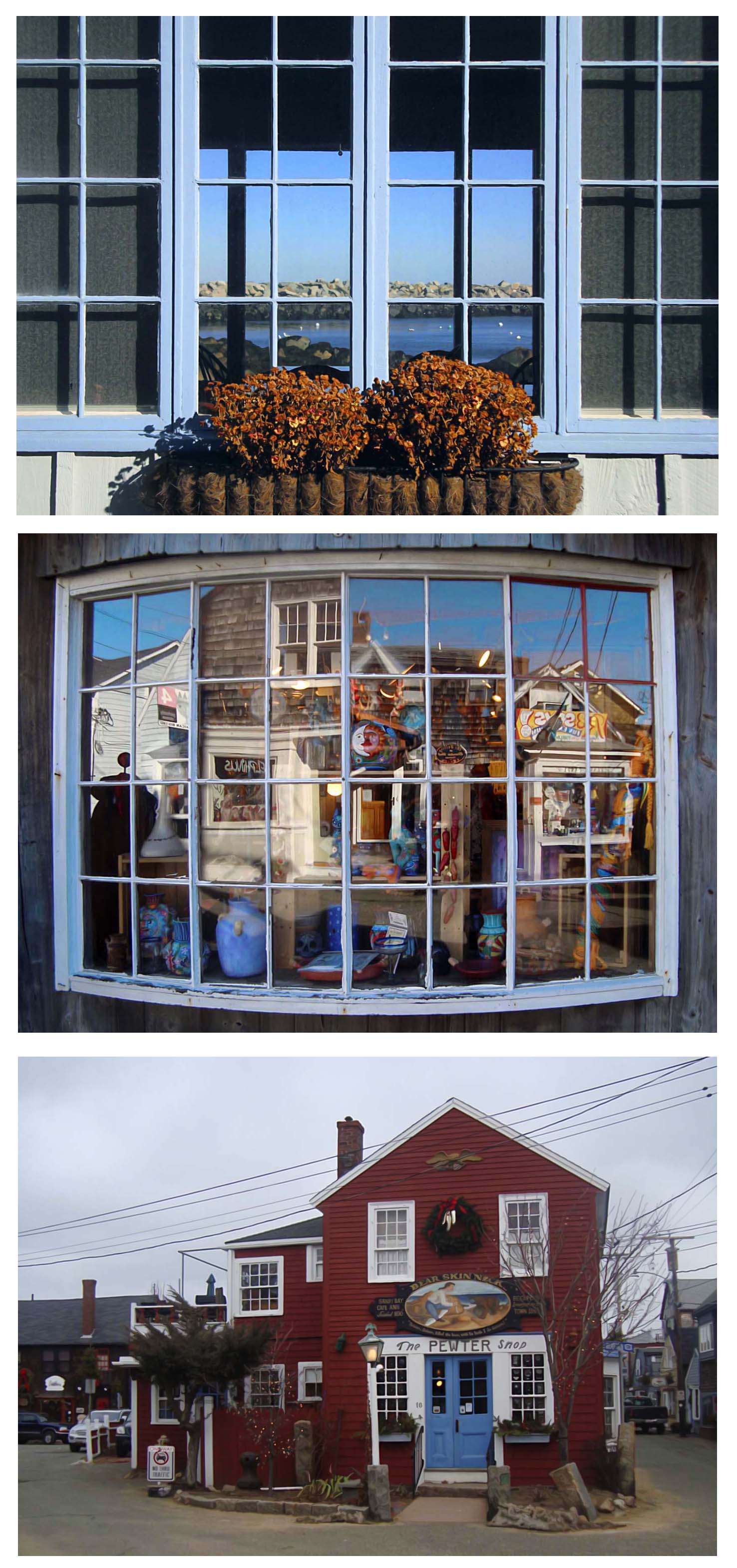
Roger W. Babson in his Story of Bear Skin Neck puts it as follows: “…Ebenezer Babson, who then resided at the Farms, saw the bear attack the boy [his nephew, Henry Witham]. He immediately attacked the bear to get his attention away from the child, but having no gun he permitted the bear to follow him into the water. There, after a terrific struggle, Ebenezer killed the bear with a fish knife.” (As depicted in the sign over the front door of The Pewter Shop.)
The story is continued by George Jay Babson: “He then brought the bear onto the shore, skinned him, and spread the skin on the rocks to dry. Ebenezer died shortly afterwards, presumably at sea, but his nephew Henry Witham, whose life he saved, lived to a ripe old age. Naturally, he often told the story of his rescue, and when people asked how Ebenezer killed the bear, he would reply: ‘With his knife, I do declare.'”
And hence the little ditty: “Babson, Babson, killed a bear, With his knife, I do declare.”
From John J. Babson, History of the Town of Gloucester Cape Ann Including the Town of Rockport (Massachusetts: Proctor Brothers, 1860) and The Witham Family History
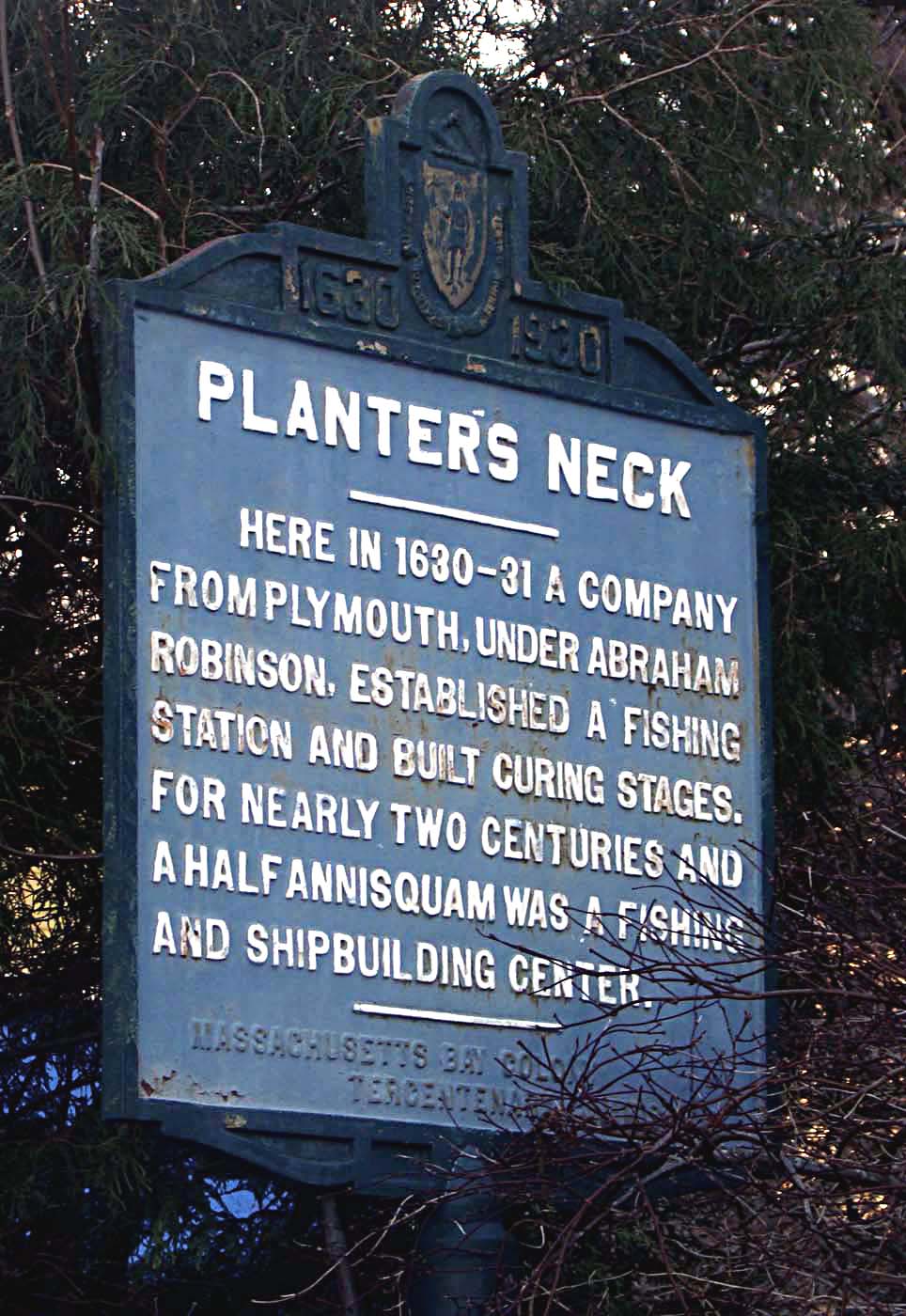
That Planters Neck is the peninsula portion of Annisquam, west of Lobster Cove, with convenient access to Mill River (which was impounded in the 17th century to provide the first water power for milling corn), the Annisquam River and Ipswich Bay? It was divided up into house lots by the early settlers, or planters. Copeland and Rogers write that: “One of the generally accepted stories about the early settlement of the Cape is that in 1631 a band of Pilgrims came across Massachusetts Bay and settled at Planters Neck, where they set up a fishing stage. The leader of that band is said to have been Abraham Robinson, and it also has been generally accepted that he was the son of Reverend John Robinson who had been pastor of the Pilgrims in Holland before they migrated to Plymouth.
This is a photo of the plaque at Planters Neck from 1930, acknowledging its tercentennial.
(edited excerpt from A Guide to The Maximus Poems of Charles Olson by George F. Butterick)
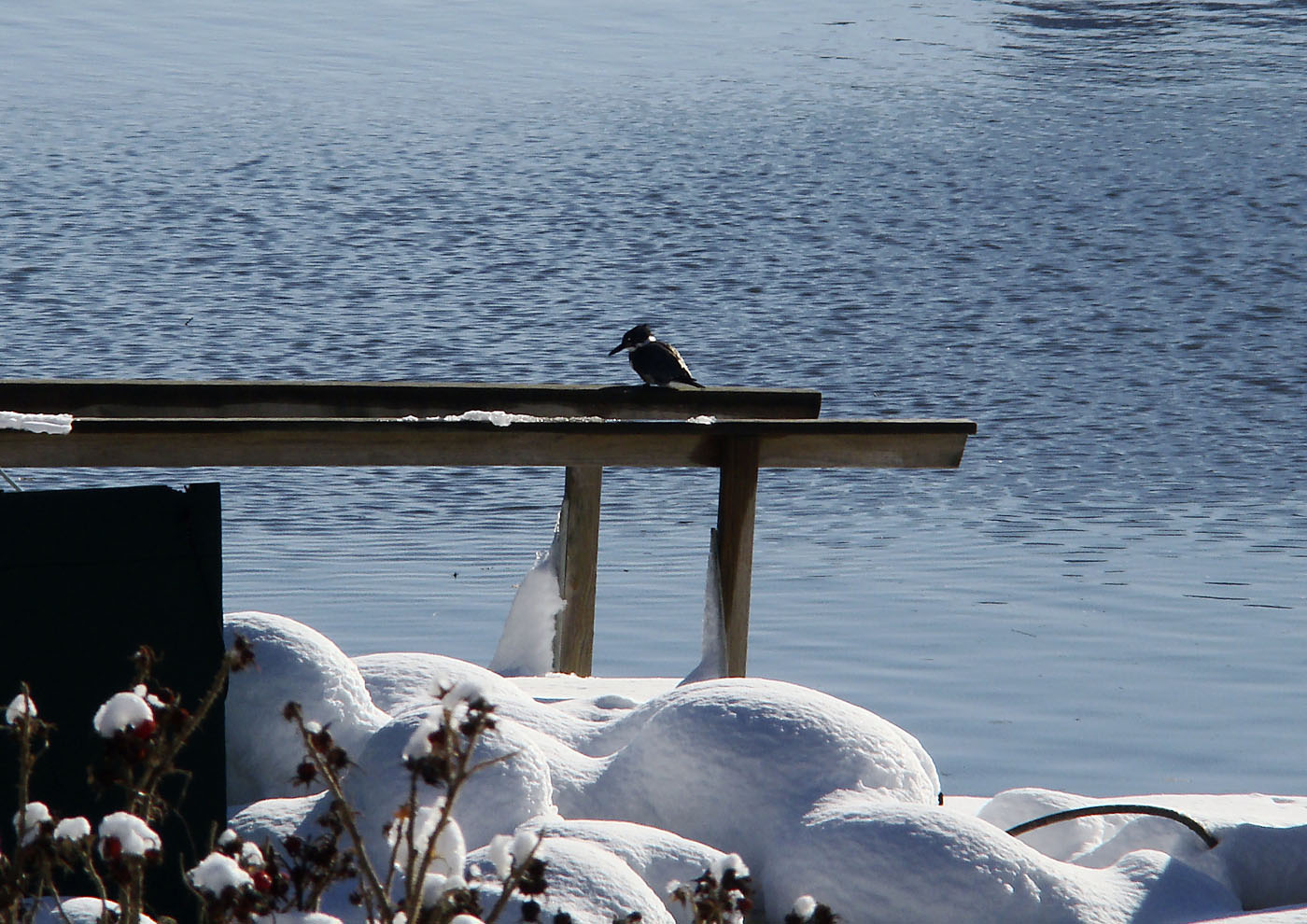
That the Belted Kingfisher is a common waterside resident throughout North America, often seen hovering before it plunges headfirst into water to catch a fish. It frequently announces its presence by its loud rattling cry. It is a medium-sized bird with a large head and shaggy crest, large, thick bill, bluish head and back, white throat and collar, white underneath with blue breast band.
I have seldom seen one sitting quietly like this, and generally only know one is around when I hear its raucous cry and then see it flying by or diving into the water.
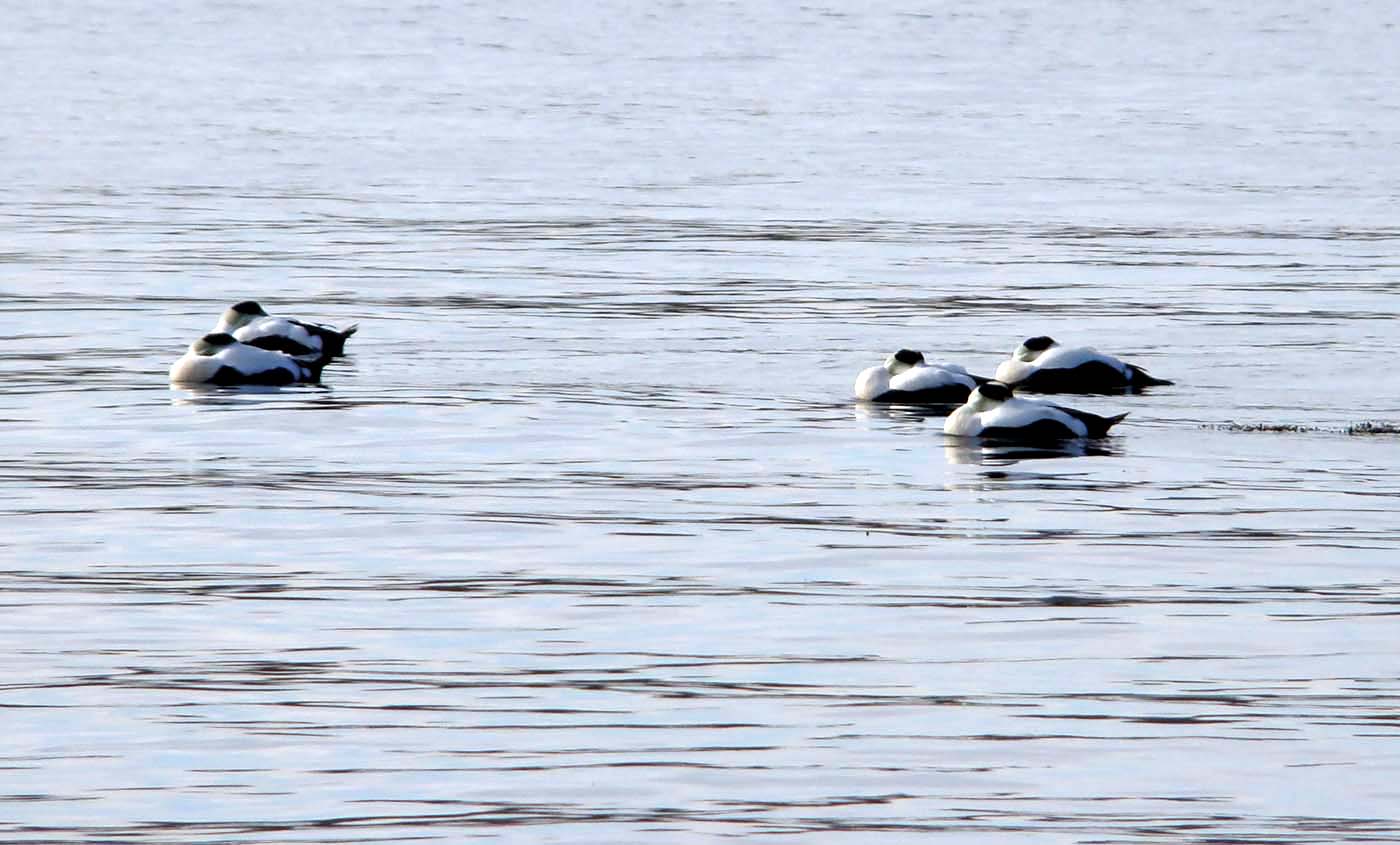
That the Common Eider is the largest duck in the Northern Hemisphere? The male’s bright white, black, and green plumage contrasts markedly with the female’s camouflaging dull striped brown.
Mother Common Eiders lead their young to water, and often are accompanied by nonbreeding hens that participate in chick protection. Broods often come together to form “crèches” of a few to over 150 ducklings. Attacks by predators may cause several broods to cluster together into a crèche. Once formed, a crèche tends to stay together throughout the brood rearing period, although some of the different females attending it may leave.
This raft of male eiders all have their beaks tucked under their wings, as it was bitterly cold and windy.
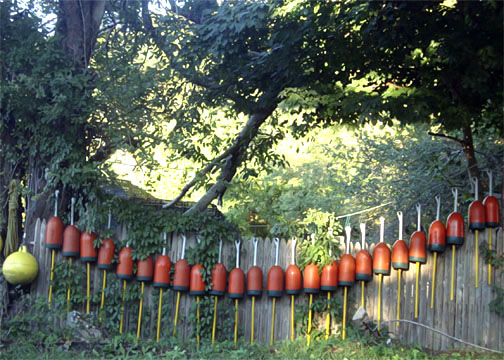
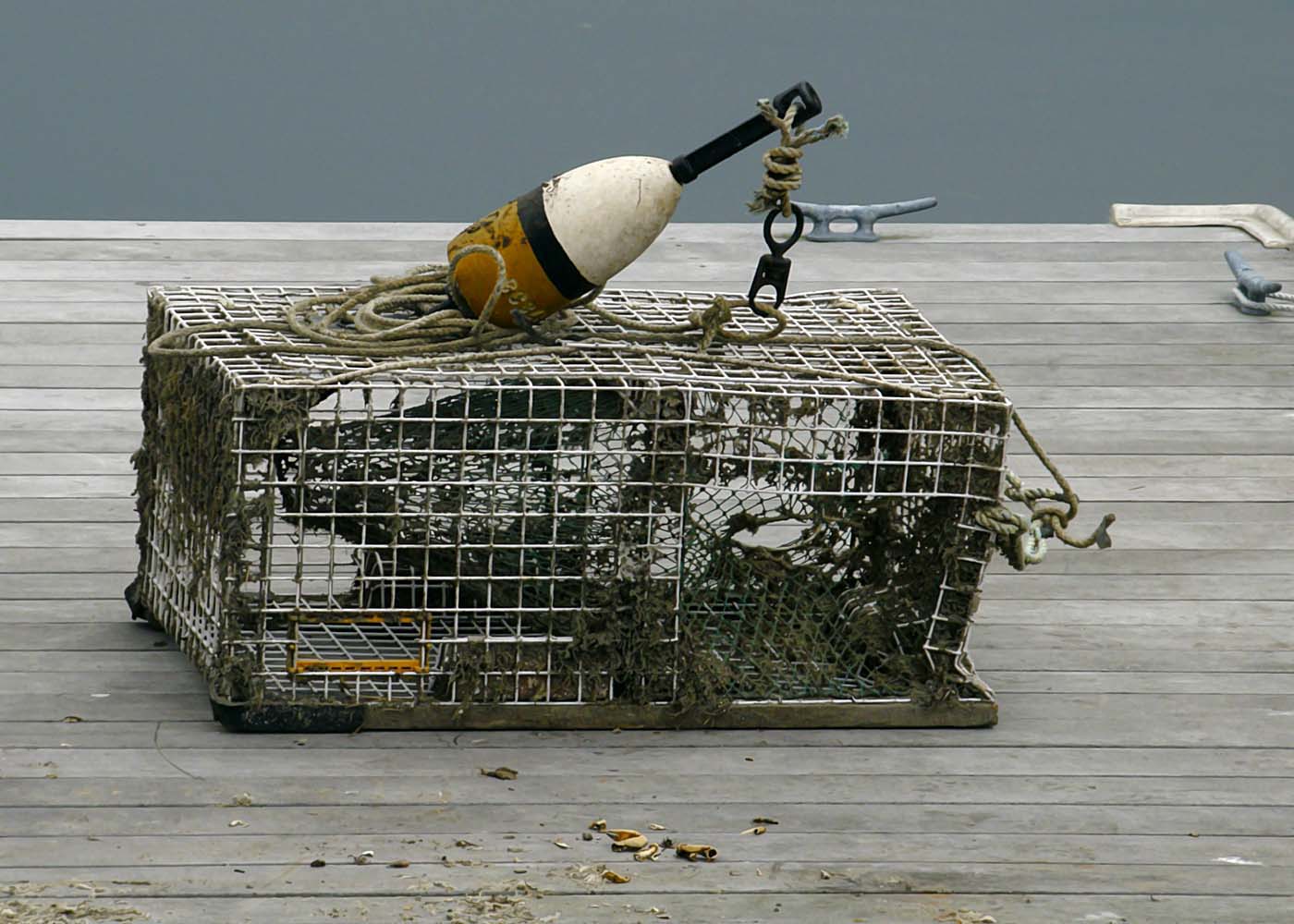
That a buoy is a floating device that can have many different purposes? It can be anchored (stationary) or allowed to drift. Some types of buoys are: sea mark (channel and hazard markers), lifebuoy (in case you fall off the boat), decompression (deployed by submerged divers to mark their position underwater while doing decompression stops), mooring (to tie your boat to), and lobster trap.
Lobster trap buoys are brightly colored buoys used for the marking of lobster trap locations so lobstermen can find their lobster traps? Each lobster fisherman has his or her own color markings or registration numbers so they know which ones are theirs. They are only allowed to haul their own traps and must display their buoy color or license number on their boat so law enforcement officials know what they should be hauling. The buoys are brightly colored with highly visible numbers so they can be seen under conditions when there is poor visibility like rain, fog, sea smoke, etc.
The word buoy can also be used figuratively. For example, a person can buoy (lift up) someone’s spirits by providing help, empathy, or an enjoyable GMG post. Hope your spirits were buoyed today by this orange toothed buoy smile.
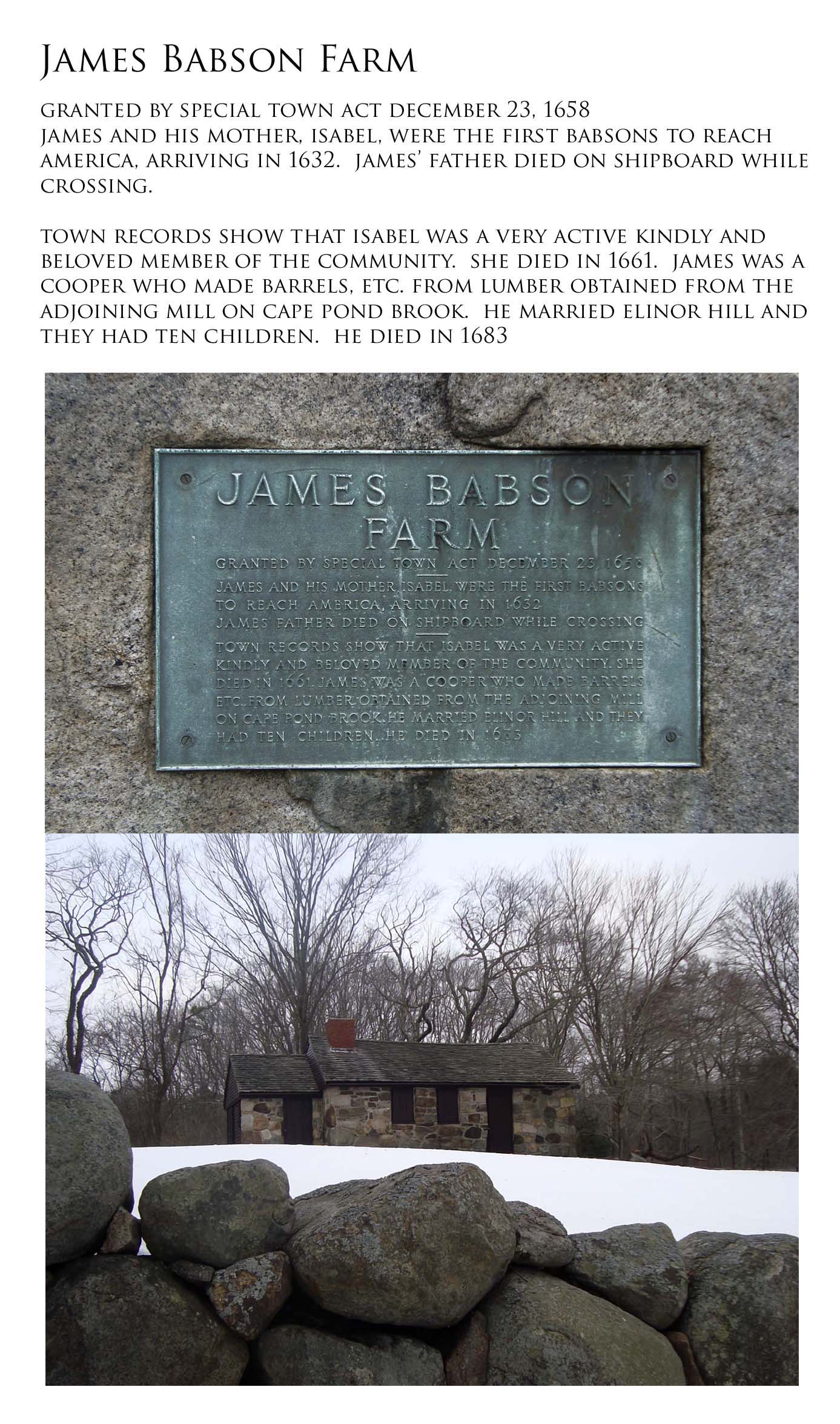
That on the 28th of December 1658 James was granted “twelve acres of fresh meadow [at Beaver Dam] lying above the Mill, also twenty acres of upland lying by the side of it”? (Gloucester Town Records 1: 71) This was where he and his wife settled and was known as the James Babson farm. It was here that he built the little stone cooperage shop, still standing today and open to visitors every summer. The barrels he made here were taken to Good Harbor Beach, filled with fish and shipped to England, the West Indies, etc. Roger W. Babson’s research indicated that James Babson’s stone shop was the first factory on Cape Ann.
From genealogy.com
E.J. Lefavour http://www.khanstudiointernational.com
Photos by E.J. Lefavour
Spread The GMG Love By Sharing With These Buttons:
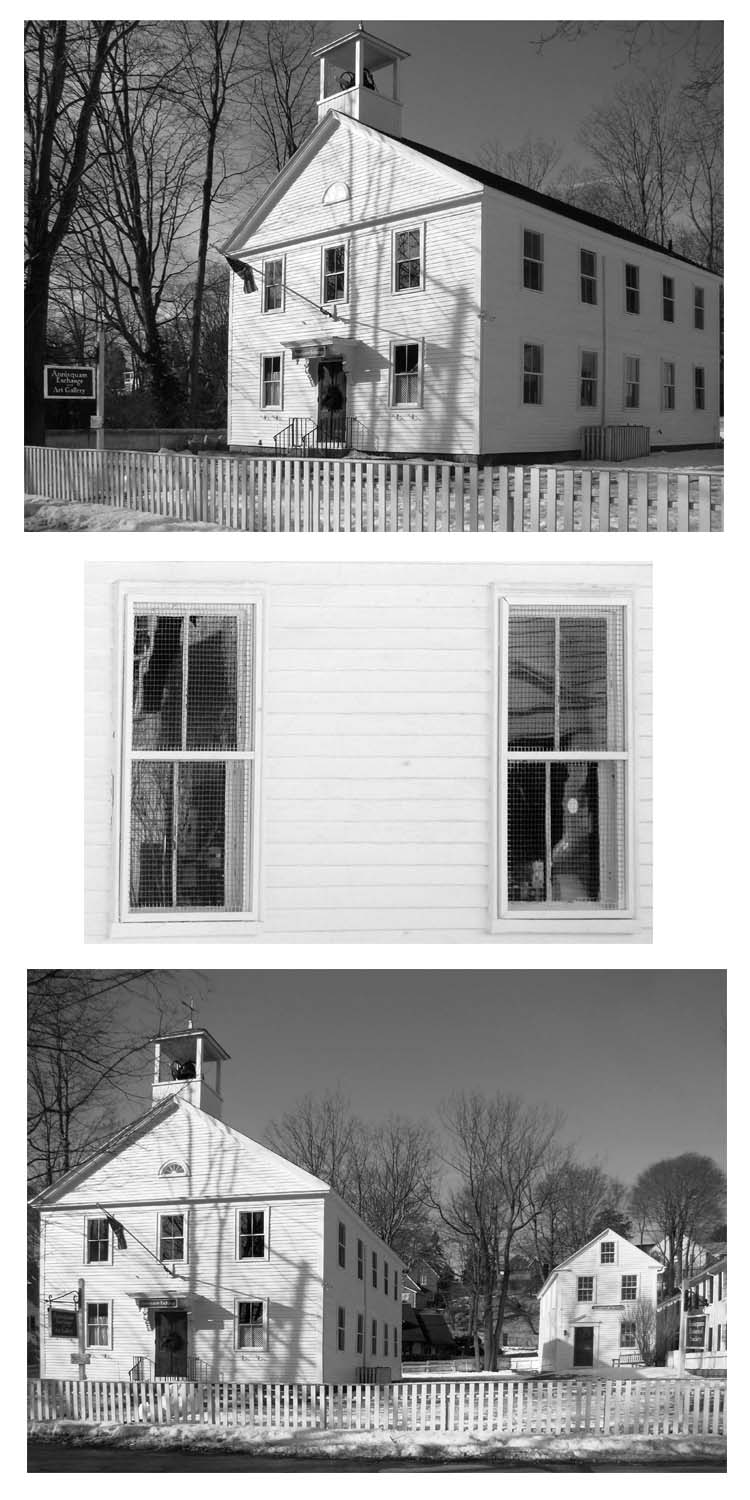
That The Annisquam Exchange has served the community for over 66 years by donating its profits for the maintenance of the historic buildings of the village: Village Hall, Village Church, Leonard School, Library and Firehouse? The Exchange also supports the Good Neighbors Program and the village’s Mt. Adnah Cemetery. The Exchange is a wonderful consignment shop that sells jewelry, both costume and designer, antiques and collectibles, small furniture pieces, lamps, linens, china, clocks, cards, prints and paintings. On the second floor above the Exchange is the Art Gallery. In addition to the permanent exhibition, there are two group exhibitions by local artists in the main gallery. The small gallery hosts two special exhibits of local artists. The Gallery and Exchange are Open May 1st through October 16th. Annisquam is one of the oldest and best-preserved villages in Gloucester. The Annisquam Exchange was established to insure that the history, architecture, art and community of Annisquam be preserved for future generations. The Exchange began in the old Firehouse, which is now the Historical Society Museum for the preservation of Annisquam’s 380 year-old history. You can learn more about The Exchange by visiting their website at http://annisquamexchange.com/AnnisquamExchange/Annisquam_Exchange.html
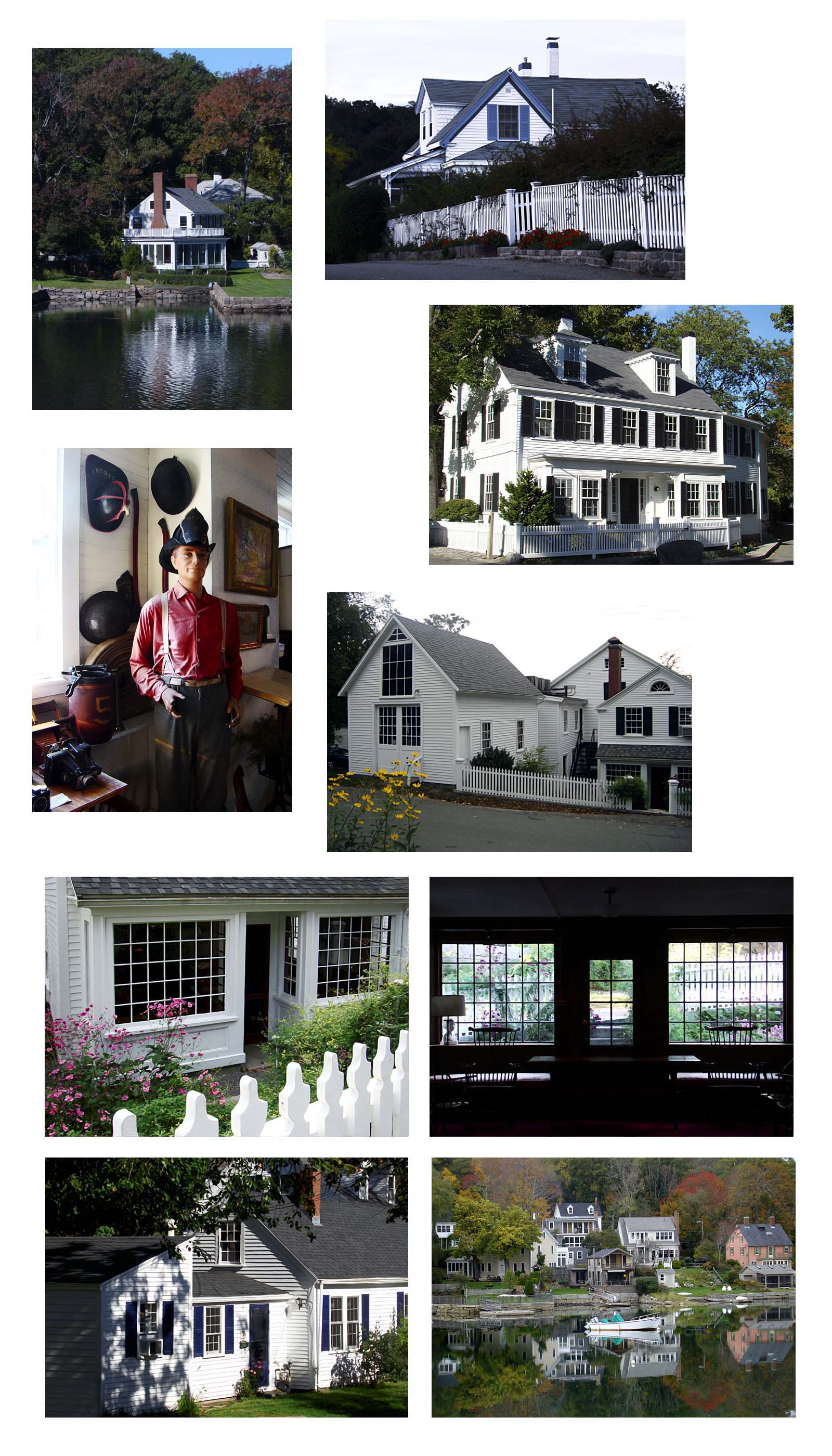
The Exchange moved to its present location in the historic Leonard School in the mid 1940’s. My neighbor, Sarah Hackett, attended the first through fourth grades at the Leonard School in the early 1930’s. These four grades were taught in the single room on the ground floor, and her class consisted of 8 students. Her mother was also a teacher at the school when she was a young woman. Once she married though, she was required to quit teaching, as married women were not allowed to teach in those days. The wire mesh on the windows was installed to keep them from being broken by fly balls of children playing on the green during recess. There is similar mesh on the inside of the windows for the same purpose, when weather was inclement and the children stayed inside to play. The school, as well as Leonard Street, was named after Father Ezra Leonard (remember him from the Annisquam Village Church post?).
The school was built in 1834 – the land and building cost $840. In 1836, William Young was paid a salary of $16 for teaching at the school; Samuel Young was paid $87.75 for teaching and supplying wood to heat the school. (From Gloucester Record of School Buildings and Selectmen’s Records of Payments, researched and provided by Katherine Groves of Gloucester.)
The top photo is of the Annisquam Exchange/Leonard School. The middle photo is of the mesh windows. The 3rd photo is of the Exchange and the Historical Society (old firehouse) to the right of it.
That en plein air is a French expression which means “in the open air”, and is particularly used to describe the act of painting outdoors?
Artists have long painted outdoors, but in the mid-19th century working in natural light became particularly important to the Barbizon school and Impressionism. The popularity of painting en plein air increased in the 1870s with the introduction of paints in tubes. Previously, each painter made their own paints by grinding and mixing dry pigment powders with linseed oil. It was during this period that the “Box Easel”, typically known as the French Easel, was invented. It is uncertain who developed it first, but these highly portable easels, with telescopic legs and built-in paint box and palette, made treks into the forest and up the hillsides less onerous. Still made today, they remain a popular choice even for home use since they fold up to the size of a brief case and thus are easy to store. One popular version is named the Jullian easel, designed by Roger Jullian, a French prisoner of war during World War II, who devoted himself to designing and later manufacturing the perfect sketch box easel.
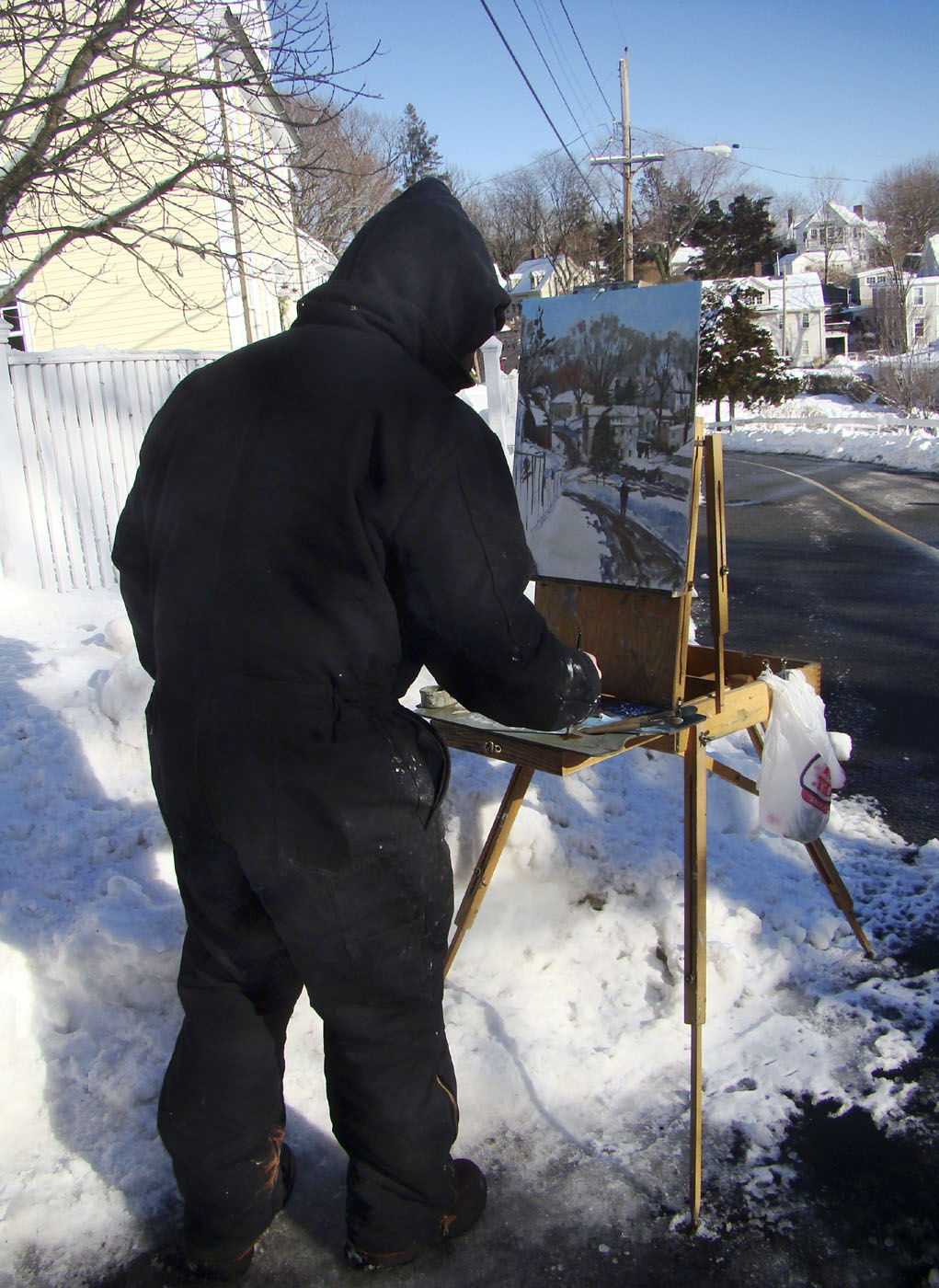
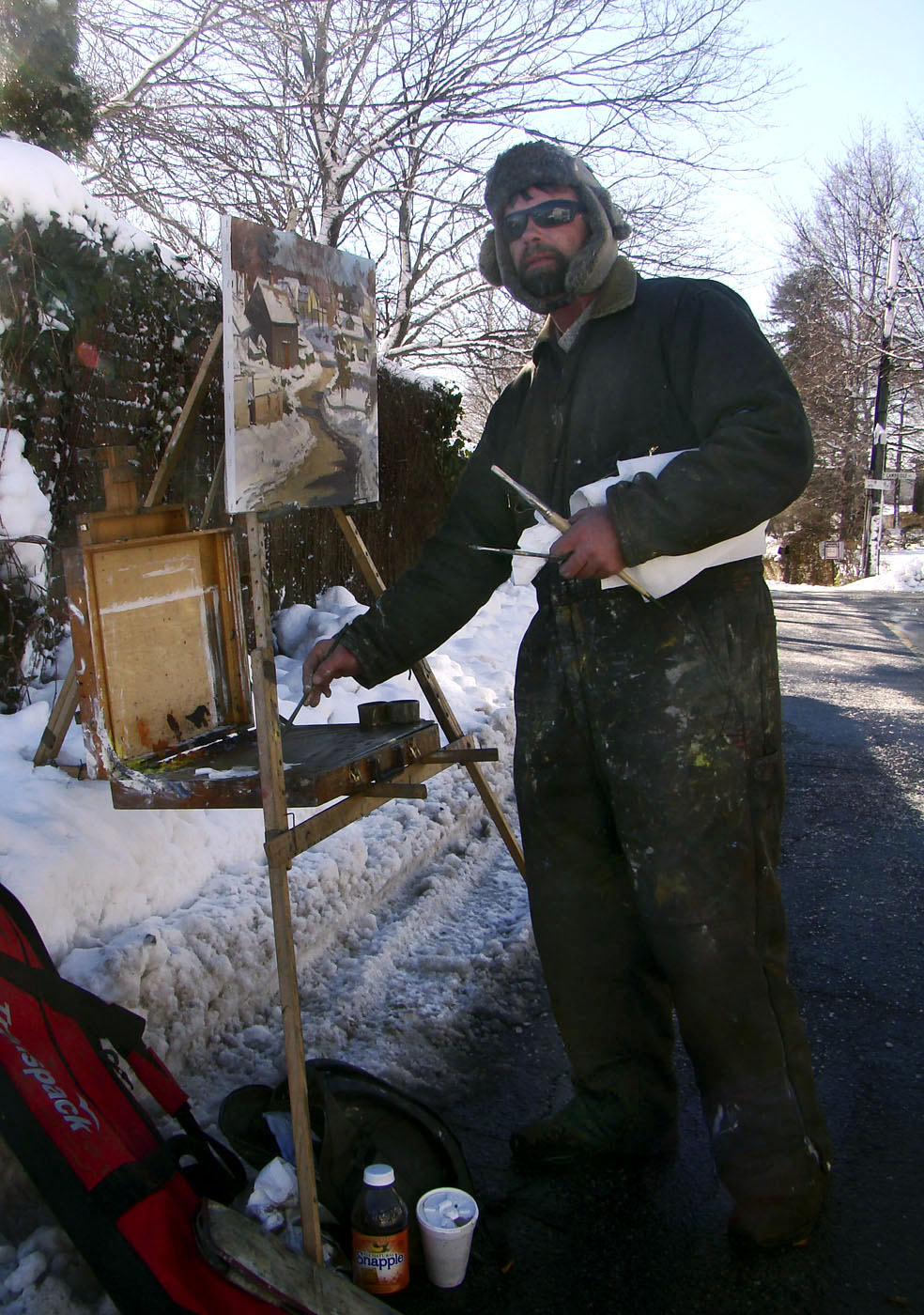
While walking around Annisquam the day after the storm, I encountered these two artists painting en plein air, and it was a very chilly plein air at that. Each was painting their view of the Village from opposite sides of the end of Leonard Street. Chris Coyne (first picture), really impressed me by having included me in his painting by the time I reached the top of the rise where they were set up. Chris has a gallery at 37 Bearskin Neck, called Chris Coyne Fine Art www.coynefineart.com. The second artist is Caleb Stone of Ipswich. Caleb’s website is http://calebstoneart.com. Both are very accomplished artists, and it was nice to meet them and impressive to watch them work in the bitter cold with no gloves on. Personally, I’m a wimpy studio painter and you’d never catch me outside painting in the cold like that. These guys are hardcore.
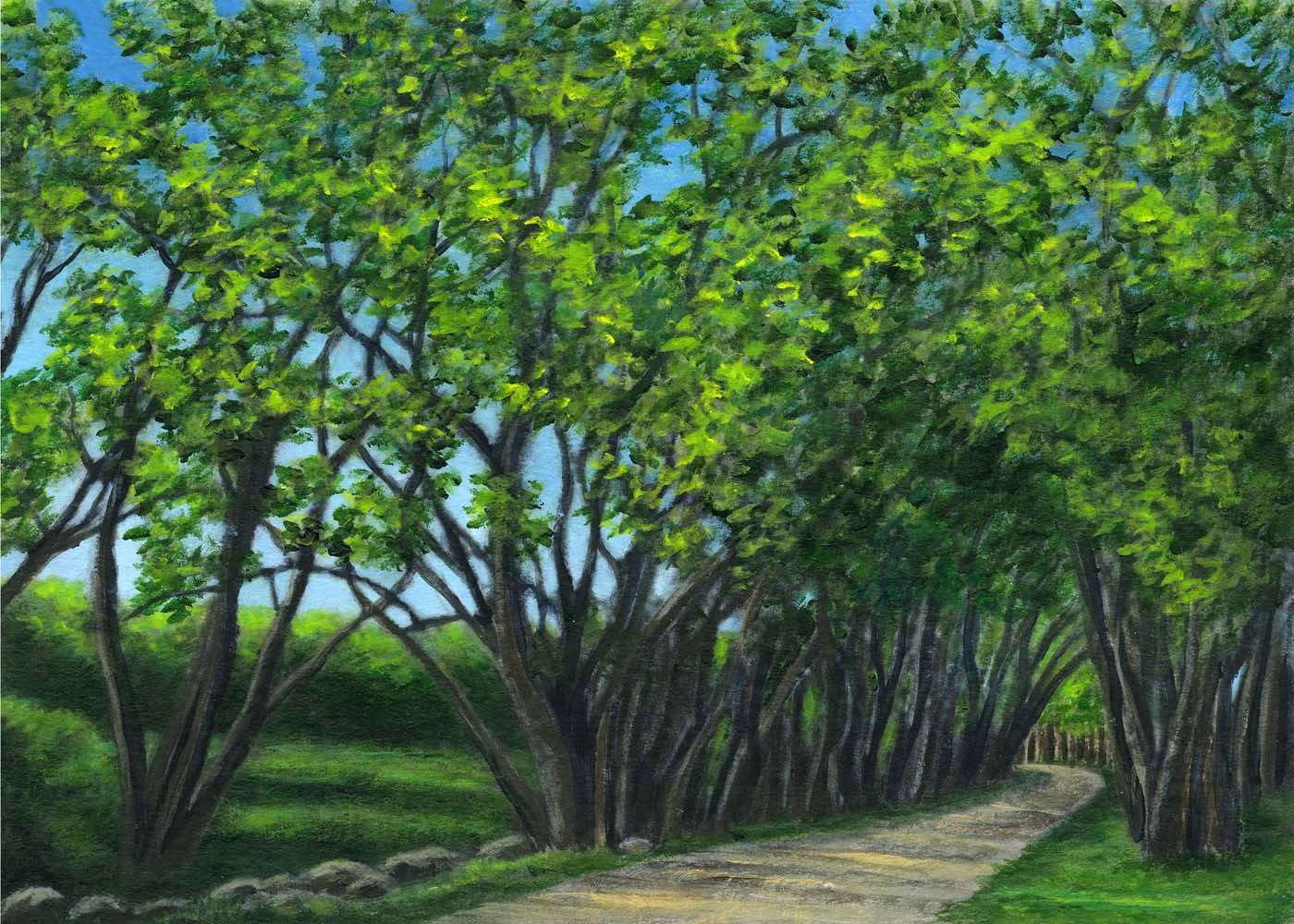
That sometime in the 1840’s there was a need for a road to be built on a bit of land, which was almost a swamp. Horses and oxen would sink in the mud and mire. At that time, the city did not provide roads, so the neighbors decided to build their own. They used stone from the local quarries for the paving; however, the land was too unstable to support stone. Discouraged by their failed efforts, one of the men suggested setting out willow trees, which easily reproduce from cuttings and were known for their rapid growth – the idea being that their roots, remarkable for their toughness, magnitude, length and tenacity of life, would meet across the road and make a foundation, thus reinforcing the road. From the swamp, they cut some willow switches. After gathering a good number of them, the men stuck the slender branches into the ground on each side of the roadway. These branches sprouted and thrived and their roots held the roadbed firm. In time, these willows, with their green and lovely plumes, became a Cape Ann landmark.
This painting was done from an old black and white photo of the Willows of Annisquam in winter at the suggestion of an older neighbor who remembers and loved the Willows. She also loaned me the Anne Kelly Lane book about the Willows. They were located on the stretch of Washington Street near where the Willow Rest and Riverdale Post Office are now, and most disappeared after a blight killed them off in the 1950’s, although if you look, you will still see a few along the roadside.
Going Thru the Willows
Two men planted twigs
On a road nearby the sea,
One by one they sprouted up
And grew into a tree
Love sought their shade at evening
And there breathed its early vows
And old and young alike
Would stroll beneath their boughs
Cape Ann loved the dangling plumes
Of the willows on the shore
But “going thru the willows”
Is now just a bit of lore?
(edited excerpts from “The Willows of Cape Ann” by Anne Kelly Lane)
That The Shalin Liu Performance Center was named after Shalin Liu, A Taiwanese-born philanthropist who donated $3 million toward the Rockport Chamber Music Festival concert hall, with a caveat that $500,000 of the gift be devoted to music education programs for students? She is an avid concertgoer and supporter of the Center’s educational and outreach efforts. Long before she had money to give away, she was reaching out to help others. When she was an 18-year-old student in Taipei, she got word that a former classmate had lost a leg in an accident. She wrote to the son of Taiwan leader Chiang Kai-shek, who was running a government agency that focused on the young. She implored him to help the badly injured student. Her persistence paid off. The boy received an artificial leg and was able to walk again.
Lui attended Taiwan University, where she studied philosophy and literature. In 1973, she moved to the United States to pursue a master’s degree in Asian philosophy at Indiana University. She later moved to the Boston area where she raised a family and worked at Harvard University’s Harvard-Yenching Library and the Harvard Law School library. Concern for the terminally ill motivated her to train as a hospice worker and work in nursing homes. Her life is highlighted by big and small acts of kindness. Her kindness has certainly greatly benefitted Cape Ann. If you haven’t been to the Shalin Liu Performance Center yet, check out their upcoming performances and go to one. It is one of the most beautiful performance spaces I have ever been to, and its right in our backyard. Go to http://www.rcmf.org/newperformance.html for info.
That between 1880-1886, Alpheus Hyatt founded the directed the Annisquam Seaside Laboratory, predecessor of the Marine Biological Laboratory at Woods Hole, under the auspices of the Boston Society of Natural History, and with support from the Women’s Educational Association of Boston? This summer school was primarily for the training of teachers of natural science, but several of the staff and students became well-known professional scientists, contributing to research as well as to science education. Alpheus Hyatt (1838-1902), trained by Louis Agassiz at Harvard University, was primarily a paleontologist who specialized in fossil cephalopods and their evolution. He also did special research on sponges and bryozoans. Hyatt transferred his Annisquam Seaside laboratory to Woods Hole, was instrumental in raising funds, and became the first President of the Board of Trustees for the Marine Biological Laboratory in 1888. Alpheus Hyatt was the father of Anna Hyatt Huntington, who created the Joan of Arc sculpture used in the World War I Memorial in Legion Square.
Inquiring minds wanted to know, so I grabbed my shovel and went digging. This is where Hyatt’s Seaside Laboratory was located on River Road in Annisquam, prior to relocating to Woods Hole (location information courtesy of Jim Groves).
That cozy Annisquam village grew up on the east side of the river’s northern end beginning in 1631? The village grew into a fishing and shipbuilding center that rivaled Gloucester Harbor in its early days. The Annisquam River was considered an important harbor of refuge for vessels traveling along the coast. Charles Boardman Hawes, in his book Gloucester by Land and Sea, illustrates this with the story of a sermon delivered by a fire-and-brimstone minister at the Isles of Shoals:
Suppose, my brethren, any of you should be taken short in the bay, in a northeast storm, your hearts trembling with fear, and nothing but death before you. Whither would your thoughts turn? What would you do?” he asked his congregation. One fisherman replied matter-of-factly, “Why, I should hoist the foresail and scud away for ’Squam.”
The name is said to derive from Ann (as in Cape Ann) and squam, meaning harbor. In the late 19th-century, it was home to both granite quarrying and an artist colony, which attracted painters including George Loftus Noyes and Margaret Fitzhugh Browne.
Although I love every part of Cape Ann that I have discovered since moving here, I do feel especially blessed to be able to spend some time living in Annisquam and getting to know this tucked away quaint little seaside village, which staunchly resists change and cherishes its history. Being here and talking with some of the longtime inhabitants is what motivated me to delve into the history behind the things I see, photograph and paint, and to do my “Did You Know” posts. I want to thank Martha and Geoffrey Bentley, whose house I am renting for the winter, for making this experience possible.
Did you know A lobster trap or lobster pot is a portable trap which traps lobsters or crayfish and is used in lobster fishing. A lobster trap can hold several lobsters. Lobster traps were traditionally constructed out of wood but they are now usually plastic coated metal. An opening permits the lobster to enter a tunnel of netting. Pots are usually constructed in two parts, called the “chamber” or “kitchen”, where there is bait, and exits into the “parlour”, where it is trapped from escape. Lobster pots are usually dropped to the sea floor about a dozen at a time, and are marked by a buoy so they can be picked up later. A piece of bait, often fish or chum, is placed inside the trap, and the traps are dropped onto the sea floor. A long rope is attached to each trap, at the end of which is a plastic or styrofoam buoy that bears the owner’s license number. The entrances to the traps are designed to be one-way entrances only. The traps are checked every other day by the fisherman and rebaited if necessary. One study indicated that lobster traps are very inefficient and allow almost all lobsters to escape. Yet, this inefficiency also allows younger lobsters to escape and breed, thus reducing the possibility of overfishing. In other words, we only get to eat the not very smart lobsters that couldn’t figure out how to get out of the trap.
In the 1950’s, during the Great Lobster War, my father, Willis Lefavour, and his partner, Bob Winchell, did an underwater shoot in the Damariscotta River for Salt Water Farms in Damariscotta, Maine, of lobsters entering traps. Their photographic documentation proved the previously unknown fact that lobsters enter the trap head first. Before that it was not known for sure how they entered. Since lobsters swim backwards, it was thought that they could have entered either backwards or head first. For the shoot, they used ASA 10 film and kept their light meters in mason jars.
Did you know that sea serpent sightings around Gloucester became front-page news in 1817 and 1818? On August 17, 1818, the Boston Commercial Gazette reported the following, under the title “The Leviathan of the Deep”:
The famous Sea Serpent, was seen on the 16th near Squam Light House, by many persons, some of whom were within twenty feet of him. He is now described as being ‘perfectly harmless, and might easily be caught.’ . . . The knowing ones in Boston have been computing the average amount which will be derived from an exhibition of the Sea Serpent. One hundred thousand dollars is the sum decided on!
The serpent was said to be more than 130 feet long and to pass through the water “with the rapidity of a meteor through the heavens.” On September 5 the Newport Mercury ran the exciting headline “The Sea Serpent—Taken!” The serpent had been captured by several people near the lighthouse, according to the story, after it had dragged their boat for two miles. The newspaper The Watch Tower soon reported the disappointing news that the appearance of the serpent was “very different from when it was alive and swimming.” The creature caught was a mere 10 feet long, with a head “of a hard scaly substance, which a harpoon cannot penetrate.” The undersized monster apparently never earned its captors the vast sums of money they had hoped for.
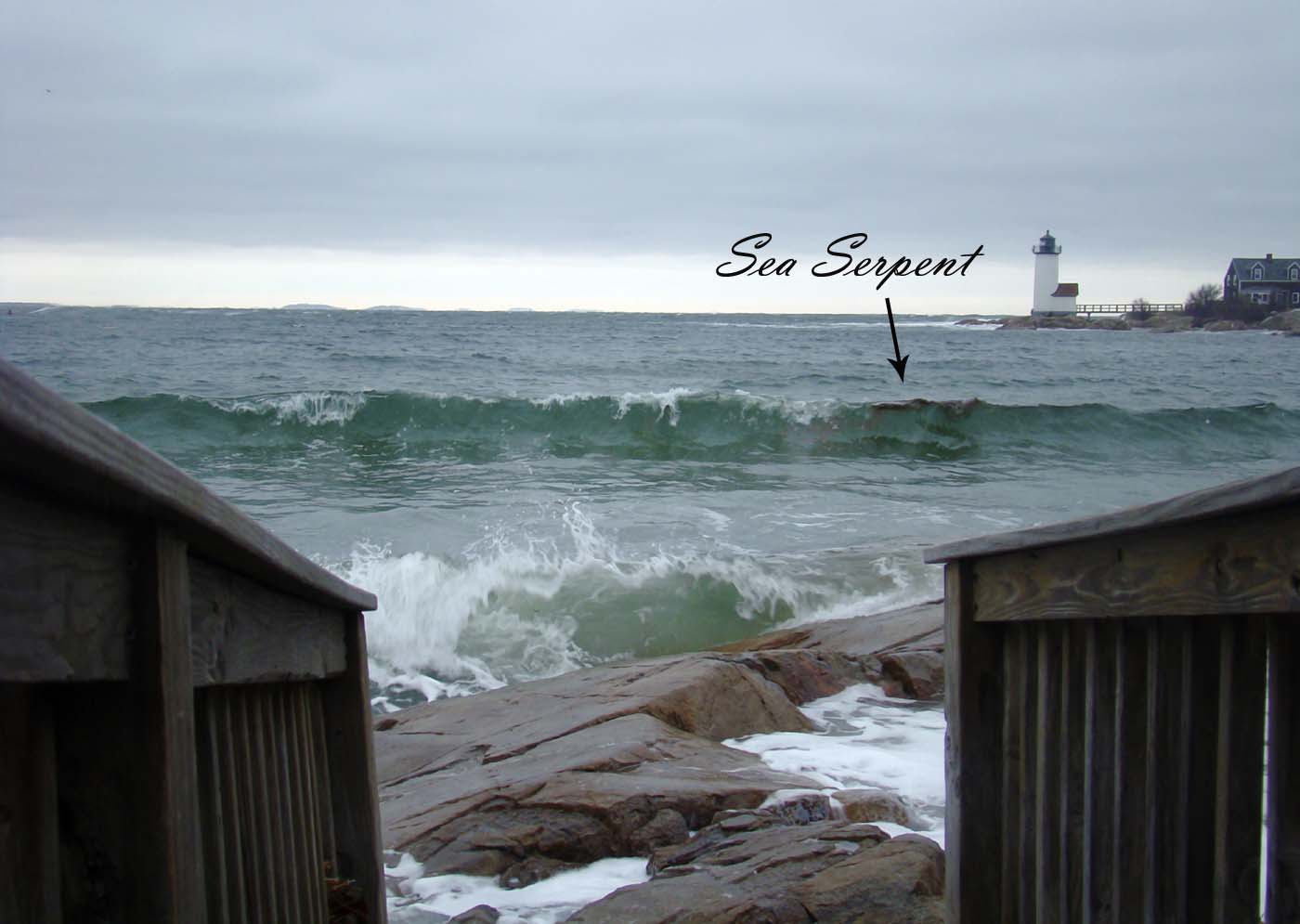
While going back through my photos from the storm, I discovered that the sea serpent is back, and I had unwittingly captured him on film. Anyone want to pay me one hundred thousand dollars for this rare photo?
That Mount Adnah, formerly known as Jakes Hill, consists of 5.12 acres, which were purchased by Annisquam Village members as a burial ground in 1848? The first person interred was David Lane, who died in 1848. The name Adnah was selected because the Hebrew translation means “rest or testimony eternal”. The cemetery was incorporated in 1860, and in 1890 the Annisquam & Bay View Civil War Monument was dedicated to the Bay View and Annisquam men who served in the Civil War from 1861-1865. Nine men from Bay View and Annisquam lost their lives in the Civil War, and their names are inscribed on the monument. Over the past 155 years, this beautiful location has been improved with walls, shrubs, monuments, tombs, pathways and trees into one of the more unique cemeteries in all of New England. Persons buried at Mount Adnah represent a diverse cross-section of the Annisquam/Bay View population. I’ve walked through this cemetery on a number of occasions, and it is a very unique one. My first time there I encountered three turkeys. Beyond the stones in the photo above is a view of Lobster Cove.
Did you know that on September 8, 1814, the British frigate Nymph invaded Sandy Bay? One of her barges surprised and captured the barracks at the end of Bearskin Neck; when the second was seen entering the Old Harbor, the meetinghouse bell sounded the alarm. The crew shot at the bell to silence it and hit the steeple instead. Firing the shot, the carronade went through the bottom of the barge, and the crew was captured as they swam ashore. Their captain affected an exchange of prisoners and promised not to bother the town any more. The church (First Congregational Church of Rockport, United Church of Christ) still has the cannonball. The wooden replica that can be seen in the steeple was probably added in one of the later reconstructions. When Sandy Bay became the Town of Rockport in 1840, the meetinghouse was completely redecorated and the steeple enlarged to support a heavier bell. The fishermen conferred the nickname “The Old Sloop”. In 1842 the General Court released the meetinghouse to the Congregational Church.
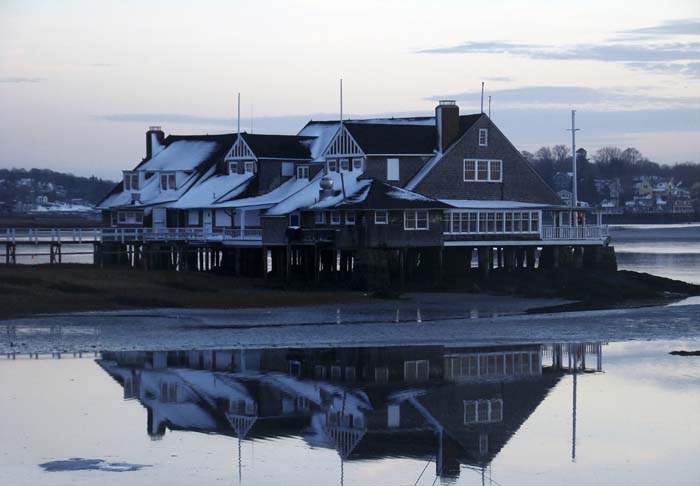
Did you know that The Annisquam Yacht Club is a private club whose purpose since 1896 has been to provide for its members a haven for sailing, yachting, tennis, and friendship. The membership of the Annisquam Yacht Club is a diverse group of families, professionals, students and retirees — all of whom share a passion for Annisquam, yachting, tennis, and the ocean.
Motif No. 1 (Whether you love it or hate it – I personally liked the old original one better.)
Did you know this little bit of history about Motif No. 1?
The fishing shack was built in the 1840’s. In the 1890’s to 1930’s, it served as a rendezvous for tourists coming to see the U.S. Navy fleet every summer. In the 1930’s it was used as a studio by painter, John Buckley. In 1933, a scale model of the shack won first place in the historic float competition at the Worlds Fair in Chicago. In 1942 Aldro Hibbard organizes Rockport artists to paint the Motif. In 1945, painter John Buckley sells the Motif to the town, dedicating it “to the fishermen and artists of Rockport.” In 1949, Lester G. Hornby, a Rockport artist, founds Motif No. 1 Day as a celebration of Rockport’s official start of the summer season. In 1978, after Motif No. 1 collapses into the water during the great February blizzard, a duplicate is built. In 2002, Motif No. 1 appears on the Massachusetts stamp as part of the “Greetings from America” postage stamp set. In 2003, a painting of Motif No. 1 is seen on the wall of a dentist’s office in Rockport native, Andrew Stanton’s, hit Disney film, “Finding Nemo”. In 2006, there is a revitalization project to reconstruct the roof, replace some side shingles and apply a new coat of paint. In 2009, Motif No. 1 is featured prominently in the hit Disney movie, “The Proposal”. Also in 2009, lighting is installed to illuminate Motif No. 1 at night.
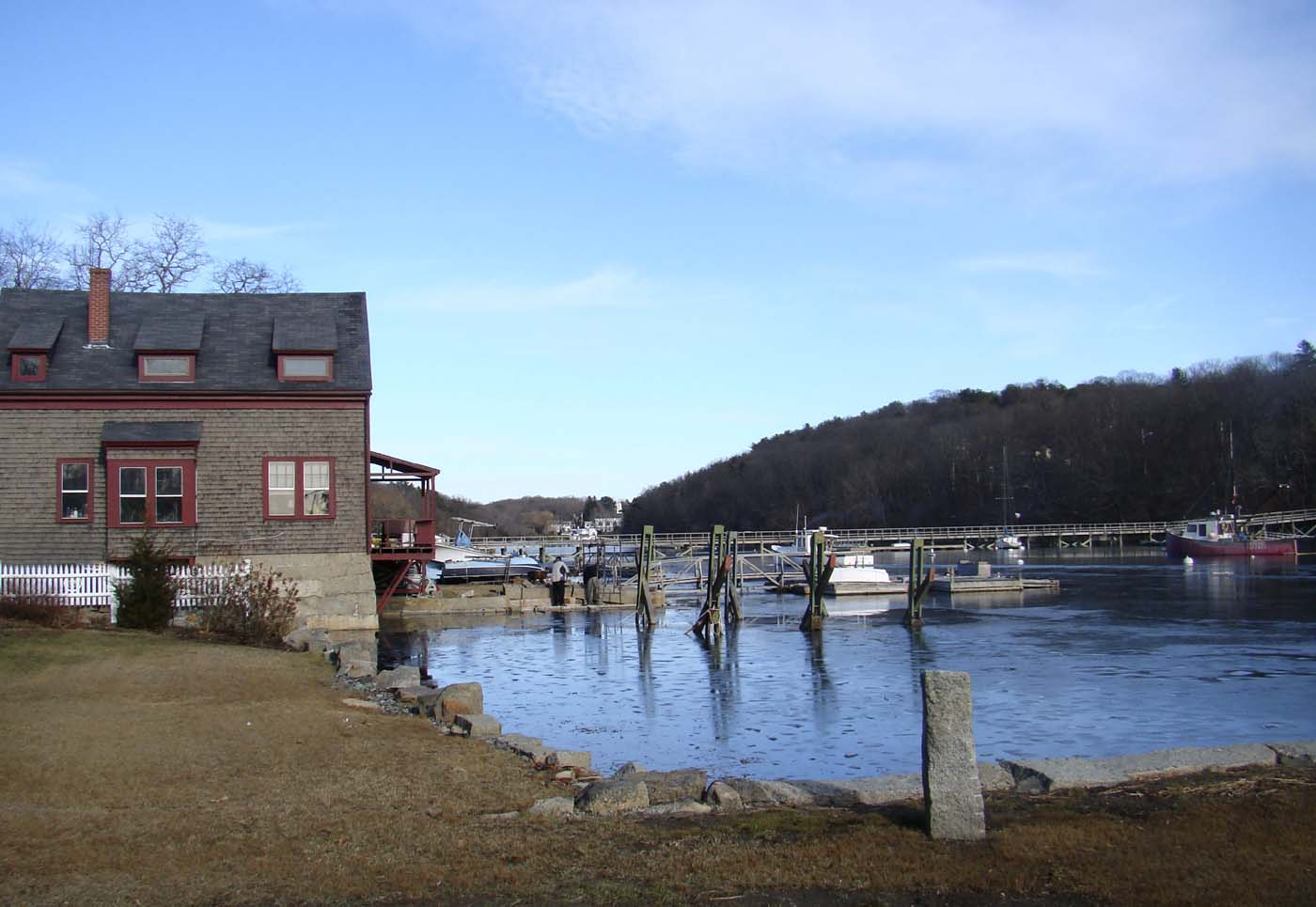
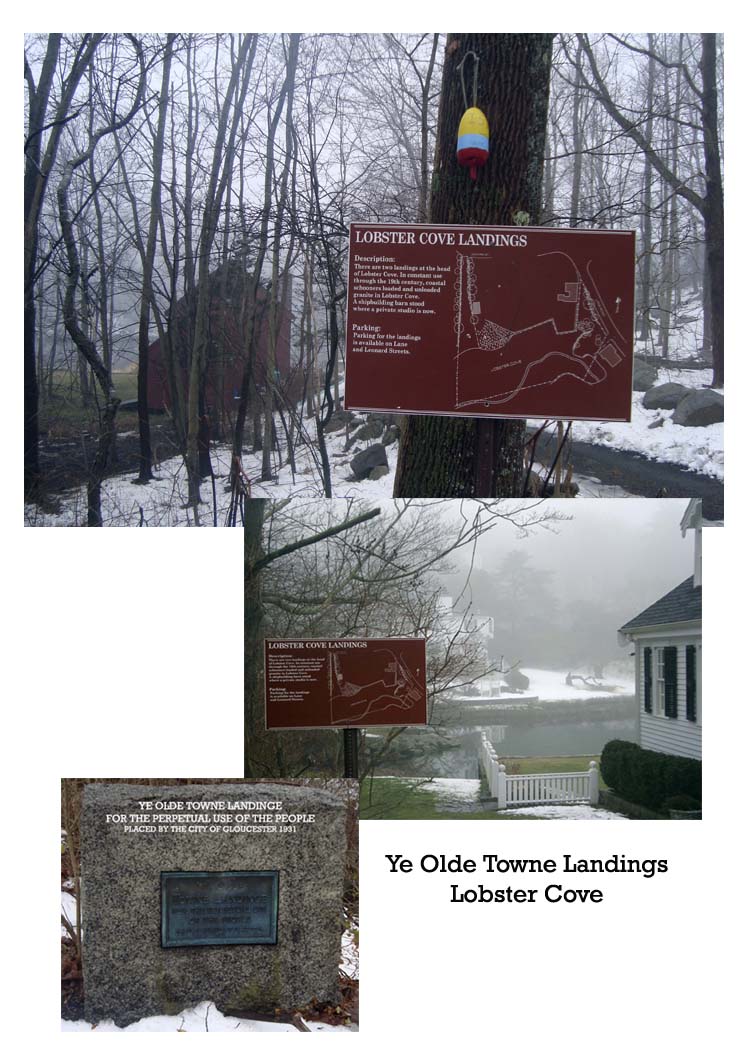
Did you know that there are two landings at the head of lobster cove placed by the City of Gloucester in 1931 for the perpetual use of the people? In constant use through the 19th century, coastal schooners loaded and unloaded granite in Lobster Cove. A shipbuilding barn stood where this private studio (the red building in the first photo) now stands. Parking for the landings is available on Lane and Leonard Streets.
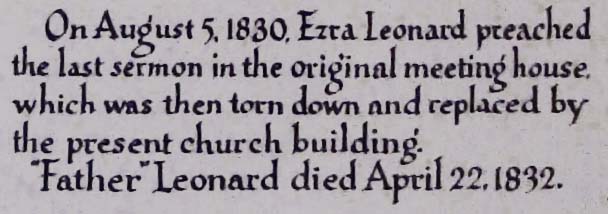
That Father Ezra Leonard did not return from the grave to preach his last sermon.
I received an email this morning from Susan, a very observant GMG reader in Granville, NY. She said: “I live in Granville, NY and read GMG each day online. I was very interested in your entry regarding the Annisquam Village Church. One thing I noted was that on Aug. 5, 1880 Ezra Leonard preached the last sermon in the original meetinghouse, but he died on April 22, 1832! Now, that is not possible!”
I looked closely at the photograph of the sign I had included in the post, and saw that indeed the date of Father’s Leonard’s last sermon did appear to be August 5, 1880. I blew up the photo of the sign and found that in fact it says August 5, 1830 (see blown up version here). This sign appears to have been done by hand, and the first 3 loops up at the bottom, giving it the definite illusion when printed smaller, of being an 8. The 3 further down doesn’t loop up, so is more clearly a 3. I was very impressed that a reader looked at the post so closely to pick that up. In case anyone else had done the same, I just wanted to provide clarification.
Spread The GMG Love By Sharing With These Buttons:



















 Good Morning Gloucester