Oak Hill Cemetery is a sentimental favorite as it is the first cemetery in which I located ancestors I had never known. I knew my grandparents were in Calvary, but not much else when I started stalking cemeteries for ancestors. This is where I experienced my first “AHA!” moment in cemetery research.
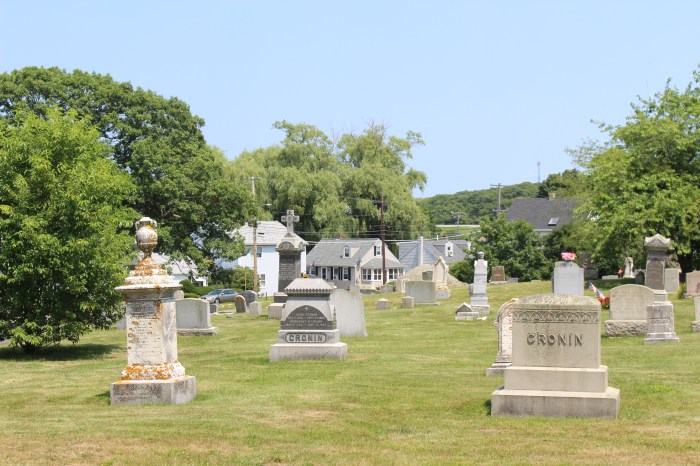
A Guide to Cemeteries in Essex County Massachusetts by the Essex Society of Genealogists (1991) says Oak Hill is also known as St. Ann’s Cemetery and that records are held in the St. Ann’s rectory. The entry describes it as “small, hilly, and well-kept”. I agree on all counts, except perhaps I would clarify that though it may be small, it is spread out and has some areas kind of hidden from first glance.
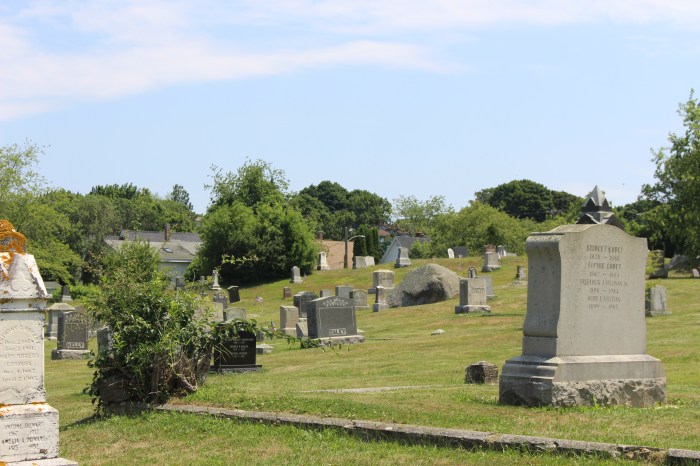
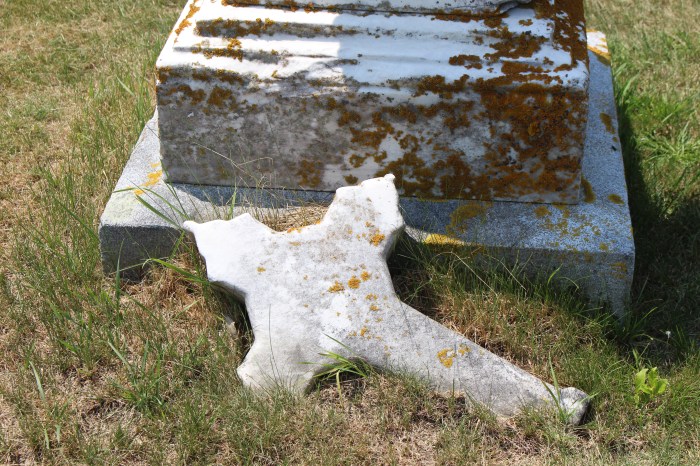
There is some evidence of deterioration, but in general is a very pretty and peaceful resting place.
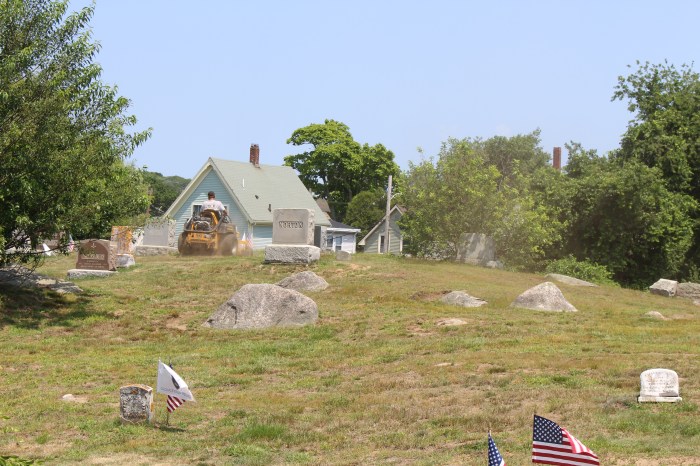
The cemetery was being mowed the day we visited. That guy must be very adept at swinging that tractor around these stones (natural and man made).


 Good Morning Gloucester
Yes, Oak Hill is considered St. Ann’s Church cemetery as is Calvary. Cemetery records were lost in a fire in the 1950’s. The archdiocese manages both cemeteries now.
LikeLike
Pat,
Thanks for sharing this I also found this while doing a quick look thought you may like it also. I really like the history too!
http://gloucester-ma.gov/Archive/ViewFile/Item/4402
CPA Application for St. Anne’s Church, Holy Family Parish Joseph Parisi attended to request historic designation for St. Anne’s Church. He explained: St. Anne’s is the first and largest Catholic church in Gloucester, they currently accommodate 4700 families; the church seats 900. (There are 14,000 Catholics on Cape Ann.) A wooden church was first built at the current location in 1855. Prior to 1948 there were not many Catholics on Cape Ann. Then the Irish, Portuguese, and Italians began to come in. The church raised $100,000 and built a stone church at this location in 1876, and the wooden church was moved and repurposed.
They are applying for CPA funds to preserve the structure. The floor joists are sitting on dirt. They need to replace the sills and the joists. They need to create handicapped accessibility from the street and to the second floor. They will build on an elevator vestibule onto the
church. The commission had a question about the project because the preliminary application only addresses the accessibility project, which is not the preservation part of the project, although there were checkboxes on the application that said it would be a “historic preservation” and “rehab/restore” project. Mr. Parisi said that the final application would address the preservation part of the project. The commission agreed to vote on the historic significance of the building under the assumption that the final application would focus on that.
Jeff Crawford made a motion to deem the church historically significant; it was passed unanimously.
🙂 Dave & Kim 🙂
LikeLike