Jack o’lantern traditions. There’s this – our annual amateur foray

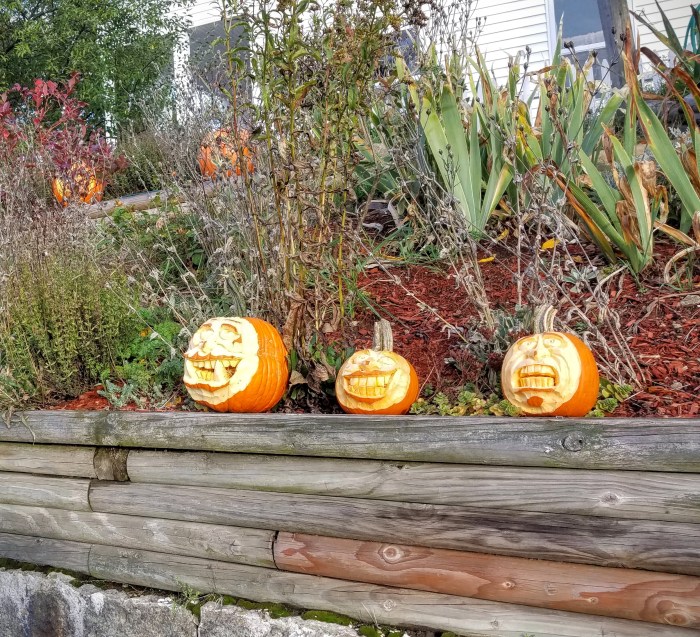
and then this public art tableau that we stop for each year, just past 370 Main Street, Gloucester (before the Crow’s Nest heading into downtown Gloucester)

Excerpt from The Pumpkin, ca.1846 Thanksgiving poem
Oh, fruit loved of boyhood! the old days recalling,
When wood-grapes were purpling and brown nuts were falling!
When wild, ugly faces we carved in its skin,
Glaring out through the dark with a candle within!
When we laughed round the corn-heap, with hearts all in tune,
Our chair a broad pumpkin,—our lantern the moon,
Telling tales of the fairy who travelled like steam,
In a pumpkin-shell coach, with two rats for her team!
Selected Whittier links and timeline bits:
The Garrison of Cape Ann.
From the hills of home forth looking, far beneath the tent-like span
Of the sky, I see the white gleam of the headland of Cape Ann.
Well I know its coves and beaches to the ebb-tide glimmering down,
And the white-walled hamlet children of its ancient fishing-town.
Long has passed the summer morning, and its memory waxes old,
When along yon breezy headlands with a pleasant friend I strolled.
Ah! the autumn sun is shining, and the ocean wind blows cool,
And the golden-rod and aster bloom around thy grave, Rantoul!
With the memory of that morning by the summer sea I blend
A wild and wondrous story, by the younger Mather penned,
In that quaint Magnalia Christi, with all strange and marvellous things,
Heaped up huge and undigested, like the chaos Ovid sings.
Dear to me these far, faint glimpses of the dual life of old,
Inward, grand with awe and reverence; outward, mean and coarse and cold;
Gleams of mystic beauty playing over dull and vulgar clay,
Golden-threaded fancies weaving in a web of hodden gray.
The great eventful Present hides the Past; but through the din
Of its loud life hints and echoes from the life behind steal in;
And the lore of home and fireside, and the legendary rhyme,
Make the task of duty lighter which the true man owes his time.
So, with something of the feeling which the Covenanter knew,
When with pious chisel wandering Scotland‘s moorland graveyards through,
From the graves of old traditions I part the black-berry-vines,
Wipe the moss from off the headstones, and re-touch the faded lines.
Where the sea-waves back and forward, hoarse with rolling pebbles, ran,
The garrison-house stood watching on the gray rocks of Cape Ann;
On its windy site uplifting gabled roof and palisade,
And rough walls of unhewn timber with the moon-light overlaid.
On his slow round walked the sentry, south and eastward looking forth
O’er a rude and broken coast-line, white with breakers stretching north,—
Wood and rock and gleaming sand-drift, jagged capes, with bush and tree,
Leaning inland from the smiting of the wild and gusty sea.
Before the deep-mouthed chimney, dimly lit by dying brands,
Twenty soldiers sat and waited, with their muskets in their hands;
On the rough-hewn oaken table the venison haunch was shared,
And the pewter tankard circled slowly round from beard to beard.
Long they sat and talked together,—talked of wizards Satan-sold;
Of all ghostly sights and noises,—signs and wonders manifold;
Of the spectre-ship of Salem, with the dead men in her shrouds,
Sailing sheer above the water, in the loom of morning clouds;
Of the marvellous valley hidden in the depths of Gloucester woods,
Full of plants that love the summer,—blooms of warmer latitudes;
Where the Arctic birch is braided by the tropic’s flowery vines,
And the white magnolia-blossoms star the twilight of the pines!
But their voices sank yet lower, sank to husky tones of fear,
As they spake of present tokens of the powers of evil near;
Of a spectral host, defying stroke of steel and aim of gun;
Never yet was ball to slay them in the mould of mortals run!
Thrice, with plumes and flowing scalp-locks, from the midnight wood they came,—
Thrice around the block-house marching, met, unharmed, its volleyed flame;
Then, with mocking laugh and gesture, sunk in earth or lost in air,
All the ghostly wonder vanished, and the moonlit sands lay bare.
Midnight came; from out the forest moved a dusky mass that soon
Grew to warriors, plumed and painted, grimly marching in the moon.
‘Ghosts or witches,’ said the captain, ‘thus I foil the Evil One!’
And he rammed a silver button, from his doublet, down his gun.
Once again the spectral horror moved the guarded wall about;
Once again the levelled muskets through the palisades flashed out,
With that deadly aim the squirrel on his tree-top might not shun,
Nor the beach-bird seaward flying with his slant wing to the sun.
Like the idle rain of summer sped the harmless shower of lead.
With a laugh of fierce derision, once again the phantoms fled;
Once again, without a shadow on the sands the moonlight lay,
And the white smoke curling through it drifted slowly down the bay!
‘God preserve us!’ said the captain; “never mortal foes were there;
They have vanished with their leader, Prince and Power of the air!
Lay aside your useless weapons; skill and prowess naught avail;
They who do the Devil‘s service wear their master’s coat of mail!”
So the night grew near to cock-crow, when again a warning call
Roused the score of weary soldiers watching round the dusky hall:
And they looked to flint and priming, and they longed for break of day;
But the captain closed his Bible: ‘Let us cease from man, and pray!’
To the men who went before us, all the unseen powers seemed near,
And their steadfast strength of courage struck its roots in holy fear.
Every hand forsook the musket, every head was bowed and bare,
Every stout knee pressed the flag-stones, as the captain led in prayer.
Ceased thereat the mystic marching of the spectres round the wall,
But a sound abhorred, unearthly, smote the ears and hearts of all,—
Howls of rage and shrieks of anguish! Never after mortal man
Saw the ghostly leaguers marching round the block-house of Cape Ann.
So to us who walk in summer through the cool and sea-blown town,
From the childhood of its people comes the solemn legend down.
Not in vain the ancient fiction, in whose moral lives the youth
And the fitness and the freshness of an undecaying truth.
Soon or late to all our dwellings come the spectres of the mind,
Doubts and fears and dread forebodings, in the darkness undefined;
Round us throng the grim projections of the heart and of the brain,
And our pride of strength is weakness, and the cunning hand is vain.
In the dark we cry like children; and no answer from on high
Breaks the crystal spheres of silence, and no white wings downward fly;
But the heavenly help we pray for comes to faith, and not to sight,
And our prayers themselves drive backward all the spirits of the night!
John Greenleaf Whittier, Garrison of Cape Ann, 1857. Boston and New York, Houghton, Mifflin and company, 1888-89.


 Good Morning Gloucester
Nice to see this post on ESP and Whittier.
But why do you say that George Latimer is an “alleged fugitive slave”?
The Whittier poem, “Massachusetts to Virginia” may have helped to pass the 1843 Personal Liberty Act. Signed petitions on Cape Ann show the names of those who supported and argued against the Act. In the end,sate-wide protesters garnered more than 65,000 signatures and helped to raise money for Latimer’s freedom. Keep in mind that some of our well-known Gloucestermen attempted to return black freedom seekers back to bondage–as late as 1859.
We hunt your bondmen, flying from Slavery’s hateful hell;
Our voices, at your bidding, take up the bloodhound’s yell;
We gather, at your summons, above our fathers’ graves, 35
From Freedom’s holy altar-horns to tear your wretched slaves!
Look to it well, Virginians! In calmness we have borne, 85
In answer to our faith and trust, your insult and your scorn;
You’ve spurned our kindest counsels; you’ve hunted for our lives;
And shaken round our hearths and homes your manacles and gyves!
LikeLike
Whittier’s words/description- see
https://goo.gl/EJeq7W (p.286)
yes, so devoted to the cause.
Riverside Edition published a definitive Whittier collection in 1888 with Whittier. (They published Longfellow’s in 1886–with help from his sibling. Longfellow died in 1882)
Includes nearly 100 titles under ‘anti-slavery poems’
re quoted letter in this post (Harvard education vs his own remote family farm): along with culling, editing, revising and curating his body of work, Whittier added intros and notes.
Whittier’s introduction to a decades earlier collection was re-printed in the 1888 one, reminding his readers then and now a definitive anthology was on his mind.
For a long time.
“The edition of my poems published in 1857 contained the following note by way of preface:–
In these volumes, for the first time, a complete collection of my poetical writings has been made. While it is satisfactory to know that these scattered children of my brain have found a home, I cannot but regret that I have been unable, by reason of illness, to give that attention to their revision and arrangement which respect for the opinion of others and my own afterthought and experience demand.
That there are pieces in this collection which I would ‘willingly let die,’ I am free to confess. But it is now too late to disown them, …(read more) https://goo.gl/naMqpK
LikeLike
Some very fine detail here and pumpkins never looked so good! Brings out the art aspect of trick or treat! 🙂 Dave & Kim 🙂
LikeLike
It truly does. Very cool display
LikeLike
Latimer had light skin which confused matters at first. But his light coloring–unlike those of darker men–soon incited the passionate support of Northerners with the help of abolitionists like Bowditch. There is much more to say on the metamorphizing depictions of Latimer over his life time in our collective memory, but it is undeniable that he and his wife escaped from a brutal life in slavery. He was not an “alleged” fugitive and Whittier never questioned this.
More to the point, some on Cape Ann did not support the Personal Liberty Act. The majority here continued to support the rights of Southerns to their “property” on the eve of the Civil War and voted on a town resolution to that effect.
LikeLike
Yes. That’s why he wrote it that way.
LikeLike
Thanks Catherine.. one of the best posts on GMG!
LikeLike
Well, that’s a nice compliment. Thank you, Barry. And what about you– was it pumpkins, poetry, locale…
LikeLike
Poems and whittiers brilliance
LikeLike
Timing-
“On this Day November 1, 1857, The Atlantic Monthly First Published
…in 1857, the first issue of The Atlantic Monthly magazine was published in Boston. Although none of the articles was signed, most readers easily recognized the work of such New England luminaries as Ralph Waldo Emerson, Henry Wadsworth Longfellow, and Harriet Beecher Stowe. The writers, poets, and philosophers who launched the new journal believed that, as the intellectual elite of New England, they had a mission to create not just a magazine but a culture — a distinctly American literary culture…”
They get to Whittier and others follow the link to read the full Mass Moment
http://www.massmoments.org/moment.cfm?mid=315
LikeLike