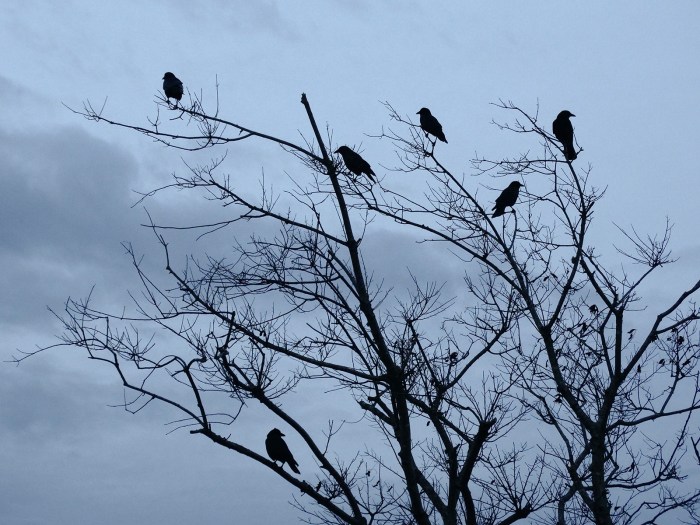
Crows are very social and caring creatures, and also among the smartest animals on the planet. (See WPBS A Murder of Crows)
When I was a girl, I rescued an injured crow and nursed him back to health. The day after I released him in the back yard and he flew off, he returned with a mass murder numbering scores of crows, all cawing and covering the back yard, with him at the head of them. I guess he brought them to meet me, or they came to thank me for taking care of him. It was pretty amazing, and I still remember it like it was yesterday.
A group of crows is called a “murder.” There are several different explanations for the origin of this term, mostly based on old folk tales and superstitions.
For instance, there is a folktale that crows will gather and decide the capital fate of another crow.
Many view the appearance of crows as an omen of death because ravens and crows are scavengers and are generally associated with dead bodies, battlefields, and cemeteries, and they’re thought to circle in large numbers above sites where animals or people are expected to soon die.
But the term “murder of crows” mostly reflects a time when groupings of many animals had colorful and poetic names. Other fun examples of “group” names include: an ostentation of peacocks, a parliament of owls, a knot frogs, and a skulk of foxes.
E.J. Lefavour


 Good Morning Gloucester
Nice photo E.J. I saw/heard hundreds of crows in the trees the other day. Never before had I seen so many at once. Wondered if they were migrating during this ‘season of change.’
LikeLike
I don’t think of crows migrating, but did find this on the National Wildlife Federation site, which might explain the large numbers you’ve seen:
Why do crows congregate in large numbers to sleep?
Crows take this approach primarily in fall and winter. Roost size ranges from fewer than 100 individuals to hundreds of thousands. One site in Fort Cobb, Oklahoma, holds an estimated 2 million crows. Why they sleep in large groups is largely a matter of conjecture. They may all be attracted to one spot that offers advantages such as protection from predators and weather. Roosts also may be located near a large food source. The congregations probably serve some as yet unknown social function as well. Not all crows join these groups, and many sleep at home with just their families near them.
LikeLiked by 1 person
Hi, E.J.! Thanks for the informative piece on crows. I’ll look at them in a new light, now. Are you heading South for the winter?
LikeLike
Hi Leslie,
No, I am staying here this winter. I don’t think we’ll have a repeat of last year, and I do enjoy winter, if it is not crazy cold and tons of snow.
LikeLike
I love both the picture and your story. Crows are fascinating. We have recently had 6 or 7 at a time in our yard, learning to balance on thin twigs in order to reach the cage of suet. They do seem to call others when they are successful. I love to hear them caw from a distance.
LikeLike
They are very intelligent, and when they learn something new, they pass the knowledge on to the others in their flock. I’ve also always loved the sound of them cawing in the distance.
LikeLike
My favorite bird in the whole world, I have raised and rescued many, I adore them all!
LikeLike
Thanks, EJ. Crows are a favorite of mine too.
There are many terms of venery, or collective nouns, in a book by James Lipton called An Exultation of Larks, which is an update of the much older (15th century, I think) Book of St Albans. I bet you’d enjoy them both.
LikeLike
The title alone I love. I read something last night that said that when anything in nature is doing what it was created to do, it is praising the Creator in the process. An Exultation of Larks is a perfect example.
LikeLiked by 1 person
Beautiful expression of nature, E.J. Thanks for sharing!
LikeLike
Love this. Great post EJ!
LikeLiked by 1 person
Thanks Chief!
LikeLike
Love your childhood story. That is so cool the crows communed with you like that.
LikeLike