Was Lassie on Edward Hopper’s mind in 1939, too?

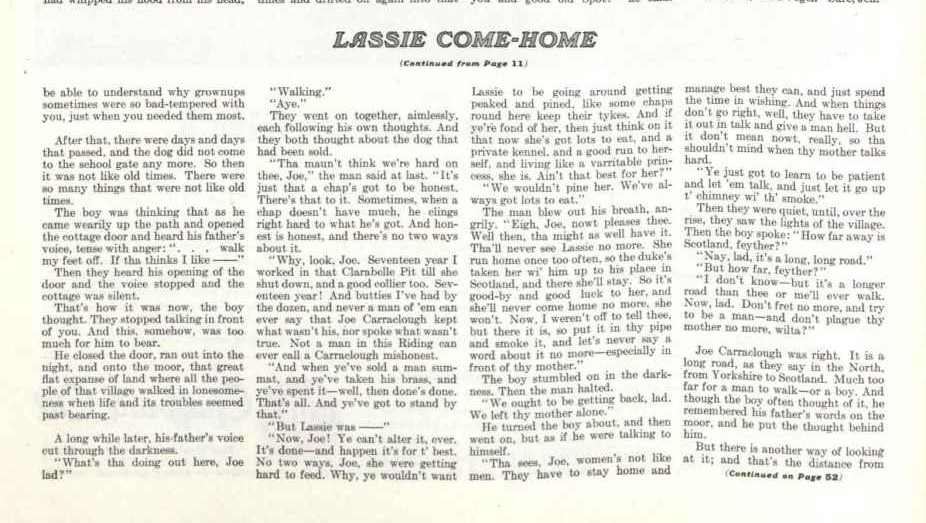
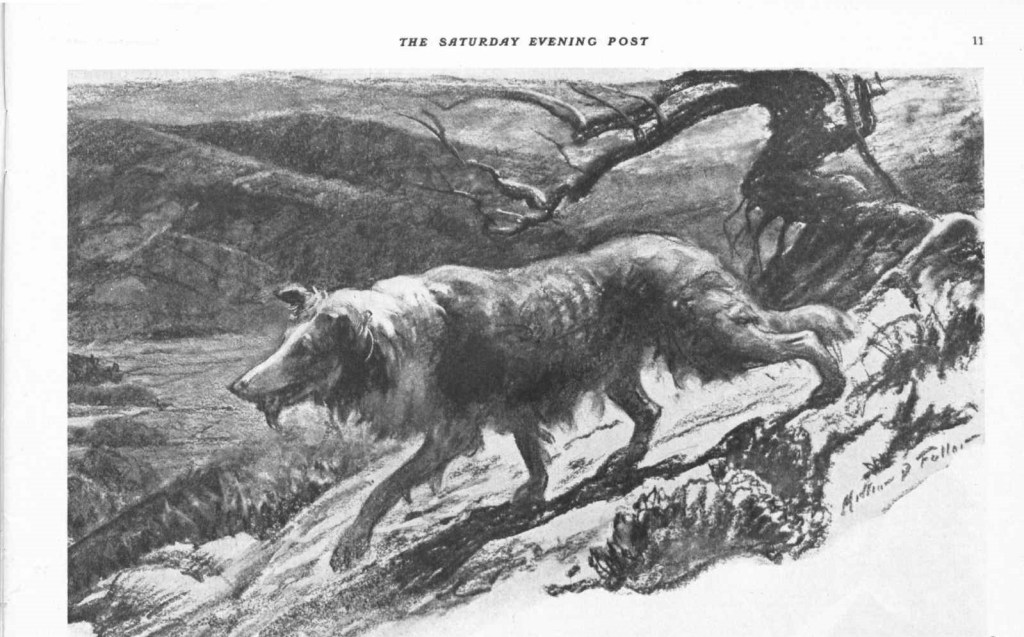
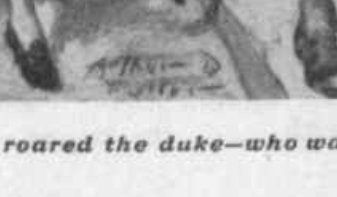
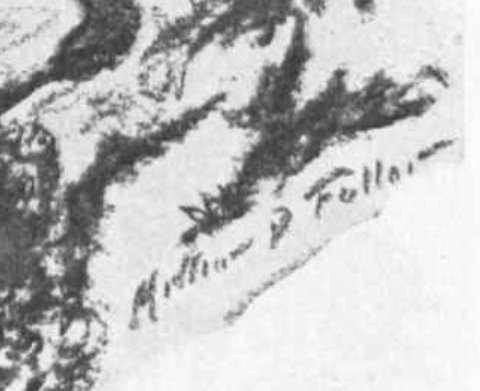
Illustrations: The short story, Lassie Come-Home by Edward Knight with illustrations by Arthur D. Fuller*, was an instant must-read-and-share when it was first published in the popular magazine, The Saturday Evening Post on December 17, 1938. Edward Hopper painted Cape Cod, Evening in 1939. *The illustratorโ€™s signature is tough to read without the credit beneath the byline. (Scroll down to see and read the story pages or to print a PDF. It’s a great read!)

You may know the memorable and unbreakable bond of the boy and his dog which Lassie Come-Home describes, and the small and epic journeys.

The short story, Lassie Come-Home by Edward Knight with illustrations by Arthur D. Fuller, was an instant must-read-and-share when it was first published in the popular magazine, The Saturday Evening Post on December 17, 1938.

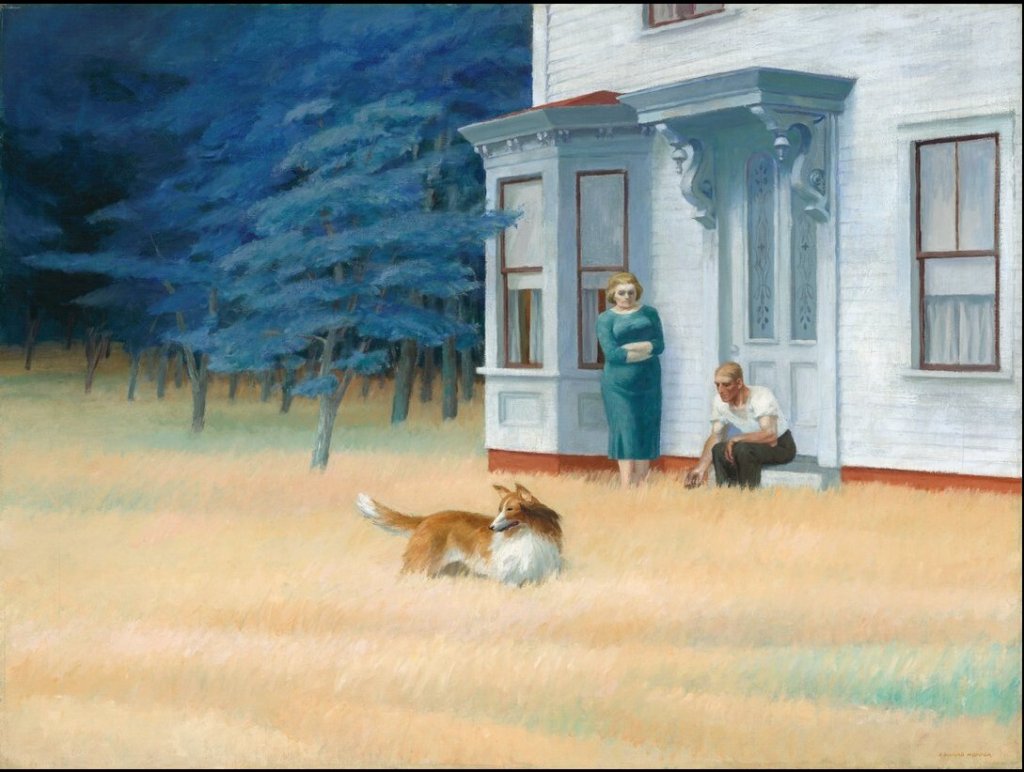
Edward Hopper painted Cape Cod, Evening in 1939.

The short story is set in England and opens with a small family of three in recurring and searing pain: Two parents who have fallen on hard times and are under great emotional strain struggle to comfort their only child because they sold the family dog. Their beautiful collie, “Lassie”, is so devoted to their son, the dog runs away from the new owner straight back to the boy over and over again. Under the circumstances, any and every solution is untenable. His parents’ misplaced anger, adult exchanges, and silence confuse the boy. Their anguish and love is palpable.

Out of desperation, Lassie is removed to Scotland which they believe will be an insurmountable distance to cover.

It’s not. And no wonder a legend is born!

The first Lassie novel was published in 1940. Swift adaptations followed. It’s easy to see how the story resonated with American audiences during the Great Depression, even perhaps the great American artist, Edward Hopper.

If not Lassie herself, it’s tempting to consider the intergenerational communication and couple dynamics explored in Knight’s story as themes Hopper noticed, too.

“…Then they heard his opening of the door and the voice stopped and the cottage was silent. That’s how it was now, the boy thought. They stopped talking in front of you. And this, somehow, was too much for him to bear. He closed the door, ran out into the night, and onto the moor, that great flat expanse of land where all the people of that village walked in lonesomeness when life and its troubles seemed past bearing…”

Lassie Come-Home, Edward Knight, The Saturday Evening Post, 1938 Dec. 17

Both used punctuation in titles. Knight offset the story’s title with a vital hyphen, Lassie Come-Home (command-comfort) that might have caught Hopper’s attention. Hopper used commas often for emphasis–as in Cape Cod, Evening.

Beyond the Great Depression, 1938 may have appeared especially distant, simpler, on first pass. Yet, with international tensions rising year by year and the horrors of WWI just a generation past, neither 1938 nor 1939 were simple. Jan Struther, another UK author, broached topics of peacetime, lengthy stasis, and looming loss in the popular Mrs. Miniver pieces, published in The Times London newspaper (1937-39 ), at the same times as Lassie. Reader’s Digest distribution was international beginning in 1938.

In Cape Cod, Evening 1939, Hopper’s dog reacts, hears something, like a whippoorwill, or so the story goes. (Lloyd Goodrich’s Hopper bio, 1971; also Gail Levin, 1995) Levin’s book takes time to introduce the reader to Hoppers’ friends, and so we understand the grief from the loss of their friend Harriet Jenness who died “in early July of 1939. It was she who had firmed up the Hoppers’ courage to build in the first place and provided a roof till theirs was done.” (Levin, 1995.)

Cape Cod, Evening is constantly changing because it’s laden with enigmatic motifs. It’s late summer and fall. Unsettling and calm. Are the man and woman taking a momentary break together (as with the son and father walking in the Lassie story) or engaged in a forced desist (as with the parents going silent in the Lassie story)? Active fight or passive summer ennui? And what about that evergreen Hopper forest at the edge? Is it a cool and reachable retreat? Are the trees leaning, falling? Is the sea of dry grass sunlit and waving or scorched and still? And why no path? The man and woman are lost in thought. Worried? Families will have to have difficult conversations. Some won’t return. And what about the significance of that star dog with the striking fur?

Hopper was 35 at the onset of WWI, registered, but not called for duty. He was 57 in 1939.

1939

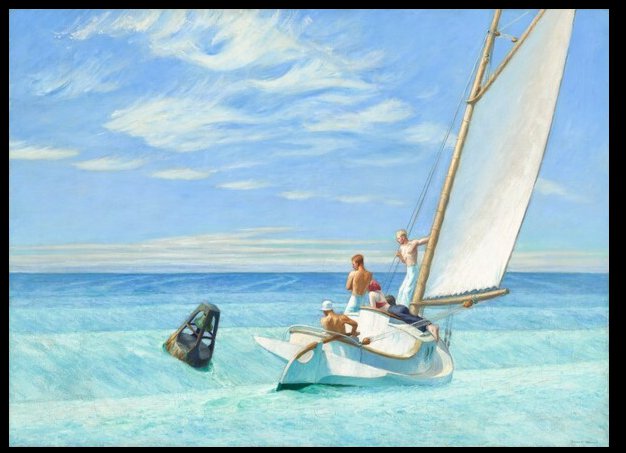
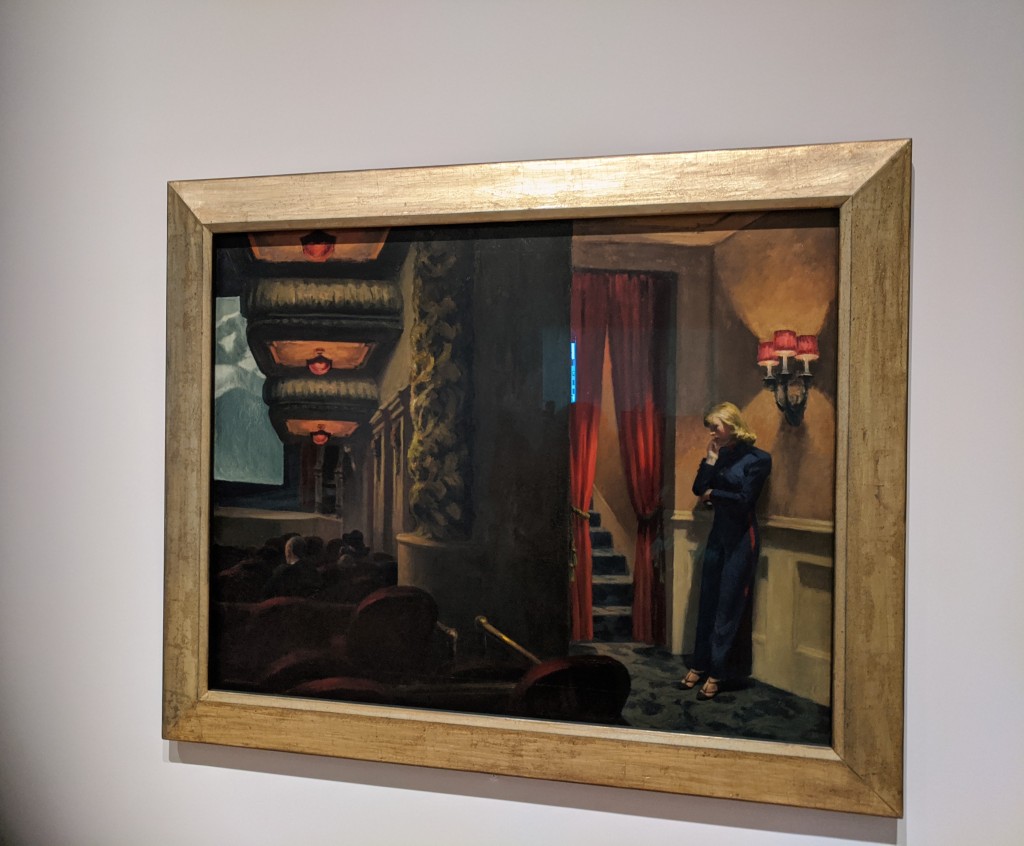
Edward Hopper paintings dated 1939: Bridle Path (Bruce Museum of Art, CT), Ground Swell ( NGA collection), Cape Cod, Evening (NGA collection), and New York Movie (MoMa). As a group, they make a strong case that Hopper was thinking about 1939 in 1939.
World War Two

Edward Hopper and Jo Hopper were on the Cape when war broke out.

On August 29, 1939, friends dropped by their summer home in Truro and Jo Hopper noted in her diary how the woman said, “…Sheโ€™d been to England last week. Said they all prepared for warโ€”everyone has his funkhole ready for an air raid.” On August 30 she added “E.” went to town on errands and picked up a magazine:

“Augu. 30. Still raining. After lunch E. went to P.O. & bought back kerosene, Readers Dig, postcard from Ginny at fair + the note from D R.โ€”to see us Sept. 18 at 11. Onion soup & banana salad for lunch & tummy ache over dishes. E. so tired. Standing up at canvas. Canvas seems standing still. But Iโ€™ve seen that happen before…”

Josephine N. Hopper, Aug. 30, 1929 diary page. Provincetown Art Museum Collection, 2016. “Donation by Laurence C. and J. Anton Schiffenhaus in honor of their mother Mary Schiffenhaus (a close and personal friend of Josephine and Edward Hopper)”

On September 1, 1939 Germany invaded Poland, and England and France declared war on Germany just two days later.

On September 3, Jo mentions art and war :

“…Eโ€™s 2 canvases*. Sailboat without sky as yet. Tonight Bertha Frank & Edgar Cobb came up to say good bye for the season. Everyone else in Truro had their supper dishes washedโ€”but we hadnโ€™t begun yet. E. was still working when they arrived. Heโ€™s been plenty interrupted today. We didnโ€™t swimโ€”it looked so cold. Ginny said not cold but very dirty + water full of pink jelly fish.

So war is declared today & yesterday we saw that over into Poland. E. had a Times yesterday & we saw that. How Nat. news dwarfs everything. Why Pittsburgh festivities. Why anything. E. said he could drive an ambulance. I hope not. We most of everything need to get well…”

Josephine N. Hopper, Sept. 3, 1939. *Ground Swell and Cape Cod, Evening

star dogs

Examples of dogs in famous visual arts and letters abound before Lassie. During WWI, the soon to be famous german shepherd puppy Rin Tin Tin was rescued from the battlefield by Lee Duncan, and brought back to the United States. He was trained exceptionally well then on a hunch for the Silent Movie era. The original Rin Tin Tin’s first Hollywood movie was a bit part in 1922. He starred in so many box office hits, when he died in 1932 his death ‘stopped the presses’. Generations of Rin Tin Tin descendents followed, representing his public legacy if not his agility and acting chops. Other shepherds were used in later vehicles. For more about Rin Tin Tin’s global fame and impact and Duncan’s life–he did not trademark the name– see Susan Orleans biography, Rin Tin Tin: The Life and the Legend. (Also her short piece The Dog Star, New Yorker, Aug. 2011 and a preview excerpt NY Times Oct. 2011.) I doubt Hopper would add a German Shepherd in a 1939 painting.

And before Rin Tin Tin? There would be no Dorothy without Toto. Frank Baum wrote the The Wizard of Oz in 1900. The production of the movie adaptation made news ahead of its release August 29th, 1939. (It failed to earn a profit until re-releases decades later.)

Jack London’s Buck in The Call of the Wild debuted in 1903.


The Whitney Museum holds an early portrait drawing by Edward Hopper (1882-1967) of a contented dog–framed in a doghouse door naturally–dated 1893.

Edward Hopper Cape Cod, Evening 1939 was acquired by the National Gallery of Art in 1982.

Beach Grass, architecture, Color, composition, And…

I think about Wyeth and Chase a lot when I look at Hopper’s Cape Cod, Evening. Same when I encounter any one of the three.

Wyeth

A decade after Cape Cod, Evening, American artist and fan of Hopper, Andrew Wyeth, completed Christina’s World, 1948 (Museum of Modern Art, New York).

William Merritt Chase

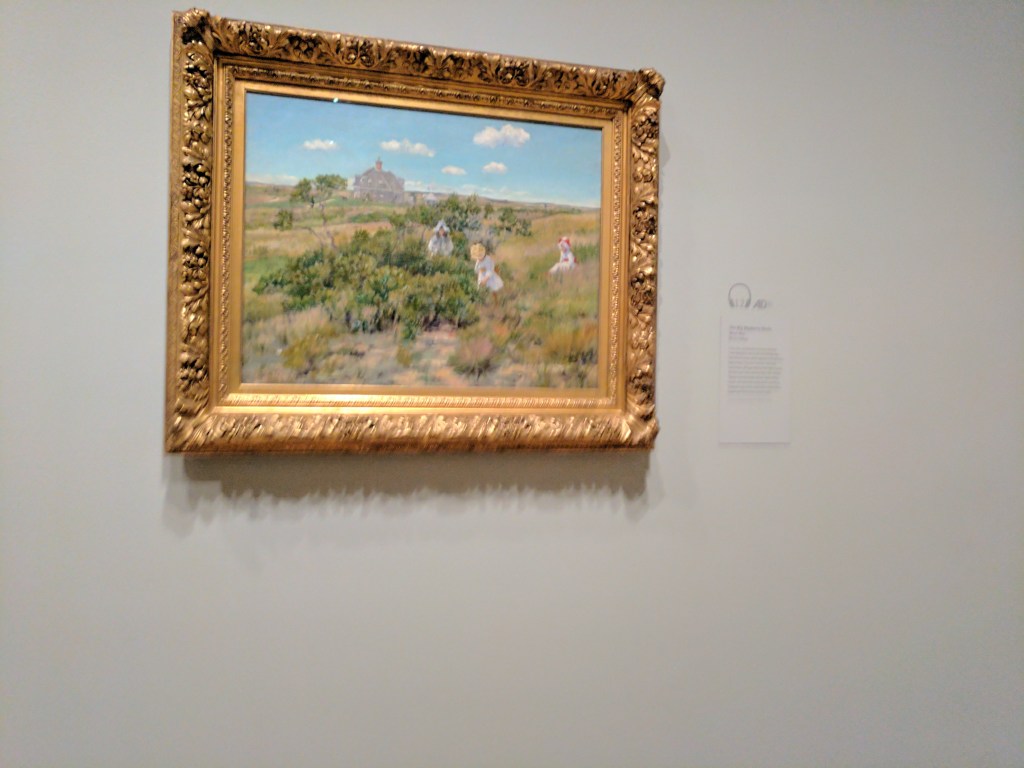
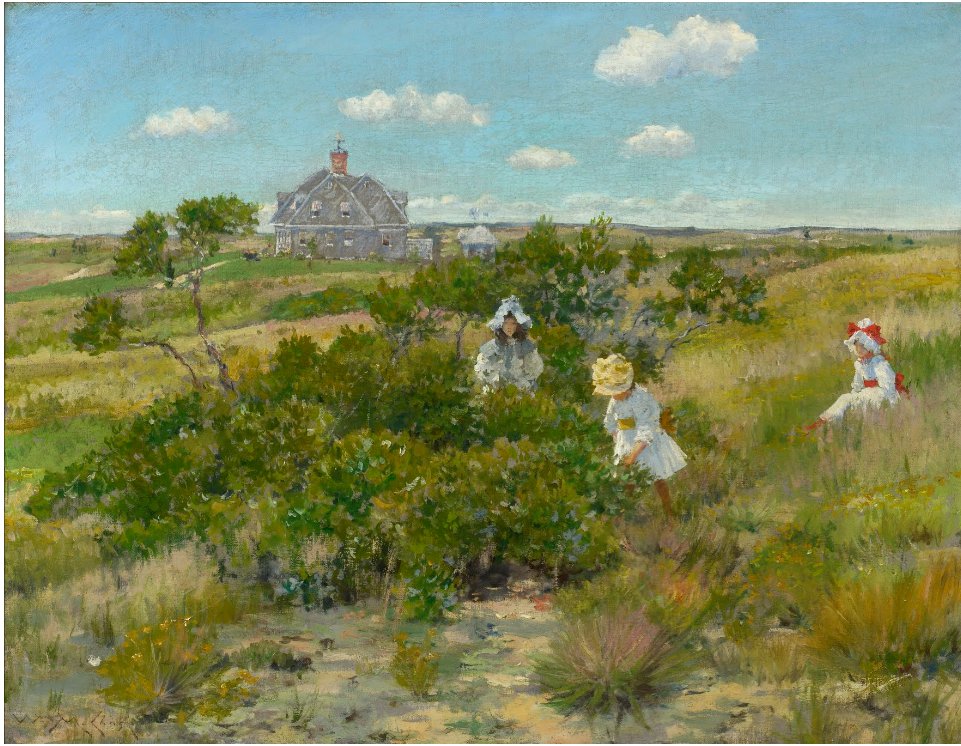
Dry grass dunes and vegetation in the Hamptons on Long Island by American artist William Merritt Chase, art world famous in his day, and one of Hopper’s esteemed fine art professors. Photos: C. Ryan. Installation views from the William Merritt Chase exhibition at the MFA in 2017. Shinnecock Hills of Southampton seen in two works: Bayberry Bush 1895 (Parrish Art Museum) and Seaside Flowers (Crystal Bridges) The photo with the supercharged green is how it’s often depicted, but not how I experience this Chase series in person. (Chase painted a bevy of great dogs in other works.)

The Saturday Evening Post

The Saturday Evening Post’s tag line “Founded 1728 by Benj. Franklin”

Select to enlarge pages and pinch or zoom. PDF below. Lassie Come-Home by Edward Knight with illustrations by Arthur D. Fuller. The Saturday Evening Post. December 17, 1938

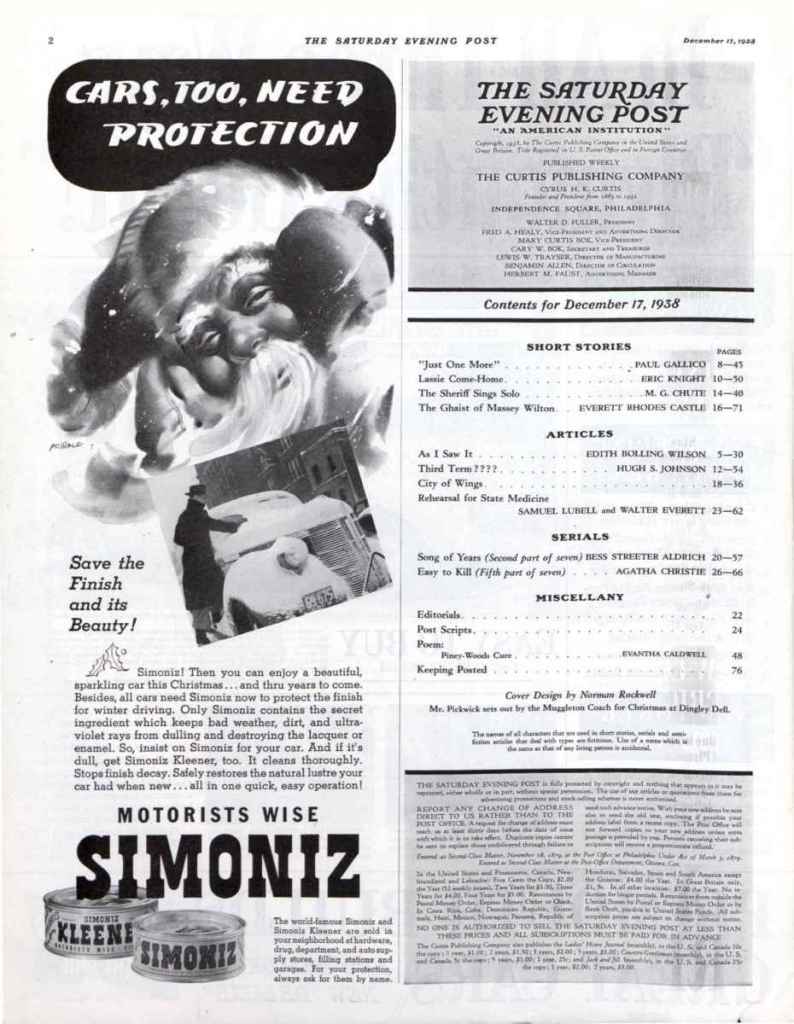
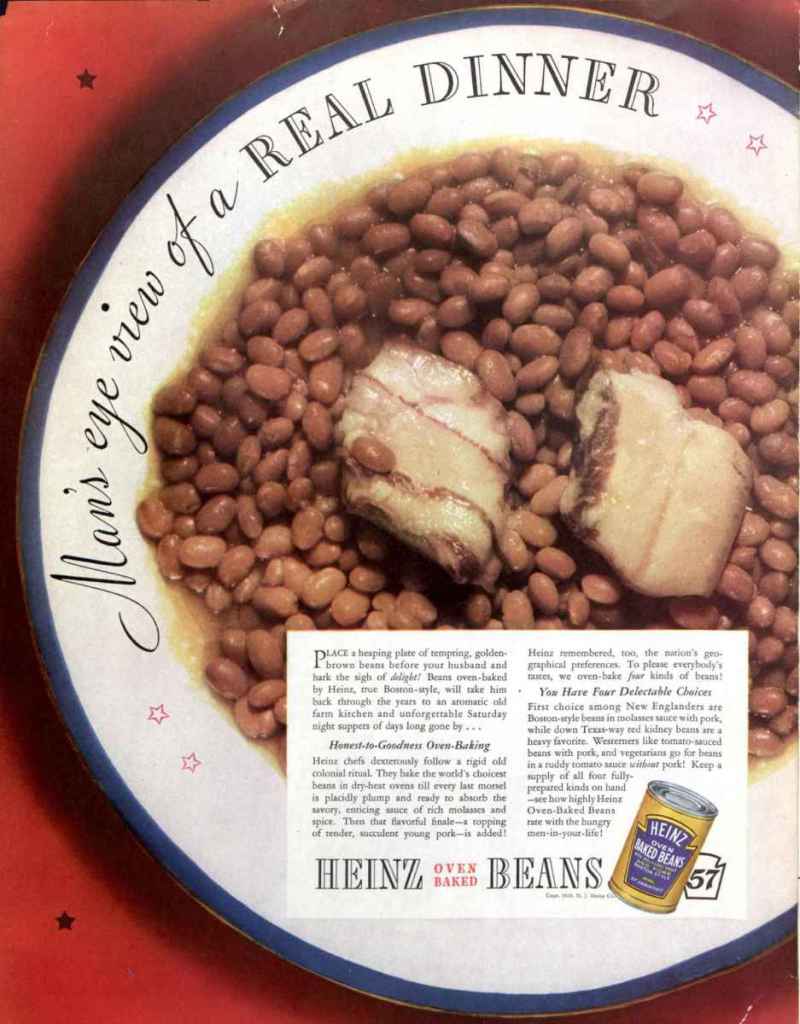
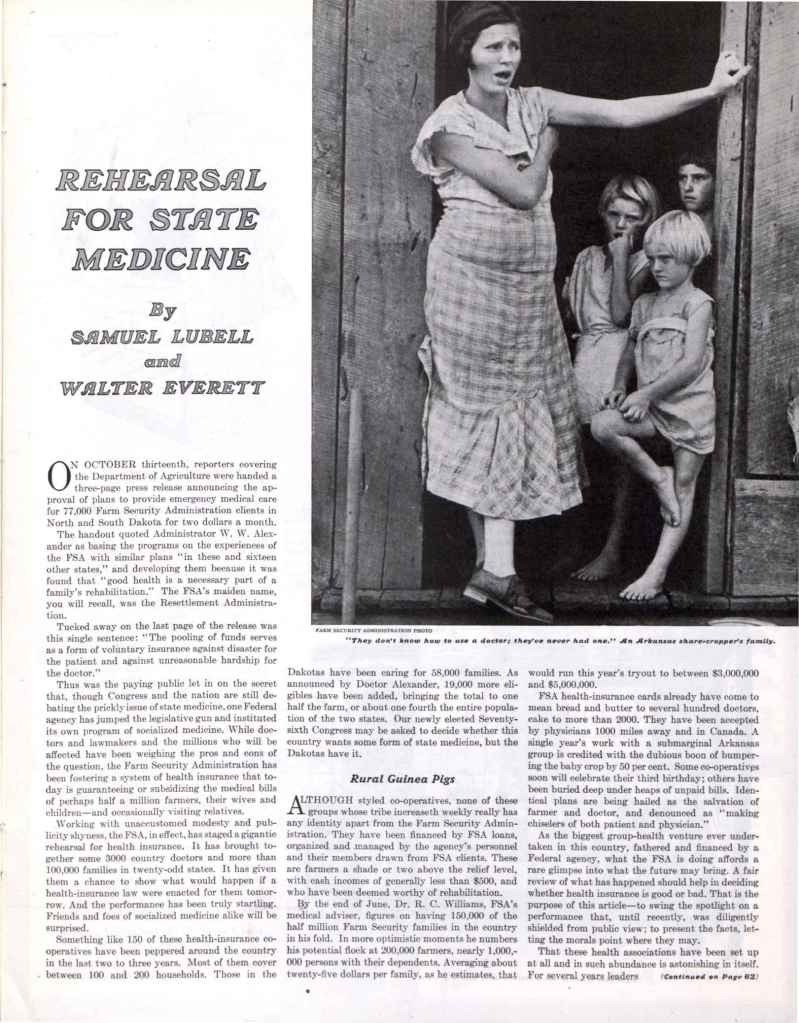
The issue also featured a Norman Rockwell on the cover, a serialized Agatha Christie installment, an investigative long read about universal healthcare– illustrated with a Farm Security Administration (FSA) photograph by Arthur Rothstein in Arkansas, circa 1935–and several classic ads. New Yorkers Jo and Ed Hopper did not eat at home much, and when they did…beans were a big draw. The prominent full page color Heinz ad was on the inside cover of this issue. I do not know the illustrator of the Gulfpride Oil ad, but it’s great. For more information about the FSA and Arthur Rothstein with a timeline continue reading here ; for more about Roy Stryker & the origins of the FSA and Gordon Parks continue reading here; and for more about the FSA and Howard Liberman continue reading here.


-by Catherine Ryan

cryanaid.com Edward Hopper All Around Gloucester

**First published 8/26/2023 on the occasion of National Dog Day. August 26 is International Dog Day. **

Was Lassie on Edward Hopper’s mind in 1939?

**August 26 is International Dog Day**

Illustrations: The short story, Lassie Come-Home by Edward Knight with illustrations by Arthur D. Fuller*, was an instant must-read-and-share when it was first published in the popular magazine, The Saturday Evening Post on December 17, 1938. Edward Hopper painted Cape Cod, Evening in 1939. *The illustratorโ€™s signature is tough to read without the credit beneath the byline. (Scroll down to see and read the story pages or to print a PDF. It’s a great read!)

You may know the memorable and unbreakable bond of the boy and his dog which Lassie Come-Home describes, and the small and epic journeys.

The short story, Lassie Come-Home by Edward Knight with illustrations by Arthur D. Fuller, was an instant must-read-and-share when it was first published in the popular magazine, The Saturday Evening Post on December 17, 1938.

Edward Hopper painted Cape Cod, Evening in 1939.

The short story is set in England and opens with a small family of three in recurring and searing pain: Two parents who have fallen on hard times and are under great emotional strain struggle to comfort their only child because they sold the family dog. Their beautiful collie, “Lassie”, is so devoted to their son, the dog runs away from the new owner straight back to the boy over and over again. Under the circumstances, any and every solution is untenable. His parents’ misplaced anger, adult exchanges, and silence confuse the boy. Their anguish and love is palpable.

Out of desperation, Lassie is removed to Scotland which they believe will be an insurmountable distance to cover.

It’s not. And no wonder a legend is born!

The first Lassie novel was published in 1940. Swift adaptations followed. It’s easy to see how the story resonated with American audiences during the Great Depression, even perhaps the great American artist, Edward Hopper.

If not Lassie herself, it’s tempting to consider the intergenerational communication and couple dynamics explored in Knight’s story as themes Hopper noticed, too.

“…Then they heard his opening of the door and the voice stopped and the cottage was silent. That’s how it was now, the boy thought. They stopped talking in front of you. And this, somehow, was too much for him to bear. He closed the door, ran out into the night, and onto the moor, that great flat expanse of land where all the people of that village walked in lonesomeness when life and its troubles seemed past bearing…”

Lassie Come-Home, Edward Knight, The Saturday Evening Post, 1938 Dec. 17

Both used punctuation in titles. Knight offset the story’s title with a vital hyphen, Lassie Come-Home (command-comfort) that might have caught Hopper’s attention. Hopper used commas often for emphasis–as in Cape Cod, Evening.

Beyond the Great Depression, 1938 may have appeared especially distant, simpler, on first pass. Yet, with international tensions rising year by year and the horrors of WWI just a generation past, neither 1938 nor 1939 were simple. Jan Struther, another UK author, broached topics of peacetime, lengthy stasis, and looming loss in the popular Mrs. Miniver pieces, published in The Times London newspaper (1937-39 ), at the same times as Lassie. Reader’s Digest distribution was international beginning in 1938.

In Cape Cod, Evening 1939, Hopper’s dog reacts, hears something, like a whippoorwill, or so the story goes. (Lloyd Goodrich’s Hopper bio, 1971; also Gail Levin, 1995) Levin’s book takes time to introduce the reader to Hoppers’ friends, and so we understand the grief from the loss of their friend Harriet Jenness who died “in early July of 1939. It was she who had firmed up the Hoppers’ courage to build in the first place and provided a roof till theirs was done.” (Levin, 1995.)

Cape Cod, Evening is constantly changing because it’s laden with enigmatic motifs. It’s late summer and fall. Unsettling and calm. Are the man and woman taking a momentary break together (as with the son and father walking in the Lassie story) or engaged in a forced desist (as with the parents going silent in the Lassie story)? Active fight or passive summer ennui? And what about that evergreen Hopper forest at the edge? Is it a cool and reachable retreat? Are the trees leaning, falling? Is the sea of dry grass sunlit and waving or scorched and still? And why no path? The man and woman are lost in thought. Worried? Families will have to have difficult conversations. Some won’t return. And what about the significance of that star dog with the striking fur?

Hopper was 35 at the onset of WWI, registered, but not called for duty. He was 57 in 1939.

1939

Edward Hopper paintings dated 1939: Bridle Path (Bruce Museum of Art, CT), Ground Swell ( NGA collection), Cape Cod, Evening (NGA collection), and New York Movie (MoMa)

As a group, they make a strong case that Hopper was thinking about 1939 in 1939.
Edward Hopper and Jo Hopper were on the Cape when war broke out.

On August 29, 1939, friends dropped by their summer home in Truro and Jo Hopper noted in her diary how the woman said, “…Sheโ€™d been to England last week. Said they all prepared for wayโ€”everyone has his funkhole ready for an air raid.” On August 30 she added “E.” went to town on errands and picked up a magazine:

“Augu. 30. Still raining. After lunch E. went to P.O. & bought back kerosene, Readers Dig, postcard from Ginny at fair + the note from D R.โ€”to see us Sept. 18 at 11. Onion soup & banana salad for lunch & tummy ache over dishes. E. so tired. Standing up at canvas. Canvas seems standing still. But Iโ€™ve seen that happen before…”

Josephine N. Hopper, Aug. 30, 1929 diary page. Provincetown Art Museum Collection, 2016. “Donation by Laurence C. and J. Anton Schiffenhaus in honor of their mother Mary Schiffenhaus (a close and personal friend of Josephine and Edward Hopper)”

On September 1, 1939 Germany invaded Poland, and England and France declared war on Germany just two days later.

On September 3, Jo mentions art and war :

“…Eโ€™s 2 canvases*. Sailboat without sky as yet. Tonight Bertha Frank & Edgar Cobb came up to say good bye for the season. Everyone else in Truro had their supper dishes washedโ€”but we hadnโ€™t begun yet. E. was still working when they arrived. Heโ€™s been plenty interrupted today. We didnโ€™t swimโ€”it looked so cold. Ginny said not cold but very dirty + water full of pink jelly fish.

So war is declared today & yesterday we saw that over into Poland. E. had a Times yesterday & we saw that. How Nat. news dwarfs everything. Why Pittsburgh festivities. Why anything. E. said he could drive an ambulance. I hope not. We most of everything need to get well…”

Josephine N. Hopper, Sept. 3, 1939. *Ground Swell and Cape Cod, Evening

star dogs

Examples of dogs in famous visual arts and letters abound before Lassie. During WWI, the soon to be famous german shepherd puppy Rin Tin Tin was rescued from the battlefield by Lee Duncan, and brought back to the United States. He was trained exceptionally well then on a hunch for the Silent Movie era. The original Rin Tin Tin’s first Hollywood movie was a bit part in 1922. He starred in so many box office hits, when he died in 1932 his death ‘stopped the presses’. Generations of Rin Tin Tin descendents followed, representing his public legacy if not his agility and acting chops. Other shepherds were used in later vehicles. For more about Rin Tin Tin’s global fame and impact and Duncan’s life–he did not trademark the name– see Susan Orleans biography, Rin Tin Tin: The Life and the Legend. (Also her short piece The Dog Star, New Yorker, Aug. 2011 and a preview excerpt NY Times Oct. 2011.)

And before Rin Tin Tin? There would be no Dorothy without Toto. Frank Baum wrote the The Wizard of Oz in 1900. The production of the movie adaptation made news and was released August 29th, 1939. It failed to earn a profit until re-releases decades later.

Jack London’s Buck in The Call of the Wild debuted in 1903.


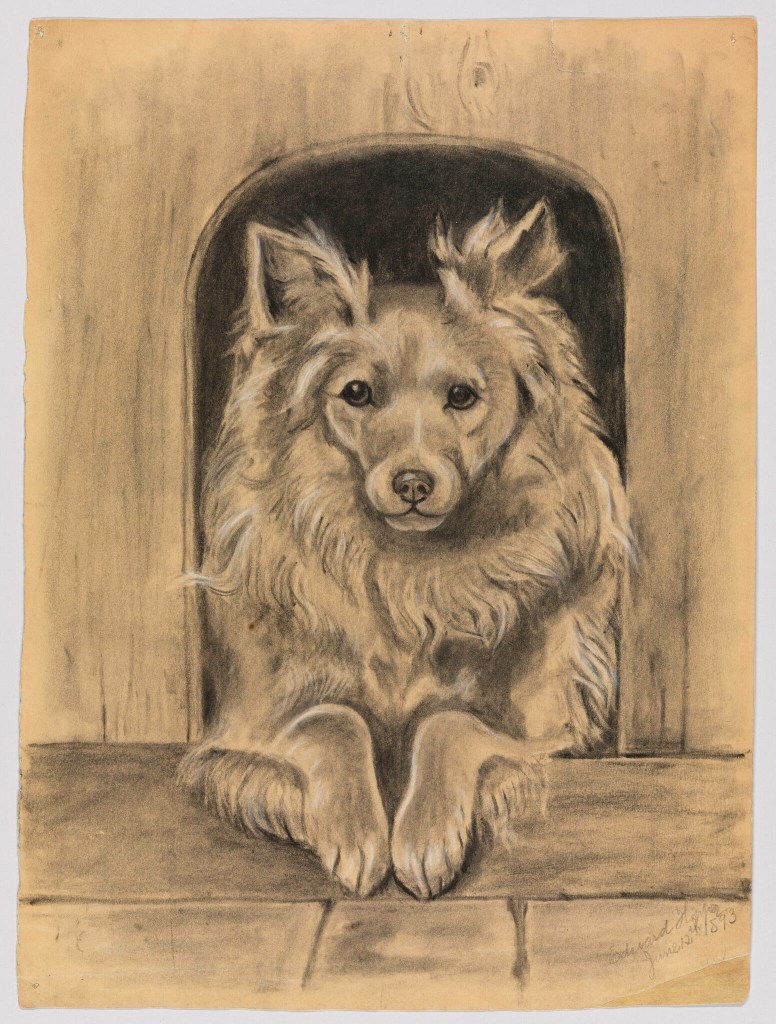
The Whitney Museum holds an early portrait drawing by Hopper of a contented dog–framed in a doghouse door naturally–dated 1893.
Edward Hopper Cape Cod, Evening 1939 was acquired by the National Gallery of Art in 1982.

Beach Grass, architecture, Color, composition, And…

I think about Wyeth and Chase a lot when I look at Hopper’s Cape Cod, Evening. Same when I encounter any one of the three.

Wyeth

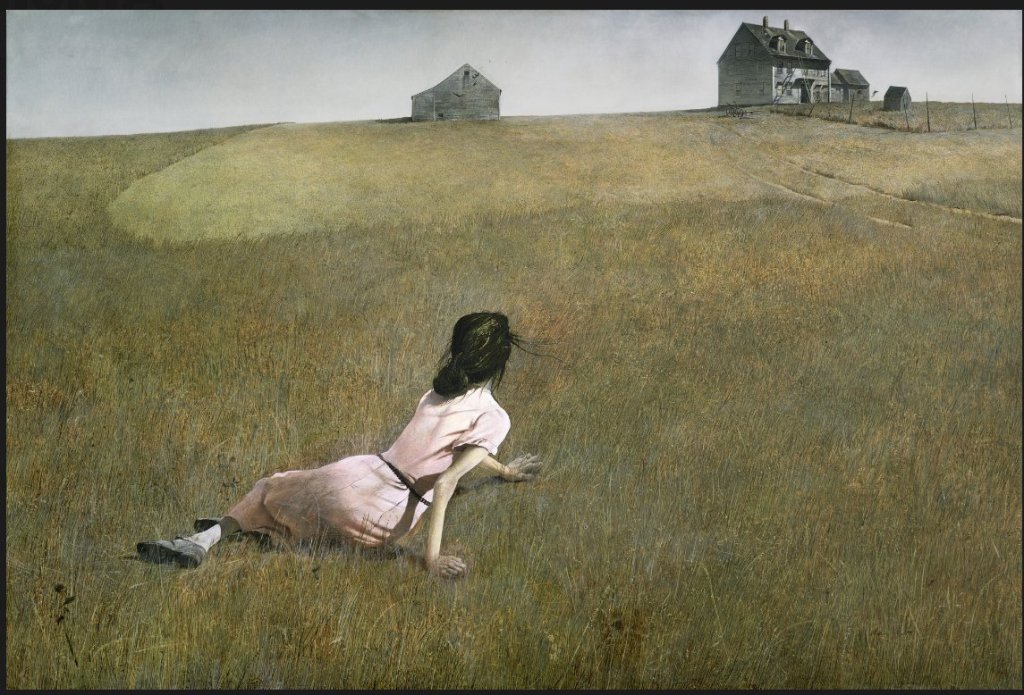
A decade after Cape Cod, Evening, American artist and fan of Hopper, Andrew Wyeth, completed Christina’s World, 1948 (Museum of Modern Art, New York).
William Merritt Chase

Dry grass dunes and vegetation in the Hamptons on Long Island by American artist William Merritt Chase, art world famous in his day, and one of Hopper’s esteemed fine art professors. Photos: C. Ryan. Installation views from the William Merritt Chase exhibition at the MFA in 2017. Shinnecock Hills of Southampton seen in two works: Bayberry Bush 1895 (Parrish Art Museum) and Seaside Flowers (Crystal Bridges) The photo with the supercharged green is how it’s often depicted, but not how I experience this Chase series in person. (Chase painted a bevy of great dogs in other works.)
The Saturday Evening Post

The Saturday Evening Post’s tag line “Founded 1728 by Benj. Franklin”

Select to enlarge pages and pinch or zoom. PDF below. Lassie Come-Home by Edward Knight with illustrations by Arthur D. Fuller. The Saturday Evening Post. December 17, 1938
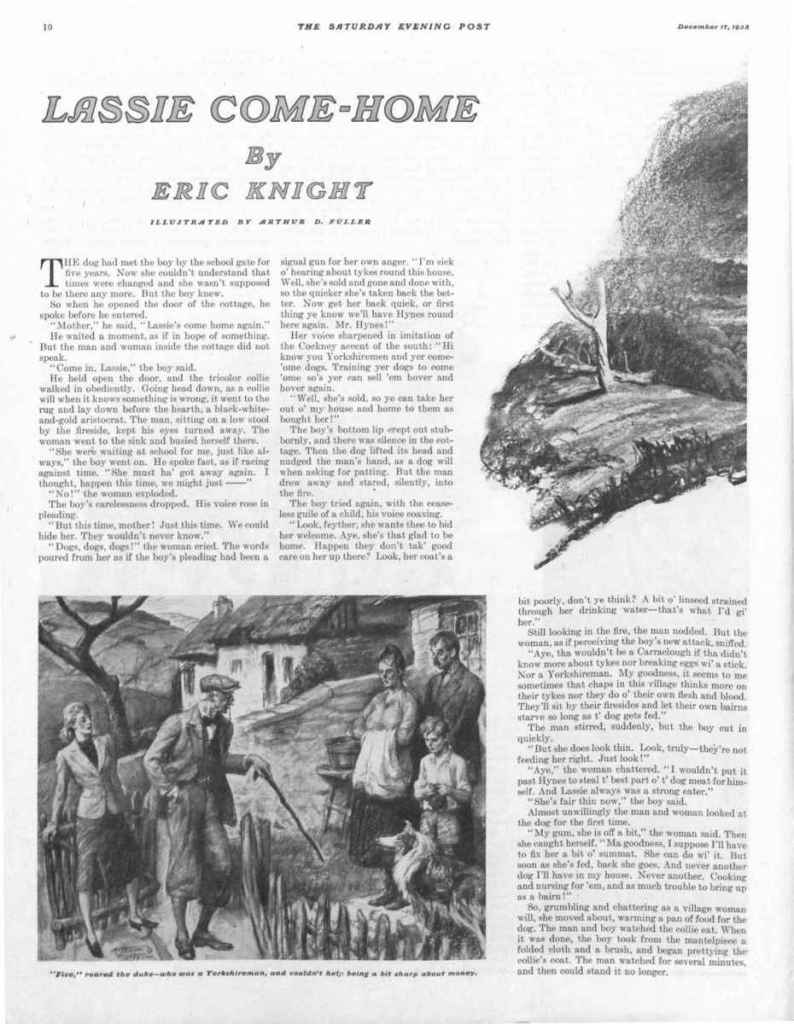
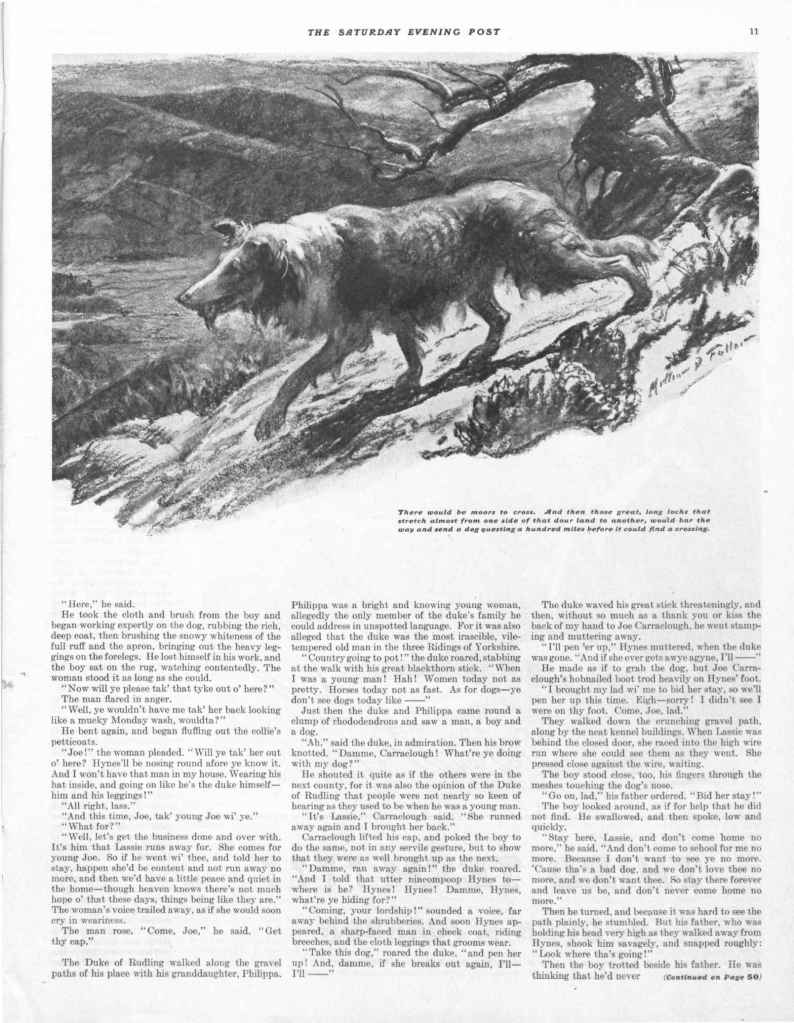
The issue also featured a Norman Rockwell on the cover, a serialized Agatha Christie installment, an investigative long read about universal healthcare– illustrated with a Farm Security Administration (FSA) photograph by Arthur Rothstein in Arkansas, circa 1935–and several classic ads. New Yorkers Jo and Ed Hopper did not eat at home much, and when they did…beans were a big draw. The prominent full page color Heinz ad was on the inside cover of this issue. I do not know the illustrator of the Gulfpride Oil ad, but it’s great. For more information about the FSA and Arthur Rothstein with a timeline continue reading here ; for more about Roy Stryker & the origins of the FSA and Gordon Parks continue reading here; and for more about the FSA and Howard Liberman continue reading here.


-by Catherine Ryan

cryanaid.com Edward Hopper All Around Gloucester

**First published 8/26/2023 on the occasion of National Dog Day. August 26 is International Dog Day. **

WHAT’S THE ART DISPLAYED BEHIND GOVERNOR BAKER? Here’s a tip for all those political handshake photographs: please add the artist and art to the list of names

Cat Ryan submits-

Joey, Good Morning Gloucester is really something! After my post about local artists and art displayed in City Hall and the White House Collection, the artist, proprietor, FOB, and fun Pauline Bresnahan sent me a picture with a note. She was thinking about art at the State House:

โ€œYesterday the Mayor was sworn in at the State House (for the Seaport Economic Advisory Council) and she put some photos on FB and I was wondering who did the painting over the Governorโ€™s shoulder in the photo that I attached and am sending to you?โ€

Hereโ€™s Paulineโ€™s attachment

https://gm1.ggpht.com/IZ4fCXxXy5iDiwitCBA6o4aiYEYFLJCY9BJ6UJwJab3A_x2Gs4GH7NUEhuv_jA5918aM6XUN-Agrsxmjimt9mMImZe46sKYWXmBVwWFkt7X1yOPPL8Js5oKSzftP4BTz0sWaFWNPXGvyt430nFCURL127FAXMkfQfl_siBB45jqf6lgMz0ltD6vcEsT0c6WQoBIrhgFVhoVvW1IKq5rYWJwQ6mhgfP8qP9ktyS2oXMtMIygPFnhptDCOn5uJnASwaOMRE1lEShCrJ4aVBm3fFrNOIJRTe7Pj1RrQ5nRWasDLnnP4ETcHuksc3v4HD19LBZXeKoTUe7u1D8SV25IRb7a4xfuYh2VkJhb1z0JGKS3-vvl3YVo1HyWsJN4KJcIio_y3YF4h790jI_RzU1c2T8Fq9TdrIGg-pmrCmhbxJSE5h96iTbuOcavv9_BhNpd9kitlRt4QfhRZh8ExAcf7swcIzpR2_8HtcZ2em3GmmiVXqErUh8RA_gIQuhZOvwQgOvXdviEYjtxf8Ei3vGvy2kgQP0ZIF1VI7jSgX2MUeBCm1OtP8NhF8MxT6fMbkP0SctKI4h2UUwjnw1gEkavFqalKSES9YmnJ_EOLCOenYIEtqo0Vw5Ar3R6oJzIn=w480-h640-l75-ft

The dramatic harbor scene is on loan from the Museum of Fine Arts, Boston and was created by JONAS LIE (1880-1940), The Fishermanโ€™s Return, ca.1919, John Pickering Lyman Collection, Gift of Miss Theodora Lyman.

You read that correctly. His name is โ€˜Lieโ€™. I know, located in the State Houseโ€”the state capitol and house of governmentโ€”the symbol of the Commonwealth of MA, politics and its peopleโ€”it may seem at first an unfortunate selection when you read the surname.

Not to worry, his painting skills and life story are a great fit for the State House.

Lie was a well-known early 20th century painter and his peers considered him a master. One example of his stature and connections: Lie, Stuart Davis and Eugene Speicher were charged with the selection of paintings as members of the Central Arts Committee for the legendary exhibit, American Art Today at the 1939 New York Worldโ€™s Fair. Holger Cahill was their Director. Artists John Gregory, Paul Manship and William Zorach selected sculpture. John Taylor Arms, Anne Goldthwaite and Hugo Gellert selected the prints and drawings.

Is there a Gloucester, MA, connection? You bet โ€“and one you can see in many of Lieโ€™s works. He was a summer traveler to Cape Ann before WW1 along with other New England locales through the 1930s because he was a mainstream American artist of his time. He had a studio on Bearskin Neck and lived on Mt. Pleasant in Rockport. Later the studio was Max Kuehneโ€™s. 

Lie was born in Norway to an American mother, Helen Augusta Steele of Hartford, Ct. His Norwegian father, Sverre Lie, was a civil engineer. One of his aunts was the pianist Erika Lie Nieesn and he was named after an uncle, the major Norwegian writer Jonas Lie. After his father died in 1892 he went to live in Paris with family, before joining his American mother and sister in New York City the following year. They settled in Plainfield, NJ. After art studies, Lie found work as a shirt designer, took more classes, exhibited and received prizes. William Merritt Chase bought two works in 1905. In 1906, he traveled back to Norway to visit family and again to Paris. He was deeply inspired by Monet. When he returned he resumed his art career. He admired the Ashcan artists and their American style. Another trip in 1909 to Paris, Fauvism and Matisse. 

Lie painted the engineering project of his time, the building of the Panama Canal. The Metropolitan Museum of Art and the Detroit Institutes of Art acquired a work from this series. The rest were eventually gifted to West Point in 1929 as a memorial to US Army Corps of Engineers Colonel George Washington Goethals, Chief Engineer of the building of the Canal. Goethals was credited with having the forethought to ensure that a record of the project was preserved in art. Art form(s) actually. Leave it to the engineer to appreciate the art and beauty in industry. Right?

Lie was invited as a guest of General Goethals along with Joseph Pennell who created the gorgeous etching portfolio The Building of the Canal, 1912. Goethals also selected artist William B Van Ingen to paint 4 large murals, mounted on site in the rotunda in 1915. The Panama Canal opened softly the preceding year, on August 15, 1914 as World War 1 eclipsed any coverage.

Lie was involved with the installation of the famous Armory show of 1913, and 4 of his works were exhibited. In the printed matter, his name shows up alphabetically between Fernand Leger and George Luks. See the 1914 journal advert. Charles Hawthorne urged summer students to Provincetown while the New York School of Fine and Applied Art hoped that students would paint with โ€˜Jonas Lee, one of Americaโ€™s foremost paintersโ€™.  He was quite active in the arts community. He organized the Society of American Painters in 1919. He purchased a home in the Adirondacks to be near the hospital where his wife sought treatment for and eventually succumbed to TB. In 1933 he gave Amber Light, a painting of FDRโ€™s yacht to the President, his friend.

Lie is known for his vivid color and impressions of New England harbors, boats and coves, painted during summer visits, his New York City scenes, landscapes, seasons, Utah copper mines, and the Panama series.

What about the Governorโ€™s suite, the historic restoration, the Governorโ€™s portrait, protocol and tradition?

The Massachusetts State House includes the state legislature and the offices of the Governor. The 1798 building was designed by Charles Bulfinch and was designated as a National Historic Landmark* in 1960. This magnificent landmark needed an overhaul and major renovations. Restoration has been happening throughout the structure, mostly for the first time in a century.  Itโ€™s difficult to invest in heritage and modernize facilities without public criticism. Years of research span terms. The Governor suite in particular came under fire for its historic restoration. It was expensive.

โ€œThe executive office now looks like it did in 1798, Petersen said. It cost $11.3 million to renovate and restore these 19,000 square feet of the State House, including the lieutenant governorโ€™s office, constituent services on the second floor, and what will soon be an emergency response room on the fourth floor. The executive offices now have temperature control, wireless Internet capability, sprinklers, blast-resistant storm windows, security cameras, including some with facial recognition, and sensors that can detect if a room is occupied.โ€

Daunting! I can understand why Governor Baker selected the former Chief Of Staffโ€™s office for his everyday office. “I want a regular office where I can spill a cup of coffee and not worry about it,” the governor said.

The Jonas Lie painting is prominent in nearly every ceremonial signing and photograph because itโ€™s hung directly behind the Governorโ€™s desk. It is difficult to find any mention of the artist and painting. When staging formal photographs if there is a featured artwork in the frame, it is my recommendation and hope that credit to the artist and artwork are listed along with people featured in the photograph.

The State House is working on their website and thereโ€™s a great virtual tour. Visit https://malegislature.gov/VirtualTour

So what does the Governor see from his vantage of the signing seat during ceremonies and meetings? More tradition, history, and art. Each incoming Governor selects a portrait of a former Governor which is installed above the mantel and across from the desk.  Former Governor Patrickโ€™s choice was John Albion Andrew, Massachusetts 25th Governor. Governor Baker selected former Governor John A. Volpe, a North Shore Wakefield native, who served 1961-63 and again 1965-69, the first 4-year term in MA. He resigned midterm in his final year to accept President Nixonโ€™s appointment to head the Department of Transportation. You can read more about it here http://www.nga.org/cms/home/governors/past-governors-bios/page_massachusetts/col2-content/main-content-list/title_volpe_john.html

The incoming Governor selects this portrait fairly quickly. Volpeโ€™s national policy led to Amtrak. With the winter and MBTA crises at hand, comparisons can be drawnโ€ฆI will ask! I havenโ€™t been in the Governor offices. But Fred Bodin and I had a great look around earlier this year and Senator Tarr gave us a brief impromptu tour. Ask him about the Cod. There was an installation of local artists in the hall outside the Senate Chamber. 

*Boston has 58 properties with National Historic Landmark designation. Gloucester has 2: Schooner Adventure and Beauport. City Hall should/will have this designation.

Link to yesterdayโ€™s post https://goodmorninggloucester.wordpress.com/2015/08/11/this-is-what-gloucester-looks-like-at-the-white-house-and-city-hall-its-all-local/

Also find it at Joey_Cโ€™s twitter http://t.co/upEgxcTajq