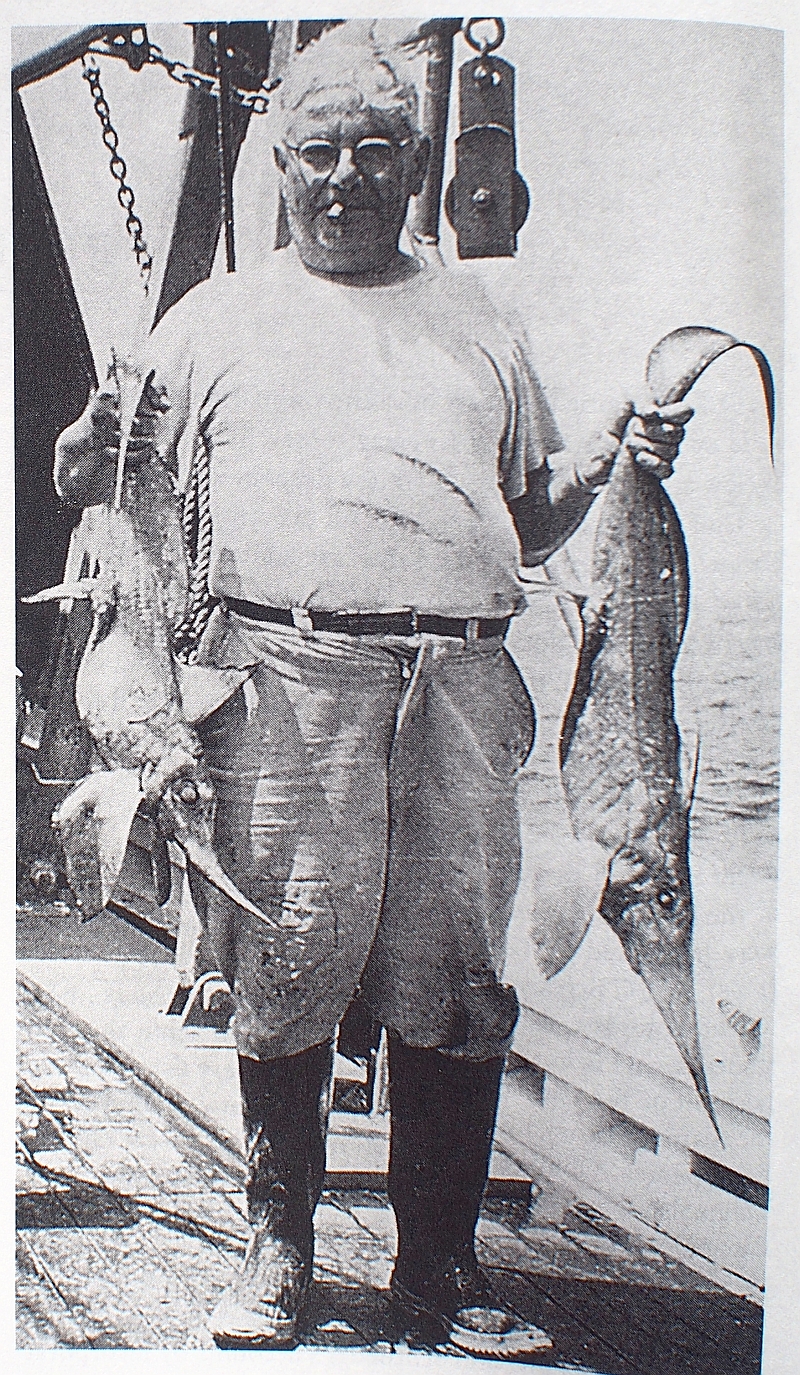
William C. Schroeder (1895-1977), coauthor Fishes of the Gulf of Maine by Bigelow and Schroeder (1953) online courtesy of MBL/WHOI http://www.gma.org/fogm/Default.htm
William C. Schroeder was born on Staten Island in 1895. He quit school at age 14 to support his mother after his parents separated and became a professional musician playing various stringed instruments at concerts that included an appearance at Carnegie Hall. He married Adah Jensen when he was twenty-one and enrolled at George Washington University six years later. Schroeder transferred to Harvard in 1924. He remained there until 1931, but started leading the dual existence common at the time as he was identified as an assistant Aquatic Biologist, U.S. Bureau of Fisheries in 1928 when he coauthored Fishes of the Chesapeake Bay with Samuel F. Hildebrand. This pattern continued when he took the position of business manager at WHOI in 1932. During the twenty years he maintained that position, he collaborated with Henry B. Bigelow to publish volumes one and two on the sharks and skates for Yale’s Sears Foundation Fishes of the Western North Atlantic, a new edition of Fishes of the Gulf of Maineand five other papers on lampreys, hagfish, sharks, rays and chimaeras.
By 1948 Schroeder was running out of fish to write about. He wanted to get to the edge of the shelf and seek the “little known bottom dwellers” that had not been sampled since the Fish Commission’s Fish Hawk dragged a small beam trawl from 50 to 600 fathoms in 1880. He tried trips on the R/V Caryn and Atlantis with tantalizing results but he craved a little more power and a little more wire. In the summers of 1952-3 Schroeder chartered Henry Klimm’s 83 foot Cap’n Bill II. One hundred and ninety three successful tows from 50 to 730 fathoms between LaHave Bank and Cape Charles produced 75 species of sharks, skates and chimaeras. One major setback was the implosion of the standard aluminum head rope floats that had to be replaced with glass floats. Another difficulty arose when the net would get plugged with big lobsters, ocean perch or red crabs. Bill Schroeder shrugged off these obstacles and brought home a lobster claw to Mary Sears. It fed sixteen people.
(From Woods Hole Historical Museum, “Four Fishermen” by Martin R. Bartlett)
Photograph: William C. Schroeder on board Cap’n Bill II, with chimaeras Harriotta raleighana in hand. (Photograph by Jan Hahn, © Sears Foundation for Marine Research)

 Good Morning Gloucester