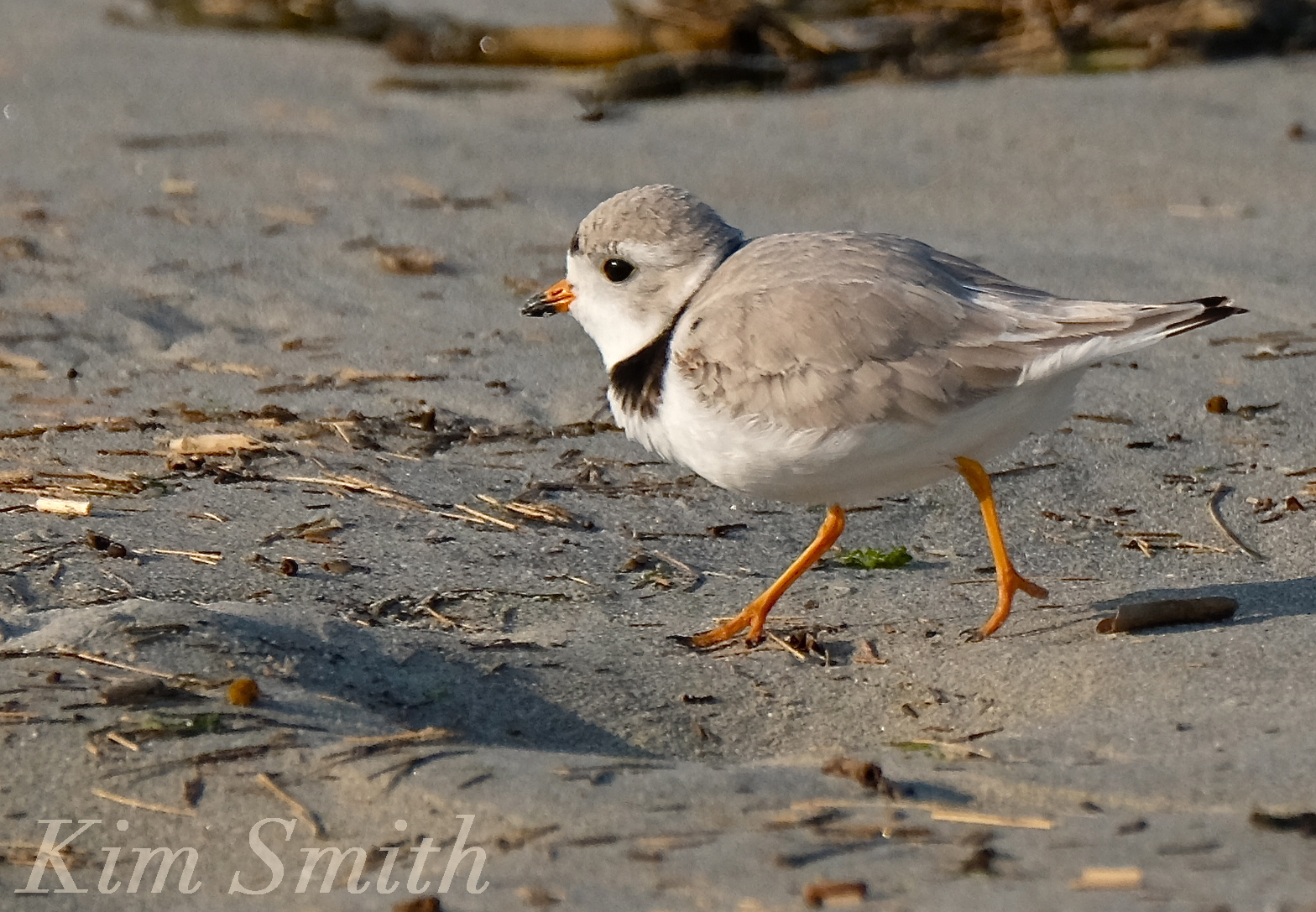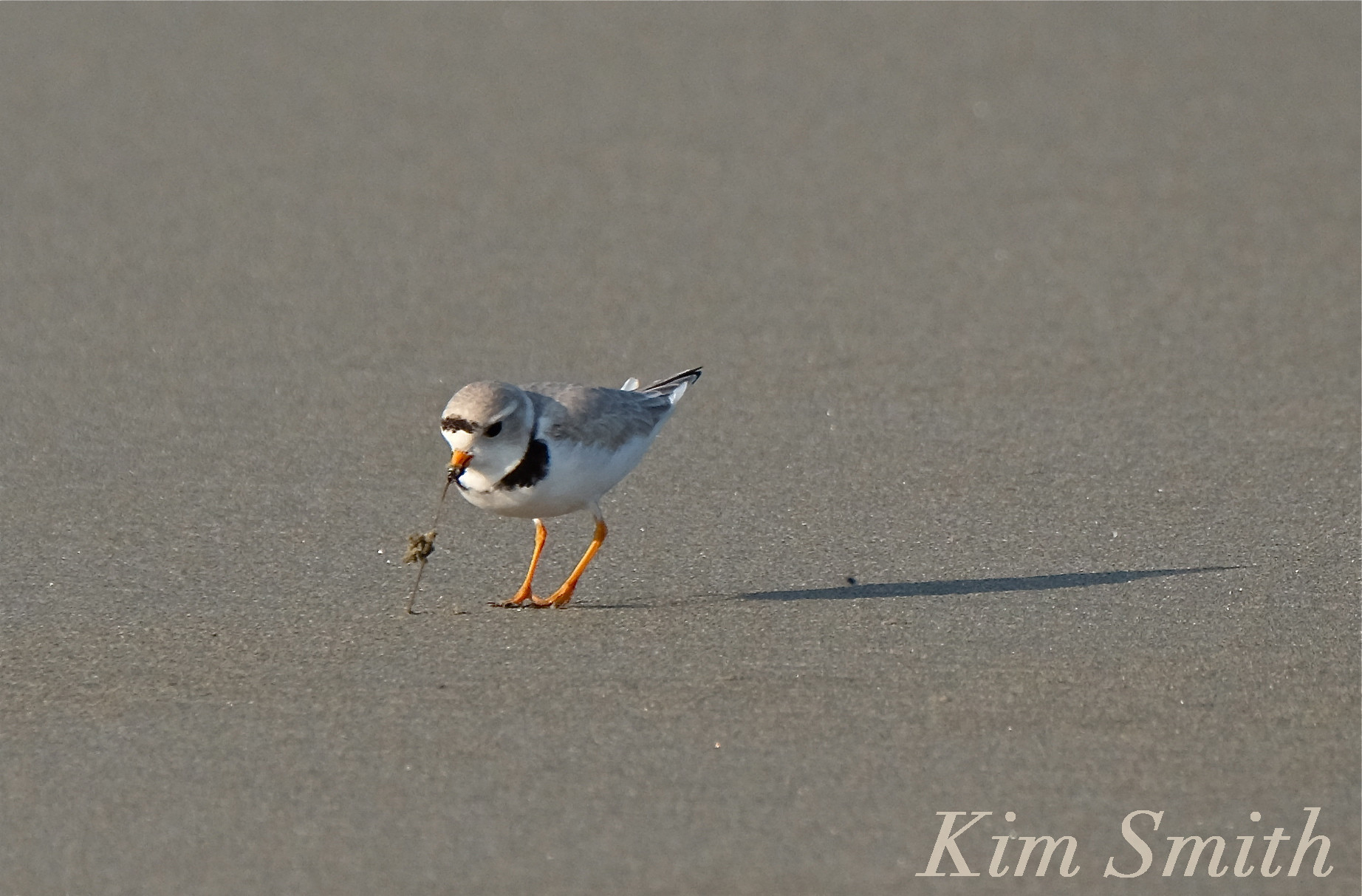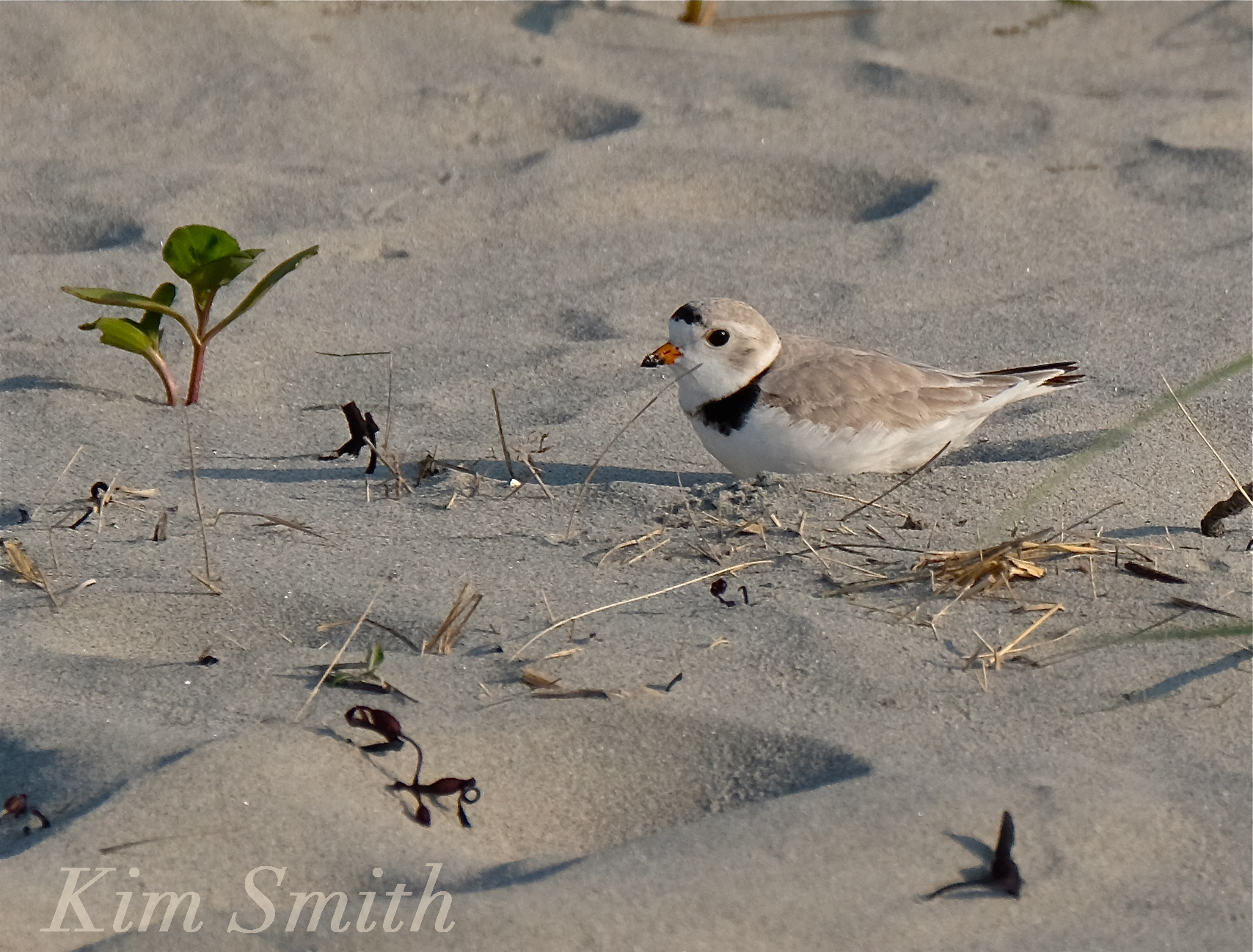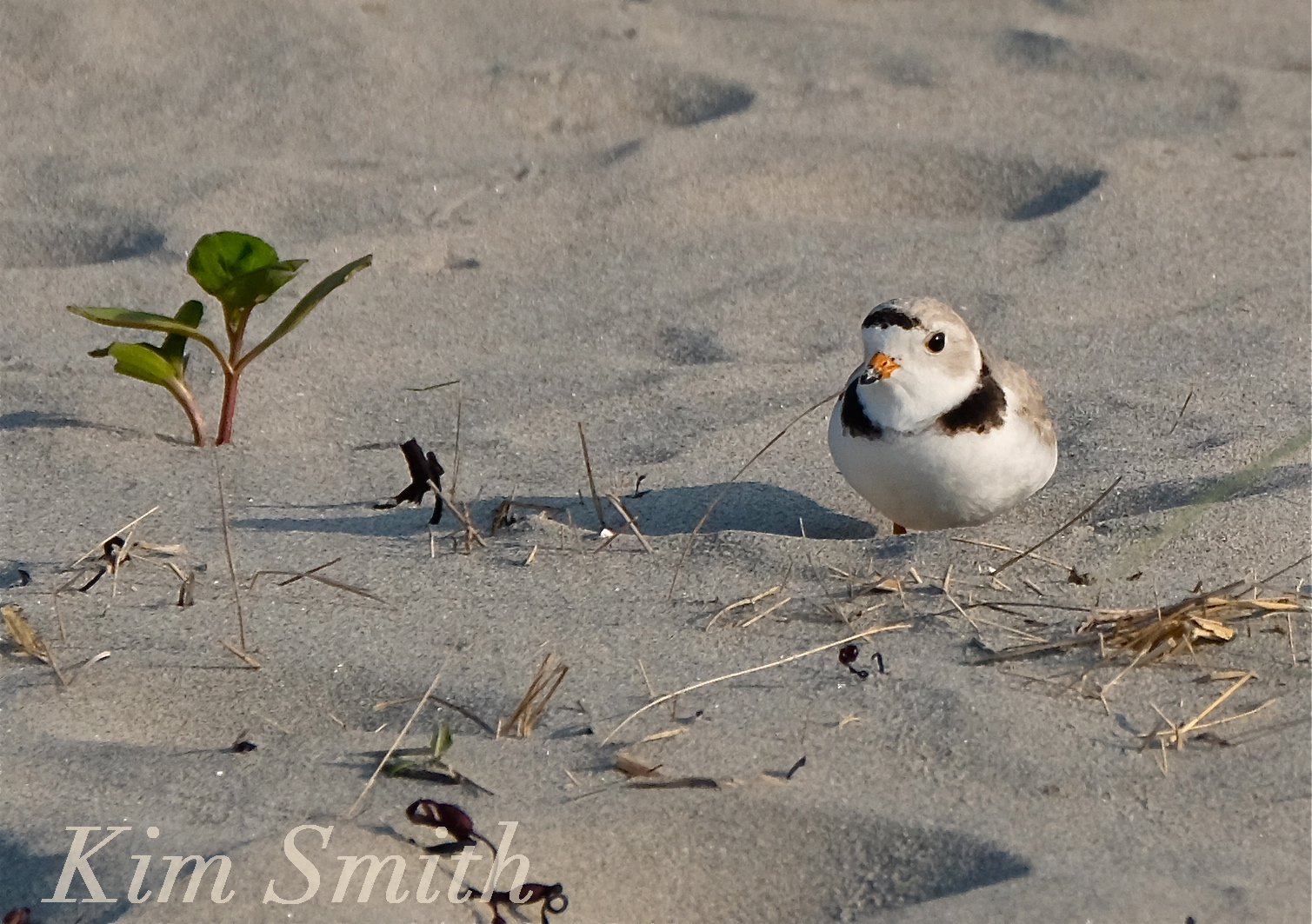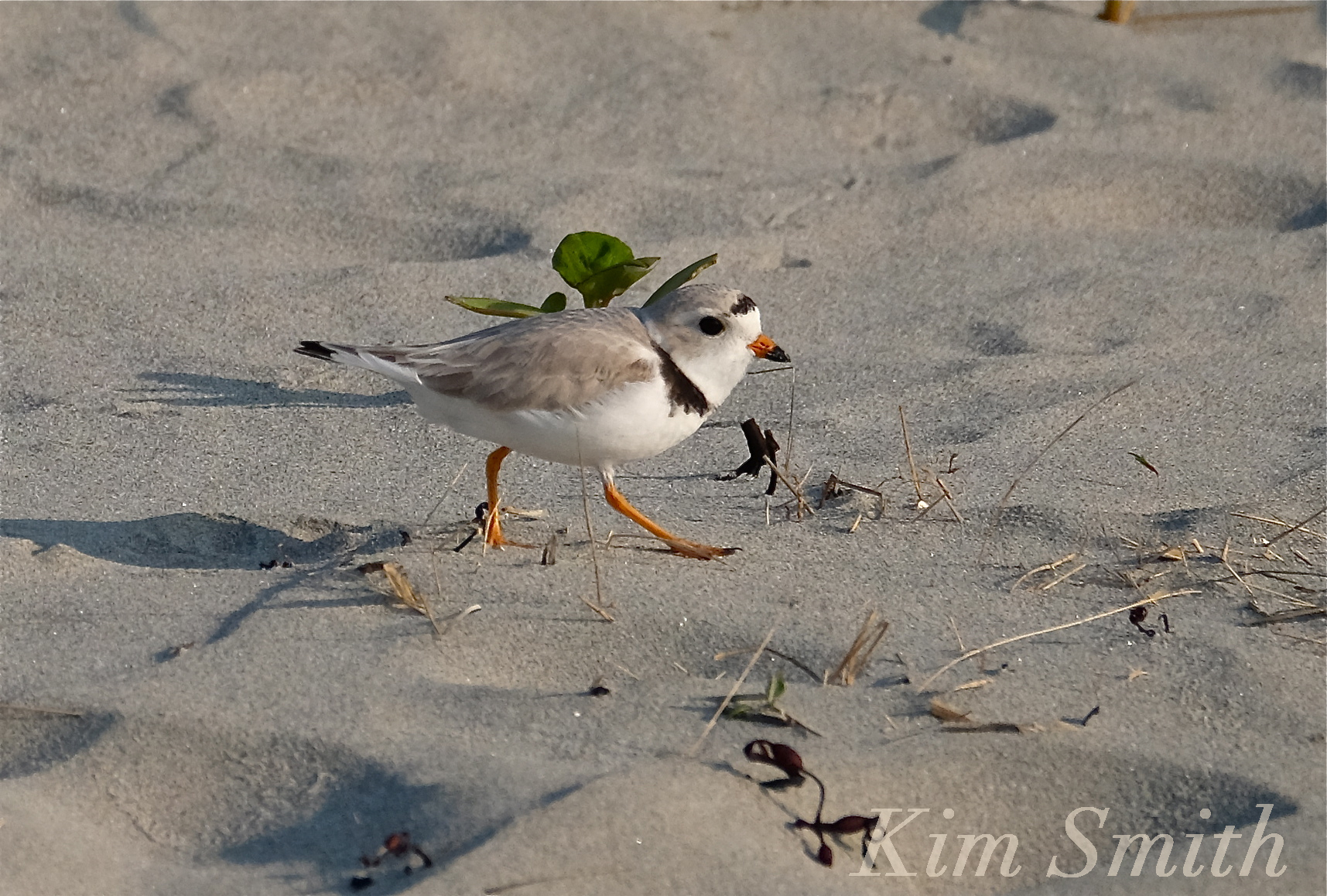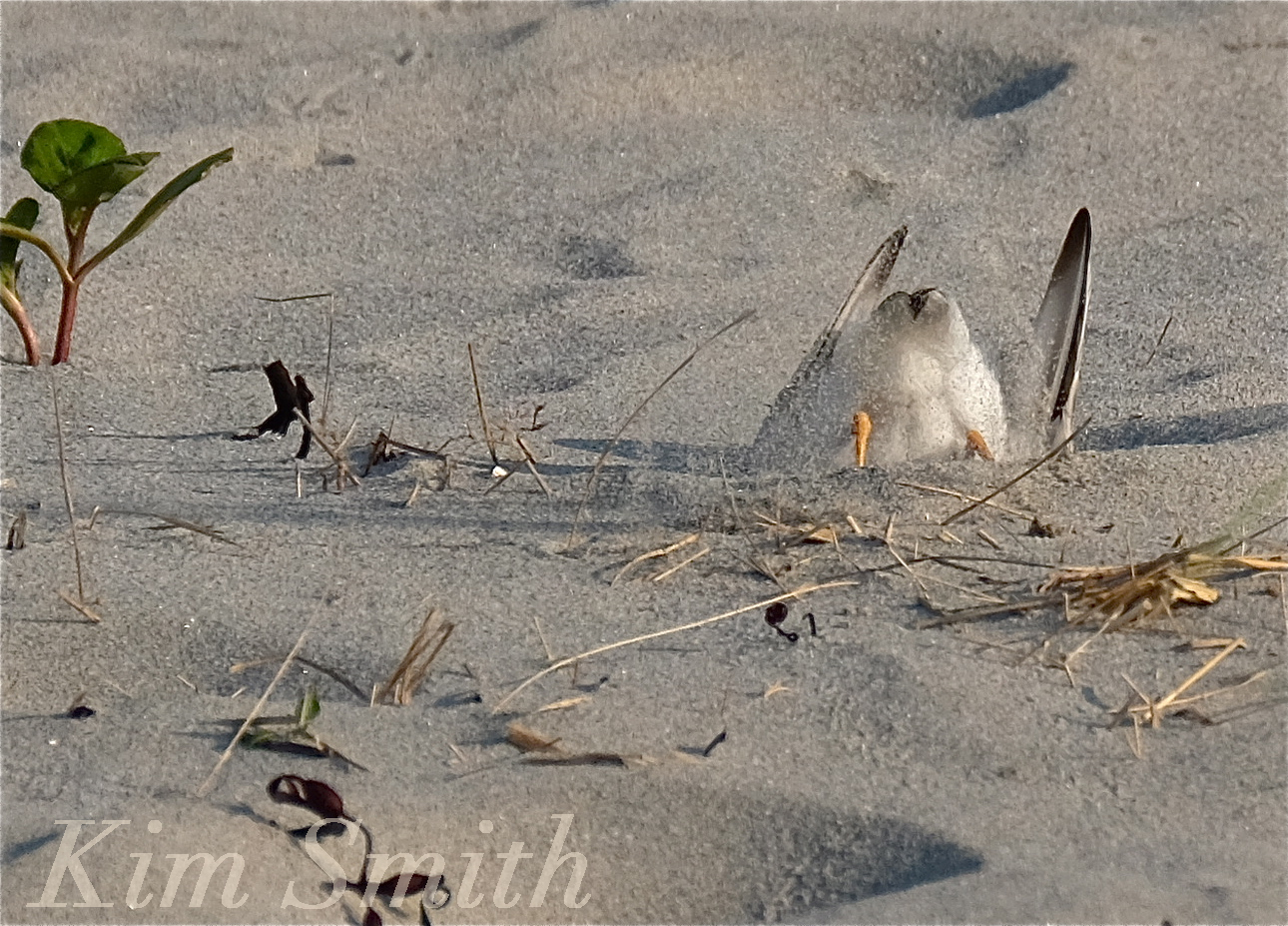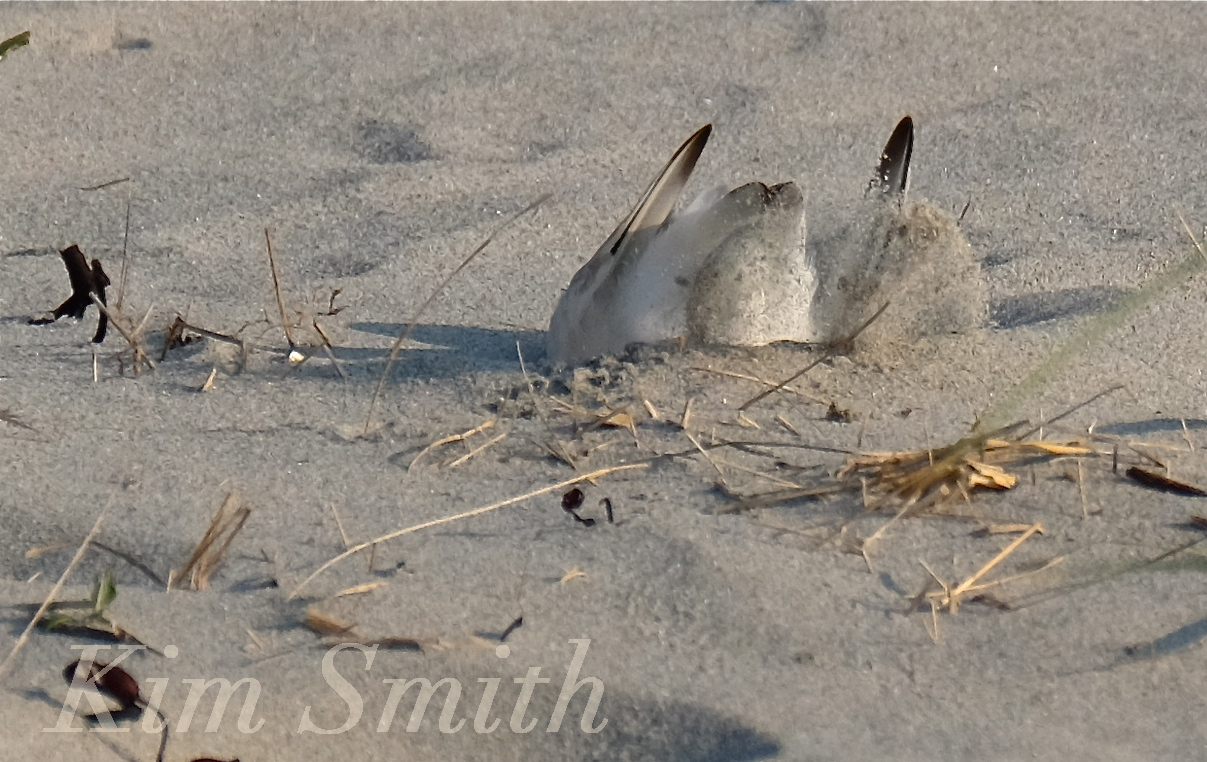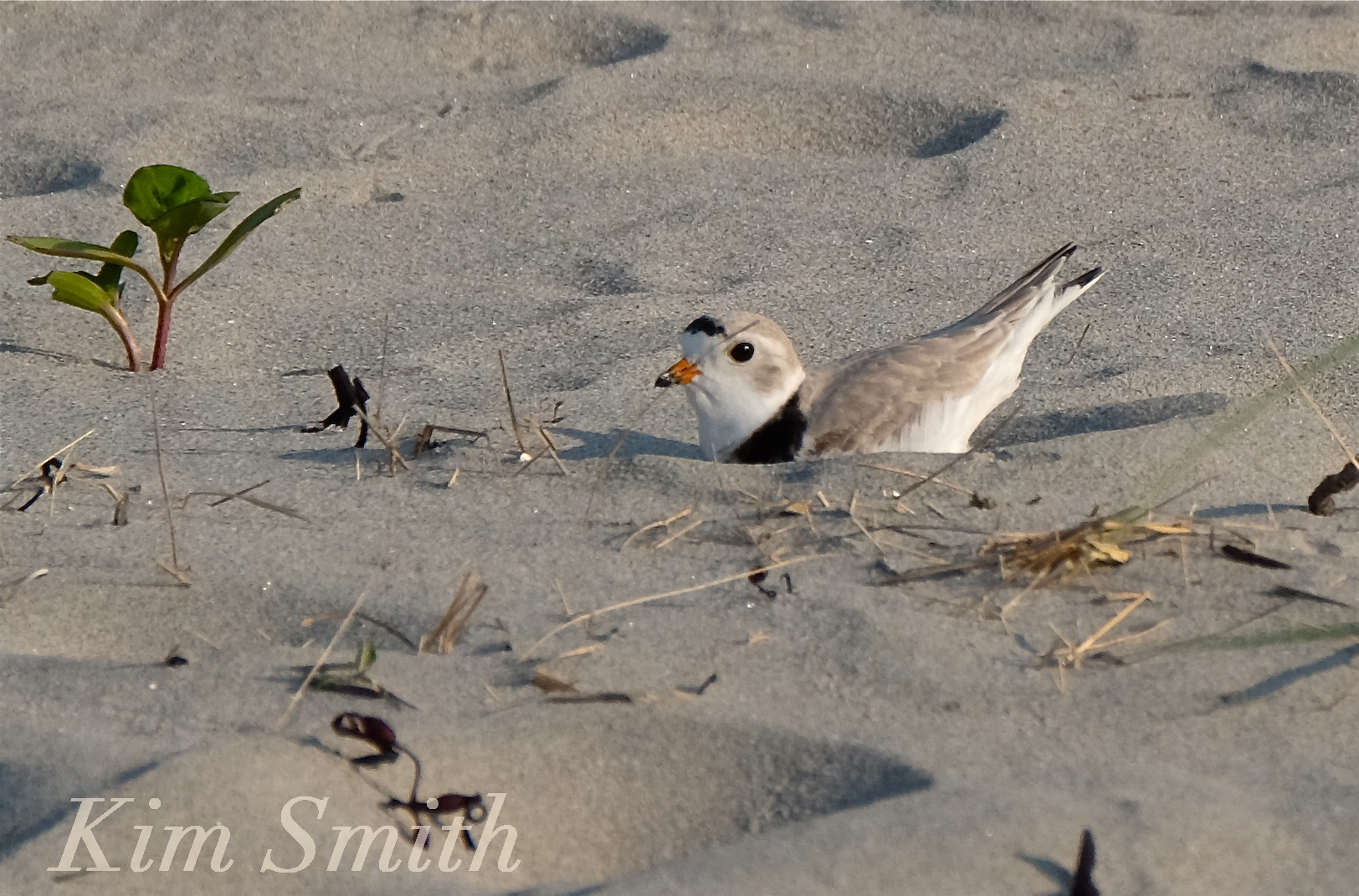
THREE ACTIONS WE CAN ALL TAKE TO HELP THE PIPING PLOVER CHICKS SURVIVE

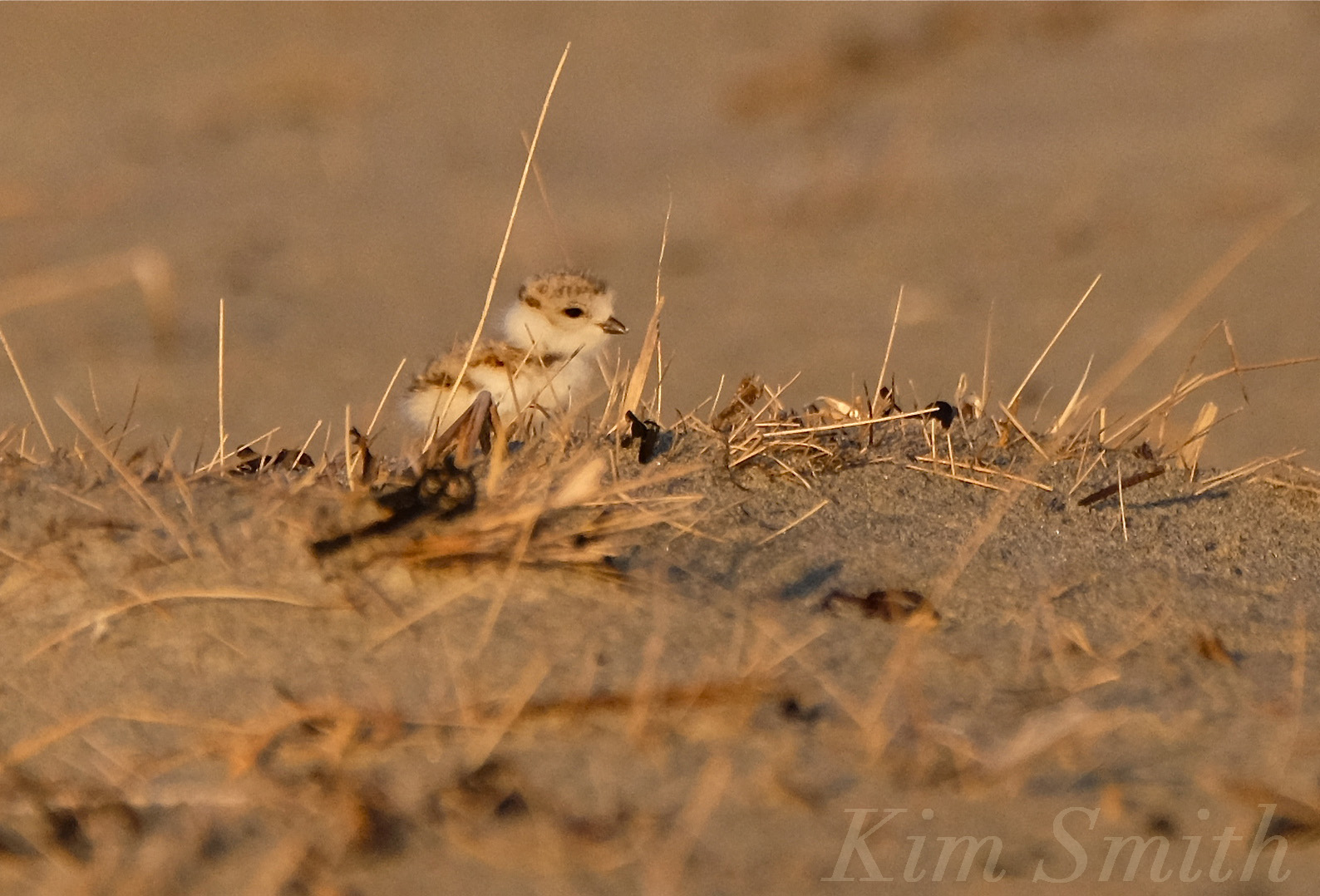
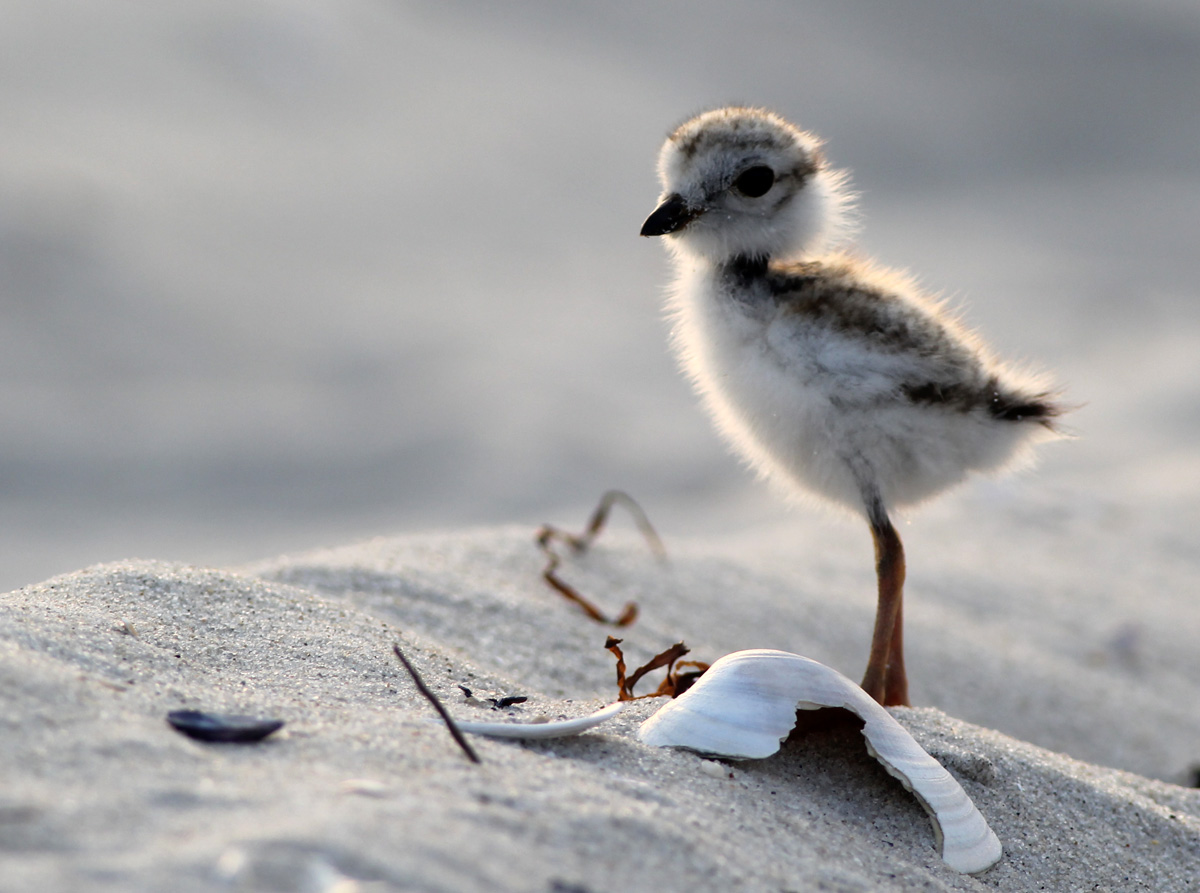
Piping Plover chicks nestlings -2 copyright Kim Smith 6-13-16ACTION NO. 1) HELP NEGATE THE LITTER PROBLEM

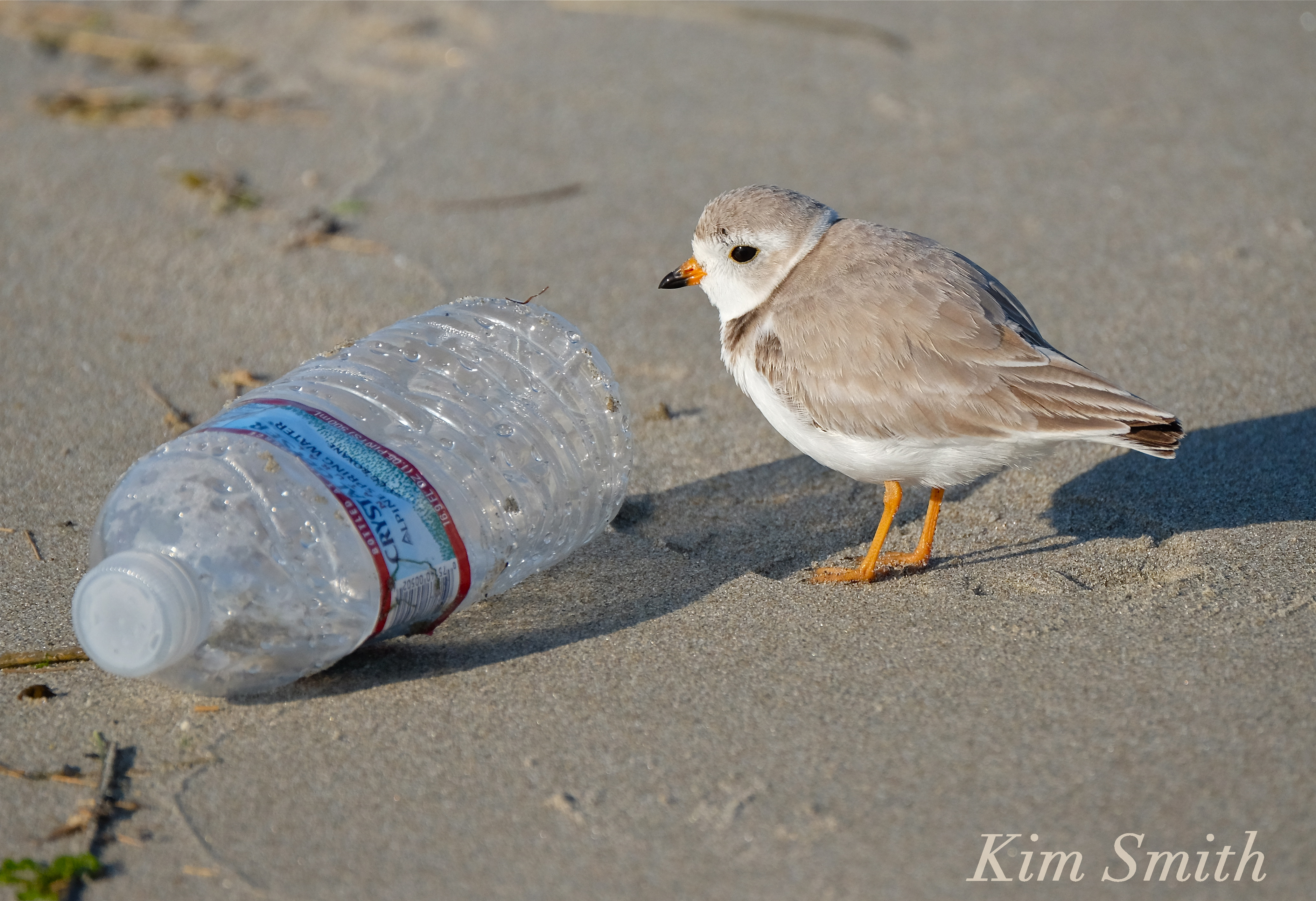
The number one threat to the Plover’s survival is the trash left on the beach. If you see someone littering, please remind them to clean up after themselves. Explain that we have a threatened species nesting on the beach and that the trash left behind attracts gulls and crows, which will undoubtedly eat the baby Plovers. Additionally, if you are so inclined and can lend a hand, please bring a trash bag and fill it on your way out. I know tons of friends already do this and it is a huge help. If more of us did it, and folks saw us doing it, they might be inspired not to leave theirs behind. If you see me on the beach filming, I now carry trash bags in my gear bag and would be happy to give you one. Getting rid of the trash on the beach doesn’t just help the Plovers, but all marine and wildlife.

ACTION NO. 2) HELP NEGATE THE THOUGHTLESS DOG OWNER PROBLEM

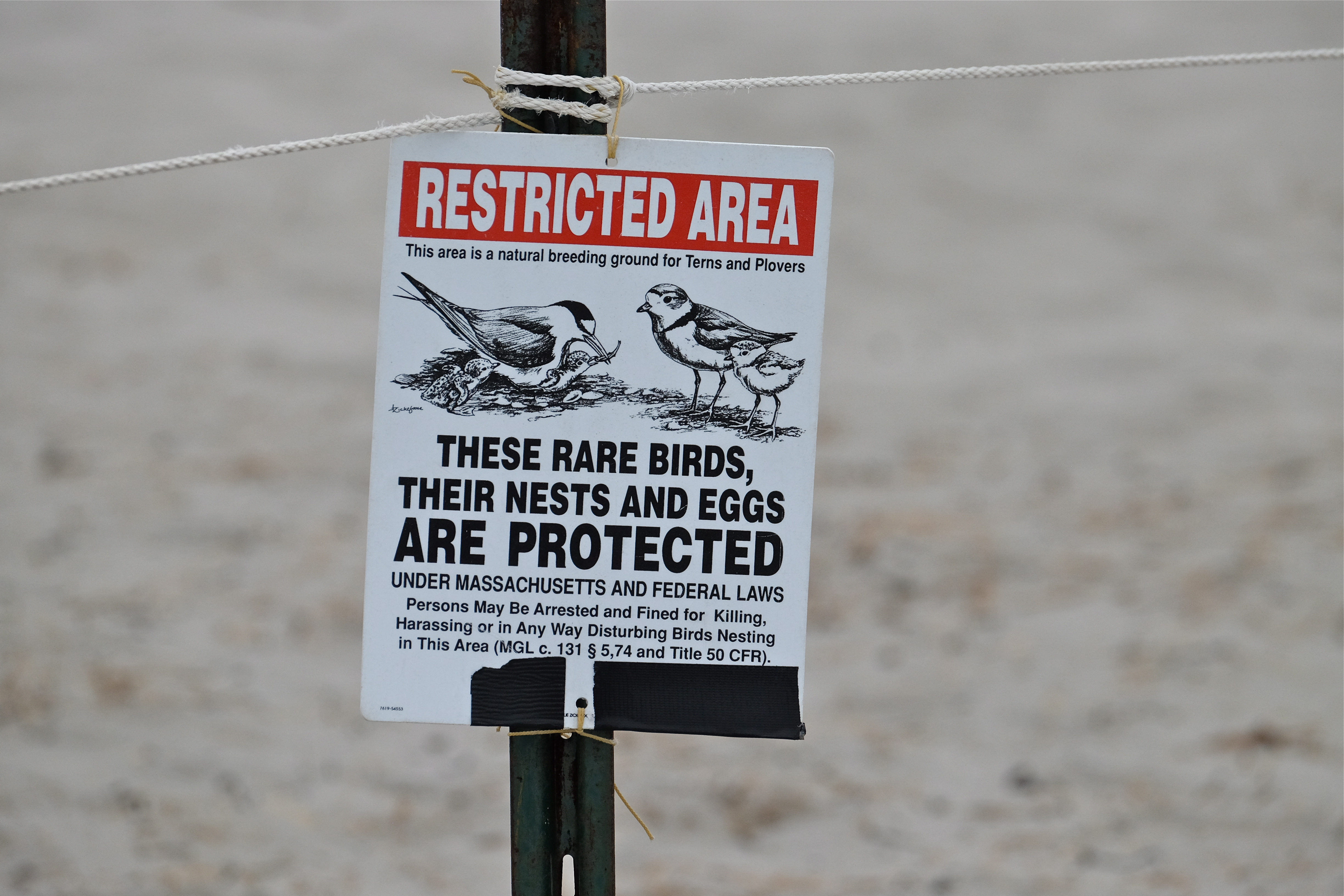
Inform the dog owner about the law. Explain to them that their dog, leashed or unleashed, can easily squish cotton-ball sized chicks. The babies are all over the beach now, not just in the roped off area. If the dog owner still disregards and if you can, take down their license plate number. I did it today for the first time and Diane, who is the animal control officer, just happened to be at the beach shortly after it happened. She asked for the information and studied the photo that I took to determine what type of dog.

ACTION NO. 3) HELP INFORM BEACH GOERS ABOUT THE CHICKS

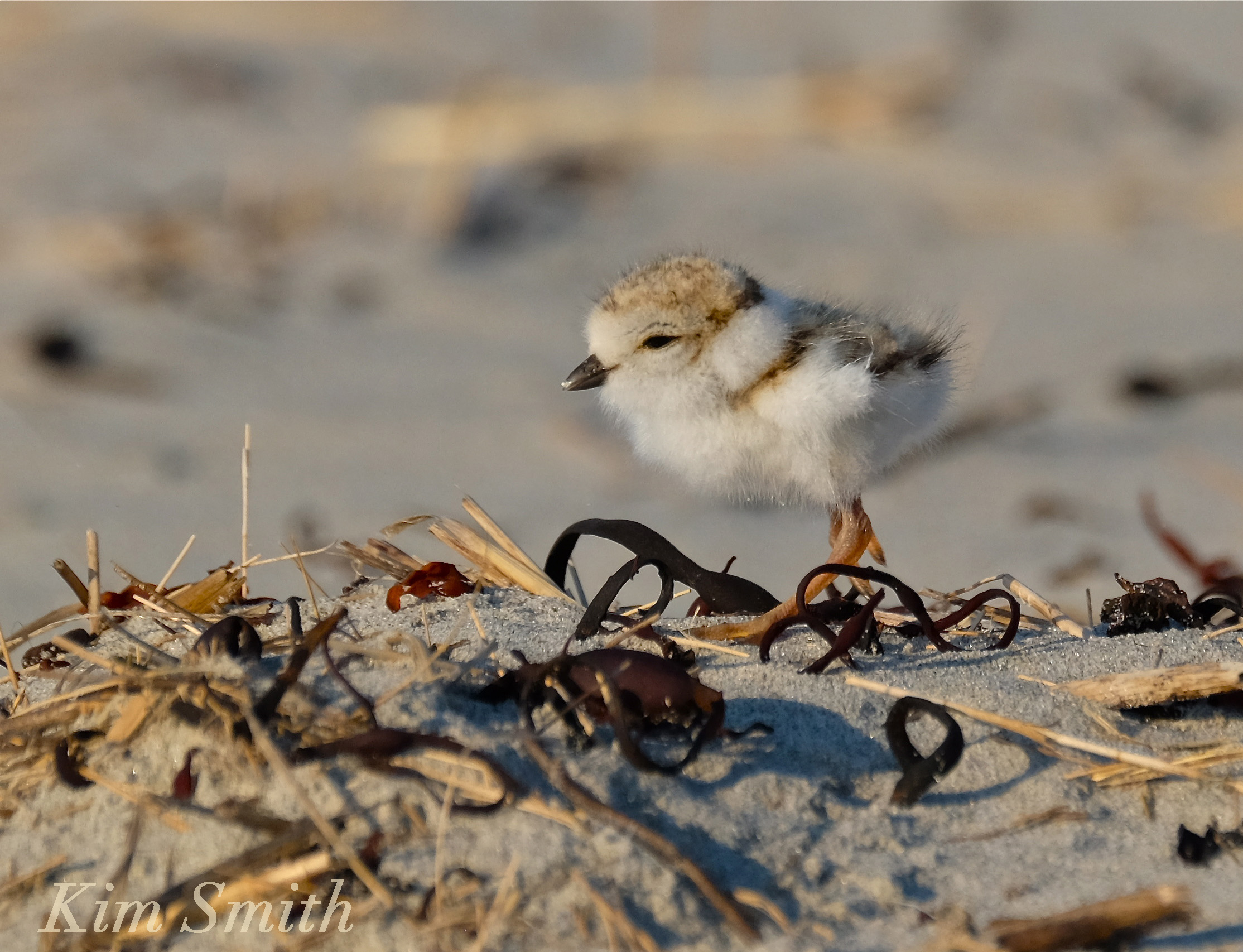
The baby Plovers are at their most vulnerable in the first 10 to 14 days. As of this writing, all three chicks have survived the first three days, and that is nothing short of a miracle. The Plovers chicks are now running to the water’s edge. Please walk carefully on the beach and along the shoreline as they are not yet quick enough to get out of the way. Upload a photo of a Piping Plover chick to your phone and show it to folks on the beach. Explain that they aren’t much larger than a cotton ball. Additionally, David Rimmer, Director of Land Stewardship at Essex County Greenbelt, who was checking on the Plovers this morning, is concerned that a child may see a Plover chick and try to catch it. This has happened! In case of any kind of emergency situation such as this, David urges that the the Plover be place in the cordoned off area.

Thank you for you help, and the Piping Plovers thank you, too!

Piping Plover chicks nestlings copyright Kim Smith 6-14-16In the above photo you can see how tiny the Plover chick is in relation to the sunbather.
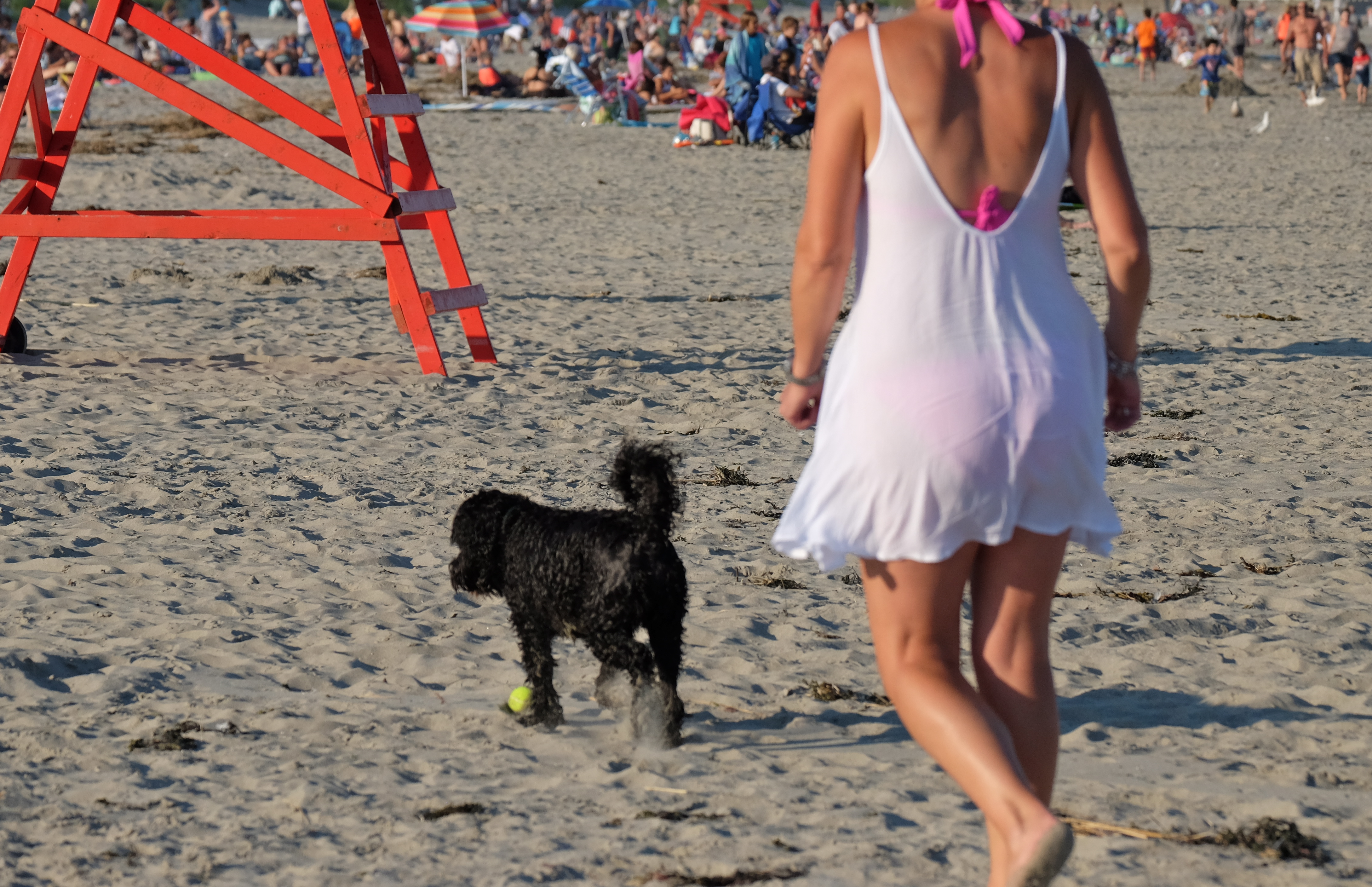
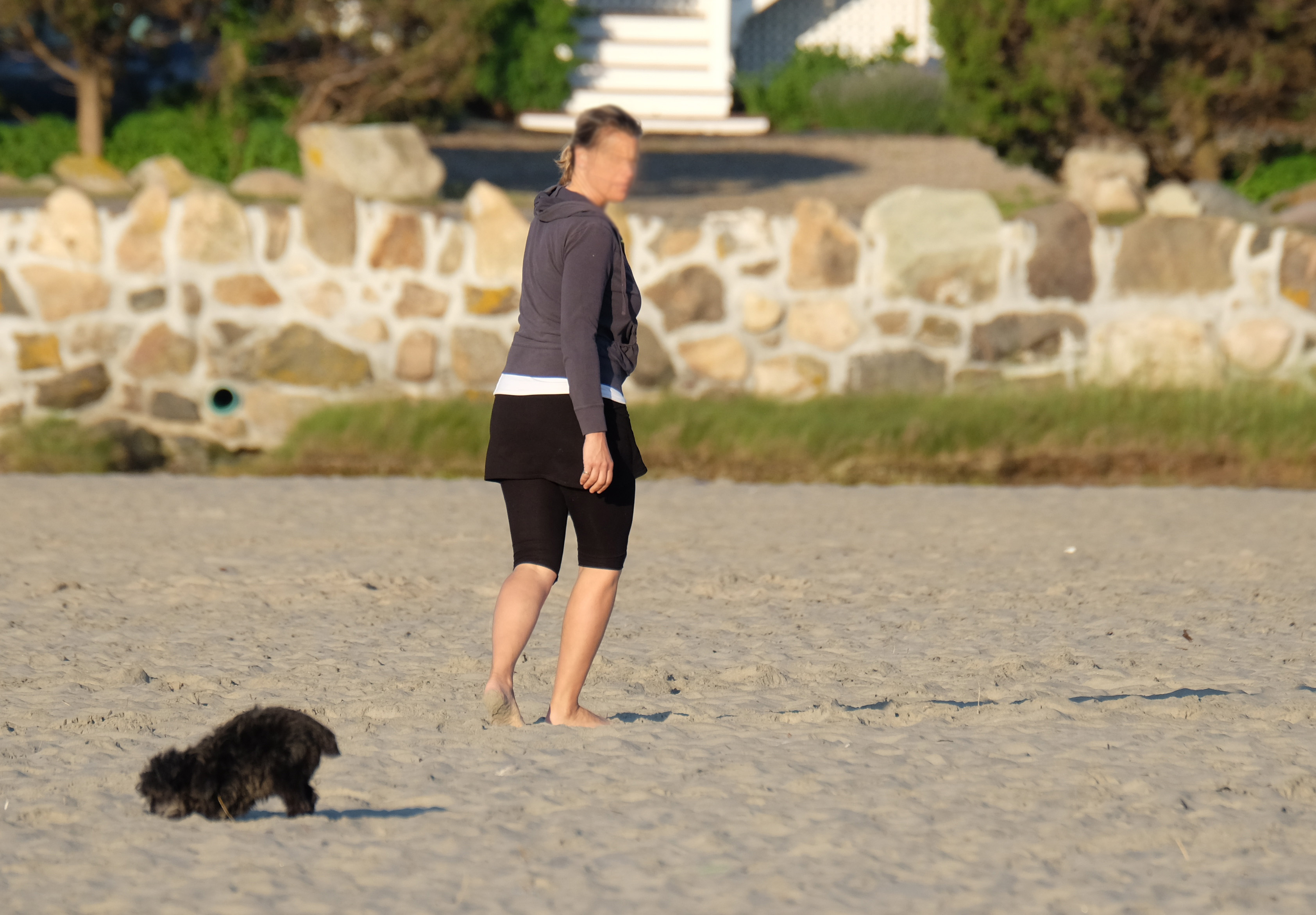
DSCF2770This woman claims she brings her dog every evening after five and states she has for fifteen years.

https://www.instagram.com/p/BH2Fxq5jTdq/

https://www.instagram.com/p/BH2KACSD4T6/

MEET THE GOOD HARBOR BEACH PIPING PLOVER BABY CHICKS!

Please help get the word out that the Good  Harbor Piping Plover chicks have hatched and that they are extremely vulnerable. Feel free to share these photos on social media.Piping Plovers chicks nestlings babies Kim Smith

Monday Day One: Judging from when the nest was first spotted, I had a feeling the Plovers were going to hatch Monday. The morning was drizzly and foggy and it was difficult to see into the nest but there appeared to be more activity than usual. By the time I returned later in the afternoon it was a wonder and joy to see all three Plovers had hatched!

Unlike songbirds, the Piping Plover chicks leave the nest almost immediately. They are not fed by the adults and begin to forage for insects in the sand soon after hatching. Although only hours old, they can run, and run they do, looking mostly like jet propelled cotton balls.

Piping Plovers chicks nestlings babes copyright Kim Smith 6-11-16

The chicks snuggle under Dad. Both Mom and Dad take turns guarding the nestlings, in thirty minute intervals, just as they did when on the nest waiting for the babies to hatch. 

Piping Plover chicks Mom Dad copyright Kim Smith 6-12-16Dad (left) and Mom (right) changing guard.

Tuesday Day Two:

Piping Plover chicks nestlings -3 copyright Kim Smith 6-12-16Miniature rockets zooming over miniature sand mounds, running so fast, they’ll often land in a face plant.  I captured a somersault on film!Piping Plover chicks nestlings copyright Kim Smith 6-12-16

Nature’s camouflage in hues of sand and dune.

Piping Plover chicks nestlings -2 copyright Kim Smith 6-12-16

Mom and chick, all three survive day number two!

Read More Here Continue reading “MEET THE GOOD HARBOR BEACH PIPING PLOVER BABY CHICKS!”

Gloucester portraits: Good Harbor Beach piping plover and David Rimmer Essex County Greenbelt with an Edward Hopper house. And Leon Kroll double bridge.

There are more than 110 portraits of the City of Gloucester by the American artist Edward Hopper. There are a few 1923 Good Harbor Beach scenes including one with Jo Nivison seated sketching, and in the distance Bass Rocks and a ‘Hopper’ house. That vista was already a Gloucester motif.

Copy of Edward Hopper all around Gloucester MA (more than 90 works) (73)

piping plover with Hopper house

20160714_070910(0)

Dave with Hopper house

20160714_072617
Dave with Hopper house                                                                                                                                  David Rimmer, Director of Land Stewardship, Essex County Greenbelt monitoring piping plovers 2016, Good Harbor Beach.


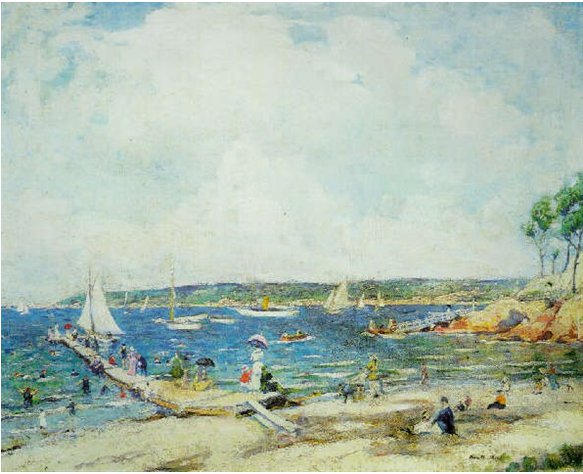
Eleven years before the image of Jo sketching, Hopper painted the other side of Good Harbor (Brier Neck) when he first came to New England. Leon Kroll painted two pedestrian bridges on the Bass Rocks side of the beach that same year.

Copy of Edward Hopper all around Gloucester MA (more than 90 works) (75)

Note the double bridges on Good Harbor.

Leon Kroll 1912 double bride 26 x 32 oil on

Leon Kroll, 1912, oil on canvas, (Good Harbor Beach, Gloucester) 26 x 32


Leon Kroll 1912 oil on canvas 26 x 32  sold at Sothebys 2011 bridge at bass rocks informal title 170,500
Leon Kroll 1911, 26 x 32 oil on canvas (Bridge at Bass Rocks) sold at Sotheby’s auction in 2011 for $115,700
8 point 5 by 10 three quarters 1912 leon kroll
Leon Kroll, 1912 oil on panel, 8.5 x 11-3/4


Knoll also painted Niles and Pavilion. He kept returning to Gloucester; eventually his family purchased a home in Folly Cove in 1932. Learn more at Cape Ann Museum and see Kroll works of art on display.

Leon Kroll Niles Beach 26 x 32
Leon Kroll, Niles Beach 1913

Copy of Edward Hopper all around Gloucester MA (more than 90 works) (74)

Copy of Edward Hopper all around Gloucester MA (more than 90 works) (71)

Piping Plovers Found Dead in CT. MA conservation plans eased and peaceful

The US Fish and Wildlife Service, Massachusetts Wildlife, announced a new statewide piping plover conservation plan last Friday.

Thank you to the GMG reader who saw the news on TV, and wrote a comment on the Disney-Pixar post. Massachusetts may be the model for North America. The MA Wildlife report includes the conservation approach implemented in Cape Cod last year, home to 60+% of MA piping plover population.  I don’t have the tv station’s coverage, but I included the WBUR wire pick, and piping plover reports from CT, NH, and ME. Kim Smith is covering the pair on Good Harbor Beach. Nesting Piping Plovers have been seen on Coffins Beach and Revere Beach.

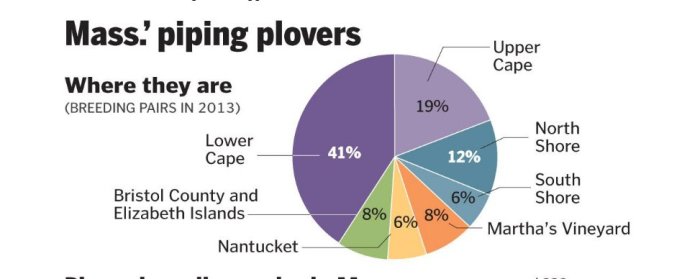
Currently, the Atlantic coast population (North Carolina to Eastern Canada) of piping plovers continues to hold steady just under 2,000 pairs. The Massachusetts State Department of Fish and Wildlife targets maintaining 625 pairs with greater intervention should the population fall below 500 pairs.

Boston Globe
YR 2013, State Department Fish and Wildlife


Piping plovers were not rare enough to be described as a ‘wild’ species in 1895 in Daniel Giraud Elliot’s North American Shore Birds. He wrote that where the species had been formerly ‘most abundant’ the piping plover was “found chiefly on the more retired parts of the cost where it was free from molestation…its acquaintance with man has caused it to be at the present time, in most places where it is found, a rather wary bird.” The fattened birds were “palatable, yet sometimes sedgy in flavor.” Skunks and other predators, influx in summer population, and loss of habitat were concerns. Plastic trash is a striking difference now. At least we don’t eat them.

CONNECTICUT

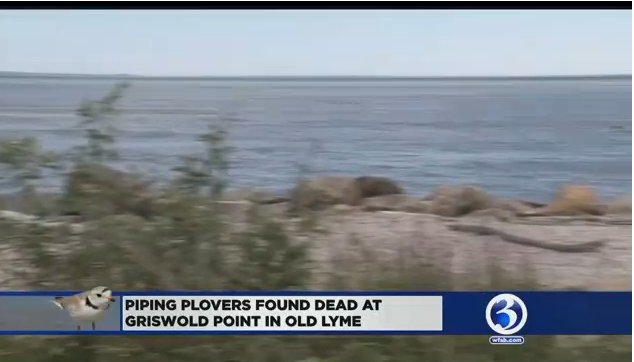
Three Piping Plovers were recently killed in their nesting habitat at Griswold Point in Old Lyme CT. It’s believed a fourth was intentionally stepped on in Bluff Point State Park in Groton, CT. “People ignore the signs.”

Screenshot_071116_082958_AM.jpg
2 minute video

The Connecticut Department of Energy and Conservation monitors the piping plovers.  The Connecticut Audubon Society doesn’t maintain piping plover information, however they do have an incredible osprey project to report. Tom Andersen told me that the CT Audubon Society has built up a network of more than 300 volunteers to find and monitor osprey. An intern has plotted the work of these citizen scientists on this Osprey Nation map. Nests have grown from 200 to 500. I think I’m inspired to do a map of the piping plovers if someone in MA or in the state office hasn’t done it already!

MASSACHUSETTS – CAPE COD

Massachusetts may be the national model.

Read WBUR on the MA Wildlife press release with a focus on Nauset New Plan Allows Beachgoers More Room While Protecting Piping Plovers

David Abel wrote about it back in January for the Boston Globe (January 21, 2016)  Beachgoers may get break as plovers rebound:  

“In Orleans, after years of losing hundreds of thousands of dollars a year in fees for stickers to drive on town beaches, local officials independently sought and obtained a federal waiver last year to allow a limited number of vehicles back on the beach.” 

“For Russ Hopping, who oversees about 27 miles of beaches from Ipswich to Nantucket for the Trustees of Reservations, a federal waiver would mean more than getting rid of some fences on their beaches. It would mean fewer headaches. With some 60 plover pairs on their beaches last summer, Hopping hopes new flexibility would translate into fewer complaints and greater protection for the birds. 

“That we’ve reached the point that this opportunity even exists represents a conservation success story for Massachusetts,” he said.

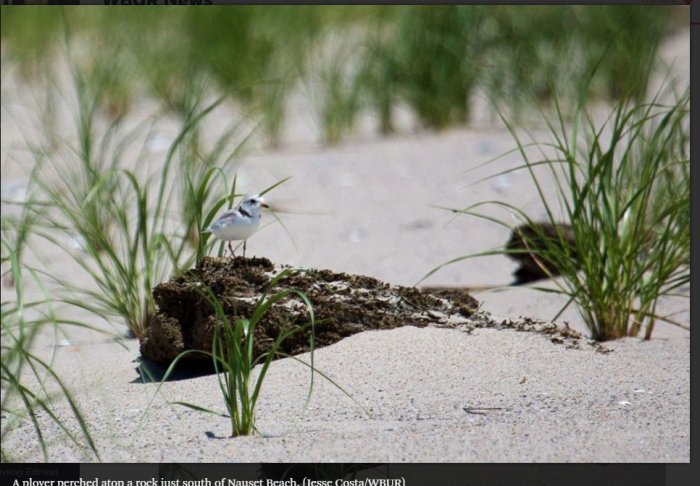
Nauset WBUR
photograph Jesse Costa/WBUR

South shore and Plum Island stories have been contentious (e.g. WBZ’s 2010 story in Plymouth Are they protecting the plovers or their view? )

The town of Duxbury canceled their annual 4th of July beach bonfire because piping plover pairs returned and were nesting year after year. “Most Duxbury residents said they understand the need to cancel the bonfire for the bird. Since the birds return every year, the committee said next year they’ll consider a new tradition of having the beach bonfire at another time.”

NEW HAMPSHIRE

There are 7 pairs  reported in NH right now in Seabrook and Hampton.Since protection efforts began in New Hampshire in 1997 through 2015, 99 nesting pairs of plovers have fledged 127 chicks on the state’s seacoast.”

MAINE

The Rachel Carson National Wildlife Refuge and Maine Audubon  report Piping Plovers first sightings in 2016 on beaches at Kennebunkport, Kennebunk and Old Orchard Beach. They’re sending an estimate about nests.

MASSACHUSETTS- CAPE ANN- Gloucester

search for Kim Smith’s exceptional documentation and photographs on Good Morning Gloucester about the one nesting pair on Good Harbor Beach

more on GMG:


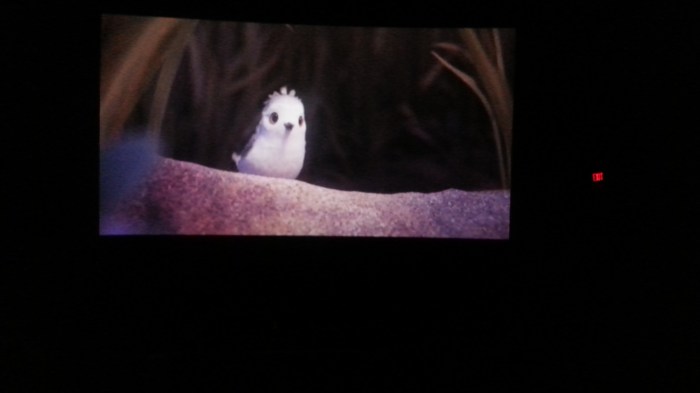
Could Disney help the Good Harbor Beach Piping Plovers?

The new animated short film shown prior to Finding Dory is stunning. It features a baby bird beckoned by her mother from the dunes to the edge of the waves. The animated baby bird masters its first venture beyond the nest. Some things have to be seen on the big screen.

Positive news:

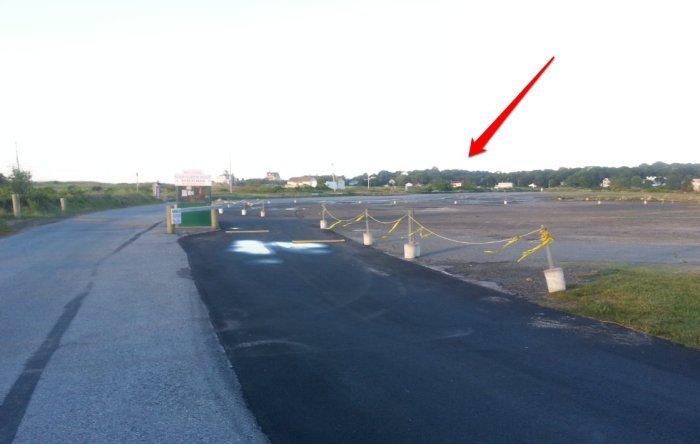
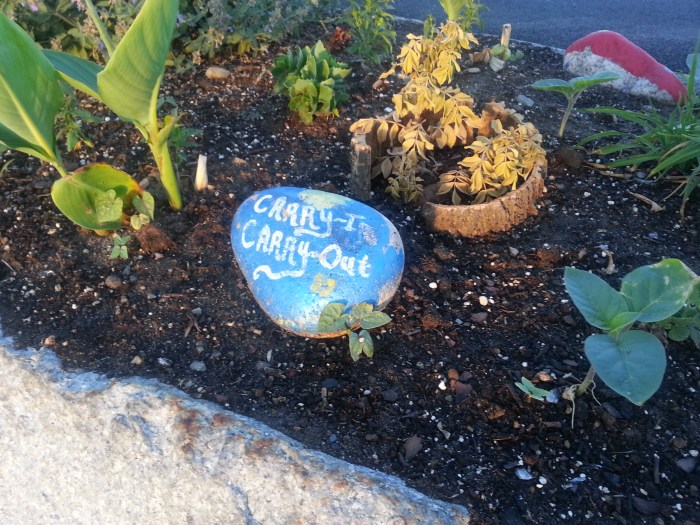
On a recent morning, very early, Patti Amaral swept her arms joyfully imploring me to look– an entirely litter free Good Harbor Beach parking lot after a weekend and before DPW had arrived. She exclaimed what a positive change has transpired over the past 10 years and how many people help.

20160703_064421

20160706_054704

She still sees some litter in this vista, but it’s camouflaged. She hopes to see the removal of the last vestiges of raked and buried trash from years’ back. I doctored a photo to help. It’s to the right of the back green gate.


Screenshot_070916_112243_AM


20160706_054730

20160706_054724

20160705_180816

DOG OWNER AND TRASH TROUBLE AT GOOD HARBOR BEACH PART TWO

Crow battle copyright Kim SmithDear Friends,

A reminder that no dogs are allowed on Good Harbor Beach during the summer and particularly while the Piping Plovers are nesting. It truly is a matter of life and death for these rare and endangered tender shorebirds. The past several mornings there have been dogs on GHB, off leash. Although the Plovers nest is at the edge of the dune, once they have hatched, the tiny nestlings will soon be going to the water’s edge to feed. They will most assuredly be squished by an exuberant pooch if owners do not keep their dogs off the beach. Please let your house guests, friends, neighbors, and family know about these rare creatures calling Good Harbor Beach home for the summer, and why it is so vitally important to keep dogs off the beach.

Yes, I took photos of the scofflaws, but do not want to post another batch. I’d rather we spend the time helping people understand why, and trying to prevent further incidences.

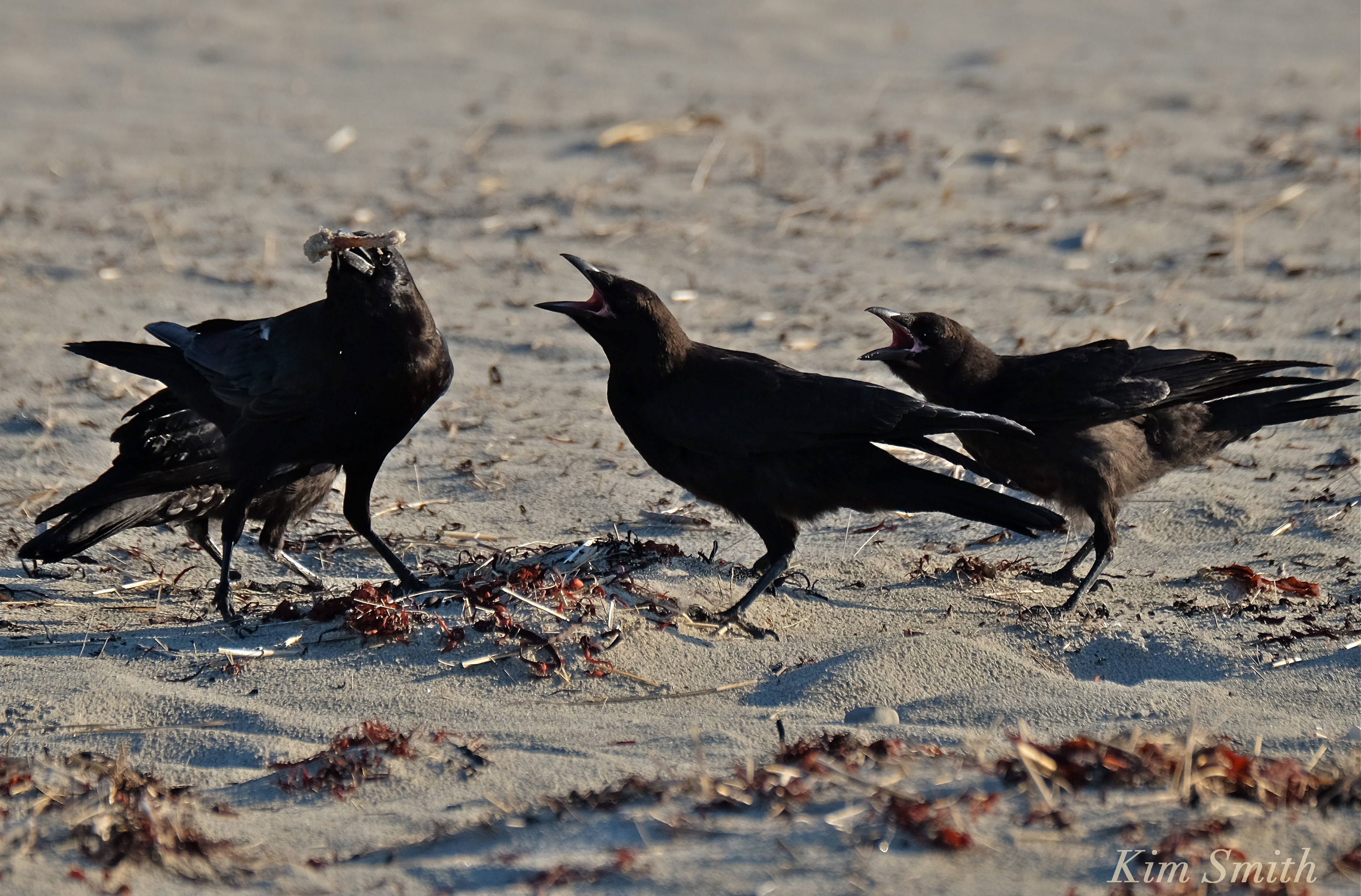
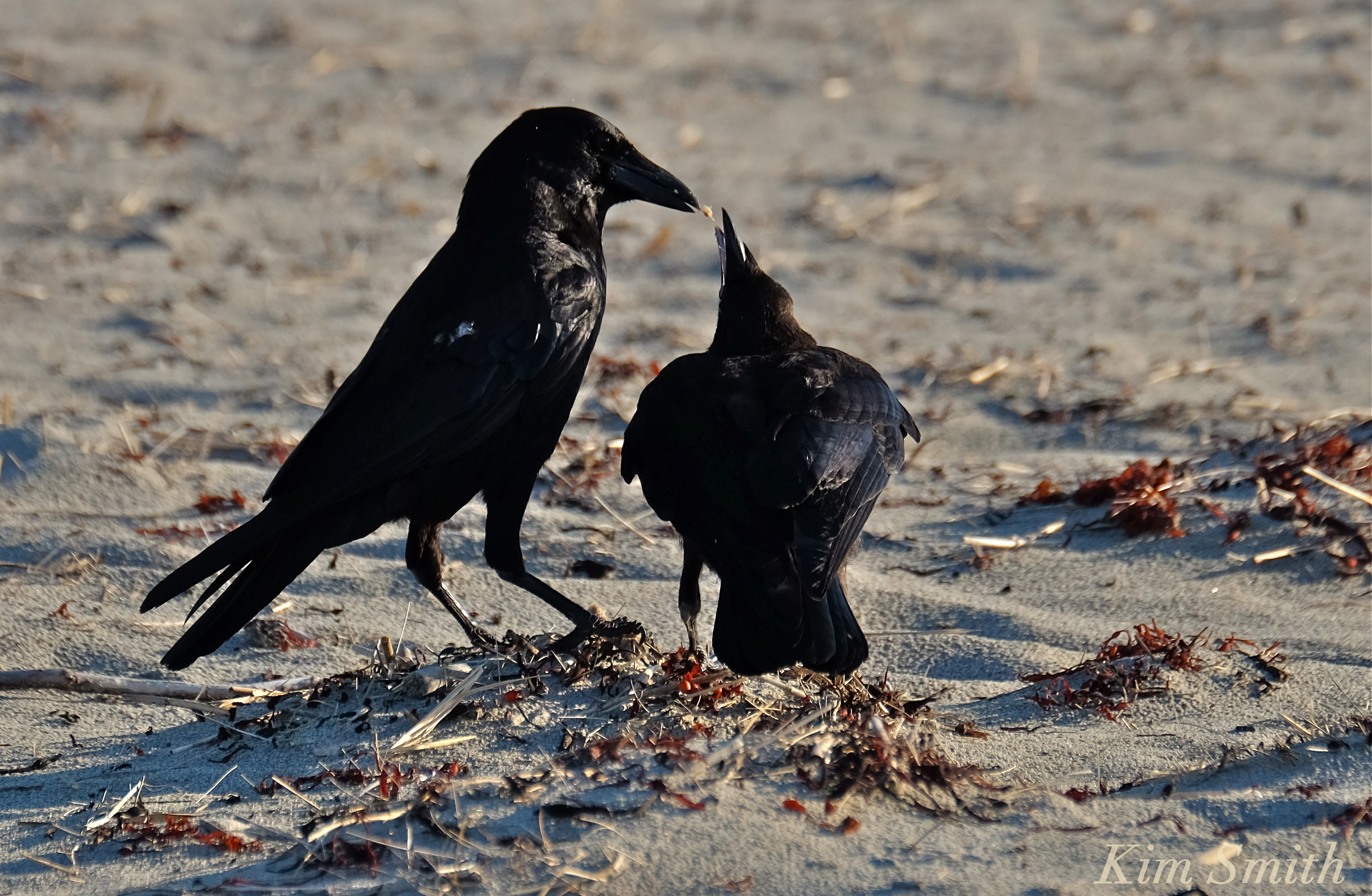
Piping Plover with garbage plastic bottle pollution copyright Kim SmithOf far greater concern is the fact that last night some persons were picnicking in the Plover’s cordoned off area. The thoughtless ones buried their trash in the sand, but left some remaining on top. At daybreak several crows, I am sure drawn by the brightly colored Doritos bag, began digging in the sand. They were soon joined by a dozen or so crow family members, where a great noisy battle ensued over the bones and garbage. The combat took place in the Plover’s plot, causing the nesting Plover extreme distress. She left the nest, trying all her tricks to distract the crows from the eggs, and was really quite brave in fending them off, all the while calling frantically to her mate. The battle lines were coming closer and closer to the Plover nest.

Why was she so alarmed? Because crows (and gulls) eat Piping Plover eggs!

As a filmmaker I try very hard not to intervene in wildlife behaviors while filming, I stand as still as a stone and the creatures soon forget about me and go about their normal business. However, in this case, the garbage strewn about in the Plover’s plot was human created and needed human intervention. I chased the crows out of the area and within a few moments, the Plovers had resumed their morning routine.Crow battle -2copyright Kim Smith

Some folks are under the misguided notion that it is a good thing to bury trash, even burying glass bottles. Tony and Murray, our awesome GHB DPW crew, told me that burying bottles is the worst thing people do because as the clean up tractor unwittingly is driven over the hidden garbage, bottles break, and then there is broken glass everywhere. Burying food and bones and plastic is nearly as bad. The seagulls and crows inevitably find the trash, drag it all across the beach, and then the plastic ends up in the ocean. If there weren’t so much nightly trash left on the beach, we wouldn’t have nearly as many crows, and the shorebirds would be far safer.

Please, no dogs and no trash on our beautiful beach. Thank you. The Piping Plovers thank you too.Crow feeding copyright Kim Smith

Deborah Cramer bird watch report: Piping plovers, oyster catcher, red knots sandpipers

Deborah Cramer update related to the Narrow Edge GMG post:

“Piping plovers are also on Coffin’s Beach, an oyster catcher has come into Essex Bay, and in a few weeks, and right now the red knots are up in the Arctic nesting.  They’ll be heading back later this summer, and some will pause to refuel in Essex Bay.”


David Eliot Gould’s 1895 entry on piping plovers reads like the summer of 2016:

“From many of its resorts along the Atlantic Coast, where in former days it was most abundant, it has been driven by the advance of fashion and the influx of the summer’s passing population, until it is now found chiefly on the more retired parts of the coast where it is most free from molestation.”  

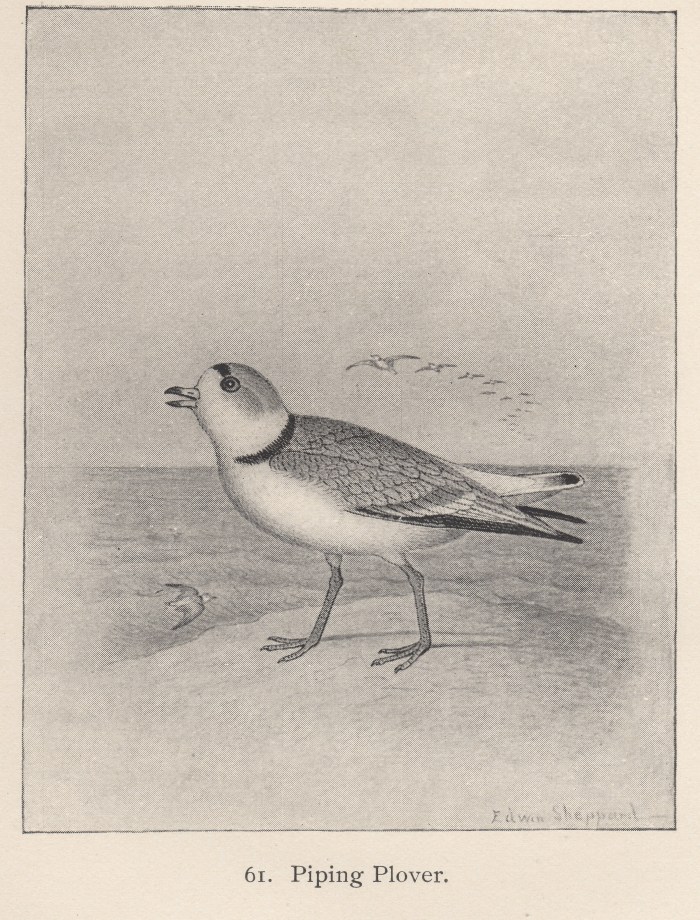
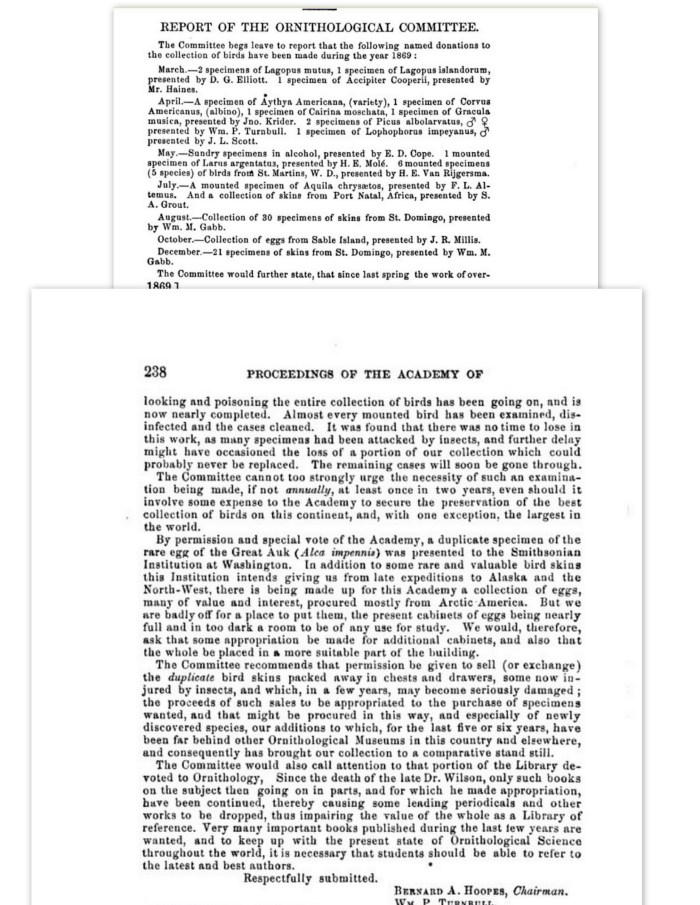
I’ve added the illustration. The artist, “Ernest” Sheppard, illustrated scientific and natural history, primarily birds, including History of North American Birds in 1874.  He was on the staff of the Academy of Natural Sciences in Philadelphia; in 1969 he was one member of the 3 man ornithological committee of the Academy that pleaded for more funding and care in their department. So, what did they ask for “to ensure the preservation of the best collection of birds on the continent, and, with one exception, the largest in the world” ?

First they recounted recent acquisitions such as a rare egg of the Great Auk. Then they explained that the repository required more funding,  space, display,  inventory systems, and conservation (a tricky endeavor with these specimens.) Insects were on the warpath! Poison was effective.

The 2016 restoration of the Civil War coat and display options may resonate.

Sheppard
illustration from the 1895 book by David Eliot Gould, North American Shore Birds; a history of the snipes, sandpipers, plovers and their allies, inhabiting the beaches and marshes, illustration by Edwin Sheppard.


From the ornithological committee’s submission to the annual report, excerpted from Proceedings of the Academy of Natural Sciences of Philadelphia, Volume 21, 1869

1869 PA Academy


DOG OWNER TROUBLE AT GOOD HARBOR BEACH AND WHY IT IS NOT A GOOD IDEA TO IGNORE FEDERAL LAWS

Piping Plover overexposed copyright Kim SmithFor the sake of the Piping Plovers folks really and truly need to keep their dogs off Good Harbor Beach. It is a matter of life and death for these beautiful creatures and their soon-to-be-arriving offspring. Additionally, the following article was brought to our attention by friend Pauline Bresnahan. The town of Scarborough, Maine, was threatened with a $12,000.00 fine for not enforcing their leash laws. A dog off leash killed a Piping Plover. If one of Gloucester’s Piping Plovers are killed by a dog, we taxpayers could very well be held responsible for the maximum fine. Read the story here.Good Harbor Beach No Dogs cooyright Kim Smith

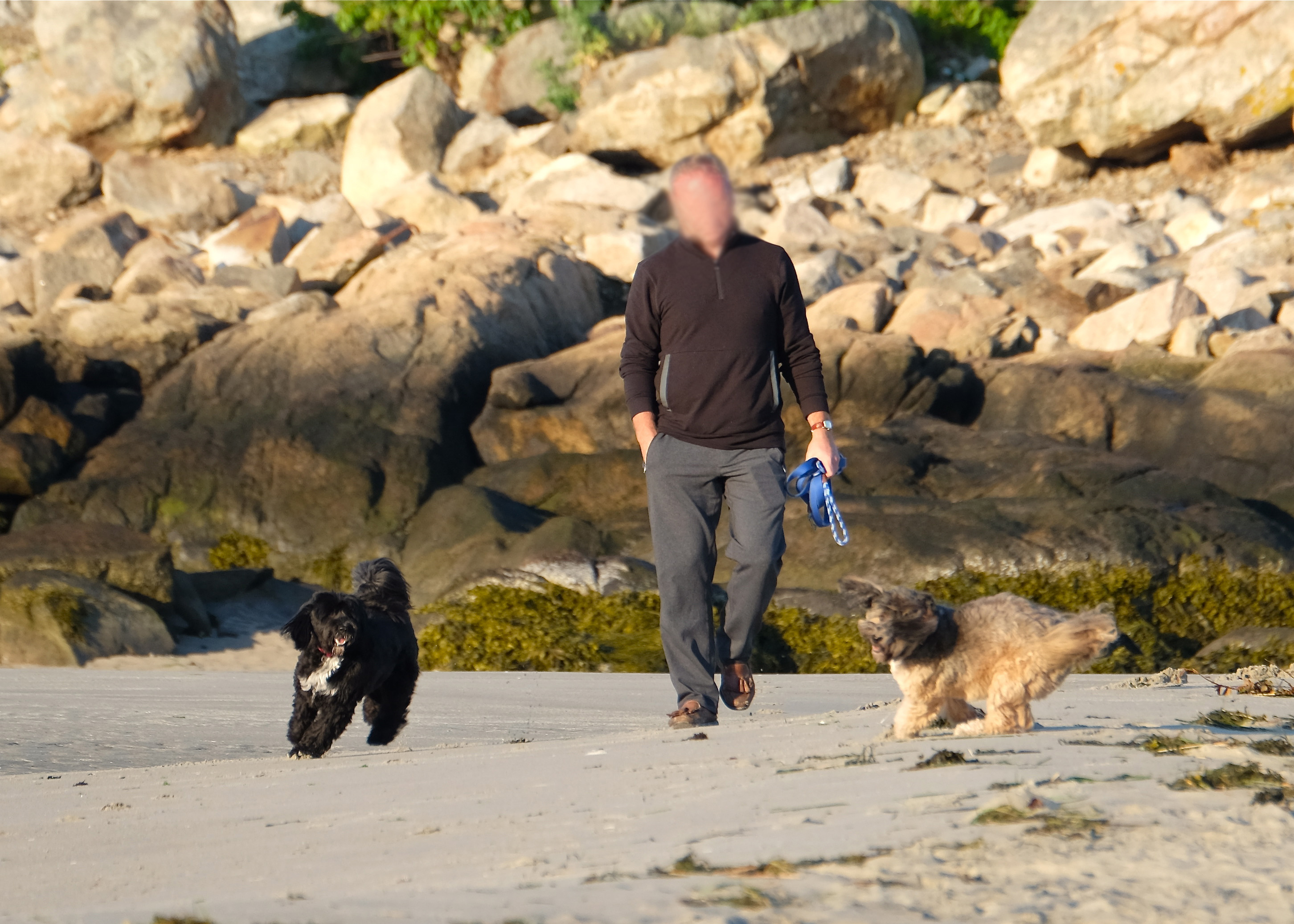
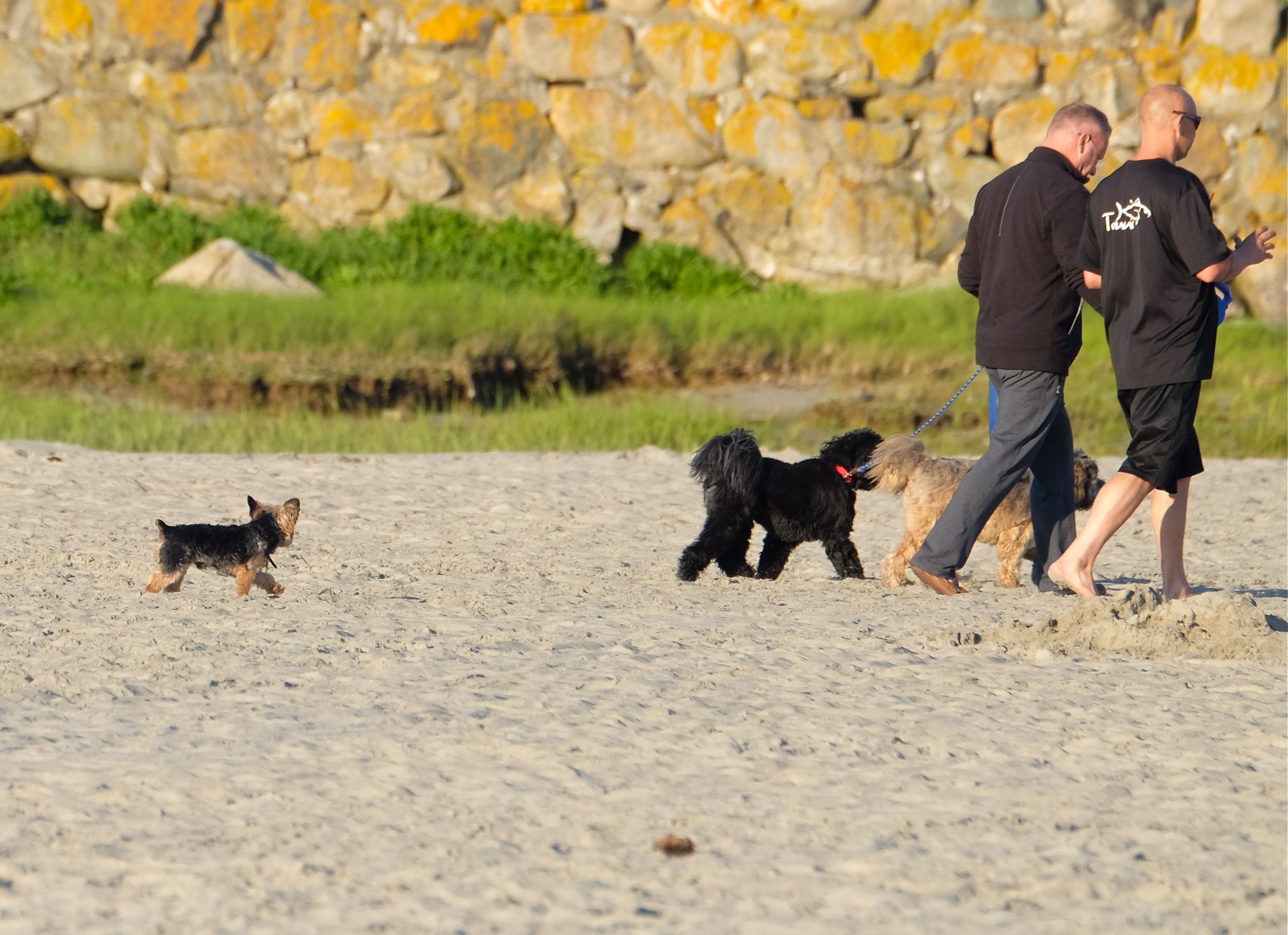
Good harbor Beach ScofflawThis morning I arrived at GHB a little later than usual, around 6:30am. Within the first three minutes, there were three dogs on the beach, and all off leash. The man in the above photo had two dogs, and one of the dogs made a beeline for the Piping Plover nesting site. The guy did absolutely nothing to prevent his dog from running into the restricted area. I called out to him to let him know. He made a rude remark and called his dog back, but only after it was halfway in. The dog owner then walked the length of the beach with his dogs still off leash. When he returned his dogs chased the gulls as well as the Plover feeding at the shoreline. Now if it was a fledgling Plover, the baby bird wouldn’t have stood a chance in heck in the face of the exuberant dog. So after the dog ran into the restricted area, chased one Plover at the water’s edge, he then put his dogs on leash as he was leaving the beach. He was joined by another fellow at the footbridge, whose dog was off leash.Good harbor Beach no dogs copyright Kim Smith

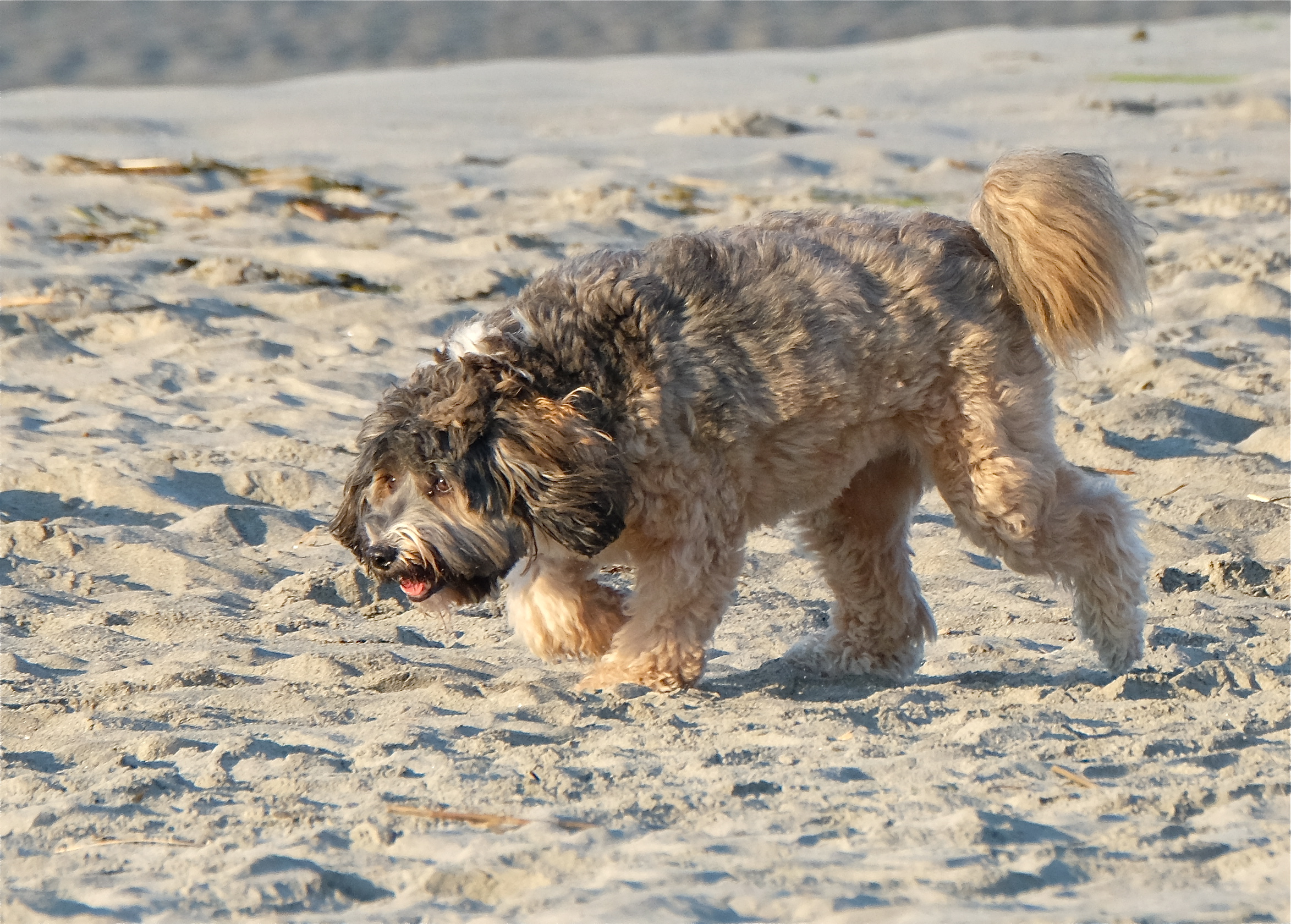
It is in some dog’s nature to chase birds. Why oh why would a dog owner bring a dog like that to the beach with a known endangered bird species? The rule is no dogs during the summer months. We have a sweet Scottish Terrier and I sure would love to bring her with me when I am filming and photographing early in the morning. But even she, with her calm, gentle disposition, I know would terrify the Plovers and could easily accidentally squish a nestling.Good Harbor Beach Dog copyright Kim Smith

The Culprit. Is this a bad dog? No, of course not. I think it looks quite cute. Are there any bad dogs, or just thoughtless owners?

Piping Plover retruning to nest copyright Kim Smith

Plover returning to its nest this morning

With merely only a few thousand pairs of nesting Piping Plovers remaining nationwide, it’s super important that we all work together as a community to insure the successful nesting of the Good Harbor Beach Piping Plovers. There are so many unavoidable, natural mishaps for the birds and their nestlings; let’s prevent the avoidable disasters. Please, let all your friends and family know to keep dogs off the beach. If you see a dog, please ask the owner to remove the dog.

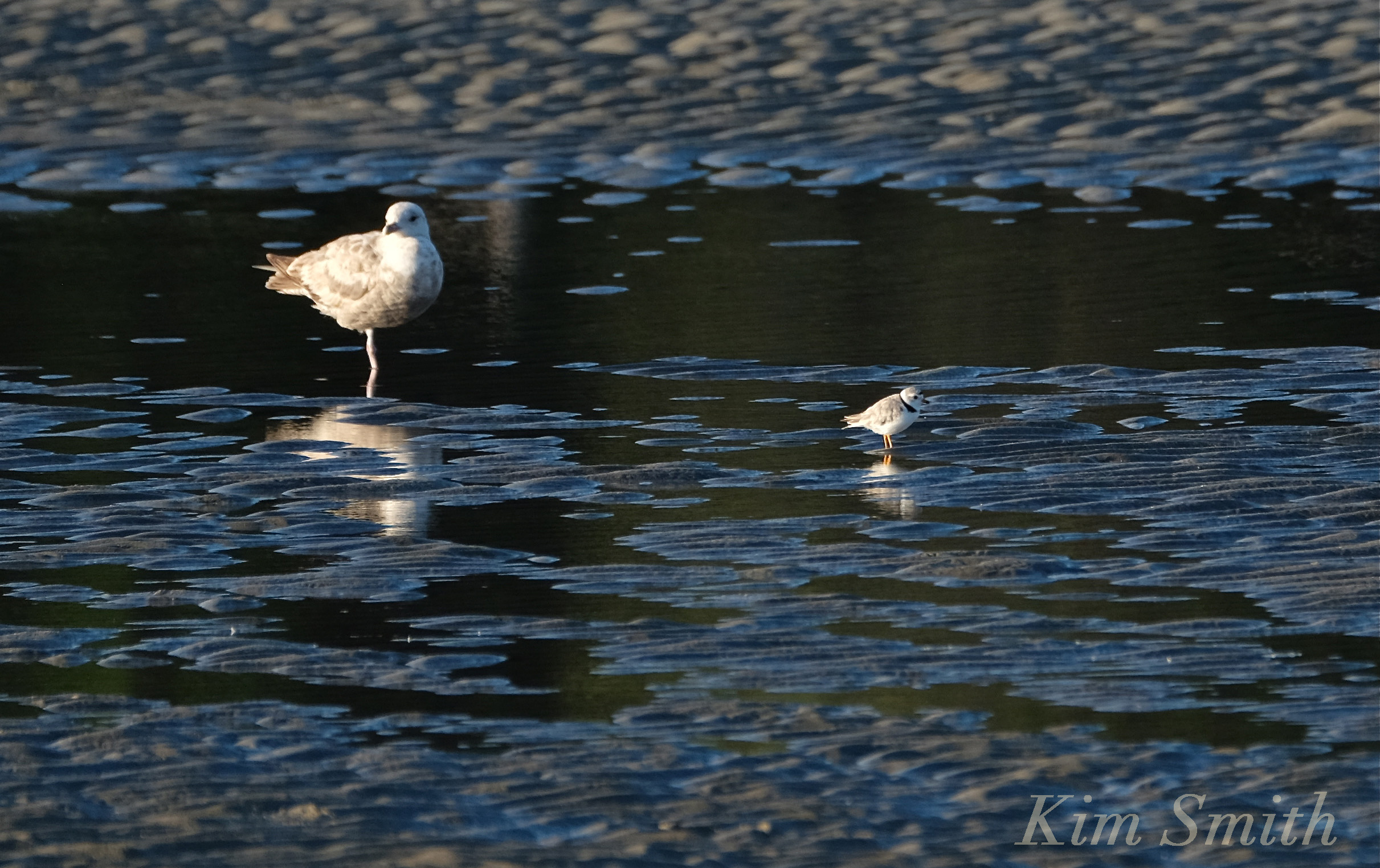
Piping Plover comparative photo with seagull copyright Kim SmithIn the above photo, you can compare the size of the adult Plover to the size of the immature gull and get an idea of just how tiny they are. And the nestlings are teeny tiny!

It’s no excuse for the behavior of today’s scofflaws, but I think we need bold signs at both ends of Good Harbor Beach, clearly explaining what a federally endangered species is, what a Piping Plover is, and why it is so important to keep all dogs off the beach. Also, perhaps if an officer were stationed at the footbridge end beginning at 5:30am, handing out tickets, folks would take the law more seriously. Or, if the officer were positioned in the middle of the beach, he would catch offenders in the act. I imagine it wouldn’t take more than a few days of ticketing for word to get out that the laws were being enforced. In just the short period of time that I was there this morning, the City could have earned well over a thousand dollars in dog fines alone!

      *   *   *

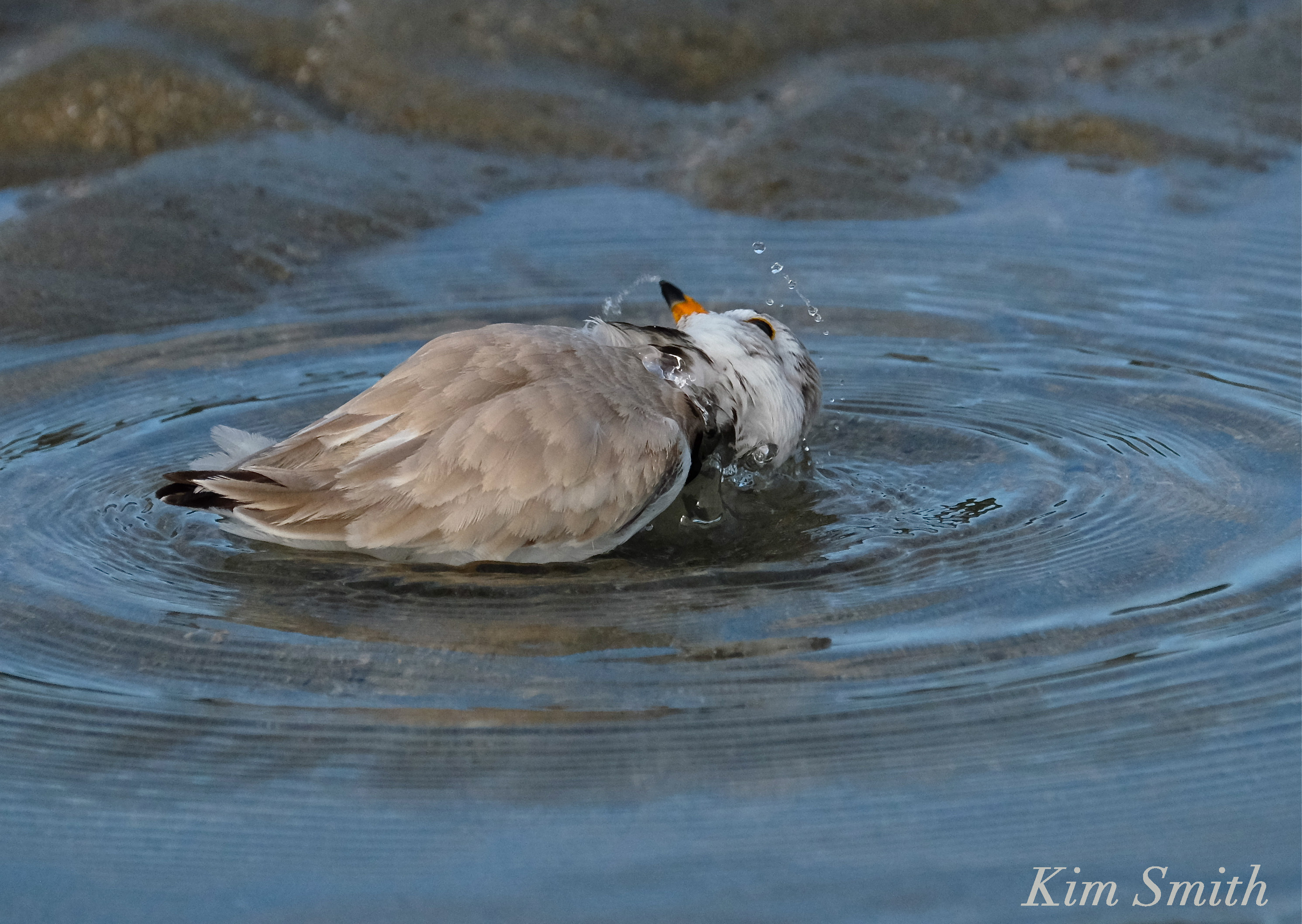
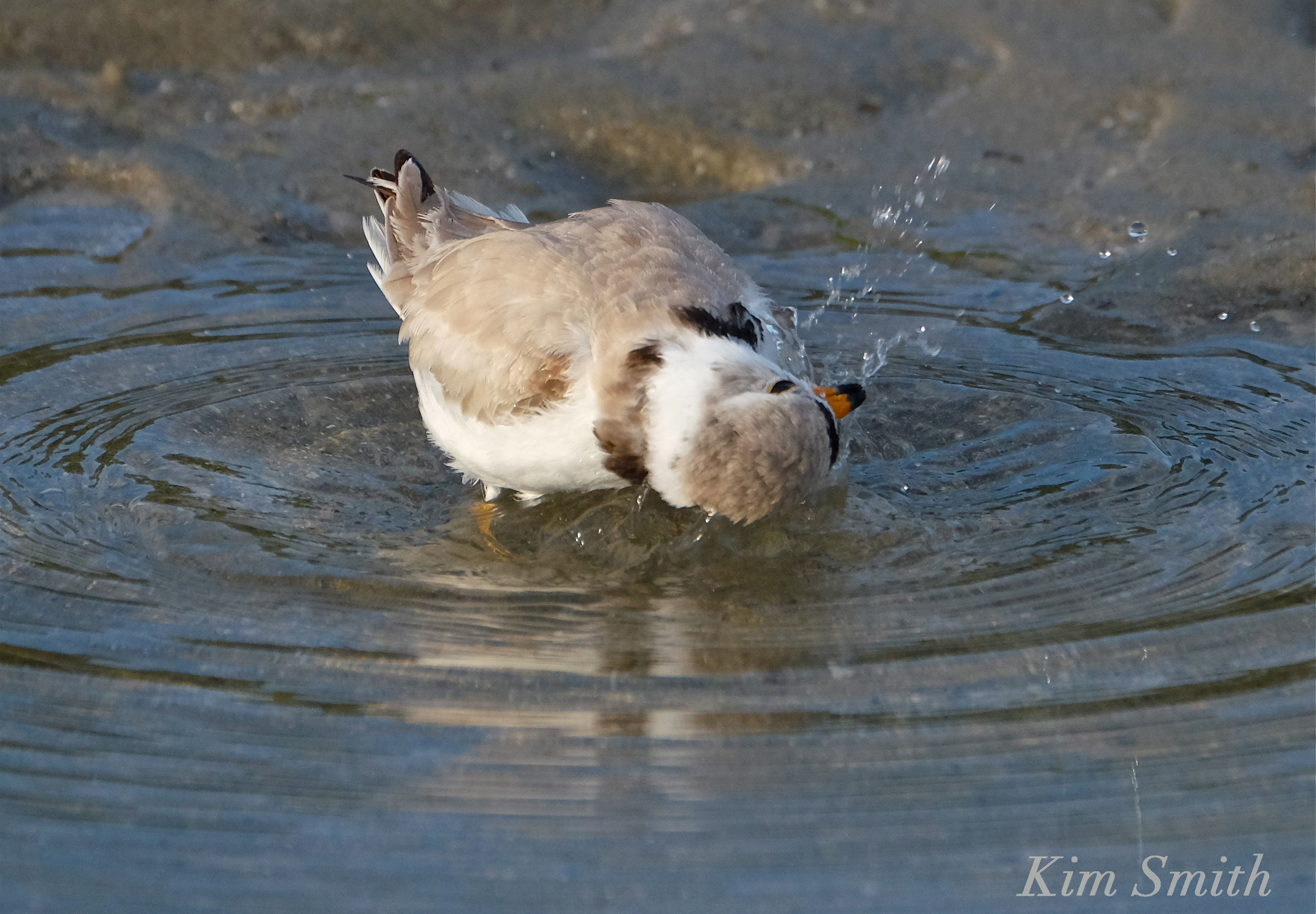
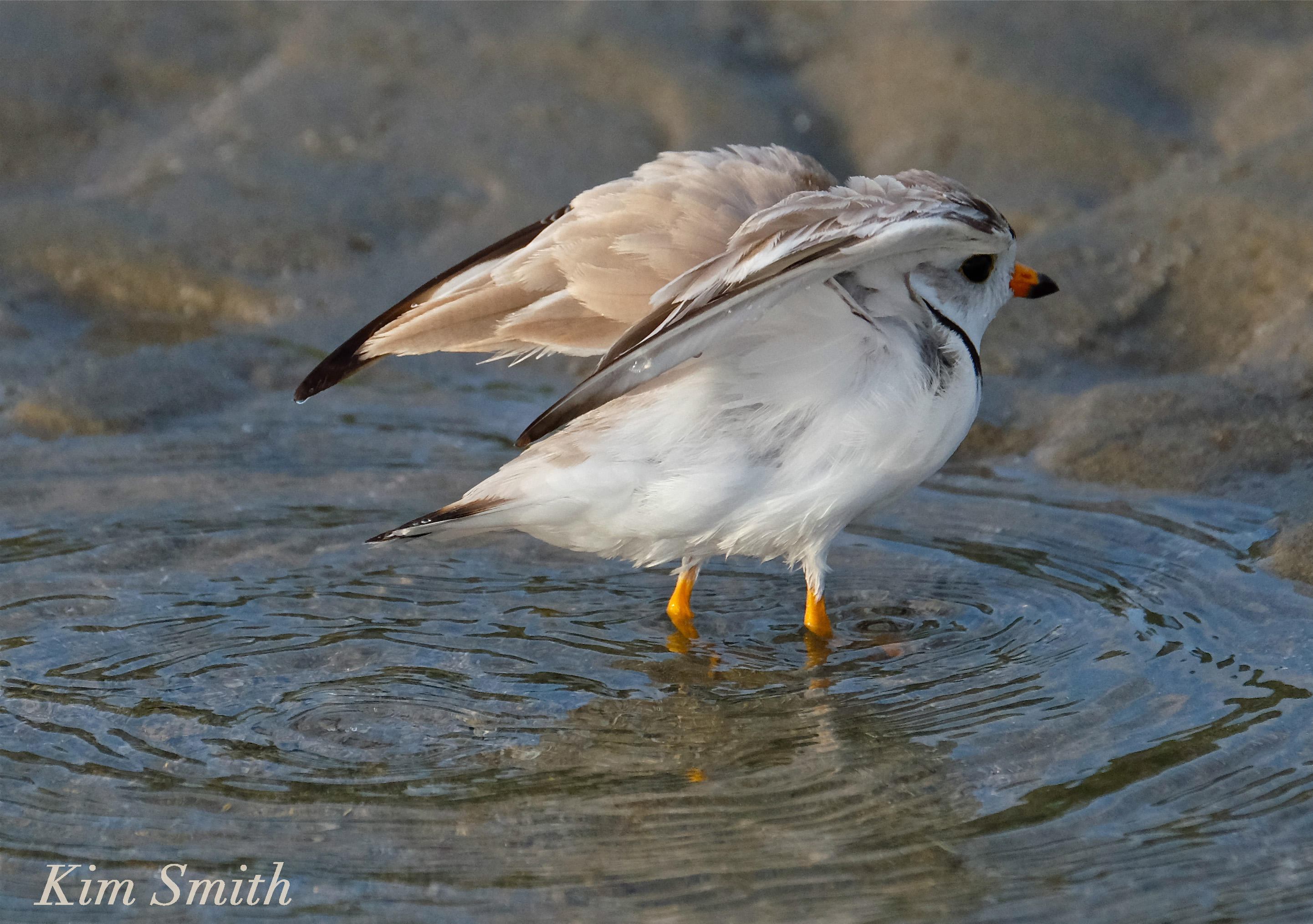
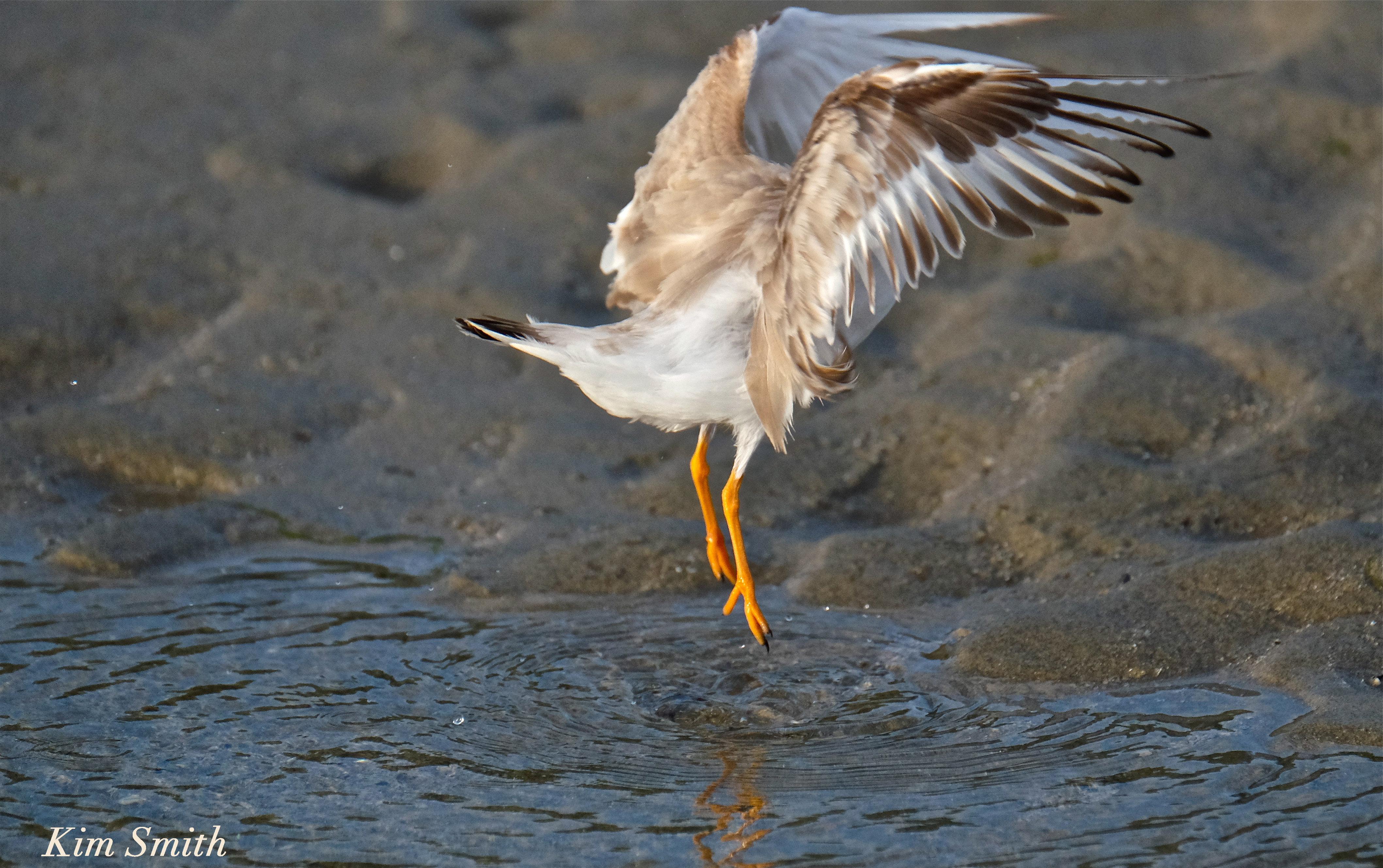
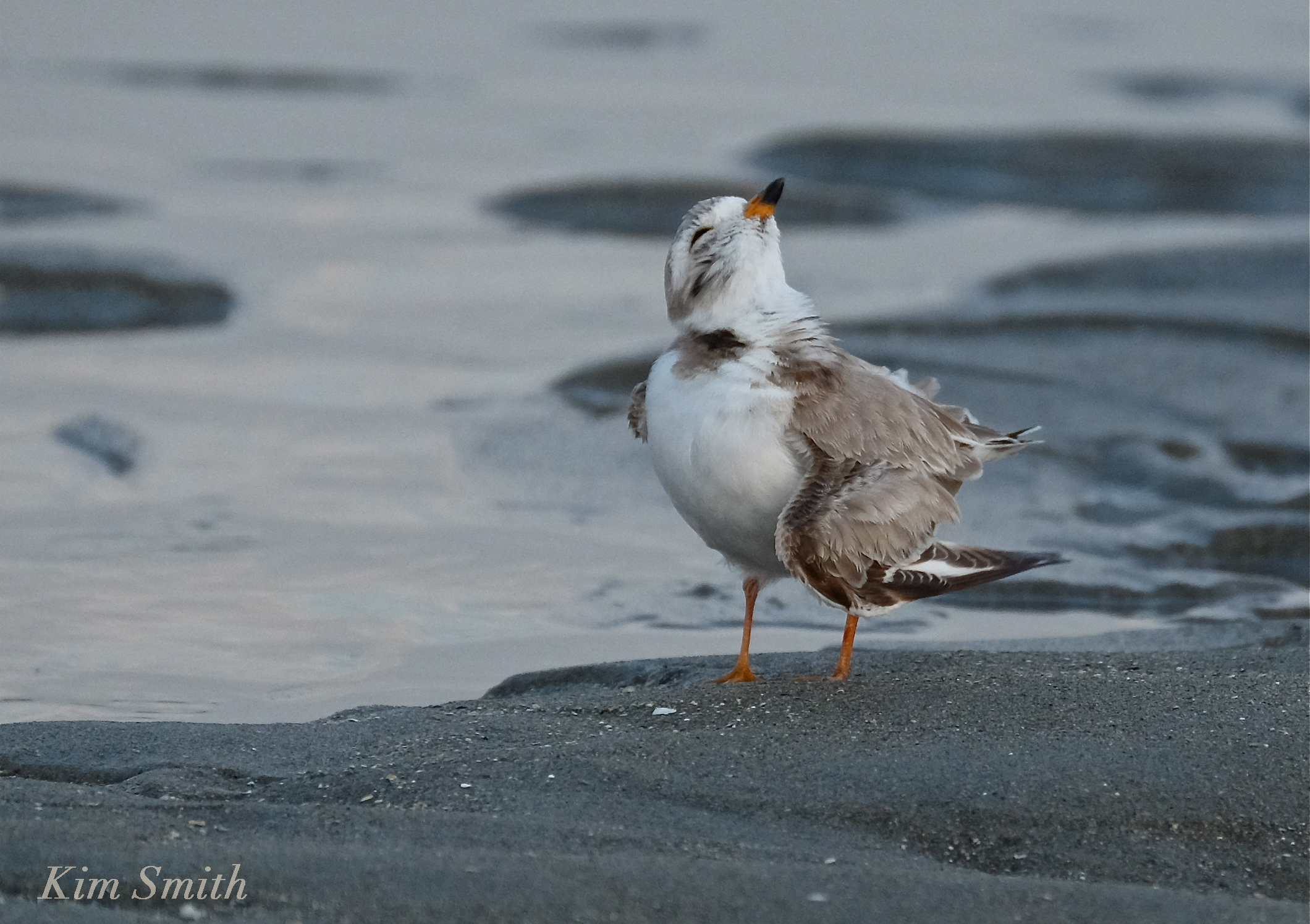
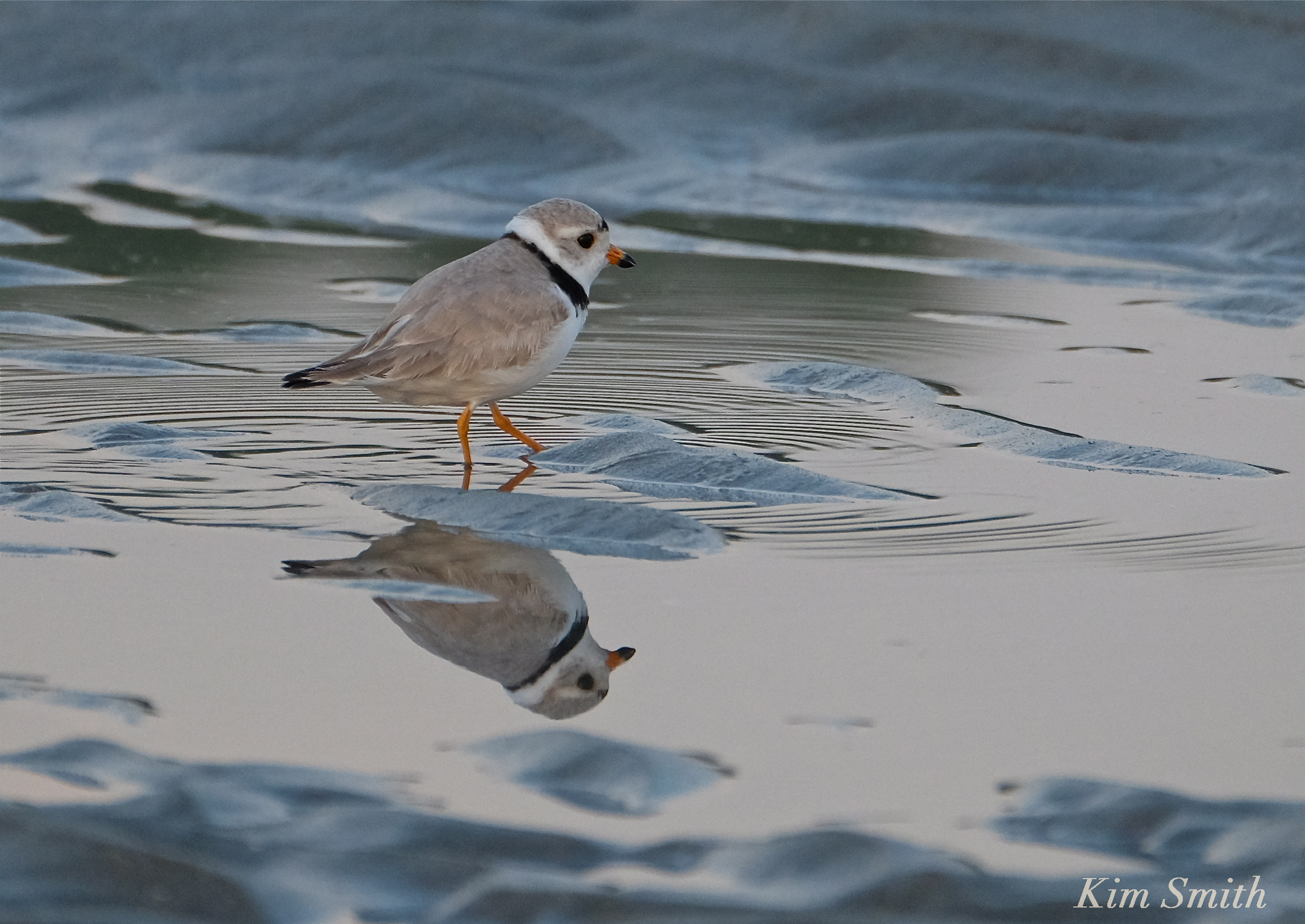
Male and Female Piping Plover’s take turns on the nest. Every morning they each spend time at the water’s edge feeding and bathing in the tide pools. Today this little fellow gave himself an extra vigorous washing! 

Piping plover bath copyright Kim Smith.Piping plover bath -2 copyright Kim Smith.Dunking from side to side

Piping plover drying wings copyright Kim Smith.Drying WingsPiping plover drying wings-2 copyright Kim Smith.

GOOD HARBOR BEACH SUNRISE SCENES AND PIPING PLOVER NEST!

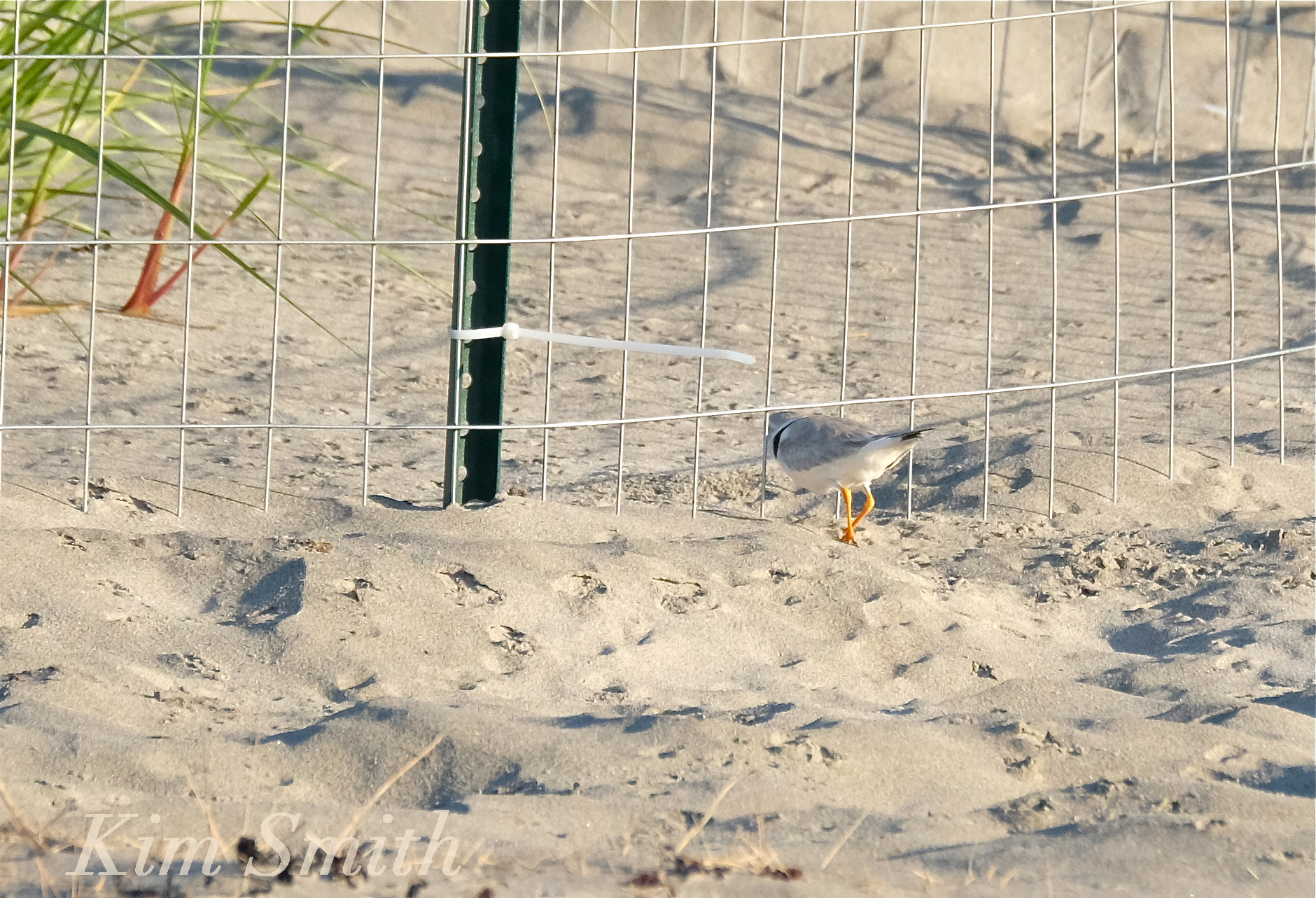
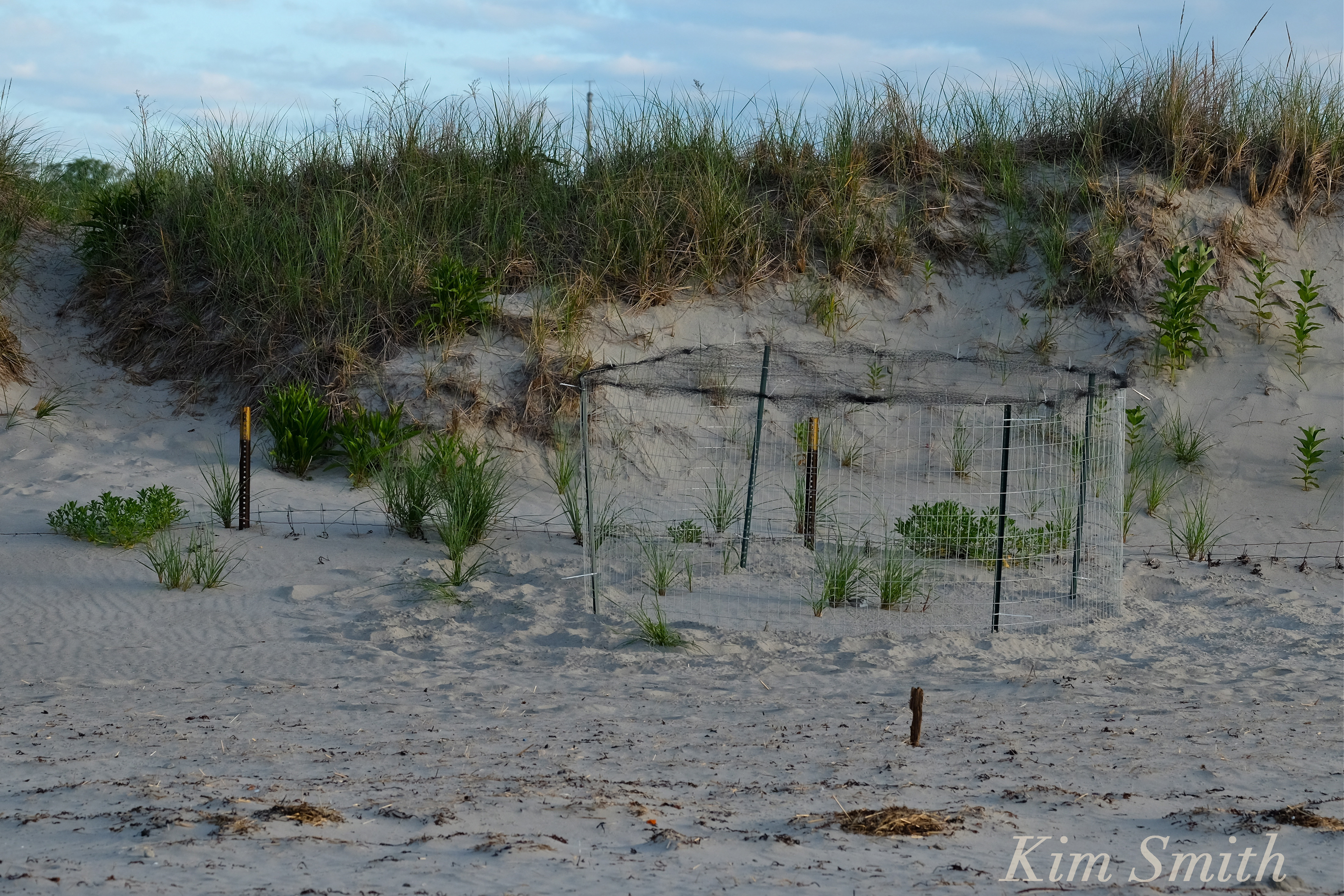
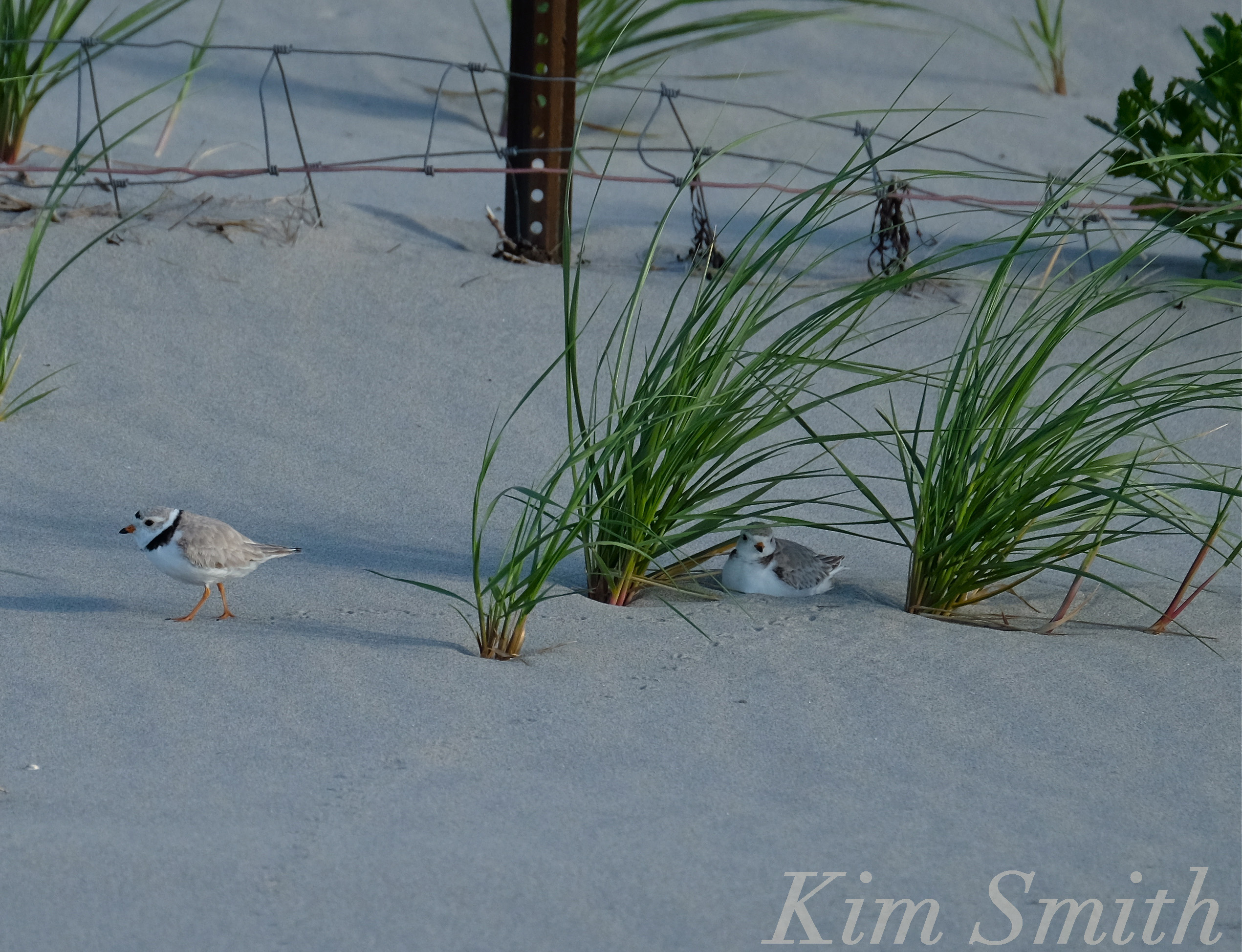
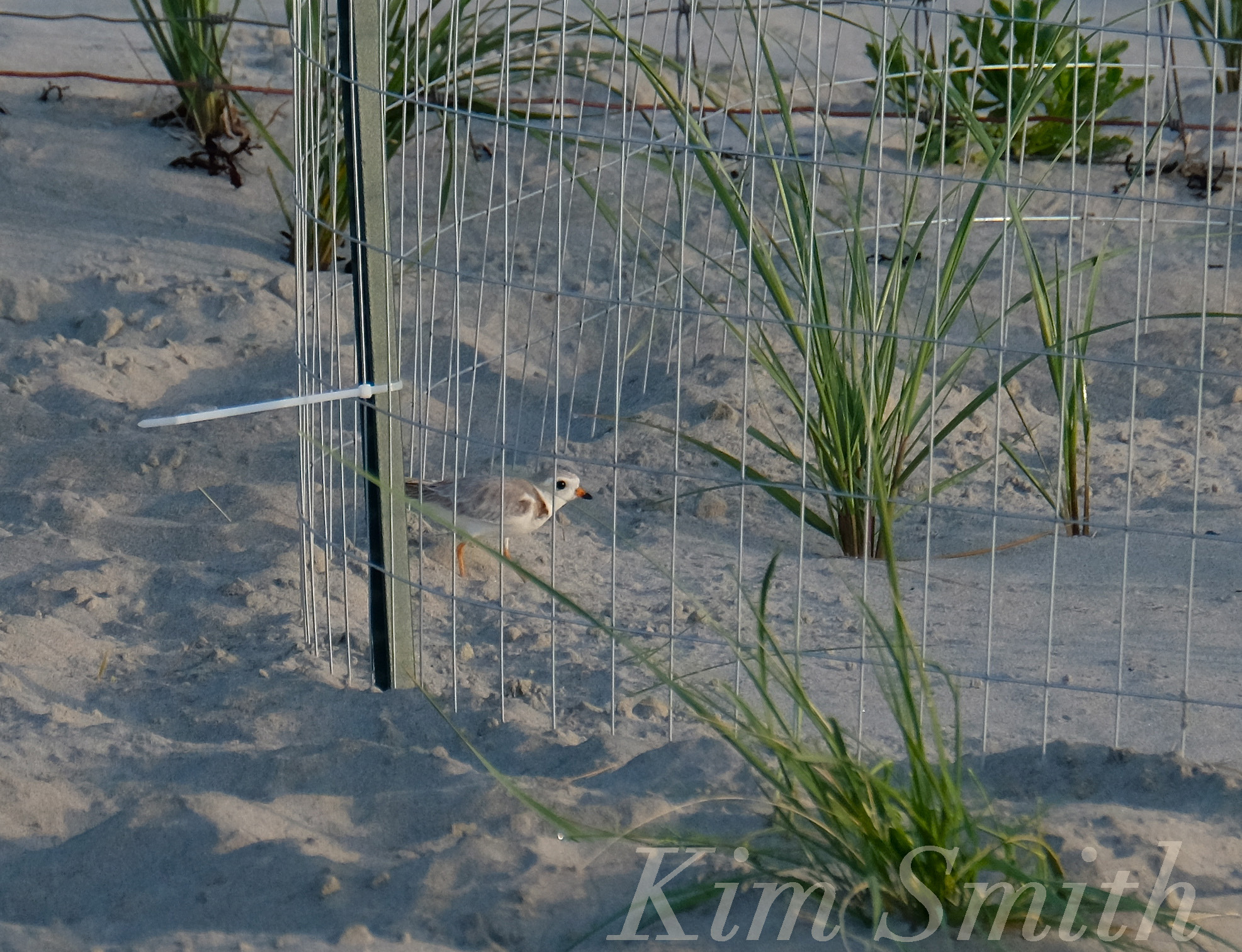
Good Harbor Beach Sunrise -2 Gloucester MA copyright Kim SmithPiping Plovers nesting -4 Gloucester MA copyright Kim SmithAn approximately six foot in diameter protective barrier has been installed around the plover’s nest. This is a huge relief as many of us have noticed dog tracks in the cordoned off area. The plover’s don’t seem to mind the wire construct and go about their morning routine, running through the spaces between the wire grid as if the barrier had always been in place. In the above photo, you can see a plover sitting on its nest between the two clumps of grass within the enclosure.

Piping Plovers nesting Gloucester MA copyright Kim SmithEvery morning the plover’s switch places several times, with both parents taking turns sitting on the nest, while the other leaves the restricted area to feed at the shoreline and bath in the tide pools. The above photo was taken on the 13th of June, before the barrier was put in place. There are minimal tacks around the nest site, so it would be logical to assume the nest was very recently established. The photo below, taken on the 15th, show many more tracks and it looks like there are three eggs.

Piping Plovers Three eggs Gloucester MA copyright Kim Smith

Piping Plovers Two eggs Gloucester MA copyright Kim Smith

Nest on the 16th, I only see two eggs however I think the plovers move the eggs around in the nest. And too, my camera lens is zoomed all the way, and the image is cropped.

Piping Plovers nesting -3 Gloucester MA copyright Kim SmithThis morning the plovers were easily slipping through the wires.

Twin Light GHB Sunrise copyright Kim Smith

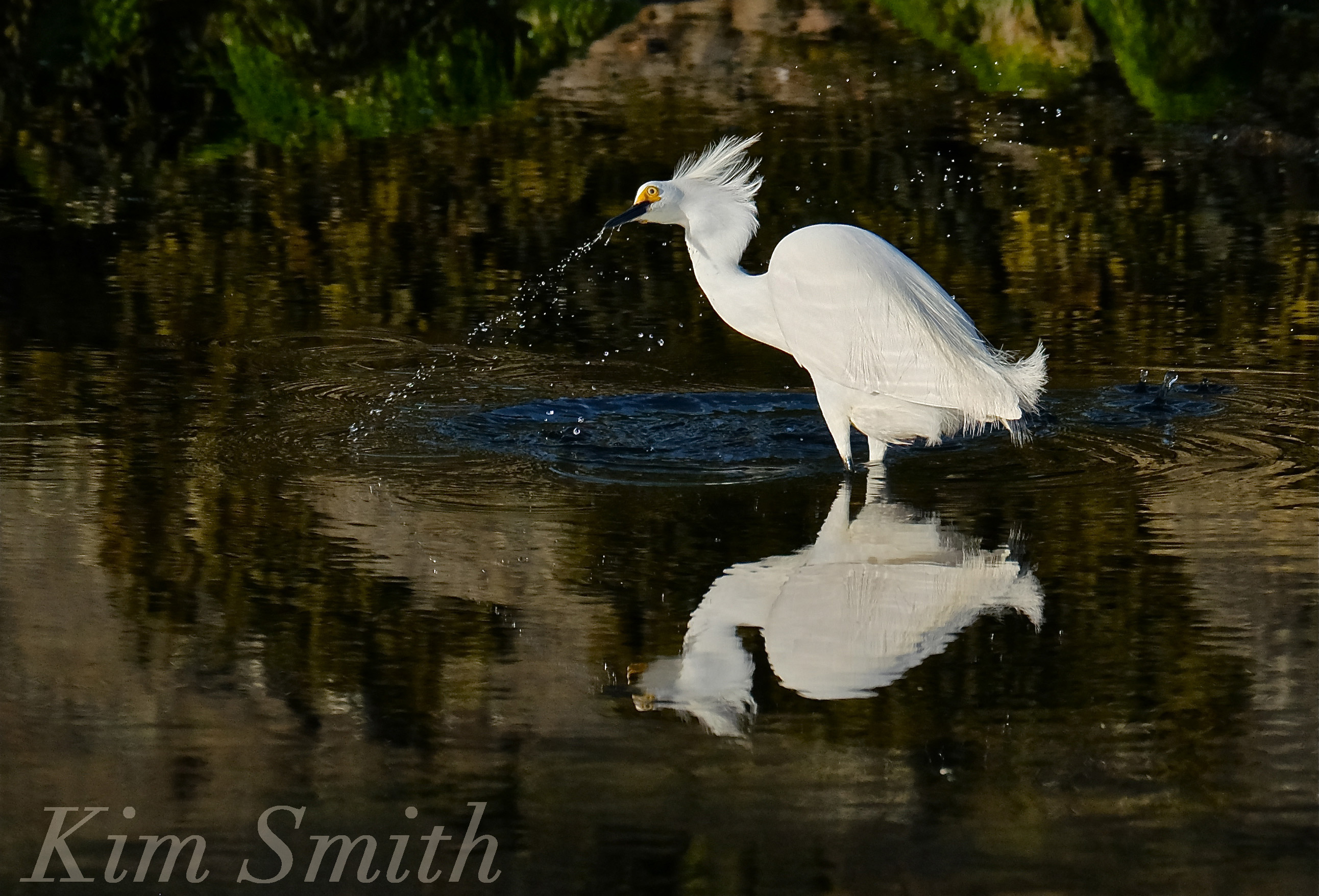
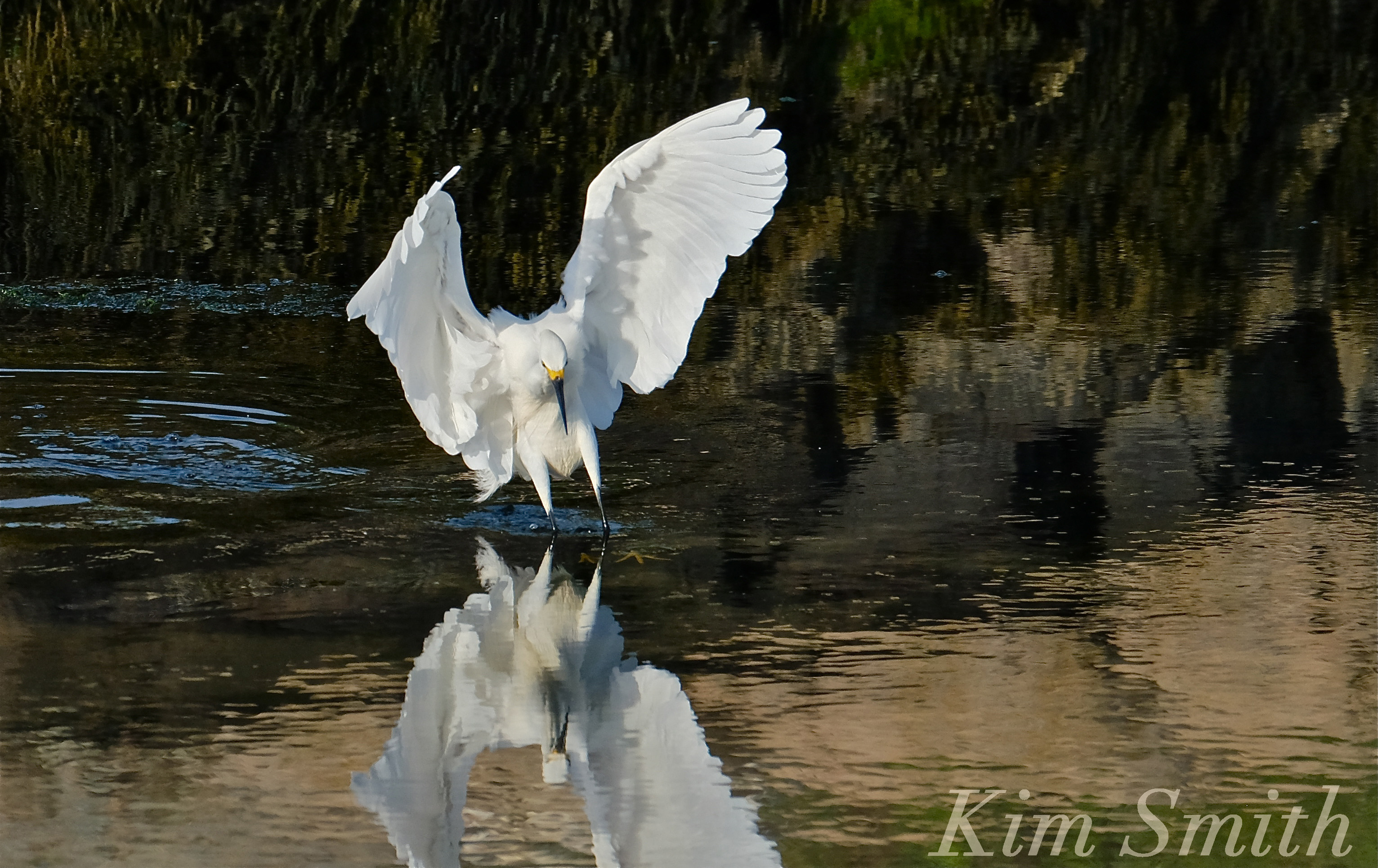
Snowy Egret Good Harbor Beach copyright Kim SmithSnowy Egret Good Harbor Beach -2 copyright Kim SmithSnowy Egrets fishing at the GHB tidal river this morning.


GOOD HARBOR BEACH STORM SKY DRAMA AND PIPING PLOVER UPDATE

Good Harbor Beach storm sky copyright Kim SmithJPGStopped at Good Harbor to check on the Piping Plovers on my way into work this morning. No babies yet. I spotted three adults, feeding in the tidal flats, grooming, and giving every bird of another species besides their own the business, in no uncertain terms. Big raindrops began to fall, I don’t trust the manufacturer’s claim that my cameras are waterproof, and work was waiting. First light at Good Harbor is always different, depending on what is happening in the sky above, and it is always beautiful.

Piping Plover good Harbor Beach Gloucester MA copyright Kim Smith

Bath time

Piping Plover good Harbor Beach Gloucester MA -2 copyright Kim Smith

Piping Plover good Harbor Beach Gloucester MA -1 copyright Kim Smith

SWAN, DUCKLING, AND PLOVER UPDATE AND HUGE SHOUT OUT TO THE GLOUCESTER DPW UNDER THE DIRECTION OF JOE LUCIDO FOR DOING A TREMENDOUS JOB CLEANING OUR BEACHES

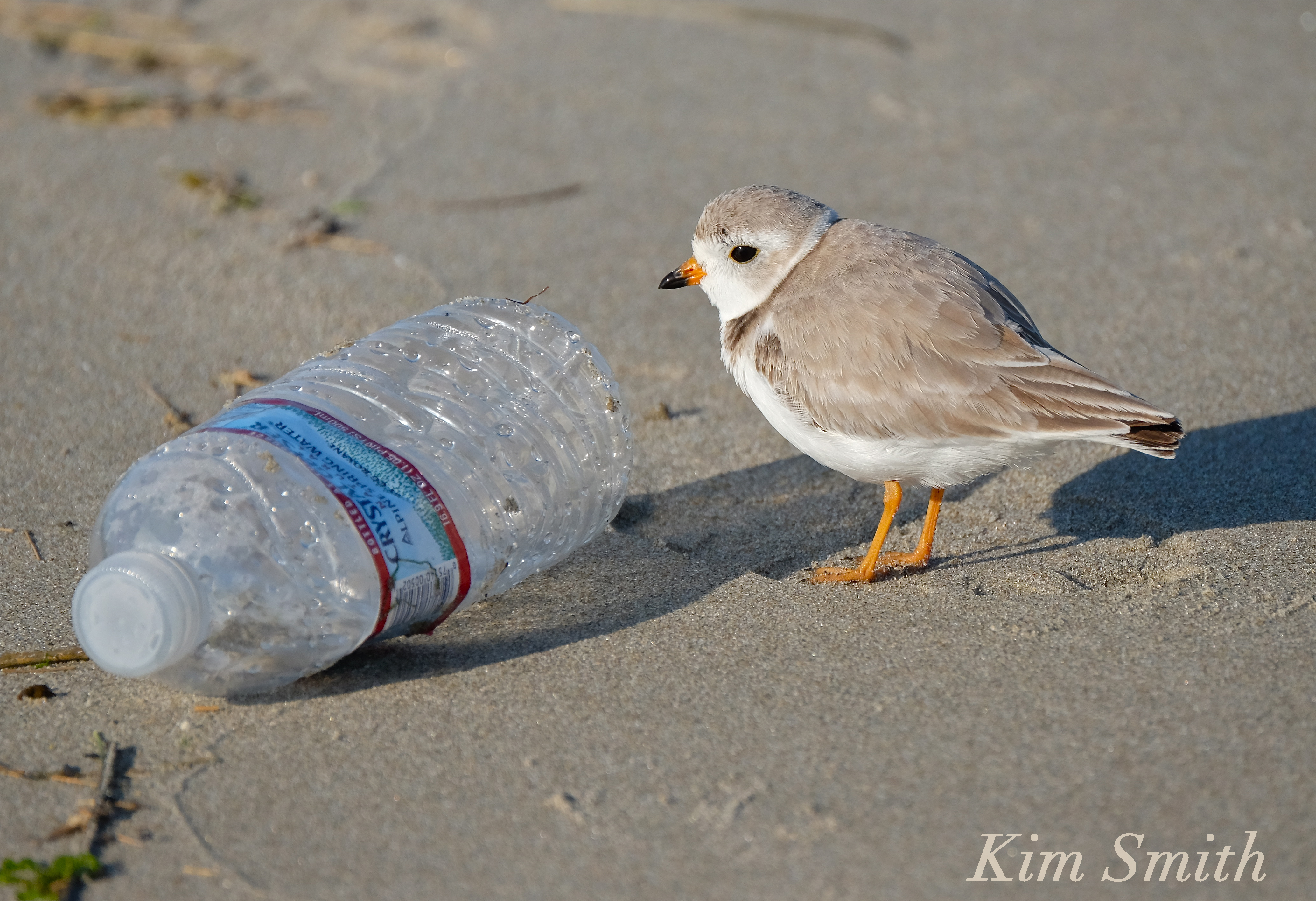
Piping Plover with garbage plastic bottle pollution copyright Kim SmithLandscape design work is keeping me away from beloved film projects (although I do love my work no doubts). I did mange this morning to go to Good Harbor Beach to check on the Piping Plovers, to Henry’s to see Mr. Swan, and to the marsh for the ducklings. There were two plovers awakening in the little GHB cordoned off sanctuary, feeding and chasing away intruders. Mr. Swan was chilling at Henry’s, and the three sweet duckling families I have been filming don’t appear to have lost any additional members.

Spending time at Good Harbor Beach filming the plovers before the beach has been cleaned has certainly been an eye opener. Although not even officially summer yet, every morning at daybreak I find the beach littered with an astonishing amount of plastic bottles, trash, food, and plastic bags. According to Rose Piccolo at the DPW, the cleanup crew arrives around 7am and typically has the beaches cleaned by 8:30am. They do a really truly phenomenal job of making our beaches look pristine and attractive before the 9am opening.

A most sincere thank you to Joe Lucido and the Gloucester DPW for a job well done.

https://www.instagram.com/p/BGKMouyDynW/
https://www.instagram.com/p/BGKHcb1DypO/

FIRST LOOK BEAUTIFUL GOOD HARBOR BEACH PIPING PLOVERS!

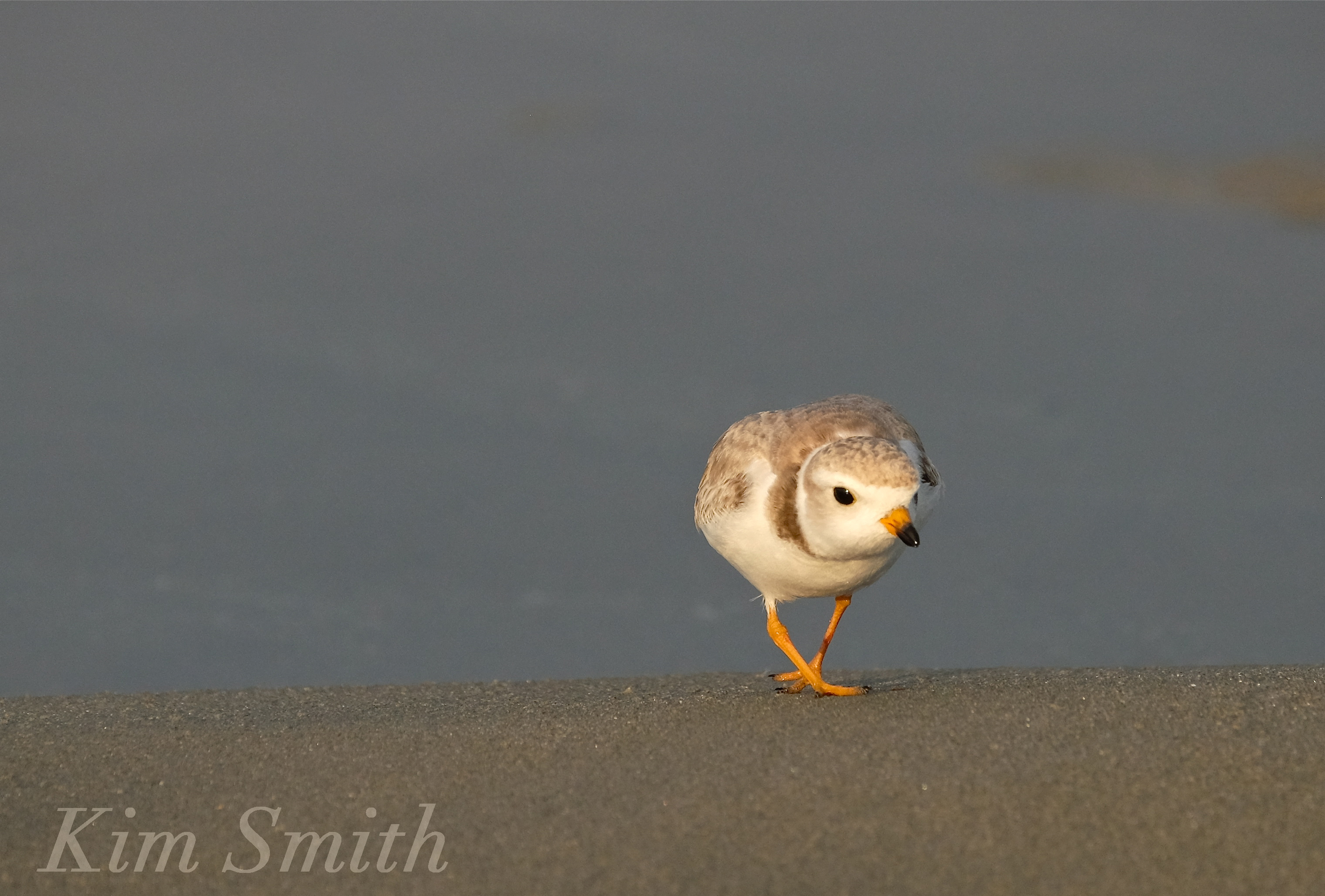
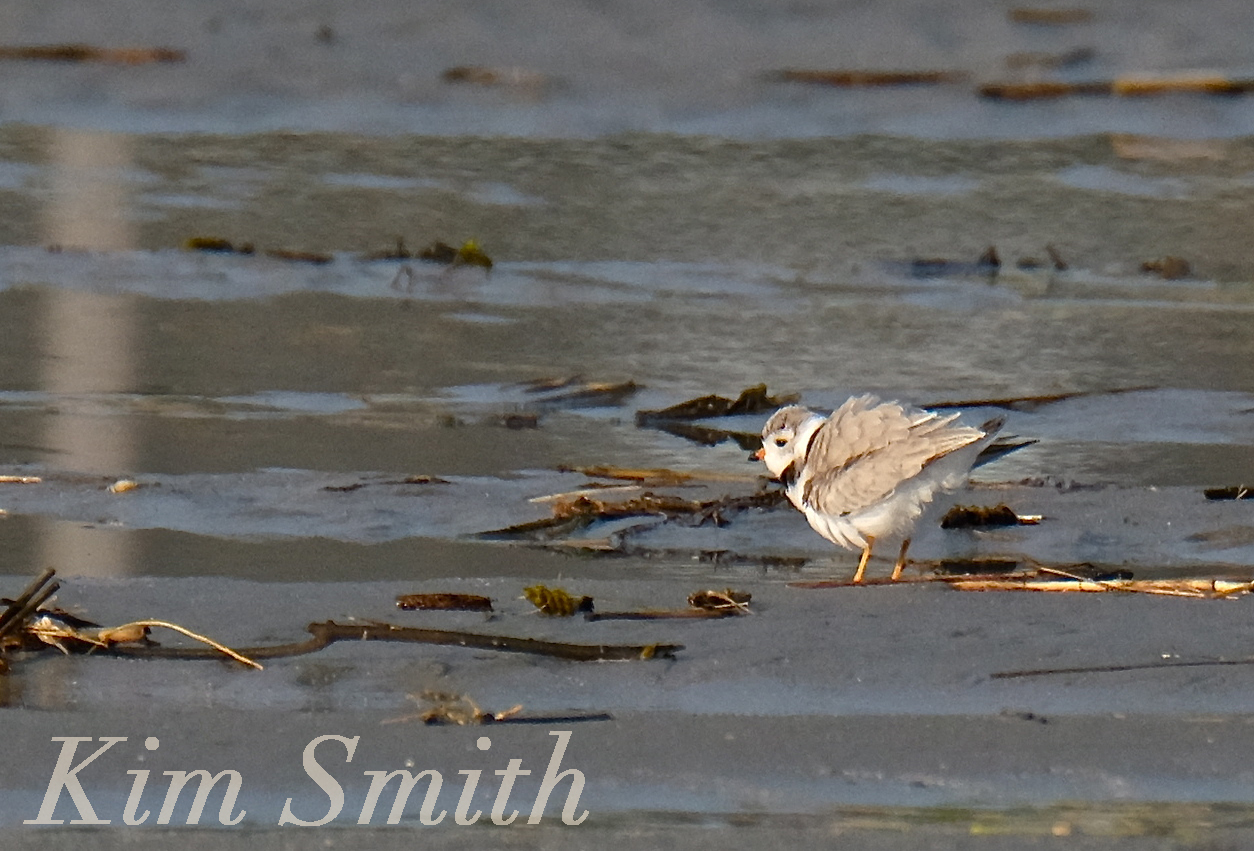
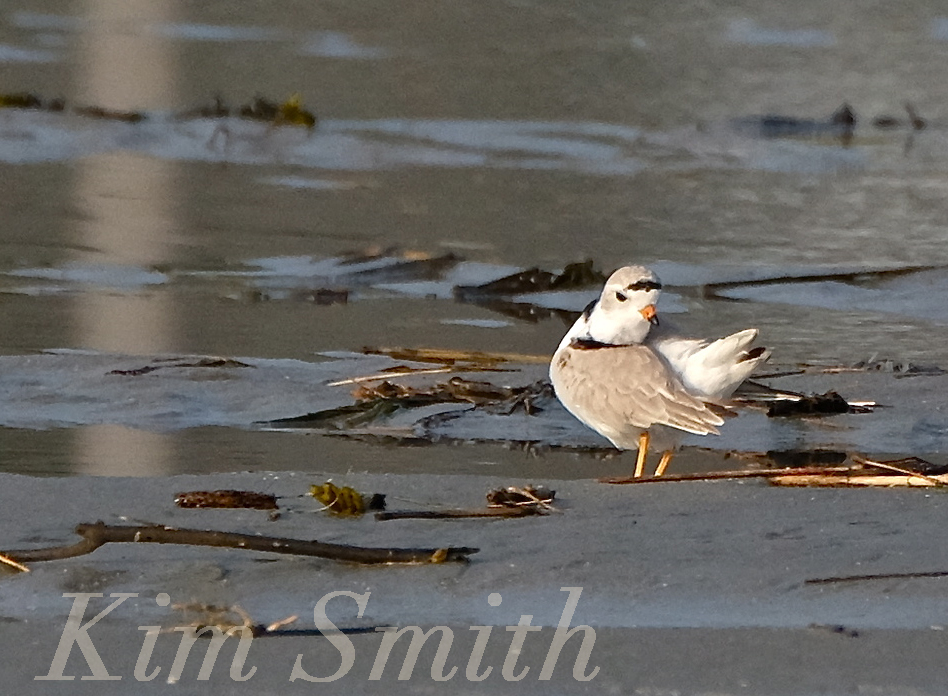
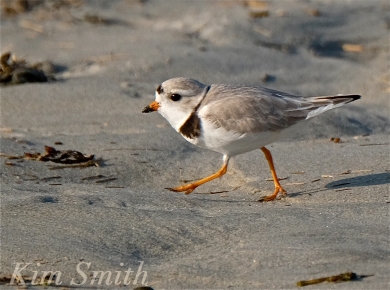
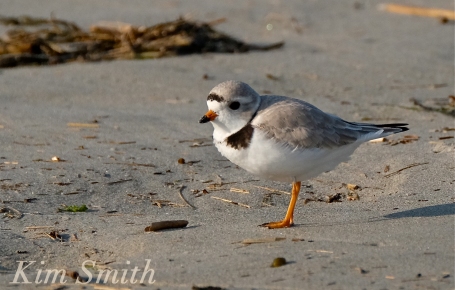
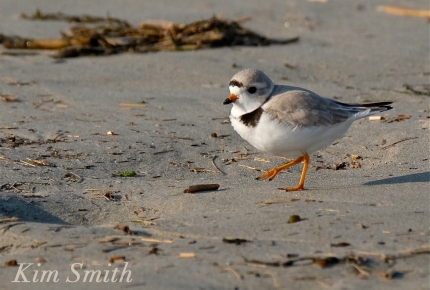
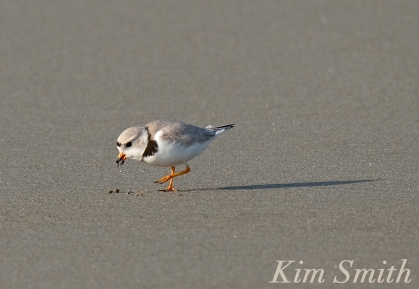
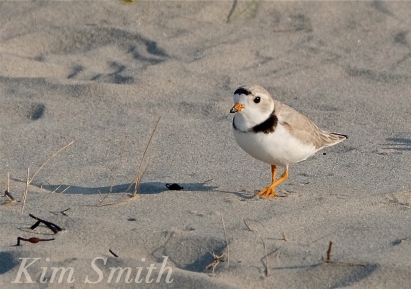
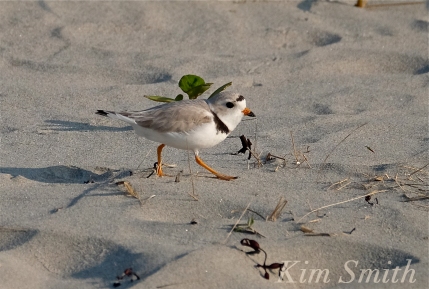
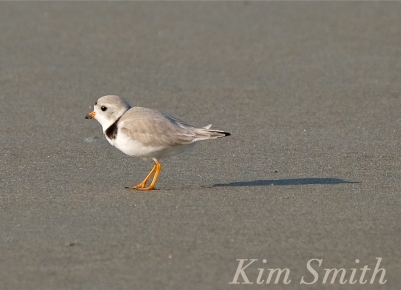
PIPING PLOVERS RUNNING 2 GOOD HARBOR BEACH GLOUCESTER COPYRIGHT KIM SMITHNot shy in the least, the four Good Harbor Beach Piping Plovers spent the early part of the morning running and feeding along the shoreline, bathing in the tidal flats, and ferociously defending their territory against other avian intruders. A jogger ran past the one preening at the water’s edge–he was quite close–but that did not seem to alarm the Plover. They are diminutive little creatures, about six to seven inches in length, and show mostly white feathers when flying overhead.

PIPING PLOVERS -Eating 4 GOOD HARBOR BEACH GLOUCESTER COPYRIGHT KIM SMITH

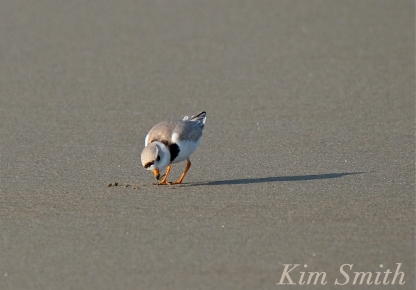
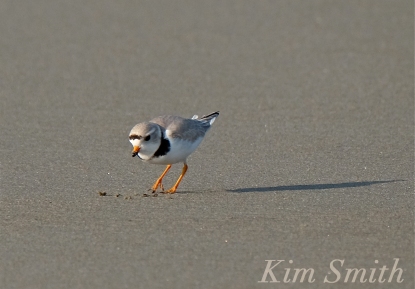
Breakfast – Piping Plovers eat insects and small invertebrates

One Piping Plover seemed to be testing different sites to nest, momentarily hunkering down, then leaving the spot, and then returning a few moments later to vigorously dig a deeper depression in the sand, before then flying away.

PIPING PLOVERS NESTING -5 GOOD HARBOR BEACH GLOUCESTER COPYRIGHT KIM SMITHTesting the depression

PIPING PLOVERS NESTING 2 GOOD HARBOR BEACH GLOUCESTER COPYRIGHT KIM SMITH

Leaving the possible nesting site

PIPING PLOVERS -5 GOOD HARBOR BEACH GLOUCESTER COPYRIGHT KIM SMITH

Returning to the depression

PIPING PLOVERS NESTING -3 GOOD HARBOR BEACH GLOUCESTER COPYRIGHT KIM SMITH

PIPING PLOVERS NESTING -4 GOOD HARBOR BEACH GLOUCESTER COPYRIGHT KIM SMITH

Digging in!

PIPING PLOVERS NESTING GOOD HARBOR BEACH GLOUCESTER COPYRIGHT KIM SMITH

The roped off area appears to be a terrific solution in helping to protect the possible nesting sites. Visitors to Good Harbor Beach this morning were very mindful about respecting the boundary. And there was not a single dog in sight, off leash or otherwise. The Plovers flew in and out of the restricted area, as did Killdeers and several other species of shore birds.

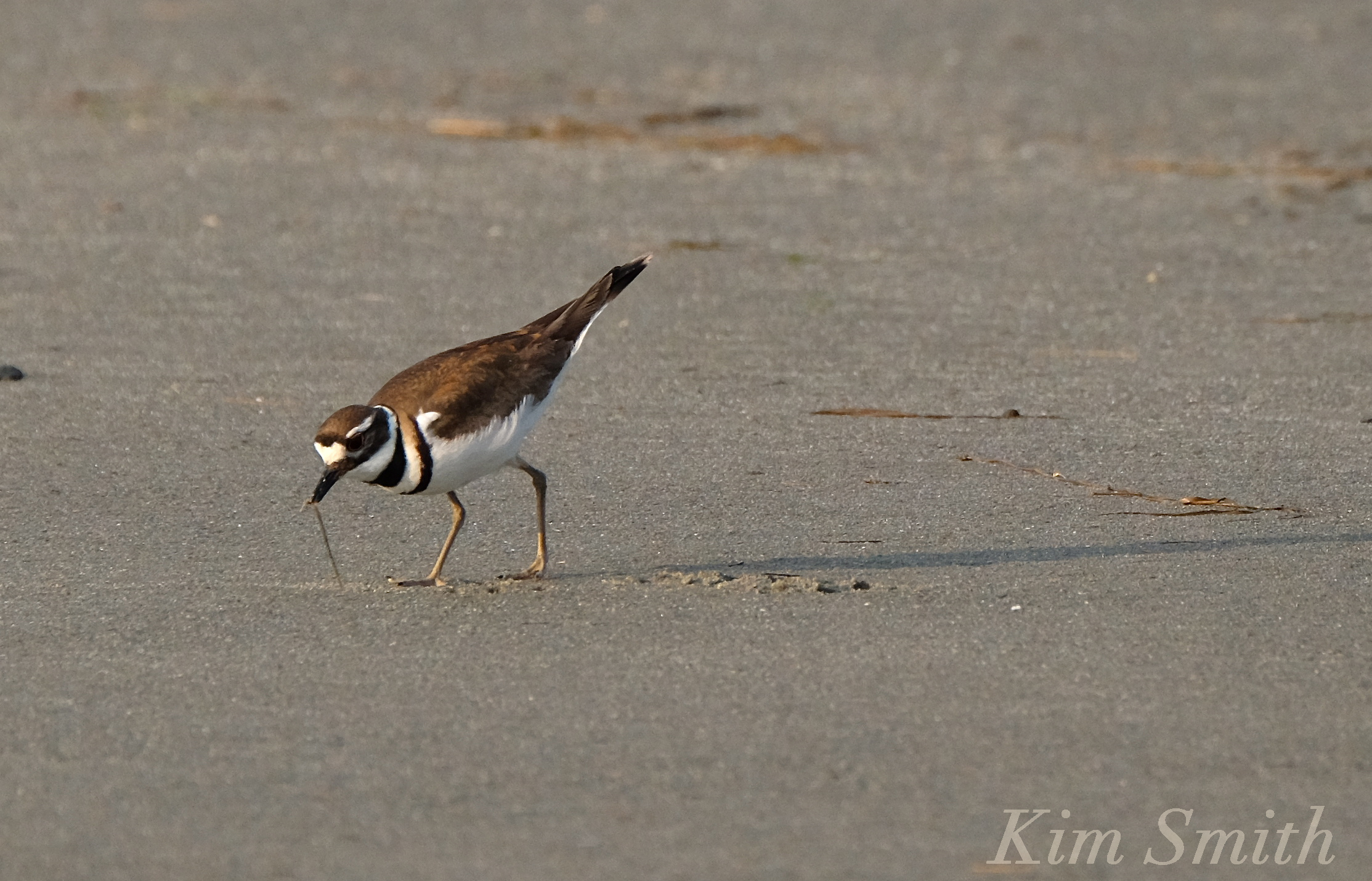
KILLDEER GOOD HARBOR BEACH GLOUCESTER COPYRIGHT KIM SMITHA Killdeer feeding near the Piping Plovers. The Killdeers, also members of the Charadadriidae, are slightly larger and a much darker brown than the Piping Plovers.

PIPING PLOVERS GOOD HARBOR BEACH GLOUCESTER -1 COPYRIGHT KIM SMITHPIPING PLOVERS PREENING GOOD HARBOR BEACH GLOUCESTER COPYRIGHT KIM SMITHPreening

RARE AND ENDANGERED PIPING PLOVERS AT GOOD HARBOR BEACH

Yet another bird that was nearly hunted to extinction for its beautiful feathers, as of 2012 when the most recent study was concluded, there were only 3,600 breeding Piping Plovers along the Atlantic Coast.

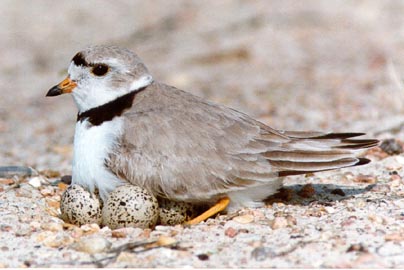
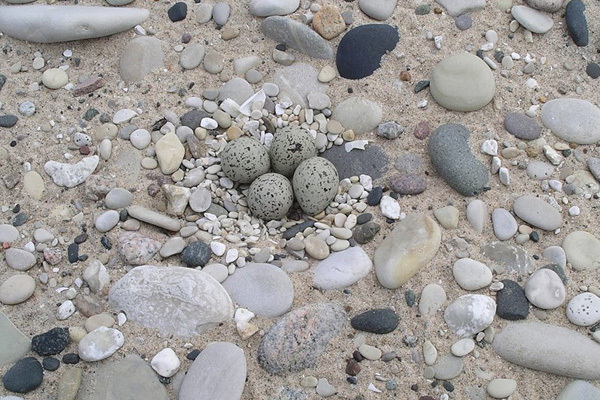
piping-plover-on-nestPiping Plover’s are a softy colored, mostly tan and white, pint-sized shorebird and like their nests and eggs, exquisitely camouflage with colors of sand and pebbles. This also makes them highly vulnerable to disturbances by humans; even if when people are trying to avoid their nesting sites, it is very easy to unwittingly crush eggs and chicks.

Piping Plovers have been observed on Good Harbor Beach this spring and could quite possibly nest here. The Gloucester DPW, working in conjunction with the Conservation Commission, MA Department of Wildlife, and Mass Audubon have cordoned off a roughly 200 feet by 200 feet area between the GHB bridge and boardwalk number three (the large rock that was exposed several storms ago lies within the area).

This area of the beach may be closed off for as long as eight weeks, possibly longer. If the nest is disturbed, the Piping Plovers will abandon the first and create a new nest, which will extend the time of beach closure.

It is to everyone’s benefit, plover and people alike, to heed the signs and to please keep dogs on leash at all times.

Are dogs allowed on the beach at this time of year?

prd_037300

OLYMPUS DIGITAL CAMERA

PIPL_nest_002

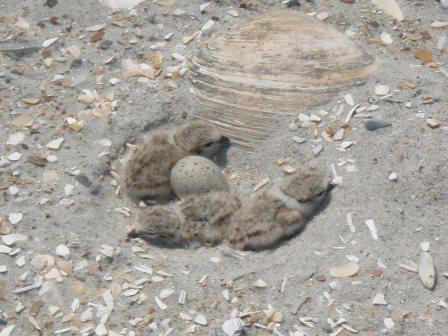
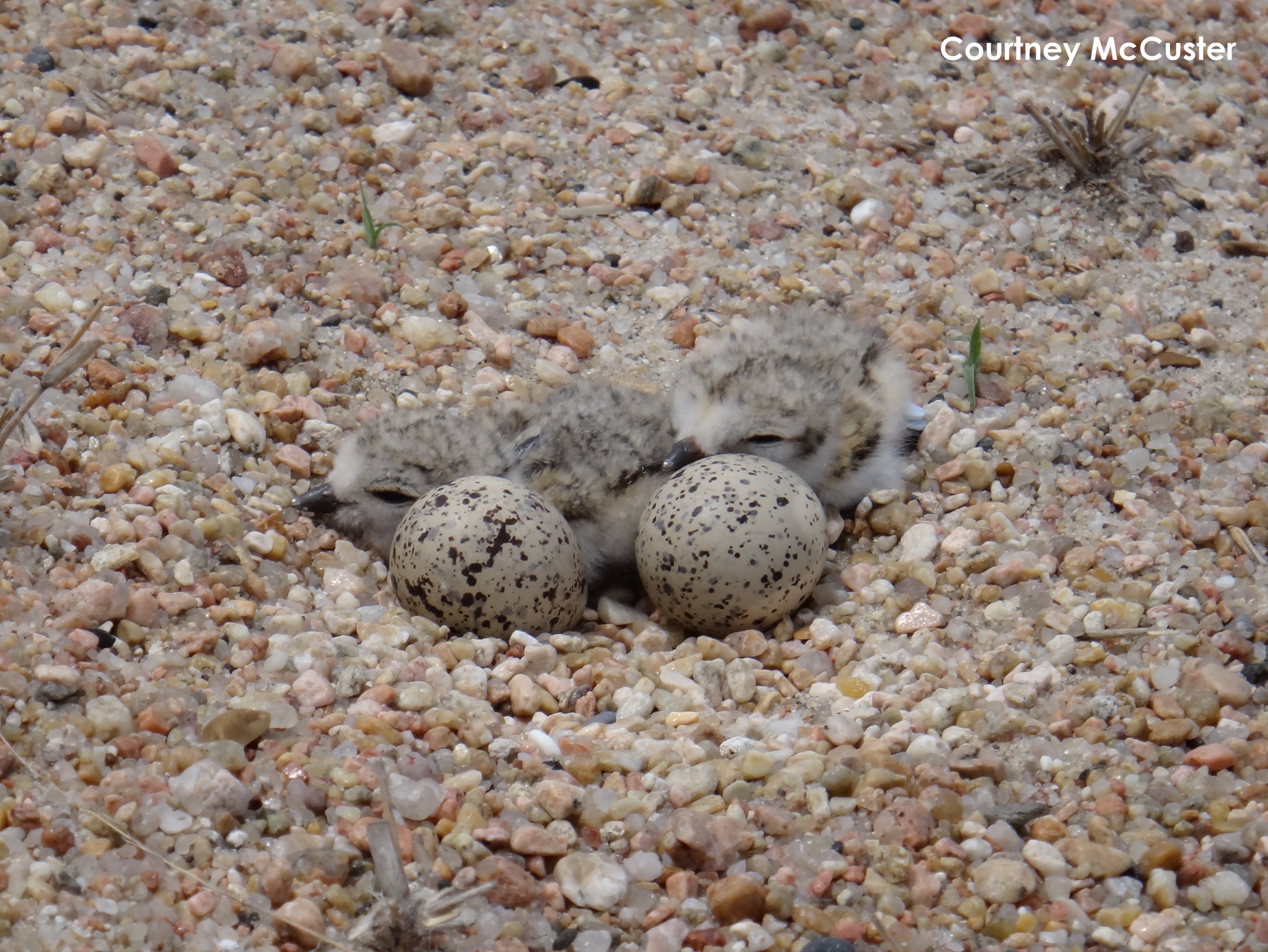
You can see from the photos of different Piping Plover nests from several regions of the country how perfectly the pebble-lined nests and babies meld with their surroundings–a good thing to keep them safe from predators, but not such a good plan for nests in well-trafficked areas.

The male selects the nesting site, defending it from other males. He scrapes a nest in the sand and both the male and female toss stones and bits of shell into the depression. Both the male and female incubate the eggs. It takes about 25 days to incubate the eggs and another three to four weeks for the chicks to fledge.

20130716_0151

Like the Killdeer, Piping Plovers cleverly display a broken wing, a trick designed to distract predators from their nests and babies. Both Killdeers and Piping Plovers are in the same family, Charadriidae. The Piping Plover’s scientific name, Charadrius melodus, and common name, comes from its lovely melodic piping bird song.

PIPL_Defense_001

https://www.instagram.com/p/BFrn9KYjyma/

DSCF3628

ALL IMAGES EXCEPT THE LAST TWO, COURTESY GOOGLE IMAGE SEARCH