Margaret Atwood Quote of the Week From Greg Bover

image

13 December, 2013

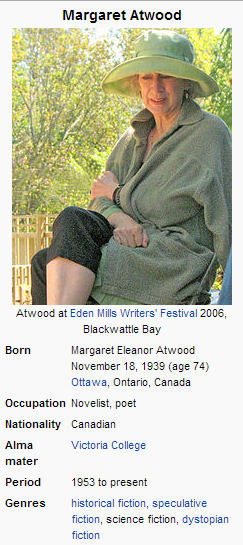
“Another belief of mine: that everyone else my age is an adult, whereas I am merely in disguise.”

Margaret Atwood  (1939 –     )

Born in Canada to parents engaged in the study of forest entomology, Atwood spent much of her youth in the woods and did not attend school full time until she was a teenager. A voracious reader, she ultimately graduated from the University of Toronto with a degree in English and the goal of becoming a writer. She did several years of postgraduate work at Radcliffe and Harvard, but did not finish her dissertation. Her poetry began to receive widespread notice in the 1960’s, but her novel The Handmaid’s Tale (1981) propelled her to celebrity status, winning the Arthur C. Clarke and Governor General’s award, and making her an icon of the feminist movement. Other works of speculative fiction, Oryx and Crake, (2003) and The Blind Assassin (2000) have won her the Booker Prize and the Dan David Prize, as well as a long list of honorary doctorates at prestigious institutions including Smith, Harvard, Oxford and the Sorbonne. Atwood is well regarded in humanist and liberal circles and is a member of the Green Party of Canada.

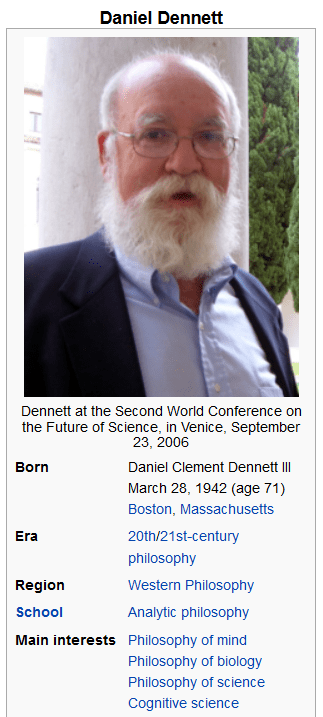
Daniel C. Dennett Quote of The week From Greg Bover

December 5, 2013

image

“If you can approach the world’s complexities, both its glories and its horrors, with an attitude of humble curiosity, acknowledging that however deeply you have seen, you have only just scratched the surface, you will find worlds within worlds, beauties you could not heretofore imagine, and your own mundane preoccupations will shrink to proper size, not all that important in the greater scheme of things.”
Daniel C. Dennett, (1942-     ) from Breaking the Spell: Religion as a Natural Phenomenon

Boston born, Dennett spent his early years in Lebanon, where his father, an operative of the OSS, was killed in the Second World War. Later educated at Phillips Exeter, Harvard and Oxford, Dennett nevertheless refers to himself as an autodidact. Now a professor at Tufts University and Director of the Center for Cognitive Studies, he is principally known as a philosopher, humanist, and atheist, having written extensively on free will and a naturalist view of human evolution. The author of more than a dozen books, including Consciousness Explained (1992) Dennett was both a Fulbright and Guggenheim Fellow and received the Erasmus Prize in 2012. An avid sailor, he lives in North Andover, Massachusetts.

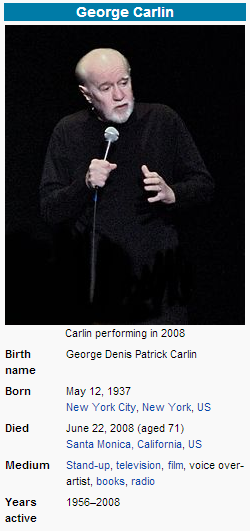
George Carlin Quote of The Week From Greg Bover

“I put a dollar in a change machine. Nothing changed”

George Carlin (1937-2008)

image

A five-time Grammy award winner, Carlin’s often dark humor can be heard on 20 albums, in six books, and appears in ten movies. A native New Yorker, he made his name on the Ed Sullivan Shoe and the Tonight Show, first with Jack Paar and later and even more frequently with Johnny Carson, for whom he often substituted as host.  Carlin was the first host of Saturday Night Live. His best known routine was Seven Words You Can Never Say on Television, for which he was arrested and fined on several occasions. Liberal, brilliant, thoughtful and reflective, he took stand-up to a new level while supporting free speech and free thinking. He was awarded the Mark Twain Prize for American Humor in 2008.

Max De Pree Quote of The Week From Greg Bover

November 15, 2013

“We cannot become who we want to be by remaining who we are.”

Max De Pree (1924- )

A Michigan native, Max De Pree is the son of D. J. De Pree, who started the very successful Herman Miller furniture company. Max and his brother Hugh ran and expanded the company from the 60’s up into the 90’s. He has written extensively on leadership in both the business and non-profit communities and his Leadership is an Art was a best seller. In the mid 1950’s he commissioned Charles and Ray Eames to design a home in Zeeland, close to corporate headquarters. It remains an icon of modernist architecture and interior design.

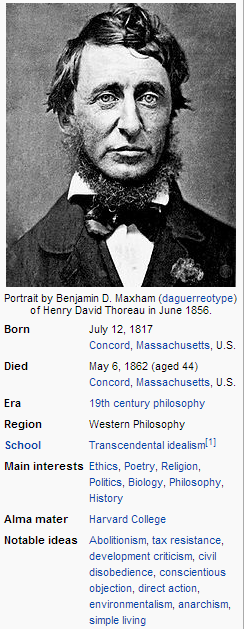
Henry David Thoreau Quote of The Week From Greg Bover

If we will be quiet and ready enough, we shall find compensation in every disappointment.
Henry David Thoreau (1817-1862)

image

Sometimes called the first environmentalist, Thoreau, born and raised in Concord, Massachusetts, was mentored by the Transcendentalists Ralph Waldo Emerson and Bronson Alcott, his neighbors. His book Walden, about the two years he spent living in a hut he had built himself on Emerson’s woodlot at Walden Pond, has become a classic of American literature for its introspection blended with natural history. His Civil Disobedience, written as an explanation of his non-payment of taxes as a protest against the Mexican-American war, is still influential, and his books on his journeys to Maine, Canada and Cape Cod go much deeper than mere travelogues. Thoreau is also credited with the invention of raisin bread.

Jay DiPrima will read from Thoreau’s Civil Disobedience at seven o’clock next Thursday evening at the Sawyer Free Library as part of the Gloucester Lyceum Series.

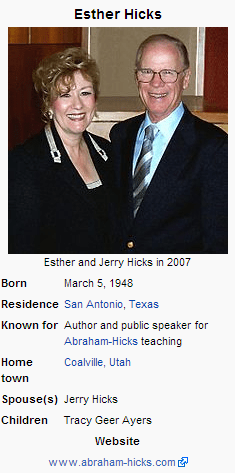
Esther (neé Weaver) Hicks Quote of The Week From Greg Bover

November 1, 2013

“Worrying is using your imagination to create something that you don’t want.”

Esther (neé Weaver) Hicks (1948-    )

image

A Utah native, Hicks is a motivational speaker and the author, with her husband Jerry, now deceased, of nine books including the Law of Attraction series, which she says was inspired by a group of “non-physical entities called Abraham.” Hicks maintains that her connection to Abraham has taught her that the purpose of life is to seek joy, and that individuals are the extension of their thoughts. Many of the concepts Hicks expounds were first written about by William Walker Atkinson in the early twentieth century. Hicks has disavowed The Secret by Rhonda Byrne, a movie about her teachings and Abraham, because of her disagreements with Byrne over marketing and contractual issues. Her publishing house includes books, DVD’s, a speaker series, cruises, a YouTube channel, and phone apps.

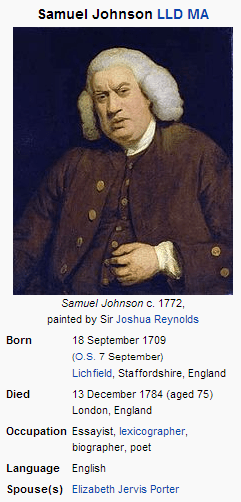
Samuel Johnson Quote of The Week from Greg Bover

18 October, 2013

“Kindness is always in our power, even when fondness is not.”

Samuel Johnson (1709-1784)

image

Dr. Johnson was the most important English literary figure of his age. He wrote plays, essays and poems including the perceptive “Vanity of Human Wishes,” but he was best known for his Dictionary of the English Language (1755), an almost incomprehensible feat of mainly solo scholarship, written in just nine years, and the first to feature examples, largely from Shakespeare, Dryden, and Milton, of the 114,000 words in a literary context. Johnson was also the subject of one of the most famous biographies ever written, the minutely detailed Life of Samuel Johnson, by James Boswell. It is from this biography and other descriptions of the tics and outbursts of the good Doctor that it is now thought that he suffered from Tourette’s syndrome, a condition not yet defined in his time. Johnson is also credited with the observation that “Patriotism is the last refuge of scoundrels.”

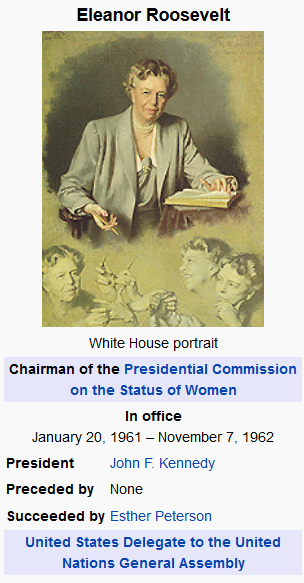
Eleanor Roosevelt Quote of the Week From Greg Bover

October 10, 2013

“What other people think of me is none of my business”

Eleanor Roosevelt  (1884-1962)

image

A New Yorker by birth and niece of Theodore Roosevelt, Eleanor lost both parents and a brother before she was eleven. She attended Allenwood Academy in London and was influenced by headmistress Marie Souvestre, an early feminist. She married Franklin Delano Roosevelt, her fifth cousin, in 1904, and supported his forays into politics despite his polio and her discovery of his extra-marital affairs. Wishing to carve out an identity for herself, she became active, first in the New York State Democratic Party when FDR was Governor, and then as the most outspoken of all First Ladies when he was elected President for the first of his four terms in 1932. She was an ardent supporter of the rights of women and minorities, and created much controversy when she opposed some of her husband’s policies, including Japanese-American internment during the Second World War. Following FDR’s death in 1945 she was named one of the first delegates to the United Nations, the founding of which she had strongly supported, and continued her social justice advocacy for the rest of her life, becoming one of the most admired and respected Americans of her era.

Note: This quote is also attributed to Wayne Dyer, Rupaul, Simon Cowell and several others. ER is the earliest author I could find.

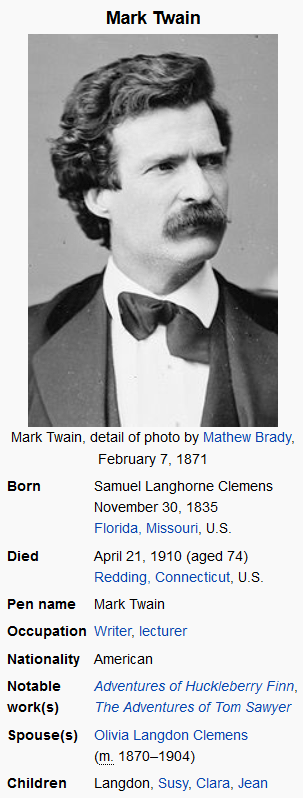
Samuel Langhorne Clemens Quote of The Week From Greg Bover

“Anger is an acid that can do more harm to the vessel in which it is stored than to anything on which it is poured.”

Samuel Langhorne Clemens, (1835-1910)

image

Best known by his pen name, Mark Twain, Clemens was a giant of American humor and letters. A Missouri native, he had brief careers as a miner and a river boat pilot before his short stories began to receive widespread notice. He was the keenest wit of his age and wrote what many call the greatest of American novels, The Adventures of Huckleberry Finn (1885).  Through a series of bad investments he lost all of the money he made from his books and a good deal of his wife’s substantial inheritance, which motivated him to begin many years of international speaking tours. The money from these performances eventually overcame his debt and added to his fame. He was a friend and advisor to presidents, scholars, and scientists, Nicola Tesla chief among them. Born when Halley’s comet was in the sky, he died, as he predicted, when it returned.

Greg Bover

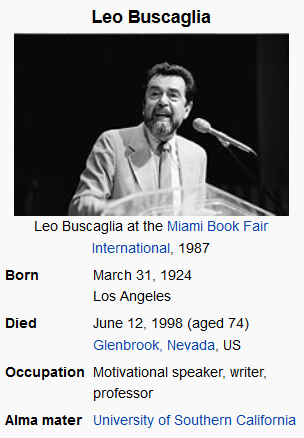
Felice Leonardo “Leo” Buscaglia Quote of The Week From Greg Bover

September 19, 2013

“Don’t brood. Get on with living and loving. You don’t have forever.”

Felice Leonardo “Leo” Buscaglia (1924-1998)

image

A California native born to an Italian immigrant family, Buscaglia spent much of his childhood in Italy, returning to the United States for his education, which culminated in three degrees from USC including a PhD. After joining the faculty, he was motivated to begin offering a class on love following the suicide of a favorite student. He wrote more than a dozen books on how to connect with other humans. His arresting lecturing style caught the attention of producers at PBS who made him a celebrity speaker, often featured during pledge drives, and a sought after counselor. Five of his books were on the New York Times best seller list simultaneously. Another similar piece of his advice: “Don’t spend your precious time asking ‘Why isn’t the world a better place?’ It will only be time wasted. The question to ask is ‘How can I make it better?’ To that there is an answer.”

Greg Bover

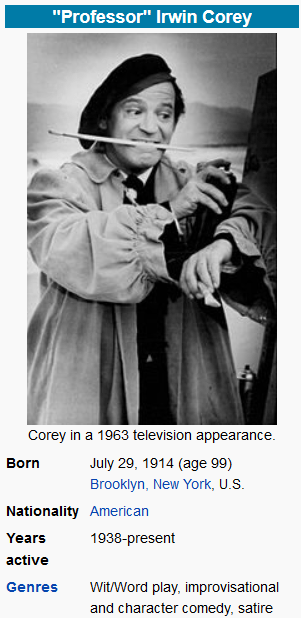
Professor Irwin Corey Quote of The Week From Greg Bover

September 13, 2013

“If we don’t change direction soon we will end up where we are going.”

Professor Irwin Corey (1914-   )

image

A New York born comedian and actor, Corey is known as “The World’s Foremost Authority” for his ability to improvise impressively and at length on almost any topic while making little real sense but sounding completely plausible. Blacklisted in the 40’s and 50’s for his leftist politics, he nonetheless rebounded to appear numerous times on the Tonight Show. Author Thomas Pynchon, famously publicity-shy, tapped “The Professor” to stand in for him at the National Book Award ceremony for Gravity’s Rainbow. Lenny Bruce was a fervent fan of Professor Corey, calling him one of the most brilliant comedians of all time.

Greg Bover

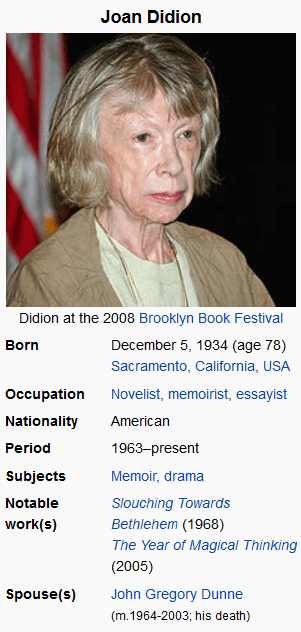
Joan Didion Quote of The Week From Greg Bover

September 5, 2013

“Character – the willingness to accept responsibility for one’s own life – is the source from which self-respect springs.”

Joan Didion  (1934-     )

image

A Sacramento native, Didion grew up in an Army family, their constant relocations causing her to feel like a perpetual outsider. As a student at UC Berkeley, she won a writing contest sponsored by Vogue, leading to a job at the magazine. She was married to writer John Gregory Dunne, and is the author of five novels and more than a dozen non-fiction books.  Didion often writes about what she sees as chaos in American culture. Her work is permeated by a sense of foreboding dread of social change and anxiety at individual uncertainty. Her best known work, Slouching Toward Bethlehem, is a series of vignettes illustrating life in 1960’s California. One of her most recent works, The Year of Magical Thinking describes her experiences around the deaths of her husband and daughter in a short span of time. President Obama will present her with the National Medal of Arts and Humanities this year.

With this post the Quote of the Week celebrates three years with Good Morning Gloucester, one hundred and fifty entries. Just so you know, I write the biographies based on my research to give the quote context, and one can click on the name or the picture that Joey adds to be connected to a Wikipedia entry for that particular author. Sometimes the adages are only attributed when I can’t find evidence of the direct quote; famous quipsters like Abraham Lincoln and Yogi Berra are often credited with things others actually said first.

I am always encouraged by your comments, and your suggestions are welcome too.

Many thanks to Joey and the GMG team for creating a forum where these lines can be shared. I find it astonishing how much wisdom there is in the world, and how the thoughts of famous men and women can apply to my own life. I hope you do too.

Greg Bover

Marcus Tullius Cicero Quote of The Week From Greg Bover

“Gratitude is not only the greatest of virtues, but also the parent of all the others.”

Marcus Tullius Cicero (106 BC – 43 BC)

image

A Roman statesman, philosopher, and orator, Cicero is credited with lifting Latin prose from its utilitarian origins to new literary and rhetorical heights. Born into a prominent family of the Roman Equestrian order, (the family name means “chickpea”), Cicero distinguished himself first as a lawyer and speaker, and was elected to a series of government offices at an early age, rising through the ranks during the dangerous years of the Sulla dictatorship, despite his support for a constitutional republic. He aligned himself with Pompey during the civil war that brought Julius Caesar to power, but was later assassinated for his support of Octavian (Augustus) and his antipathy to Marc Antony. Many of Cicero’s speeches and writings survived the Dark Ages to form the basis of later thinking on the formation of governments based on the consent of the governed. Leaders of the American and French revolutions often cited Cicero as the source of their belief in the natural rights of man.

Greg Bover

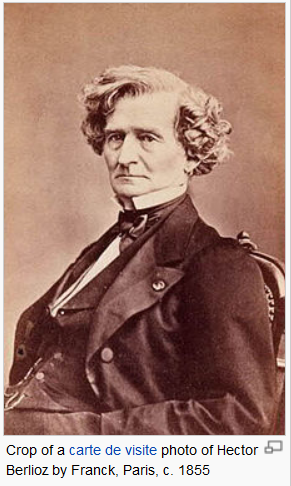
Hector Berlioz Quote Of The Week From Greg Bover

“Time is a great teacher, but unfortunately it kills all its pupils.”

Hector Berlioz (1803-1869)     suggested by Rick Isaacs

image

Born in France, Berlioz was initially sent to Paris to study medicine, but spent the majority of his time in the library of the Conservatoire, in which he later enrolled to study composition. He himself was influenced by Beethoven, Gluck, and Mozart, among others, but would go on to have a profound effect on symphonic music, especially in powerful instrumentation, along with Liszt and Wagner, his contemporaries. Much of Berlioz’s work was inspired by the poetry of Byron, Goethe, and Shakespeare; his best known work, Symphonie fantastique, was inspired in part by Thomas deQuincey’s Confessions of an Opium Eater.  Later in life, Berlioz came full circle, returning to the Paris Conservatoire to serve as Head Librarian. Gustav Mahler, Richard Strauss and Nikolai Rimsky-Korsakov all gave credit to Berlioz for work that pre-figured their own.

Greg Bover

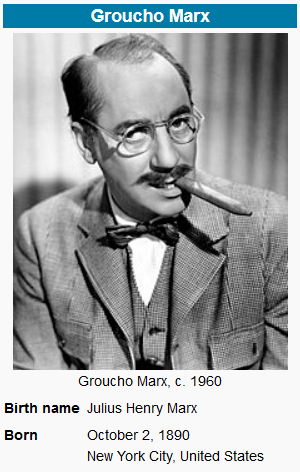
Julius Henry "Groucho" Marx Quote of The Week From Greg Bover

“I’ve had a perfectly wonderful evening. But this wasn’t it.”

Julius Henry "Groucho" Marx (1890-1977)

image

Groucho’s comedy career spanned vaudeville, radio, film and later television. He made 26 movies, half of them with his brothers, Harpo, Chico, Gummo, and Zeppo. His solo career included the radio and television show “You Bet Your Life” which ran for 11 years in the 40’s and 50’s. Self-deprecating and self-taught, he was a voracious reader who said his greatest achievement was to have one of his books listed as a cultural treasure by the Library of Congress. Another favorite quote among his many witticisms is “Outside of a dog, man’s best friend is a book. Inside of a dog, it’s too dark to read.”

Greg Bover

William Arthur Ward Quote of the Week From Greg Bover

“Feeling gratitude and not expressing it is like wrapping a present and not giving it.”

William Arthur Ward (1921-1994)

A Louisiana native, Ward was as near to a professional proverbian as one can find in American society. After a stint in the Philippines with the US Army, Ward was Assistant to the President of Texas Wesleyan University, founded by the Methodist Episcopal Church. He headed a number of church groups during his active community life and wrote an inspirational column that appeared in the Fort Worth Star-Telegram for many years. Among the publications that featured his extraordinary output of quotable sayings were The Reader’s Digest, The Christian Advocate, and Science of the Mind magazine. Ward also served on the boards of the Rotary, the Red Cross, and the Boy Scouts of America.

Greg Bover

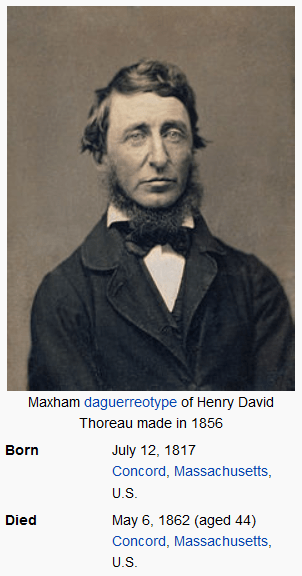
Henry David Thoreau Quote of The Week From Greg Bover

“The price of anything is the amount of life you exchange for it.”

Henry David Thoreau (1817-1862)

image

Sometimes called the first environmentalist, Thoreau, born and raised in Concord, Massachusetts, was mentored by the Transcendentalists Ralph Waldo Emerson and Bronson Alcott, his neighbors. His book Walden, about the two years he spent living in a hut he had built himself on Emerson’s woodlot at Walden Pond, has become a classic of American literature for its introspection blended with natural history. His Civil Disobedience, written as an explanation of his non-payment of taxes as a protest against the Mexican-American war, is still influential, and his books on his journeys to Maine, Canada and Cape Cod go much deeper than mere travelogues. Thoreau is also credited with the invention of raisin bread.

Greg Bover

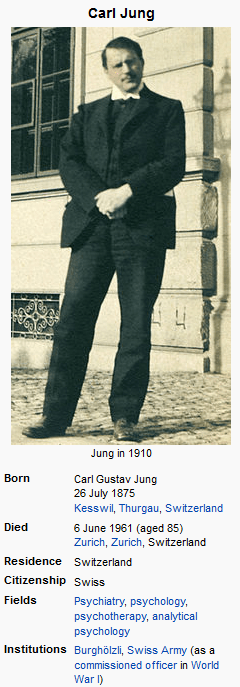
Carl Jung Quote of The Week From Greg Bover

June 20, 2013

“Everything that irritates us about others can lead us to an understanding of ourselves.”

Carl Jung (1875-1961)

image

The founder of analytical psychology, Jung was born, raised and educated in Switzerland. His mother’s mysticism and his own early experiences with little understood psychological phenomena such as neurosis led him to a life-long study of the mind. In 1906 he met the somewhat older Sigmund Freud and formed a friendship and professional relationship that lasted for many years though they eventually fell out over the nature of the unconscious mind, Jung holding that the “collective unconscious” had a deeper and more powerful effect on the psyche. He was responsible for the development of several core concepts of modern psychology, including extroverted and introverted personalities, archetypes and “individuation”, the process of integrating the conscious and unconscious within one’s self. His theories led to a number of current psychological tools, including the Myers-Briggs Type Indicator, a test sorting individuals according to their perception of the world and their decision-making processes. Jung’s studies went well beyond the strictly scientific, including dream analysis, astrology, alchemy, and the occult.

Greg Bover

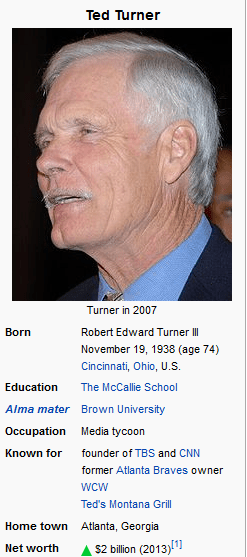
Ted (Robert Edward) Turner Quote Of The Week From Greg Bover

“If I only had a little humility, I’d be perfect.”

Ted (Robert Edward) Turner (1938-     )

image

Media mogul, billionaire, philanthropist and sailor, Ted Turner was born in Ohio, but his family moved to Atlanta when he was nine. Educated at The McCallie School and Brown University, from which he was expelled for having a woman in his room, Turner took over a successful billboard business at 24 when his father took his own life. Over the next two decades he parleyed that business into an empire by shrewdly expanding a local television station into the giant TBS cable network, while establishing CNN, the Cartoon Network, TNT, TCM and others. As captain and owner of the sloop Courageous he successfully defended America’s Cup in 1977, beating Australia 4-0. He owns the Atlanta Braves and the Hawks, more land than Rhode Island and Delaware combined, and a herd of 50,000 bison. Famously outspoken, “The Mouth of the South” has pledged a billion dollars to the United Nations Foundation and supports anti-war and environmental causes. Married three times, most recently to Jane Fonda, he now says he has four girlfriends, a situation he describes as “complicated.”

Greg Bover

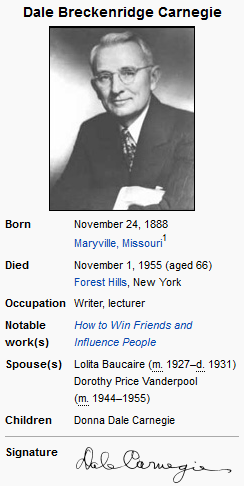
Dale Carnegie Quote of The Week from Greg Bover

“If you can’t sleep, then get up and do something instead of lying there and worrying. It’s the worry that gets you, not the loss of sleep.”

Dale Carnegie (1888-1955)

image

Born into poverty in rural Missouri, Carnegie managed to get through the state teachers college, but got his first jobs selling correspondence courses, then soap and bacon. After an unsuccessful stint as an actor he began teaching public speaking through the YMCA and published a book on the subject for businessmen in 1926.  His second book ten years later, How to Win Friends and Influence People, made him an international celebrity, sold millions of copies and was translated into dozens of languages. It is still in print and still relevant today. Millions of people have taken the Dale Carnegie Training to improve their self-confidence, reduce their stress, and learn better communication skills. Carnegie’s ideas on leadership are widely taught in business schools and form the basis of many self-improvement courses.  He also observed: “People rarely succeed unless they have fun in what they are doing.”

Greg Bover