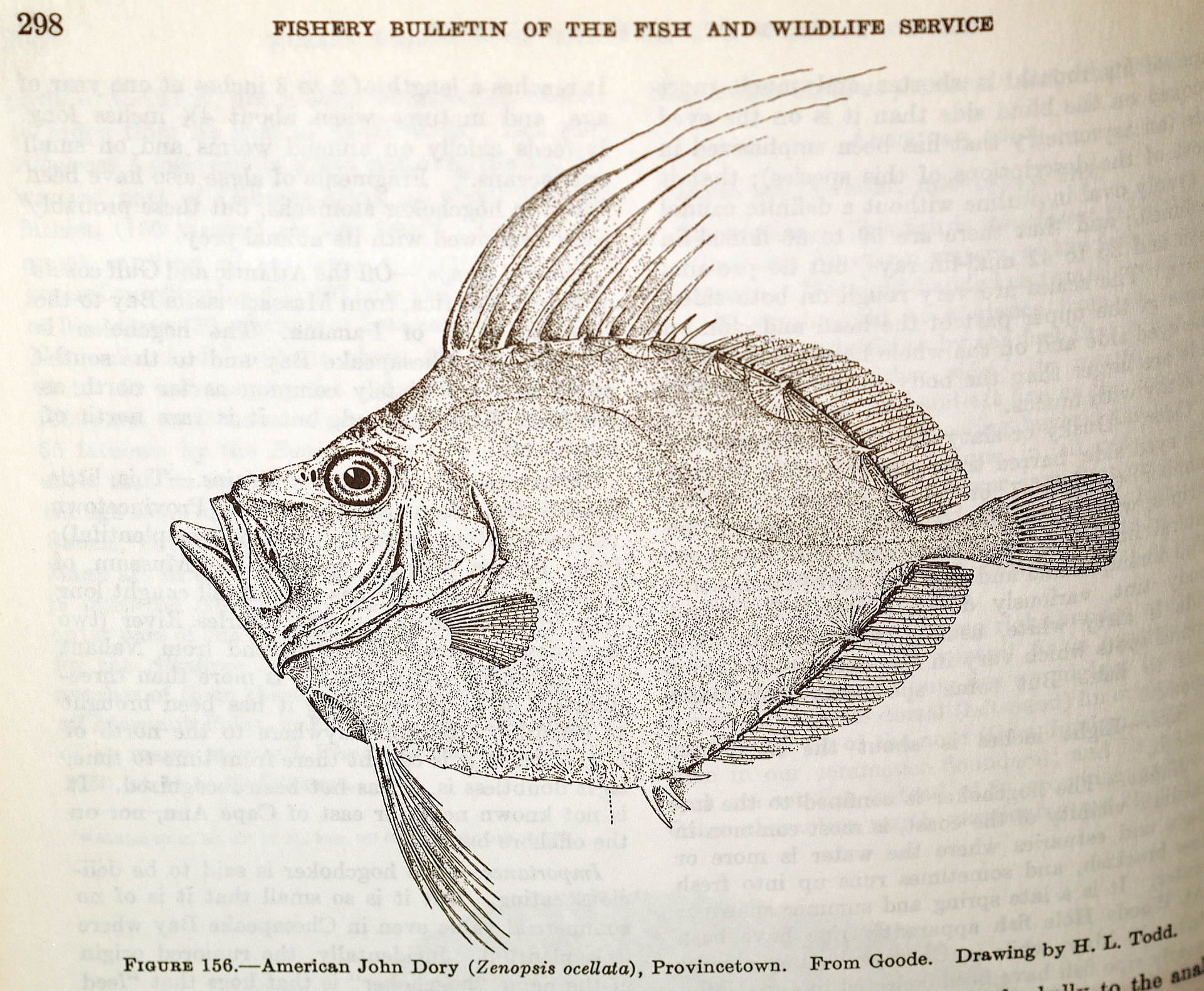
Size— The largest four specimens yet seen measured 18¼ and 18½ inches; 19 inches, weighing 3 pounds; and 20 inches, weighing 4½ pounds and 24 inches, weighing 7 pounds
General range— Outer part of the continental shelf from the latitude of Chesapeake Bay to the vicinity of Sable Island, Nova Scotia, and perhaps to the Laurentian Channel that separates the Nova Scotian Banks from the Newfoundland Banks. It reaches the inner parts of the Gulf of Maine now and then as a stray.
From Fishes of the Gulf of Maine by Bigelow and Schroeder, 1953
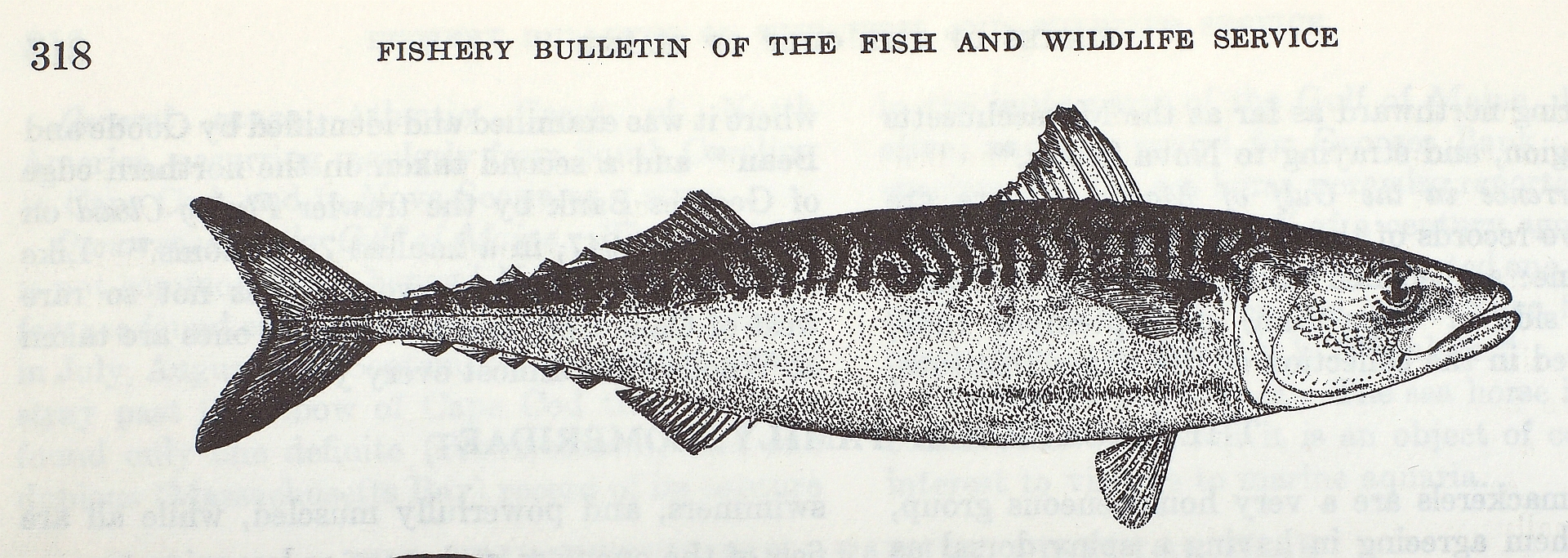
MACKEREL (Scomber scombrus) Drawing by Luella E. Cable
On dark nights the schools are likely to be betrayed by the “firing” of the water, caused by the luminescence of the tiny organisms that they disturb in their progress. The trail of bluish light left behind by individual fish as they dart to one side or the other, while one rows or sails through a school on a moonless, overcast night when the water is firing, is the most beautiful spectacle that our coastal waters afford.
From Fishes of the Gulf of Maine by Bigelow and Schroeder, 1953
When bluefish invade mackerel schools at night the fireworks on display below are spectacular. The larger streaks tearing through a mackerel school tell the story.
Al Bezanson
Spread The GMG Love By Sharing With These Buttons:
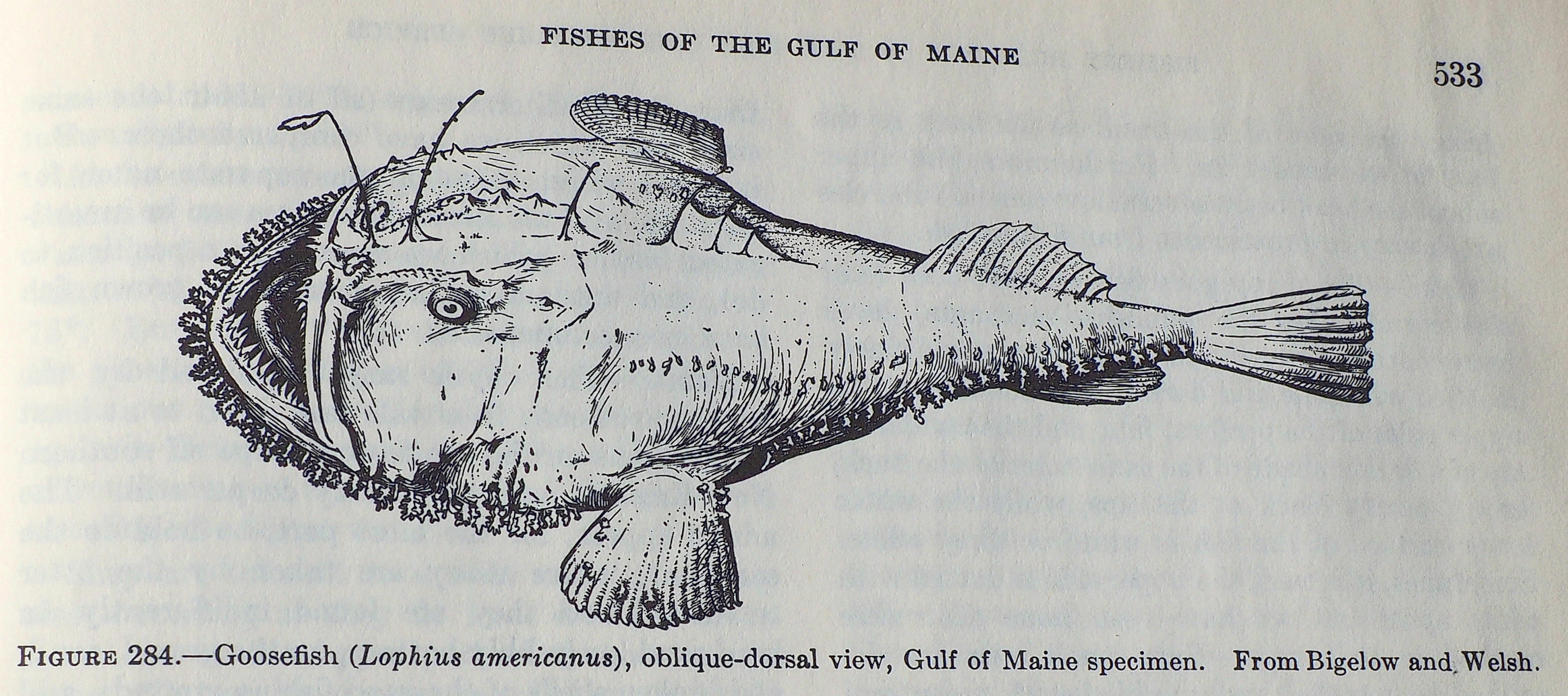
MONKFISH; ANGLER; ALLMOUTH; MOLLIGUT; FISHING FROG … The first spine bears an irregular leaflike flap of skin at its tip, which plays an important role in the daily life of the goosefish as a lure for its prey … Weighing up to 50 pounds … The goosefish has often been cited for its remarkable appetite. We read, for instance, of one that had made a meal of 21 flounders and 1 dogfish, all of marketable size; of half a pailful of cunners, tomcod, and sea bass in another; of 75 herring in a third; and of one that had taken 7 wild ducks at one meal. In fact it is nothing unusual for one to contain at one time a mass of food half as heavy as the fish itself. And with its enormous mouth (one 3½ feet long gapes about 9 inches horizontally and 8 inches vertically) it is able to swallow fish of almost its own size. Fulton, for instance, found a codling 23 inches long in a British goosefish of only 26 inches, while Field took a winter flounder almost as big as its captor from an American specimen. One that we once gaffed at the surface, on Nantucket Shoals, contained a haddock 31 inches long, weighing 12 pounds, while Captain Atwood long ago described seeing one attempting to swallow another as large as itself.
Importance—
No regular commercial use has been made of the goosefish in America up to the present time. But it is an excellent food fish, white-meated, free of bones, and of pleasant flavor.
If you were a goosefish you would say the “importance” situation has taken a bad turn since 1953. The 2002, third edition, of Fishes of the Gulf of Maine notes: Total landings remained at a low level until the mid-1970s, increasing from a few hundred metric tons to around 6,000 mt in 1978. Landings remained stable at between 8,000 and 10,000 mt until the late 1980s and then increased to a peak level of 26,800 mt in 1996. Usually only the tails are landed. There is also a lucrative market for goosefish livers.
In the 1960s the Bureau of Commercial Fisheries Technological Lab on Emerson Avenue in Gloucester was involved in marketing support for goosefish (monkfish), then considered an underutilized species. I worked there at that time and recall Julia Child and the Boston Globe’s food editor, Dorothy Crandall visiting the lab and providing enthusiastic support. Here’s a 1979 photo of Julia Child with a monkfish. https://www.nefsc.noaa.gov/read/popdy/monkfish/
Al Bezanson
Spread The GMG Love By Sharing With These Buttons:
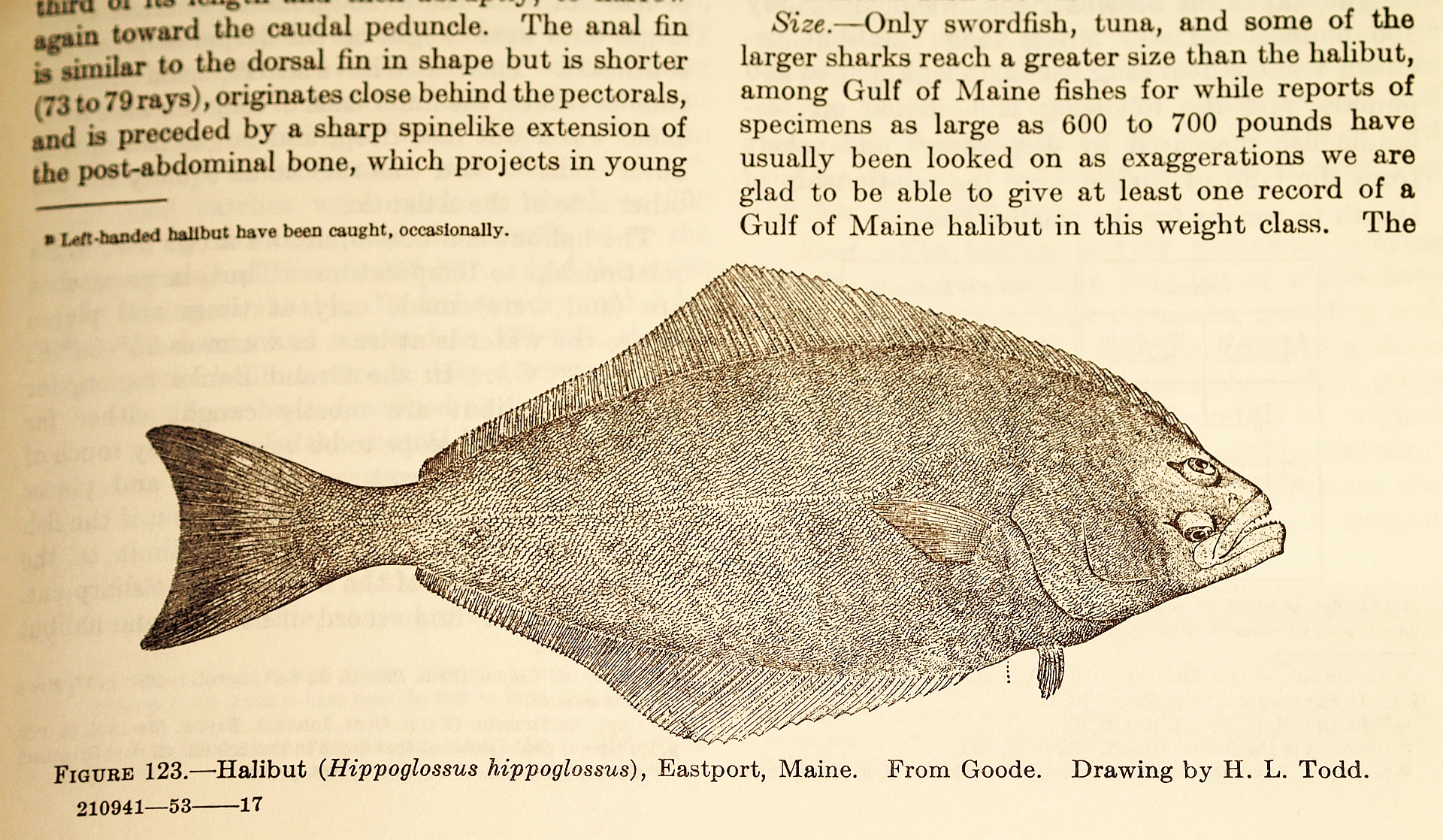
Halibut caught in shallow water are very active, usually starting off at great speed when they are hauled up from the bottom, often spinning the dory around in their attempts to escape. (Goode and Collins, 1887) The offshore fishery for halibut began about 1830, when cod fishermen brought word to Gloucester of a great abundance of them on Georges Bank,[61] and they were caught there for a few years thereafter in numbers that seem almost unbelievable today. Thus we read of 250 caught in three hours; of vessels loaded in a couple of days; and of a single smack landing 20,000 pounds in a day.
From Fishes of the Gulf of Maine by Bigelow and Schoeder, 1953
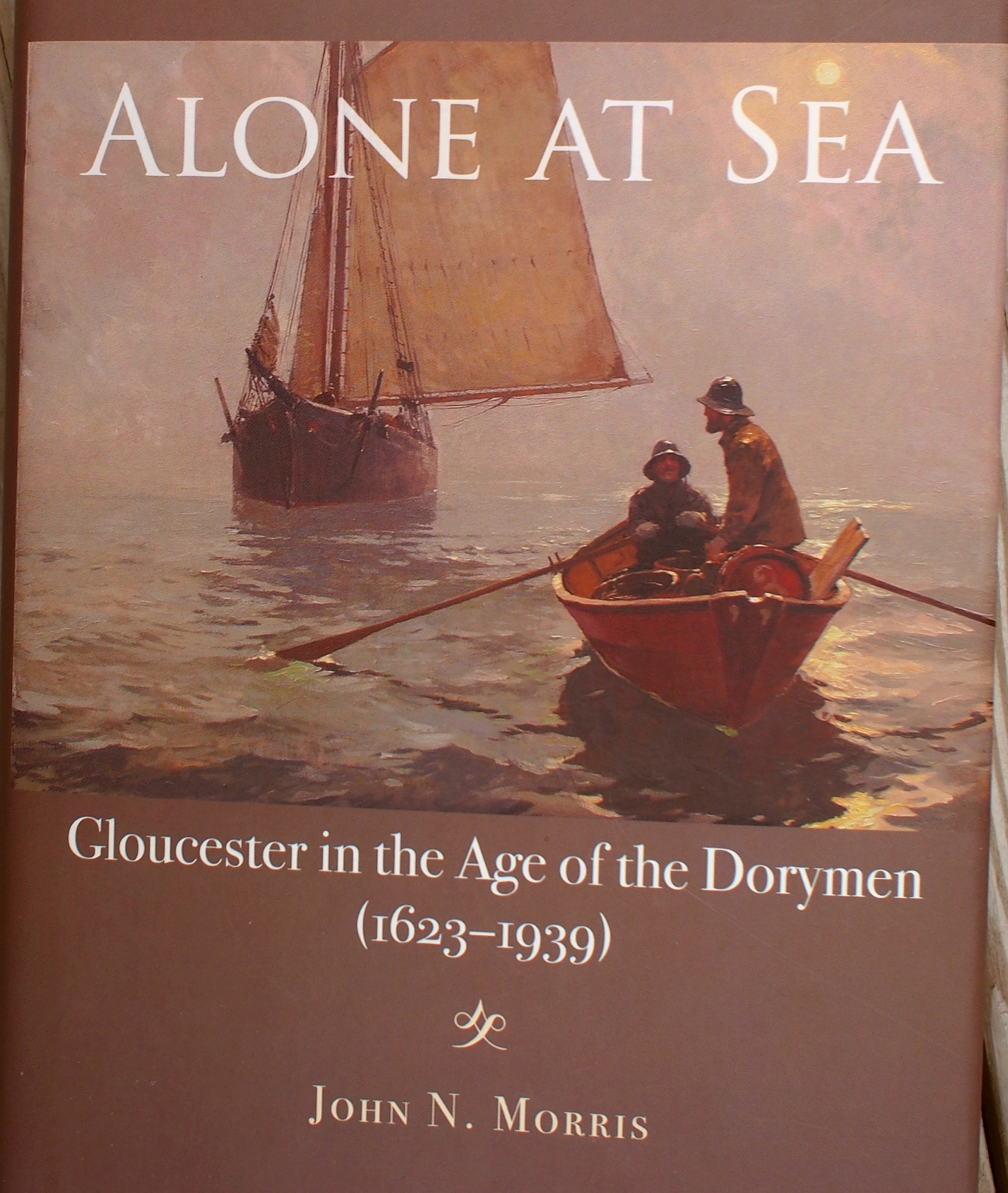
GLOUCESTER — On March 7, 1935, two men trawling for halibut from a Gloucester schooner off Newfoundland disappeared from their overturned dory and were presumed drowned. The deaths of Charles Daley and Stephen Olsson were unremarkable, except that they were among the last of their kind. Their families mourned and then turned to the task of surviving without them. Within a few years, dory fishing was no longer. (From a review of Alone at Sea by John N Morris, 2010)
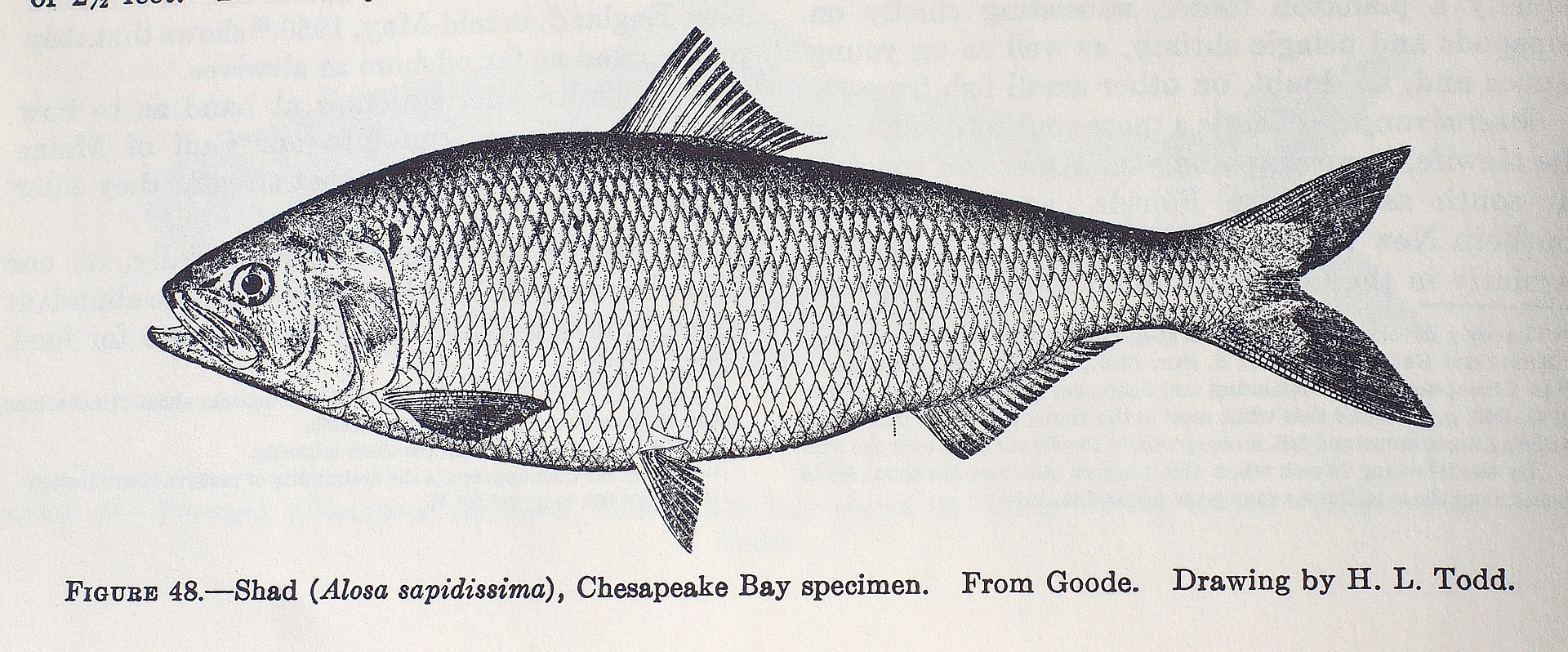
A typical member of the herring tribe. Largest of the herrings that visit our gulf, growing to a length of 2 ½ feet. One tagged in Chesapeake Bay was recaught 39 days later at Race Point. The shad, like the alewife, spends most of its life at sea, and makes most of its growth there, but runs up into fresh rivers to spawn, the spent fish soon returning to salt water, and its fry running down also.
From Fishes of the Gulf of Maine by Bigelow and Schroeder, 1953
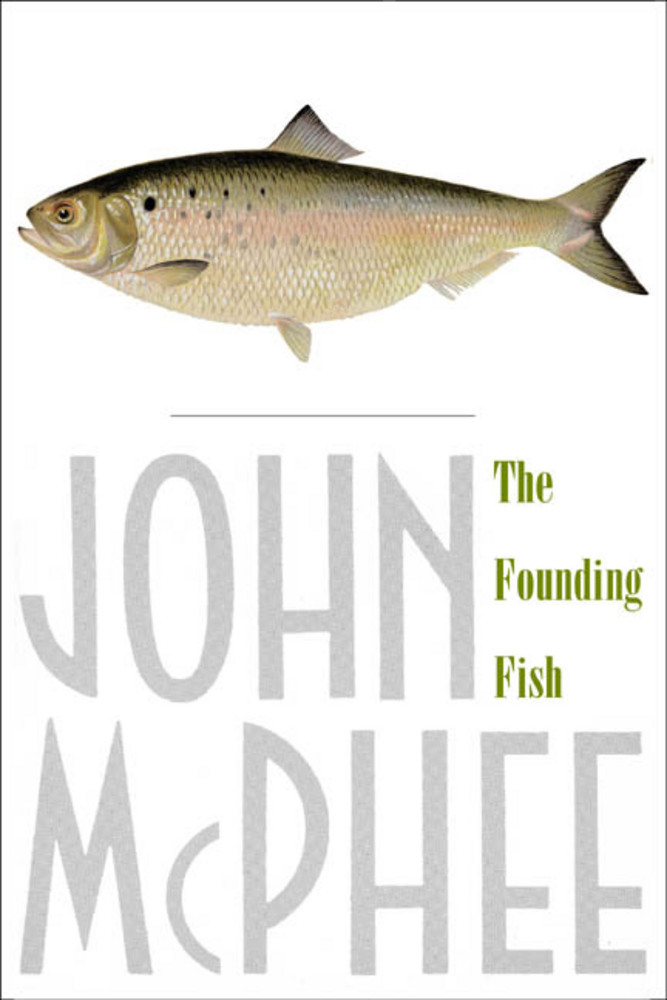
In the spring of 1778, the shad run in the Schuylkill River saved George Washington’s army from starvation at Valley Forge. Thus one could claim that this country owes its victory over the British to shad and, hence, the title of John McPhee’s book, The Founding Fish.
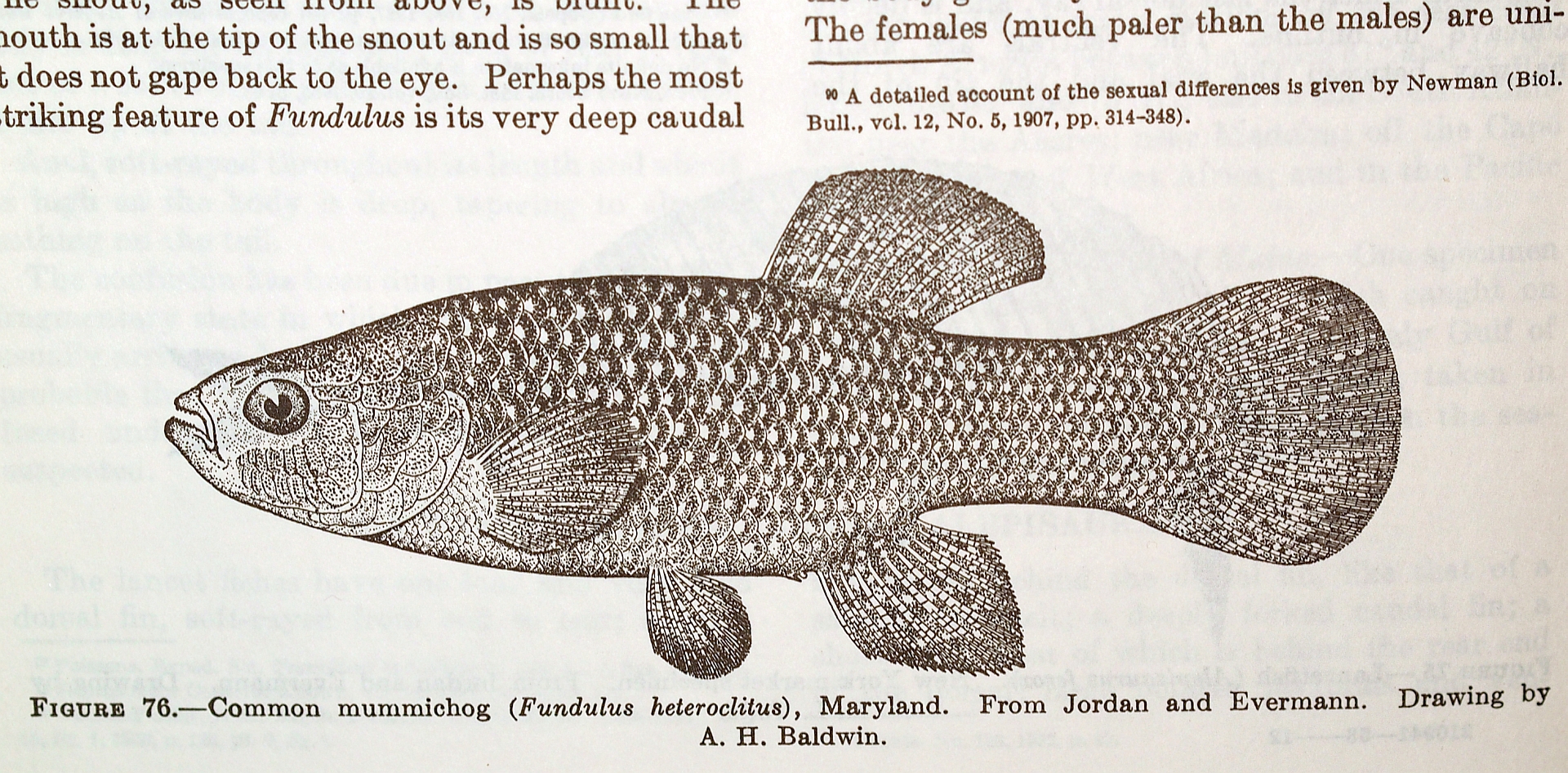
Killifish; Salt-water minnow; Chub; Mummy… So closely do they hug the shore that a line drawn 100 yards from land would probably enclose all the mummichogs in the Gulf of Maine… Seldom more than 4 inches long. Abound in the tidal creeks that cut our salt marshes, in muddy pools, in ditches. Shoals of “mummies” may often be seen moving in with the flood tide. Often trapped in little pools until the next tide arrives.
From Fishes of the Gulf of Maine by Bigelow and Schroeder, 1953
-Al Bezanson
Spread The GMG Love By Sharing With These Buttons:
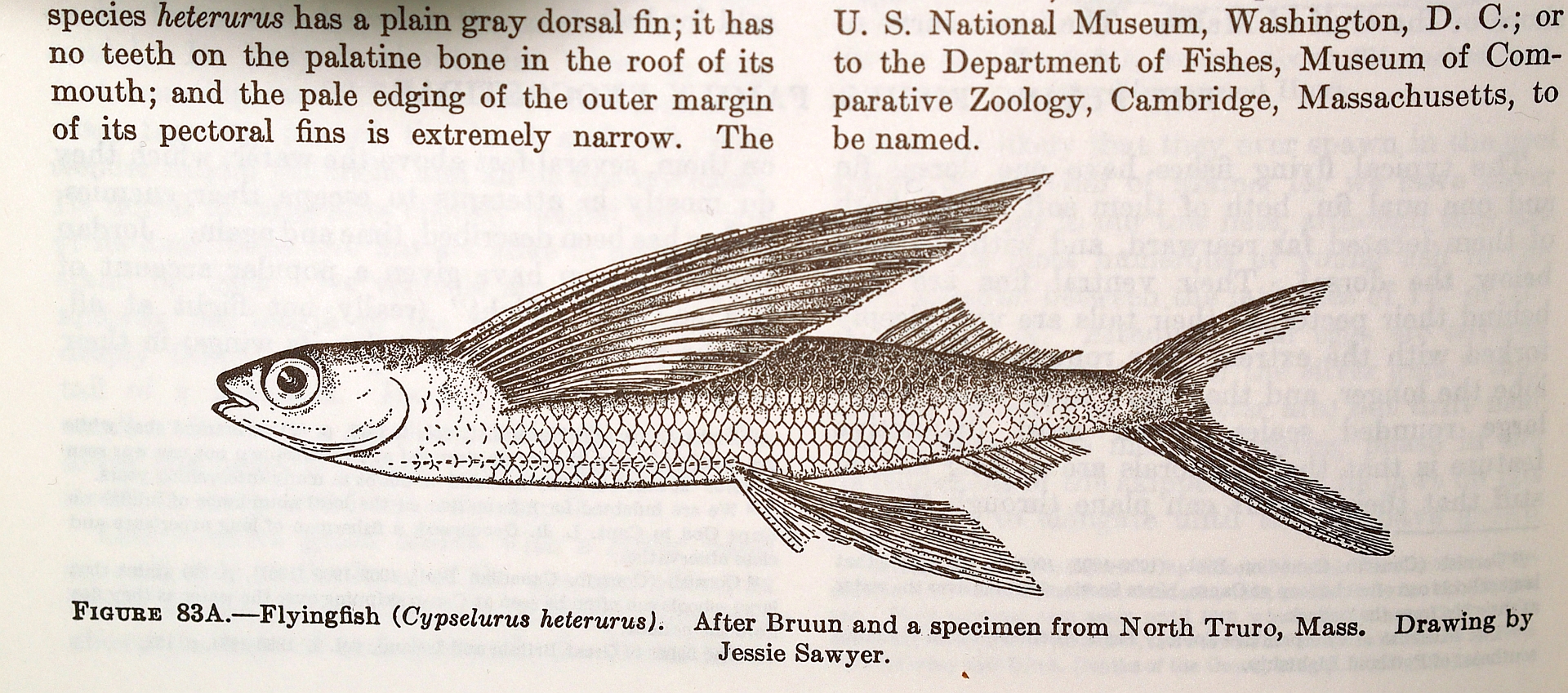
Their most distinctive feature is that their pectorals are so long and so stiff that their owners can plane through the air on them, several feet above the water, which they do mostly in attempts to escape their enemies … this so-called “flight” (really not flight at all, for the flyingfish does not flap its wings)
Voyagers in tropical seas are perhaps more familiar with flyingfishes than any other fishes.
From Fishes of the the Gulf of Maine by Bigelow and Schroeder, 1953
Personal account … For close encounters of the flyingfish kind let me recommend a long voyage in a small, slow sailboat. In the Tongue of the Ocean, an immense blue marlin soaring by with mouth agape in a flock of flyingfish, at my eye level, about 25 feet abeam. That was in 1961 and still vivid. Or becalmed far at sea, dozing at the tiller at night, a flyingfish glancing off my ear. When we picked up a cat (named Scurvy) for the return voyage to Boston, her duty at first light was to gather flyingfish who had gone aground on our deck during the night. (Al Bezanson)
Spread The GMG Love By Sharing With These Buttons:
“The sea horse grotesquely resembles the “knight” in an ordinary set of wooden chessmen in its sidewise flattened body, in its deep convex belly, in its curved neck and in its curious horselike head carried at right angles to the general axis of the body. The head is surmounted by a pentagonal star-shaped “coronet,” and the snout is tubular with the small oblique mouth at its tip, like that of its relative the pipefish.”
This exquisite pen and ink drawing from 1883 by H. L. Todd is just one of many by this artist in Fishes of the Gulf of Maine by Bigelow and Schroeder, 576 pp, 1953. The book is available free online courtesy of MBL/WHOI. http://www.gma.org/fogm/
Spread The GMG Love By Sharing With These Buttons:
They search the bottom by dragging the chin barbel and the sensitive tips of the ventral fins as they swim to and fro, either for food, or to stir up shrimps and other food items. (Herrick)
The maximum size is about 15 inches and 1-1/4 pounds, but few of them are more than 9 to 12 inches long. Most common close to stream drainage.
A delicious little fish that you won’t find in markets.
From Fishes of the Gulf of Maine by Bigelow and Schroeder, 1953
Spread The GMG Love By Sharing With These Buttons:
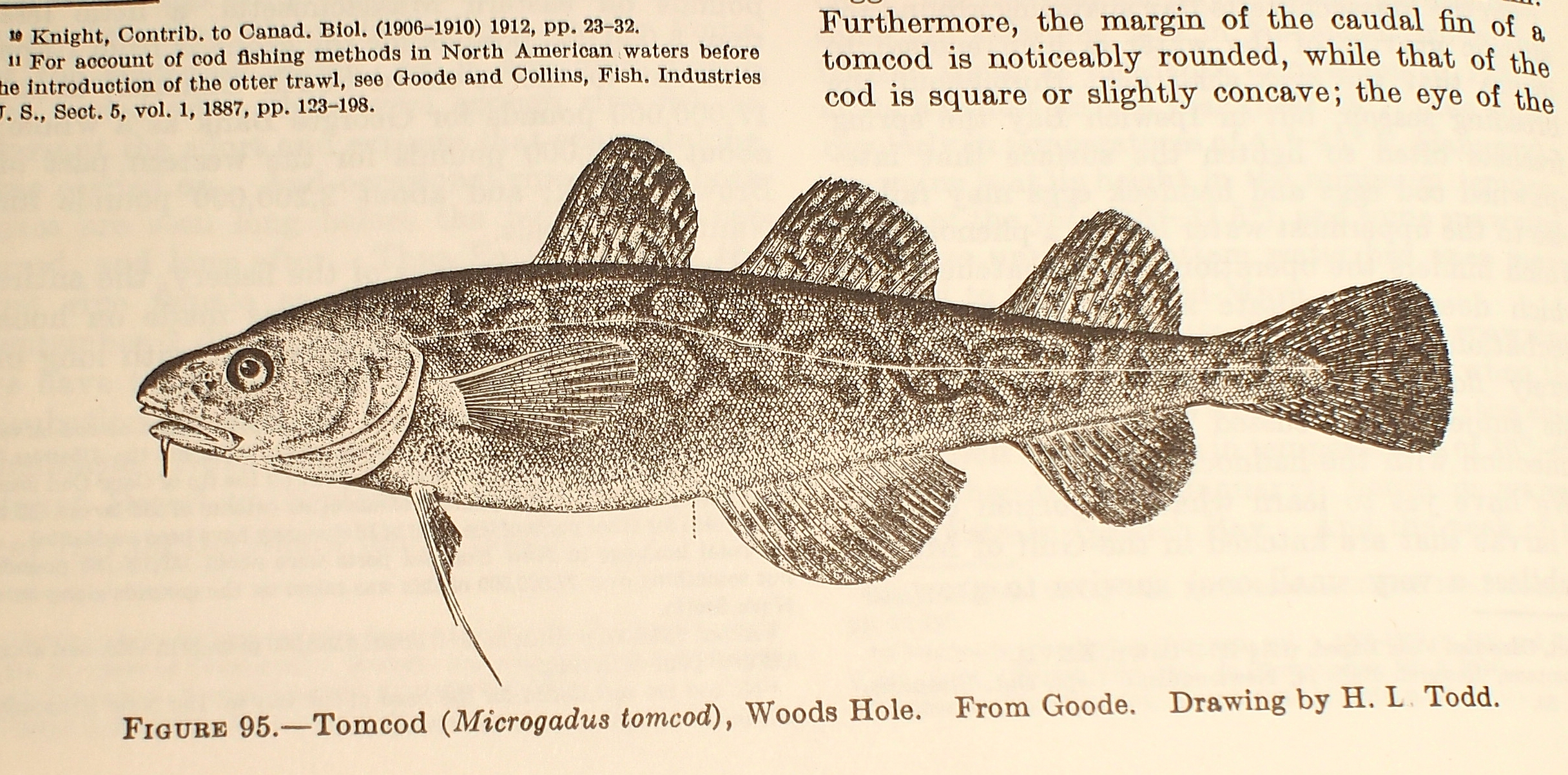
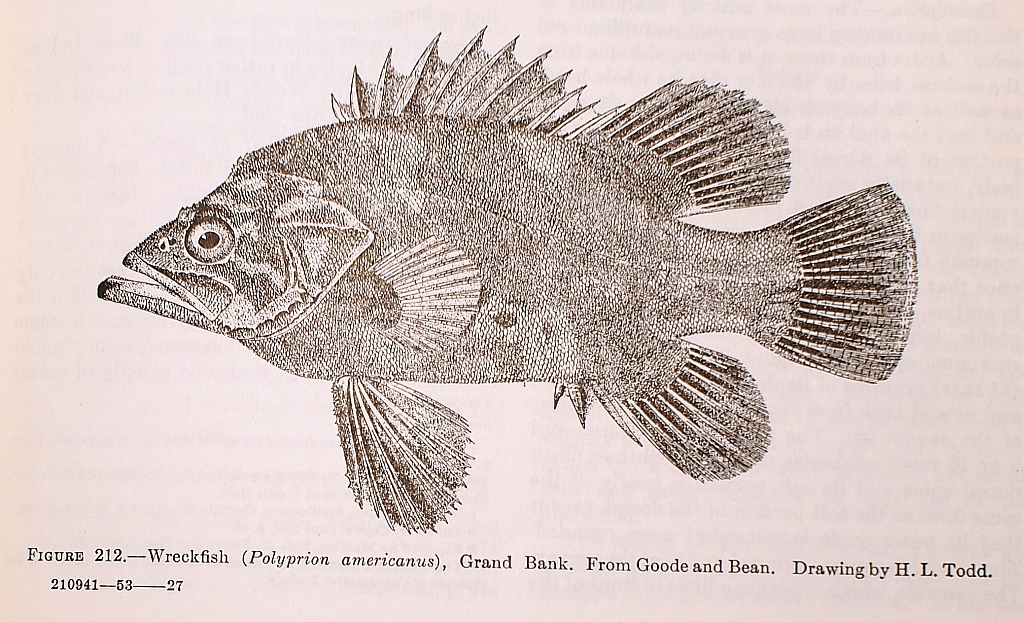
Schooner Captain and super GMG FOB Al Bezanson writes, “While searching for something else on the NOAA website I discovered that this treasure of a book is available free online. I purchased a printed copy of the 1953 edition long ago from the Museum of Comparative Biology at Harvard University, and I open it randomly at times to read a page or two about the creatures that inhabit the sea off Cape Ann. You can work your way through fish by fish, enjoy the exquisite drawings, the habits and the anecdotes about common and exotic marine life. Here are couple photos from my copy and a link to the book.”
Here’s more … MBLWHOI sponsored the copying of the 1953 edition to make it available online. There is a newer 2002 edition, not digitized, from Smithsonian Institution Press, Washington, DC, 2002. 748 pp., illus. $75.00 (ISBN 1560989513 cloth). Review here…https://academic.oup.com/bioscience/article/53/8/772/269669
OLYMPUS DIGITAL CAMERA
OLYMPUS DIGITAL CAMERA
OLYMPUS DIGITAL CAMERA
OLYMPUS DIGITAL CAMERA
OLYMPUS DIGITAL CAMERA
Spread The GMG Love By Sharing With These Buttons:











 Good Morning Gloucester