I Love Sumac!

Now that’s not an opinion you don’t hear very often. I try to get my clients to love it too or, if they can’t enjoy Smooth Sumac for its unusual beauty, to at least appreciate the shrub for the myriad species of wildlife that it supports.

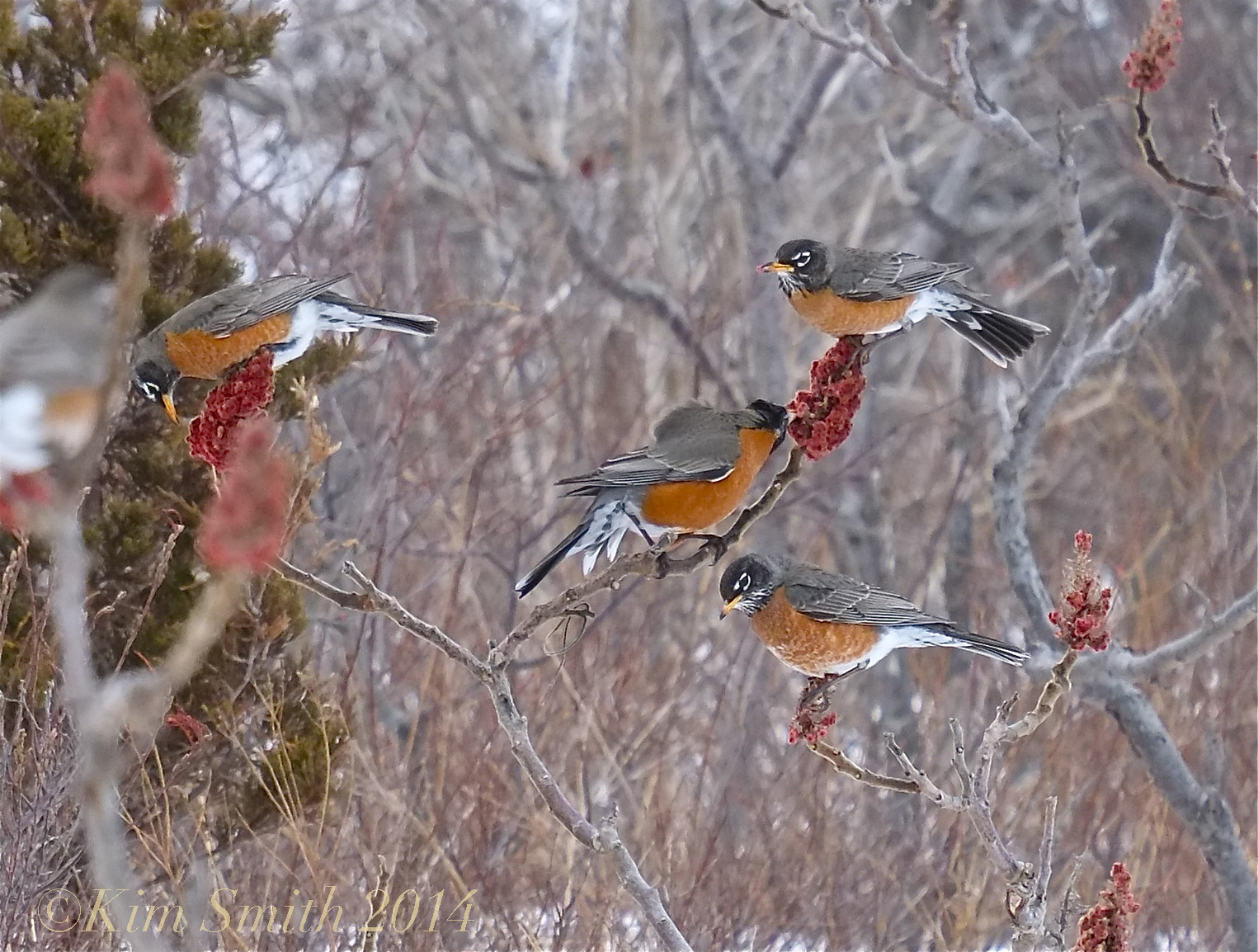
American Robins Eating Sumac ©Kim Smith 2014American Robin Flock Eating Smooth Sumac (Rhus glabra) Berries

Yesterday while walking through Halibut Reservation with daughter Liv, we encountered a very large flock of robins devouring seeds of sumac. The beautiful clump of sumac, with its bare crooked, leaning trunks and raspberry pink furry seedheads made a striking combination of shapes and textures against the windswept ocean vista. We disturbed the robin feast, but then Liv walked further down the path to photograph the Atlantic and I stayed behind, half hidden by an evergreen tree. The robins quickly returned to the ripened seedheads and I got to snap away until the next walker came along.

Smooth Sumac (Rhus glabra) is a shrub that naturally forms colonies; it can also be grown as a beautiful single-trunk tree. The yellowy-green flowers on female plants give way to deep rusty red berries held in erect, pyramidal clusters. What makes sumac so invaluable to wildlife? The fruits persist through the winter, providing nourishment for many, many species of birds and small mammals. Additionally, the foliage is a larval host plant for the Coral Hairstreak Butterfly!

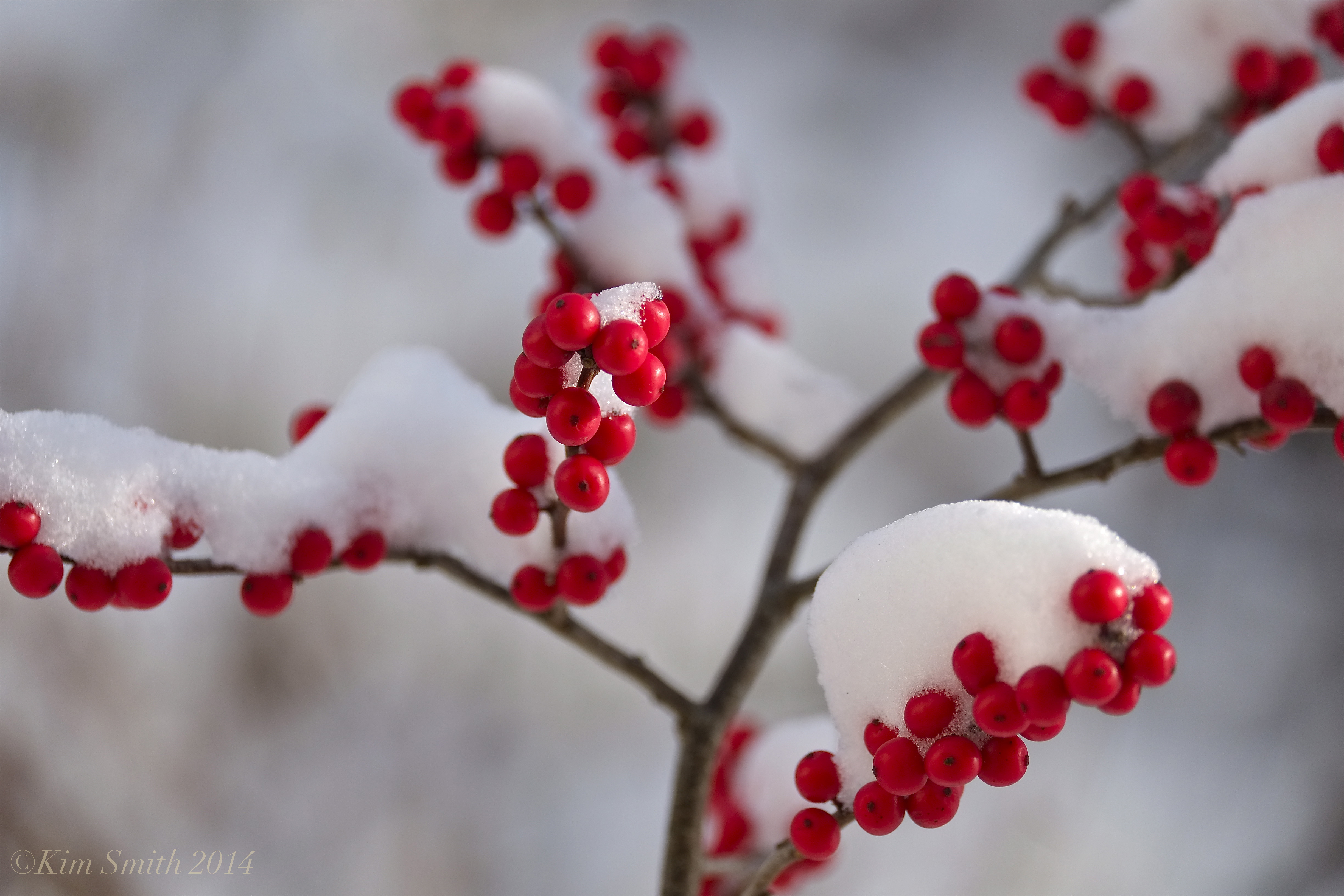
robinarrivalsAmerican Robin and Winterberry photo submitted by Jacqueline Bennett. Thanks Jacqueline for sharing your beautiful photo!

*   *   *

Liv submits apparition from Halibut Point

Birds of Cape Ann: The American Robin and Bird Food!

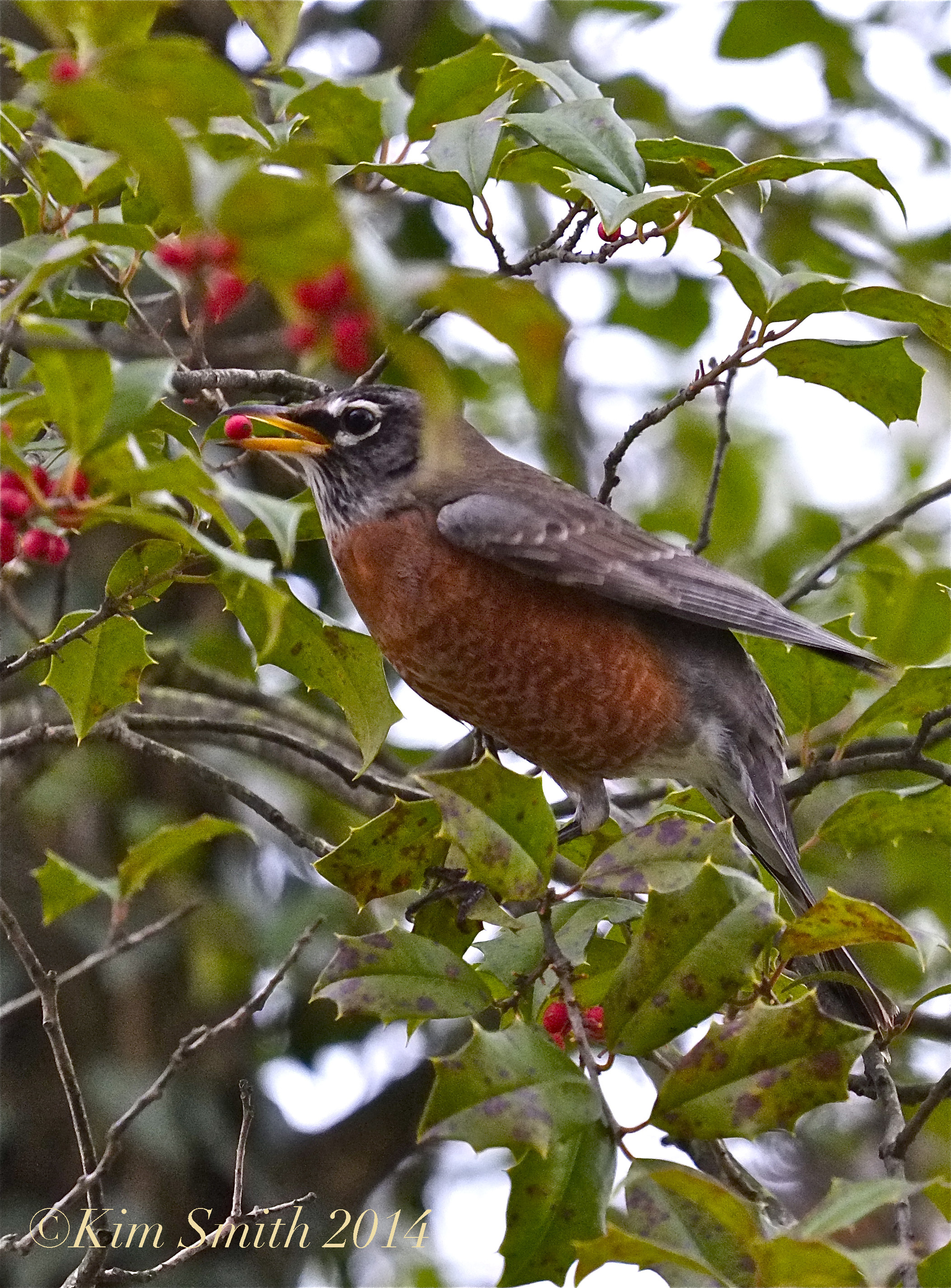
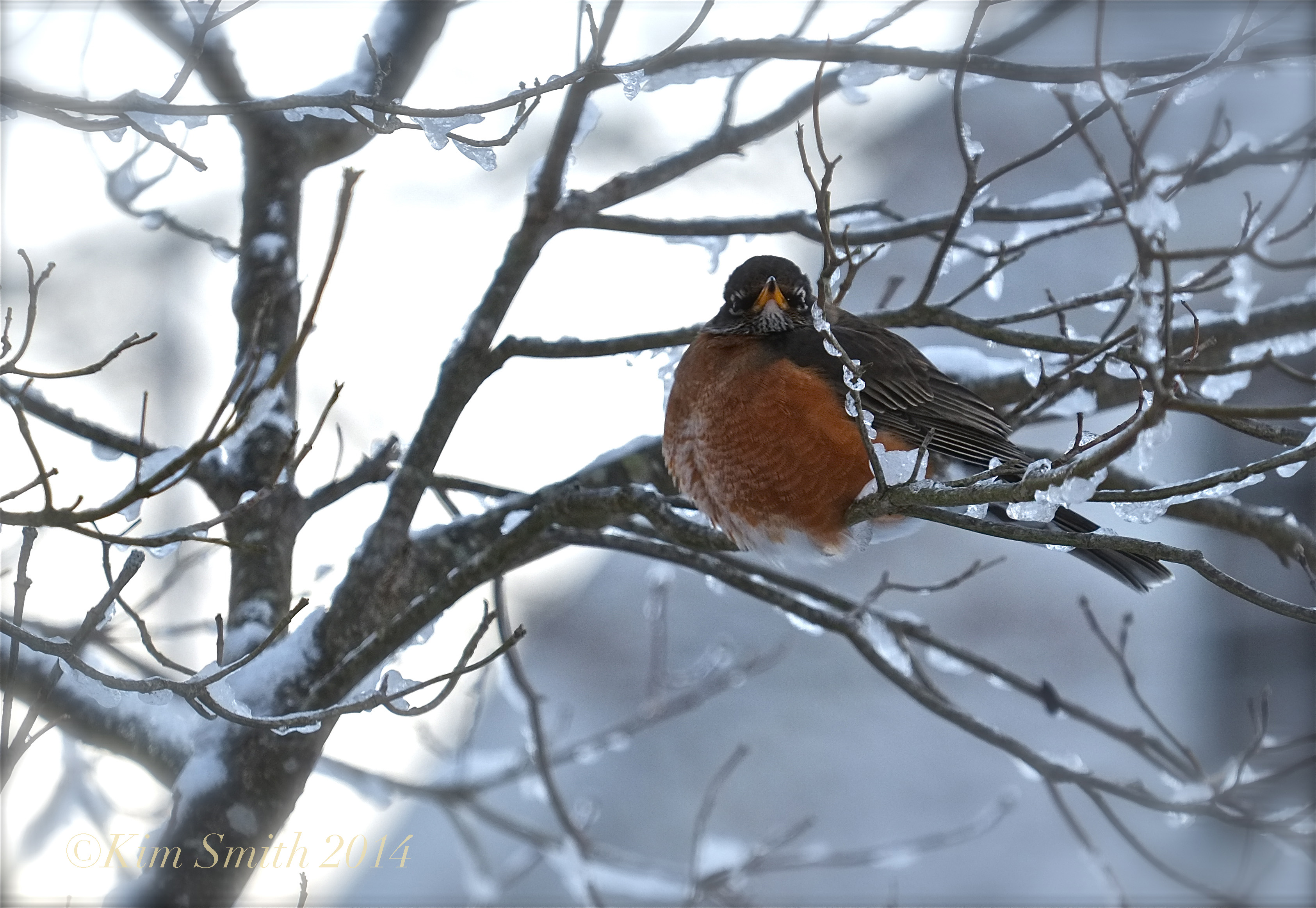
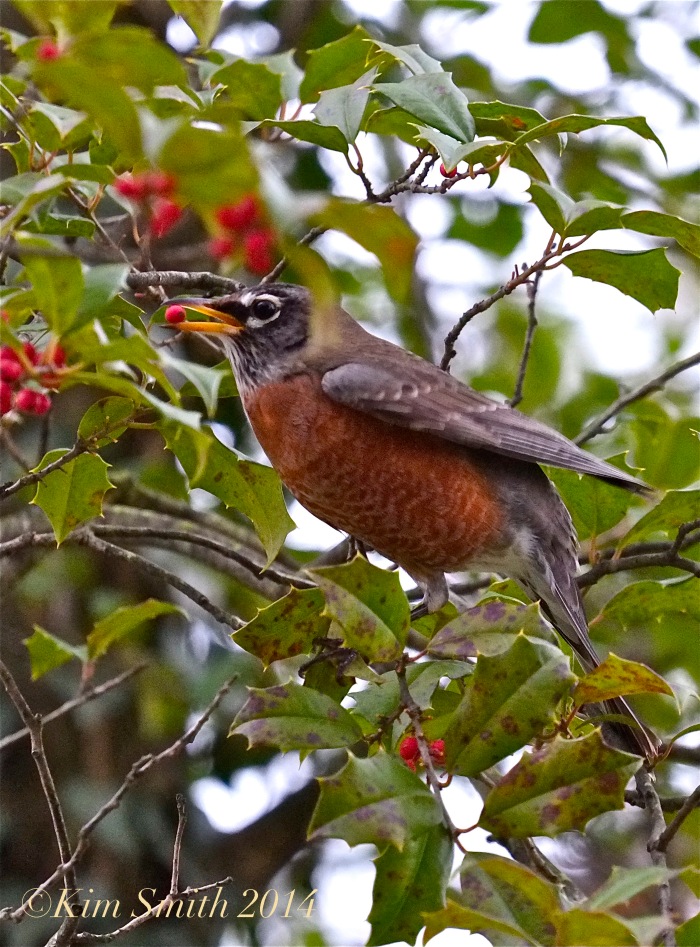
American Robin American holly ©Kim Smirh 2014

Right on schedule! Beautiful and welcome migrant flocks of American Robins arrive annually in Gloucester during the month of February, dining on local fruits, berries and fish fry.

During the winter months Cape Ann often becomes home to large flocks of robins, and we have had the joy of hosting numerous numbers in our garden. I can’t help but notice their arrival. Their shadows descend, crisscrossing the window light, followed by a wild rumpus in the ‘Dragon Lady’ hollies. This pair of hollies is planted on opposing sides of the garden path, alongside my home office. I have learned to stealthily sneak up to a window, as any sudden activity inside startles birds that are investigating our garden, and they quickly disperse. Dining not only on berries of the ‘Dragon Ladies’, but also the ‘Blue Princess’ Meserve holly and winterberry bushes, I find dozens of noisy, hungry robins.

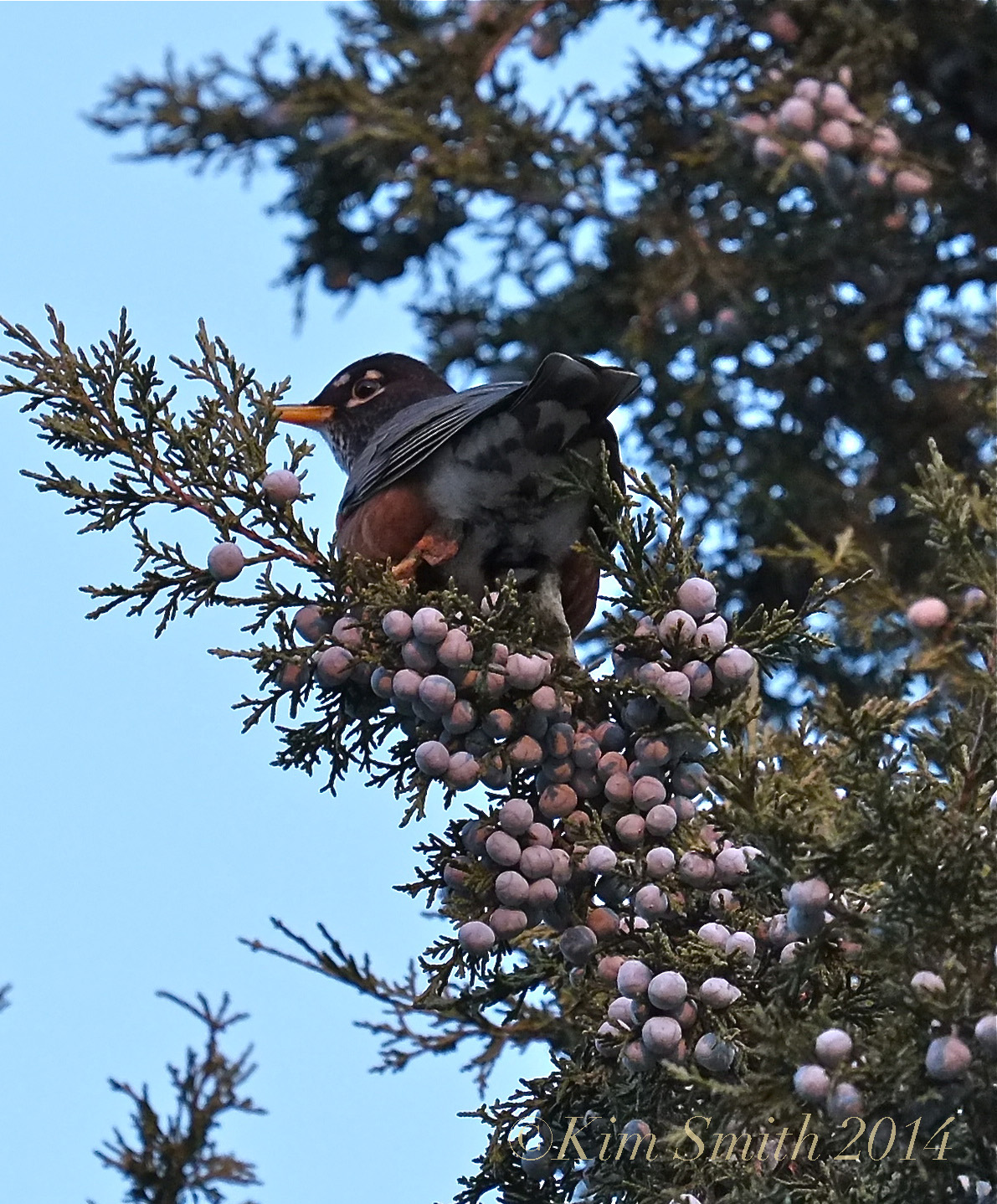
These winter nomads flock to trees and shrubs that hold their fruit through January and February, feasting on red cedar, American holly, Meserve hollies, chokecherries, crabapples, and juniper. Robins traveling along the shores of Cape Ann also comb the shoreline for mollusks, and go belly-deep for fish fry. Depleting their food supply, they move onto the next location. Gardens rife with fruiting shrubs and trees make an ideal destination for our migrating friends.
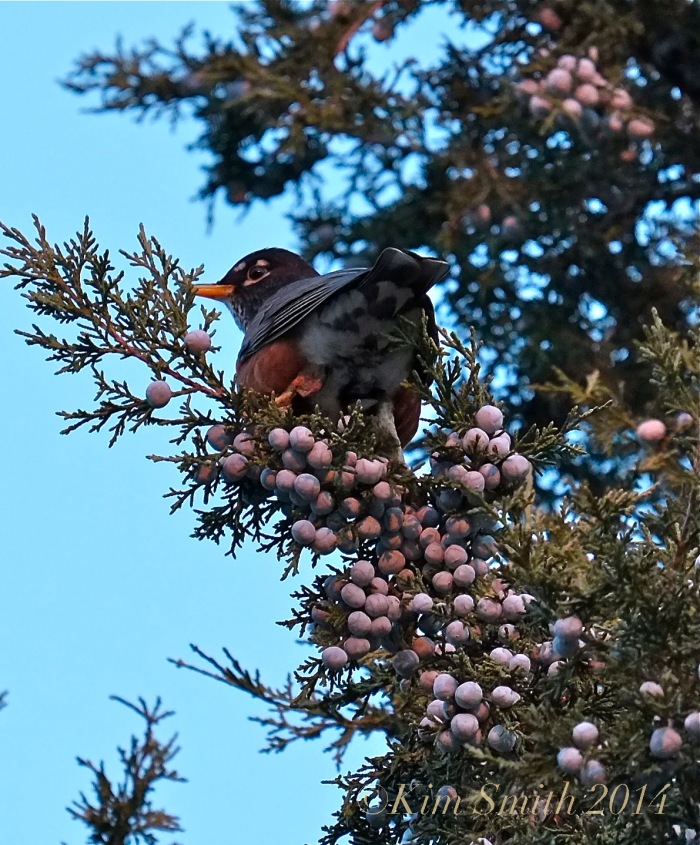
Eastern Red Cedar American Robin ©Kim Smith 2014American Robin Eating Eastern Red Cedar Fruits

Habitat Gardening Tip:

The garden designed to attract nesting pairs of summer resident robins, as well as flocks of winter travelers, would be comprised of trees and shrubs for nest building, plants that bear fruit and berries that are edible during the summer and fall, and plants that bear fruits that persist through the winter months. Suburban gardens and agricultural areas provide the ideal habitat, with open fields and lawns for foraging insects as well as trees and hedgerows in which to build their nests.

The following plants, suggested with robins in mind, will also attract legions of songbirds and Lepidoptera. The list is comprised primarily of indigenous species with a few non-native, but not invasive, plants included.

Trees for nesting ~ American Holly (Ilex opaca), Eastern Red Cedar (Juniperus virginiana), Red Maple (Acer rubrum), Sugar Maple (Acer saccharum), Flowering Dogwood (Cornus florida).

Summer and autumn fruit bearing trees, shrubs and vines for robins ~ Black Cherry (Prunus serotina), Blackberry (Rubus spp.), Flowering Dogwood (Cornus florida), Gray Dogwood (C. racemosa), Red-osier Dogwood (C. sericea), Silky Dogwood (C. amomum), Elderberry (Sambucus canadensis), Apple (Malus pumila), Virginia Rose (Rosa virginiana), Highbush Blueberry (Vaccinium corymbosum), Lowbush Blueberry (Vaccinium angustifolium), Wild Grape (Vitis spp.).

Trees and shrubs with fruits persisting through winter ~ Winterberry (Ilex verticillata), Mountain Ash (Sorbus americana), Crabapple (Malus spp.)Sargent’s Crabapple (Malus sargentii), American Holly (Ilex opaca), Meserve Hollies (Ilex meserveae), Eastern Red Cedar (Juniperus virginiana), Common Juniper (Juniperus communis), Chokecherry (Prunus virginiana), Smooth Sumac (Rhus glabra), Staghorn Sumac (Rhus typhina).
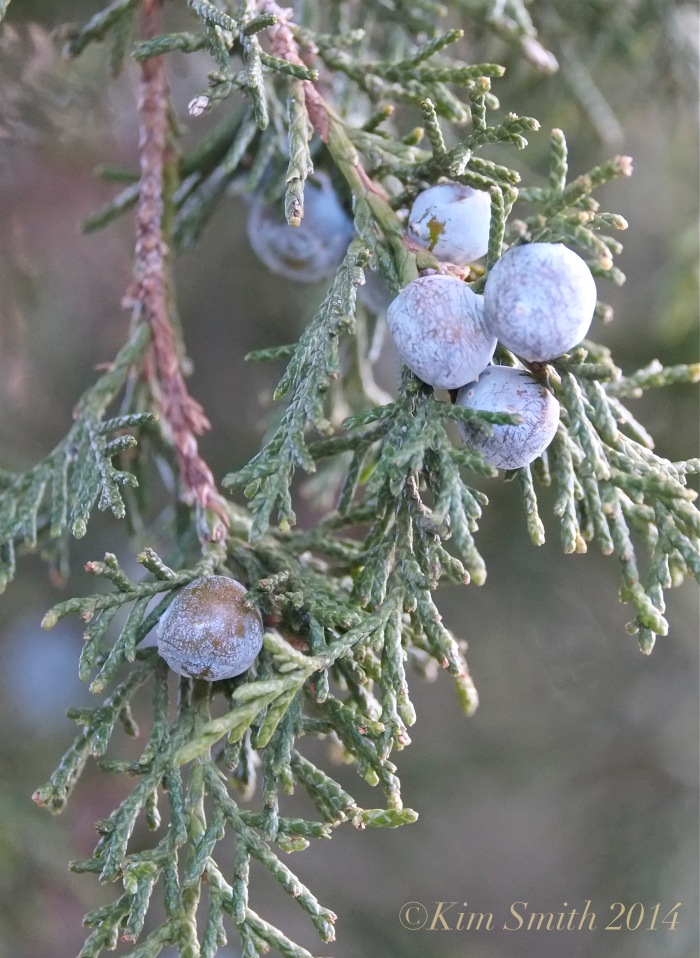
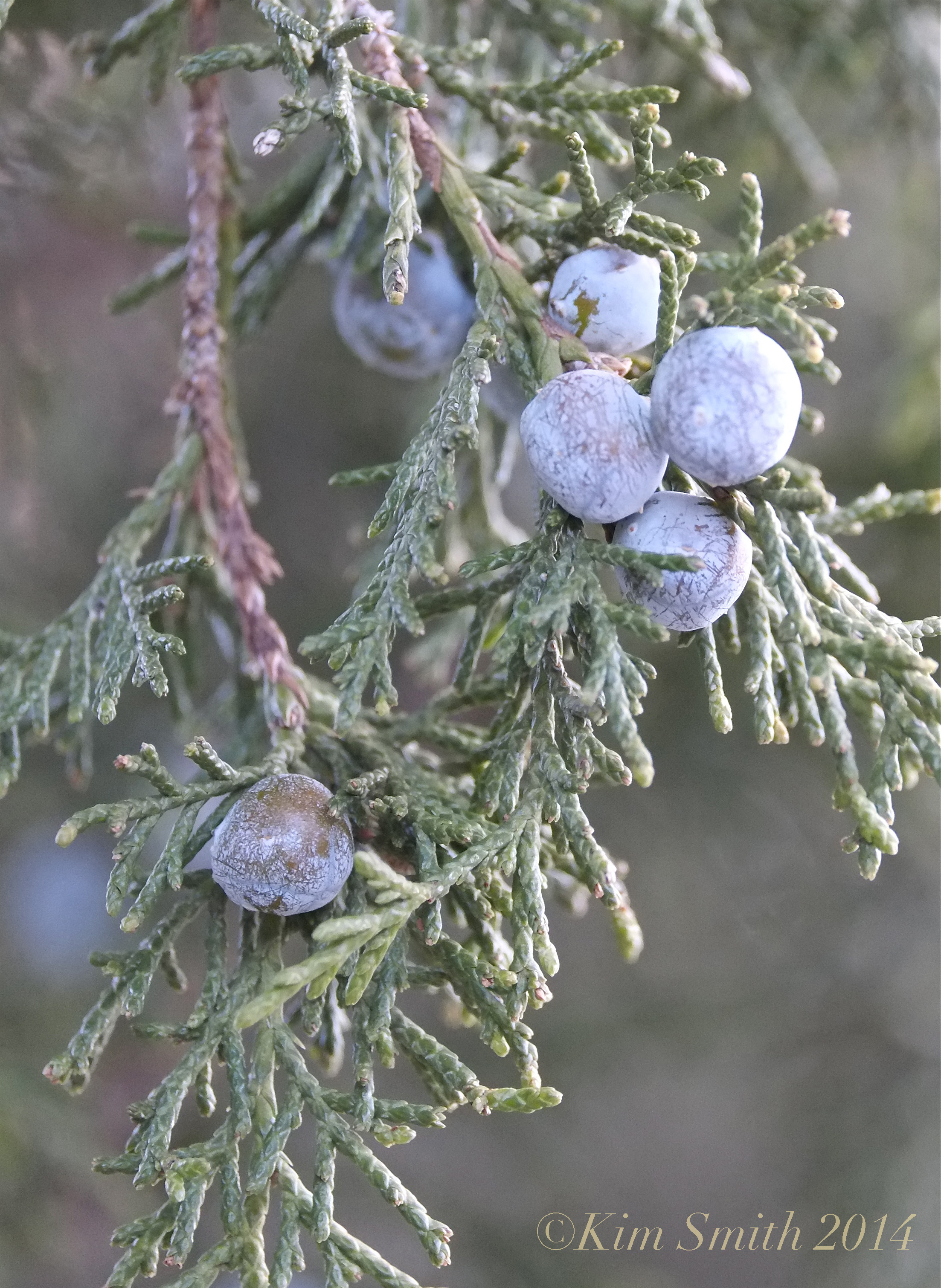
Eastern Red Cedar Juniperus virginiana  copy

Bird Food: Eastern Red Cedar (Juniperus viginiana)

To read more see previous posts:
Round Robin Redbreast

Round Robin Redbreast Snowy Day Video

American Robin (Turdus migratorius)

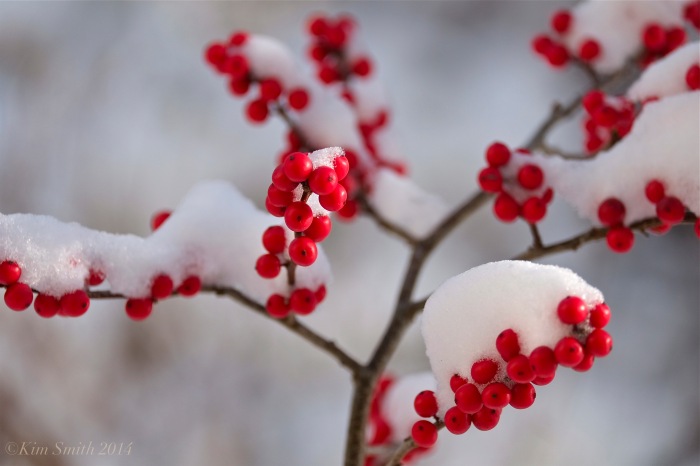
Winterberry Ilex verticillata © Kim Smith 2014Bird Food: Winterberry (Ilex verticillata)
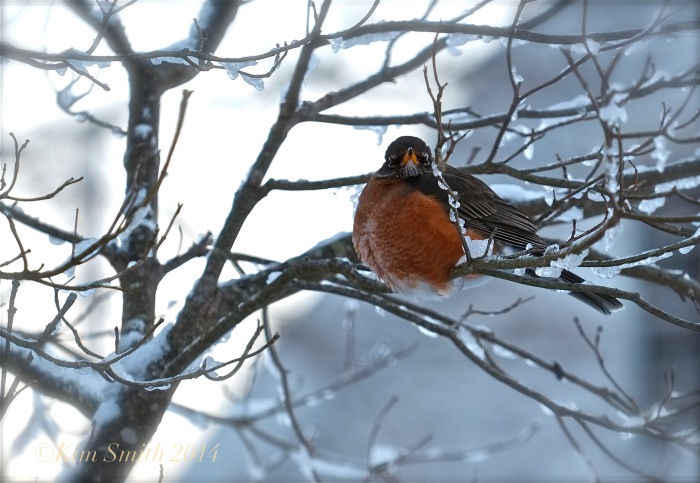
American Robin in Dogwood tree ©Kim Smith 2014Robin at dawn this morning after the storm

Birds of Cape Ann: Mourning Doves and Why Birds Fluff When Cold

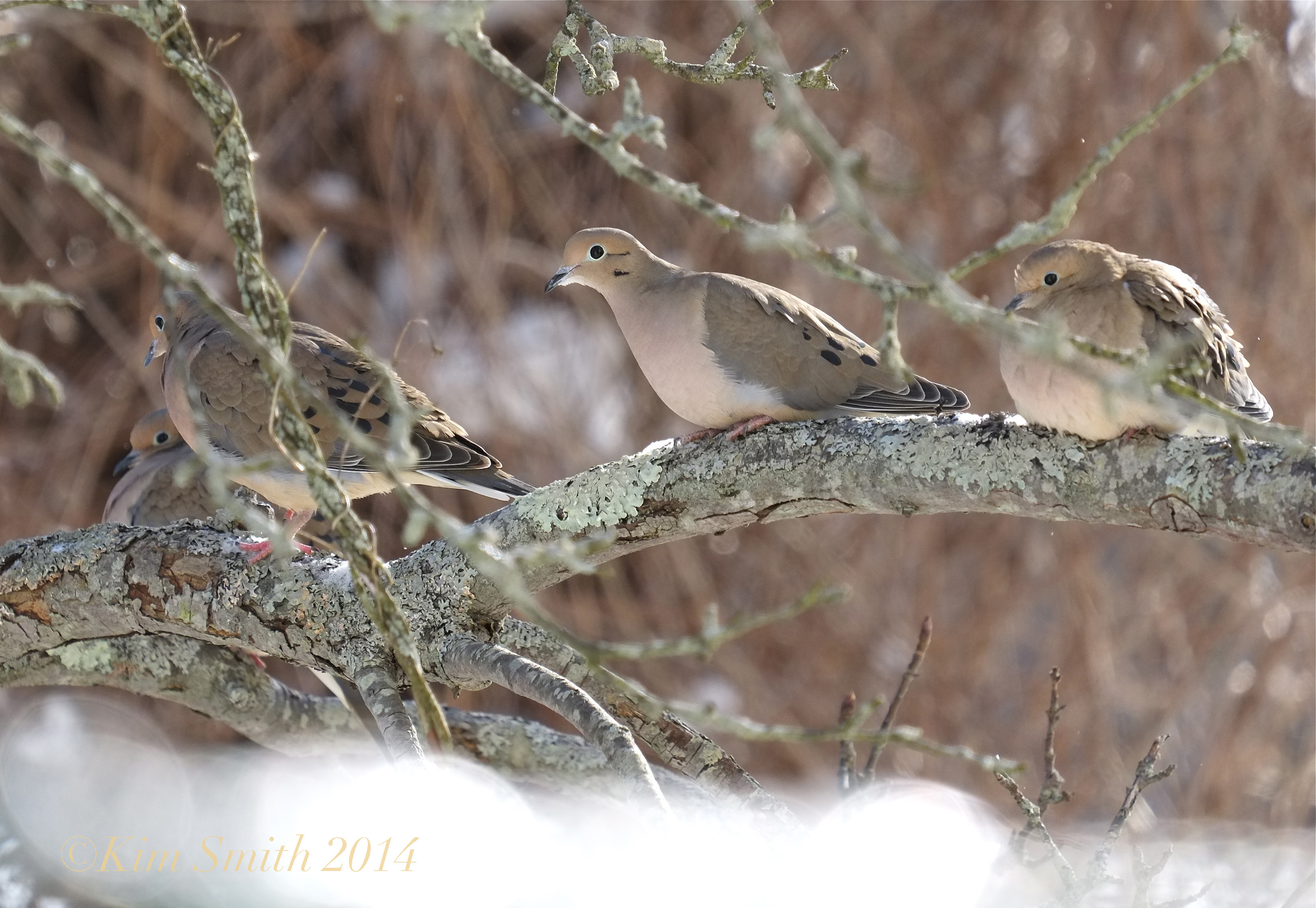
Mourning Dove pair in snowPair of Mourning Doves in Pear Tree

While writing this post and listening to recorded songs of Mourning Doves, I was immediately transported to my grandparent’s summer cottage on Cape Cod. Their home was sited on a bluff overlooking Cape Cod Bay. Adjacent to the house was a tumbled and scrubby overgrown field and, only a sort walk down down the lane, the freshwater Hiram Pond. There was no shortage of bunnies and birds, toads and turtles, along with the occasional frog and fox. From a child’s point view, it was pure paradise. Mixed with the sound of the surf, imprinted forever is the familiar song of Mourning Doves cooing at the first light of dawn. For much of the day the nesting doves remained hidden in the tangled undergrowth. Then in the fading rosy light of day’s end, their gentle song was heard again mixed with the laughter of rambunctious family feasts on the screened porch my grandfather had built.

*   *   *

Mourning Doves during the winter months are not calling to their mates but instead are struggling to survive the cold temperatures and sparse supply of food. Our bird feeders are filled often during the week, primarily with safflower seeds. As I have explained in previous posts, squirrels, which can be a real nuisance at feeders, typically are not interested in safflower seeds. Suet and such invites rats, rabbits, and raccoons, which in turn draws coyotes.

Four Mourning Doves  ©Kim Smith 2014Mourning Doves in Pear Tree ~ fluffed and unfluffed doves

Feathers are insulating and by fluffing, the bird traps pockets of air to hold in body heat and keep out the cold. During warm weather, birds press their feathers close to their bodies to eliminate the insulating air pockets to allow heat to escape.

When the bird is incubating eggs, the insulating properties of feathers can be a drawback because the feathers keep some of the bird’s body heat from reaching the eggs. The bird either sheds some its breast feathers naturally or pulls them out to expose bare skin.  The exposed area is called a brood patch.

Read More Here: Feathers

Addendum today ~ So sadly, my husband found beneath our kitchen window this morning a beautiful Mourning Dove. For the past several months we’ve had half a dozen doves, or what looked like three pairs, nestling in the pear trees and at the feeders. Our dead Mourning Dove seemed perfectly intact, except for a few drops of blood on its head. The single greatest threat to songbirds visiting our backyards are collisions with glass.  I never thought of our wind- and weather-worn original-to-the-house 1850s window glass as potentially hazardous. Time to rethink our little backyard sanctuary.

Dead Mourning Dove  ©Kim Smith 2014From Bird Watcher’s Digest, the top ten suggestions for making your windows less deadly for birds: The Top 10 Things You Can Do to Prevent Window Strikes 

Mourning Dove Coo ~

Essex Bird Shop and Pet Supply is an excellent source for bagged safflower seeds.

Mourning Dove puffed feathers ©Kim Smith 2014 copyMourning Dove (Zenaida macroura)

Exterminate All Swans by 2025

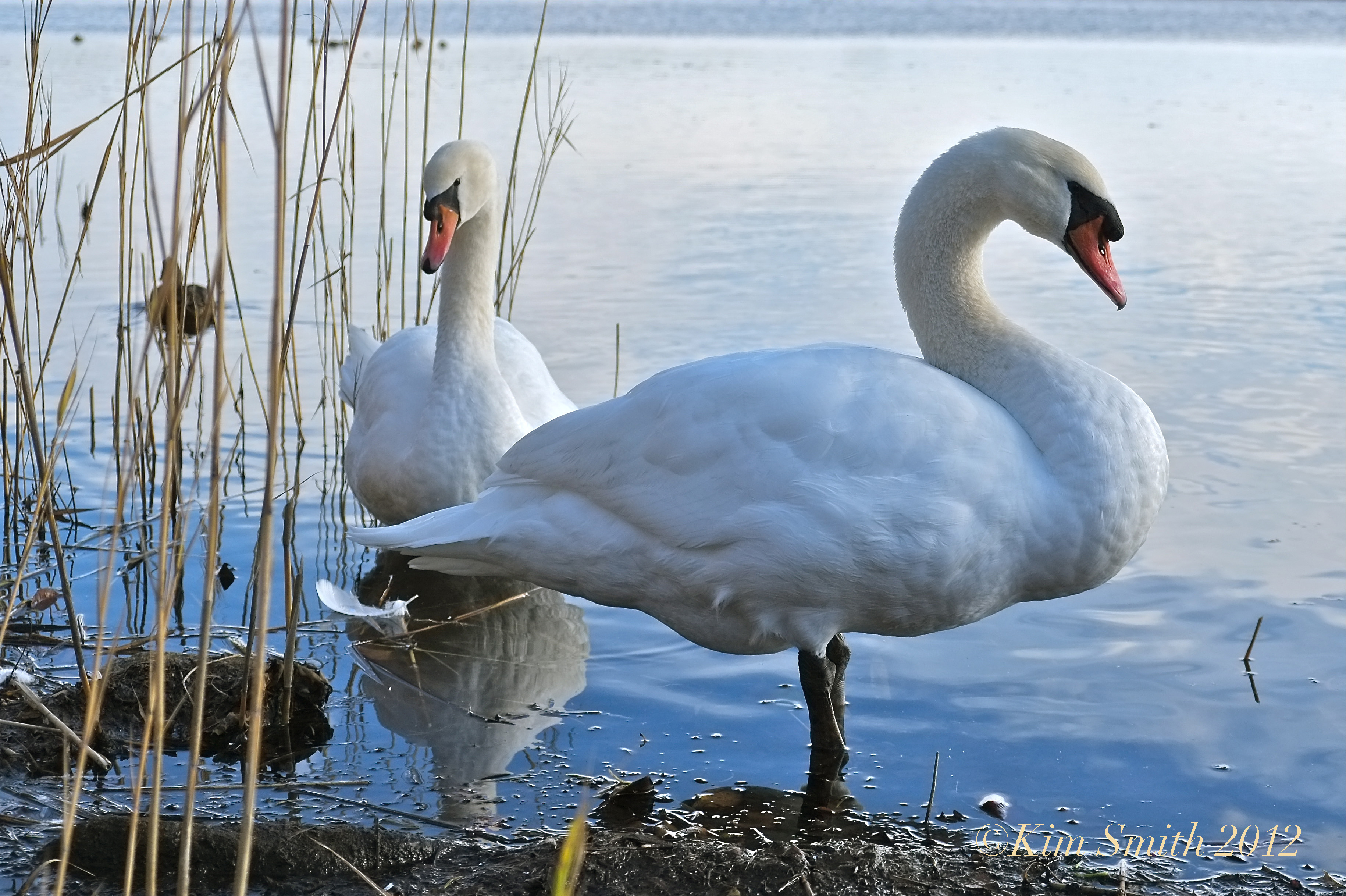
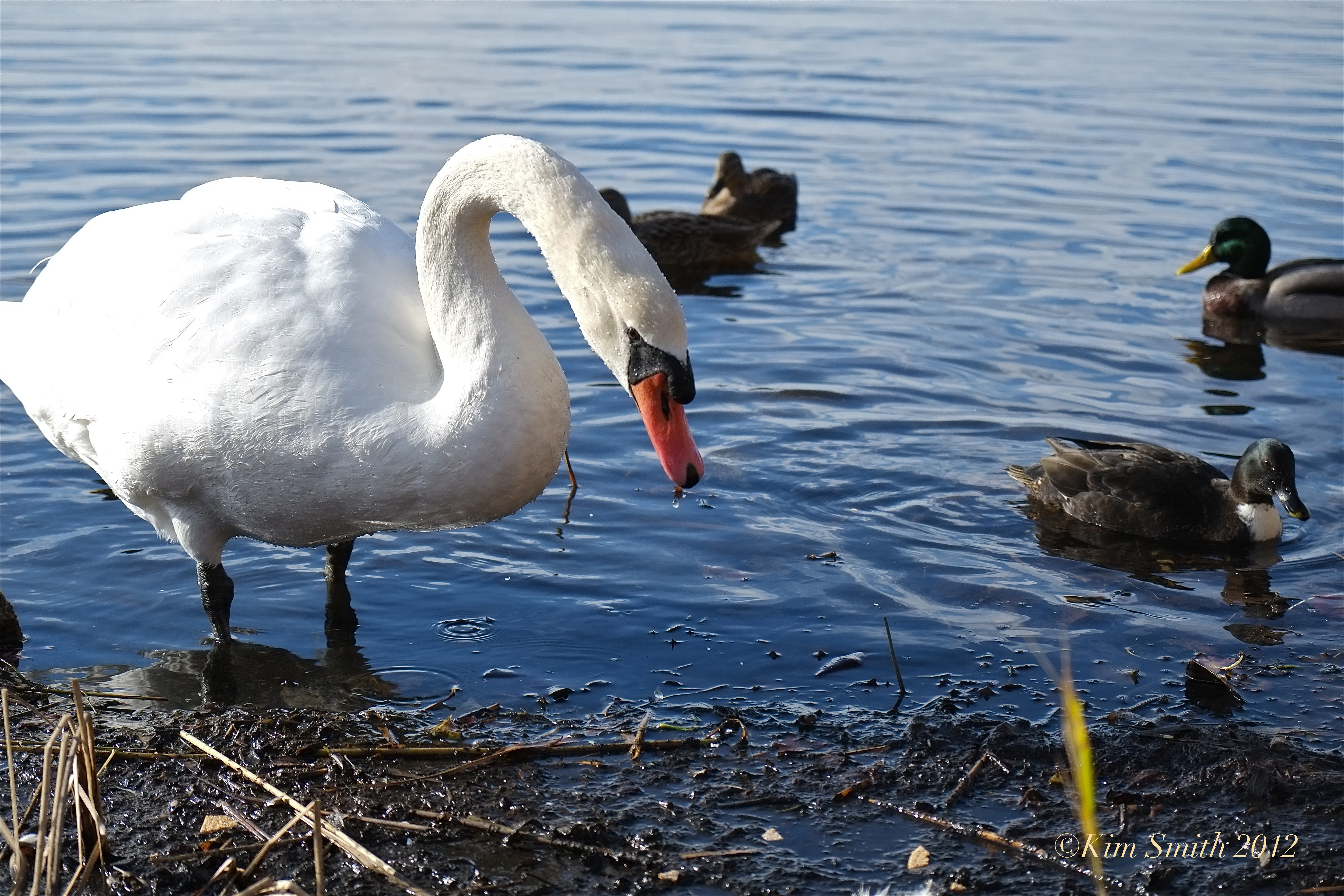
Female Pen (left) Male Cob Mute Swan ©Kim Smith 2012Female (left) and Male Mute Swans at Niles Pond

The New York State Department of Environmental Conservation’s war on swans includes gassing, shooting, and oiling eggs on nests to prevent them from hatching. Their stated goal is to eliminate all 2,200 Mute Swans in the state of New York by the year 2025.

Mute Swan Manky Mallard Nile Pond Gloucester ©Kim Smith 2012Mute Swan and Manky Mallard

Reasons cited are that the swans aggressively defend their young, they attack other waterfowl, and destroy habitat.

Audubon New York and the NYSDEC plan to put forth their agenda to the New York citizenry with their education campaign.

Mute swans were introduced in the previous century to decorate parks and estates. Today, exotic species receive a great deal of attention and generate much concern. Oftentimes information around exotics is too simplistic. Some invasions are life-threatening, but they do not often set off an extinction. They can even spur the evolution of new diversity and strengthen an existing species.

I’ve read contrary opinions, and observed the opposite, to the reasons given for the swan’s extermination. There are a number of issues to consider. Where do our readers stand on this developing story? What have been your observations and experiences when encountering a swan?

Read the complete article here.

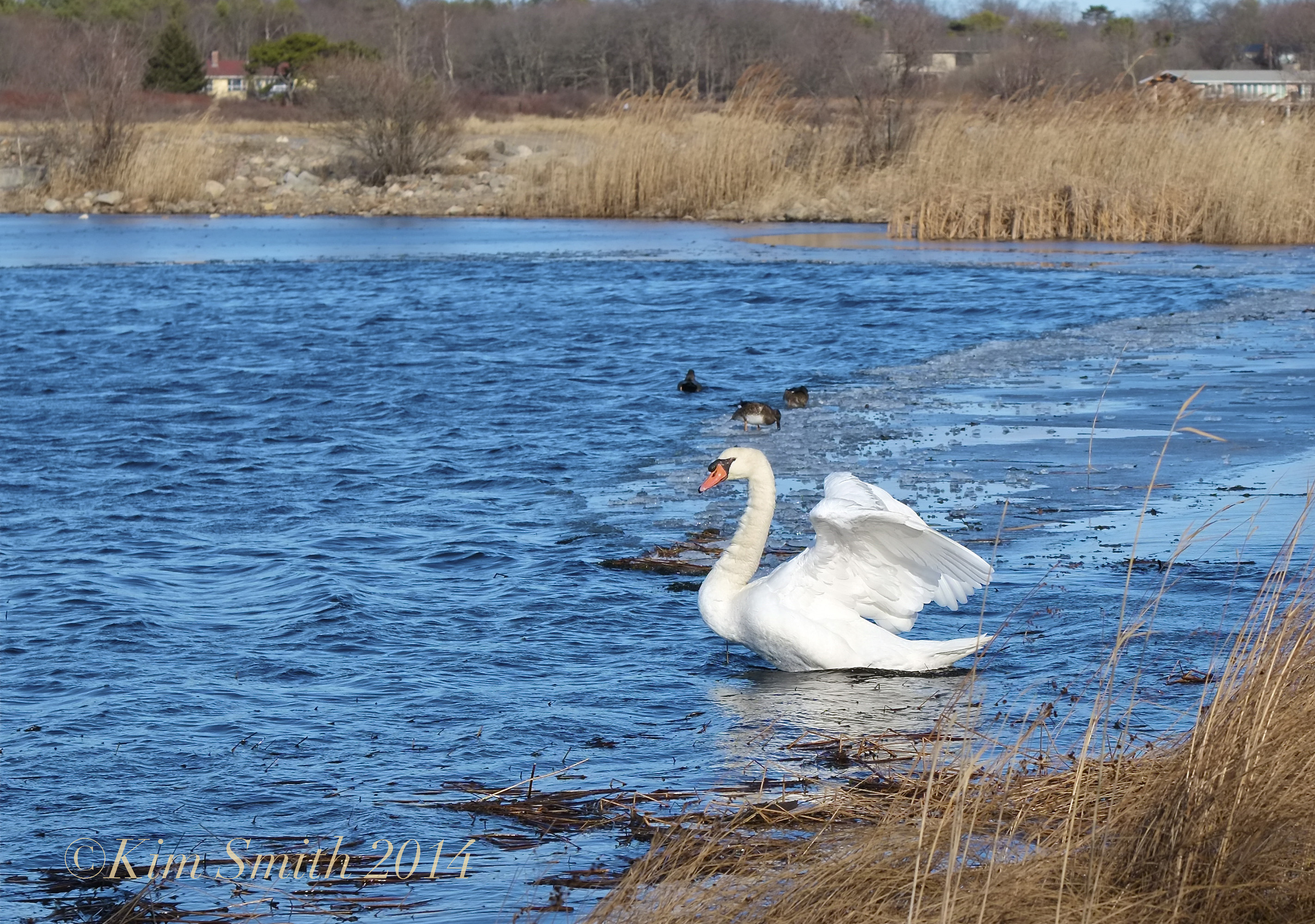
Mute Swan Niles Pond Gloucester ©Kim Smith 2014Mute Swan ~ Cygnus olor

New Video: Reflections Good Harbor Beach (and sunrise time lapse)

Outtakes from films in progress, too pretty to delete. In thinking about music for my forthcoming film I found this beautiful pan flute song “Mochica en la Noche” by Santiago y Sus Flautes de Pan. The evocative music and heron in the vivid rising sun just felt like a perfect pairing.

Birds of Cape Ann: Great Egret vs. Great Egret

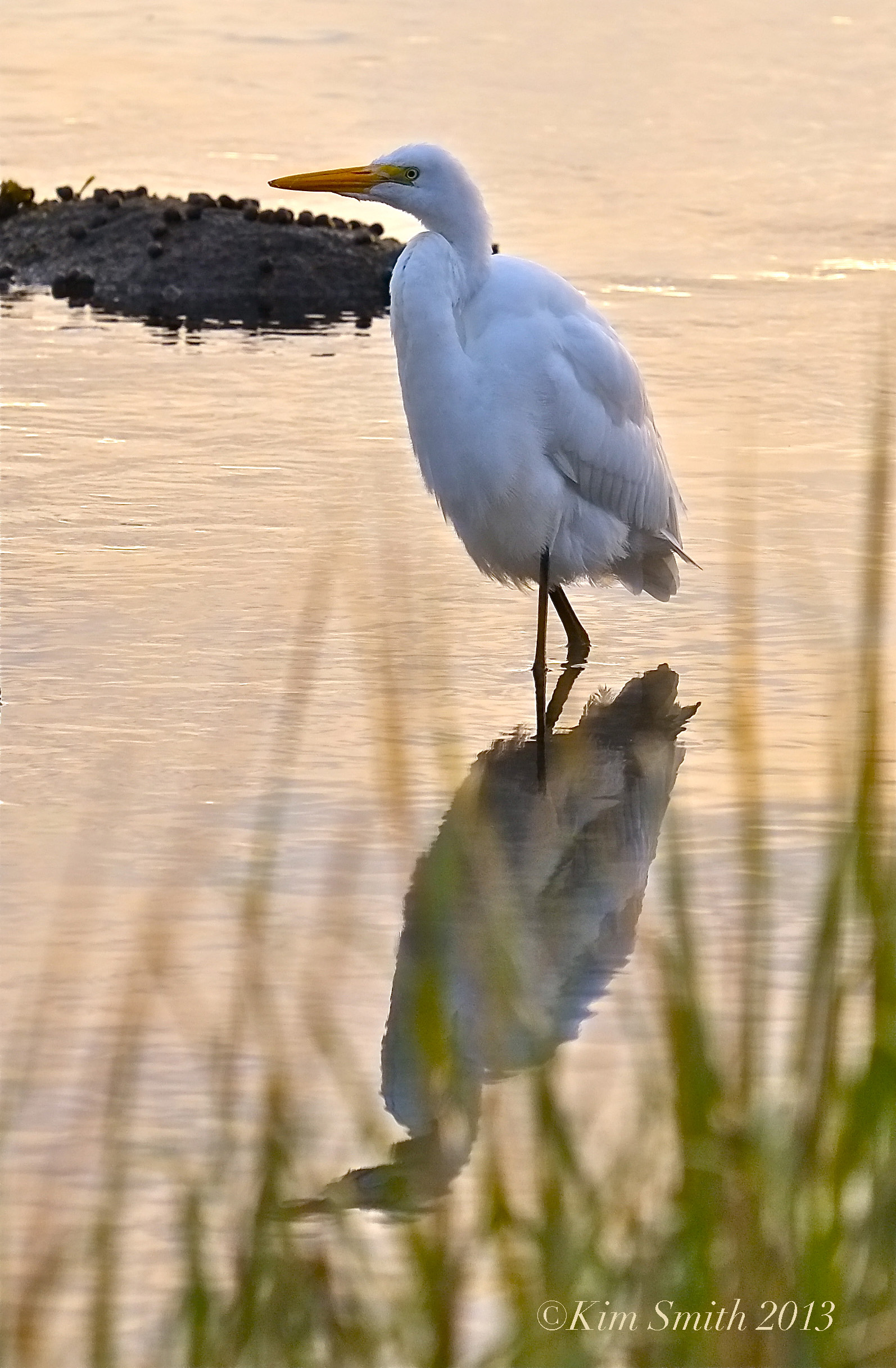
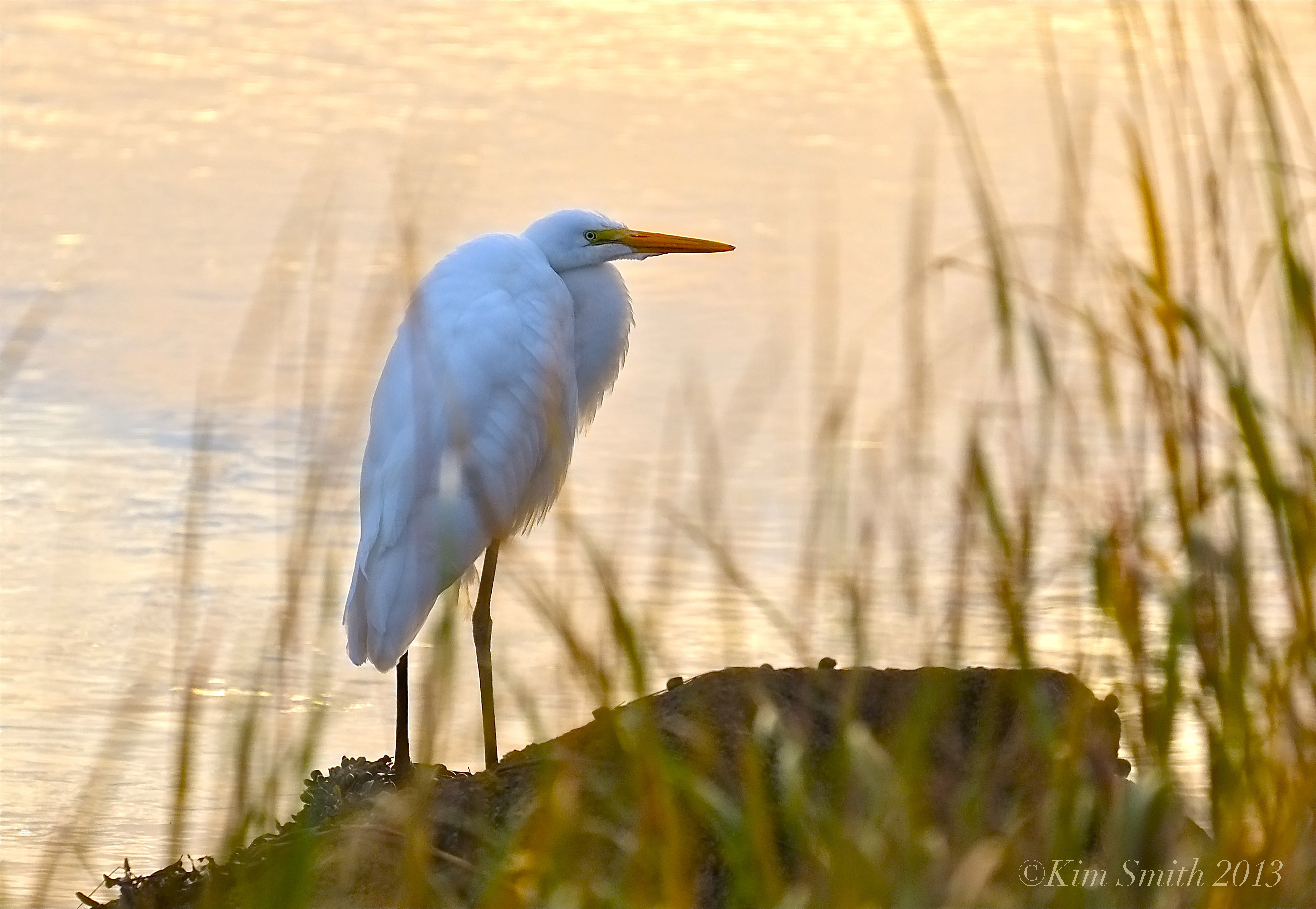
Great Egret Gloucester - ©Kim Smith 2013Great Egret (Ardea alba)

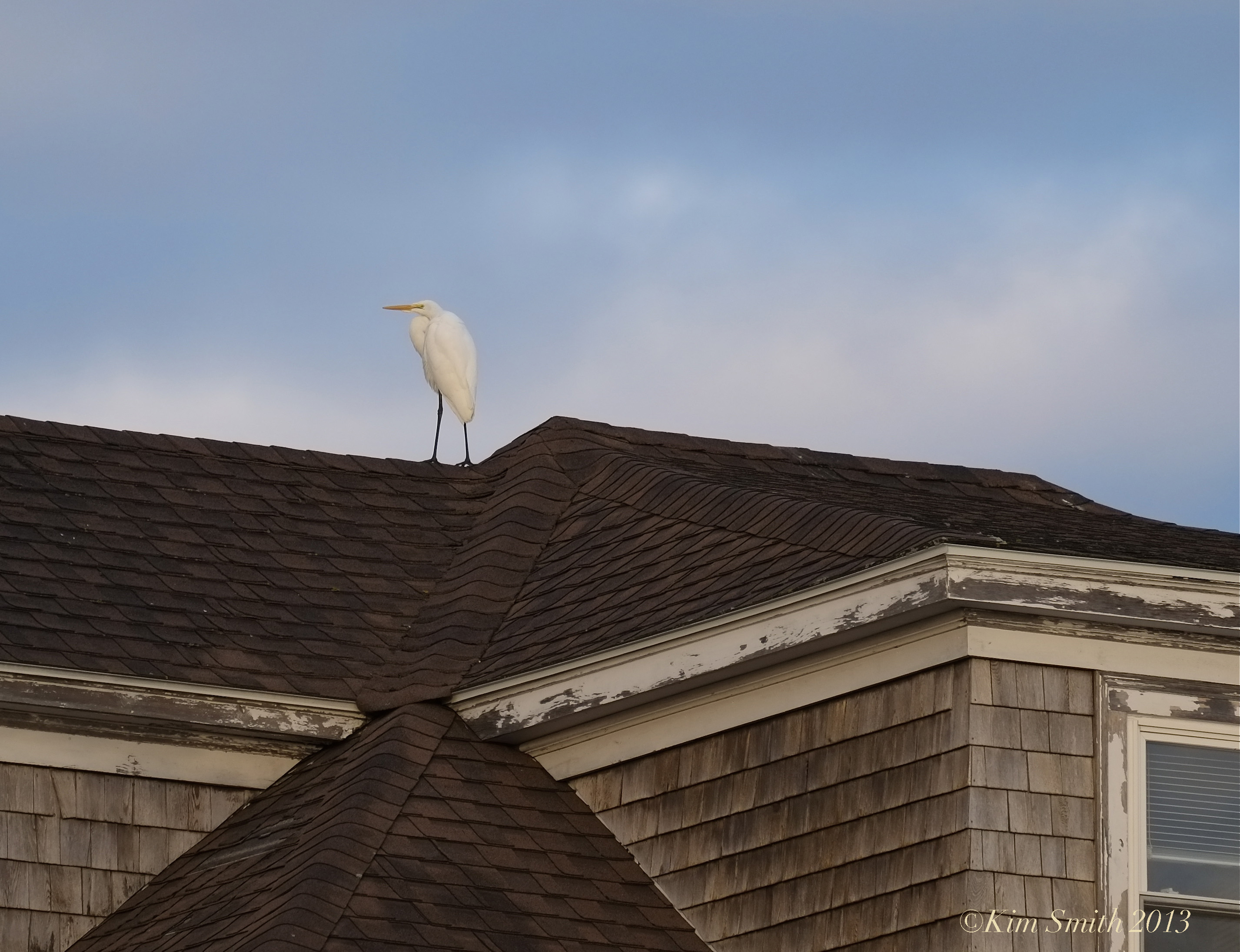
On a gorgeous dawn this past season I filmed an epic battle between two, possibly three, Great Egrets at the Good Harbor Beach marsh. The battle lasted nearly ten minutes with the defending egret aggressively flying lower and beneath the intruder, preventing it from landing anywhere on the marsh.

Great Egret Gloucester ©Kim Smith 2013

Great Egrets have interesting breeding behavior in that the male selects the nesting site and builds a platform nest of sticks and twigs in a tree, shrub, or on the ground near a marsh,  prior to selecting a mate. Both parents incubate the eggs and feed the chicks, and both male and female vigorously defend the nesting territory. Perhaps that is what I had observed, a male and/or female defending their nesting site.

Great Egret Gloucester Massachusetts ©Kim Smith 2013

The Good Harbor Beach victor first surveyed the marsh from his perch on the adjacent cottage and, after determining his foe was defeated, swooped to the tide pool below to feed peaceably alonsgide the Great Blue Heron.

Great Blue Heron Great Egret Gloucester ©Kim Smith 2013Great Blue Heron and Great Egret

Read More Here: Continue reading “Birds of Cape Ann: Great Egret vs. Great Egret”

Birds of Cape Ann: Greater Yellowlegs and the Boreal Forest

  • Lesser Yellowlegs Massachusetts © KIm Smith 2014.

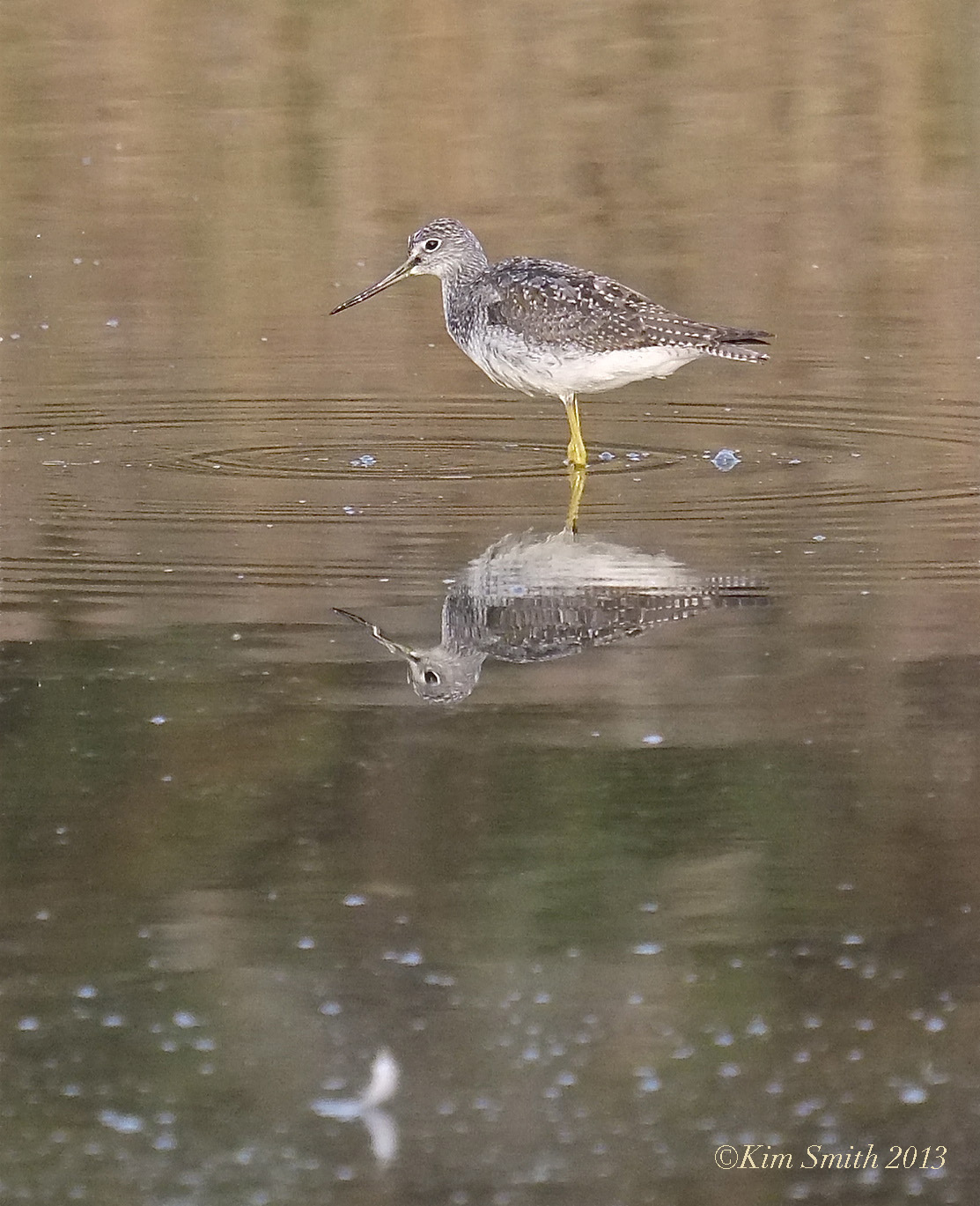
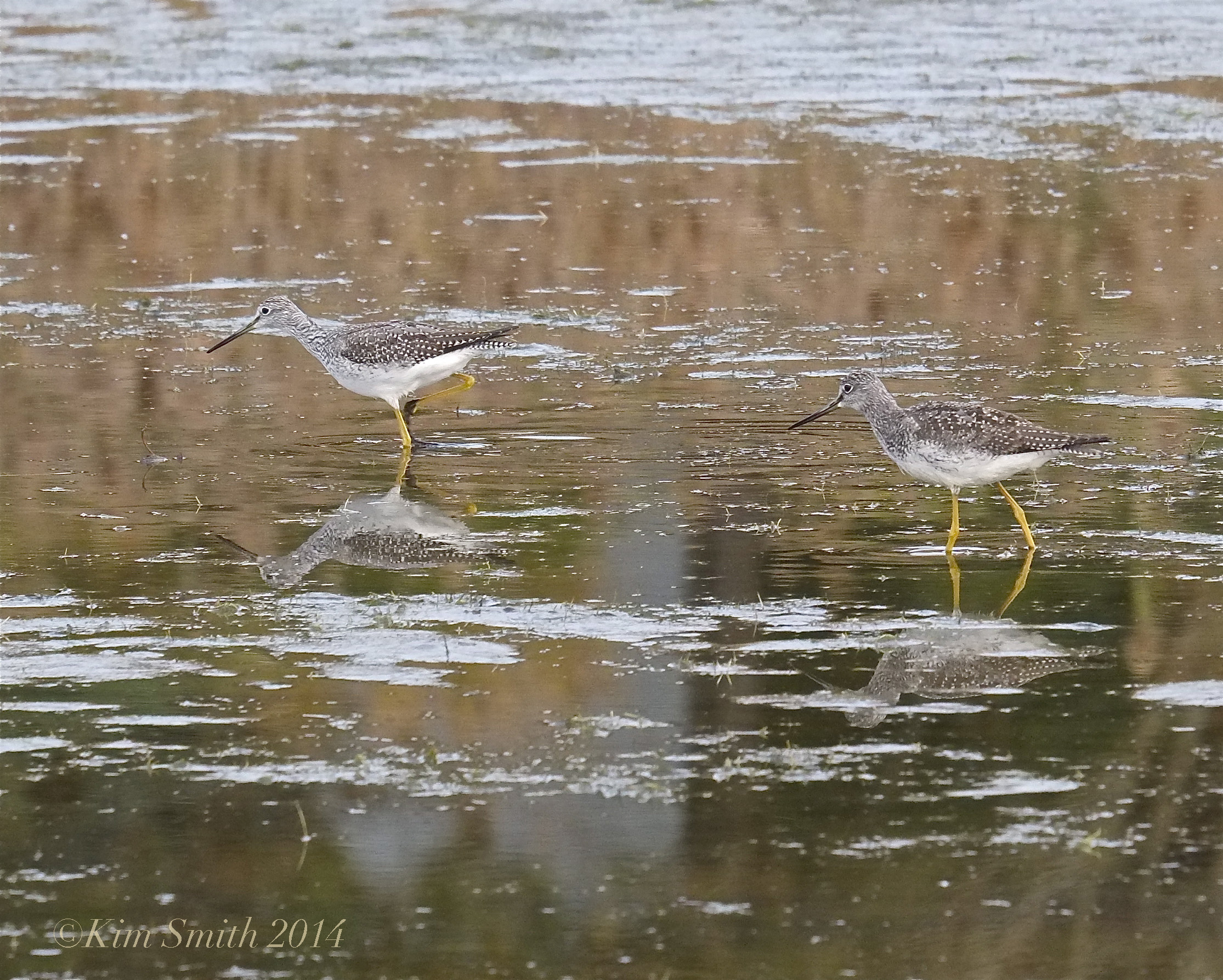
What a treat to happen upon this pair of yellow-legged shorebirds feasting on tiny invertebrates in the mudflats at Henry’s Pond. 

Lesser Yellowlegs Pair Massachusetts © KIm Smith 2014

The Yellowlegs were foraging companionably alongside the Mallards, American Black Ducks, plovers, and Kildeers. I returned the following dawn and they had already departed for parts warmer. Perhaps we’ll see them again during their spring migration as they journey north to breed in the boreal bog forests of Canada and Alaska.

Lesser Yellowlegs Massachusetts  © KIm Smith 2014 -.Greater Yellowlegs Preening

Here on Cape Ann, we are fortunate to catch fleeting glimpses of species such as Greater Yellowlegs during the great annual fall migration. The map below shows the boreal forest biome (biome is another word for ecosystem), which lies to the south of the tundra and the north of deciduous forests and grasslands. The ground in the boreal forest is damp and boggy because of snowmelt and little evaporation due to cooler summer temperatures. The moist ground and long day length at northerly latitudes during the summer makes for explosive plant growth–Think Bird Food!–not only in the wealth of plants, but myriad insects attracted!

taiga_500Boreal Forests

I believe the pair to be Greater Yellowlegs. If any of our wonderful expert bird lovers would like to weigh in on this, I would be grateful. Songbirds and shorebirds that I have filmed on Cape Ann are featured in my Monarch film and I am in the process of writing the script. I want to insure that all the bird identifications are 100 percent accurate.

Addendum: Many, many thanks to Kate and Patricia (see comments) for identifying the pair as Greater Yellowlegs (Tringa melanoleuca)!!

Map courtesy google image search.

Birds of Cape Ann: Buffleheads

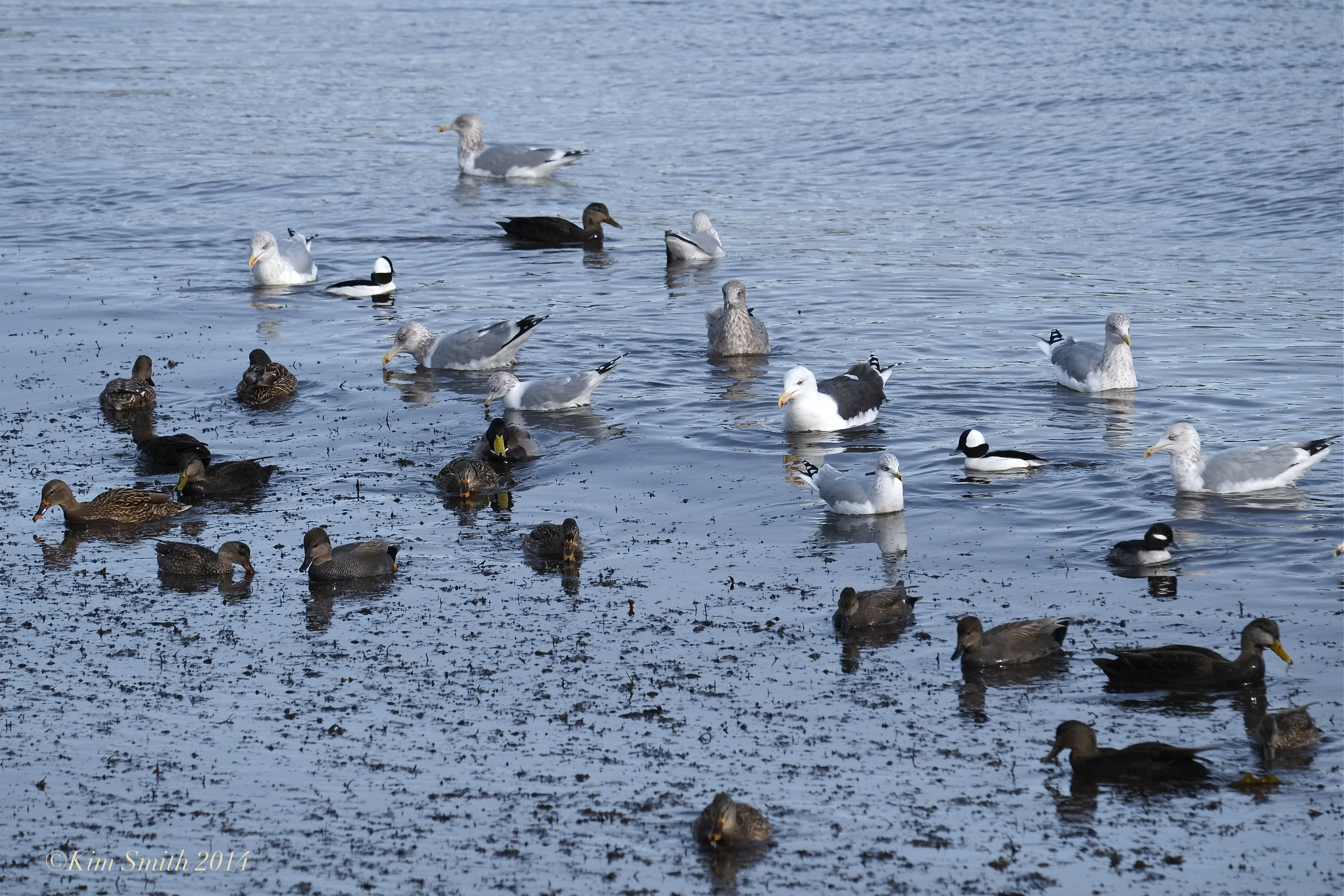
Next time you see a flock of ducks, look closely. You may be surprised by the range of  different species within the group. Although not always the case, but more often than not at this time of year, I see several species within a flock. What typically happens as I try to get closer to photograph or film a flock of shore birds, the Mallards, which seem very comfortable around people will stay and the somewhat less seen species, such as Buffleheads, Gadwalls, and American Wigeons will fly away.

Buffleheads, gulls Brace Cove ©Kim Smith 2014 I counted six different species of birds feeding in the seaweed at Brace Cove in the above photo.

This past autumn, and continuing through this winter, I have been filming and photographing B roll all around the ponds and marshes of Cape Ann. Today begins a mini series about shore birds, ducks, and wading birds, including photos and interesting facts, to help better identify the differences between the ducks and wading birds that migrate through, and winter over, on Cape Ann.

One of several Cape Ann geographical features that allows for such a wonderfully wide range of birds to be found on our shores and marshes is the fact that we lie within a largely unrestricted north south corridor for migratory species of birds and butterflies. What exactly does that mean? From the eastern coastline, all the way from Maine to Florida, and between the Appalachian Mountain range further west is a corridor where there are no barriers such as large bodies of water or mountains to fly over, which allows for unrestricted movement of birds and butterflies.

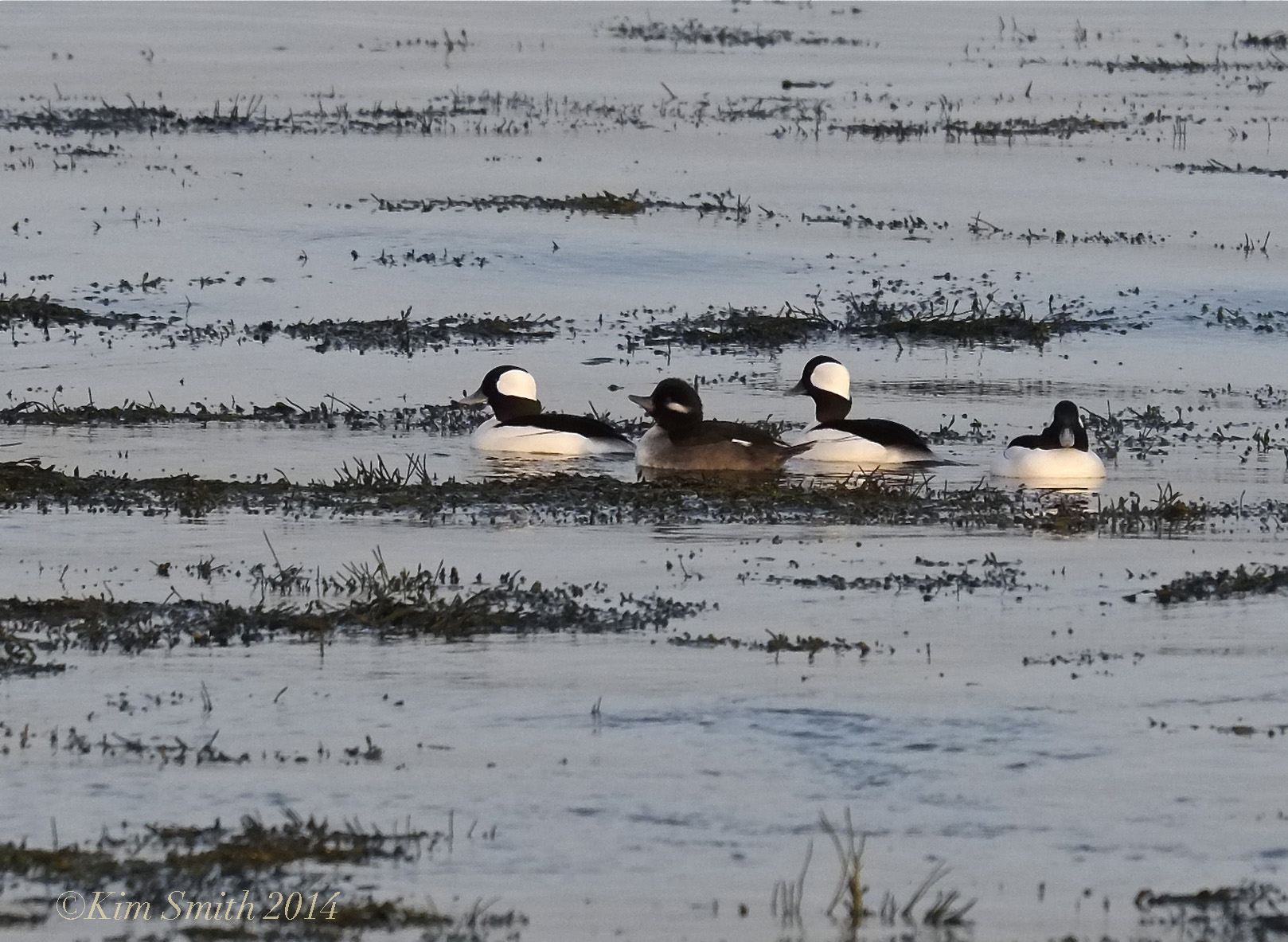
Male and Female buffflerheads ©Kim Smith 2014Male and Female Buffleheads

Male Buffleheads are one of the easiest birds to distinguish from a distance and within a group because of their sharp black and white coloring, comparatively smaller size, and pert, rounded shape. Upon closer inspection the males heads are marked with striking iridescent green and purplish feathers. The photo above shows three males and one female, and she is differentiated by her all over darker color and the patch of white feathers on her check. Rapid wingbeats make Buffleheads easier to distinguish when in flight as well. Their old-fashioned name of “Butterballs” aptly describes these beautiful and welcome winter migrants!

I am by no means a bird expert. I love to film and photograph the natural world around us and along the way find it fascinating to learn about the wildlife and flora that surrounds. Note to all GMG nature and bird-loving readers ~  I hope you’ll comment with your expertise. We would love to hear from you!