Joan of Arc was burned at the stake; however one horse hoof is raised.
Equestrian Statues – Rule
Myth or Fact
Both front legs in the air means the person on the horse died in battle.
If the horse has one front leg in the air the person died as a result of wounds received in battle.
All four legs on the ground denote the person died of natural causes.
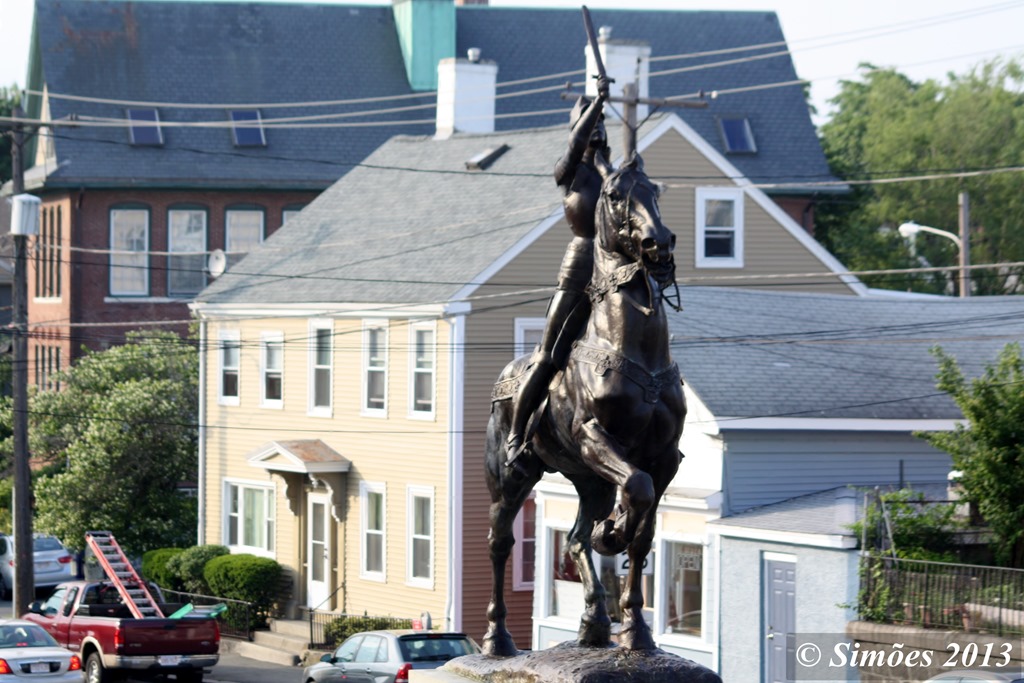
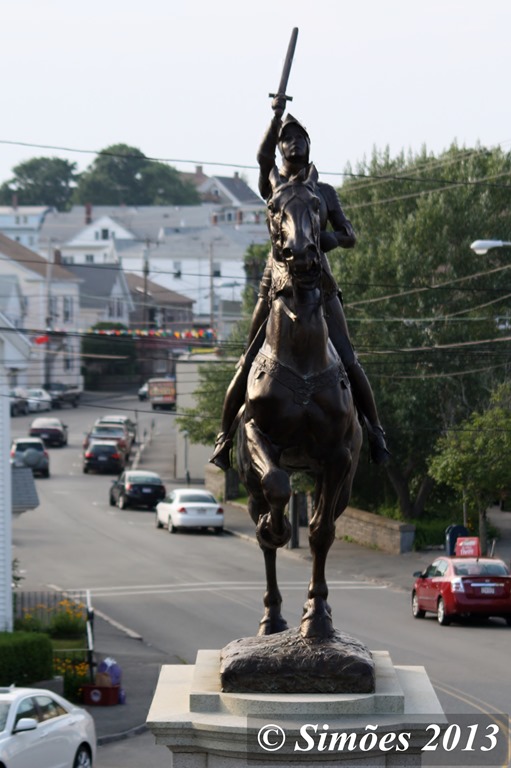



 Good Morning Gloucester
Another Myth or Fact: I heard she used to face the other direction, down Washington street. Is that true? Do people know why she was turned?
LikeLike
I heard the same thing. Maybe its an urban legend. She is still facing the same way as in the photos from her being put up the first time. I doubt they would have changed her direction and later changed it again.
LikeLike
The Joan of Arc statue always faced the old Town Hall (now the Legion), with the horse’s rear facing Washington Street. The reason for this was because the only land route into Gloucester and Rockport was over the Blynman drawbridge. When the A. Piatt Andrew Bridge was built in the 1950s to extend Route 128, Washington Street became the major road into downtown Gloucester.
LikeLike
While it’s true that visitors originally approached Joan from the front before the construction of the A. Piatt Andrew Bridge, the statue is oriented so that Joan is saluting the Legion, and by association, the legionnaires. I’ve always considered it one of life’s little ironies that Andrew, who was responsible for the placement of this great work of art in Gloucester, would eventually have a bridge named for him and that the subsequent re-routing of traffic would result in a most unfortunate approach of this sculpture. Andrew had asked the sculptor, Anna Hyatt Huntington if she would allow a copy of her famous NYC statue of Joan d’Arc to be used as a memorial for Gloucester’s residents who gave their lives in WWI. As we know she agreed, but she was not trying to suggest anything by the placement of the horse’s hoofs. There is no rule followed by equestrian sculptors about the horse’s stance and the life or death of it’s rider. I write this with some authority as I am an art historian who specializes in American sculpture and on Anna Hyatt Huntington in particular. 😀
LikeLiked by 1 person