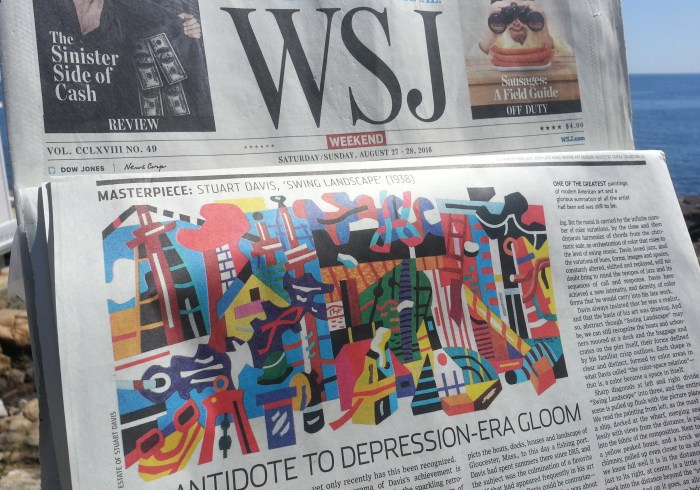
Bill Agee is an art historian and esteemed professor at Hunter. He completed the acclaimed Davis catalogue raissone (Yale University Press, 1991). His most recent book is Modern Art in America. Here he is on Stuart Davis (1892-1964) and Gloucester in today’s Wall Street Journal.
“Swing Landscape (1938) is surely one of the greatest paintings of modern American art, a glorious summation of all Davis had been and was still to be. Swing Landscape, one of nine Davis mural projects was commissioned by the WPA. It was intended for the Williamsburg Housing Project in Brooklyn. But for reasons still unclear it was never installed, and in 1942 it was acquired by the Indiana University Art Museum, in Bloomington. Because of its intended location, over the years the mural has been misread as based on views of that bustling borough.
Rather, it depicts the boats, docks, houses and landscape of Gloucester, Mass., to this day a fishing port. Davis had spent summers there since 1915, and the subject was the culmination of a favorite motif that had appeared frequently in his art since at least 1924. Davis could be contrarian–for example suggesting a painting was about one thing when it was really about something else–and here he turns these picturesque vistas, the subject of so much tourist art, into a serious, complex and ambitious mural. “
I wish this Agee excerpt was published long before the September 25th closing of the Whitney Museum show, Stuart Davis in Full Swing. Back in June, WSJ published a couple of reviews including one by Karen Wilkin.
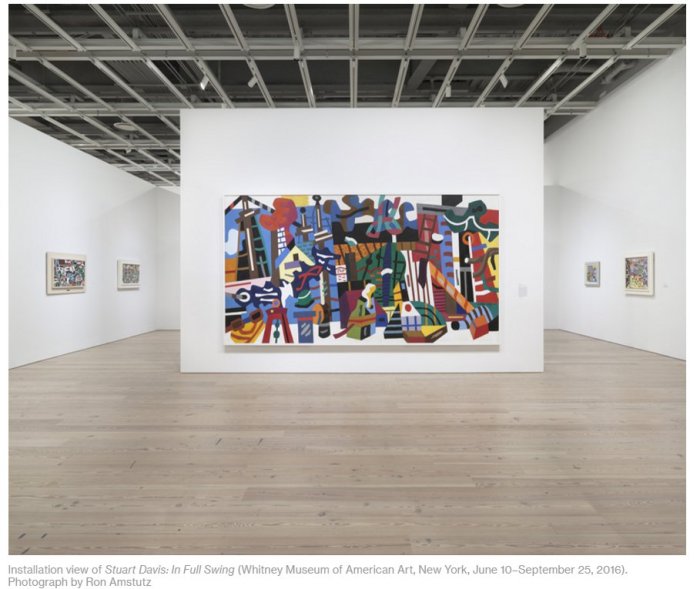
From the Whitney exhibit:
Using sketches he made of the waterfront in Gloucester, Massachusetts, he transformed masts, rigging, lobster traps, ladders, and striped poles into a vocabulary of overlapping, brightly colored shapes, all of equal intensity. To Davis, the result portrayed the “new materials, new spaces, new speeds, new time relations, new lights, and new colors” of modern America.
James Wechsler describes Davis subjects as triple distilled.




 Good Morning Gloucester