Of all the symphonic sounds one encounters riding the NYC subway trains and tracks, above a multitude of electric aches and brakes, and machinery coming and going, it’s the brief and stirring melody that never fails to stir my heart.
I have filmed it every decade since the 1980s. That such solid heavy machinery can sound delicate and fleeting and produce the identical phrasing of Beethoven’s Piano Concerto No. 5 adagio un poco movement stops me every time (25 second audio below).
Beethoven (1770-1827) was fully deaf by 40. At the time when the sounds that he heard must have grown muffled and distant and the high pitch frequencies rubbed away–in his mid thirties–he composed Symphony No. 5. What many may consider the loveliest and most layered melody the world has produced may be one of the last of his own works Beethoven could hear at all. Think about that as the subway is pulling away.
Because it was a center of the music world of its time, booming with royal and freelance opportunities for musicians and music publishing, Beethoven resided and worked in Vienna. When I hear the notes emanating from the NYC subway, I wonder about the ambient and industry sounds in Vienna that Beethoven absorbed. The upper Danube was dotted by land and ship mills for grain, textile, metal working, lumber, and fishing. Although the sounds of steam engine trains were decades away from Beethoven’s lived experience, and well before audio recordings, sounds and vibrations from man made metal and engineering production were extant.
150+ years later, preeminent American conductor and composer Leonard Bernstein, drew inspiration and intentionally quoted that Beethoven phrase in “Somewhere” from West Side Story. How could he not? Bernstein was a New Yorker. The sounds of the city were his inspiration, too. And what can be more New York than the subway and an artist delighting in references as broad as Gershwin and Beethoven and the challenge of embedding them into popular musical theater. Bernstein was also an unfailing educator and student of music. Here he is in 1954 on his first live tv appearance, on the Sunday afternoon weekly broadcast, Omnibus, with the Symphony in Air orchestra episode devoted to Beethoven’s Fifth Symphony.
The popular Beethoven ‘master class’ aired three years before his seminal musical West Side Story premiered on Broadway.One wishes there was an episode about Beethoven’s the Emperor with Bernstein.
There is a broadcast in 1956 with Josef Krips conducting. Below is a 1 min excerpt with that phrase from Beethoven Piano Concerto 5 performed with NBC Symphony of the Air and Arthur Rubinstein on piano.
And three more (duration 20 second (or less)) recordings of that Beethoven leitmotif phrase, different interpretations for joyful comparison:
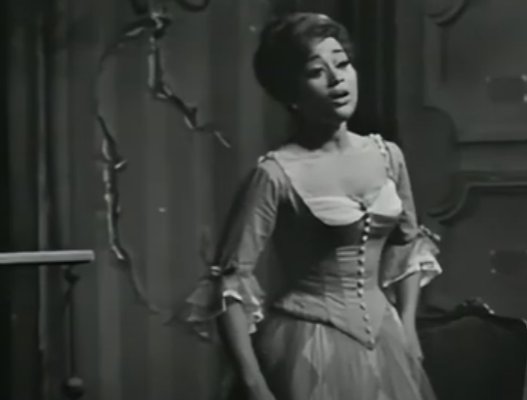
Reri Grist (American, b. 1932)
The Broadway musical, West Side Story, lyrics by Stephen Sondheim and music by Leonard Bernstein, opened in 1957. The gorgeous melodic and pining classic, “Somewhere”, was not sung by Carol Lawrence who played the role of Maria. Broadway was lucky to recognize the gorgeous voice of Reri (sounds like MiMi) Grist, a member of the background chorus who played the part of Consuelo and the off stage soloist who launched “There’s a Place for Us” into the world. You can also hear Grist’s vocals soaring in the chorus of “Tonight”.
Four years later, the song pivots to the part of Maria in the classic 1961 film adaptation. Grist was not involved in the iconic movie. She became an international opera soprano, and legendary voice teacher in New York. There doesn’t seem to be any film recording of Reri Grist with the original cast acting and singing. There is a contemporaneous video with excerpts of Grist starring in a 1965 live tv production of “Ariadne auf Naxos” — it’s incredible (and only 2000 views as of today). She’s dazzling.
1960s
2007
Flash forward decades to 2007: Broadway Cares/Equity Fights AIDS gala fundraiser featured Reri Grist singing “Somewhere” and it’s so layered and stunning and felt!
And here is a snippet from the historical rehearsal for the 2007 event with original cast members and Grist beaming and her voice lifting in “Tonight”
West Side Story film
Excerpts with examples of the leitmotif from the 1961 juggernaut with Natalie Wood as Maria (with vocals dubbed by Marni Nixon) and Richard Beymer as Tony (vocals dubbed by Jim Bryant).
Somewhere interpretations
Video and audio snippets zeroed in on that melody covered by legends: Judy Garland with Vic Damone , the Supremes (1966), Barbra Streisand (1985), Idina Menzel (Glee, 2011) , and Renee Fleming (1999)

 Good Morning Gloucester