Video Update #2 from Dave Moore: Mantis hatching from an ootheca. Thank you Dave!
Update: Kathy Chapman shares this great video ~ Thanks Kathy!

Chinese Mantis ~ Mantises have two spiked forelegs called “raptorial legs” that are used for grasping and securing captured prey.
The Truth About Praying Mantises ~
Are praying mantis beneficial to your garden? Yes and no, depending on which species of mantis you are referring. There are over 20 species native to the United States however, the mantises seen most frequently in our region are the European Mantis (Mantis religiosa) and the Chinese Mantis (Tenodera aridfolia sinensis), which were introduced to the United States in 1895 as biocontrols against other insects. They are generalist feeders and are not very effective at pest control. Mantids eat the hummingbird and bee as well as the pest. They also eat each other! The Chinese and European Mantises are fascinating creatures, but I would not purchase and release them into my garden. Chinese Mantis egg cases are easy to find in the fall. Look for the cases (called ootheca) in fields of goldenrod and Rosa rugosa.
Chinese Mantids have trianular-shaped heads with large compound eyes and three simple eyes between the antennae. Much research has been conducted on mantis eyesight. As do most mammalian predators, the mantis is capable of full stereoscopic vision and they are the only insects able to rotate their head a full 180 degrees.
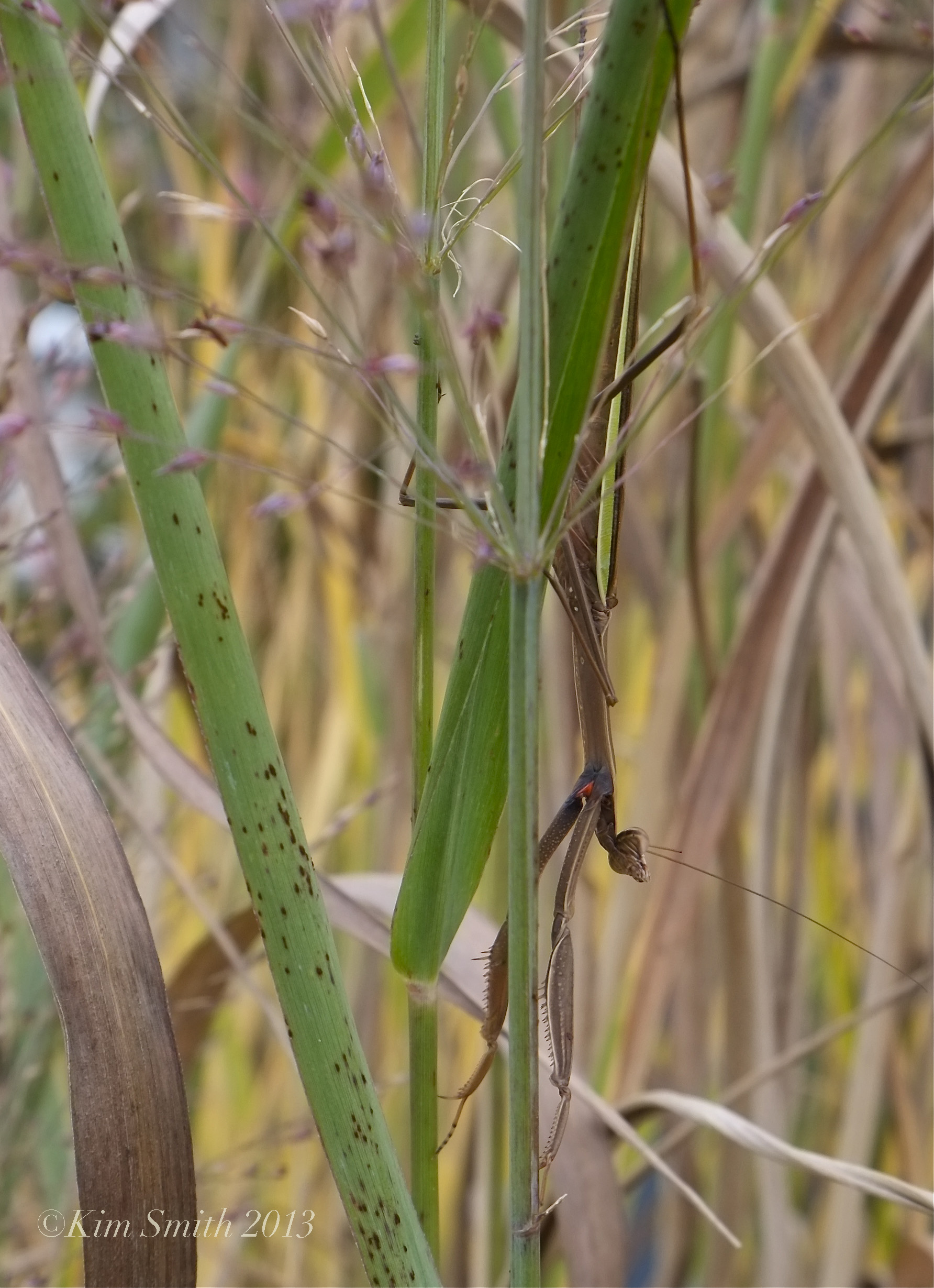
In the second photo you can see the Chinese Mantis’s head is pivoting backward at a very narrow angle!
Click once to enlarge the image, and then click again to magnify.
Interesting note ~ A type of kung fu called Praying Mantis Kung Fu was developed in the Shandong province in the mid-16oos, and is said to be inspired by the quick movements and hunting techniques of the Chinese Mantis.

 Good Morning Gloucester