The US Fish and Wildlife Service, Massachusetts Wildlife, announced a new statewide piping plover conservation plan last Friday.
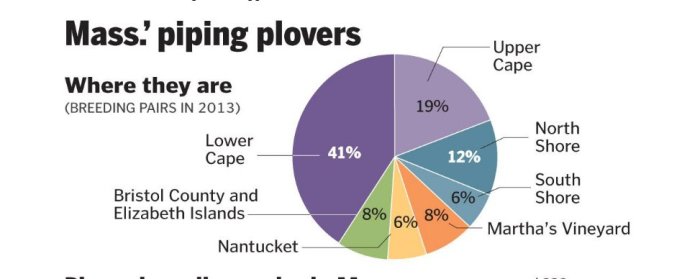
Thank you to the GMG reader who saw the news on TV, and wrote a comment on the Disney-Pixar post. Massachusetts may be the model for North America. The MA Wildlife report includes the conservation approach implemented in Cape Cod last year, home to 60+% of MA piping plover population. I don’t have the tv station’s coverage, but I included the WBUR wire pick, and piping plover reports from CT, NH, and ME. Kim Smith is covering the pair on Good Harbor Beach. Nesting Piping Plovers have been seen on Coffins Beach and Revere Beach.
Currently, the Atlantic coast population (North Carolina to Eastern Canada) of piping plovers continues to hold steady just under 2,000 pairs. The Massachusetts State Department of Fish and Wildlife targets maintaining 625 pairs with greater intervention should the population fall below 500 pairs.
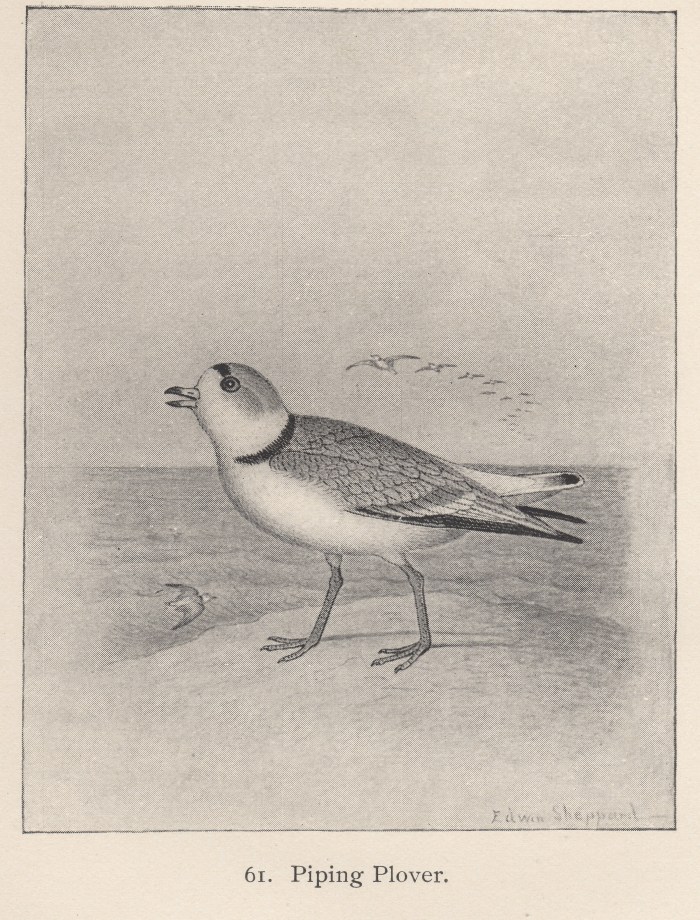
Piping plovers were not rare enough to be described as a ‘wild’ species in 1895 in Daniel Giraud Elliot’s North American Shore Birds. He wrote that where the species had been formerly ‘most abundant’ the piping plover was “found chiefly on the more retired parts of the cost where it was free from molestation…its acquaintance with man has caused it to be at the present time, in most places where it is found, a rather wary bird.” The fattened birds were “palatable, yet sometimes sedgy in flavor.” Skunks and other predators, influx in summer population, and loss of habitat were concerns. Plastic trash is a striking difference now. At least we don’t eat them.
CONNECTICUT
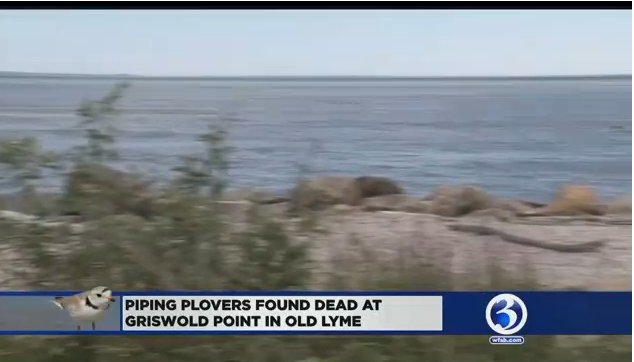
Three Piping Plovers were recently killed in their nesting habitat at Griswold Point in Old Lyme CT. It’s believed a fourth was intentionally stepped on in Bluff Point State Park in Groton, CT. “People ignore the signs.”
The Connecticut Department of Energy and Conservation monitors the piping plovers. The Connecticut Audubon Society doesn’t maintain piping plover information, however they do have an incredible osprey project to report. Tom Andersen told me that the CT Audubon Society has built up a network of more than 300 volunteers to find and monitor osprey. An intern has plotted the work of these citizen scientists on this Osprey Nation map. Nests have grown from 200 to 500. I think I’m inspired to do a map of the piping plovers if someone in MA or in the state office hasn’t done it already!
MASSACHUSETTS – CAPE COD
Massachusetts may be the national model.
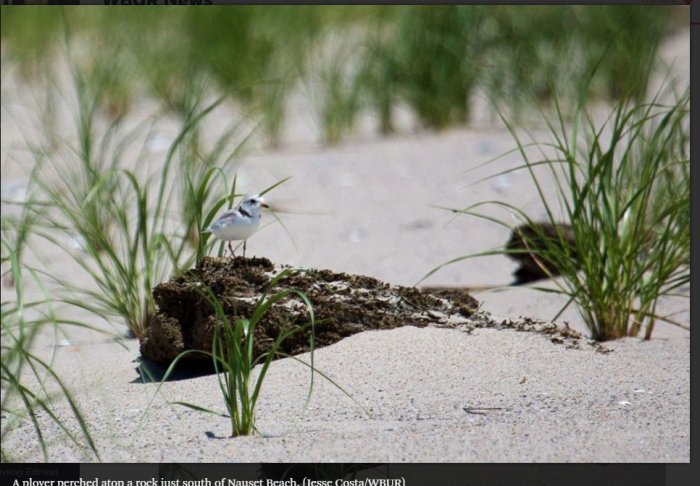
Read WBUR on the MA Wildlife press release with a focus on Nauset New Plan Allows Beachgoers More Room While Protecting Piping Plovers
David Abel wrote about it back in January for the Boston Globe (January 21, 2016) Beachgoers may get break as plovers rebound:
“In Orleans, after years of losing hundreds of thousands of dollars a year in fees for stickers to drive on town beaches, local officials independently sought and obtained a federal waiver last year to allow a limited number of vehicles back on the beach.”
“For Russ Hopping, who oversees about 27 miles of beaches from Ipswich to Nantucket for the Trustees of Reservations, a federal waiver would mean more than getting rid of some fences on their beaches. It would mean fewer headaches. With some 60 plover pairs on their beaches last summer, Hopping hopes new flexibility would translate into fewer complaints and greater protection for the birds.
“That we’ve reached the point that this opportunity even exists represents a conservation success story for Massachusetts,” he said.
South shore and Plum Island stories have been contentious (e.g. WBZ’s 2010 story in Plymouth Are they protecting the plovers or their view? )
The town of Duxbury canceled their annual 4th of July beach bonfire because piping plover pairs returned and were nesting year after year. “Most Duxbury residents said they understand the need to cancel the bonfire for the bird. Since the birds return every year, the committee said next year they’ll consider a new tradition of having the beach bonfire at another time.”
NEW HAMPSHIRE
There are 7 pairs reported in NH right now in Seabrook and Hampton. “Since protection efforts began in New Hampshire in 1997 through 2015, 99 nesting pairs of plovers have fledged 127 chicks on the state’s seacoast.”
MAINE
The Rachel Carson National Wildlife Refuge and Maine Audubon report Piping Plovers first sightings in 2016 on beaches at Kennebunkport, Kennebunk and Old Orchard Beach. They’re sending an estimate about nests.
MASSACHUSETTS- CAPE ANN- Gloucester
search for Kim Smith’s exceptional documentation and photographs on Good Morning Gloucester about the one nesting pair on Good Harbor Beach
- How to tell a male piping plover vs female
- Dog Owner and Trash Trouble Part 1
- Dog Owner and Trash Trouble Part 2
- Piping Plover update
- First look at 2016 Good Harbor Beach piping plover
- Facts on the fenced off area
more on GMG:
- see Piping Plover on Coffins Beach
- Please help with research! report local horseshoe crab sightings and reminiscences
- Piping plover fans: local author DEBORAH CRAMER The Narrow Edge on sandpipers is a must read. Oh, and dogs vs.
- reported sightings from Deborah Cramer, and excerpts from 1895 North American Shore Birds
- Disney- Pixar Piper movie


 Good Morning Gloucester