Check out my first post for the Essex County Greenbelt!

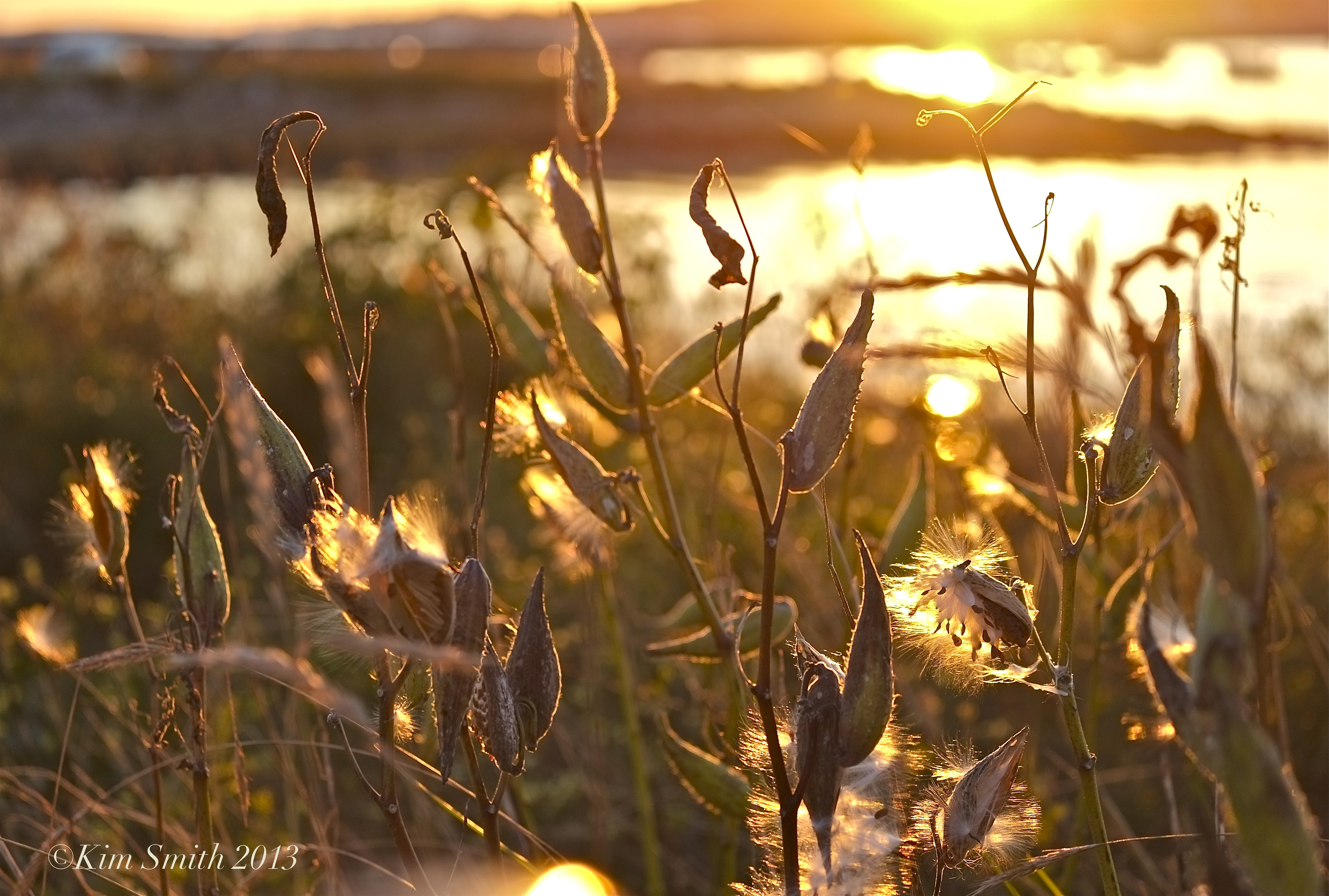
Milkweed Eastern PointMilkweed Patch at Eastern Point Lighthouse

Rockporter Patricia Mandell, who helps the Essex County Greenbelt by volunteering for Mary Williamson, Director of Communications, suggested to Mary that perhaps Greenbelt would be interested in reblogging the posts that I write for my blog, Kim Smith Designs, and for GMG; posts that are relative to the Cape Ann ecology. You have read my “World’s Easiest Method of Propagating Milkweed” here on GMG and can now find it on the Greenbelt blog. Check out Greenbelt’s blog and website for a comprehensive view of who they are and of all the good they accomplish, their properties, maps, projects, and events.

World’s Easiest Method on How to Grow Milkweed From Seed

Milkweed Eastern PointCommon Milkweed Patch Eastern Point

Now is the perfect time of year to collect and to plant milkweed seeds, either from pods that are just splitting open or from pods that have already split and are showing their silky fluff.

There are several different methods of propagating milkweed and the following is by far the simplest. Gather milkweed seeds and store in a paper bag. At the location in your garden where you are planning a milkweed patch, lightly scratch the soil with a rake. Scatter the seeds over the soil. Sprinkle a thin layer of soil over the seeds, just enough to keep them from blowing away. That’s it! Next spring, by mid-May, you will have a patch of milkweed seedlings. This super simple method works for Common Milkweed (Asclepias syriaca) and Marsh Milkweed (Asclpeias incarnata).

Note ~ when collecting seeds from wildflowers, never remove the plant from its location, and never take all the seeds.

If you’d like to learn more about this beautiful plant species, and how growing milkweed in your own garden directly benefits the Monarch Butterfly, there are over 25 posts covering milkweed on Good Morning Gloucester; too numerous to list here. Type milkweed in the search box in the upper right hand corner of the GMG home page to see all.

Monarch Butterfly Marsh Milkweed ©Kim Smith 2011

Cape Ann Milkweed Project

News Release: MONARCH WATCH ANNOUNCES ‘BRING BACK THE MONARCHS’ CAMPAIGN

How Exactly is Monsanto’s Roundup Ravaging the Monarch Butterfly Population?

Where Are All the Monarchs?

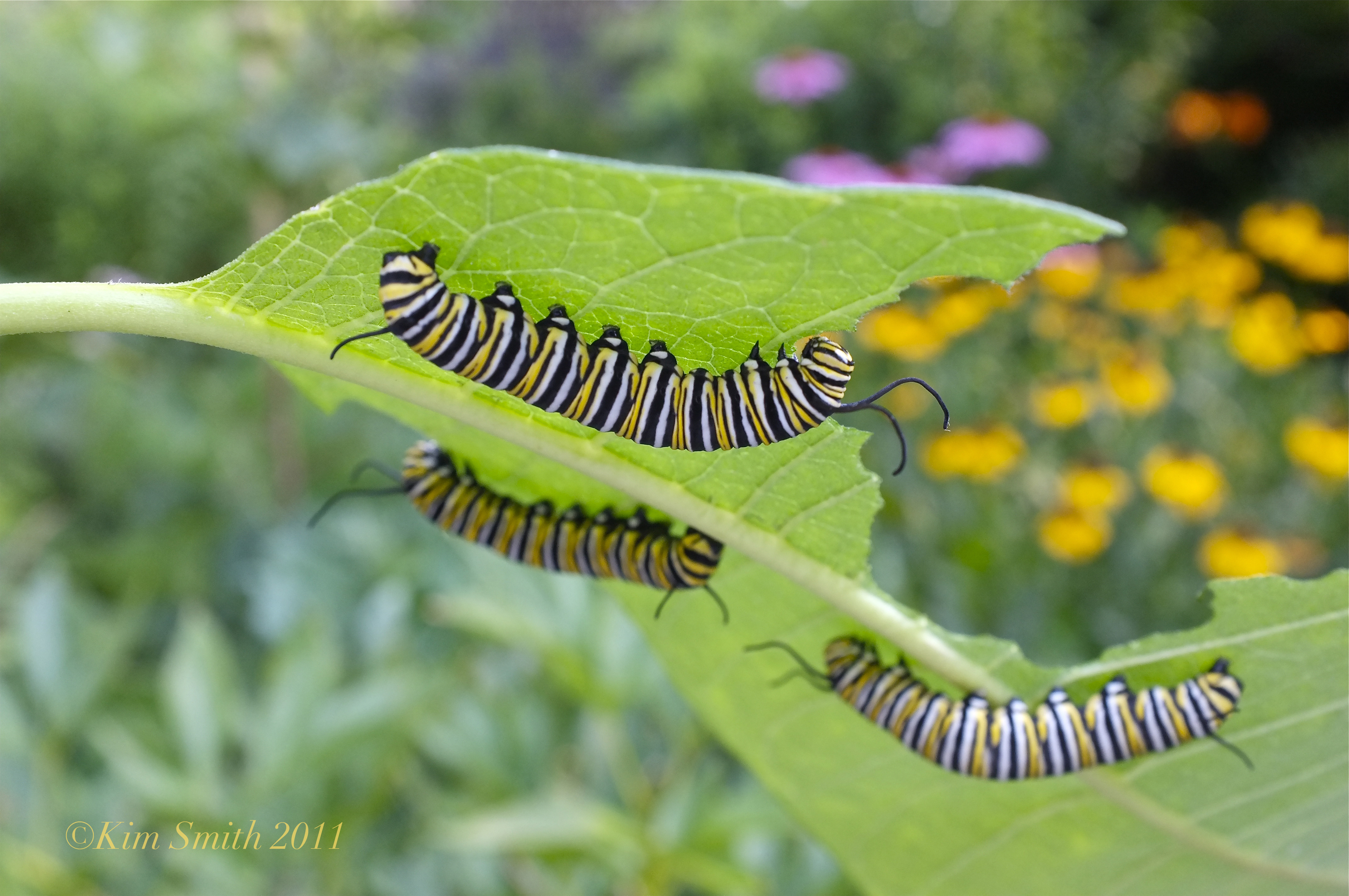
Monarch Caterpillars Feeding on Common Milkweed ©Kim Smith 2011

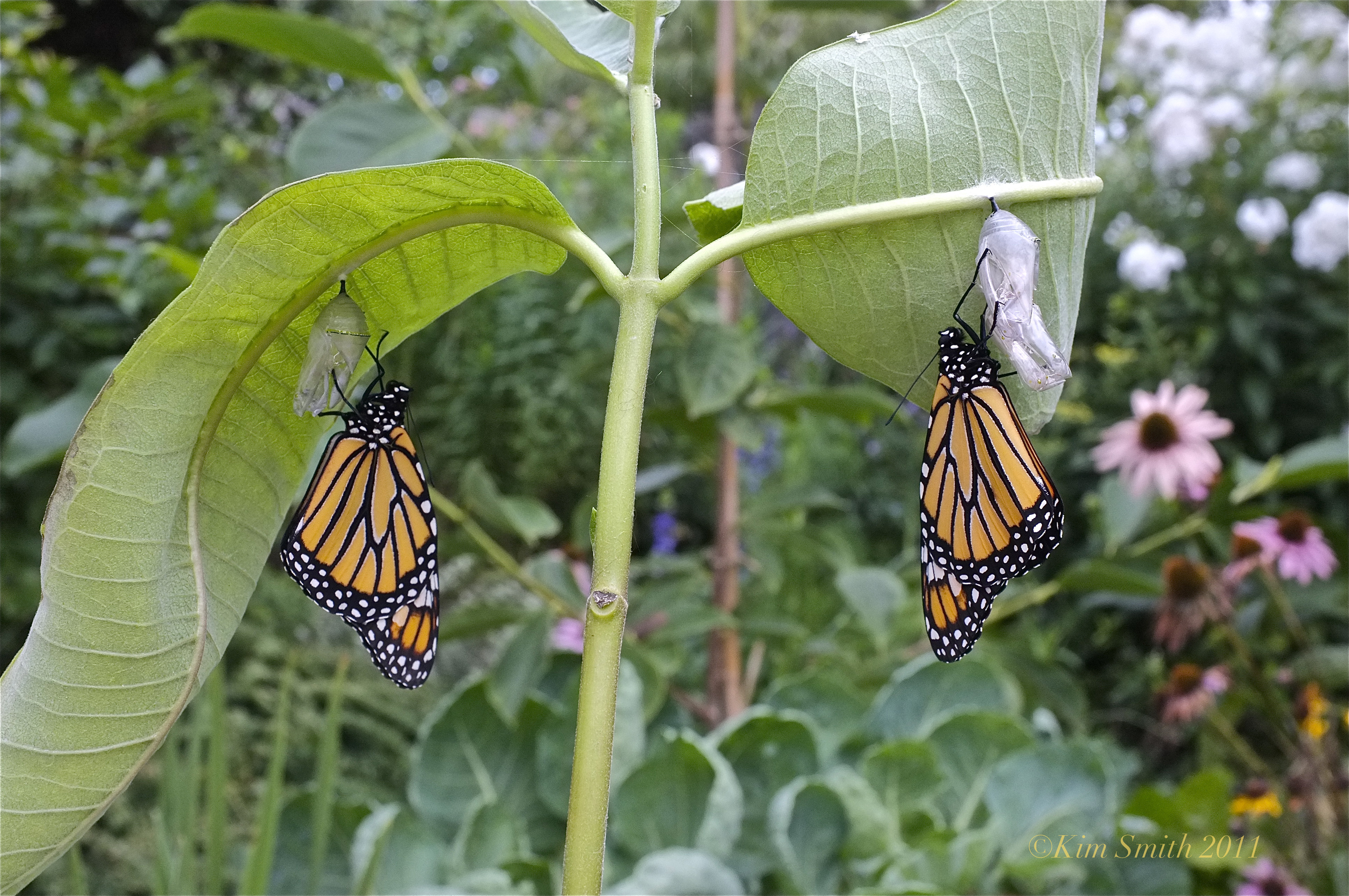
Monarch Butterfly Twins ©Kim smith 2011Two newly emerged Monarchs, with chyrsalides attached to the rib of Common Milkweed leaves

Where Are All the Monarchs?

Monarchs usually arrive in our region by the first week in July and go through several brood cycles. This year, barely any arrived. The Monarch’s sensitivity to temperature and dependence on milkweed make it vulnerable to environmental changes. Since 1994, U.S. and Mexican researchers have recorded a steady decline in the Monarch population in their overwintering grounds, with 2012-2013 being the lowest recorded to date.

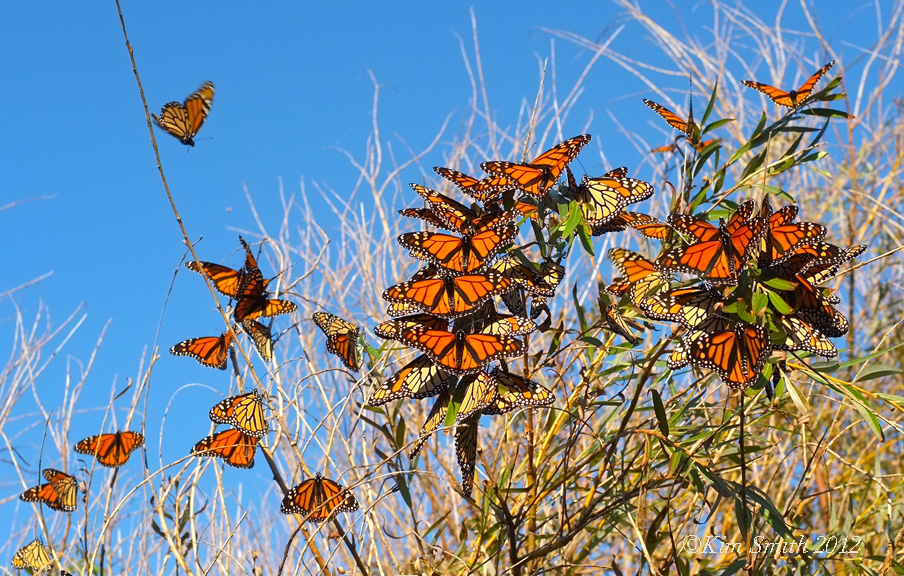
Monarch butterflies daybreak willow tree ©Kim Smith 2012

Temperature change and habitat loss affect breeding success and longevity. Dr. Chip Taylor, a leading Monarch researcher at the University of Kansas reports that the widespread adoption of GMO corn and soybean crops resistant to herbicides, along with with intensive herbicide use, coupled with the federal government’s incentivized expansion of corn and soy acreage for the production of biofuels have caused a significant drop in milkweed throughout the heart of the Monarch’s range. Lack of milkweed equals no Monarchs. “Monarch/milkweed habitat has declined significantly in parallel with the rapid adoption of glyphosate-tolerant corn and soybeans and, since 2006, the rapid expansion of corn and soy acreage to accommodate the production of biofuels,” Taylor wrote on May 29.

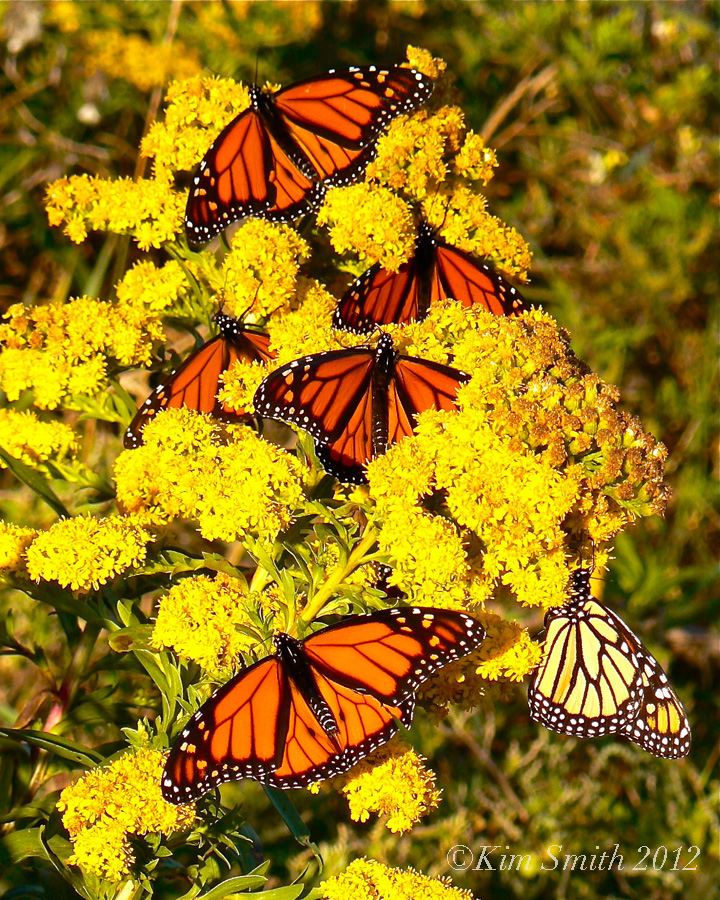
Monarch Butterfly Nectaring at Seaside Goldenrod ©Kim Smith 2011

Monarchs Nectaring at Seaside Goldenrod

What can we do? Encourage conservation organizations that conserve Monarch habitat, plant milkweed, plant nectar plants, and raise caterpillars. Hopefully the weather next spring and early summer will be more conducive to the Monarch’s northward migration and breeding success, and if and when the Monarchs arrive, they will find our milkweed plants.

Monarch Butterflies New england Aster ©Kim Smith 2012

Monarch Butterflies Nectaring at New England Asters

If anyone sees a Monarch, please email me at kimsmithdesigns@hotmail.com or leave a comment in the comment section.

Update #2: Reader Jude Writes the following ~

Hi Kim,

I have maybe 30milkweed plants in the front yard. I would be happy to harvest the seeds, are there places you know of that would be willing or have a large enough property to seed them? Can you harvest them as soon as the pods pop? I remember as a kid finding the most beautiful cocoon I have ever seen. I haven’t seen many butterflies at all and of the ones I have seen are not Monarchs.

My reponse:

Hi Jude, I am putting it out there in GMG Land that if anyone would like your milkweed seed pods to please contact me.

Yes, you can harvest immediately after the pods pop, as a matter of fact, I recommend doing just that and sowing your seeds in the fall. The easiest method is to lightly scratch the surface of the soil where you wish the milkweed to grow. Scatter the seeds and water. That’s it.

Thank you so much for writing. Hopefully, we’ll find a home for your milkweed seeds.

Update: For more information, see previous GMG posts on Monarchs and Milkweed:

How Exactly is Monsanto’s Roundup Ravaging the Monarch Butterfly Population?

News Release: MONARCH WATCH ANNOUNCES ‘BRING BACK THE MONARCHS’ CAMPAIGN

Cape Ann Milkweed Project

GloucesterCast Podcast 4/25/13 With Guest Kim Smith

Live Blogging: Kim Smith’s milkweed project!

Live at Capt. Joe n Sons. Betta hurry!!

Happy Earth Day and Habitat Gardening 101

To celebrate Earth Day (Earth Week-Earth Month-Everyday is Earth Day!), I am beginning a new series on GMG titled Habitat Gardening 101. The series is based on the lectures that I give to area conservation groups, garden clubs, libraries, and schools and is designed to provide information on the relationships between our native flora and fauna, and how to translate that information to your own garden. You will find in this series information on how to support and encourage to your garden a wide variety of wildlife, including songbirds, butterflies, bees, moths, skippers, hummingbirds, and small mammals, and the trees, wildflowers, shrubs, vines, and groundcovers that sustain these beautiful creatures.

This series could just as well be titled Beauty in Our Midst because there are so many gems to be found along our shoreline, meadows, fields, wetlands, dunes, woodlands, and roadsides. Although the series will cover a wide array of flora and wildlife, the first posts will be about several butterfly attracting trees and shrubs because they are currently in bloom. Coming Wednesday, the North American native Pussy Willow will be featured. For today, the following is one of my Top Ten Tips for Attracting Lepidoptera to Your Garden.

 *

Habitat Gardening 101 Tip #1: Plant Caterpillar Food Plants

So you want to attract tons of butterflies to your garden and you plant lots of gorgeous, colorful nectar-rich plants—and that is wonderful. To your garden will come many beautiful, albeit transient, butterflies, along with an array of many different species of beneficial pollinators. However, if you want butterflies to colonize your garden, in other words, to experience the grand beauty of the creature through all its stages of life, from egg to caterpillar to chrysalis to adult, you must also plant caterpillar food plants.

Black Swallowtail Caterpillar egg fennel ©Kim Smith 2013

Black Swallowtail Butterfly Egg on Fennel (the pinhead-sized golden yellow dot)

Each species of butterfly caterpillar will only eat from a family of plants it has coevolved a relationship with over millennia. We call this a caterpillar food plant, host plant, or larval food plant.

Perhaps you may recall that the Monarch Butterfly only deposits her eggs on milkweed plants. The Black Swallowtail Butterfly deposits her eggs on, and the caterpillars feast on, members of Umbelliferae (Apiaceae), or carrot family of plants, including carrots, parsley, fennel, dill, and Queen Anne’s Lace. Some caterpillars, like the stunning Eastern Tiger Swallowtail feed from several plant families, like those of Magnoliaceae and Rosaceae, which species include the Wild Black Cherry, the Tulip Tree, and the Sweet Bay Magnolia.

  Black Swallowtail Caterpillar Eating Parsley

If you see a green, black and yellow striped and spotted caterpillar munching on your parsley plant, it is not a Monarch caterpillar; it is a Black Swallowtail caterpillar (I am often asked this question). Monarch caterpillars are striped yellow, black, and white, always. You will never find a Black Swallowtail caterpillar munching on milkweed; likewise you will never find a Monarch caterpillar eating your parsley and fennel.

Another question frequently asked is, if I invite caterpillars to my garden, will they devour all the foliage. The answer is, for the most part, no. The damage done is relatively minimal, the plant generally recovers quickly, and bear in mind too, that plants have evolved with many mechanisms to discourage their complete destruction. Remember, the plant was responsible for inviting the butterfly to its flower in the first place!

 Black Swallowtail Caterpillar fennel ©Kim Smith 2013

Note too, that if you invite butterflies to your garden to deposit their eggs, please don’t turn around and spray pesticides, which will kill all, indiscriminately. A habitat garden, by its very definition, is an organic garden, which means no herbicides, insecticides, pesticides, and chemical fertilizers.

*

Feel free to send any and all questions, suggestions for a topic, or curiosity, to the comment section under each post.

*

Cape Ann Milkweed Project Update: Because of the chilly spring weather, milkweed shoots are slow to emerge.

Link to a list of lectures and workshops at Kim Smith Designs

News Release: MONARCH WATCH ANNOUNCES ‘BRING BACK THE MONARCHS’ CAMPAIGN

I am going to look into purchasing a large quanity of milkweed seedlings at wholesale prices for anyone in our community interested in cultivating milkweed. If interested, please leave a comment in the comment section, which will help give me an idea, very approximately, on how many plants to order. You can also wait until the fall and sow ripened milkweed seedpods. (Note: Please do not dig up any wild milkweed).

The following timely news release was in my inbox this morning!

MONARCH WATCH ANNOUNCES
‘BRING BACK THE MONARCHS’ CAMPAIGN

“In real estate it’s location, location, location and for monarchs and other wildlife it’s habitat, habitat, habitat”, said Chip Taylor, Director of Monarch Watch. Monarch Watch (www.MonarchWatch.org) started in 1992 as an outreach program dedicated to engaging the public in studies of monarchs and is now concentrating its efforts on monarch conservation. “We have a lot of habitat in this country but we are losing it at a rapid pace. Development is consuming 6,000 acres a day, a loss of 2.2 million acres per year. Further, the overuse of herbicides along roadsides and elsewhere is turning diverse areas that support monarchs, pollinators, and other wildlife into grass-filled landscapes that support few species. The adoption of genetically modified soybeans and corn have further reduced monarch habitat. If these trends continue, monarchs are certain to decline, threatening the very existence of their magnificent migration”, said Taylor.

To address these changes and restore habitats for monarchs, pollinators, and other wildlife, Monarch Watch is initiating a nationwide landscape restoration program called “Bring Back The Monarchs.” The goals of this program are to restore 20 milkweed species, used by monarch caterpillars as food, to their native ranges throughout the United States and to encourage the planting of nectar-producing native flowers that support adult monarchs and other pollinators.

This program is an outgrowth of the Monarch Waystation Program started by Monarch Watch in 2005. There are now over 5,000 certified Monarch Waystations – mostly habitats created in home gardens, schoolyards, parks, and commercial landscaping. “While these sites contribute to monarch conservation, it is clear that to save the monarch migration we need to do more,” Taylor said. “ We need to think on a bigger scale and we need to think ahead, to anticipate how things are going to change as a result of population growth, development, changes in agriculture, and most of all, changes in the climate,” said Taylor.

According to Taylor we need a comprehensive plan on how to manage the fragmented edges and marginal areas created by development and agriculture since it is these edges that support monarchs, many of our pollinators, and the many forms of wildlife that are sustained by the seeds, fruits, nuts, berries, and foliage that result from pollination. “In effect,” Taylor argues, “we need a new conservation ethic, one dealing with edges and marginal areas that addresses the changes of the recent past and anticipates those of the future.”

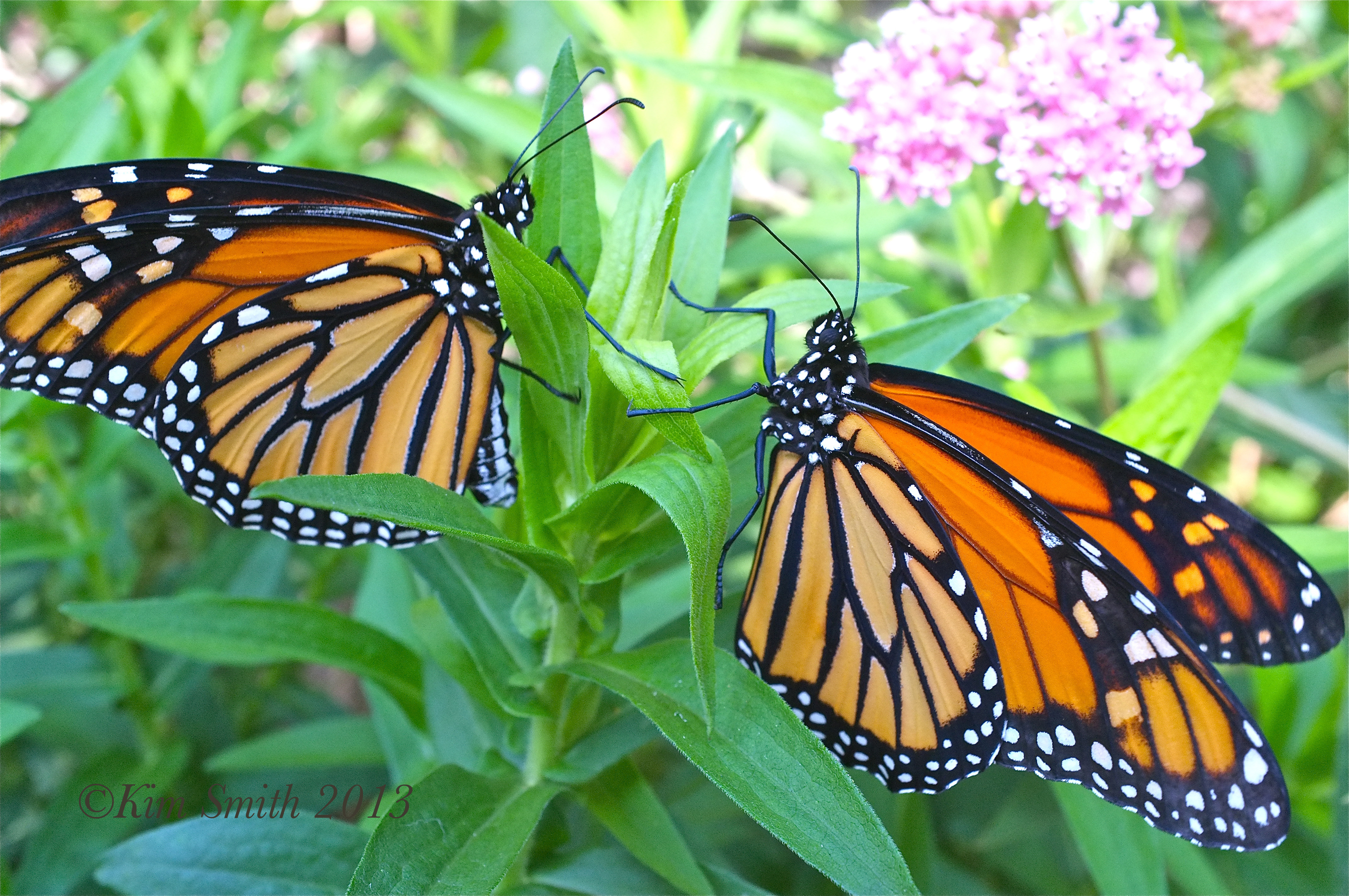
Monarch Butterfiles Female left Male right Milkweed ©Kim Smith 2012

The above photo of a male (right) and female (left) Monarch Butterflies on Marsh Milkweed is part of the GMG/Cape Ann Giclee photography show, currently on view at Cape Ann Giclee.