Let’s talk about the petition circulating in Duxbury to prevent wildlife officials from taking foxes and coyotes that are eating Piping Plover eggs. Many friends have sent links to the story and I apologize for taking over a week to respond.
Local persons are re-posting the story on their social media platforms unintentionally, and in the case of one, intentionally, inciting outrage at the Piping Plovers. This story has become sensationalized and taken out of context. I experienced a similar situation, that of a story about Piping Plovers being misrepresented, when last summer a Boston news channel interviewed me at Good Harbor Beach about our PiPls nesting in the parking lot. Instead of a feature about what a great job our DPW, Mayor’s administration, and community were doing in helping protect the nesting Piping Plovers that had been driven into the parking lot by dogs, it was edited as a story about GHB loosing income from lost parking spaces. In reality, our PiPl family had returned to the beach by the time all the parking spaces were needed.
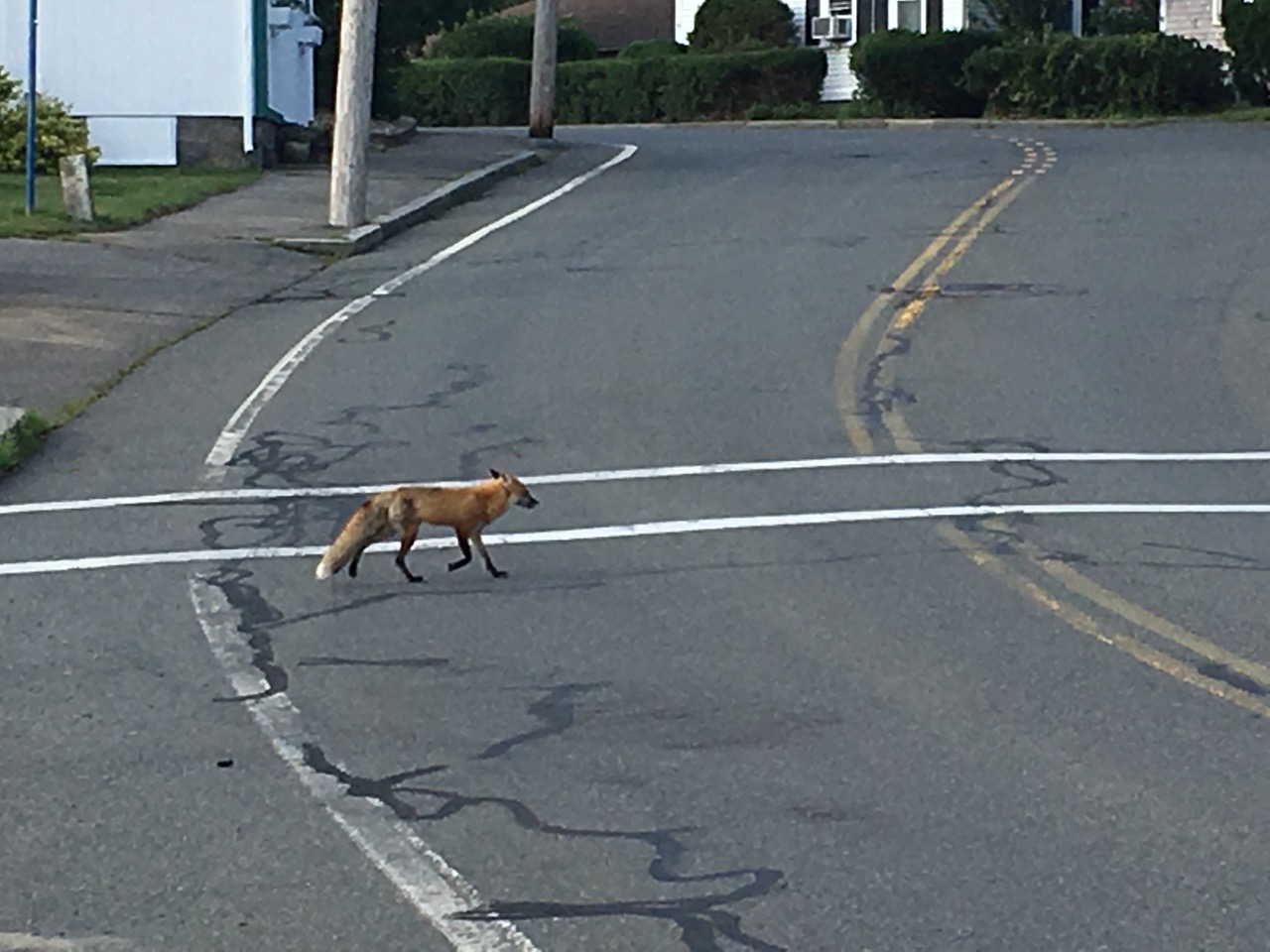
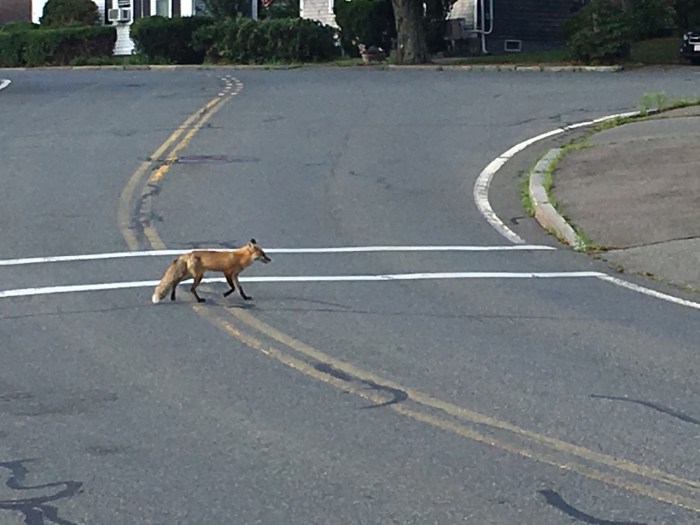
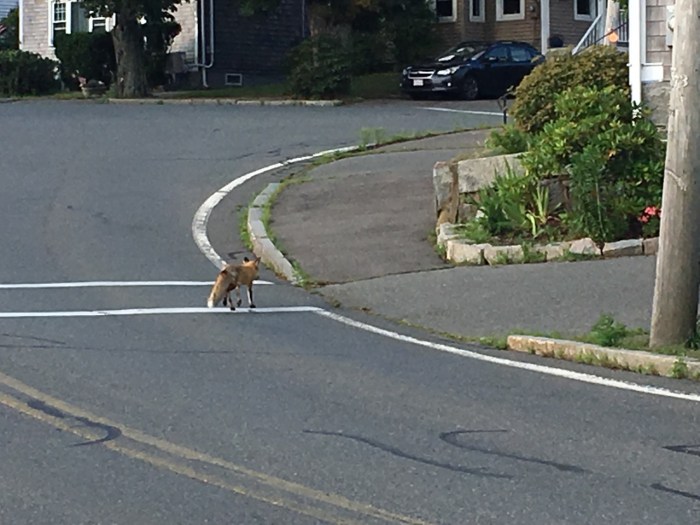
Readers should know that fox and coyote hunting is permitted in Massachusetts. The 2019 hunting season dates are January 1st through February 28th, resuming November 1st and continuing through February 29th, 2020. Read More Here. Hunting is part of our culture. To be very clear, I love all animals, I LOVE foxes, and especially Red Fox. When one made a midnight visit to our backyard several weeks ago and snooped around the base of our Blue Princess holly, my husband and I were beyond excited about the prospect of them possibly denning in our garden.
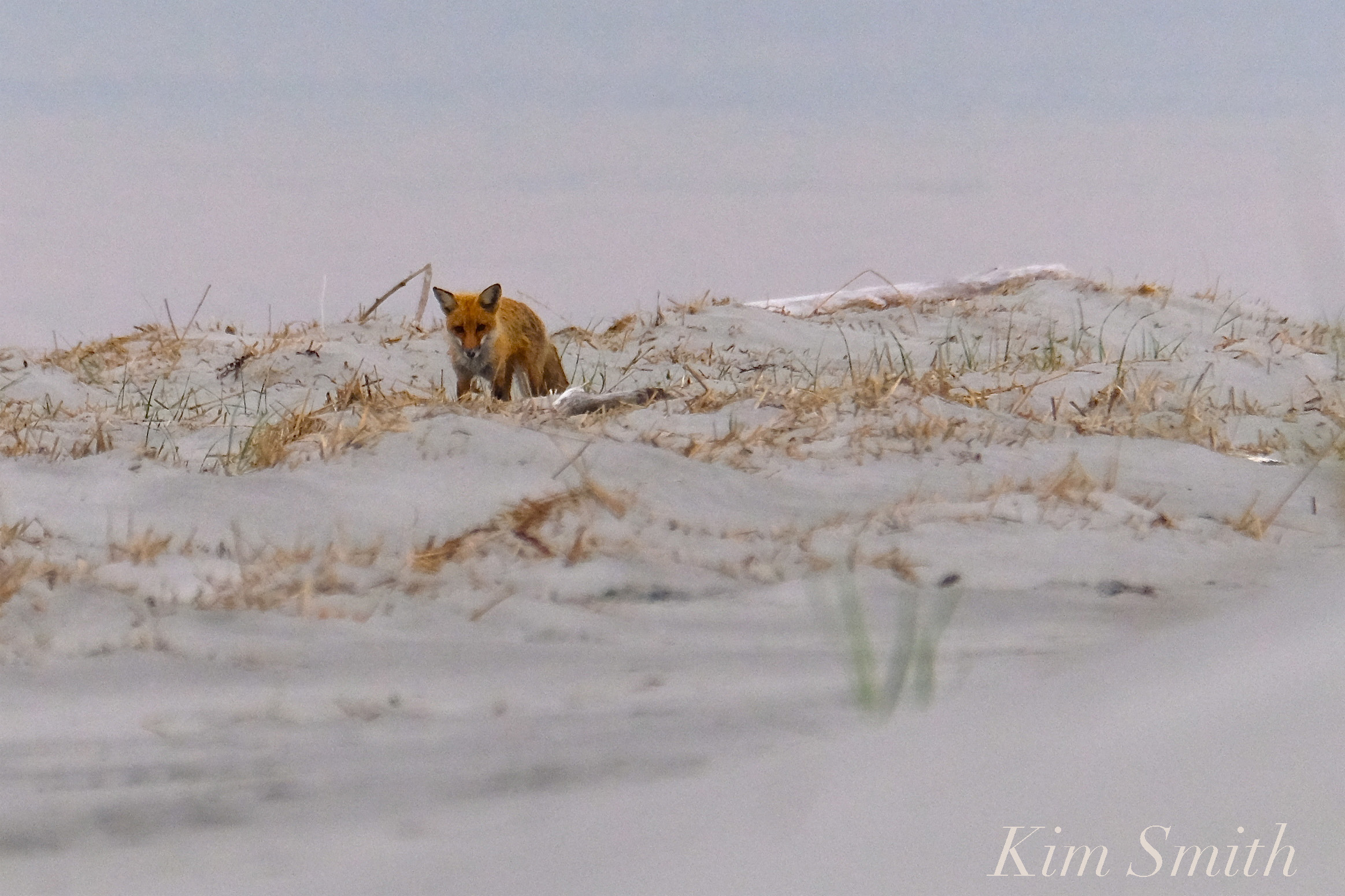
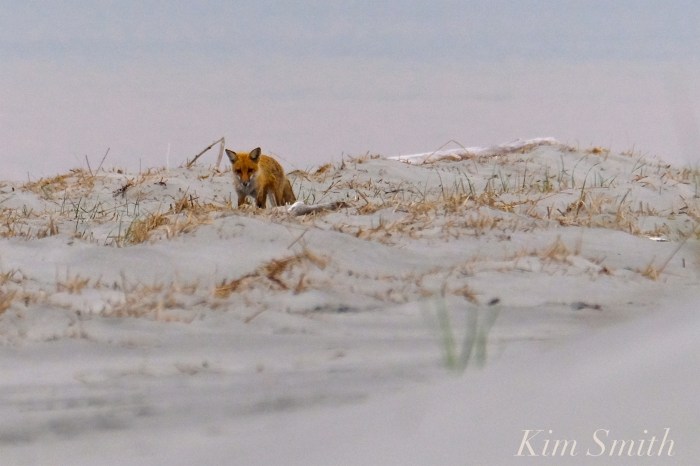 Red Fox Coffins Beach
All that being said, it is sadly understandable why a number of beaches along the Northeastern Seaboard, beside Duxbury beach (including Crane Beach, Parker River National Wildlife Refuge, other Massachusetts beaches, Rhode Island beaches, and New Jersey beaches) have had to resort to predator management programs. This is the course of last resort. Please bear in mind that Eastern Coyotes, Herring Gulls, Great Black-backed Gulls, Crows, and Red Foxes are not endangered, rare, or even threatened species, as are many of the region’s nesting shorebirds.
I have seen first hand at Coffins Beach a Red Fox mom and her kit digging in the sand and coming very close to where there was a Piping Plover nest. Last year, the only nest that was at Coffins Beach was believed by Greenbelt to have been predated by fox. In 2018, at Winthrop Beach, dogs off leash, and a skunk, caused the entire colony of 150 pairs of endangered Least Terns to abandon the established nesting area and move elsewhere. The year before that, again at Winthrop Beach, a Peregrine Falcon had killed numerous chicks, both Least Tern and Piping Plover.
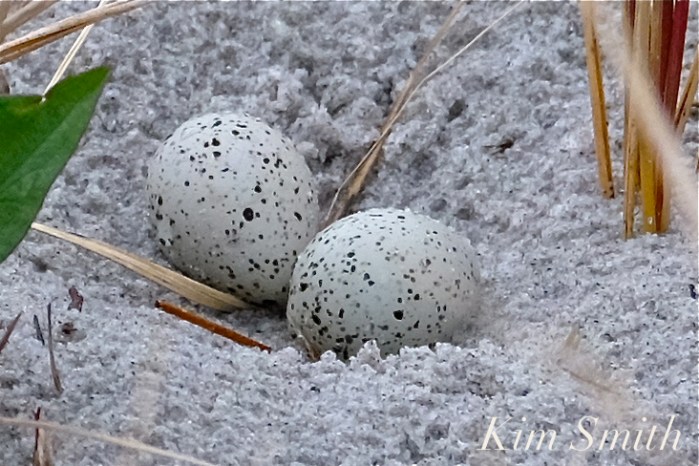
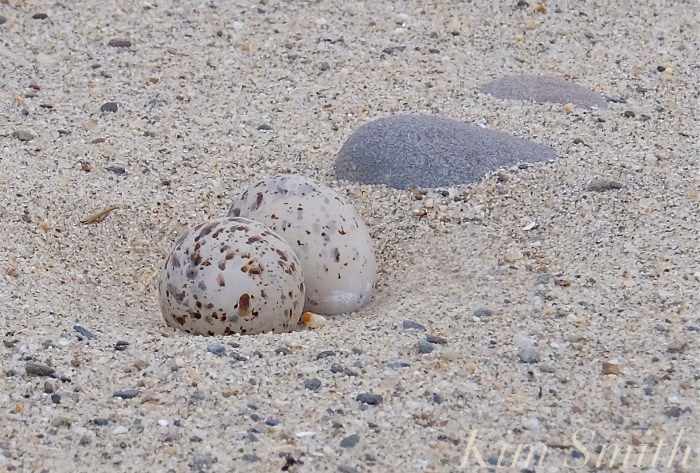 Least Tern eggs are exposed in the sand, just as are the eggs of Piping Plovers, and many other species of shorebirds.
At Crane Beach, electric fencing is used during the night to keep fox and coyote away from the PiPl and Least Tern nests. The wire exclosures that we use at Good Harbor Beach to protect the nests will only be used for as long as avian predators do not realize they can perch on the edge of the wire and eat the adults as they move in and out of the exclosure to brood the eggs.
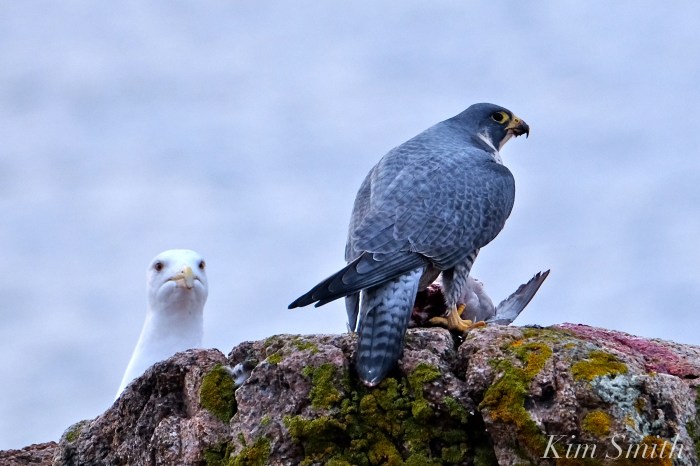
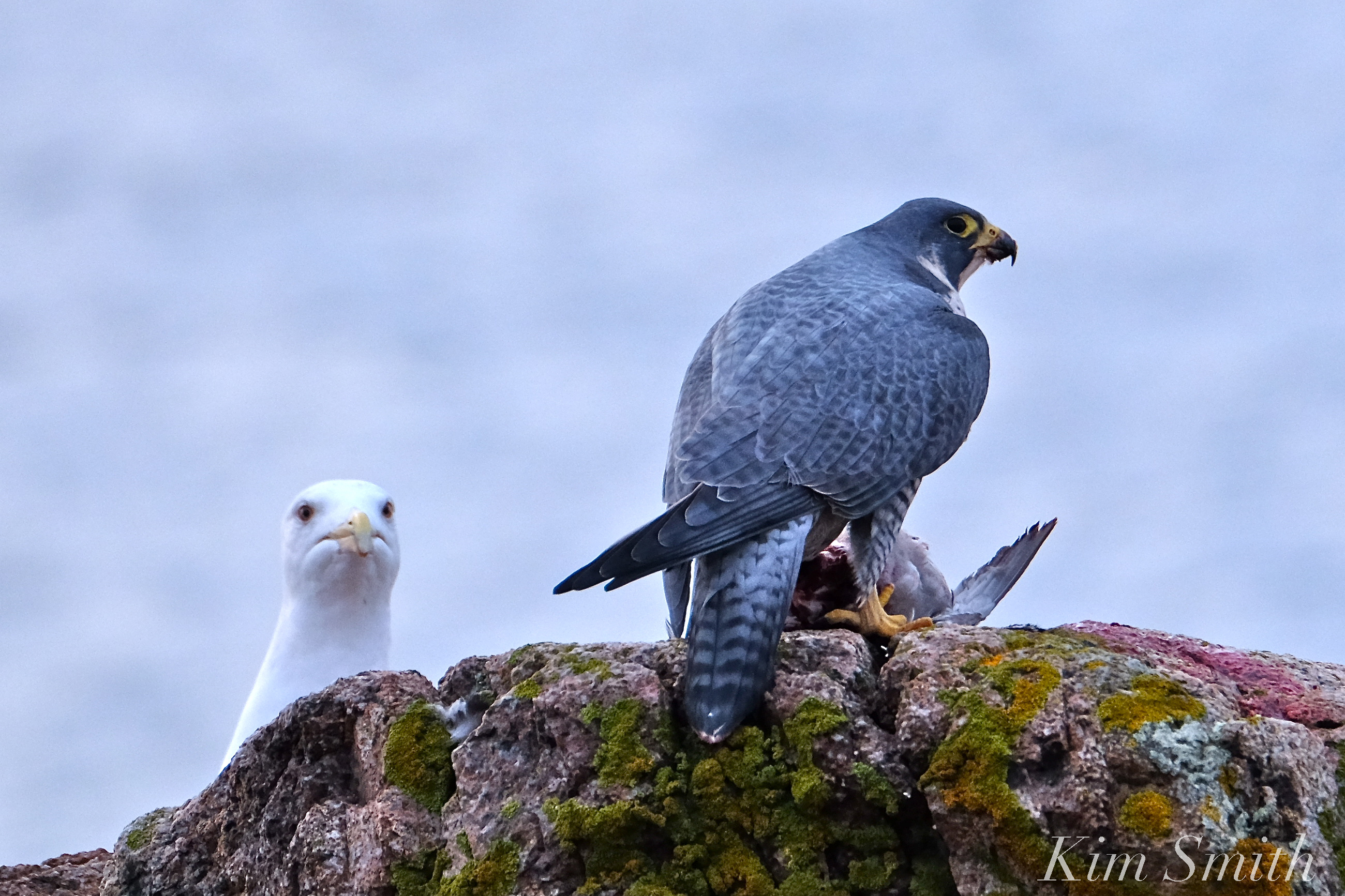
Peregrine Falcon eating a bird and a gull waiting to snatch a few morsels.
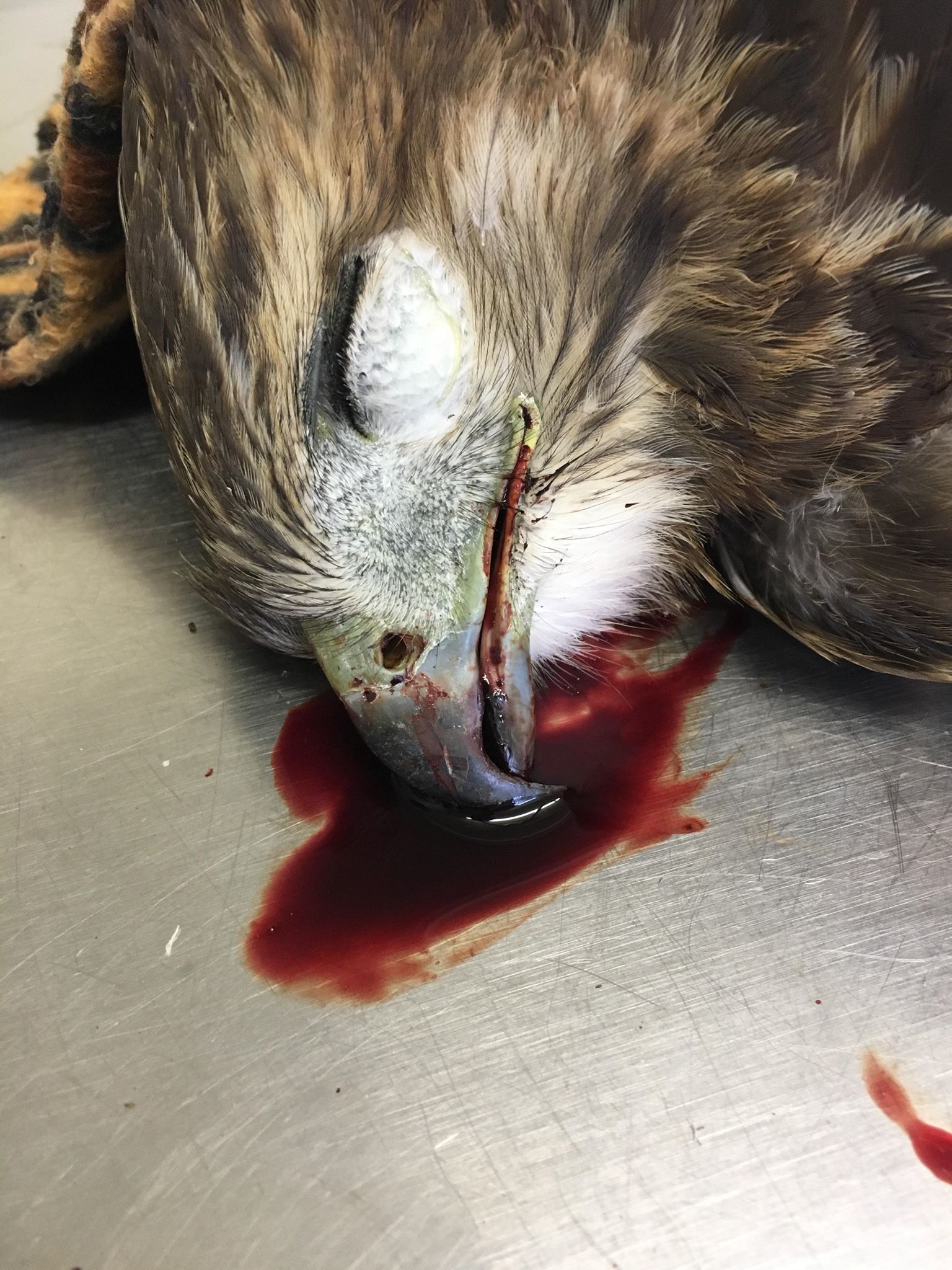
In the case of the Peregrine Falcon, it was relocated to the western part of the state. However, relocating mammals is not a legal option in Massachusetts. Electric fencing is not possible at all beaches. Wire exclosures are no longer used at Crane Beach because Great Horned Owls learned they could prey upon the adult Piping Plovers as they were entering and exiting the exclosure.
Killing wildlife to protect other species of wildlife is a very sensitive topic and again, is the action of last resort taken.
People often say, why not let nature takes its course. But there is really very little that is natural about beaches that were once shorebird habitat that have now become public. The reason why we have predation by Red and Gray Fox, Eastern Coyotes, Skunks, Crows, and a variety of gull species at public beaches is because they are attracted to the garbage left behind by people and there is nothing natural about that!
I urge everyone to read the following to gain a better understanding of why some beaches have had to to turn to predator management programs:
Recently questions have come up regarding the predator management program on Duxbury Beach. This is a controversial and oftentimes upsetting topic but is one of the challenges that the Duxbury Beach Reservation faces when trying to balance the many uses of the beach.
As landowners and stewards of Duxbury Beach for over 100 years, the Reservation strives to maintain a balance between protecting the natural resources of the beach, including habitat for wildlife, preserving the barrier which shelters the communities behind it, and providing use of the beach for recreational purposes including over-sand vehicles. In order to provide use of the beach for recreation, habitat and species conservation regulations must be adhered to including predator management mandates by the United States Fish and Wildlife Service.
Many residents of the South Shore have visited Duxbury Beach since childhood and have likely seen big changes to the beach – both through dune and infrastructure projects and in how the beach must be managed under local, state, and federal law.
Duxbury Beach is unique is many ways, including the nesting habitat it affords to rare and protected shorebirds. Unfortunately, Piping Plover conservation, which is regulated under the state and federal Endangered Species Acts, can come in to conflict with human interests, including development and recreation. In order to provide greater options for beach managers working to adhere to state and federal guidelines for plover protection while providing recreational opportunities, the state of Massachusetts has a Habitat Conservation Plan under the US Fish and Wildlife Service. The Plan allows certain “risky” activities while providing mitigation to ensure the plover population is better protected overall. The Duxbury Beach Reservation received a sub-permit under this statewide plan to allow recreational driving on the back road and front beach in closer proximity to young plover chicks.
Under this permit allowing recreational driving, the Duxbury Beach Reservation is responsible for continuing an intensive monitoring program and providing mitigation. As stated by Mass Wildlife, the only form of mitigation acceptable under the US Fish and Wildlife permit is lethal predator control, because it has the highest likelihood of offsetting the potential loss.
Predator management is not the Reservation’s first option and is carefully considered each year and on a case by case basis. The predator management program has been in place on Duxbury Beach for 8 years. For comparison, predator management has occurred on beaches in the state of Massachusetts for over 13 years. The plan on Duxbury Beach has undergone continuance debate and study throughout its tenure, with examination by multiple agencies and several opportunities for public comment.
The Duxbury Beach predator management program design was and continues to be based on extensive data collected on the beach on predator presence and egg and chick loss to ensure the program targets those species that are responsible for heavy losses. Fox have been removed 3 of the past 8 years that a predator management program has been in place, and every year the number removed has been far, far fewer than the numbers suggested on social media. This targeted removal during a limited time of year has been successful in providing two rare and protected species, the Piping Plover and Least Tern, a window of opportunity to nest and raise young on some of the little remaining nesting habitat on the east coast. It has also afforded thousands of visitors the chance to come and enjoy the beach.
Instituting a predator management program is controversial, challenging, often upsetting, and may even seem counter-intuitive to many. Why remove one species so that another may succeed? Aren’t there other options?
While it may seem simple to “let nature take its course” we do not operate in an entirely “natural” system. With the removal of large predators, such as wolves, from this area by the mid-20th century, mid-sized predators, including fox, coyote, and raccoons, were able to extend their ranges and increase in population in these areas. There are communities of hundreds of homes flanking Duxbury Beach that provide ample habitat for species like red fox that can do very well in suburban and even urban areas while other species, like the plovers and terns, have had habitat regularly destroyed by development.
Today, the largest cause of plover and tern egg and chick loss on Duxbury Beach, and many other beaches statewide, is predation by species whose populations are not in jeopardy. Unfortunately, the common predators on Duxbury Beach, including the larger mammals (fox and coyote) and avian predators (crow and gull) are more likely to be attracted to the beach due to trash. There are staff on Duxbury Beach in the summer to pick up trash on the beach, road, and parking lots in the hopes of making the beach less attractive to animals like fox. With communities at the far end of the beach it is impossible to limit the attractiveness of Duxbury Beach to predators with large ranges. There are very few suitable denning spots on the beach and most of the large mammals come to the beach from mainland Duxbury and Marshfield where they find ample denning spots under houses, sheds, etc.
Unfortunately, relocation of individual predators is not an option for multiple reasons:
- It is illegal under Massachusetts law to capture and relocate wildlife off your property
- Conflict, stress, or death caused due to intrusion into an existing individual’s territory
- Harm to the individuals removed from their territory and a struggle to find food and shelter. Humans do not always recognize appropriate habitats for wildlife and put them in bad locations.
- Spread of disease
- Disruption of ecological processes by introducing a new species or more individuals to an area
- The problem is not solved, but moved to a new location
Many have questioned why Duxbury Beach does not use “wire cages” around plover nests as are sometimes seen on other beaches. These cages are predator exclosures and are oftentimes an unsuccessful and harmful tool. Unfortunately, predators (including fox, raptors, crow, and others) can target exclosures and kill adults when they switch off the nest. This is more detrimental to plover conservation than losing eggs or chicks because of the loss of future reproductive potential of the breeding adult. Predator exclosure use is highly dependent on beach, nesting site, and predator suite. On Duxbury Beach it is not typically feasible to use exclosures, however, it is carefully considered. In addition, exclosures do not work for Least Tern nests as they are colonial nesters and fly to and from the nest.
In some cases, electric fencing can be used around plover and/or tern nesting areas. While this is only helpful in detracting large, mammalian predators, it does work on some beaches. Unfortunately, given the span, configuration, and location (dynamic beach), electric fencing is not feasible on Duxbury Beach.
This is not an easy topic and one that is discussed and voted on annually by the Reservation’s board. The Reservation will continue to collect and analyze data and assess all possible options for conservation and site management in order to protect the natural resources of the beach and maintain the protective barrier, while providing access for recreation where possible. The Reservation will also continue to work with state and federal regulators to find the best options for protection on Duxbury Beach in order to adhere to the laws we must operate under. We appreciate everyone who has taken the time to learn more about the work and understand that we are doing our upmost to strike a balance between the many uses of Duxbury Beach.
If you are interested in learning more about statewide shorebird conservation efforts or predator management work, we recommend reaching out to the Massachusetts Division of Fisheries and Wildlife.
Spread The GMG Love By Sharing With These Buttons:
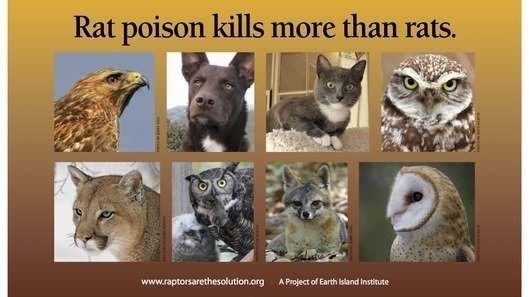

 The above graphics are printable small poster size. The black and white one is great for kids to color.




 Good Morning Gloucester