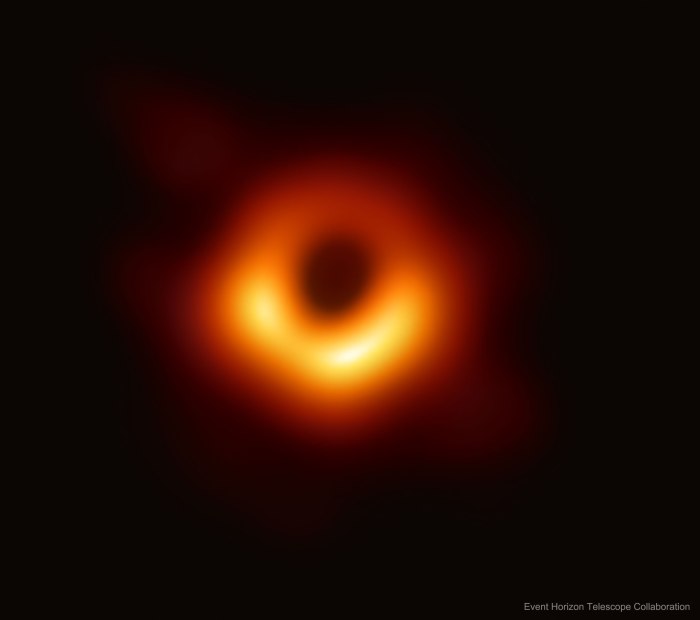
First Horizon-Scale Image of a Black Hole
Image Credit: Event Horizon Telescope Collaboration – “Scientists have obtained the first image of a black hole, using Event Horizon Telescope observations of the center of the galaxy M87. The image shows a bright ring formed as light bends in the intense gravity around a black hole that is 6.5 billion times more massive than the Sun”
Excerpt From 2016
Larry Hardesty | MIT News Office June 6, 2016
“A black hole is very, very far away and very compact,” Katie Bouman* says. “[Taking a picture of the black hole in the center of the Milky Way galaxy is] equivalent to taking an image of a grapefruit on the moon, but with a radio telescope. To image something this small means that we would need a telescope with a 10,000-kilometer diameter, which is not practical, because the diameter of the Earth is not even 13,000 kilometers.
But even twice that many telescopes would leave large gaps in the data as they approximate a 10,000-kilometer-wide antenna. Filling in those gaps is the purpose of algorithms like Bouman’s.
Bouman will present her new algorithm — which she calls CHIRP, for Continuous High-resolution Image Reconstruction using Patch priors — at the Computer Vision and Pattern Recognition conference in June. She’s joined on the conference paper by her advisor, professor of electrical engineering and computer science Bill Freeman, and by colleagues at MIT’s Haystack Observatory and the Harvard-Smithsonian Center for Astrophysics, including Sheperd Doeleman, director of the Event Horizon Telescope project.”
*then post-doc
There is talk about a Nobel for this work, another EE taking the physics prize

 Good Morning Gloucester