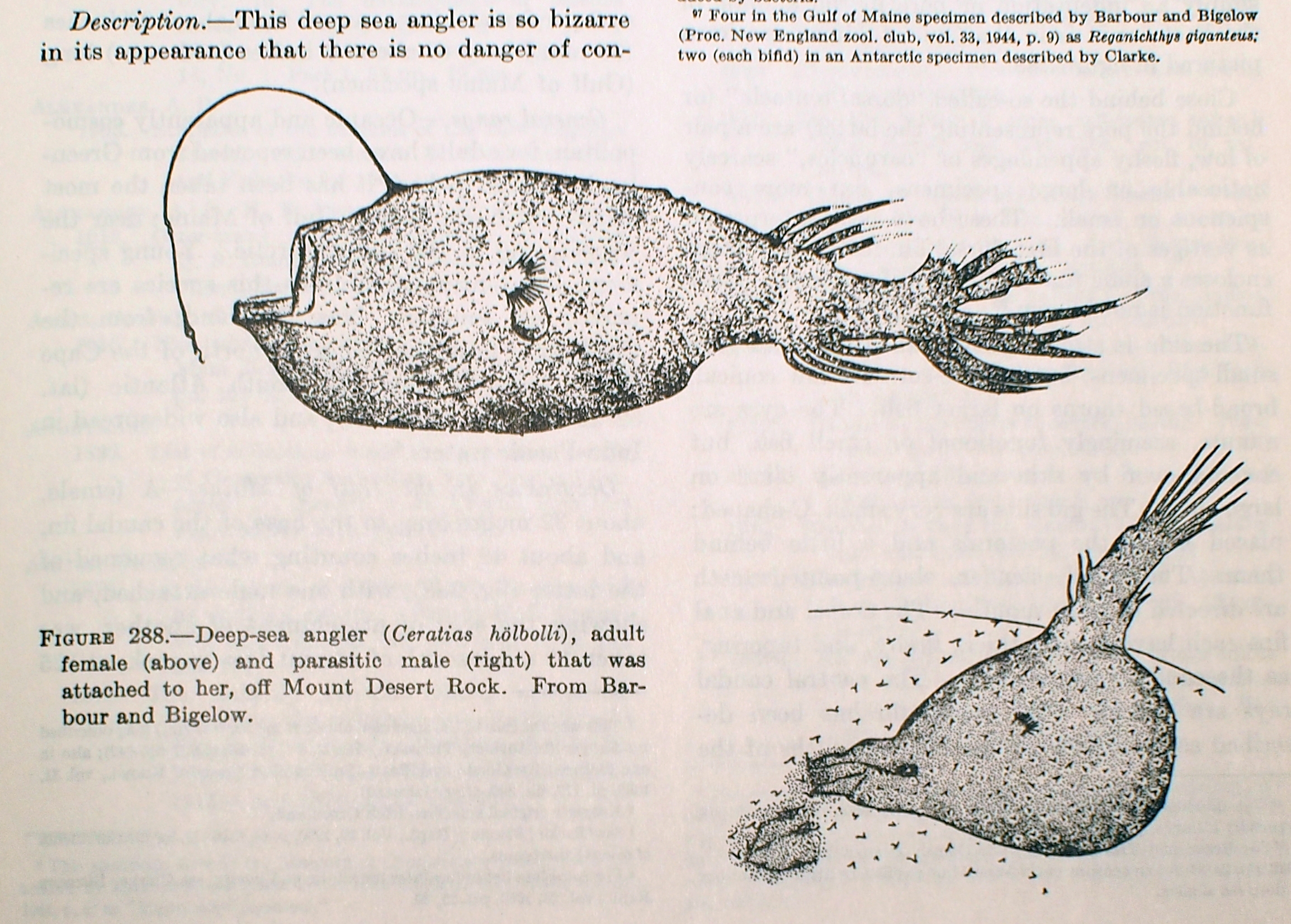
This head tentacle corresponds to the whiplike head spine of the goosefish, but is situated farther back, about abreast of the eyes. It is interpreted as representing a vestige of the first dorsal fin. The basal joint of the head tentacle is provided with retractor muscles by which it can be withdrawn rearward into a tunnel-like sheath along the head and back, bringing the “bait” close to the mouth.
Unique among the vertebrates in the fact that the males of many of them (including those of the Gulf of Maine species) are dwarfs in size as compared with the females, and live parasitic, attached to the females by their heads.
The parasitic males are fastened to the ventral side of the female, by two outgrowths from the front of the head, that are fused at the tip. They have no teeth, no tentacle-like spine and no eyes, and the alimentary canal is vestigial; in fact, about the only important internal organ is a large testis. But their fins resemble those of their mates, as do the gill openings; their skins are prickly; and they are similarly black. Those that have been seen (1 or 2 per female) have ranged from about 33/8 inches (85 mm.) long to about 6 inches (150 mm.) long (Gulf of Maine specimen).
From Fishes of the Gulf of Maine by Bigelow and Schroeder (1953) online courtesy of MBL/WHOI http://www.gma.org/fogm/Ceratias_holbolli.htm

 Good Morning Gloucester