Jack o’lantern traditions. There’s this – our annual amateur foray

and then this public art tableau that we stop for each year, just past 370 Main Street, Gloucester (before the Crow’s Nest heading into downtown Gloucester)


The history of carving jack o’lanterns includes a description in a Victorian era poem by John Greenleaf Whittier (b.1807 Haverhill, MA-d.1892 Danvers, MA; resided/buried in Amesbury)- a Massachusetts poet, legislator, journalist, editor, Quaker, and abolitionist. Cape Ann, North Shore, Essex County, and New England appear in his prose.
Excerpt from The Pumpkin, ca.1846 Thanksgiving poem
Oh, fruit loved of boyhood! the old days recalling,
When wood-grapes were purpling and brown nuts were falling!
When wild, ugly faces we carved in its skin,
Glaring out through the dark with a candle within!
When we laughed round the corn-heap, with hearts all in tune,
Our chair a broad pumpkin,—our lantern the moon,
Telling tales of the fairy who travelled like steam,
In a pumpkin-shell coach, with two rats for her team!
Whittier was a contributing founder of Atlantic Monthly. He was wildly popular, successful, and influential in his time. He helped many other writers. Letters to Whittier “poured in at the rate of ten, twenty, and sometimes thirty a day, making all manner of unreasonable requests and sending innumerable axes to grind…” In 1887 “deluged by over a thousand letters and manuscripts at his birthday, he put a public notice…that he could not answer any letters or read any manuscripts…”* Schools, cities and towns across the country were named after him. “People seem determined to use my name lately in many ways. Within a week I have had two ‘literary Institutes’** named for me, and a big vessel launched last week from Newburyport yard carries “Whittier” in brass letters to her element. I hope I shall not next hear of my name attached to notes of hand!”
Elizabeth Stuart Phelps was “one of the many woman writers Whittier befriended, but their relationship was especially close. Whittier wrote her scores of letters during his life and they met often to discuss religious themes. Whittier once wrote of her: Miss Stuart Phelps was there-an intense nature-frail but strong-a Puritan with passion and fire of Sappho and the moral courage of Joan of Arc.”** Phelps spent her summers at the seaside in East Gloucester, and was equally compassionate about social concerns.
Whittier and Phelps joined other luminaries at gatherings held in the Cambridge home of James (editor/publisher) and Annie Fields (writer) and other salons. Who might be mixing it up there? Charles Dickens, Mary Abigail Dodge, Nathaniel Hawthorne, Oliver Wendell Holmes, William Dead Howells, Sarah Orne Jewett, Lucy Larcom, Henry Wadsworth Longfellow, James Russell Lowell, Phelps, Harriet Beecher Stowe, Celia Thaxter and Whittier. Jewett, Longfellow and others visited and wrote about Gloucester. Here’s a link from the Cornell University library to Phelps’
Atlantic Monthly article
The 10th of January about the tragic 1860 Pemberton Mills collapse and fire in Lawrence, MA*** (estimated 90-200+ killed), less known than the horrific 1911 Triangle Shirtwaist Factory fire (146 killed).
*Letters of John Greenleaf Whittier 1861-1892, Volumes I II III, 1975, Harvard, edited by John B. Pickard. Fun read! We’re told one of the colleges was Whittier college, Salem, Iowa
**ditto above and below any mentions from letters in the timeline
Selected Whittier links and timeline bits:
1908 poem:
The Gloucester Mother, by Sarah Orne Jewett, copy of McClure’s Magazine where it first was published: http://www.unz.org/Pub/McClures-1908oct-00702
1888: Whittier
“Was there ever such a droll thing?”** letter to
Annie Adams Fields gossiping and happy for Elizabeth Stuart Phelps in love with a younger man
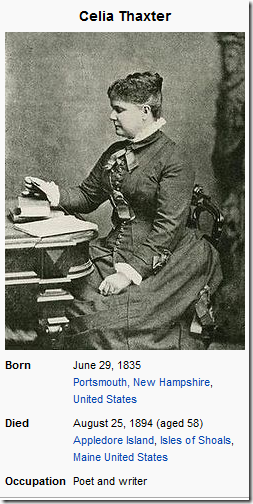
“Love seems to have cured her…I feel rather aggrieved that I wasn’t consulted.” He calls her E.S.P. To Celia Thaxter who Whittier visited on the Isle of Shoals, “
treasuring evenings in her parlor room where she told ghost stories or they exchanged folk tales:
“What do you think of Eliza Stuart’s marriage to young Ward? He is a good fellow and Elizabeth for once in her life is happy!” Phelps married Herbert Dickinson Ward in 1888–he was 27 and she was 44. It didn’t go well: she bucked his surname within three years and wrote
Confessions of a Wife in 1902.
1888 Whittier letter to Annie Fields after editing a new edition of his poetry: “I hope I am correcting a little of the bad grammar, and rhythmical blunders, which have so long annoyed my friends who have graduated from Harvard instead of a country district school.”
1886 Whittier letter mentioning Elizabeth Stuart Phelps sending a “very pretty shade of fine lace work…because of its exquisite color” gift on Christmas Eve, which Whittier re-gifted 🙂
1884 Whittier letter to Annie Fields: “Have you seen Elizabeth Phelps lately? I am not in favor of capital punishment, but the burglars who robbed her of her hard earnings would fare hard if I were on the jury that tried them…”
1882 Whittier letter “The world can no longer be to me what it was while Emerson and Longfellow lived. They should have outlived me, for Emerson was never sick, and Longfellow until the last two years had splendid health. A feeling of loneliness and isolation oppresses me. But as Emerson said to me the last time I saw him ‘the time is short’ “ collection of Swarthmore college
1879 Whittier letter to Elizabeth Stuart Phelps: “Dr. Bowditch says that a man of active brain ought to make a fool of himself occasionally and unbend at all hazards to his dignity.” admittedly hard for these two
1877 Mark Twain (work friend), Ralph Waldo Emerson, Henry Wadsworth Longfellow at Whittier’s 70th birthday celebration. Hawthorne and Whittier were not exactly fans of each other’s works.
1873: Whittier thank you note to Elizabeth Stuart Phelps for sending her book
1868: Whittier letter to Annie Fields complimenting Elizabeth Stuart Phelps The Gates Ajar “Good in itself and full of promise.” 1869 he’s promoting it to Harriet Minot Pittman
1868 Whittier thank you note to James Thomas Field for paying him the $1500 check
1857 Whittier poem: Garrison of Cape Ann* opens with a view of Cape Ann as seen from Po Hill: “From the hills of home forth looking, far beneath the tent-like span,
Of the sky, I see the white gleam headland of Cape Ann.” For readers that have come this far–the complete Garrison of Cape Ann follows the break.
1843 Whittier poem: Massachusetts to Virginia (in reference to George Latimer, alleged fugitive slave)
“The fishing smacks of Marblehead, the sea-boats of Cape Ann…” Woodie Guthrie 1958 This Land is Your Land feels like a 20th Century connection.
Continue reading “Haunting for Halloween: Pumpkin carving and poetry John Greenleaf Whittier & Elizabeth Stuart Phelps” →
Spread The GMG Love By Sharing With These Buttons:







 Good Morning Gloucester