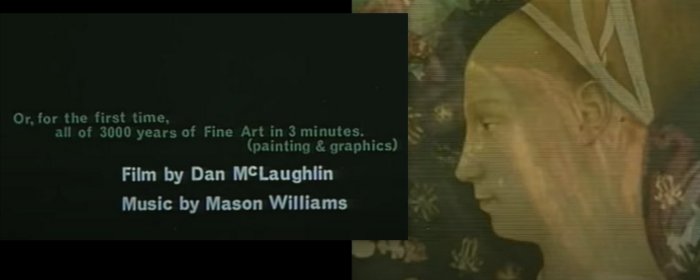
Do you remember watching the Smothers Brothers in 1968 and seeing this early music video?
Mason Williams, uber-talented musician, comedian, multimedia artist and writer, wrote for television shows as varied as Dinah Shore and Saturday Night Live and was the head writer on the Smothers Brothers. He composed Classical Gas in 1967. A year later he was inspired by a wry conceptual film, God is dog spelled backwards, a compilation of selected visual artworks (paintings and drawings) originally cut to Beethoven’s 5th Symphony: The world’s greatest music and the world’s greatest art catalyze the world’s greatest film. Williams commissioned the filmmaker, Dan McLaughlin (1932-2016), to re-edit his student art film* and set it to Classical Gas. McLaughlin was a pioneer in computer animation and leading light in his field. This iteration transformed Classical Gas basically into an early music video. The multimedia collaboration aired on the Smothers Brothers in the summer of 1968 and was a hit.
The result is masterful, though dated. Can you spot a work from the 1960s? Can you spot a work by a woman artist? A black artist? Any outside the cannon? For context, Janson’s influential textbook, History of Art, was published in 1962; McLaughlin’s student film is dated 1963. They are essentially simultaneous encyclopedic pursuits. Linda Nochlin’s groundbreaking essay “Why Have There Been No Great Women Artists?” was published in 1971; maybe the video’s popularity added some fuel to that fire. It would be fun to edit a sequel with today’s tools.
As is, the editing is trippy fast to match the lightning notes, as break neck as any subliminal messaging. It feels painterly. Brush marks, broad strokes, and beautiful washes. The art is not spliced chronologically or thematically by any categorical art history “ism”, nor by a particular place or institution as in, “Is this stretch the Louvre patch?” Pacing is punctuated with mini concentrations devoted to a single artist. Selections tend to figurative works, seated, faces and gazes, all ages. Representations of love and family feel prevalent and arbitrary. Less familiar artists are included. There are humorous beats and repetition. Paintings depicting a musical bent are fun to spot.
I’m not sure if the order of images was altered from the first iteration to its Classical Gas transformation or how much Williams was involved in the second visually if at all. (So many questions: Did McLaughlin grab images at the library, photographed from artist monographs and museum collection books? Did institutions provide photographs? Maybe he rifled through an art history department’s visual bank? Were any works photographed in person, by McLaughlin, Williams or their contacts? Did he include personal favorites?) *Some of these questions are answered in an audio tape decades after ( listen here ); sad to hear it seems from his perspective he wasn’t done right by Smothers Brothers or his distributor. Library books were combined as part of the work’s mixed media techniques. The crops and zooms helped resize vertical images for an unforgiving horizontal medium. He felt the mosaics were a happy success. Perhaps their inherent fracturing structure optimized the optical goals he envisioned.
Twenty two seconds in, the montage music video kicks off with several DaVincis. (The Portrait of a Musician is included–look for the red cap.) If you’ve never seen the video, I’d recommend letting it ride and experience it whole. If you are familiar with art history you might see a favorite painting quicken past.
Rewatching to concentrate on a few seconds is a fun ID challenge, like the game Masterpiece, or flash cards. Running at ten or twelve images per second at least it’s impossible to dial down without an editing bay. Albeit Mona Lisa, each work was afforded 2 frames. Though incomplete, here’s my stab at attribution during a single three seconds (tops), starting at timecount 22 seconds. Give it a go!
Davinci – Mona Lisa(Louvre), Portrait of a Musician (Milan), Head of Woman (Royal Collection Trust /Windsor), Head of Man Shouting (MFA Budapest), A Man Tricked by Gypsies (Royal Collection), studies of heads in profile (not sure); Rembrandt- Man With Golden Helmet (no longer considered by Rembrandt) (Gemaldegalerie Berlin), A Man in Armor (Glasgow), A young woman trying on earrings (Hermitage), A Girl with a Broom (no longer considered by Rembrandt) (National Gallery of Art), Old Man in Armchair (now considered probably by Rembrandt) National Gallery, London; Titian (Girogiane) Pastoral Concert (Louvre); Pisanello Portrait of Princess (Louvre); Alesso Madonna and Child (Louvre); Ghirlandio Old Man and His Grandson (Louvre); David Marriage at Cana (Louvre); Frans Hals The Gypsy Girl (Louvre); Van Dyck Charles I (Le Roi a la Chasse ) (Louvre); Durer Portriat of the Artist Holding a Thistle (Louvre); El Greco Saint Louis (Louvre); Jean Clouet? Portrait of Francois I; Fragonard The Bathers (Louvre); not sure (portrait of woman); Delacroix Liberty Leading People (Louvre); Daumier Crispin and Scapin (Musee d’Orsay); Goya Duchess of Alba (Hispanic Society of America); Bonnard Nu dans le bain (Nude in the Bath) (Paris); Van Gogh Detail from Starry Night (MoMa), Self portrait (Musee d’Orsay); Paul Klee Fish Magic (Philadelphia Museum of Art); Miro Lessons; Chagall; Raphael La Fonarina (National Gallery Rome); Velazquez Portrait of Juan de Pareja (Metropolitan Museum of Art); Vermeer Art of Painting (Kunshhistorisches Museum, Vienna); Grunewald Isenehim Altarpiece detail Virgin and Child (Colmar France); Bellini Portrait of a Young Man in Red (National Gallery of Art); Cezanne; and El Greco detail from Burial of the Count of Orgaz (Iglesia de Santo Tome, Toldedo, Spain).


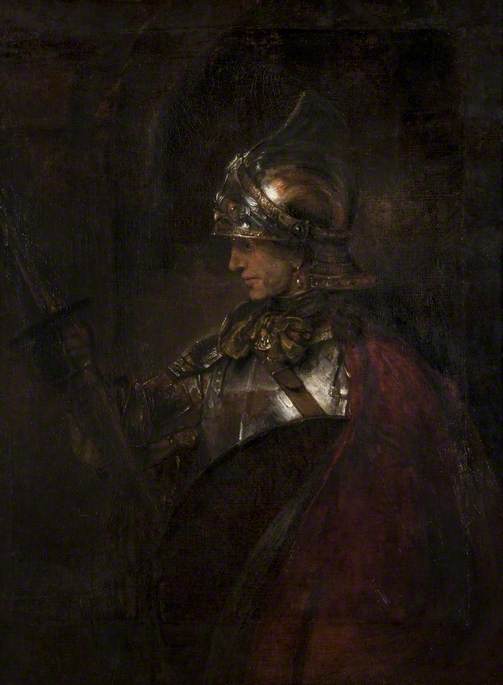
I wonder if the museums have –or could –spot their holdings? What artwork would you add that’s missing?
*McLaughlin (1932-2016) attended UCLA film school for animation graduating in 1958. After serving in the Korean War, he became a pioneer in computer animation, chairing the UCLA animation department and heading the Animation Workshop from 1970 (After Bob Shull) till his retirement in 2007. His son published his writings on animation, see more here , with sample chapters.
Mason Williams (b.1938) attended Oklahoma City University (1957-60) and served in the Navy from 1961 to 1963. Fun artworld aside: friends with Ed Ruscha from childhood.
1968- Mason Williams – here with symphony



 Good Morning Gloucester