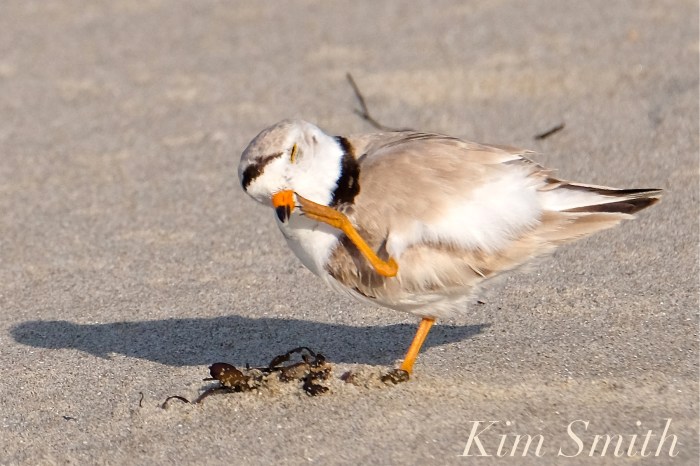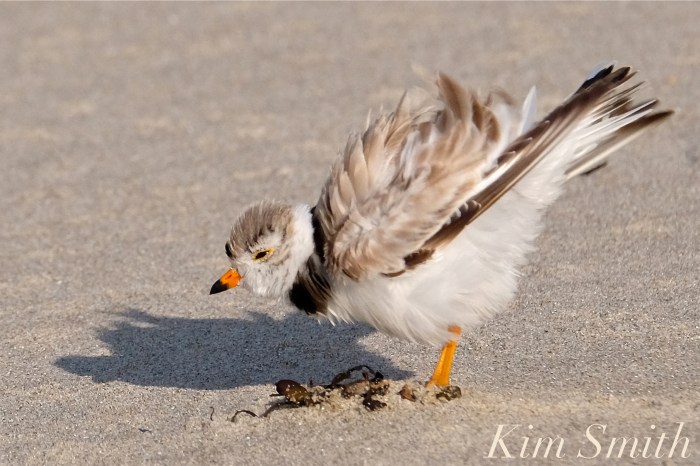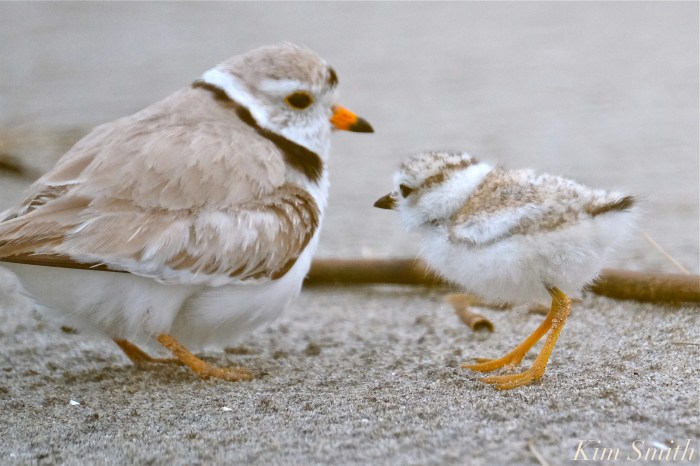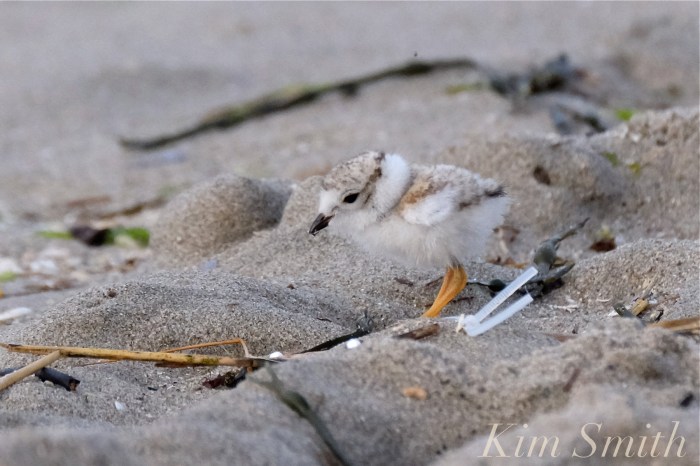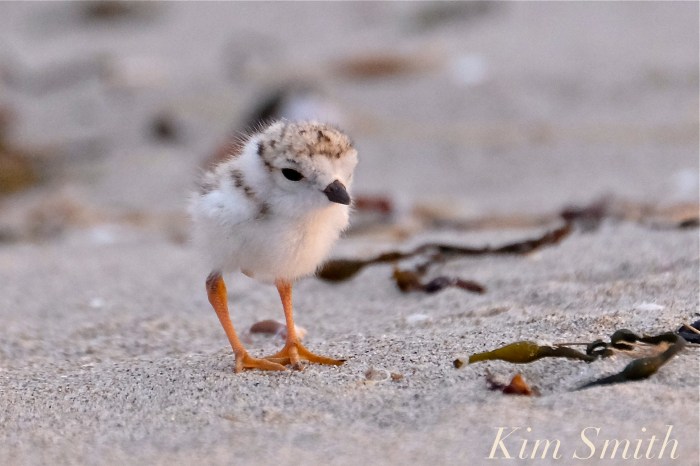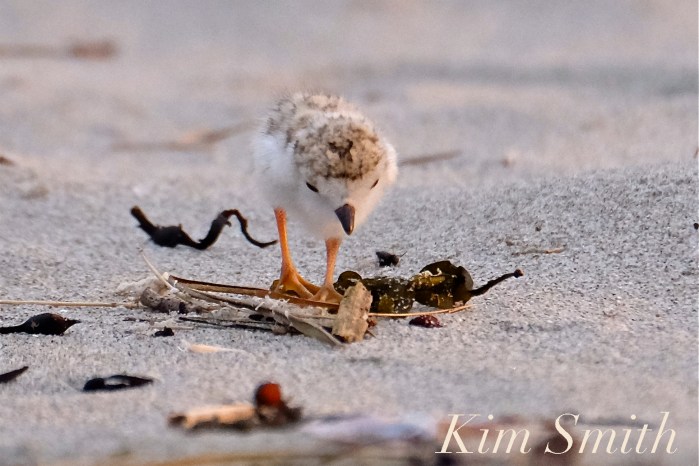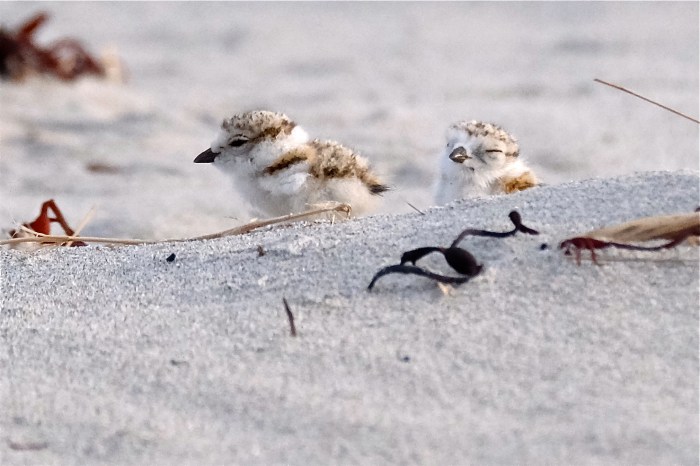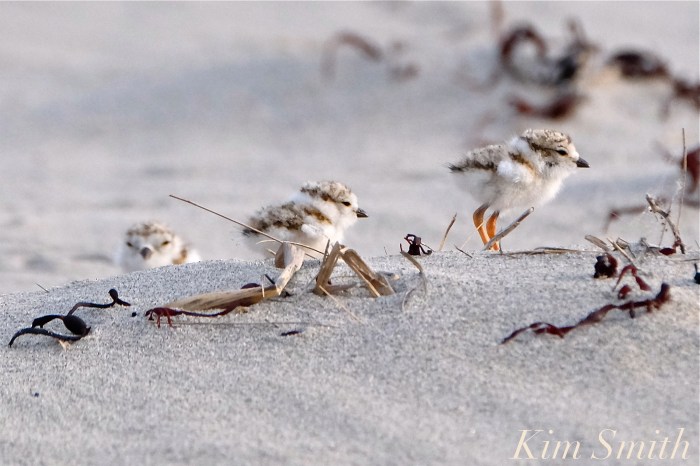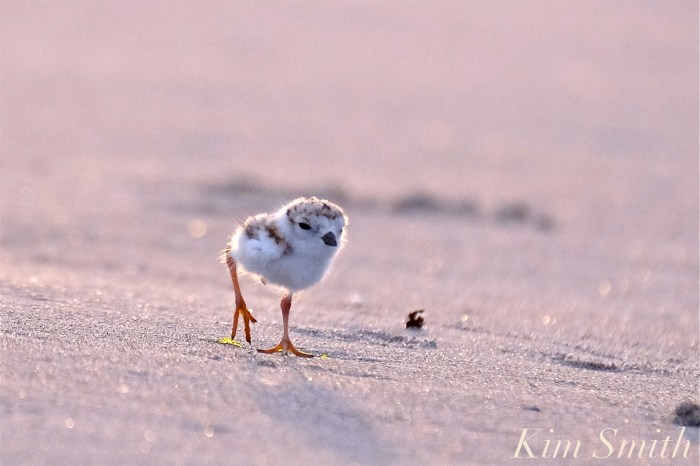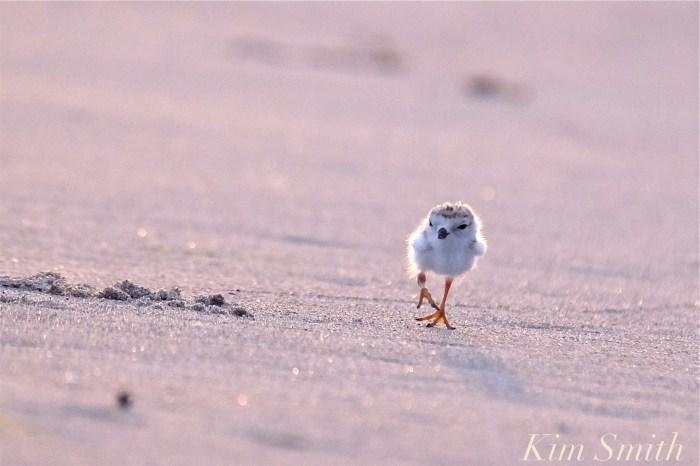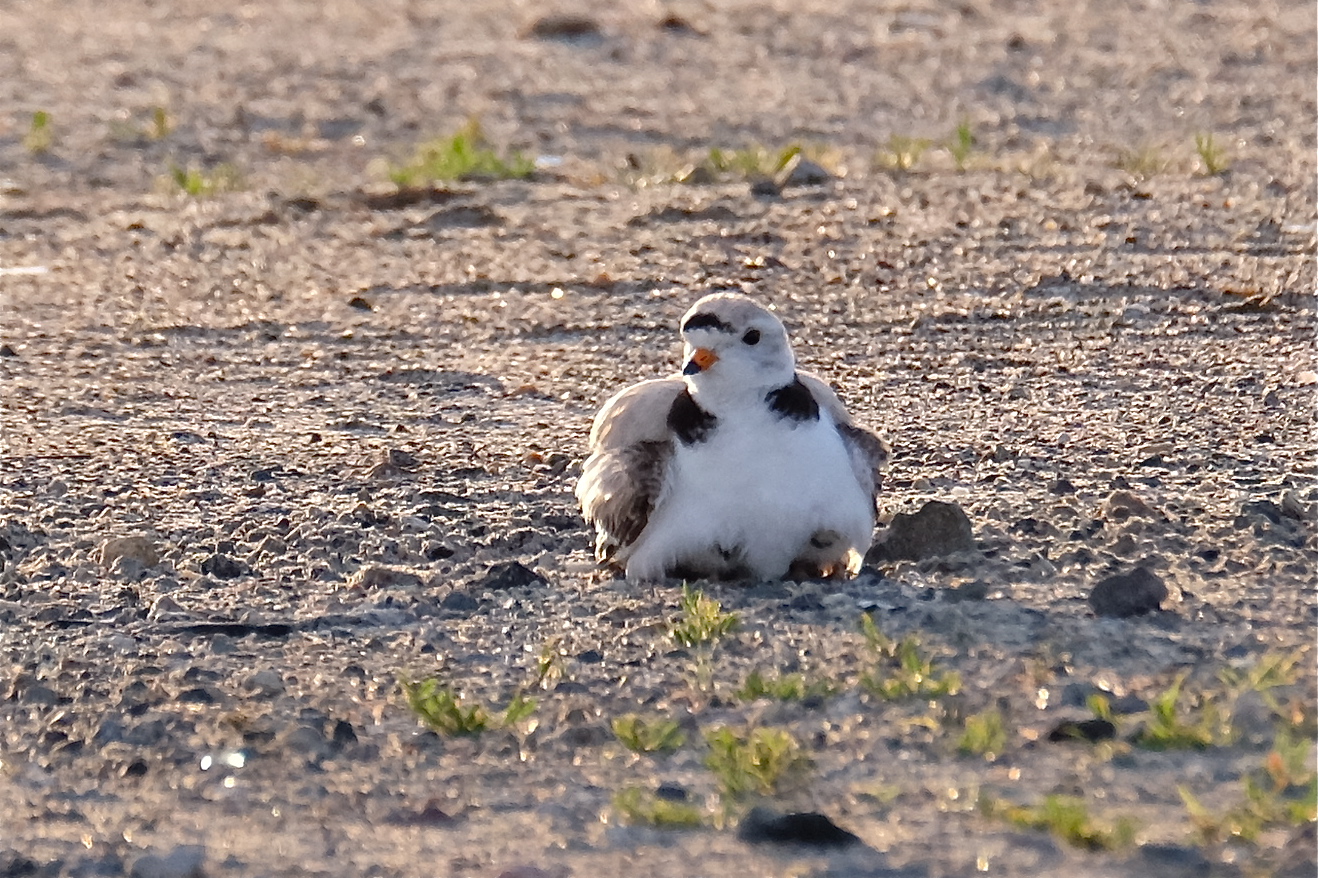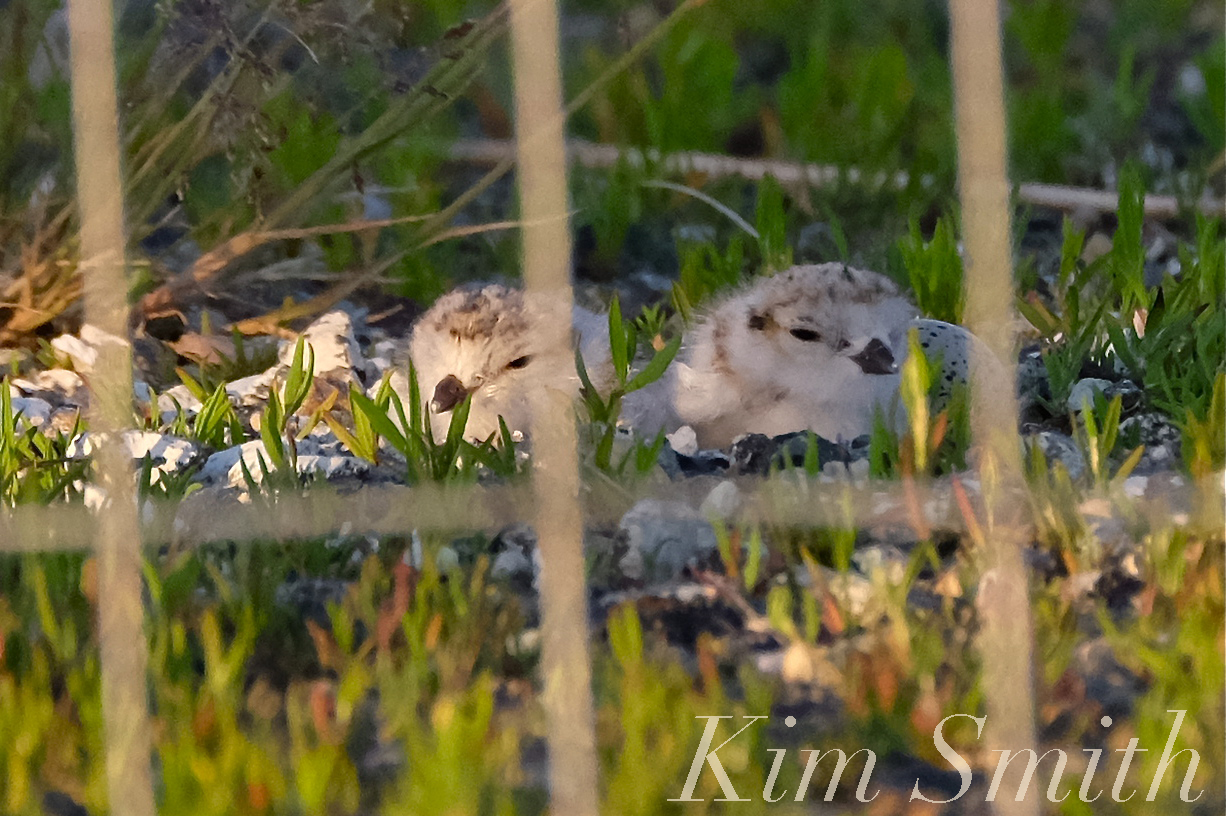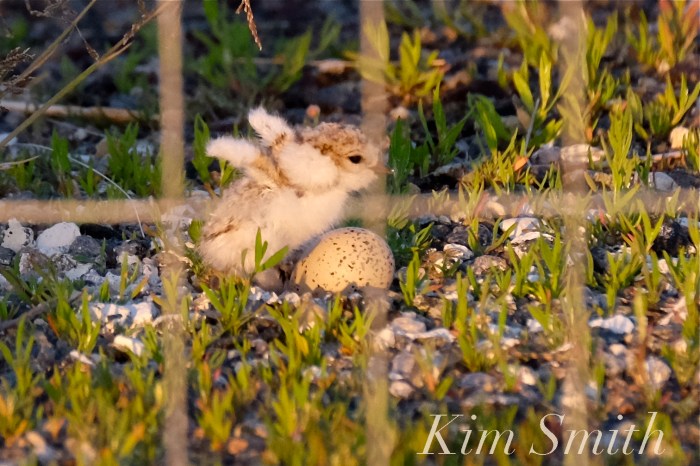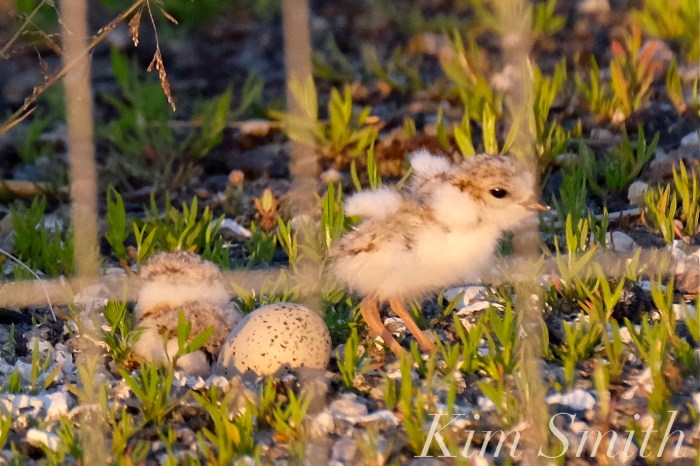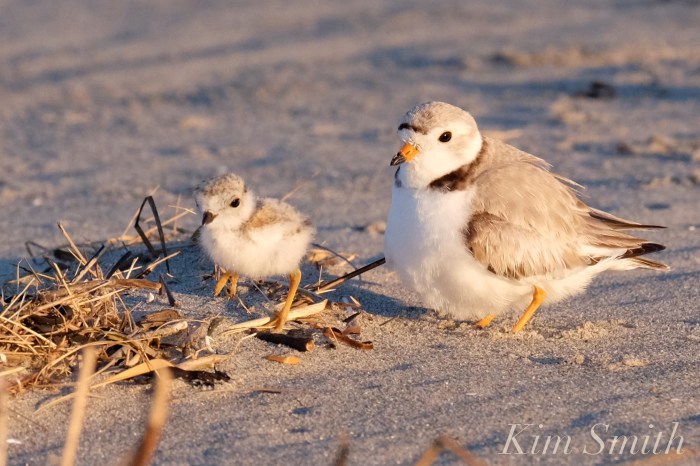
LITTLE PIP ZING ZANGING AROUND THE BEACH

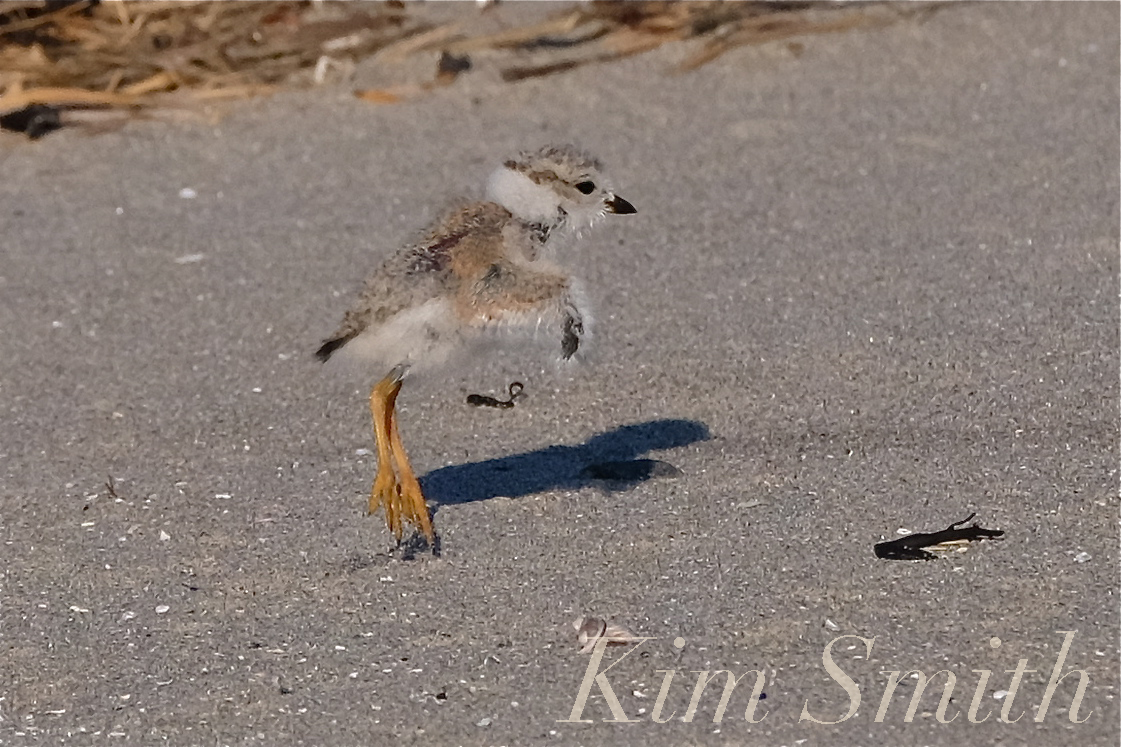
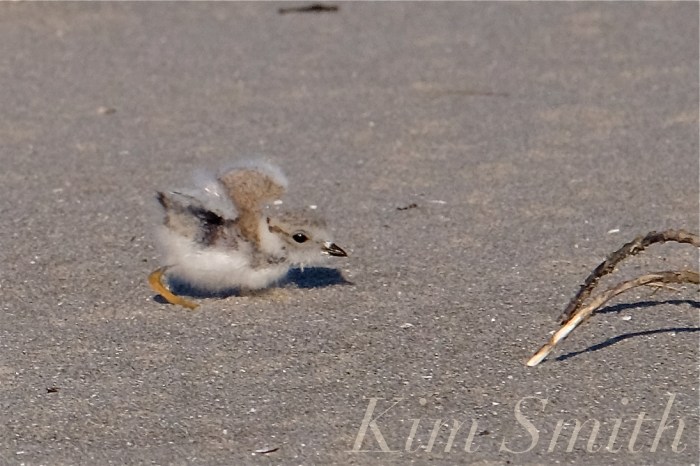
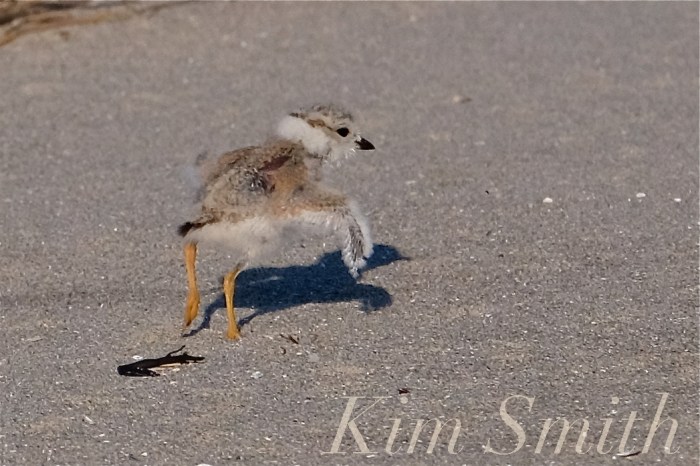
What are these things called wings?

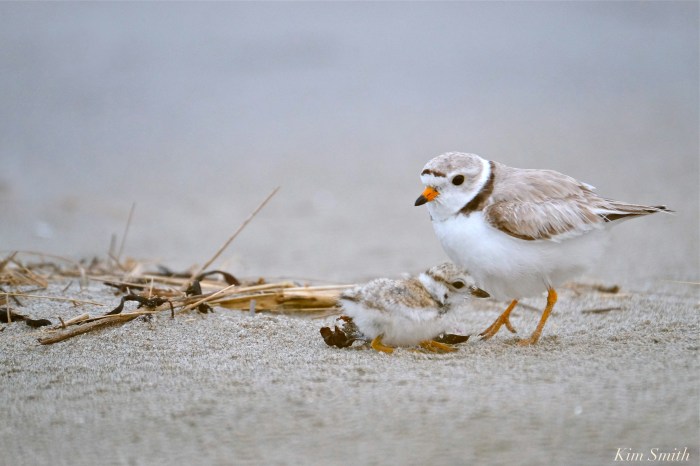
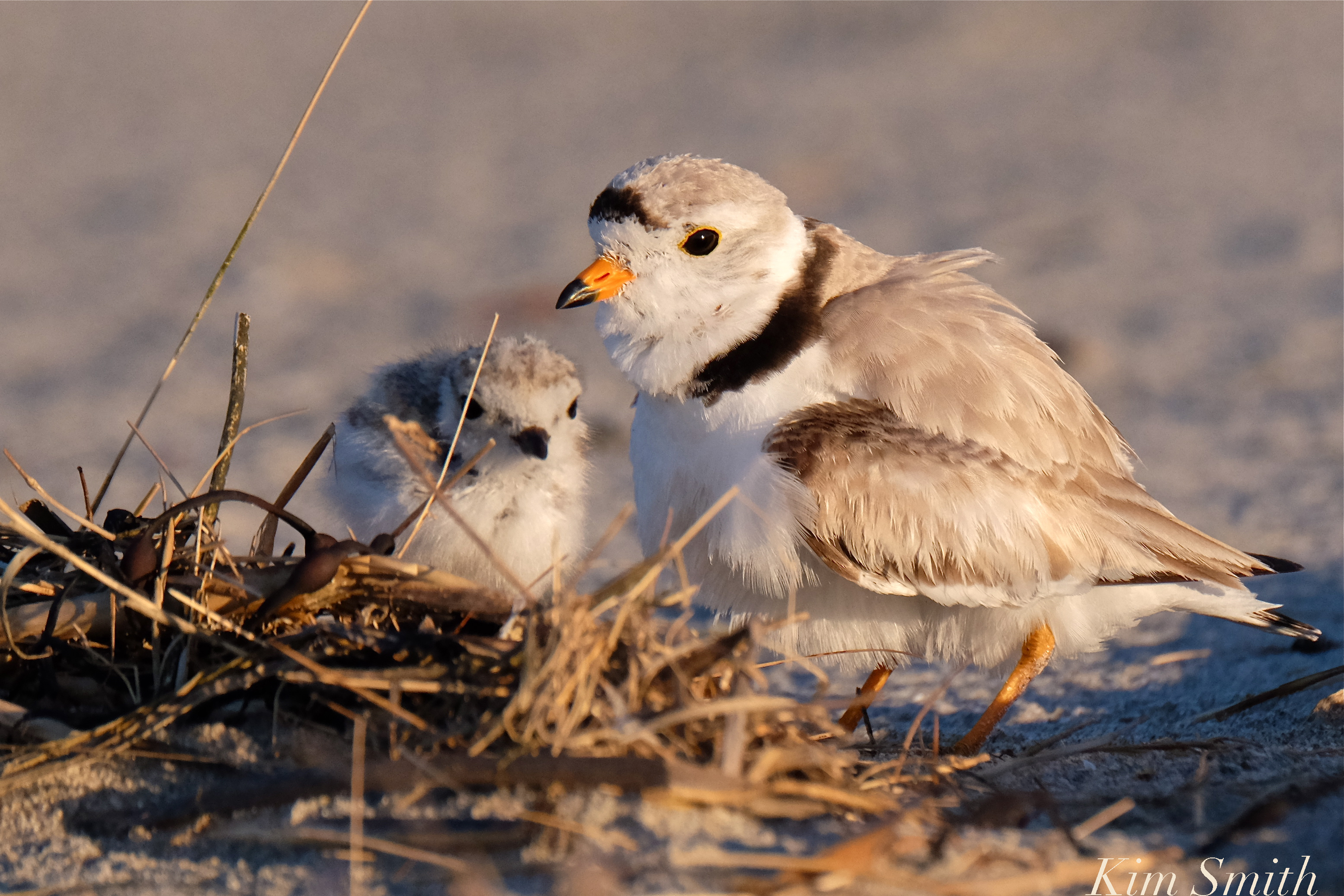
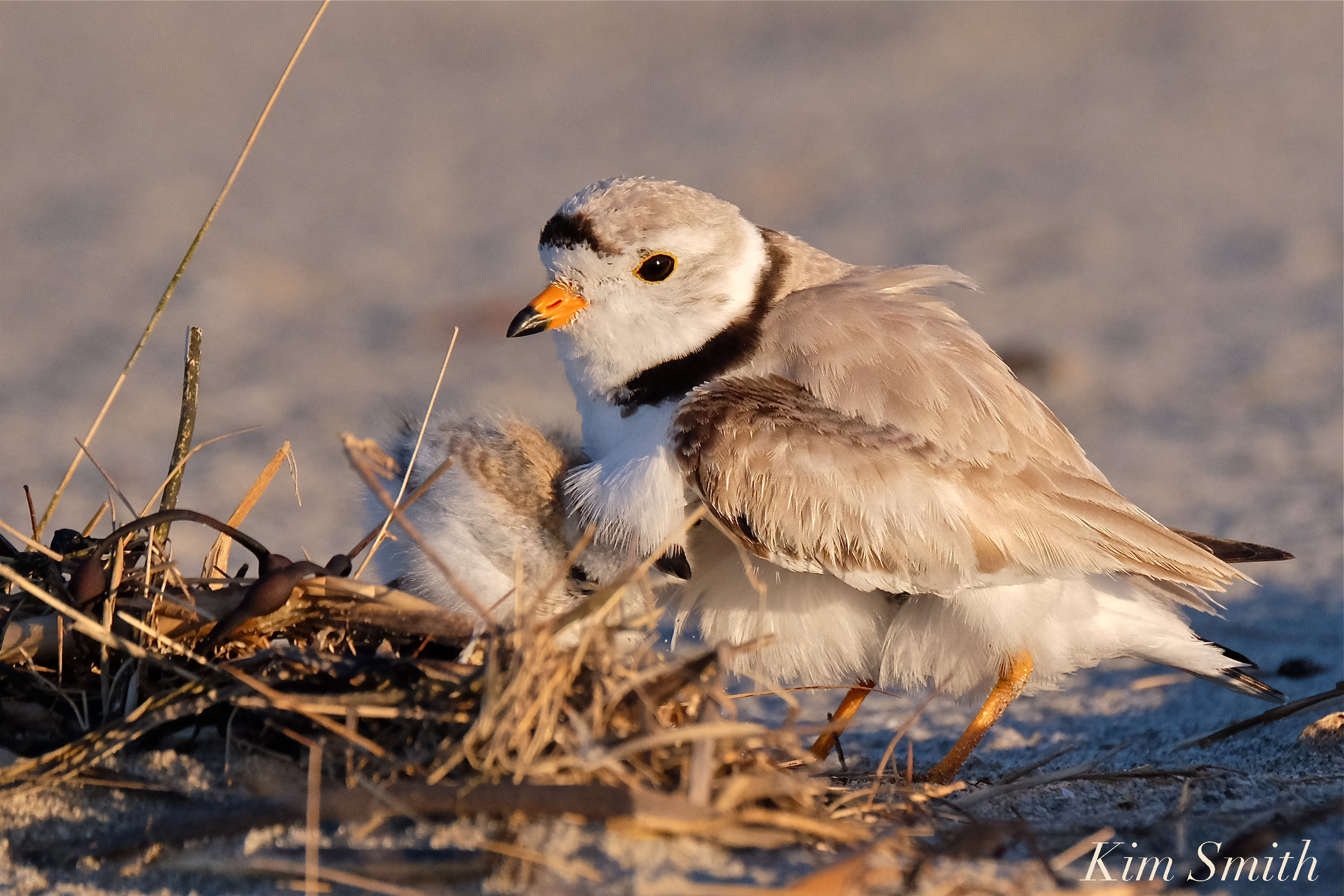
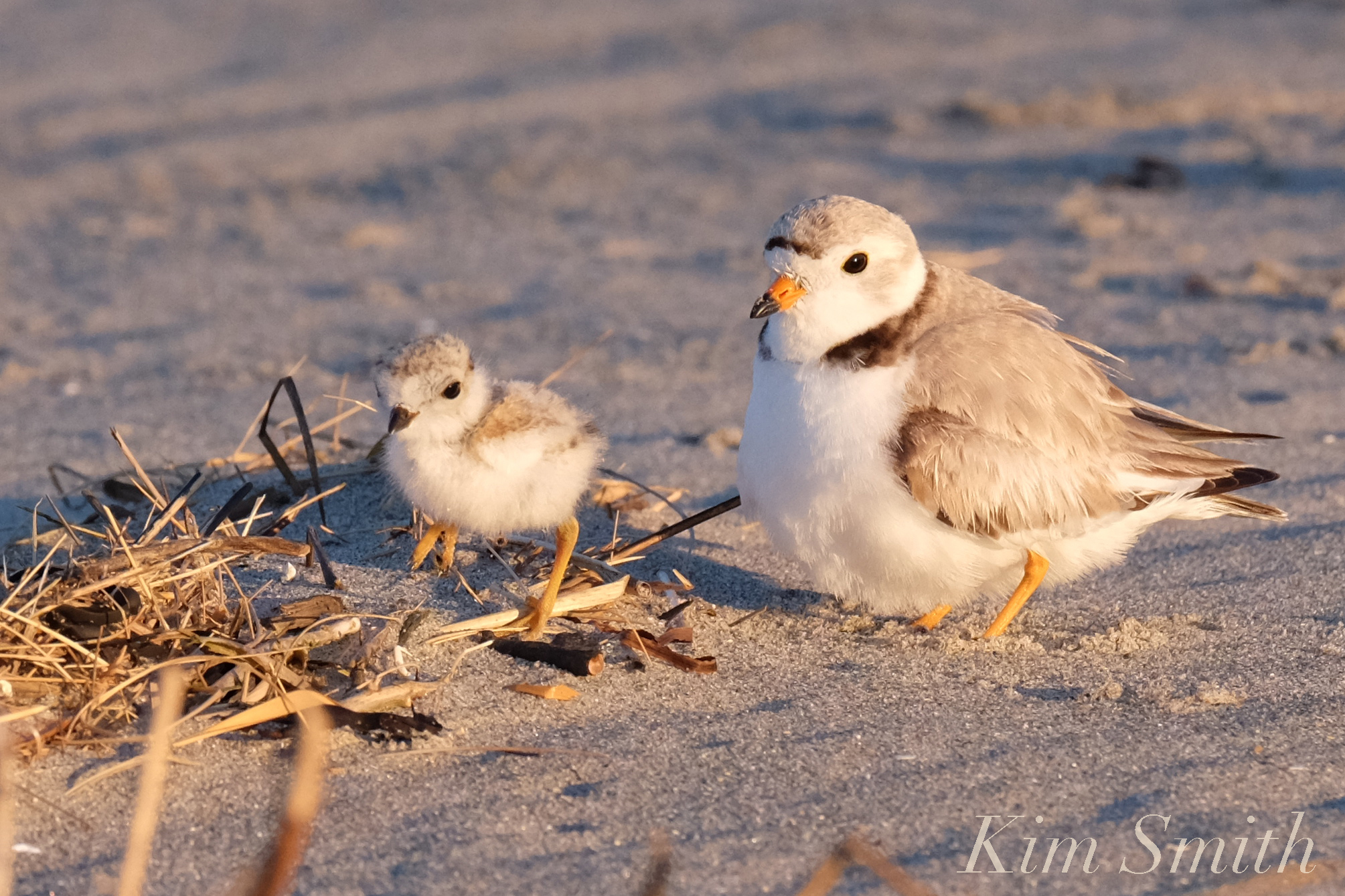
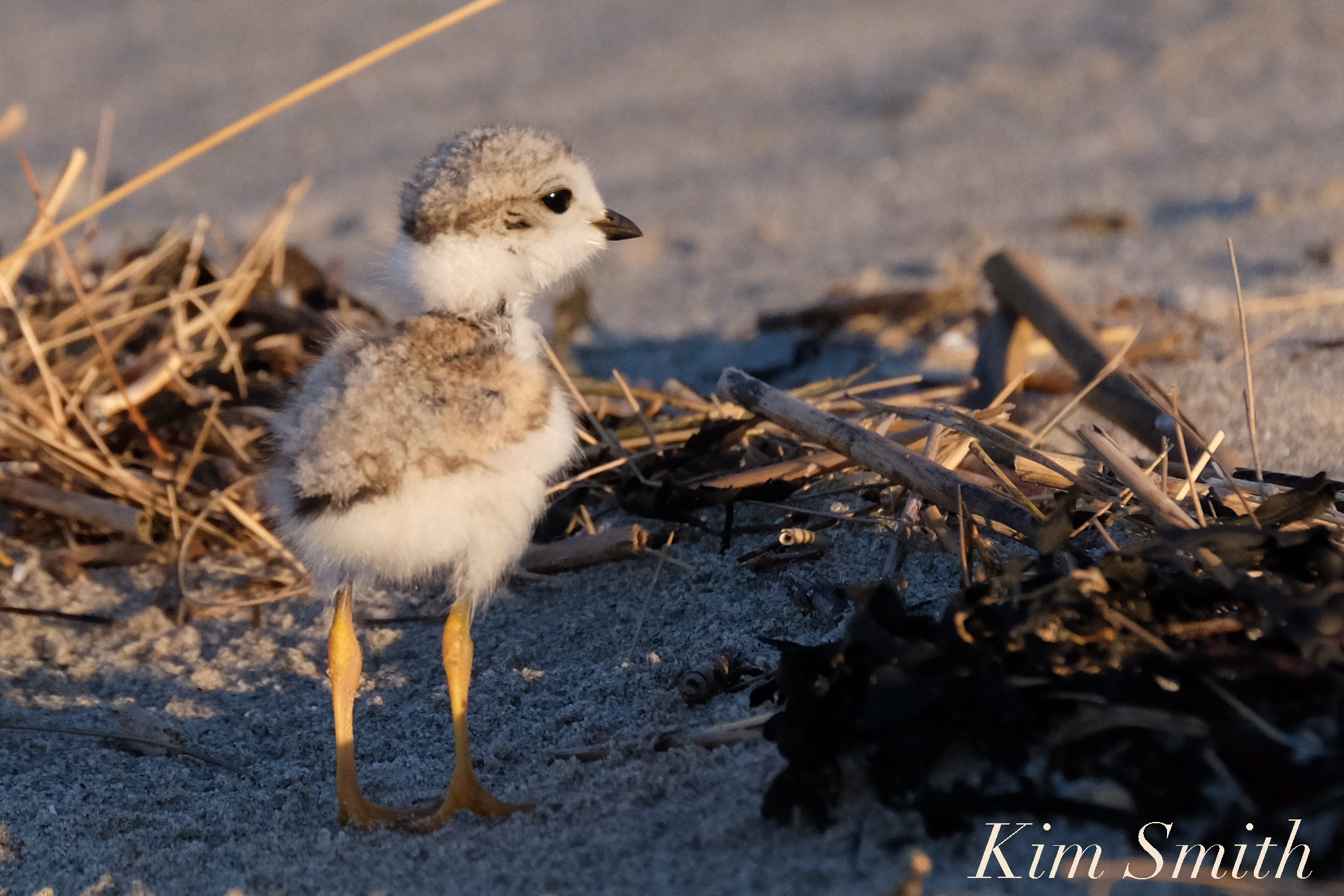
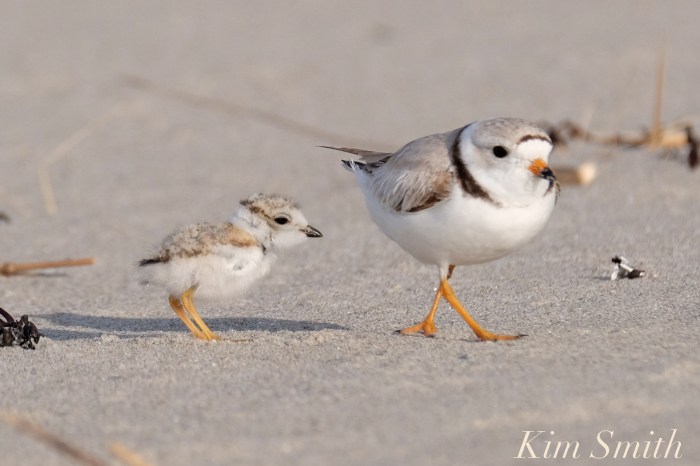
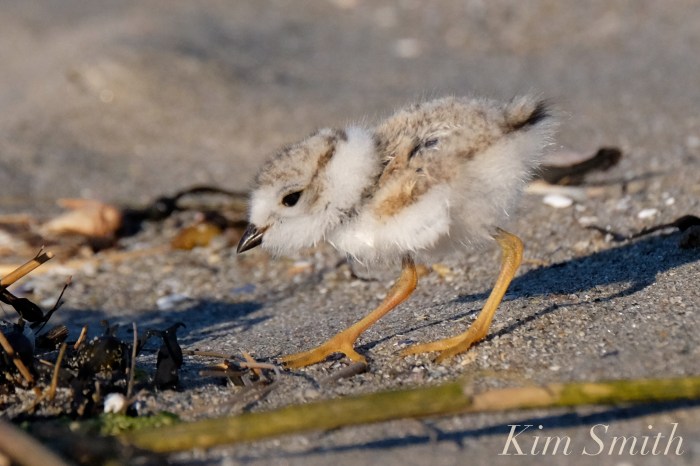
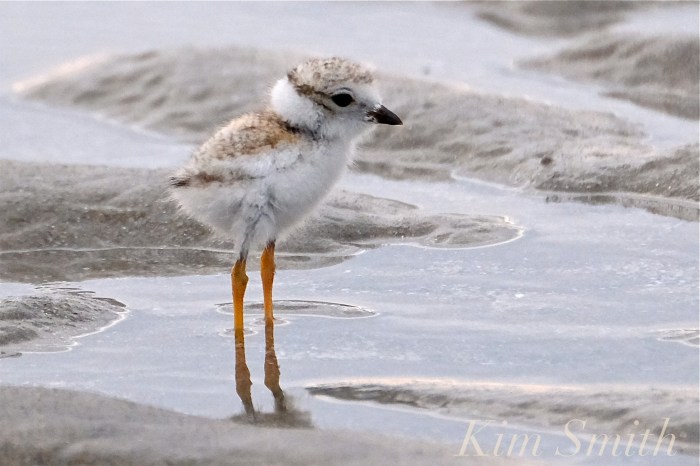
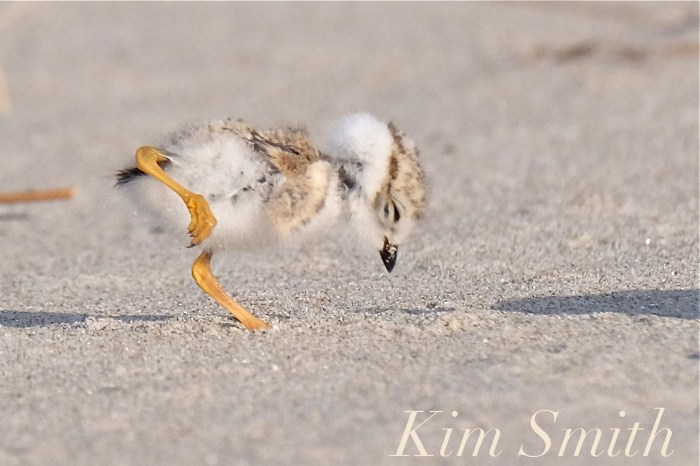
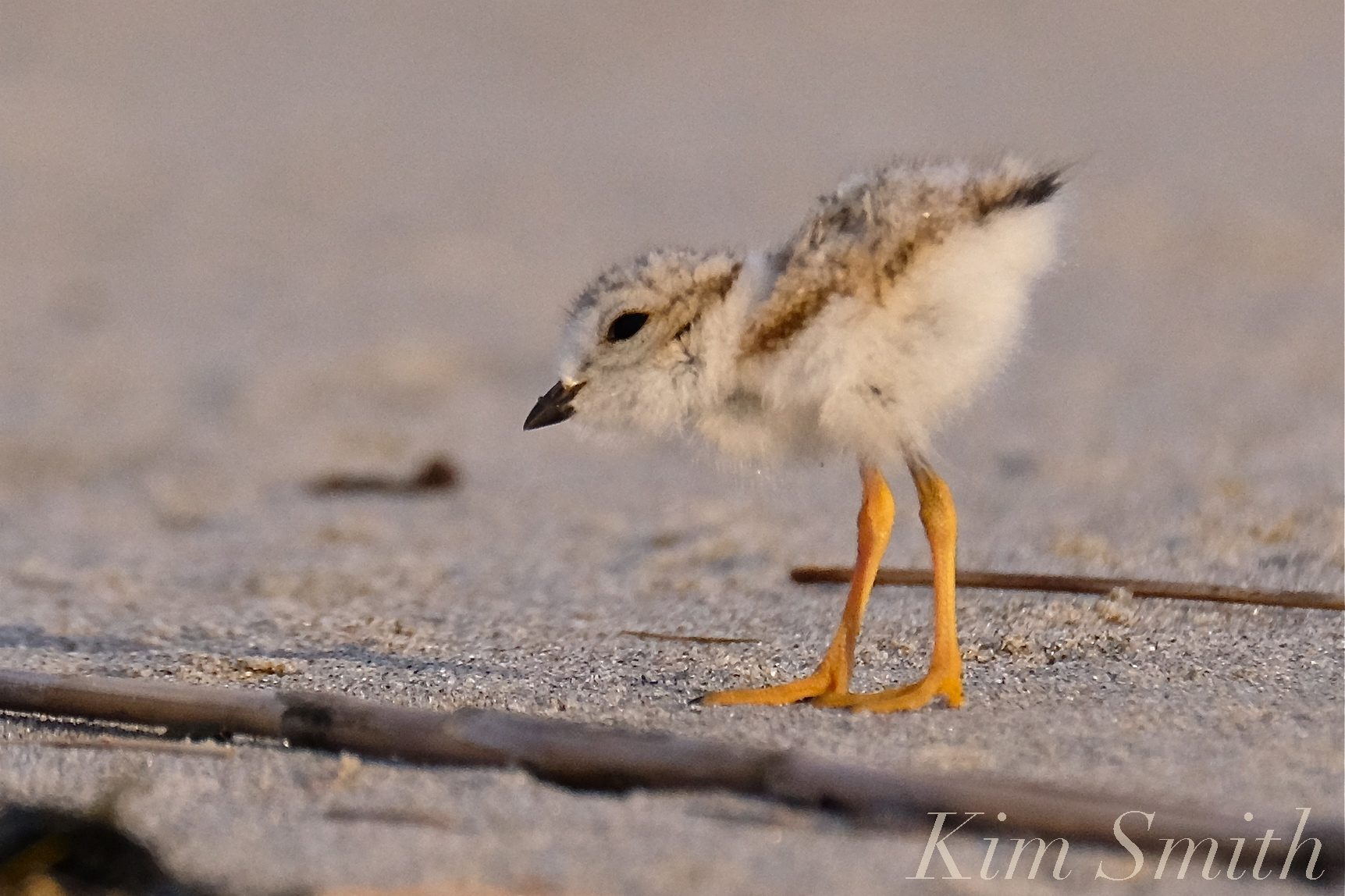
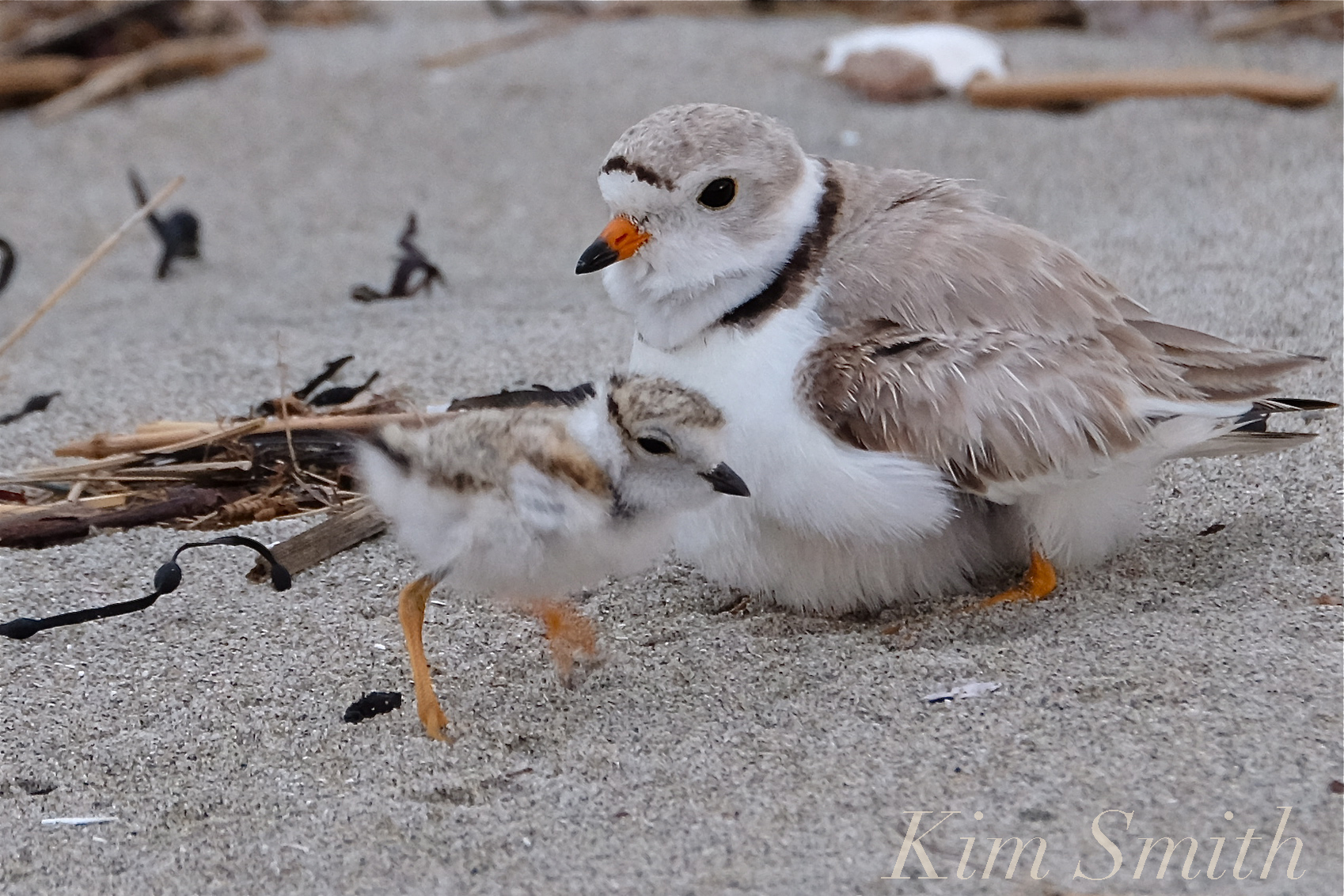
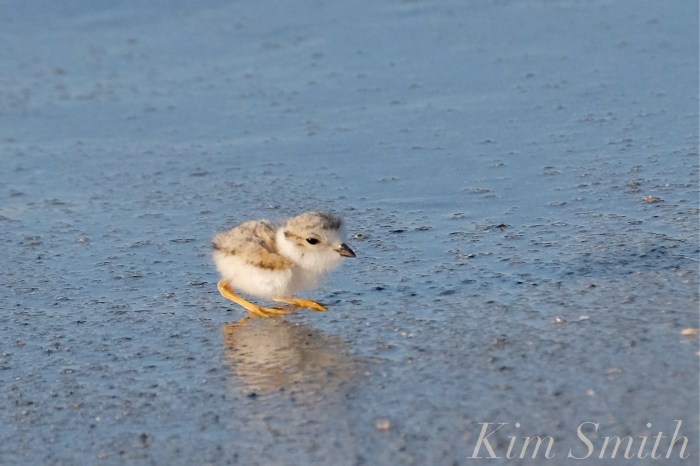
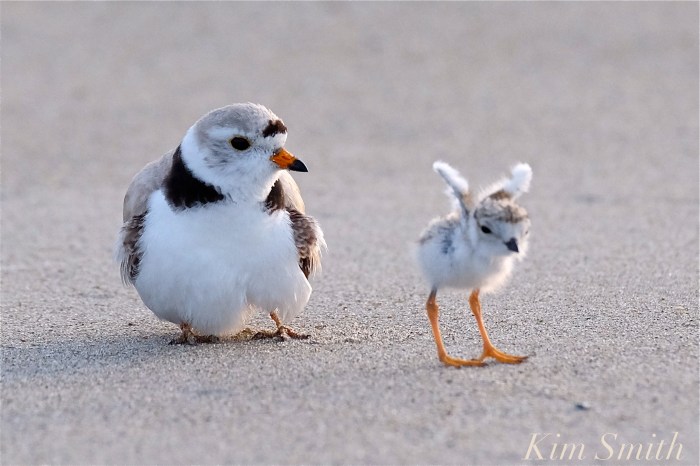
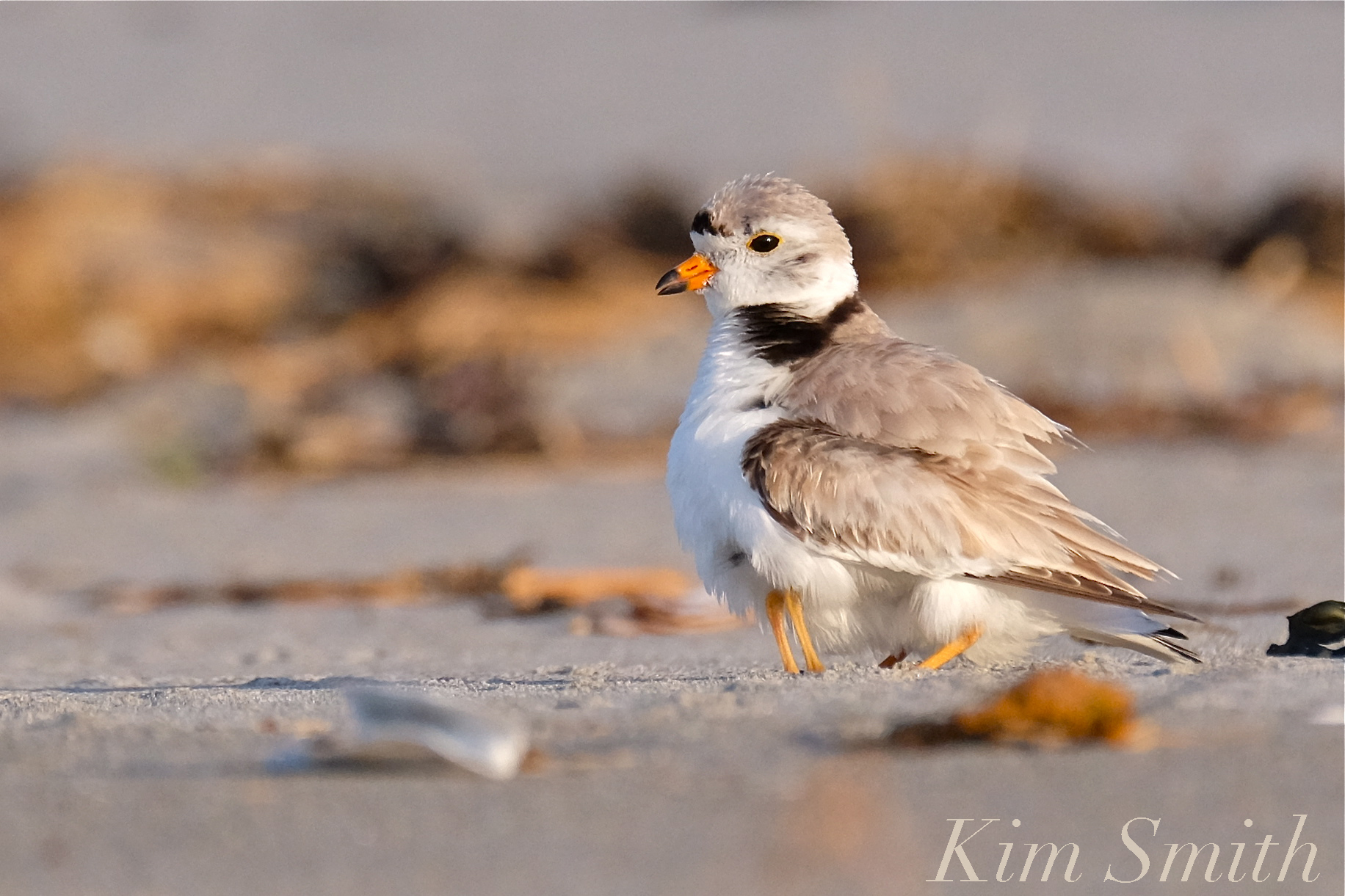
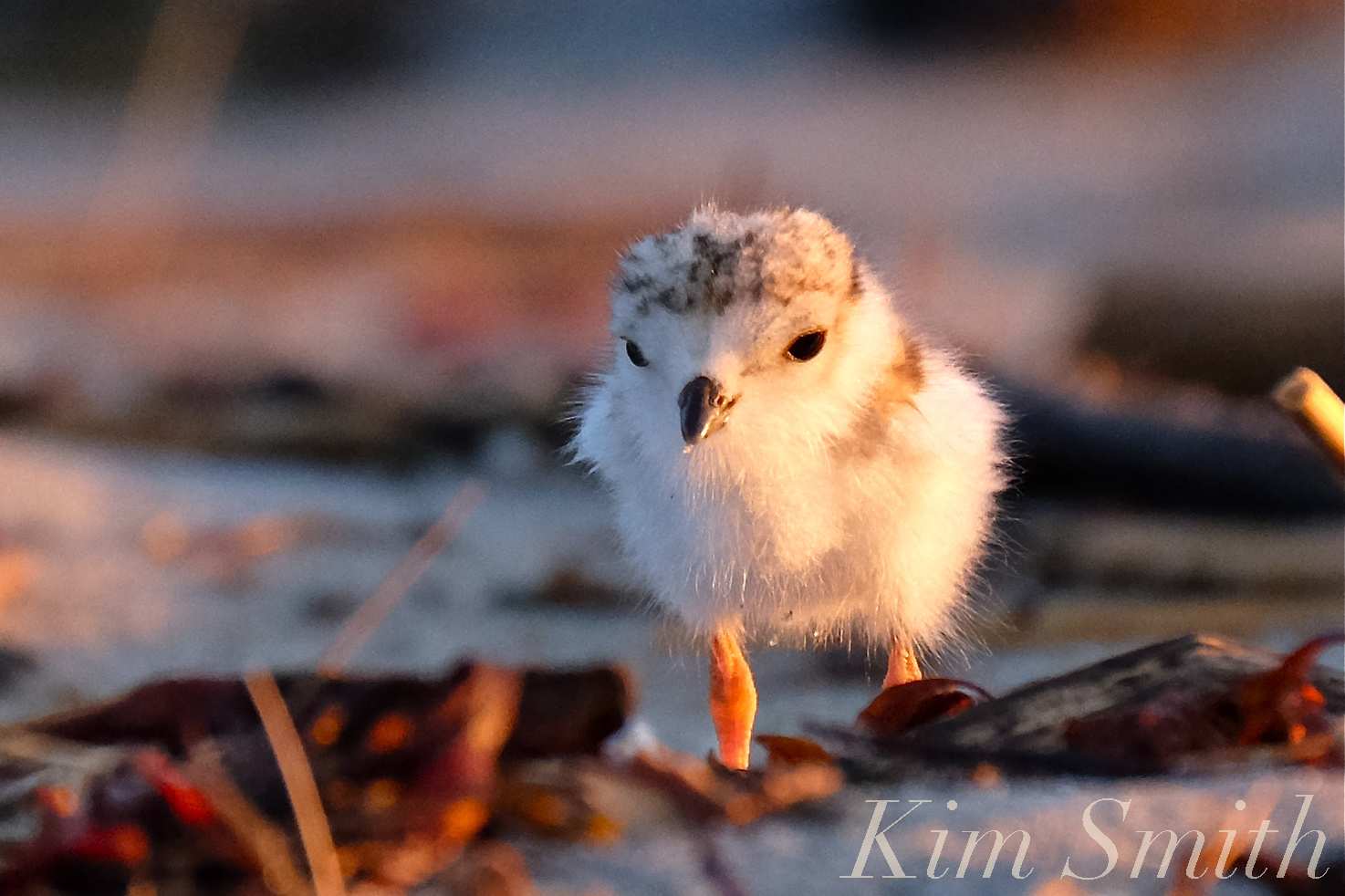
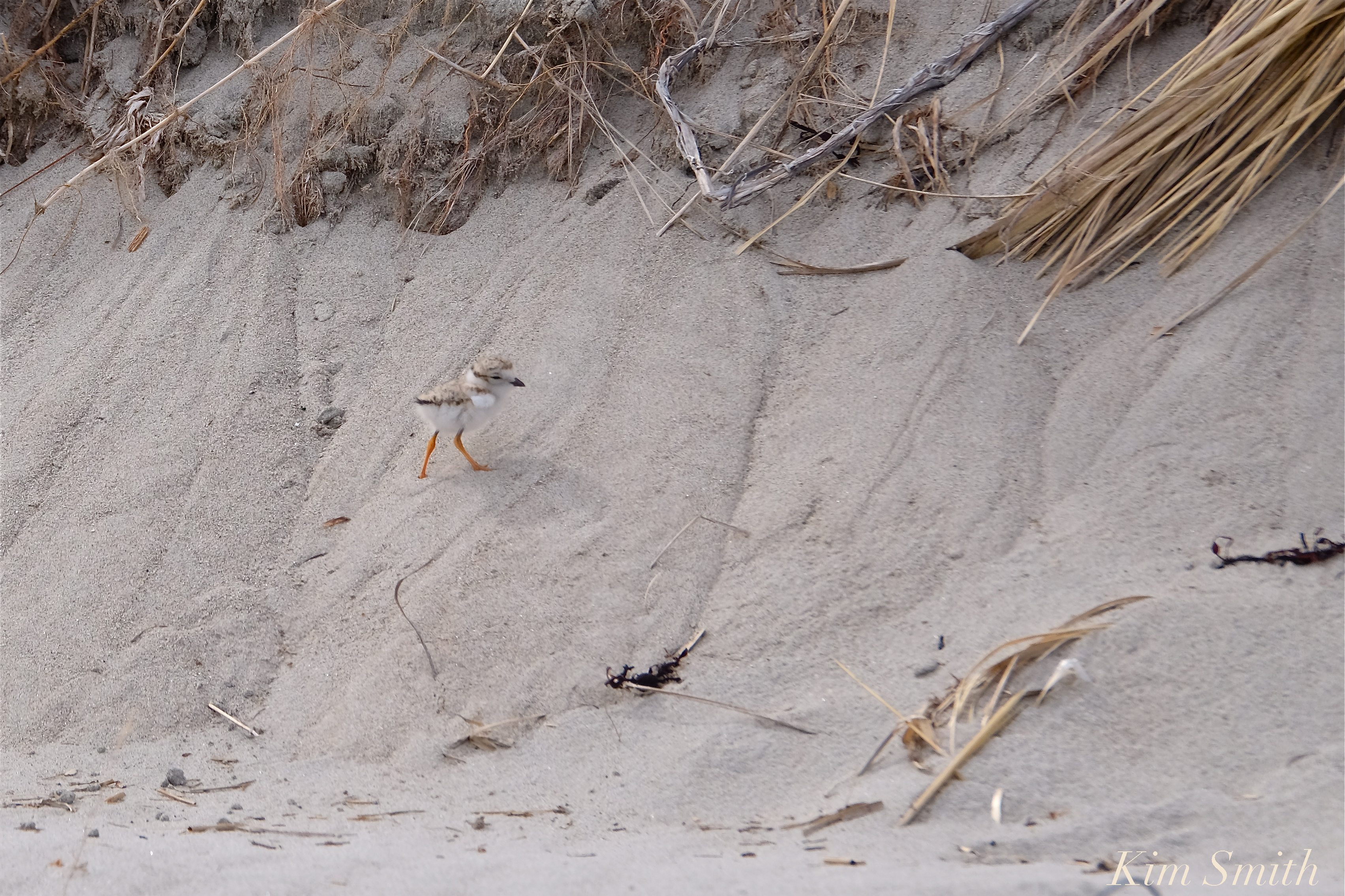
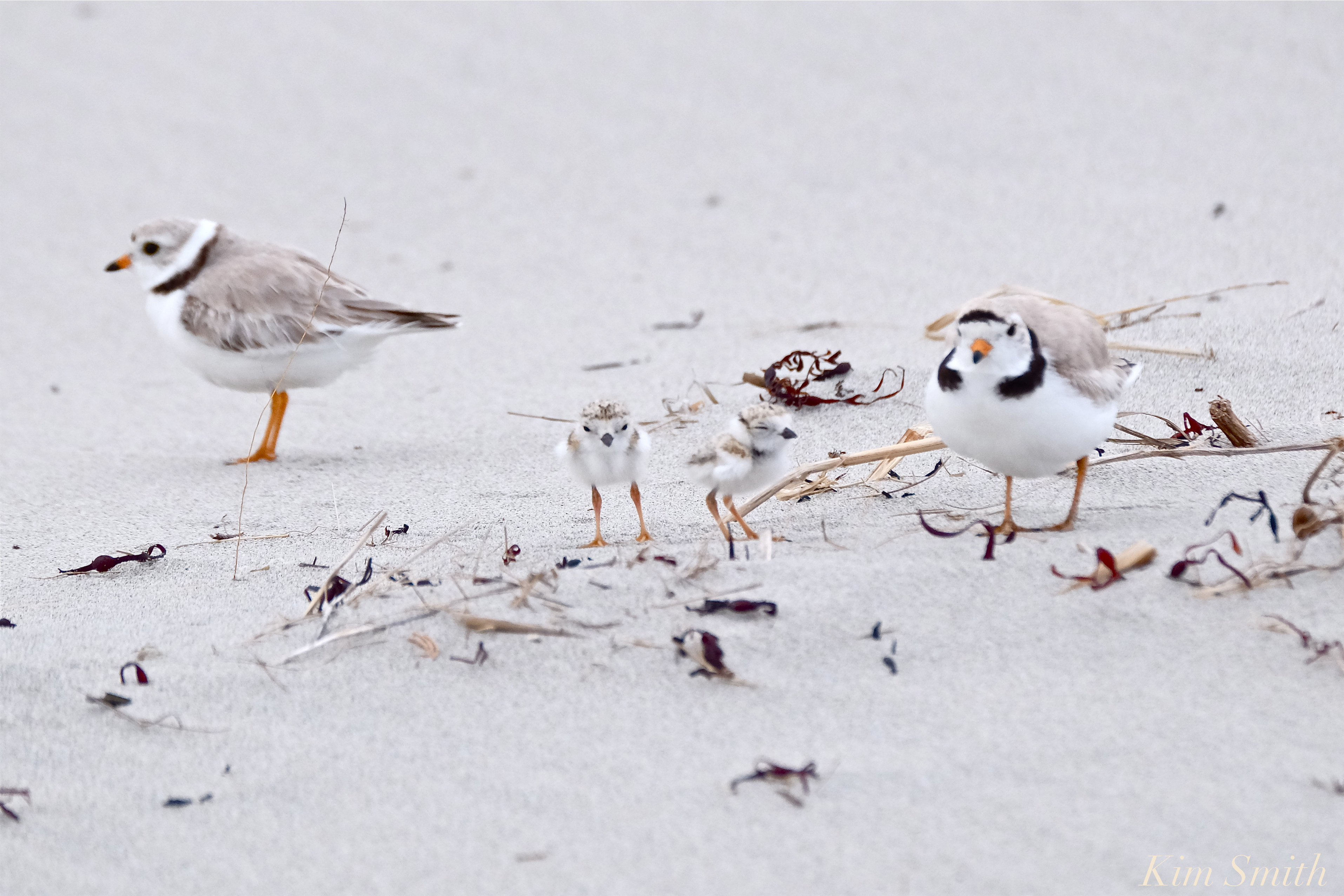
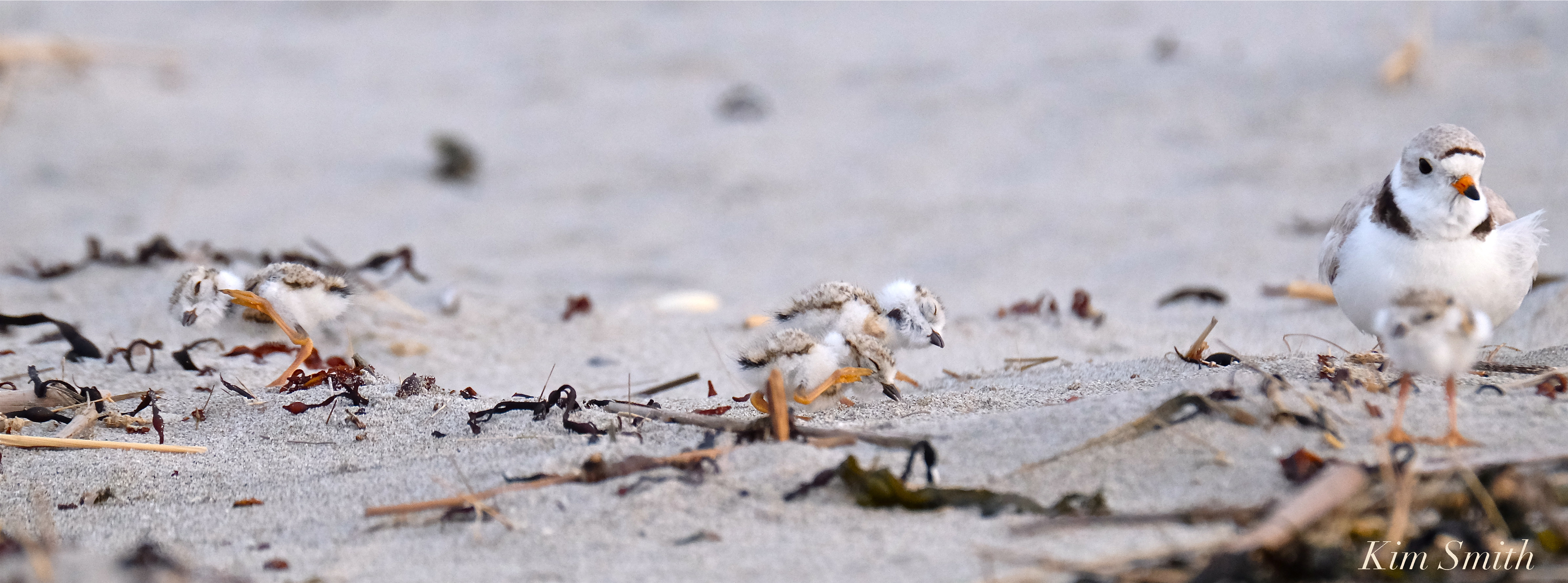
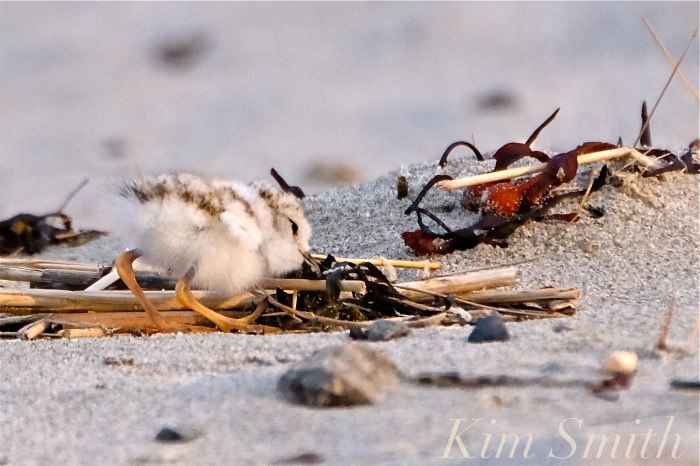
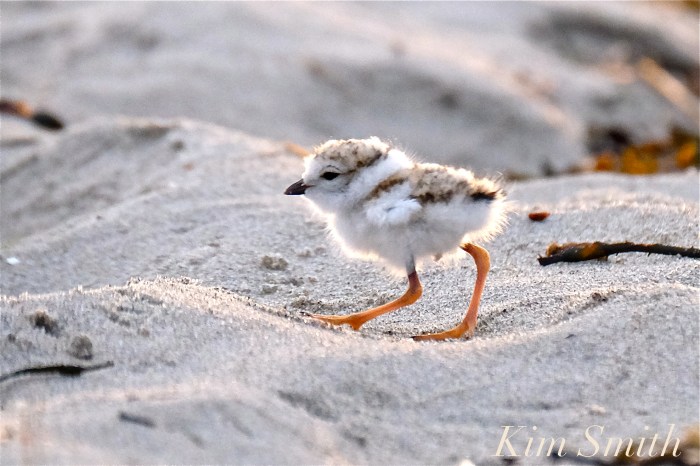
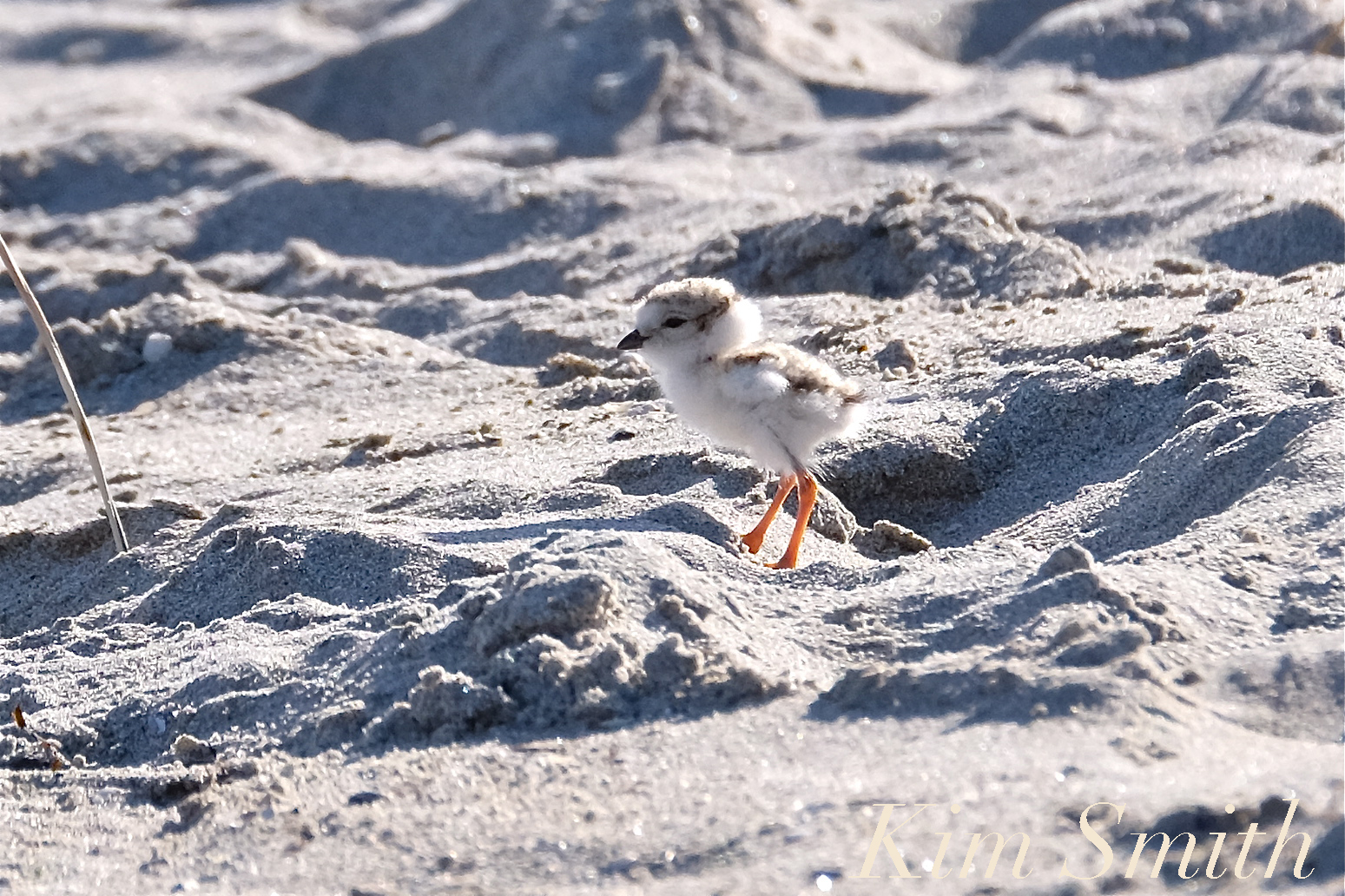
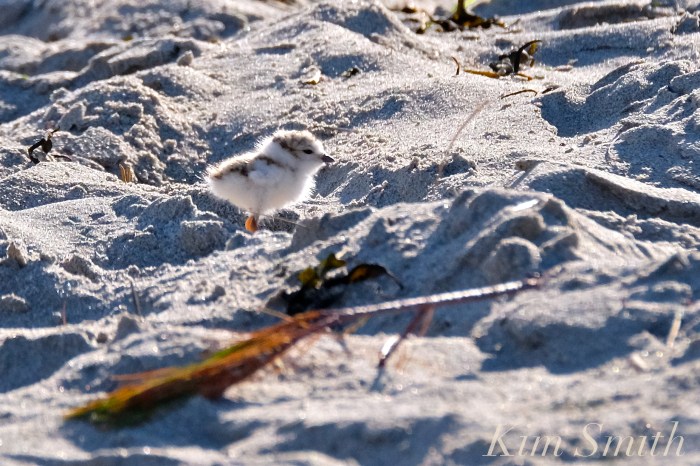
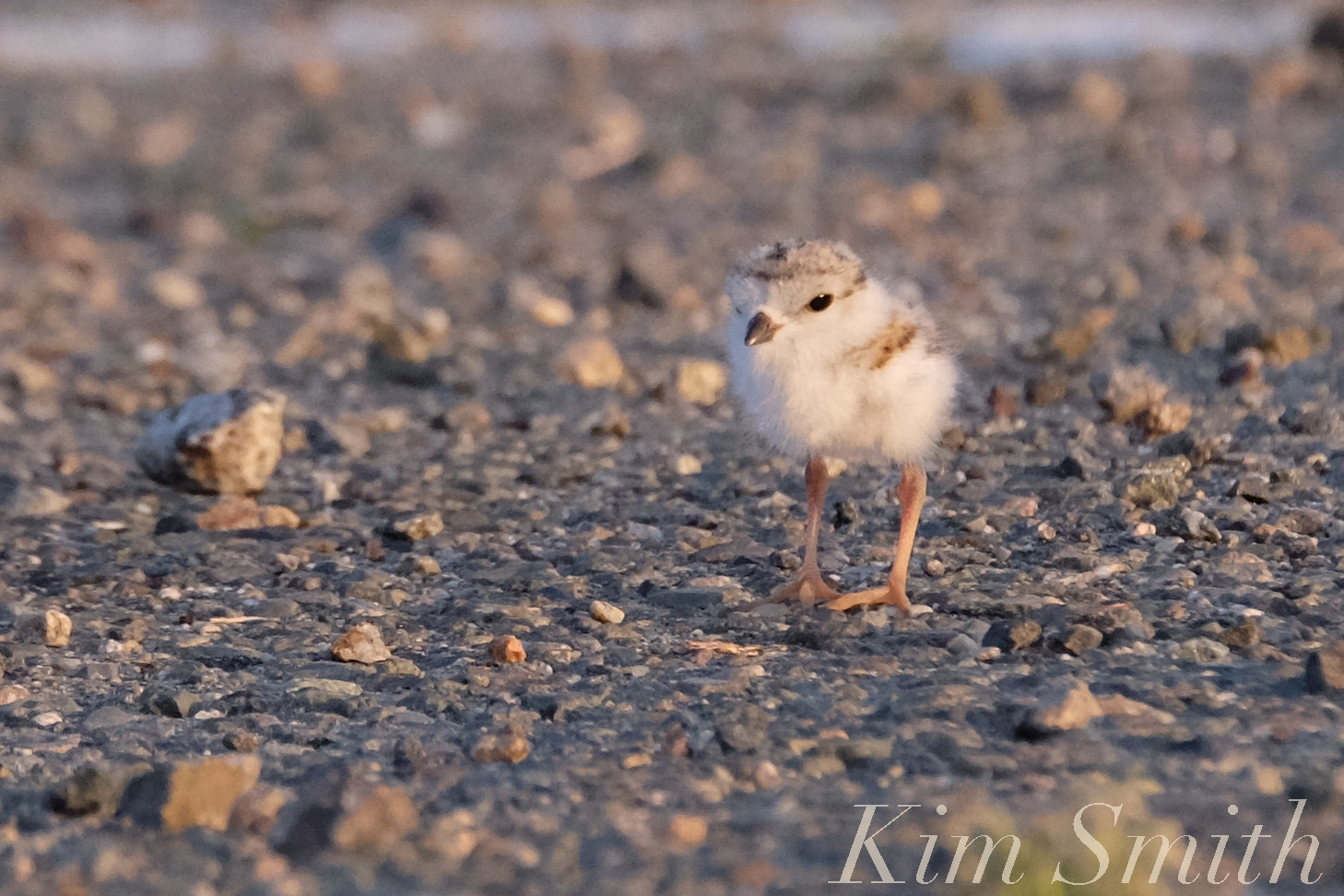
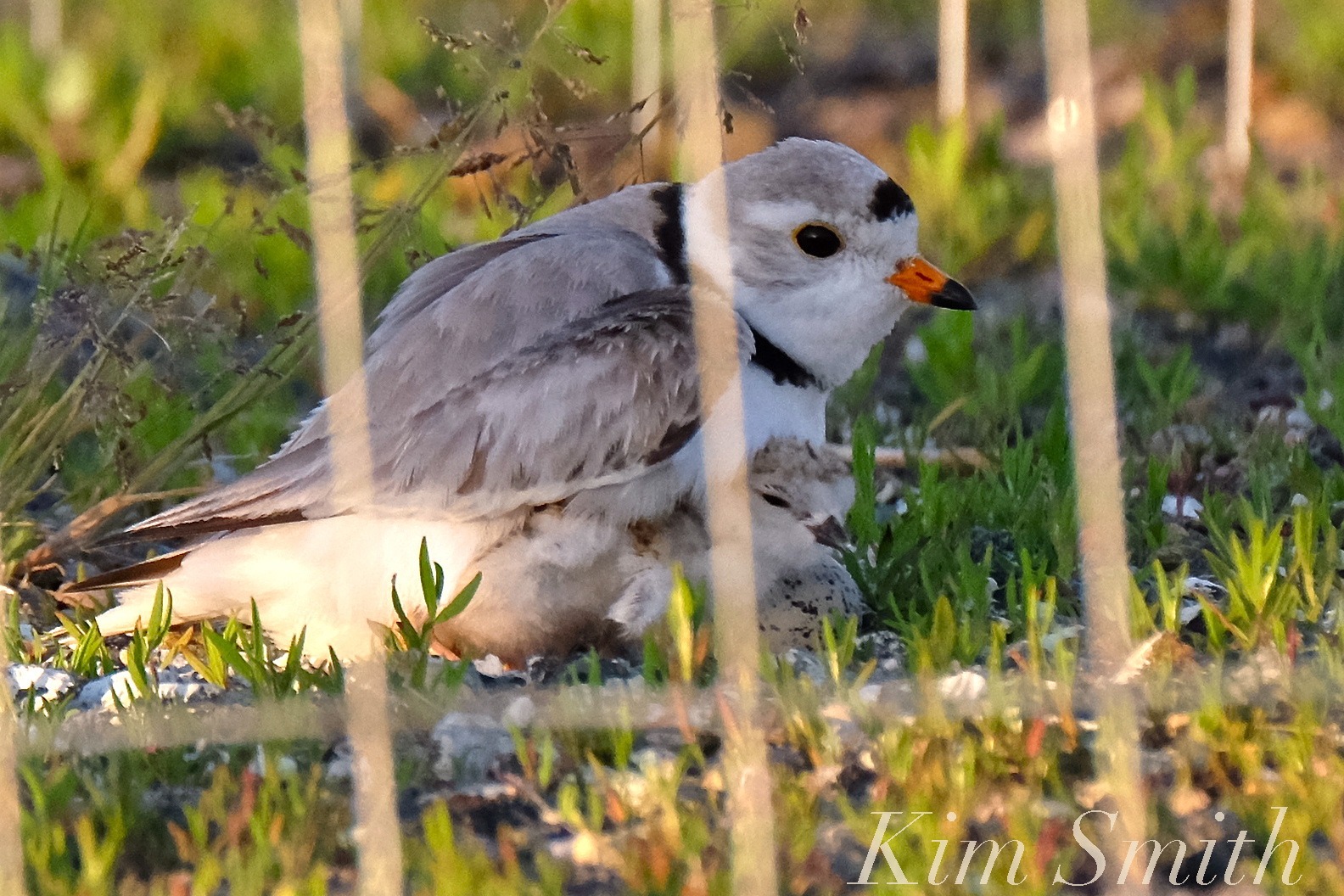
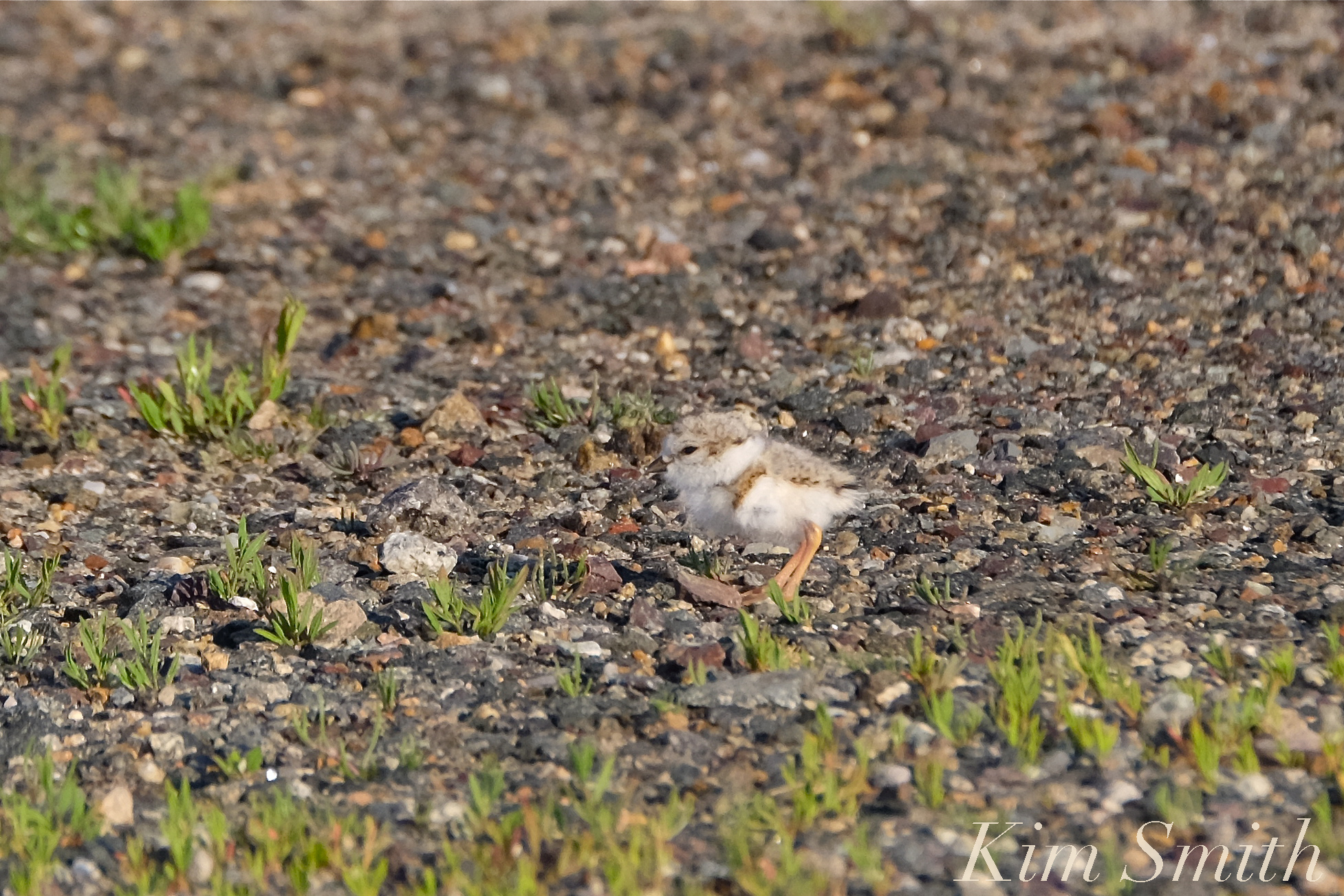
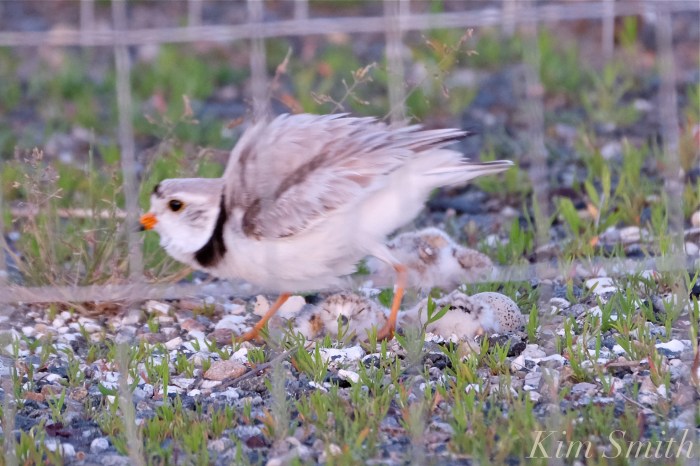
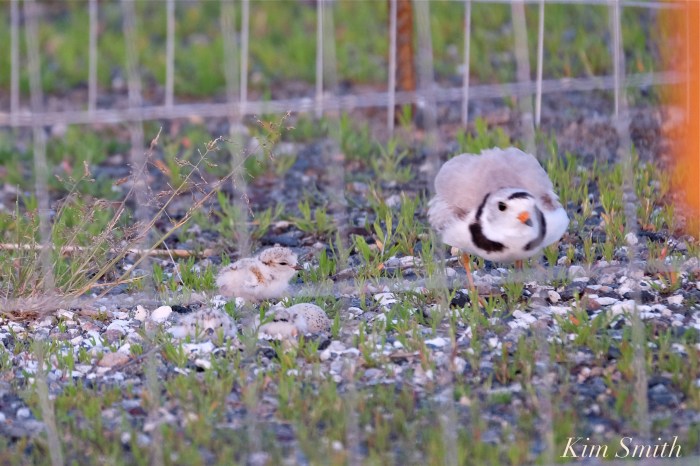
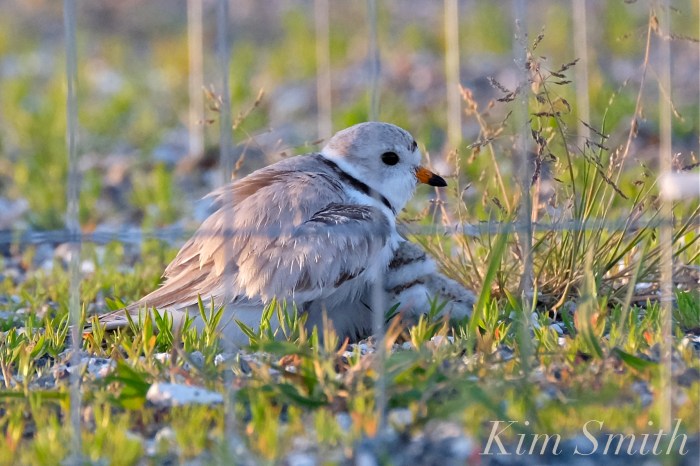
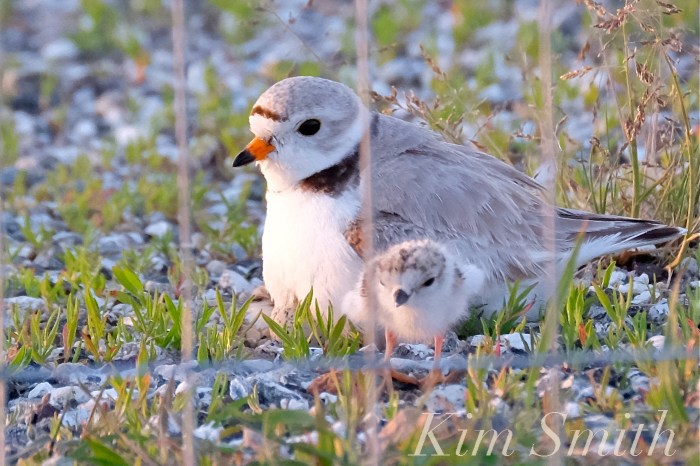
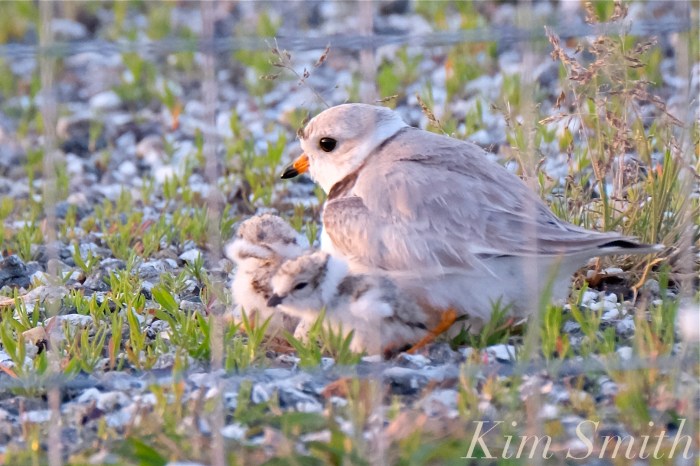
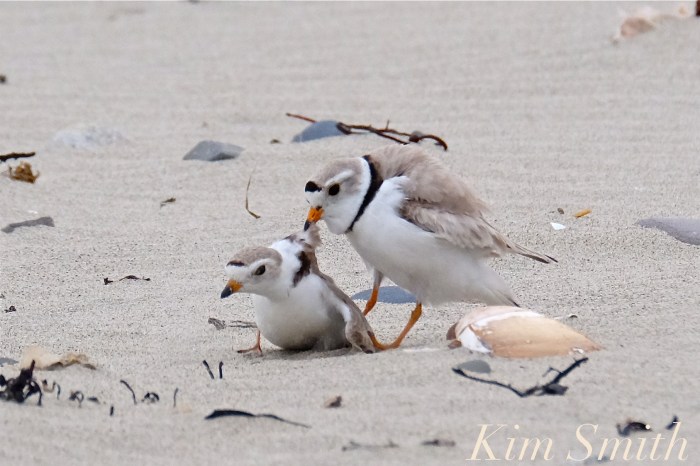
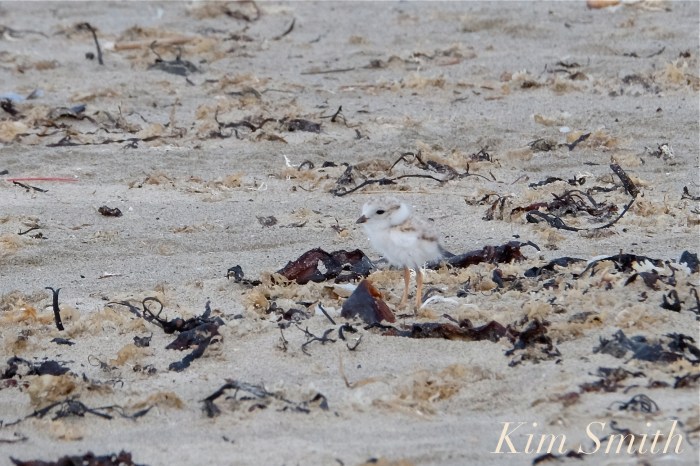
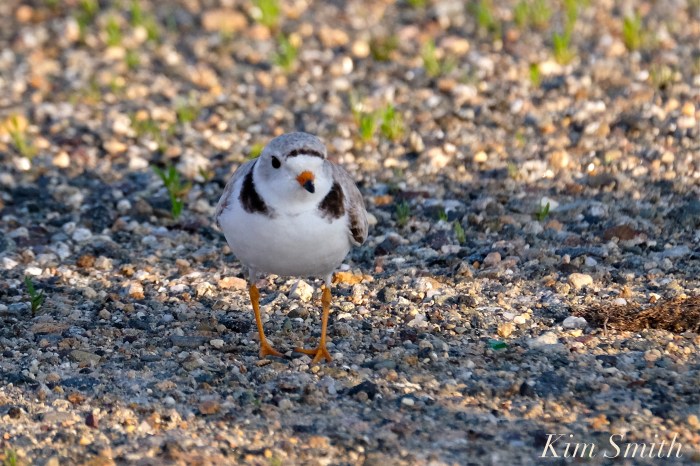
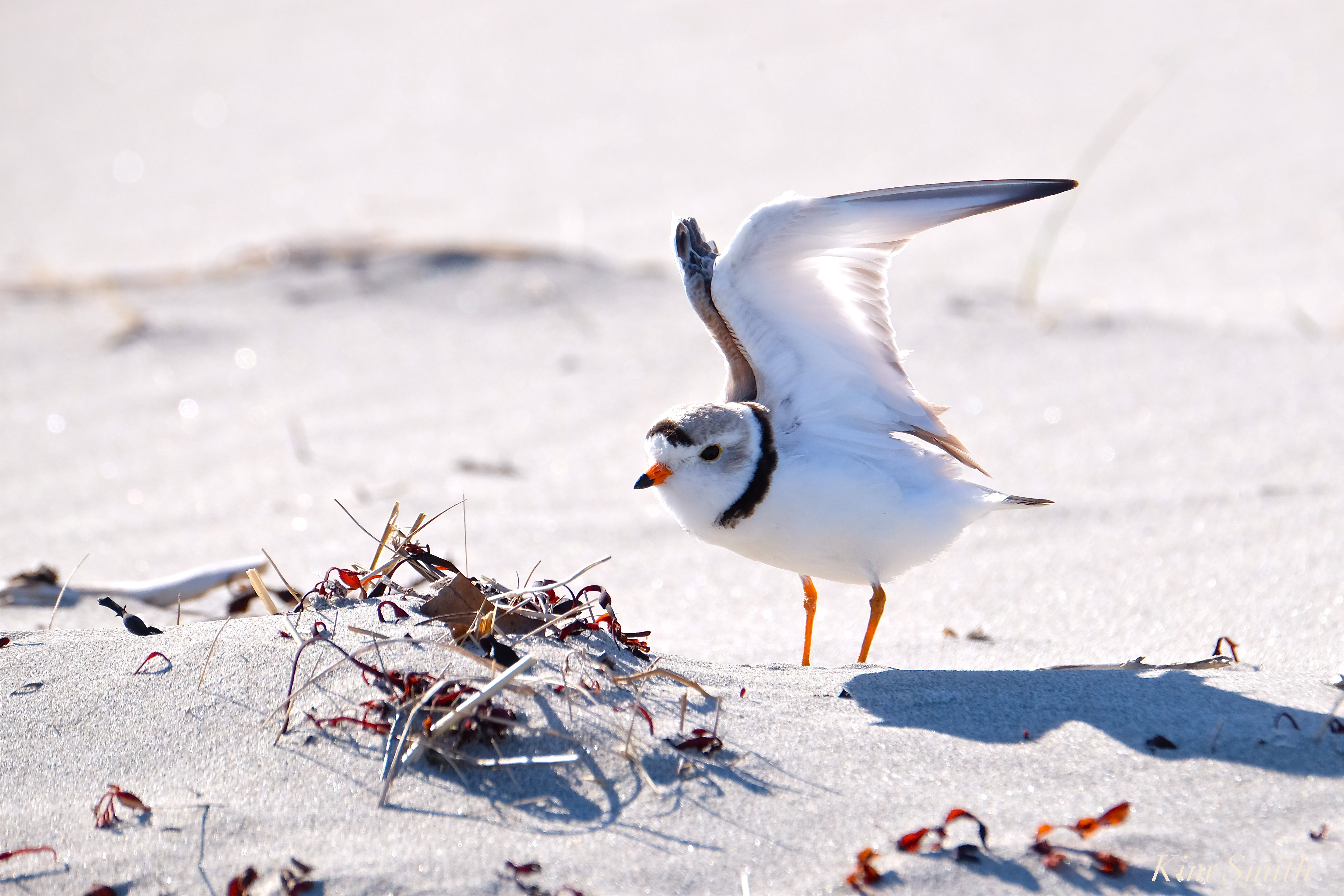
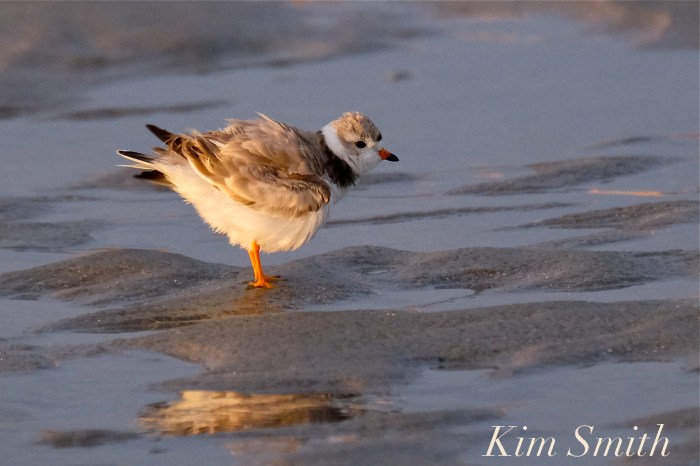
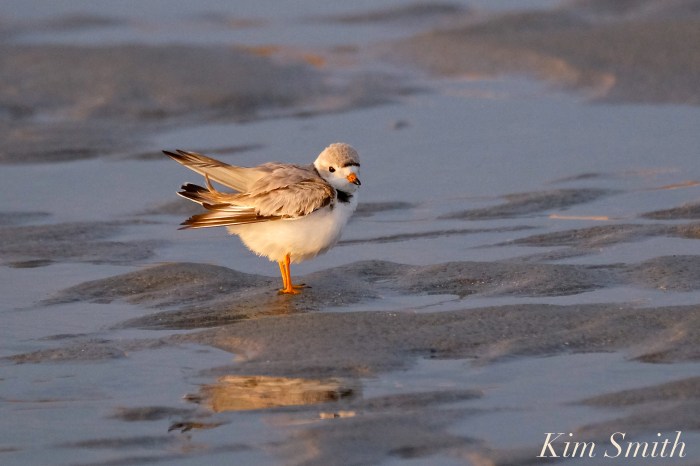
Pip grows rounder, stronger, and more capable of catching tiny sea creatures daily. We love watching the development of his wings especially. Soon his flying feathers will begin to grow. In the meanwhile, periodically throughout the day he does wonderfully zany-looking zing-zang-up-down-sideways-zig-zag mini flight tests throughout the day.

The Piping Plover’s soft sandy feather colors and patterns blend seamlessly with the surrounding beach habitat, but camouflage alone is not enough to keep the birds safe. The ability to fly to escape predatory danger is equally as important to Piping Plovers.

Massachusetts state wildlife biologists consider a Piping Plover fully fledged at 24 to 28 days, whereas federal wildlife biologists have determined a Piping Plover chick to be fully fledged at about 35 days. Judging from our observations of Little Chick last year, he did not fully fledge until five weeks old (35 days). He could manage brief sustained flight up to that time, but until he reached that five week milestone he was still at risk from predators, including and especially dogs and raptors.

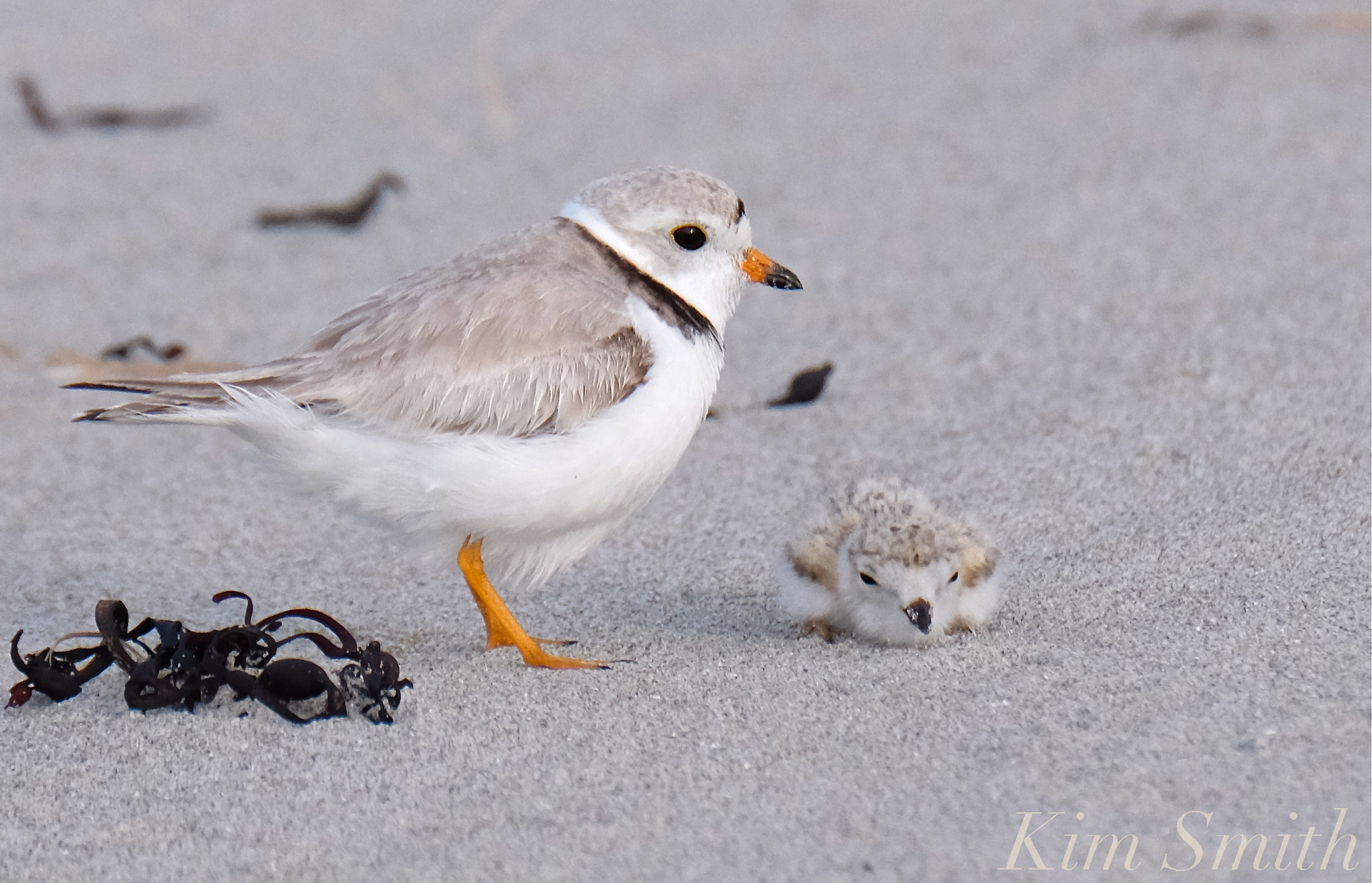
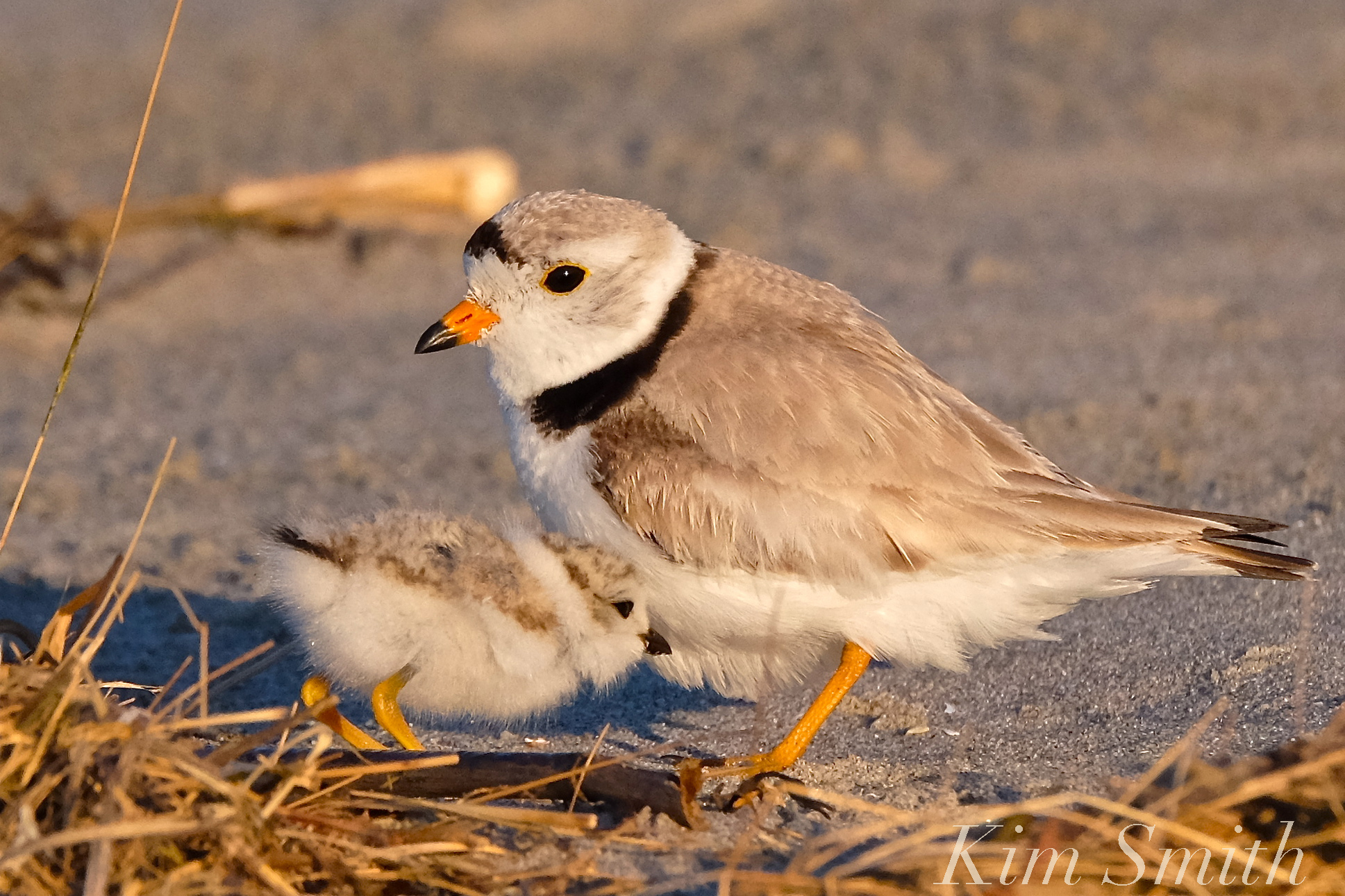
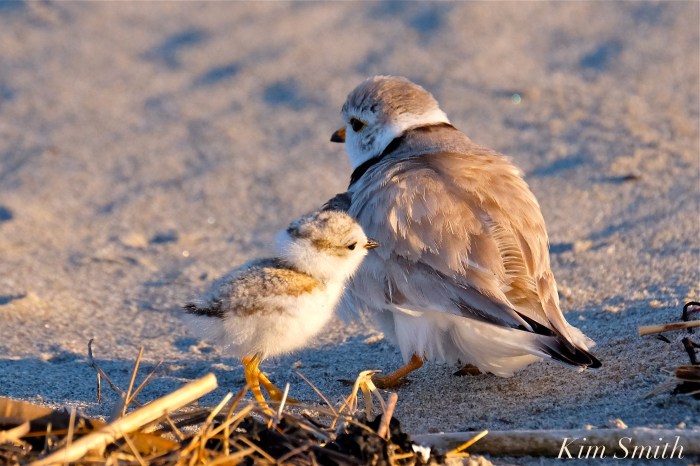
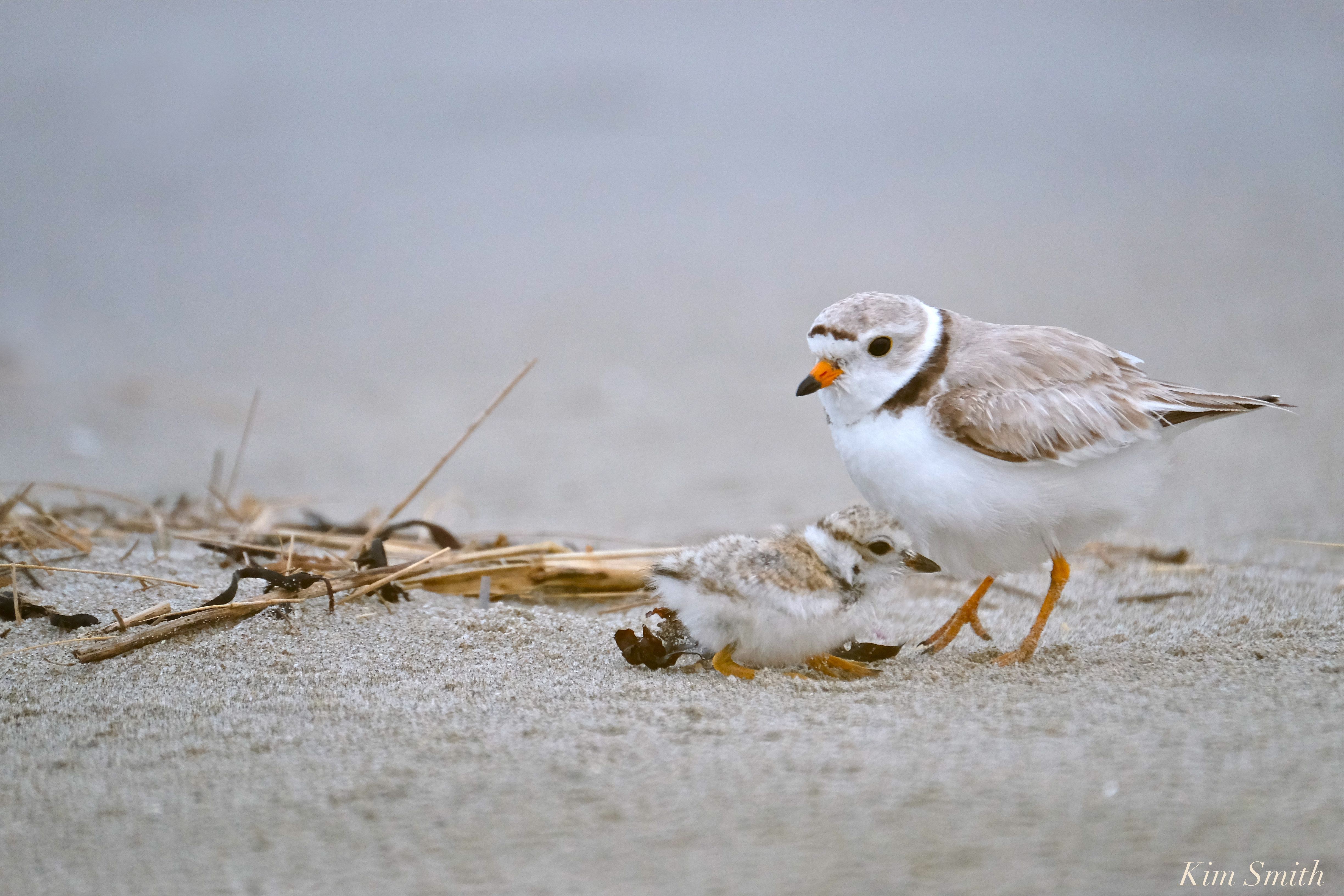
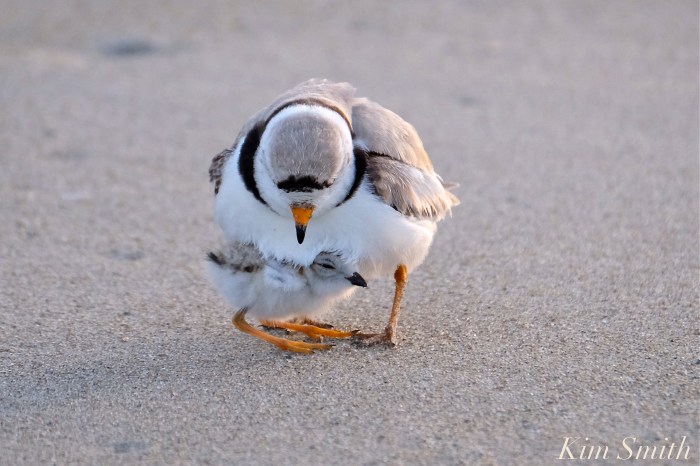
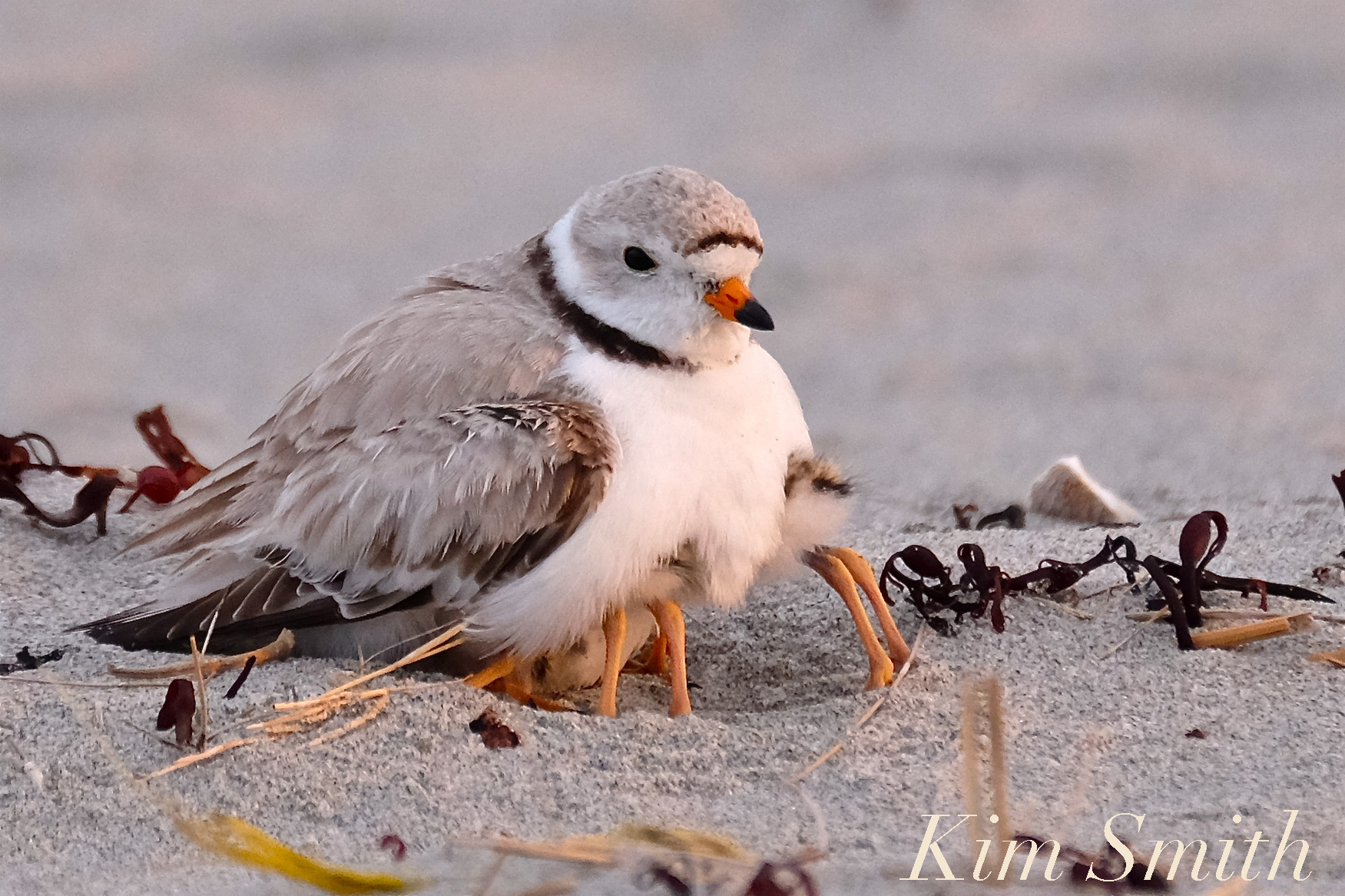
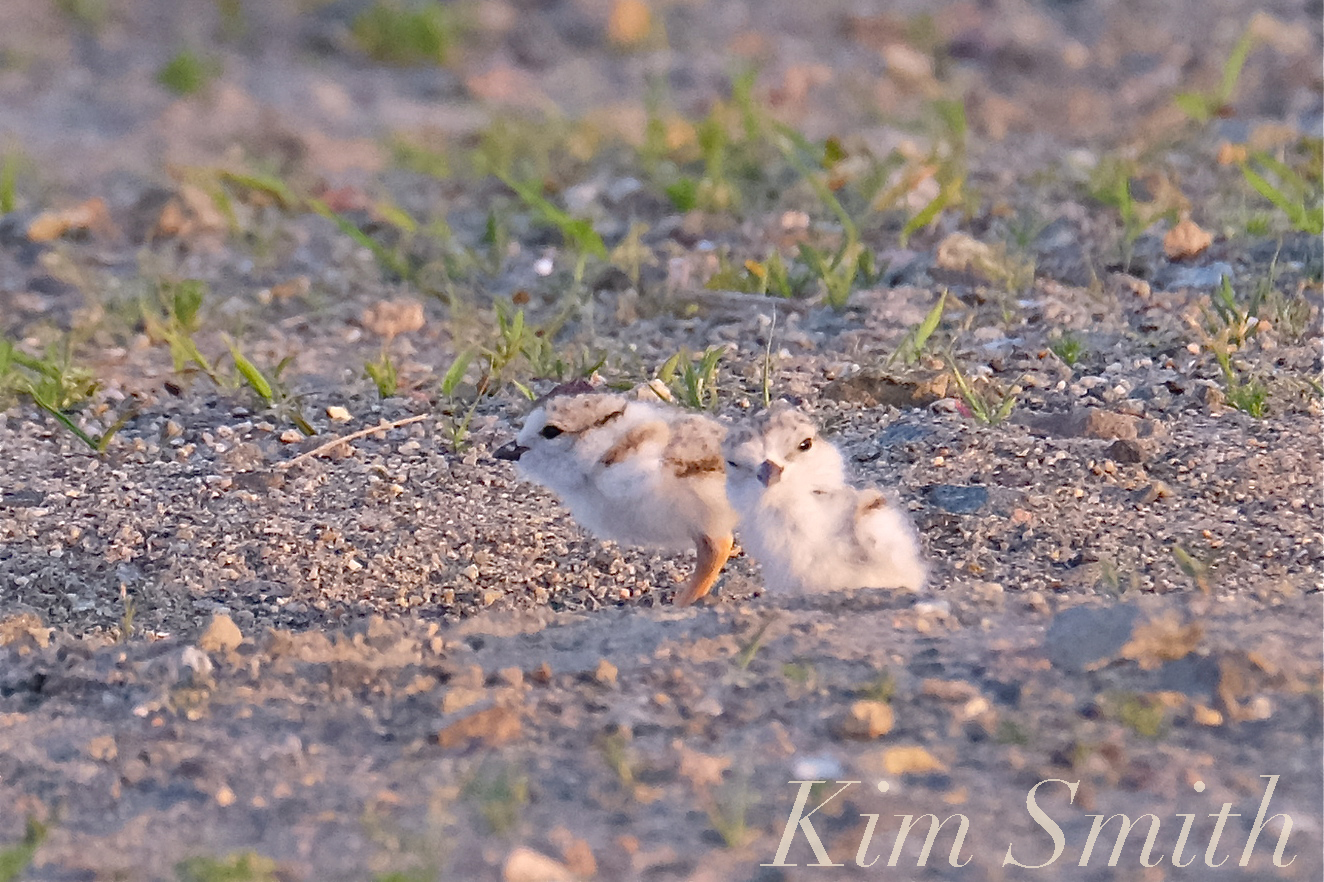
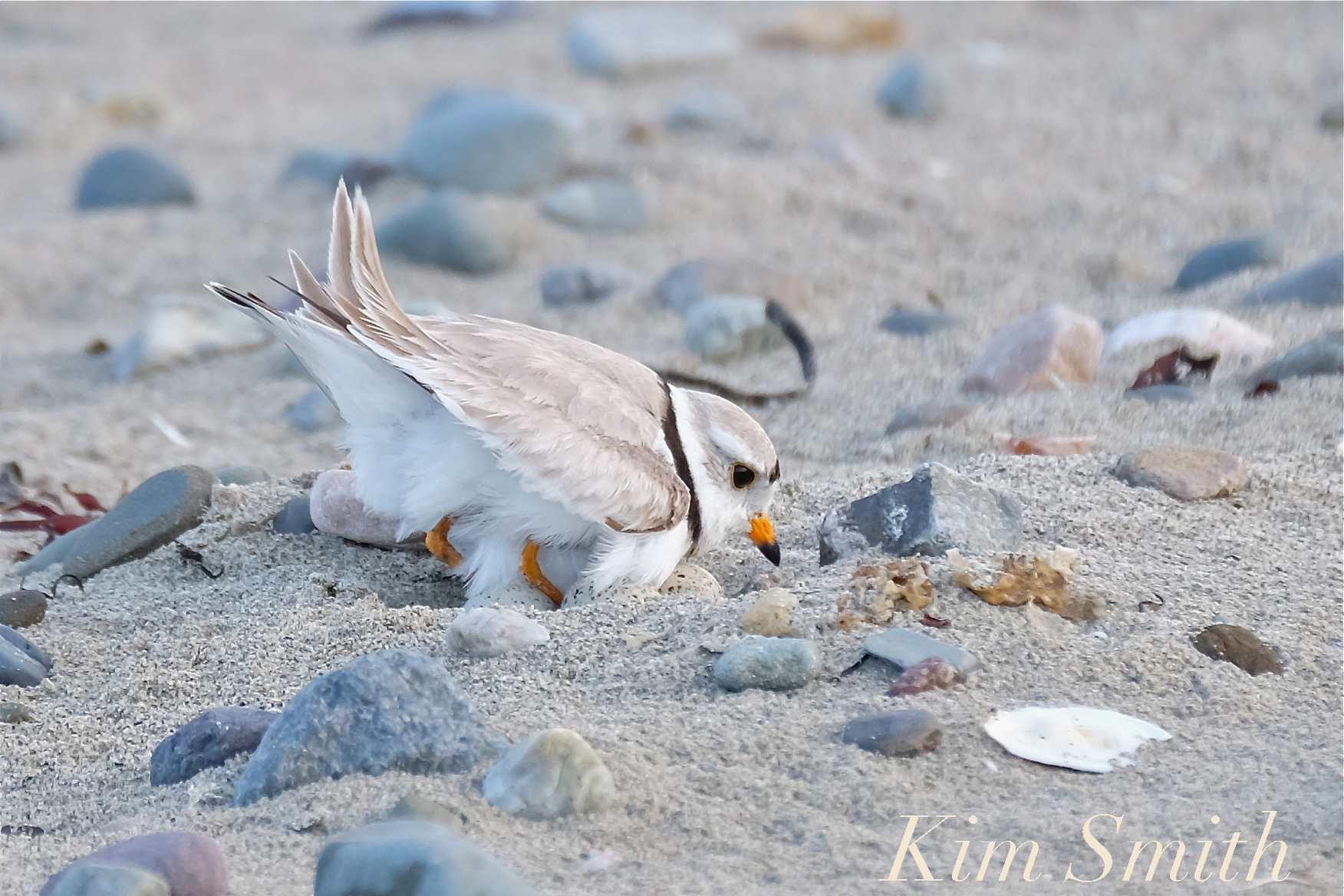
Seventeen-day-old Pip needed lots of warming snuggles on this chilly Tuesday morning.

HAPPY TWO-WEEK-OLD BIRTHDAY TO OUR LITTLE PIP!

Our Good Harbor Beach Piping Plover Little Pip made the two-week-old milestone on Saturday!!!

To survive two whole weeks is an important date for a Piping Plover chick. Pip’s chance of fledging has improved exponentially.
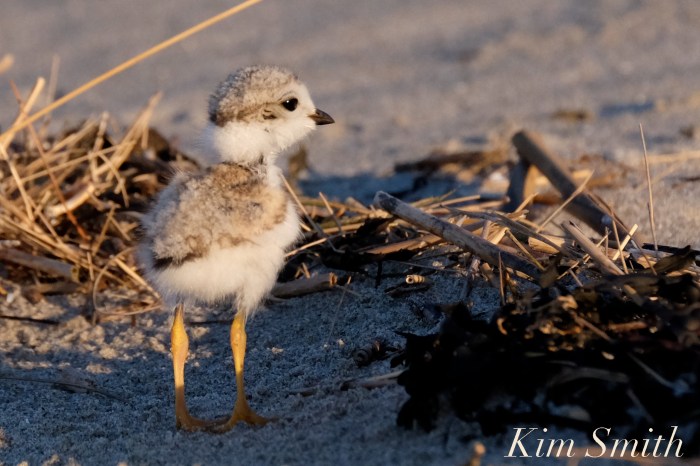
Every day he grows a little stronger, a bit taller and rounder, and noticeably faster. Less sleepy-eyed when waking up from snuggling under Mom or Dad, out he zooms from the warm wing of the parents like a jet-propelled rocket. And now he does this fascinating thing with his wings. Just as did Little Chick last year, at top speed, he zings and zangs with wings aflutter and aflap, seeming airborne for a few seconds. He won’t be able to sustain flight for another several weeks, but won’t it be marvelous when he does!
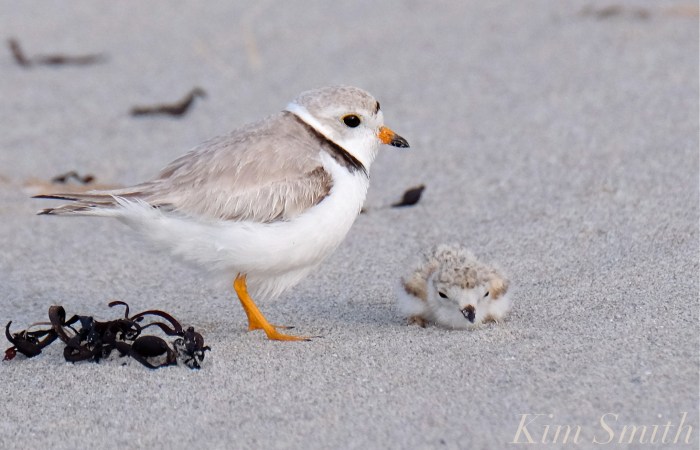
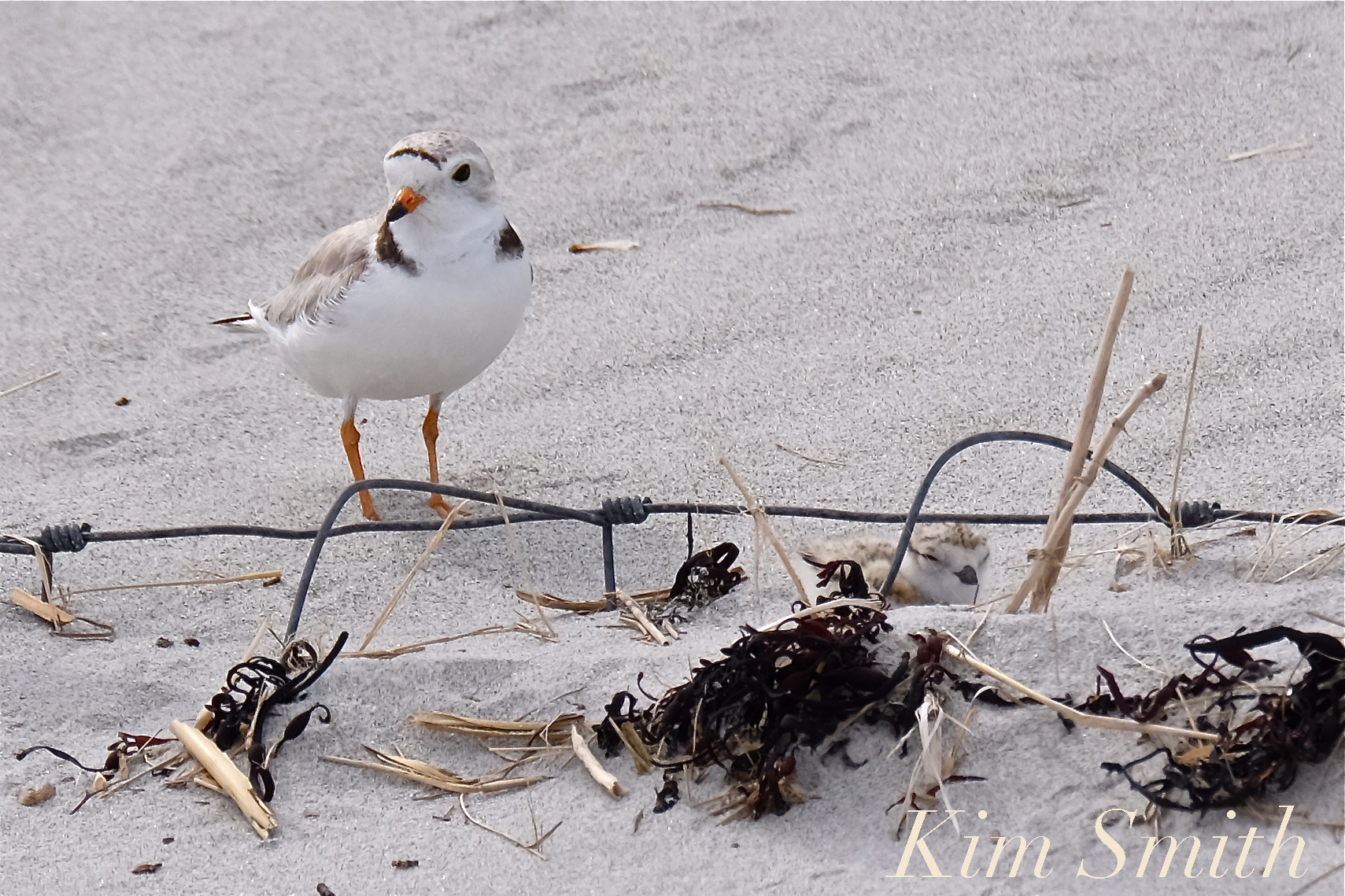
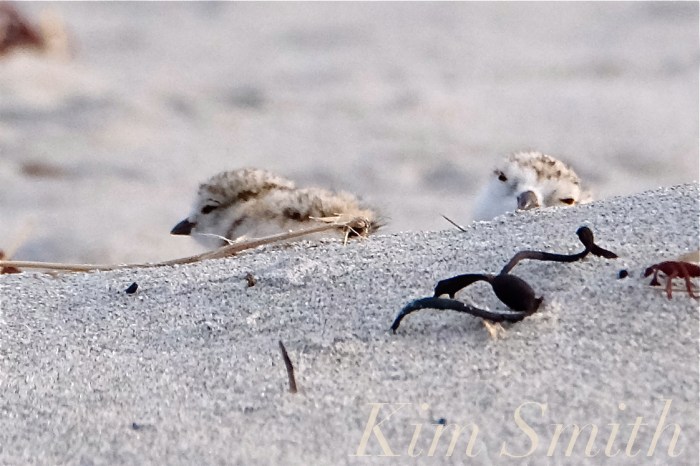
Piping Plover chicks and parents communicate with a wide range of piping calls. We are more likely to hear Mama and Papa’s shrill, urgent notes warning of pending danger. But more often, both chicks and parents communicate in soft, barely audible gentle notes. At about twelve days old, our Little Pip appeared to understand, and respond more quickly, to the piping calls of the parent’s commands. He now flattens level with the sand when Mama and Papa pipe danger notes, or when a predatory bird flies overhead.  

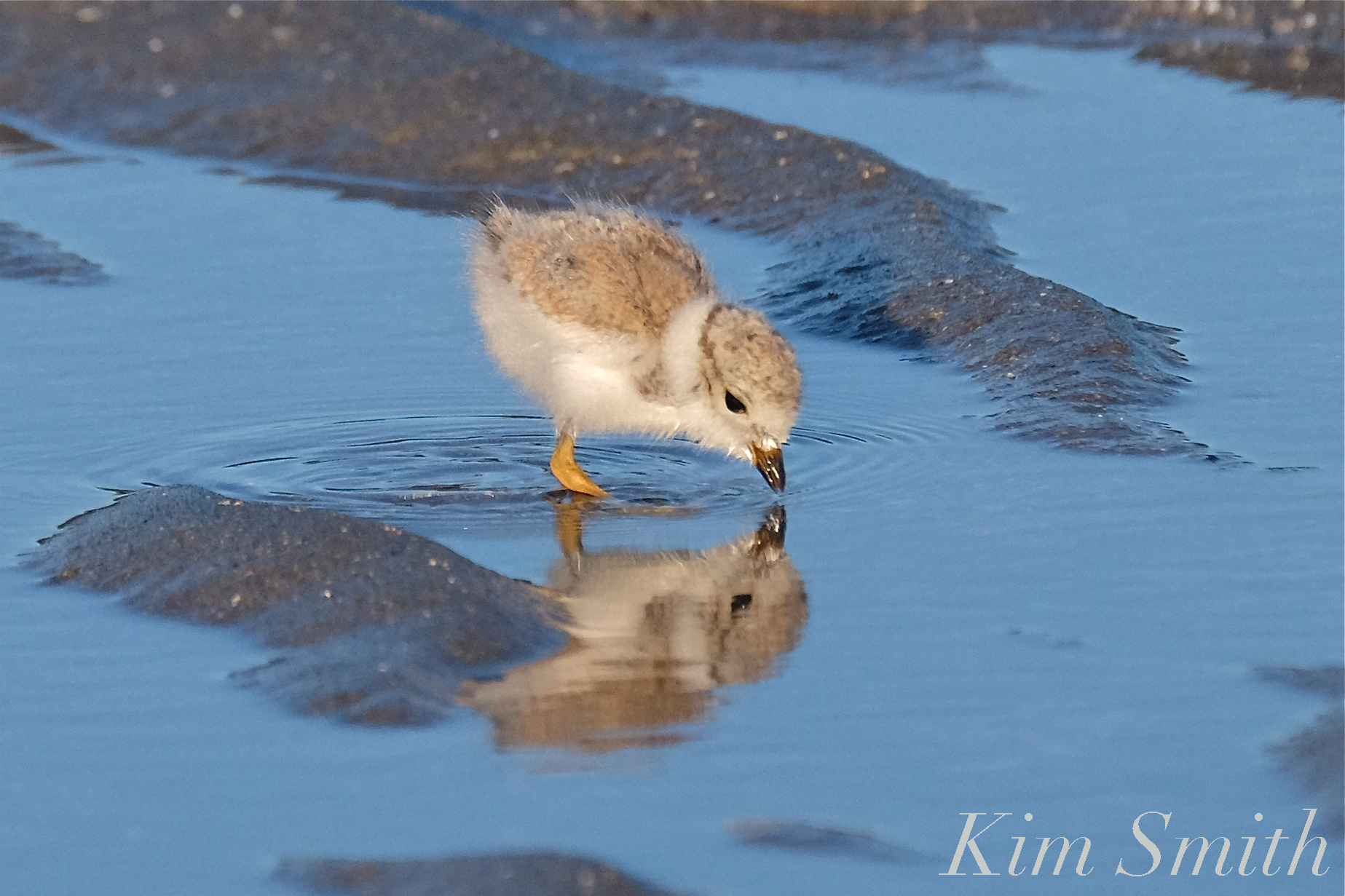
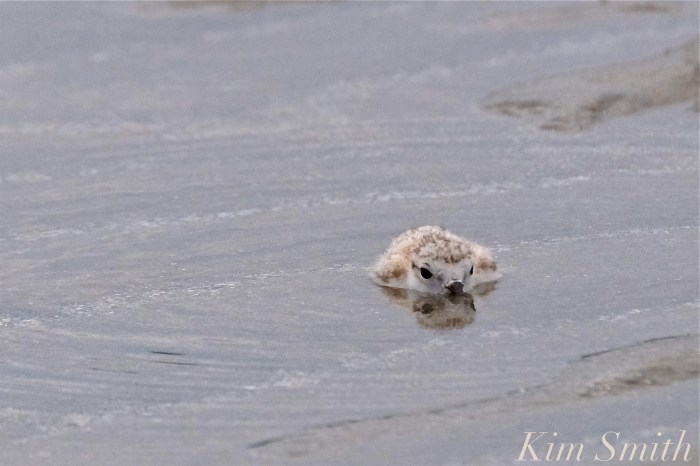
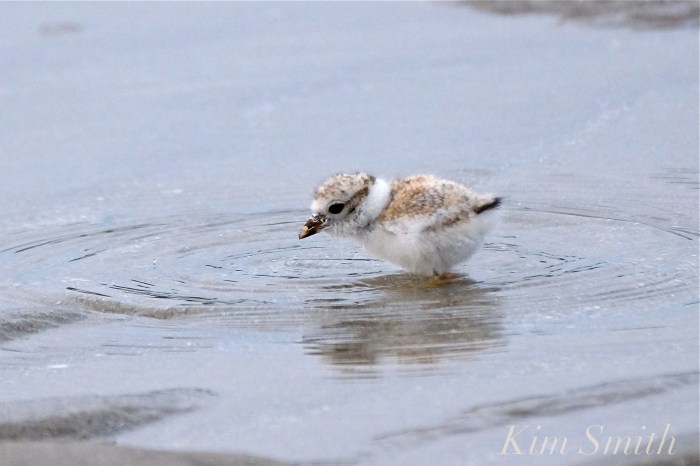
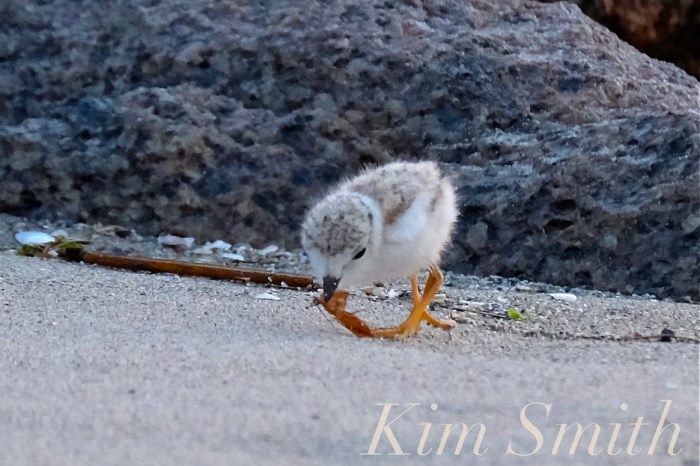
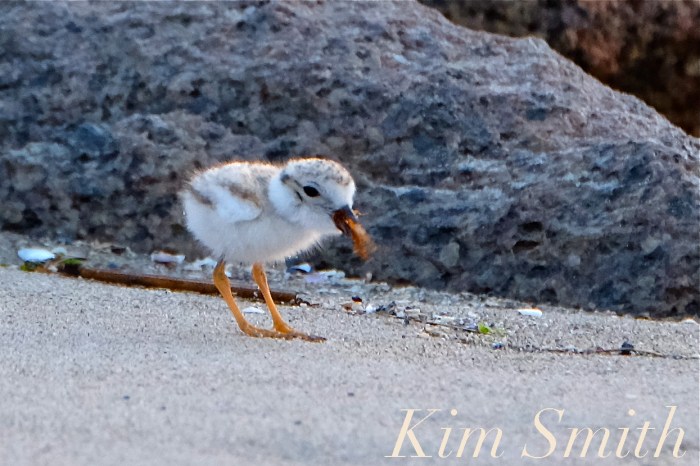
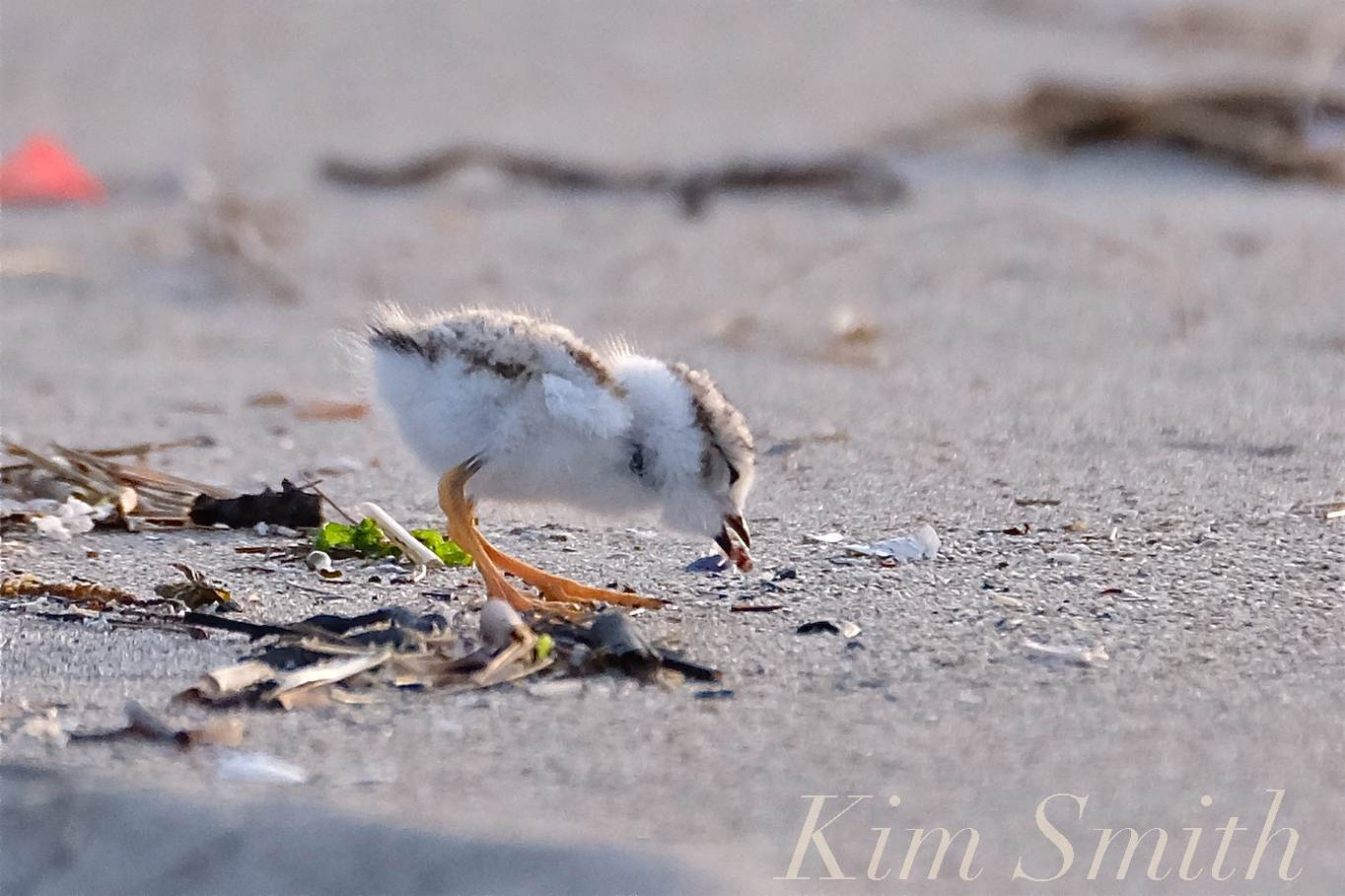
Dip-diving in the tide pools for breakfast!

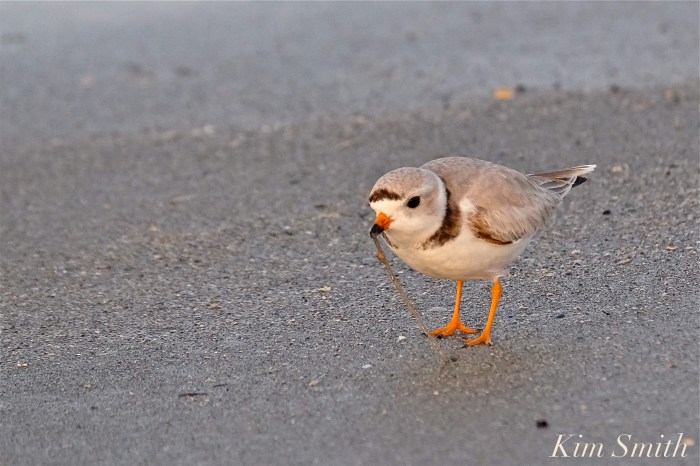
This insect was so large, from a distance I at first thought Pip was eating seaweed. He swallowed the bug in one gulp!

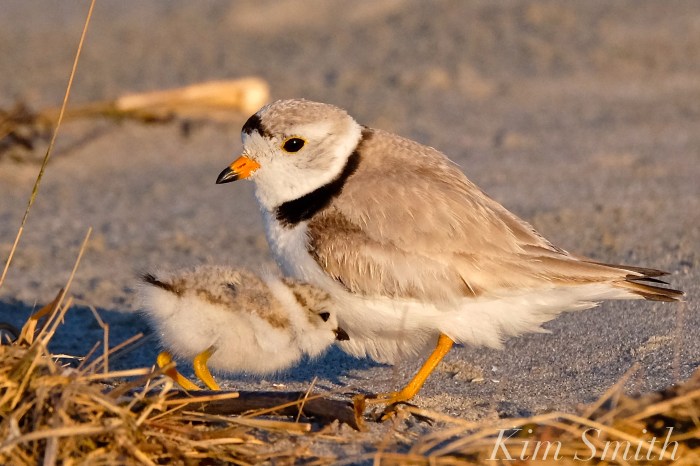
Pip continues to snuggle under wing, but will do so less and less frequently as he develops and is better able to thermoregulate. I recall our Little Chick last summer attempting to snuggle under Papa Plover even at thirty-days-old, which by the way, looked terribly silly, but sweet, to see a chick nearly as large as the parent try to snuggle under its wing.
*   *   *

Two weeks ago Saturday, our lone surviving chick hatched in the parking lot at Good Harbor Beach. Despite being driven off the beach by dogs running through the nesting area (sadly finding the lot to be the least dangerous place to nest), Mama and Papa PiPl successfully hatched four chicks from four eggs. This would not have been possible without a whole lot of help from Gloucester’s DPW, Essex County Greenbelt’s Dave Rimmer, Gloucester’s conservation agent Ken Whittaker, and a core group of super dedicated volunteers.

After spending the first day in the parking lot, the family of six–Mama, Papa, and four one-day-old chicks made the epic journey across the width of the parking lot, through the landscape of tall dune grass, tumbling down the steep slope of the dune, and into the roped off nesting area. Had Papa and Mama pre-planned this route? I think yes.

Life for a Piping Plover chick, especially at Gloucester’s most well-loved and highly trafficked of beaches, is impossibly tough. The first chick to perish was eaten by a gull, the second was taken out by a dog off leash in the nesting area, and the third, by a crow. In one way or another, the trail as to why these tender little shorebirds perished leads to the heavy footprint left by people.

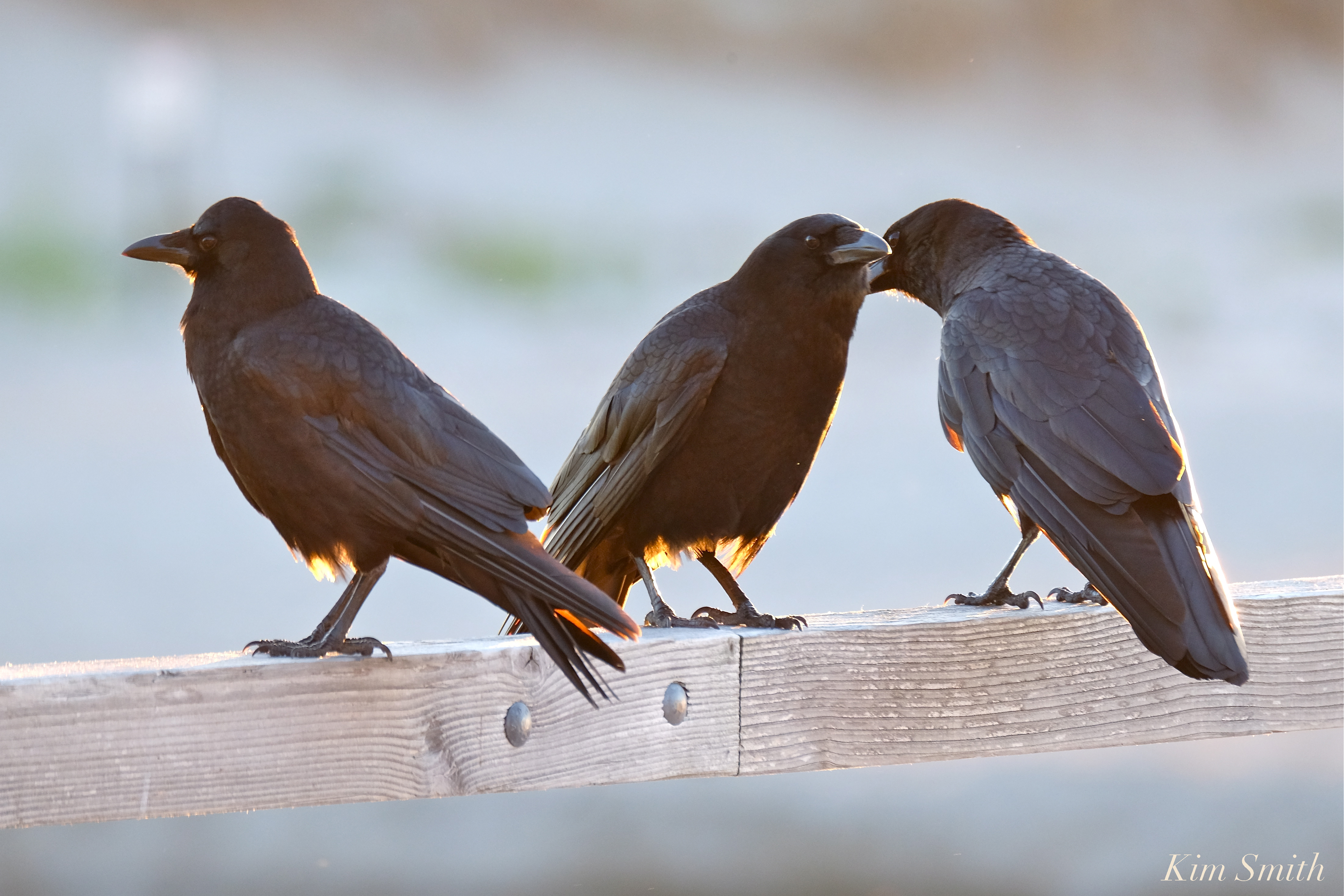
Morning meet and greet of the Crow Breakfast Club, held every day on Nautilus Road following a warm sunny beach day.

Same for the Seagull Breakfast Club

Gloucester does not have a seagull and crow problem, but we do have a littering, as well as a lack of trash barrels problem. If the crows and gulls were not finding the mounds of trash littering the beach, and piled at the entryways to the beach, each and every single morning, they would simply find somewhere else to forage. Bright and early, every morning the DPW crews arrive to clean the beach, but what happens before they arrive? For the first three hours of daylight, the crows and gulls devour a smorgasbord of tantalizing treats, feasting on loose garbage strewn the entire length of the beach, in the parking lot, and at all the entrances to the beach. Forget placing the garbage in bags if the bags are not contained in barrels; the birds, rats, and coyotes knowingly rip right through them. The plastic cups, bottles, to-go containers, and accoutrements blow freely through the dunes and marsh and eventually, all is carried into the ocean.

The trash problem holds true throughout the city. If folks stopped feeding the crows and gulls, and we solve the garbage problem, we will rid ourselves of ninety percent of the issues surrounding gulls, crows, coyotes, and rats. Carry in, carry out works to a degree, but barrels are sorely needed at locations such as the entrance to the footbridge. Additionally, residents would ideally place their garbage, in barrels, the morning of trash collection (as opposed the the night before), dumpsters always kept tightly covered, and littering laws strictly enforced.

A friend from North Carolina shared that the beaches in her community are pristine. How do you do it I asked? Two simple solutions. Number one is barrels and number two is enforcing littering laws. Every few weeks, police patrol the beaches and hand out fines for littering. After a few weeks or so, people become lax about littering, and out come the police handing out another round of fines. Would this be a money-maker for the City of Gloucester I wonder?

Plastic glistening in the morning sun – Good Harbor Beach, before the DPW arrives.

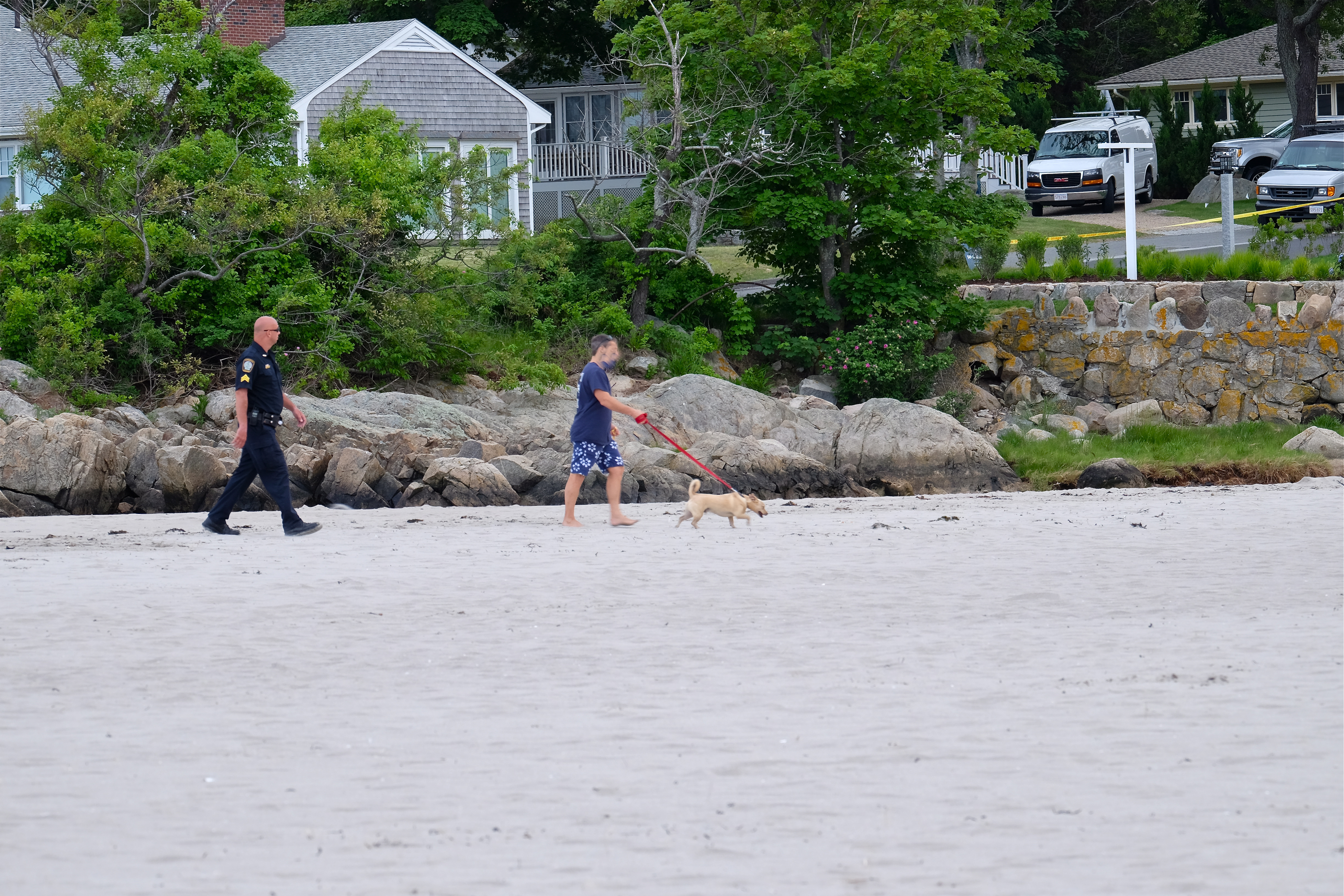
Dogs off leash at Good Harbor Beach continue to frustrate us all. Despite stepped up enforcement, local residents and out-of-towners continue to flaunt the rules and the No Dogs signs. Every single day, we monitors see dog owners with their dogs, and dog tracks, at Good Harbor Beach.

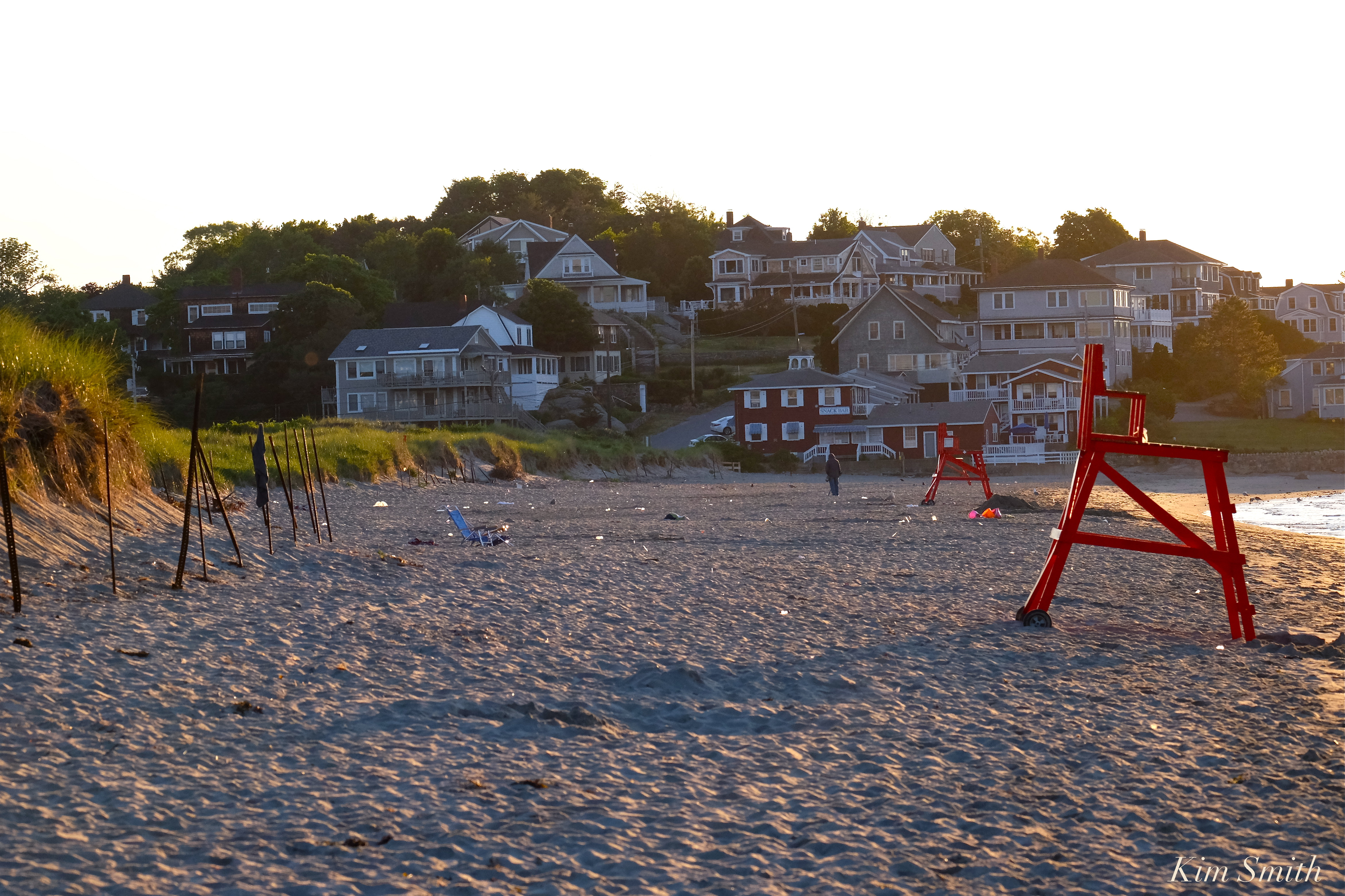
Dune fencing, which is slated to be replaced after the Piping Plovers leave, is going to help to keep the dogs (and people) out of the dunes. I hope well placed signs that speak to the fragility of the dunes will also accompany the new fencing. If you can imagine, people allow their dogs to run freely through the dunes and also use the dunes as their personal bathroom. Sometimes the scofflaws don’t even bother to climb the dunes, but run right through the nesting area and stand in broad daylight at the base of the dunes, in full view of all, to relieve themselves.
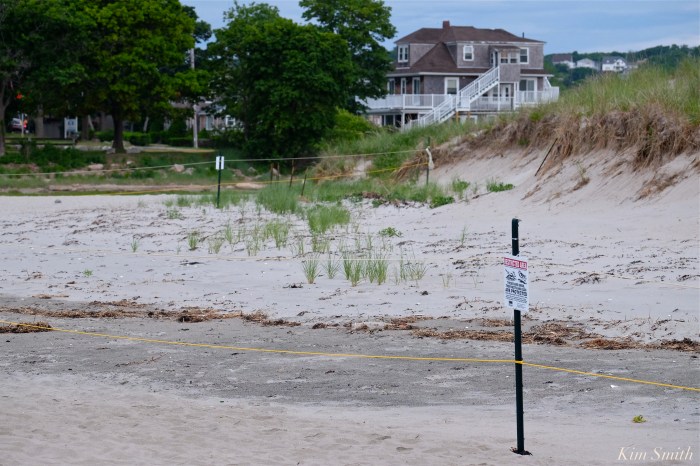
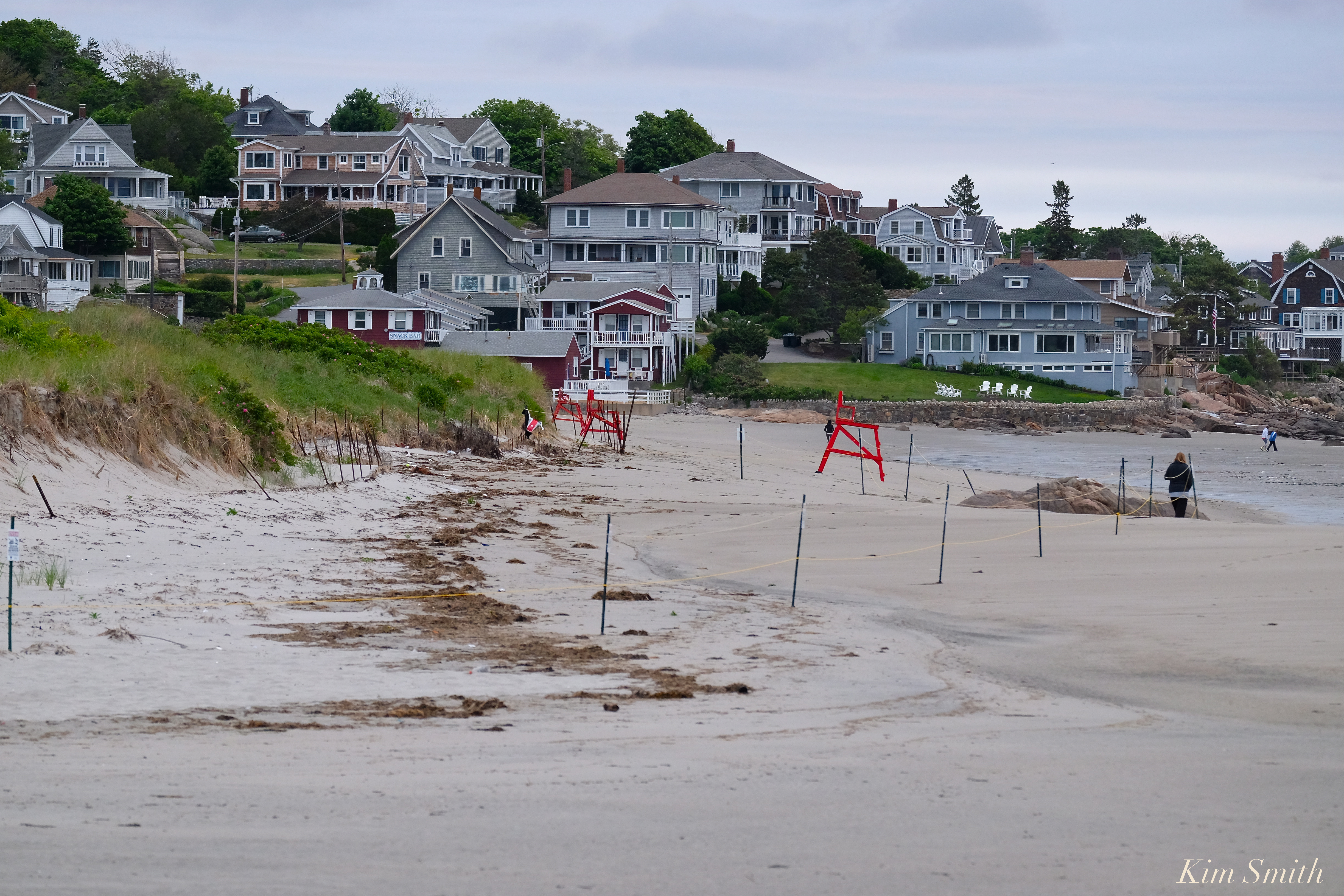
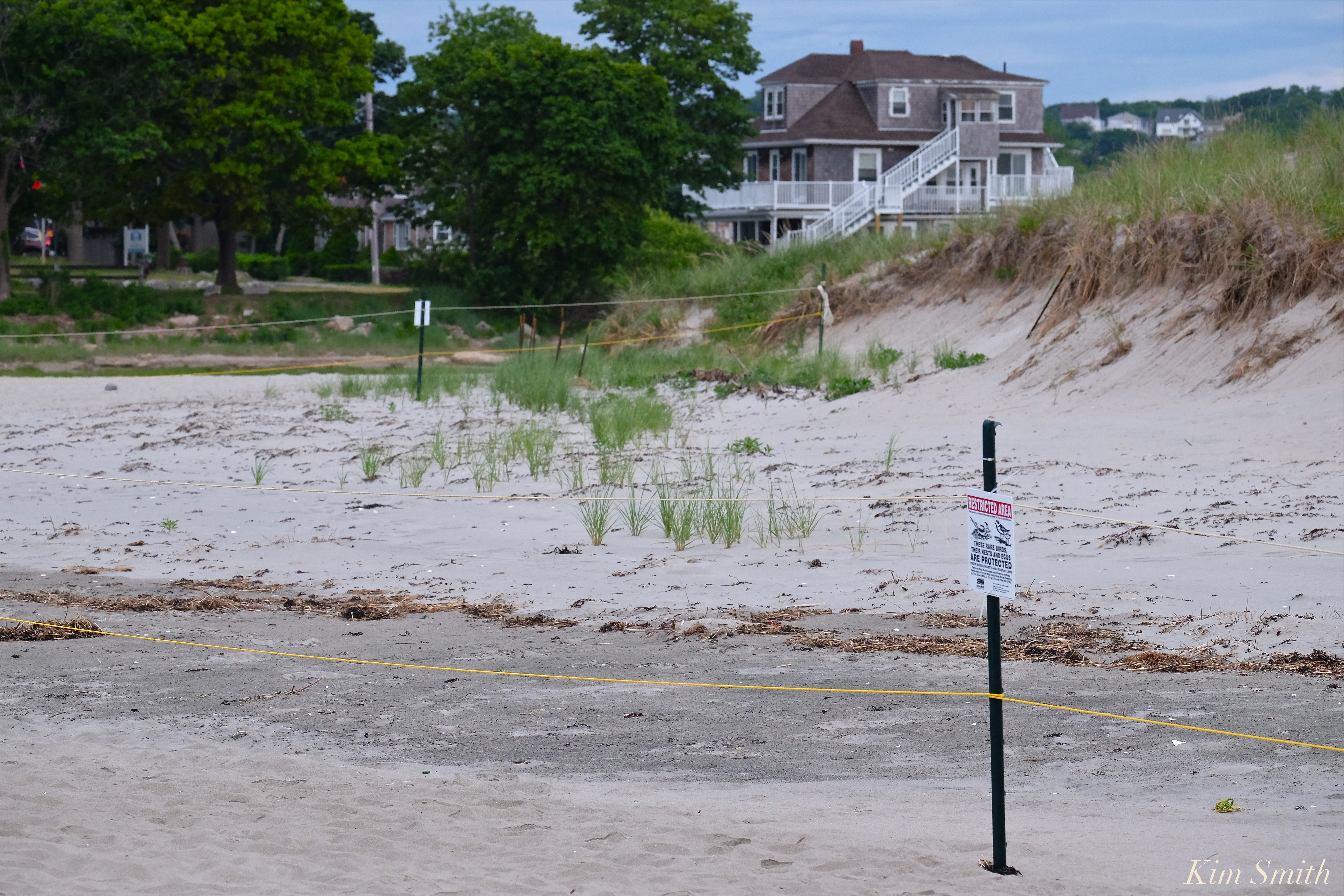
Note the beach grass growing at the base of the dunes where the roping has been in place since mid-April. I hope this area continues to be roped off, even after the PiPls depart. Growing sturdy patches of dune grass will help tremendously with the ever increasing problem of beach erosion.
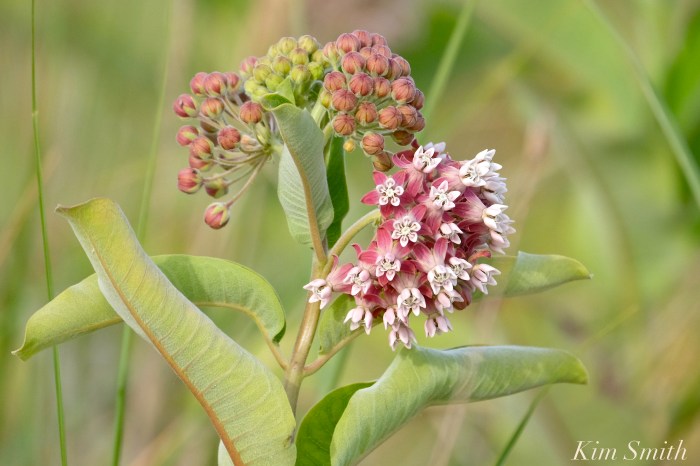
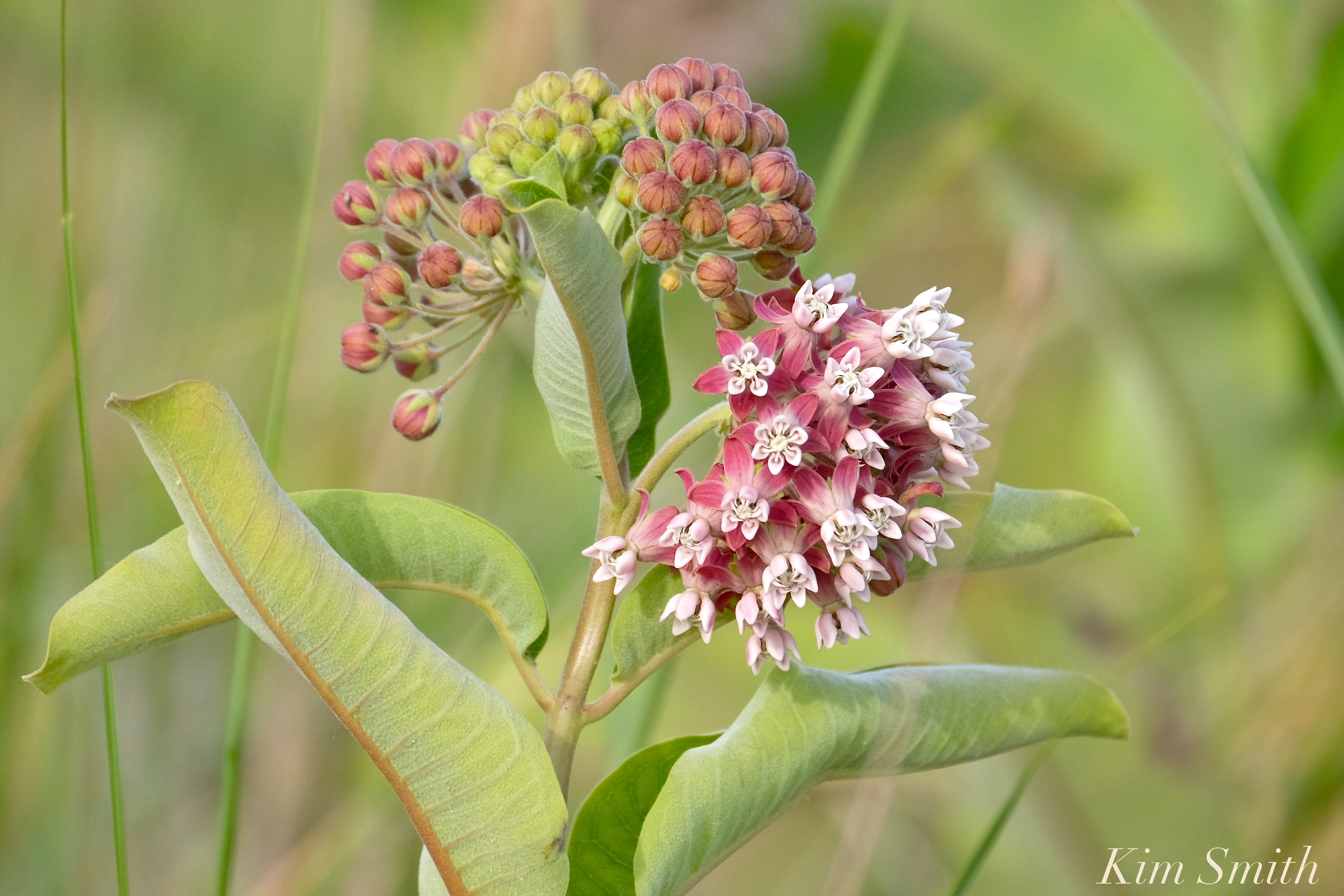
Common Milkweed (Asclepias syriaca) is coming into bloom at the Good Harbor Beach dunes. The many species of wildflowers found growing in the dunes provides myriad species of wildlife with both food and shelter.
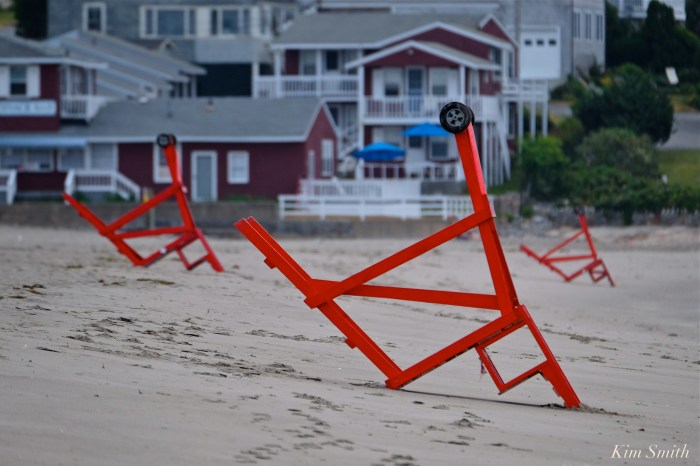
Why?

Fifteen-Day-Old Piping Plover Chick and Mama 


WHAT DO PIPING PLOVERS EAT?

“What do Piping Plovers eat, especially the chicks?” is one of the questions most frequently asked of our volunteer monitors. 

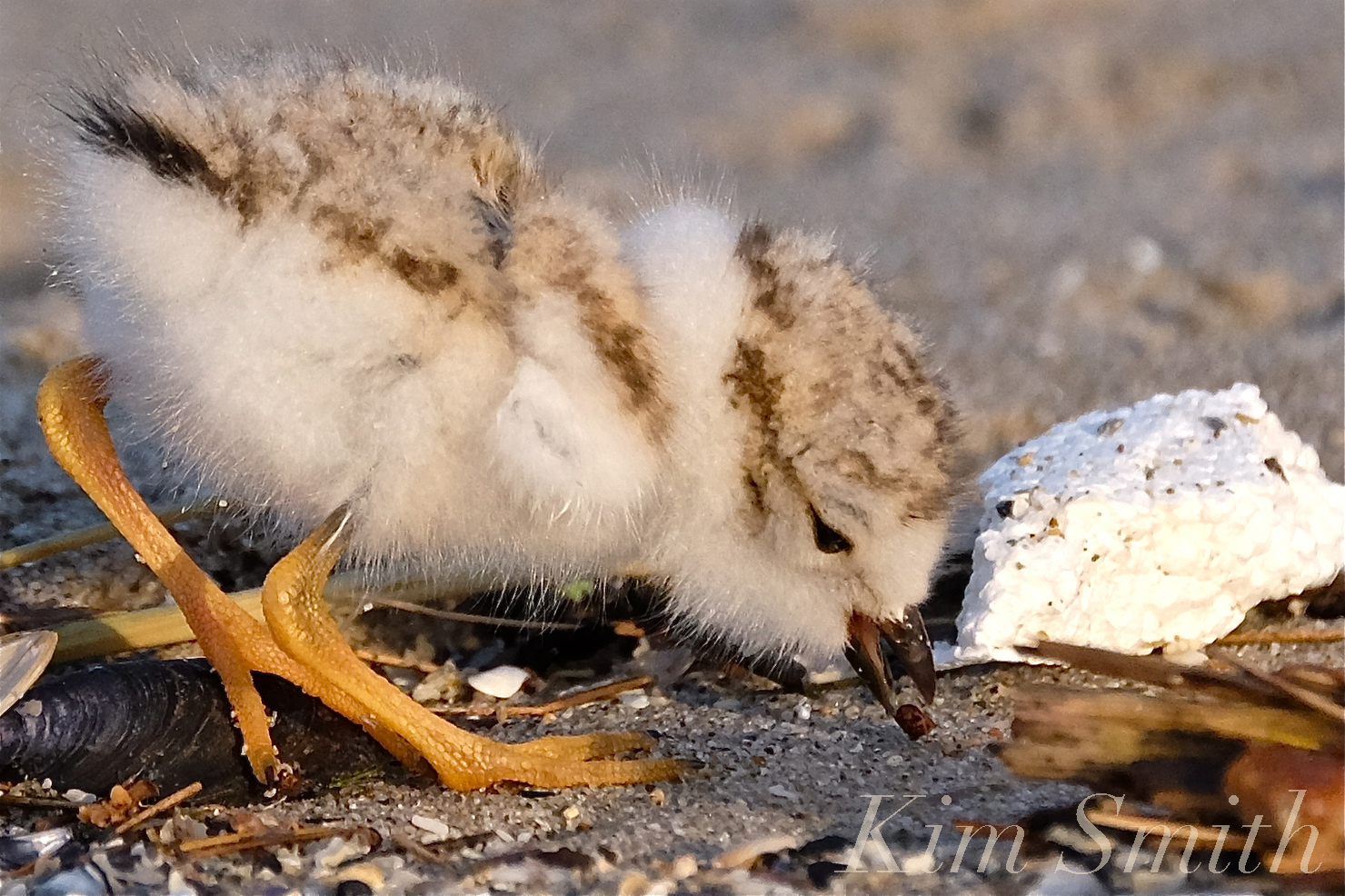
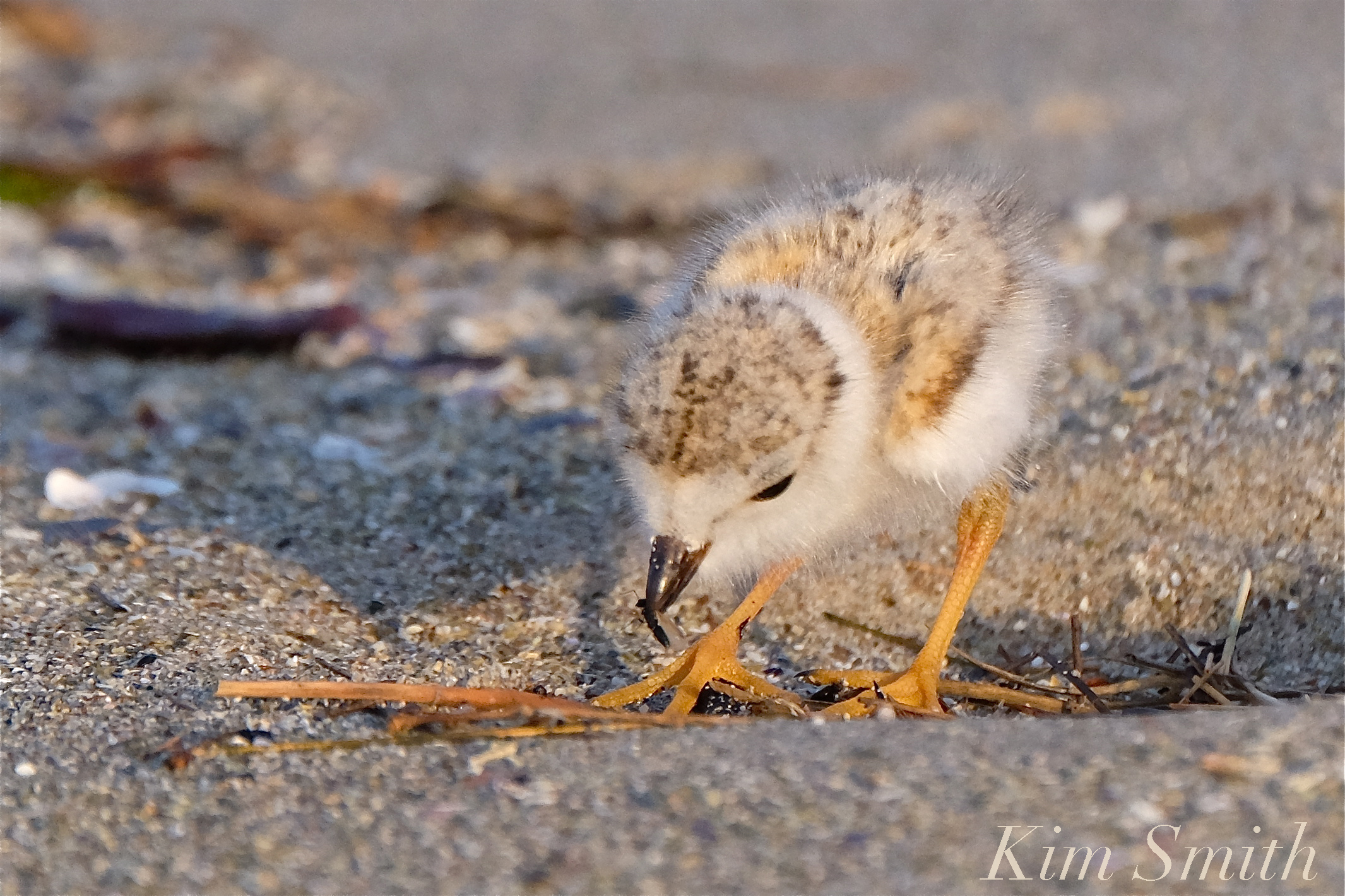
Piping Plover chicks eat everything the adults eat, only in smaller bites, and pretty much anything they can catch. We’ll often see the chicks pecking repeatedly in one spot. Unlike Mama and Papa PiPl, they don’t always eat the insect in one swallow. The chick will chase after the insect and eat it in several beakfulls.

Piping Plovers forage at the shoreline, in the intertidal zone, and at mud and sand flats. While running, they scan the immediate area, and then peck at the prey it locates. When by the water’s edge and in the sand flats, they eat sea worms, tiny crustaceans, and mollusks. When around the wrack line, they find teeny insects including spiders, beetles, ants, and insect larvae.

Here’s our little Pip at eight days old feeding on a winged insect. Piping Plover chicks begin pecking and looking for food within hours after hatching.

If you would like to be a Piping Plover volunteer monitor, please contact kwhittaker@gloucester-ma.gov. Thank you, and the PiPl thank you, too 🙂

SHOUT OUT TO GLOUCESTER’S ANIMAL CONTROL OFFICER JAMIE LEVIE

How terrific to see Officer Jamie Levie at Good Harbor Beach bright and early this morning- and a quiet peaceful morning it was. Officer Teagan Dolan was at GHB yesterday morning, too. Our sincerest thanks to ACOs Jamie and Teagan, and to Chief John McCarthy for the stepped up patrols at Good Harbor Beach and for all their kind assistance with our GHB PiPl family.


DEBUNKING PIPING PLOVER MYTH #5: PIPING PLOVER HELPERS ARE NOT CALLING FOR AN OUTRIGHT BAN OF DOGS ON THE BEACH

Despite the extremely inflammatory posts you may have been reading elsewhere, the Piping Plover volunteer monitors and local wildlife experts are not in any way, shape, or form promoting the permanent ban of dogs from Good Harbor Beach.

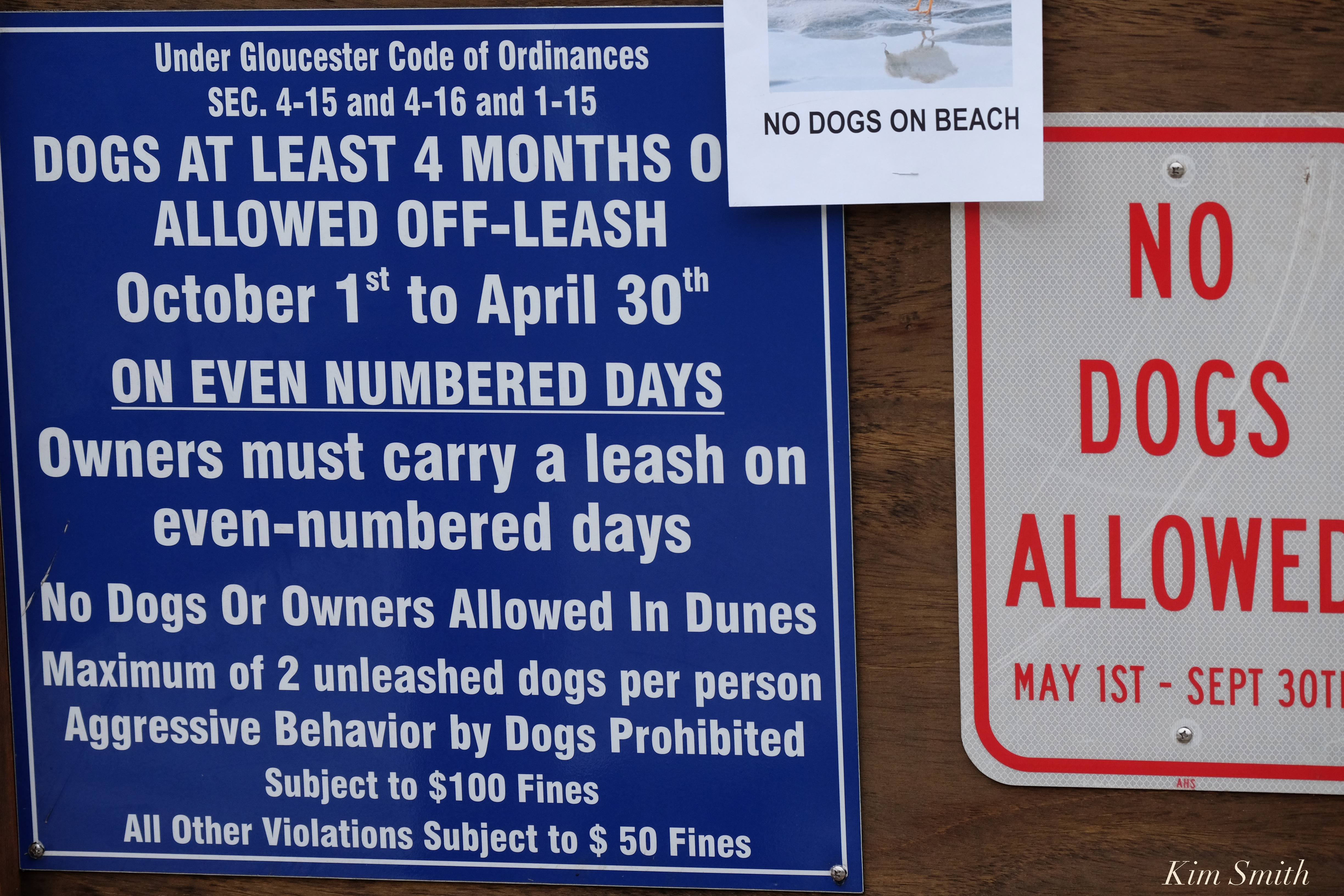
Currently, dogs are not allowed on the beach from May 1st to September 30th. The PiPl volunteer monitor core group, Dave Rimmer from Greenbelt, Ken Whittaker, who is Gloucester’s conservation agent, and Mass Wildlife’s John Regosin all agree that dogs should not be allowed on Good Harbor Beach beginning April 1st, but that it would be safe for Piping Plover fledglings and other migrating shorebirds for dogs to return after September 15th.

This new suggested time frame will allow birds to nest with far less interruption, shorebirds will nest earlier in the season (which will help with the chicks survival rate), and the chicks will be stronger by the time Good Harbor fills with summer crowds. This is a very logical and simple solution. Disallowing dogs on Massachusetts coastal beaches where shorebirds are nesting, beginning April 1st, is quite common. Allowing them to return after September 15, and in many cases after September 30th, is also very common. For Piping Plovers and other nesting shorebirds, protecting their habitat and sharing the shore is a matter of life and death.

To be very, very clear, we Piping Plover volunteers do not wish to permanently and forever ban dogs off Good Harbor Beach, or any Gloucester beaches.

Please email or call Mayor Sefatia’s office and your City Councilors and let them know your thoughts about Piping Plovers, dogs, and all the wildlife that finds a home at Good Harbor Beach. We hope you agree that making this simple change in the ordinance from April 1st to September 15th is the best solution for all our wild and domestic creatures. This modification to the dog ordinance will also show the federal agents that the Gloucester community recognizes our responsibility and takes very seriously our commitment to protecting endangered and threatened species.

Thank you.

Mayor Sefatia Romeo Theken: sromeotheken@gloucester-ma.gov, 978-281-9700

Councillors At Large

Paul Lundberg, President: plundberg@gloucester-ma.gov, 978-282-8871

Melissa Cox: mcox@gloucester-ma.gov, 978-631-9015

Jamie O’Hara: johara@gloucester-ma.gov, 978-979-7533

Jen Holmgren: jholmgren@gloucester-ma.gov, 978-335-4748

Ward 1 Councilor Scott Memhard: smemhard@gloucester-ma.gov, 978-283-1955

Ward II Councillor Ken Hecht: khecht@gloucester-ma.gov, 617,755-9400

Ward III Councillor and Vice-president Steven LeBlanc: sleblanc@gloucester-ma.gov, 978-283-3360

Ward IV Valerie Gilman: vgilman@gloucester-ma.gov, 978-621-4682

Ward V Councillor Sean Nolan: snolan@gloucester-ma.gov, 978-375-8381

If you would like to be a Piping Plover volunteer monitor, please contact Ken Whittaker at kwhittaker@gloucester-ma.gov.

  *   *   *

Our Nine-day-old Piping Plover Little Pip and Mama

HAPPY FATHER’S DAY! BROUGHT TO YOU BY PAPA PLOVER

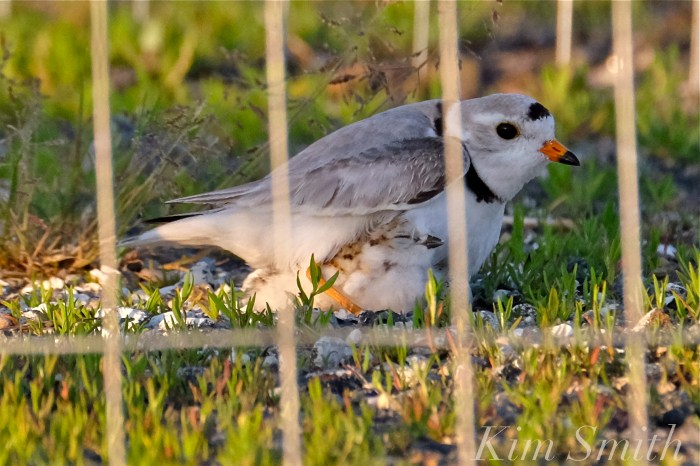
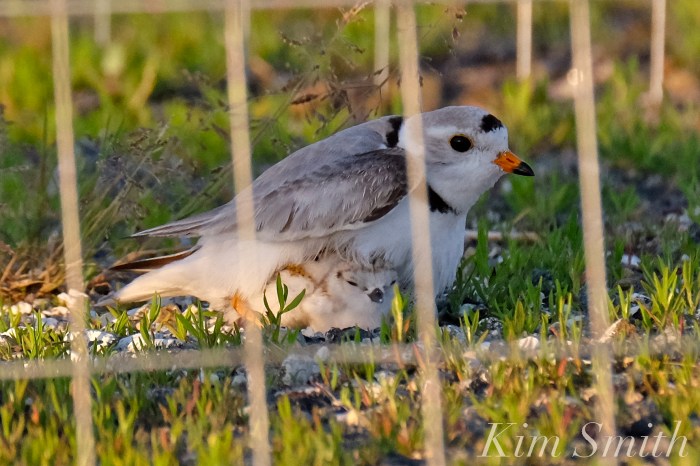
Papa and Pip snuggling today

Whenever folks stop by to ask questions at the nesting area and they see the little chicks snuggling under the adult PiPl, they almost automatically assume it is the Mama Plover. Half the time it is the female, and the other half, the male. Mom and Dad share equally in caring for the chicks, generally in twenty minute to half hour intervals. They are always within ear shot and while one is minding the chicks, the other is either feeding itself, grooming, or patrolling for predators. Last year, as is often the case, the Mama Plover departed Good Harbor Beach several weeks before the chick fledged, leaving Little Chick entirely under Papa’s care.

Eight-Day-Old Little Pip

Papa piping a warning call to Mama, while snuggling Pip 

If you would like to help monitor Pip and our PiPl family, please contact Ken Whittaker at kwhittaler-ma.gov.

OUR THIRD GOOD HARBOR BEACH PIPING PLOVER CHICK WAS KILLED THIS MORNING

We are so very sorry to share that the third chick was killed this morning. The seven-day-old chick was taken and eaten by a very large crow that swooped in unexpectedly, as witnessed by the volunteer monitors.

One week ago today all four Good Harbor Beach Piping Plovers hatched in the parking lot. We celebrated, but also knew that the really hard part was yet to come. Monitoring tiny marshmallow sized fluff balls, made the color of their surroundings, is like looking for sand upon sand. To do this several hours at a time is no small feat, made even more challenging on Gloucester’s busiest of beaches.

I would like to give a huge shout out and thank you to all our super dedicated PiPl monitors. Know that they are doing the very best they can to fend off predators of every kind, ill mannered people, astronomically high tides, diminished beach, people who have been drinking in the hot sun all day, garbage left behind on the beach (which attracts crows and gulls), and every other creepy thing you can think of. The core group is putting in many hours, are sunburnt, and neglecting their families.

A terrible mishap of death or injury to a chick could happen on anyone of our shifts. When you see a PiPl monitor at GHB, stop and feel free to ask questions about the plovers, and please thank them for their dedication. I honestly hope I don’t see one more facebook post/comment blaming the monitors about how we are not doing enough to keep the chicks safe and not reporting enough about the scofflaws. It is just plain cruel. Thank you. 

Our one remaining chick, the one volunteer monitor Heather Hall calls Pip, is the smallest of the hatchlings and the one we think hatched last. This afternoon Mom was keeping watchful eye while Pip was foraging between the foot of the dunes and line of folks at the rope’s edge.

Climbing Mount Washington

Mama Plover and Pip

Early this morning when we still had both chicks.
 

SHOUT OUT TO GLOUCESTER’S ANIMAL CONTROL OFFICERS TEAGAN AND JAMIE!

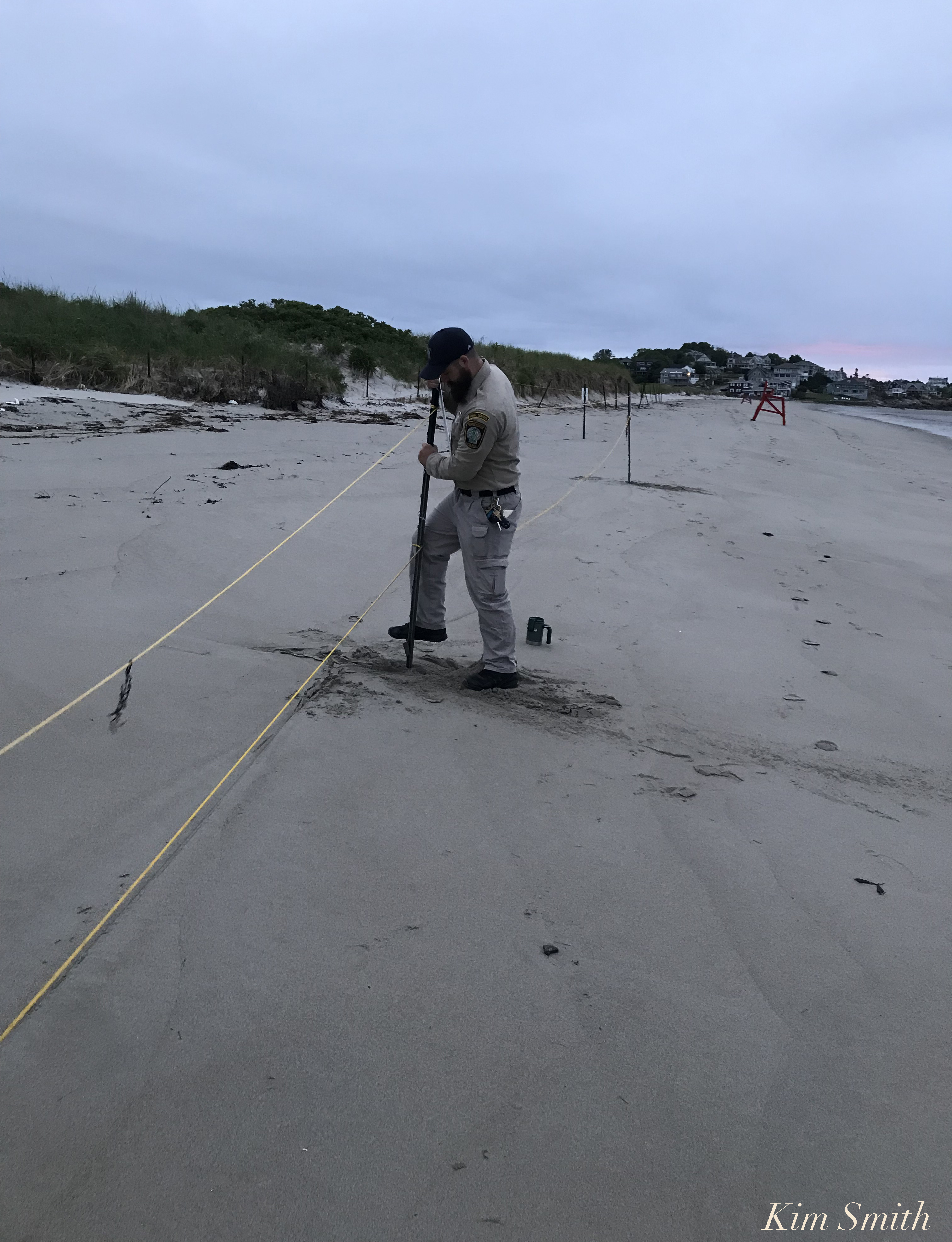
Gloucester’s Animal Control Officers Teagan and Jamie were on the scene at the crack of dawn at 4:30 this morning fixing the posts around the PiPl nesting area and writing tickets. Last night Jamie was on the beach as well. Thank you Jamie, Teagan, and Chief McCarthy for the stepped up patrolling.

The posts needed to be pulled out of the sand because last night we had yet another super high tide, all the way up to the bluff for most of the length of the beach.

I read a comment yesterday that stated falsely that the animal control officers make $80,000.00 a year and sit around and drink coffee all day. I have it on good authority that their combined incomes do not total $80,000.00 a year. Stating misinformation and disparaging the hard working people in our community is creating a false narrative and is hurtful to everyone involved, to the people, the dog owners, and to the shorebirds.

Teagan and Jamie writing tickets at dawn this morning.

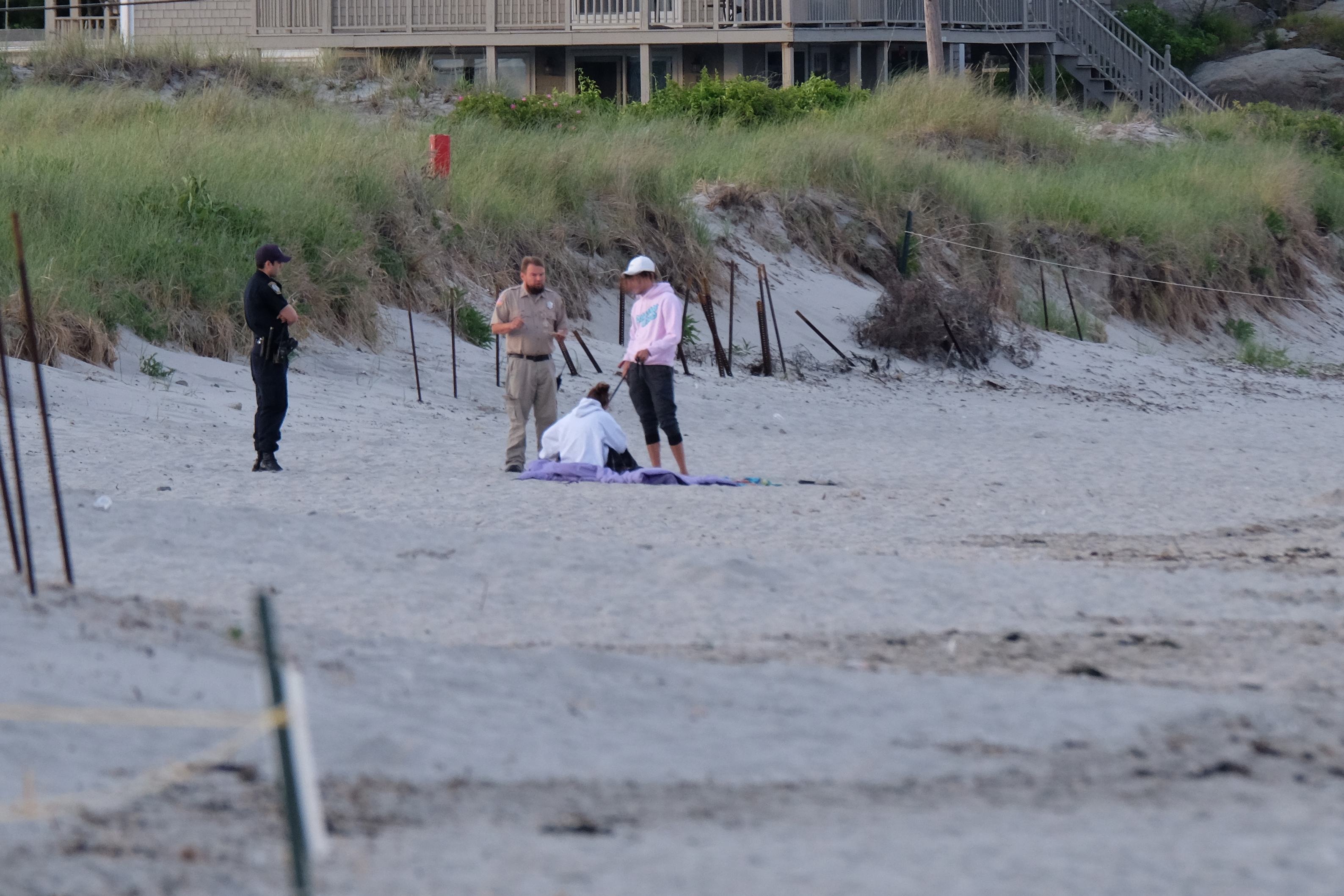
We don’t have as much an enforcement problem as we do an issue with entitlement and ignorance. Ignorance in the sense that scofflaws may be from out of town and may be unable to read, and entitlement in that some people know the rules and know the dangers that dogs pose to the shorebirds, yet choose to do as they please.

Upon entering Good Harbor Beach this morning, the scofflaws with their dog walked by these three signs.

Walking a dog on a beach is a purely recreational activity. For teeny tiny nesting shorebird chicks, protecting that same beach habitat is a matter of life and death.

If you see a dog at anytime or anywhere on Good Harbor Beach, please call this number: 978-281-9900.

As of late, it appears as though many more people now have the need of a service dog. Having a service dog requires that it be on leash at all times, not jumping on people, and not running through the dunes. Service dogs cannot go in the dunes, or anywhere on the beach that is restricted to humans.

Would the people with service dogs consider taking their dog to any other of Cape Ann’s stunning beaches, rather than to Good Harbor Beach during shorebird nesting season I wonder? 

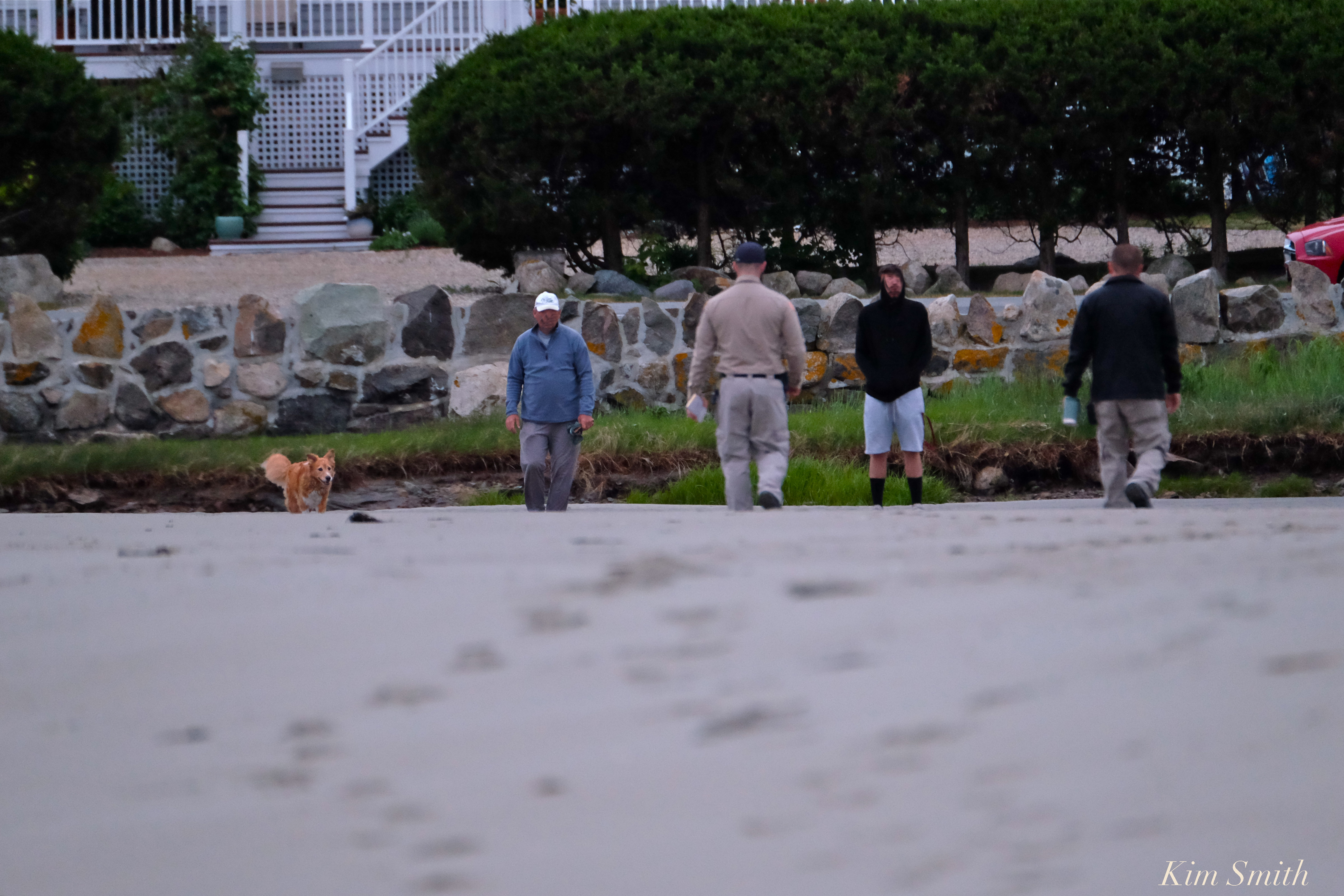
 Folks getting ticketed and escorted off the beach.

Truly, the most important action people can take is to volunteer to help watch over the chicks. We have a number of folks posing as helpers but sadly, they are not actually volunteering for shifts. Two monitors on each shift would be ideal, but this year we have fewer volunteers, and don’t even have single person coverage during large chunks of time. Keeping watch over the baby birds will make a difference in whether or not the chicks survive. Anyone can be a volunteer and anyone of us can show you what to do. Finding people to help has been especially difficult on the weekends. Please contact kwhittaker@gloucester-ma.gov if you would like to lend a hand. Thank you so very much  

Six-day-old Piping Plover Chick

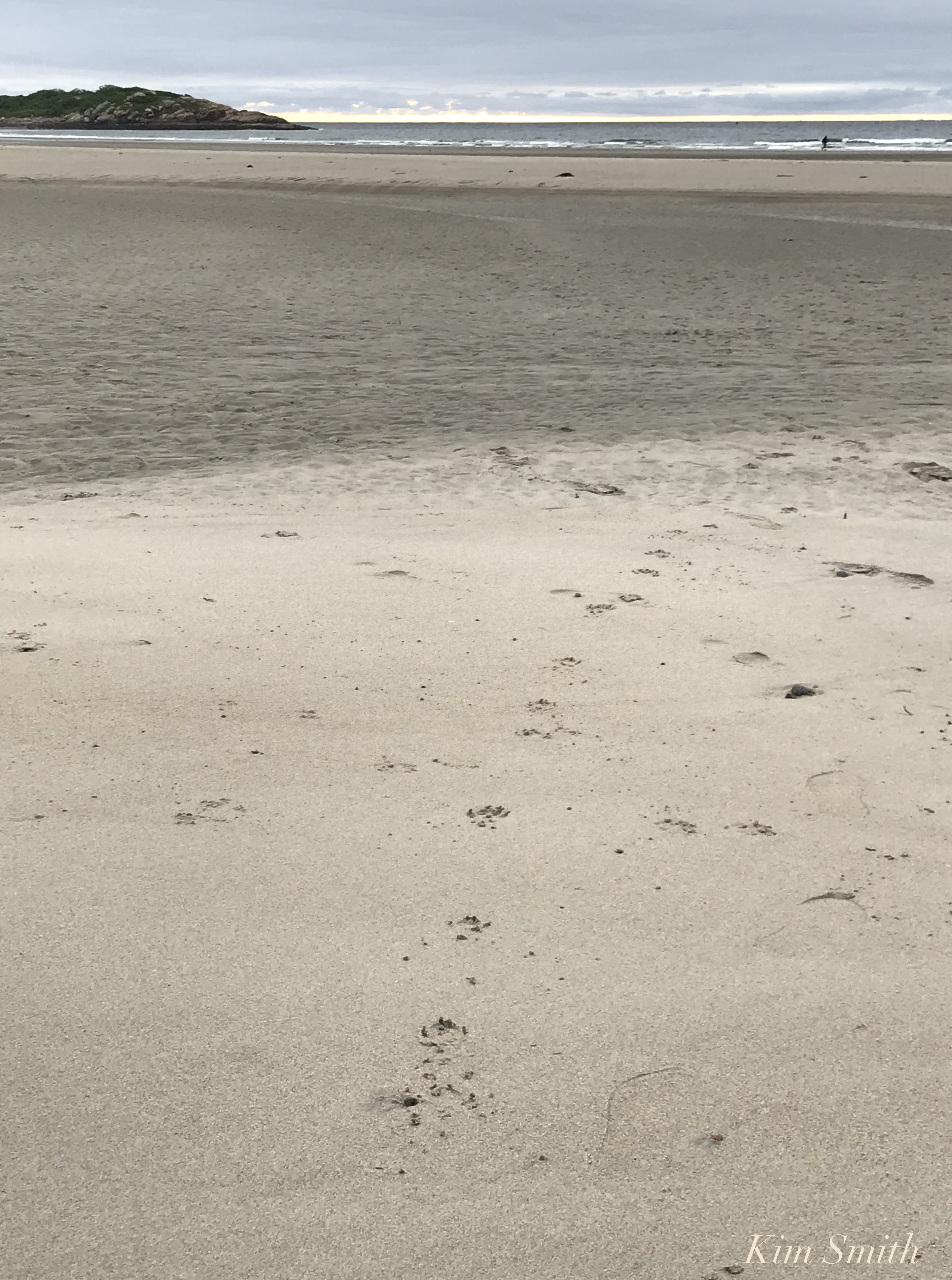
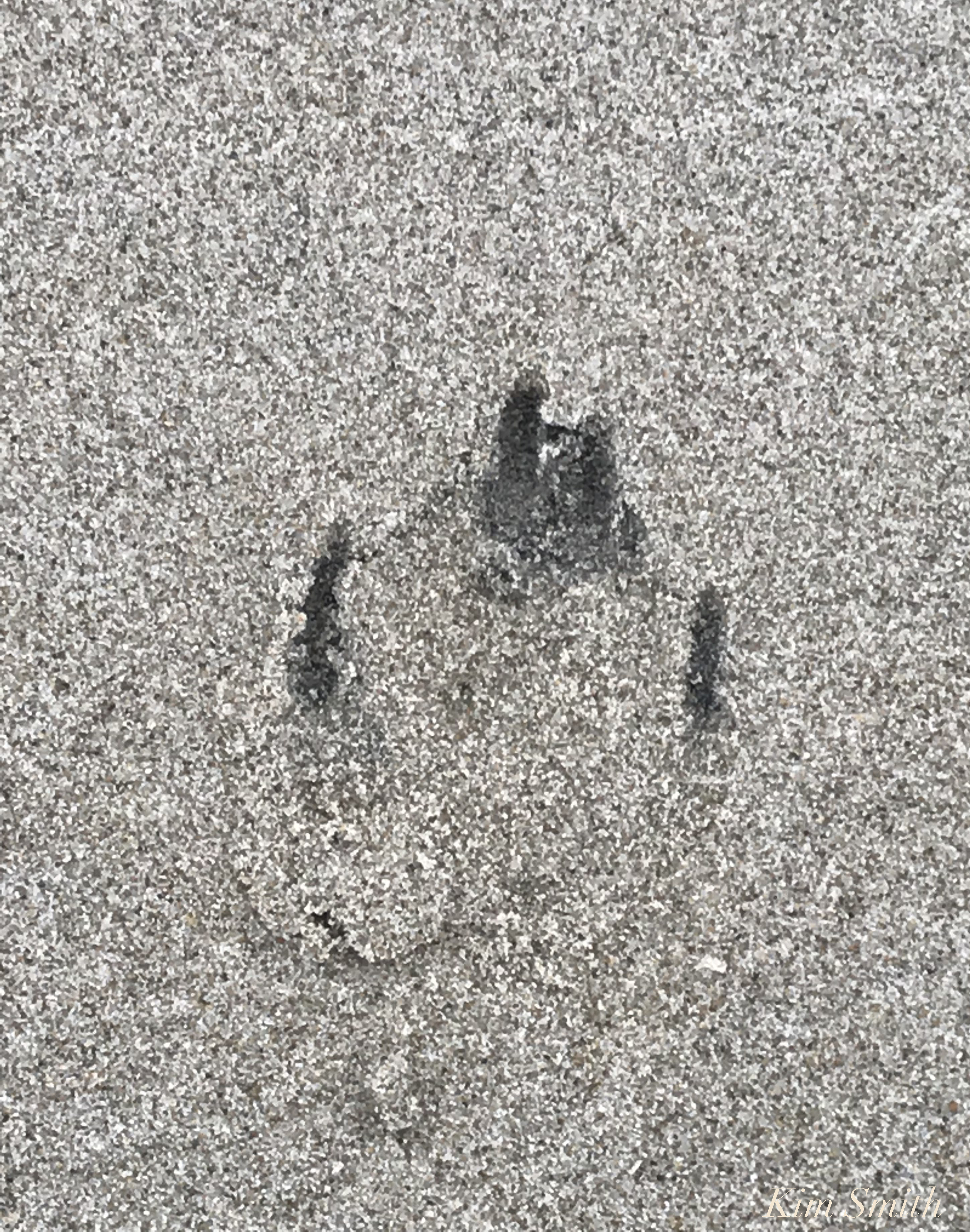
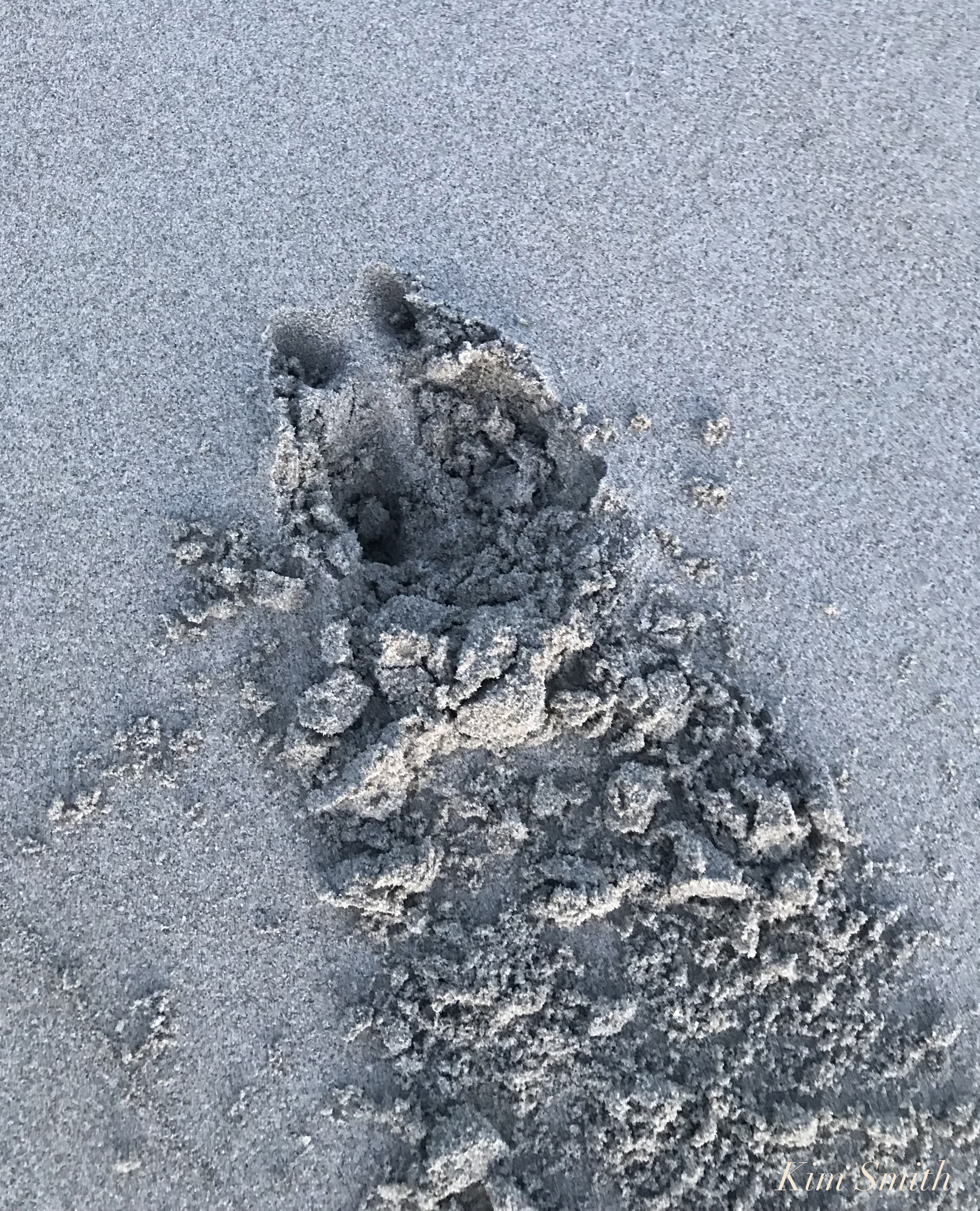
This morning’s dog tracks at Good Harbor Beach – Dog tracks are easy to spot and to differentiate from other canids (fox and coyote). For example, notice the sharp toenail indentation. Coyotes have rounded toe tip prints because they wear their nails down.

Dog tracks Good Harbor Beach

Look what other tracks were spied this week, deer! These too are easy to spot in the sand. The deer’s cloven hoof makes a broken heart shape.White-tailed Deer Tracks Good Harbor Beach

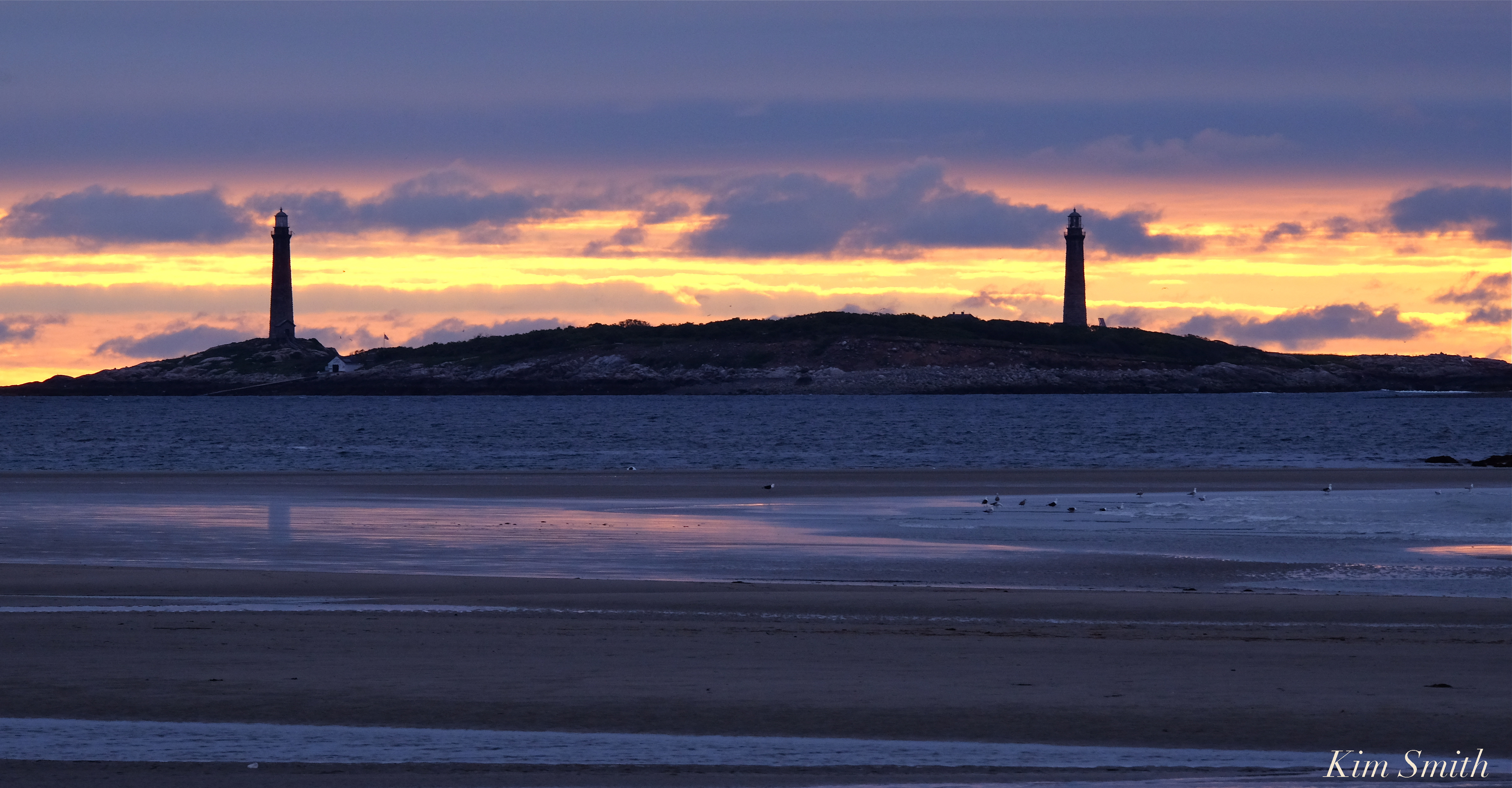
Today’s early morning Good Harbor Beach view of Thacher Island Twin Lights 

GLOUCESTER DPW GETTING THE JOB DONE-THANK YOU ONCE AGAIN!

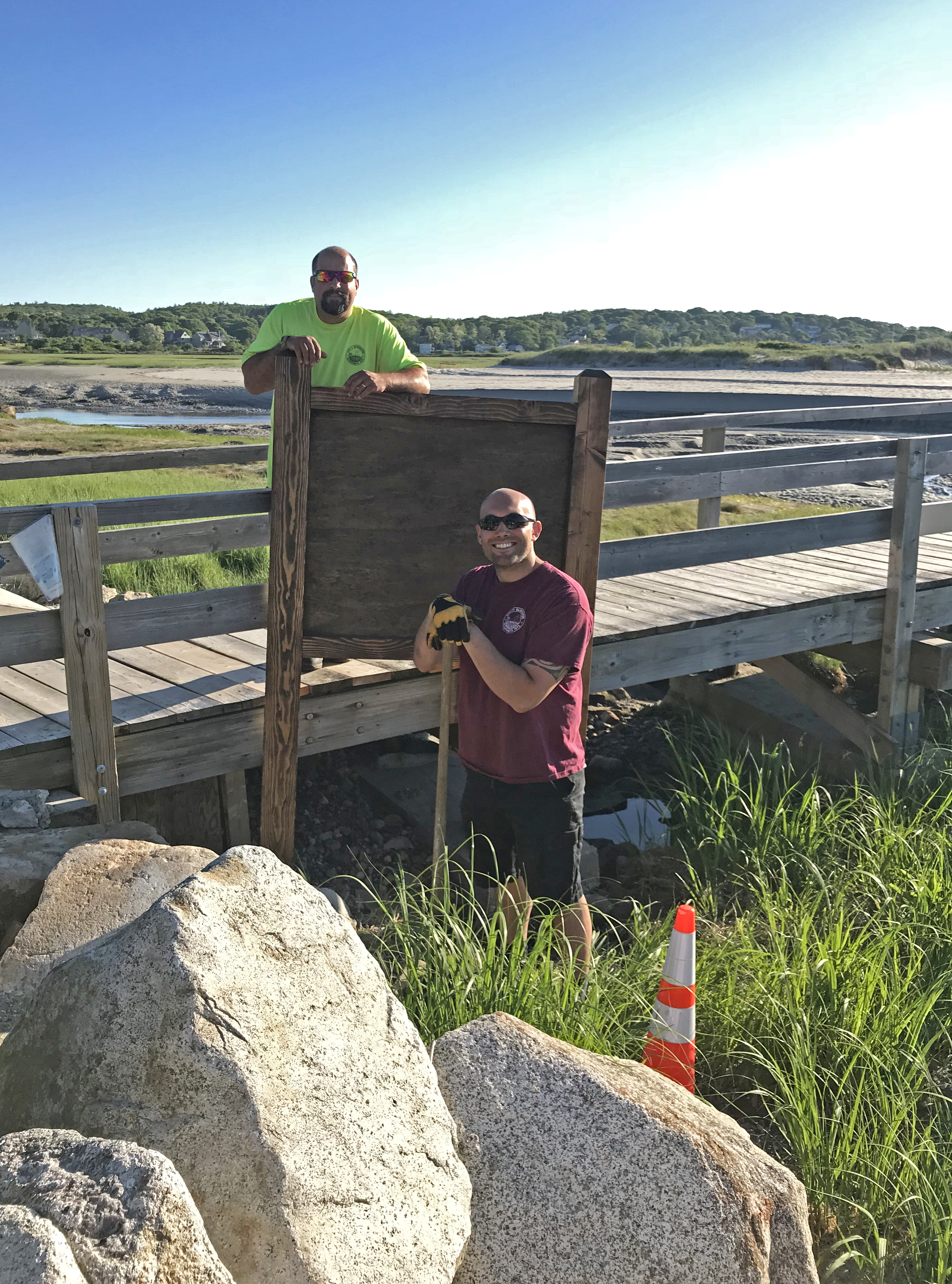
Phil Cucuru and Mike Tarantino installing the sign board.

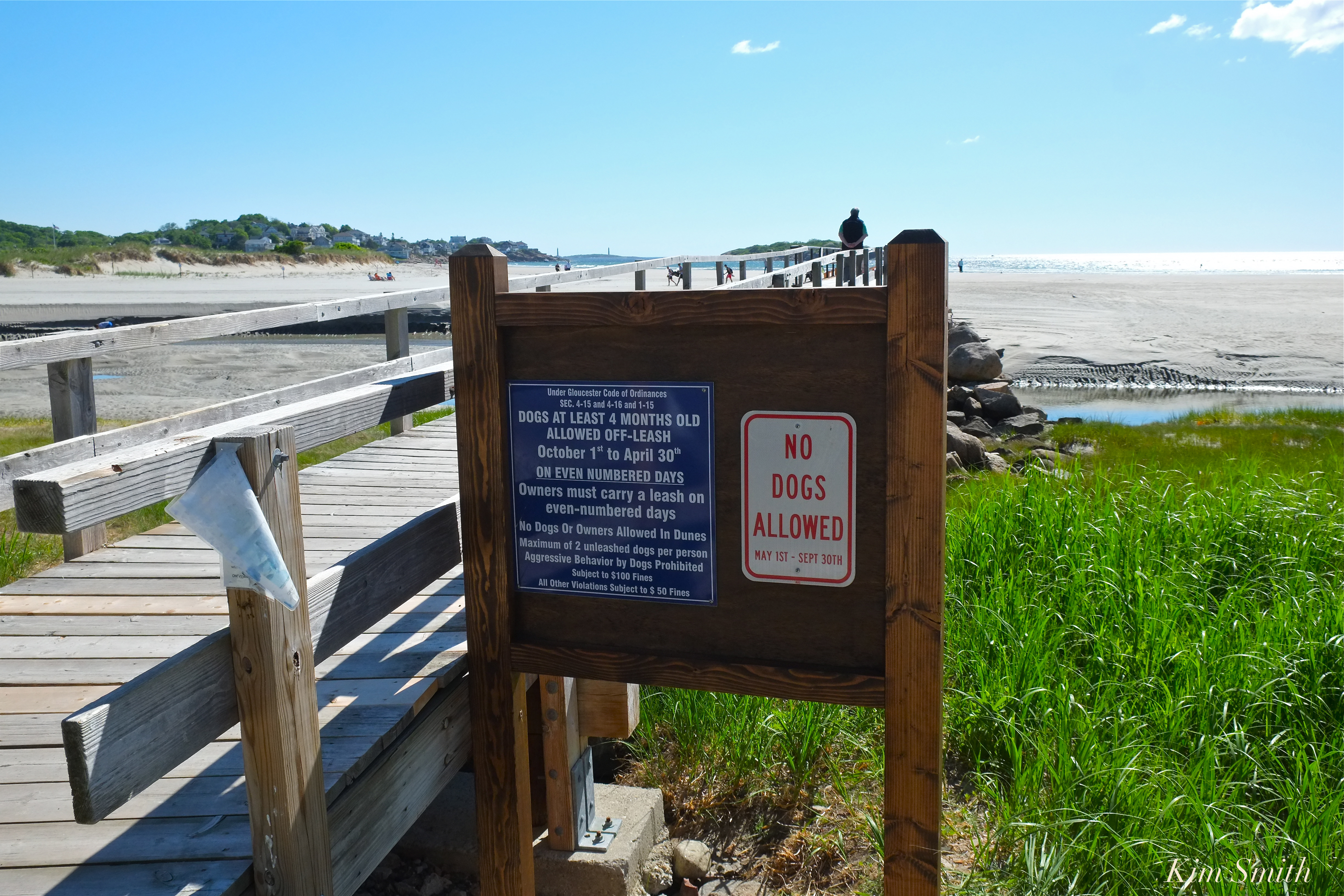
Thank you again to the Gloucester DPW, and again to Phil Cucuru and Mike Tarantino. The repaired footbridge looks beautiful and the signage placement is very noticeable. We are grateful to Phil, Mike, Joe Lucido, Tommy Nolan, Kenny Ryan, Newt, Cindy, and the entire DPW and Good Harbor Beach crew for their outstanding effort in helping our PiPl family, since when they first arrived, way back on April 3rd. Their assistance, interest, and kindness is making a difference. Thank you That’s City Councilman Scott Memhard walking the footbridge to check on the PiPl. So sorry to Scott for not getting a better photo.

WE LOST TWO CHICKS TODAY

We’re so very sorry to write that two chicks were killed today. Catherine Ryan witnessed a terrible scene with a large dog tearing around in the nesting area at dawn, and a volunteer monitor observed one taken by a gull.All that’s left of our little GHB Pipl Family – Mama (left), Papa (right) and our two remaining chicks. 

Please volunteer to be a PiPl monitor. You will truly be making a difference in whether or not our PiPl chicks survive. And you’ll meet the nicest bunch of people. Anyone of us can show you what to do. The shifts can be as long as you like, but an hour is all we are asking. The weather forecast looks gorgeous this weekend, and it is Father’s Day on Sunday, so we are hoping to have two on at each shift. Contact kwhittaker@gloucester-ma.gov.

Please share this post and help spread the word that we need volunteers. Thank you ❤

GOOD HARBOR BEACH TWO-DAY-OLD PIPING PLOVER CHICKS

Our little family is settling in, most importantly, finding lots of tiny insects in the wrack area. Cars weren’t the only threat in nesting at the parking lot, there simply did not seem to be sufficient food in the gravel and hard pack. Today, the chicks spent the early morning snuggling often under Mama and Papa; the temperature was chilly and the wind had picked up. Once the sun was shining brightly, they made their way to the water’s edge, learning how to forage on teeny mollusks and sea creatures.

The seagulls were ferocious this afternoon, so much so that our fearless pint-sized PiPl Papa bit a comparatively ogre-sized Great Black-backed in the butt, and made him squwack! The gulls were attracted to a Dunkin munchkin box that had blown into the roped off area. And although I arrived at sunrise, a dog owner and its pet had made fresh tracks through the nesting area. Between the dogs and the garbage-hungry gulls, human-created threats are far more dangerous than natural predators.

Sleepy eyes after morning snuggles

Looking mighty confident for only two-days old!

We definitely need more Piping Plover volunteer monitors, especially during the mid part of the day. If you would like to be a PiPl monitor, please email Ken Whittaker at kwhittaker@gloucester-ma.gov. Thank you


BREAKING: OUR GHB PIPING PLOVER FAMILY MAKES THE EPIC JOURNEY TO THE BEACH

Late this afternoon, Essex Greenbelt’s Dave Rimmer and my husband Tom observed the Plover family leaving the parking lot and heading toward the dunes. Dave shares that they first appeared to be heading to the beach via the marsh creek end, when they suddenly switched direction and started back in the opposite direction towards Boardwalk #3. They went part way down #3, then back toward the parking lot, then back down #3. The family next began to go through the dunes toward the the middle of the beach, away from the #3 roped off area. After all the zig and zagging, the little family returned to the boardwalk, and then headed straight through the dunes, in the direction of #3 nesting zone. Dave lost sight of the chicks, but could hear the parents urging them on. Out they tumbled, down the dune edge, and into the roped off #3 area!

Please keep your eyes peeled for tiny toothpick-legged mini-marshmallow sized chicks zooming around in the sand.

We are elated that all four chicks made it safely out of the parking lot. Quite possibly this was the PiPl plan all along. Several times I observed the adults making the overland route at the very same time that they began nesting in the parking lot, which I had not seem them do in the the previous two years that they nested at GHB (in the very same location all three years).

The PiPl left the beach due to extreme dog disturbance while trying to court and nest, sadly finding the parking lot to be the quietest and safest place. Yesterday afternoon, we all observed folks trying to bring their dogs through the parking lot and onto the beach, after the life guards had left. The presence of dogs caused extreme alarm by the parents, they would pipe loud warnings and then leave the chicks to try to distract the dog. This is when chicks are at their most vulnerable, when the adults have to leave them to defend against predators. The problem is only going to get worse now that the footbridge has reopened. Please, please to the folks bringing your dogs to the beach after hours, now it is more critical than ever to please leave your pets at home. If any of our readers see a dog on the beach at anytime of day for any reason, first make sure the chicks are safe, and then please don’t hesitate to call the police.

Trash left on the beach is another huge issue for endangered shorebird chicks, of any species. Trash on the beach equals a plethora of seagulls. As do dogs, seagulls cause extreme duress for the PiPl parents. Even though the gulls prefer the easy garbage pickings left behind, they also eat baby chicks.

If you would like to be a a volunteer PiPl monitor, please contact kwhittaker@gloucester-ma.gov. Thank you!

Huge Shout Out to all our volunteers, Gloucester’s awesome DPW, Dave Rimmer, Ken Whitaker, Jasmine Weber, and Jonathan Regosin

Both Mama and Papa are now able to tend the chicks, while they are also able to feed and take care of themselves simultaneously keeping within earshot and eyesight of each other.

SUPER SHORT VIDEO ONE-DAY-OLD PIPING PLOVER CHICKS WAKING UP IN THE MORNING SUN

Our GHB Parking Lot Family survived the first night and day two, despite shenanigans from Barn Swallows, Red-winged Blackbirds, and the ever present Bachelor. The Bachelor’s aggressive behavior seemed even more pronounced this morning. Unmated males will attack baby PiPls in hopes of mating with the female, but our Papa PiPl has his number and does his best to keep him at bay. As if they don’t have enough to contend with, Plover on Plover violence is a real threat.

Here are the chicks waking up this morning after a snuggling session with Papa.

Thank you once again to Joe Lucido and Gloucester’s DPW for their interest and help throughout and to our amazing cadre of PiPl volunteers. If you would like to be a Piping Plover volunteer monitor, please email Ken Whittaker, Gloucester’s conservation agent, at kwittaker@gloucester-ma.gov.

Mass Wildlife intern Jasmine Weber and her aunt Terry Weber 


GOODNIGHT SWEET PARKING LOT PLOVER FAMILY

Chicks Tucked Under Papa Plover

Thanks to today’s dozen or so volunteers, Gloucester’s DPW crew, and John and Jasmine from Mass Wildlife, our parking lot PiPl family made it through day one with flying colors (meaning all four chicks survived). It appears as if they are slowly advancing towards the beach. Plovers are active at night–perhaps they’ll make the migration tonight after the lot is closed–let’s hope.

We need more volunteers, at least two per shift would be fantastic. More eyes equals better coverage. Please contact Ken Whittaker at if you would like to be a PiPl volunteer monitor kwhittaker@gloucester-ma.gov.

BREAKING NEWS: OUR PIPING PLOVER GOOD HARBOR BEACH PARKING LOT CHICKS HAVE HATCHED!!!

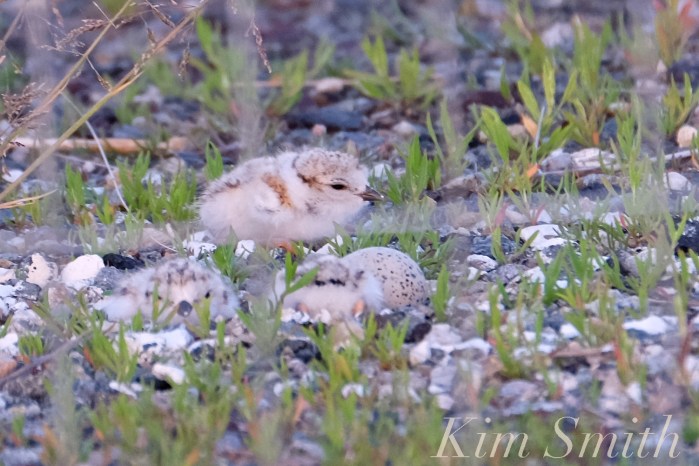
Our Piping Plover chicks began hatching yesterday afternoon. The fourth chick hatched today at 7:50am. We have all been on pins and needles and are overjoyed that all four babies appear to be healthy and vigorous.

Hopping over the yet-to-hatch egg and testing out tiny wing buds.

Piping Plovers lend true meaning to the expression “take under a protective wing.”

With thanks and gratitude to Joe Lucido and our amazing DPW, Gloucester’ s conservation agent Ken Whittaker, Mayor Sefatia, Dave Rimmer from Greenbelt, Jonathan and Jasmine from Mass Wildlife, and to all our volunteers (especially Heather Hall who has been at the GHB parking lot every single day for several hours) for helping us get this far. Now the truly challenging phase begins, which is helping the chicks grow to the next stage of life. Piping Plover Chicks fledge on average at about 35 days, which is almost to the day when last year’s Little Chick departed our shores.

We were hoping to keep the hatching on the down low for a few days, but the PiPl is out of the bag, so to speak. Volunteer Piping Plovers are most definitely needed. Please contact Ken Whittaker at kwhittaker@gloucester-ma.gov

The first to venture out of the exclosure (at 7am this morning). Piping Plovers are precocial birds, which means that within hours after hatching they are mobile and relatively mature. Piping Plover chicks begin to feed themselves within the first 24 hours after hatching.

Kenny Ryan, Cindy Frost, Cliff King, and Joe Lucido

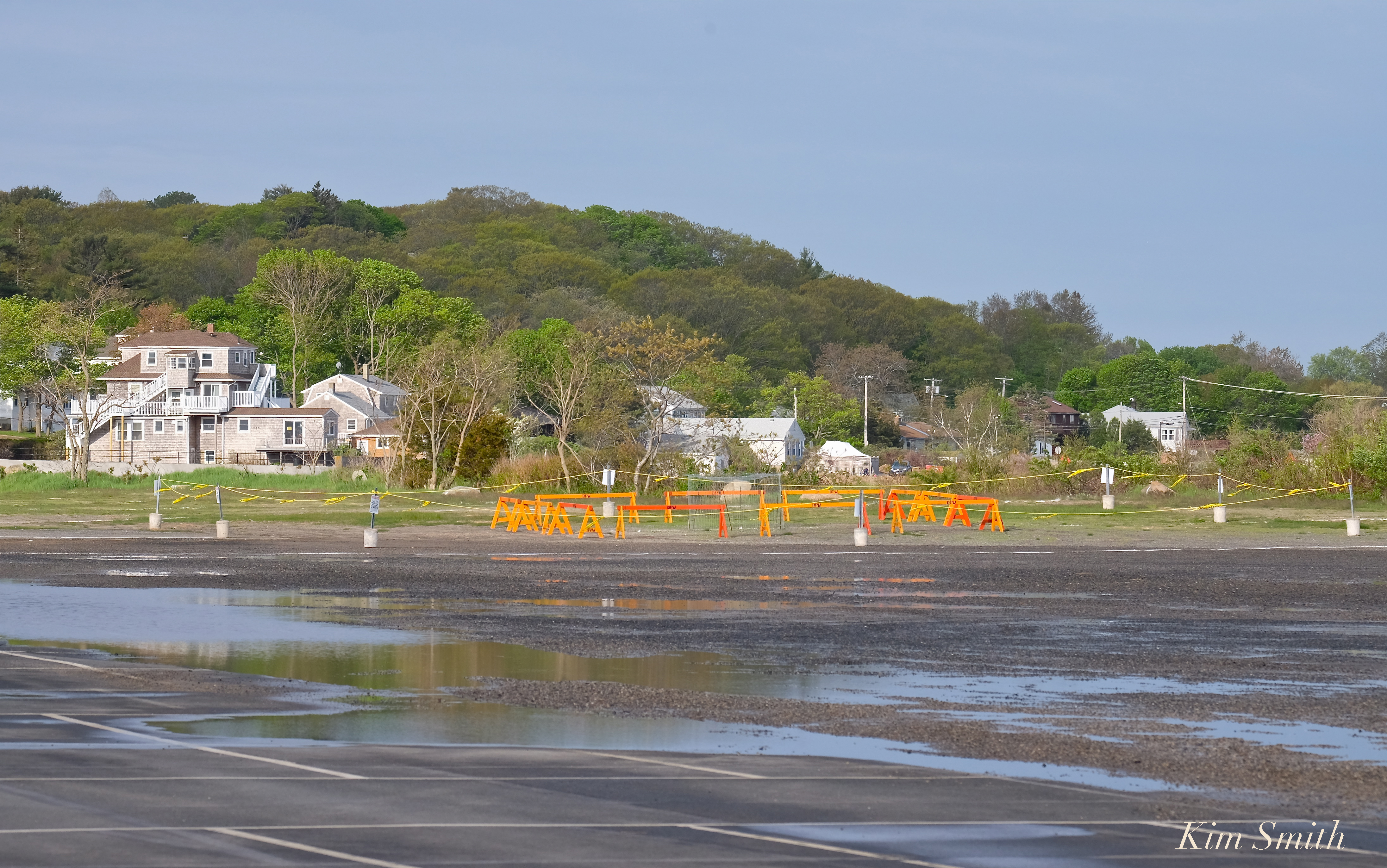
DPW Crew laying out the temporarily restricted parking area. The cordoned off zone will be in place this weekend and until the PiPl migrate to the beach.

Cliff King and Jasmine Weber – Jasmine joined the team yesterday. She is an intern at Mass Wildlife and will be with us all weekend.

Early this morning the Bachelor appeared on the scene, again, causing yet another kerfuffle. Papa leapt off the nest and chased him away, with a good bit of ruffled feathers.

A few more snapshots–see how adorable they are–wouldn’t you like to be a Piping Plover monitor this upcoming month

DEBUNKING PIPING PLOVER MYTH #4, WINTHROP BEACH IS AMAZING, AND LOTS OF SEX ON THE BEACH

DEBUNKING PIPING PLOVER MYTH #4, WINTHROP BEACH IS AMAZING, AND LOTS OF SEX ON THE BEACH

Piping Plover Mama and Chick, Winthrop Beach

Recently an “Anonymous” person made a comment on the post “Heartbreaking to See the Piping Plovers Nesting in the Good Harbor Beach Parking Lot.” The name Anonymous is placed in quotes, because the commenter is so oddly uninformed and factually incorrect, I am wondering if an actual Winthrop resident even wrote the comment. Anyway, here is the comment:

“I live in Winthrop. One pair nested on Winthrop Beach about 6 years ago. Now there are 7 nesting pairs. 80% of the beach is now roped off for the plovers. They are rarely successful and keep trying to breed until August. Gloucester needs to determine whether it would like the income from parking or a successful plover population on one of its nicest recreational beaches. I was at Good Harbor the other day and it appears that there is not much of a sandy beach left to use. I realize the birds are endangered and federal law protects them. Gloucester may have to by law pay for 24 hour security like they do in Plymouth.”

Just like the towns of Gloucester and Revere, Winthrop has a beautiful beach (officially named Winthrop Shores Reservation), which within the last decade has become home to nesting shorebirds. Both Revere and Winthrop beaches are managed by the Massachusetts Department of Conservation and Recreation (DCR) and both Revere Beach and Winthrop Beach have been on my to do list of places to visit to learn how other communities in Massachusetts manage their nesting shorebird populations.

Least Tern Nesting

Revere and Winthrop Beaches are relatively narrow at high tide, similar to Good Harbor Beach, and both beaches run adjacent to densely populated urban neighborhoods. I have been making good use of my commute from Cambridge and Boston to Gloucester this spring by regularly visiting Revere Beach, and have now added Winthrop Beach. I am so glad that I did! Go to Winthrop Beach if you have never been, or haven’t been in recent years. It is a delight in every way. Visitors sunbathe, picnic, windsurf, paddle board, ride bikes, hold hands, walk their babies, and do all the things visitors do at our Gloucester beaches. You don’t need a sticker to park, and parking is free, if you can get a spot along the main thoroughfare.

Winthrop Beach wasn’t always beautiful. Over the course of the past one hundred years, the devastating effects of pollution and erosion had washed the sand off shore, causing the beach to dip twenty feet below the seawall in some areas. This meant that every time there was a major storm, the waves were not slowed by a gradually inclining beach, but instead slammed into the seawall, flooding streets and homes, and further eroding the foundation of the seawall.

Despite this, in 2008, two pairs of Piping Plovers began nesting at Winthrop Beach. Not only has Winthrop Beach become home to nesting PiPls, at least ninety pairs of Least Terns (Sternula antillarum), a similarly threatened species of shorebirds, have also begun to nest there. The endangered Red Knot (Calidriss canutus), along with a locally nesting pair of American Oystercatchers (Haematopus palliates) forage at Winthrop Beach as well.

One half of Winthrop’s resident American Oystercatcher breeding pair.

Winthrop Beach is in the midst of a 31 million dollar restoration project. To renourish the beach, 500,000 cubic yards of sand have been distributed along the one-mile stretch, the seawall has been rebuilt, improvements to beach access and amenities have been made, road repairs to Winthrop Shore Drive completed, sidewalks widened and made handicap accessible, and gorgeous new lighting is being installed.

During the Winthrop Beach major renovation project, care was taken to protect the Piping Plovers and by 2017, the population had quadrupled. Unfortunately, despite the community’s best efforts, 2017 was an unusually bad year. No chicks fledged due to predation by a male American Kestrel. The Kestrel was subsequently captured and moved to the western part of the state.

Massachusetts holds about 30 to 40 percent of the world’s population of Piping Plovers. It is a testament to our clean beaches and water. The Piping Plover’s diet consists of invertebrates and insects, and both require a clean environment.

From my observation during the past several weeks, there are only two roped off areas; one small, similar in size to GHB nesting area #3, and the other, about three times larger. The thing is, the large area is comprised of a restricted dune restoration project and the other part is filled with popples and cobbles, not in the least an ideal location to sunbathe or picnic. There is a wide sandy area in the center of the beach for recreation. Each time that I have been there, including the Saturday afternoon of Memorial Day weekend, there were very few people on the beach. The only people I had a free moment to speak with, a group of young women that live directly across from the cordoned off area, said they LOVE that their beach is home to the nesting shorebirds. The point is, just as exists at Good Harbor Beach, there is plenty of room to share the shore.

The shorebird nesting area is pebbly and part of a dune restoration project.

The “Five Sisters” breakwater area is well loved by windsurfers and paddle boarders as well as a favored habitat by foraging shorebirds.

Beautiful Beach Pea (Lathyrus maritimous) growing in the restored dune/shorebird nesting area.

Access to Winthrop Beach is restricted by what appears to be a complete lack of public parking. Even with no one on the beach, it has been difficult to find a spot to park on the main drive along the beach, and it is not yet summer time.

On my first visit to Winthrop Beach, the timing could not have been more perfect. Least Terns and Piping Plovers were mating like crazy. It was wonderful to observe both species mating dances and rituals, and both are unique to each other. I’ll post more about the Least Terns courting, essentially “sex in exchange for fish,” as it was so terribly funny to observe.

Least Terns Mating. Males offer a minnow to a prospective female. She will allow him to mount her while simultaneously taking the fish although, sometimes the females take the fish before mating and fly off.

I’ve been back several times since and have seen some courtship displays, but nothing like the free for all of the first visit. There was however a newly hatched Piping Plover family of four tiny little chicks. And one of the pairs of Piping Plovers that I had observed mating is now nesting!

Piping Plovers Mating 1) The male’s high stepping dance, asking the female if she is interested. She says yes by positioning herself with her rear end tilted upward. 2) He dances on her back. 3) The Plovers join cloaca to cloaca 4)Invariably, love making ends with a not too nice sharp nip from the male.
The mating pair are now nesting, with at least three eggs in the nest!

Camouflaged! Can you spot the four birds in the above photo?

Just south of Winthrop Shore Reservation is Winthrop’s Yirrell Beach and it is home to several nesting Piping Plover pairs, as well as a pair of nesting American Oystercatchers.

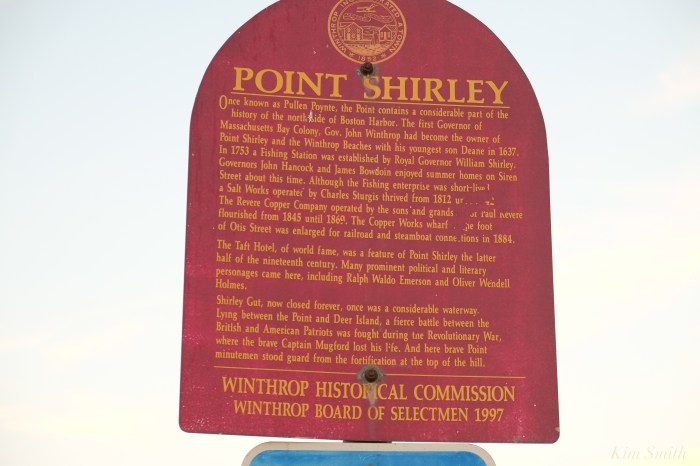
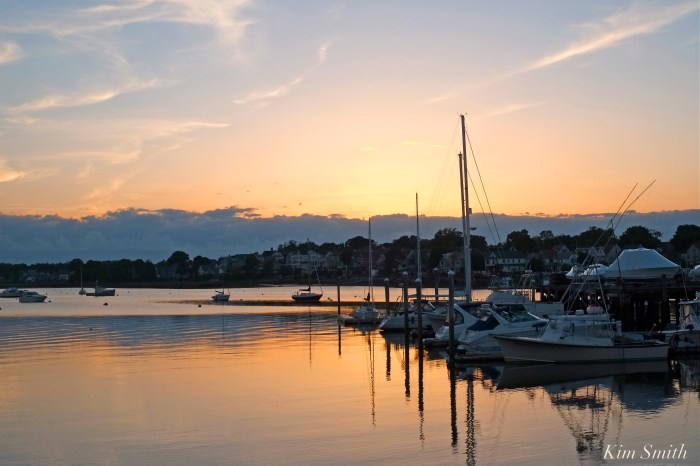
Point Shirley and Crystal Cove with views of the Boston skyline.

PIPING PLOVER MEMORIAL DAY WEEKEND UPDATE

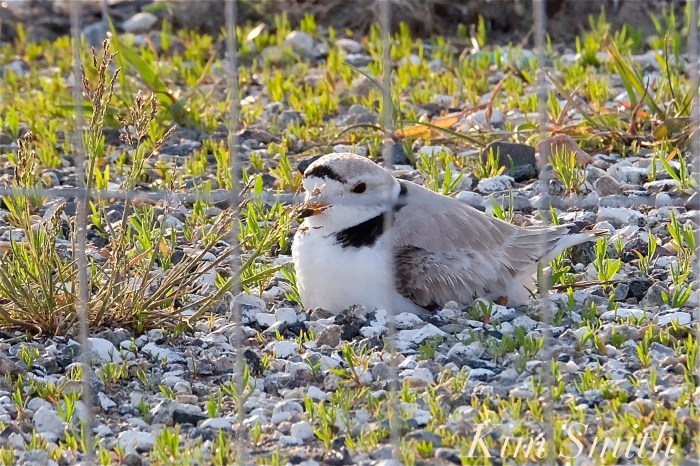
Despite the throngs of beach goers and a full parking lot by noon time on Friday, the nesting Piping Plovers appear to be doing a-okay. Both Mama and Papa Plover were seen at the nest this morning (Saturday) at daybreak. They traded places on the nest without event.

Piping Plover volunteer monitors will be checking on the PiPl throughout the day. The parking lot attendants are keeping an eye out our feathered friends as well. With a hope and prayer, and lots of cooperation from the community, our little pair will survive the holiday weekend 🙂

At daybreak this morning, Mama left the nest to stretch her wings, forage, and take a bath, but only after Papa flew on the scene to relieve her; Papa on the nest Friday evening.

DEBUNKING PIPING PLOVER MYTHS #2 AND #3

Debunking Piping Plover Myths #2 and #3

Myth #2: “The reason the Piping Plovers are nesting in the parking lot is because when they first arrived to Gloucester it was cold and they find the asphalt warmer.”

Not true and by this logic, Piping Plovers would be nesting in parking lots from here to Canada!

Piping Plovers arrive at Atlantic coast and Great Lakes beaches every year from late March through the month of May. Along the Atlantic Coast, they breed from the mid-Atlantic states to New England and all the way up the coastline to the maritime provinces of Canada, as far north as Newfoundland and Labrador. The temperature is no colder on a Gloucester beach than a beach on Plum Island or a beach on Prince Edward Island.

Myth #3: “The reason the Piping Plovers are nesting in the parking lot is because the tides are higher and the beach area was disrupted after the winter storms.”

Also not true. 

Piping Plovers typically nest on both narrow and wide sandy beaches. Unfortunately, nests and eggs are occasionally swept away during a storm when the tides are high.

Beaches all along the Massachusetts coastline were hit hard by late winter storms however, Piping Plovers often do well on beaches where winter storms have created a change in the topography. Storms generate what is called overwash, when water from the sea carrying beach sediments flows onto the dunes. Overwash is critical for beaches to maintain their shape and size in the face of sea level rise. The best foraging areas for Piping Plovers are known where you have large expansive mudflats created by storm overwash.

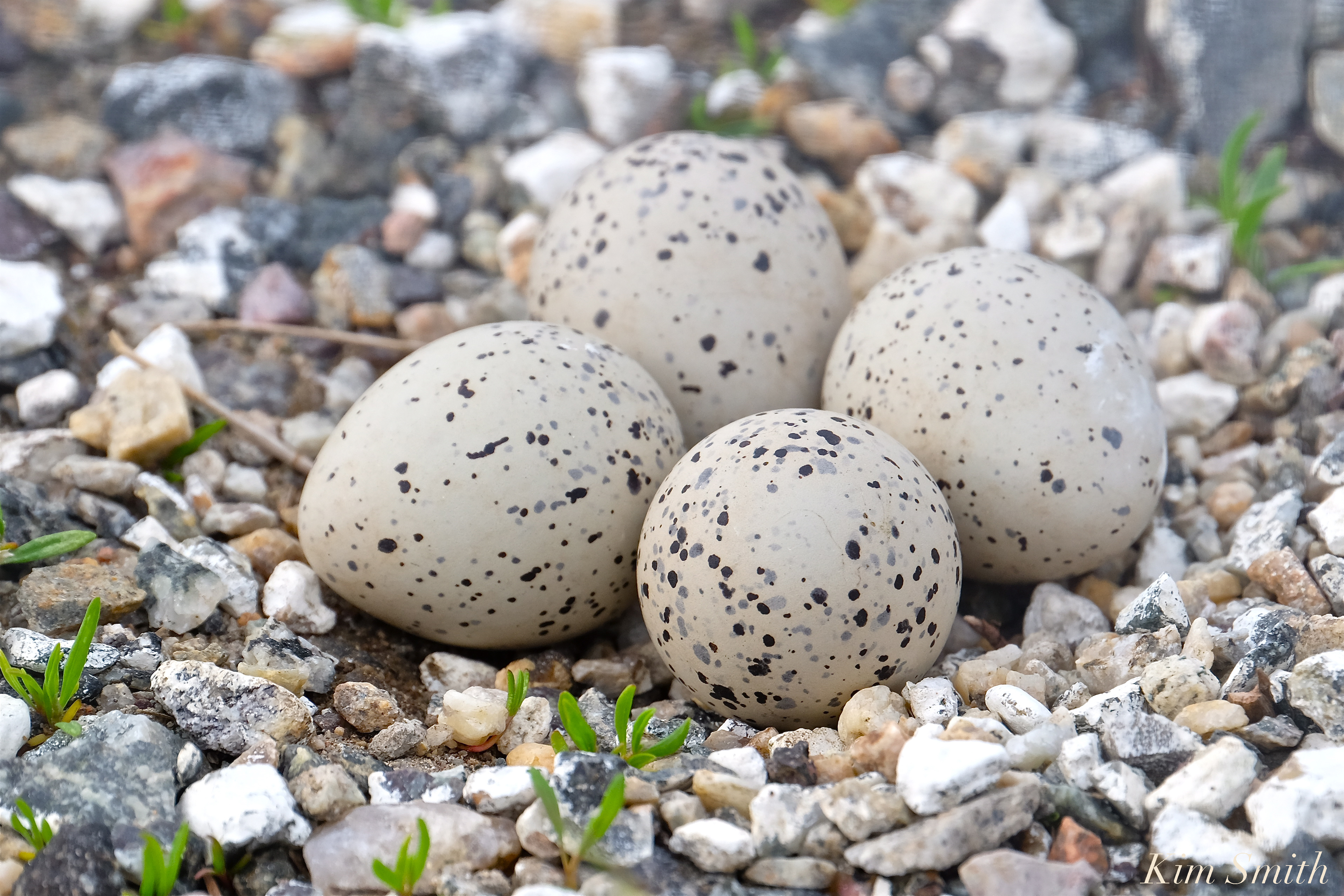
Good Harbor Beach Piping Plover parking lot nest and eggs.

As you can see, there is a theme to these comments, to blame the fact that the PiPl are nesting in the parking lot on everything else except what in actuality drove them to the parking lot.

Constant and unrelenting disruption by dogs off leash in the nesting area is what forced the Piping Plovers to the parking lot.

By speaking frankly to help bring awareness about what occurred in the nesting area at Good Harbor Beach during the months of April and May is by no means meant to malign or portray as wicked and threatening dogs or dog owners. Disruption by dogs was witnessed by myself, by fellow PiPl volunteers, as well as by Greenbelt and Mass Wildlife representatives, and the dog officers. 

In the minds of our nesting pair of Piping Plovers, the Good Harbor Beach parking lot was seemingly the safest location at the time of mating and nest scraping, as it was also the quietest and least disrupted. Readers may be wondering, why did our pair not nest in the wide expanse of dunes? I think the green growth found in the dune habitat does not provide protective camouflage as do the white painted lines and gravel found in the parking lot. If you have stopped by to see the PiPl in the parking lot, you may have noticed that they are practically invisible, the way they blend in with their surroundings. The little pair are certainly resourceful!

Don’t mistake their resourceful choice of nesting locations as ideal. The parking lot is a horrendous place to nest. It is far away from their food and water. Piping Plover parents take turns sitting on the nest. In a normal situation where the nest is on the beach, one sits on the nest while the other forages close by, but at the same time is always on the lookout to zoom in and help defend the nest from real and imagined predators. Under the parking lot circumstance, while one is brooding in the lot and the other foraging on the beach, they are not in constant contact or communication with one another, making the chance of successfully hatching young all that much slimmer.

And safeguarding the chicks during their first days after hatching in the parking lot, until they make the epic journey to the beach, is going to be a monumental challenge and take tremendous teamwork.

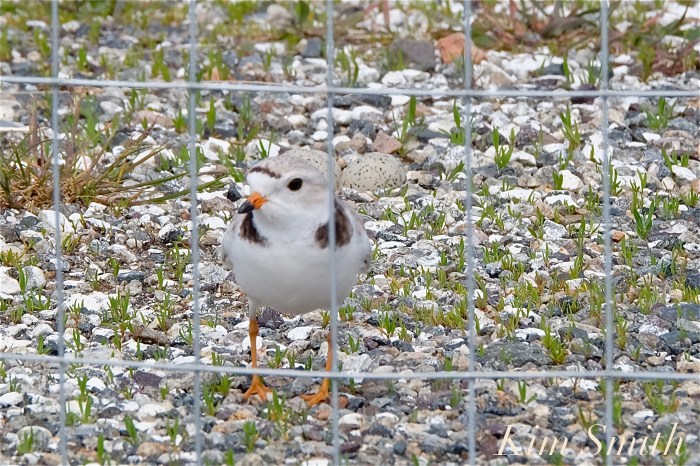
Mama at the parking lot nest exclosure while Papa is foraging at the beach and out of the range of communication.

The problems that arise with dogs on the beach during shorebird nesting season has been dealt with and resolved conscientiously in coastal communities over decades.

Some solutions for next year:

  1. With gratitude to Mayor Sefatia and the DPW, effective signage has been posted at each beach entryway. The signs need to be in place all year round because they also have a No Dunes icon. Letting people know that throughout the year the dunes are off limits to people and pets will help lessen erosion and create a healthier dune habitat, which over time will help protect our beach for everyone.
  2. Enforcement of existing ordinances.
  3. Education about the life story of the Piping Plovers.
  4. Recently a meeting of the Animal Advisor Committee was held at City Hall. Many suggestions and proposals were discussed. A very simple and effective solution for Good Harbor Beach is to close the beach to all dogs beginning April 1st and to reopen on September 16th, making the time dogs are allowed on the beach only two weeks shorter than the existing ordinance. The time period from April 1st to September 15th would give all shorebirds the uninterrupted space needed to mate and establish their nests, and time enough for the young to fledge.

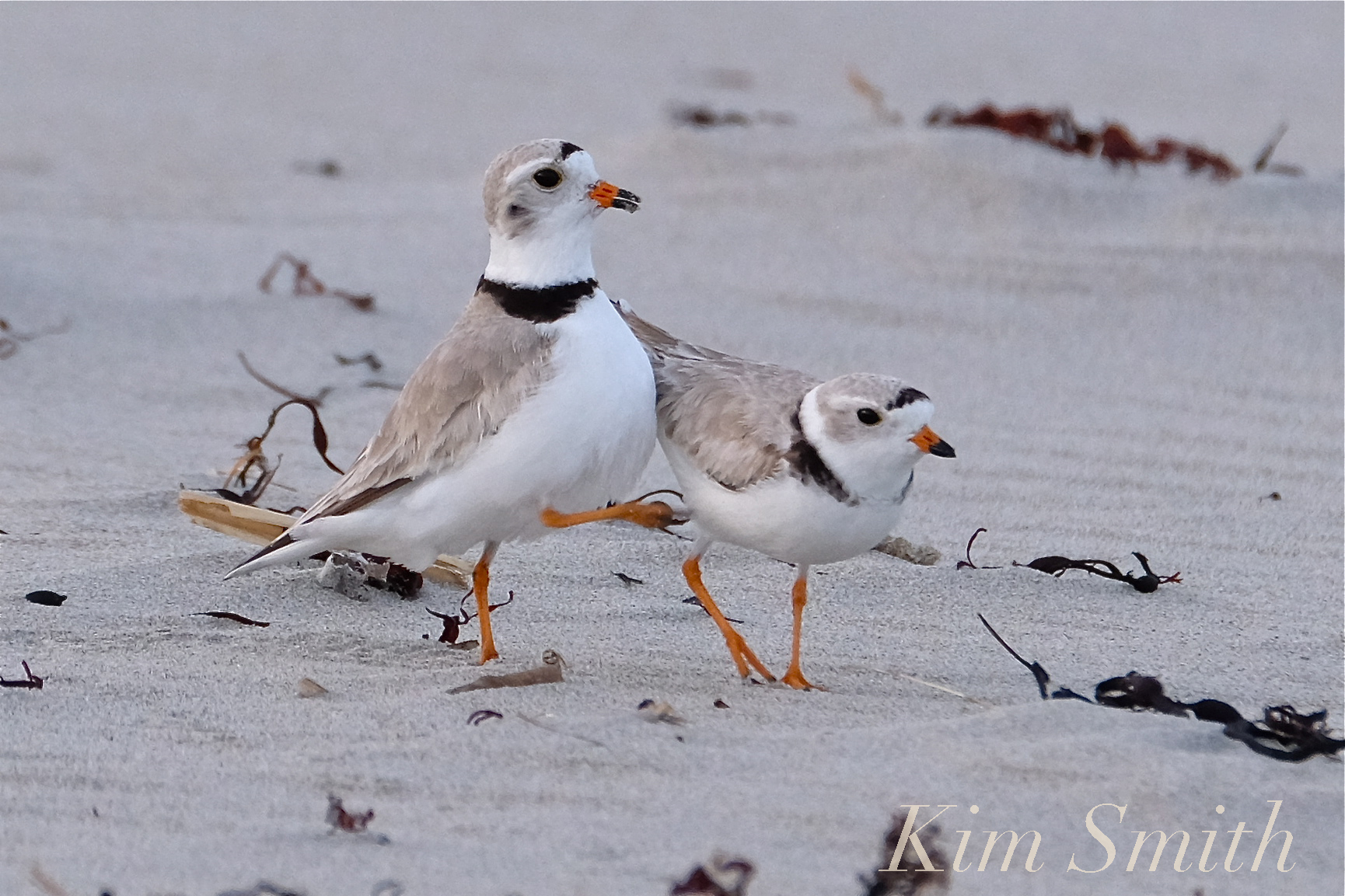
The Piping Plover mating dance is elaborate. Each time the PiPl are interrupted, they do not resume where leaving off, but begin the dance anew. In the above photo, the male is high stepping all around the female while she has positioned herself to accept the next step, where he jumps on her back, and they connect, cloaca to cloaca. The courtship dance takes about twenty to thirty minutes while copulation only lasts a mere minute.


TRACKING WILD CREATURES ON OUR LOCAL BEACHES (WILL BEARS BE NEXT?)

Just some of the paw prints seen on our local beaches this spring are Eastern Coyote, Red Fox, Skunk, Racoon, White-tailed Deer, and of course, a plethora of crows and gulls.

If you would like to see what wildlife traverses and scavenges Cape Ann beaches when we humans are not there, the best time to look is early, early in the morning, before the tracks are disturbed. Oftentimes the best days to look are after a rain storm, especially after the sand has dried a bit. Forget about tracking tracks on a windy morning. If you are not sure what you are seeing, take a close-up photo of the track, and then take a long shot, too, to see the pattern of the tracks.  
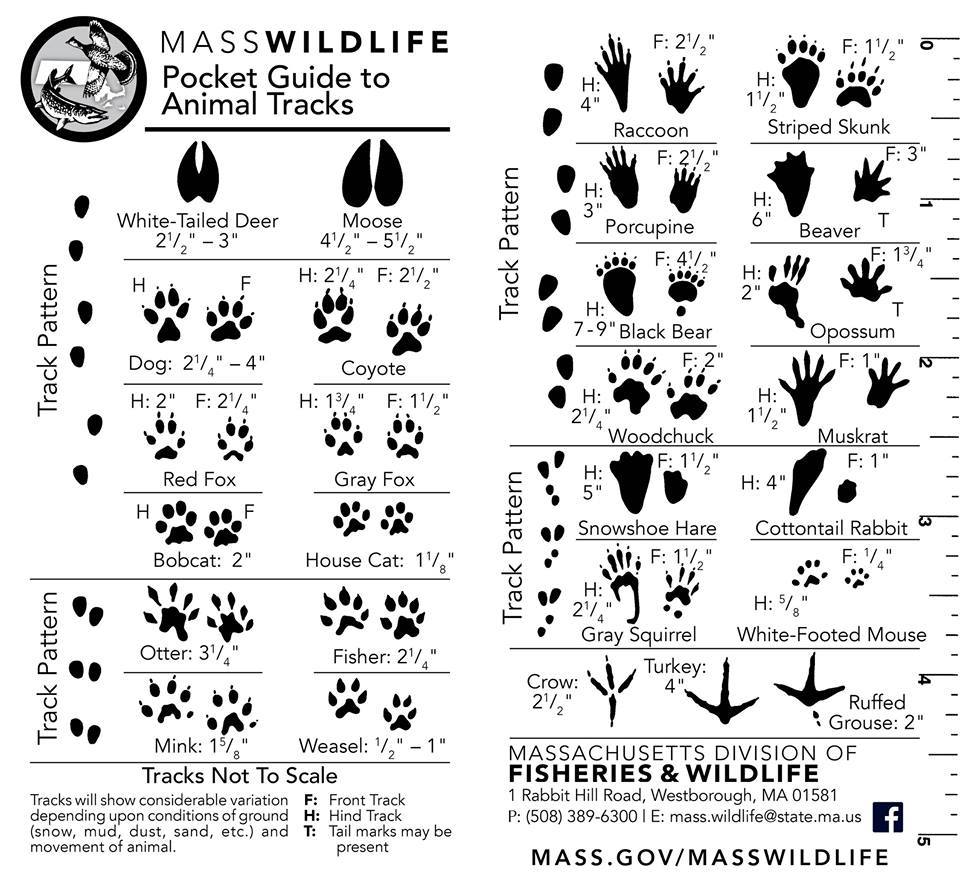
The Mass Wildlife Pocket Guide is the best handy track identification tool because it shows clearly the tracks, as well as the pattern of the tracks, and only shows wildlife we see in Massachusetts.

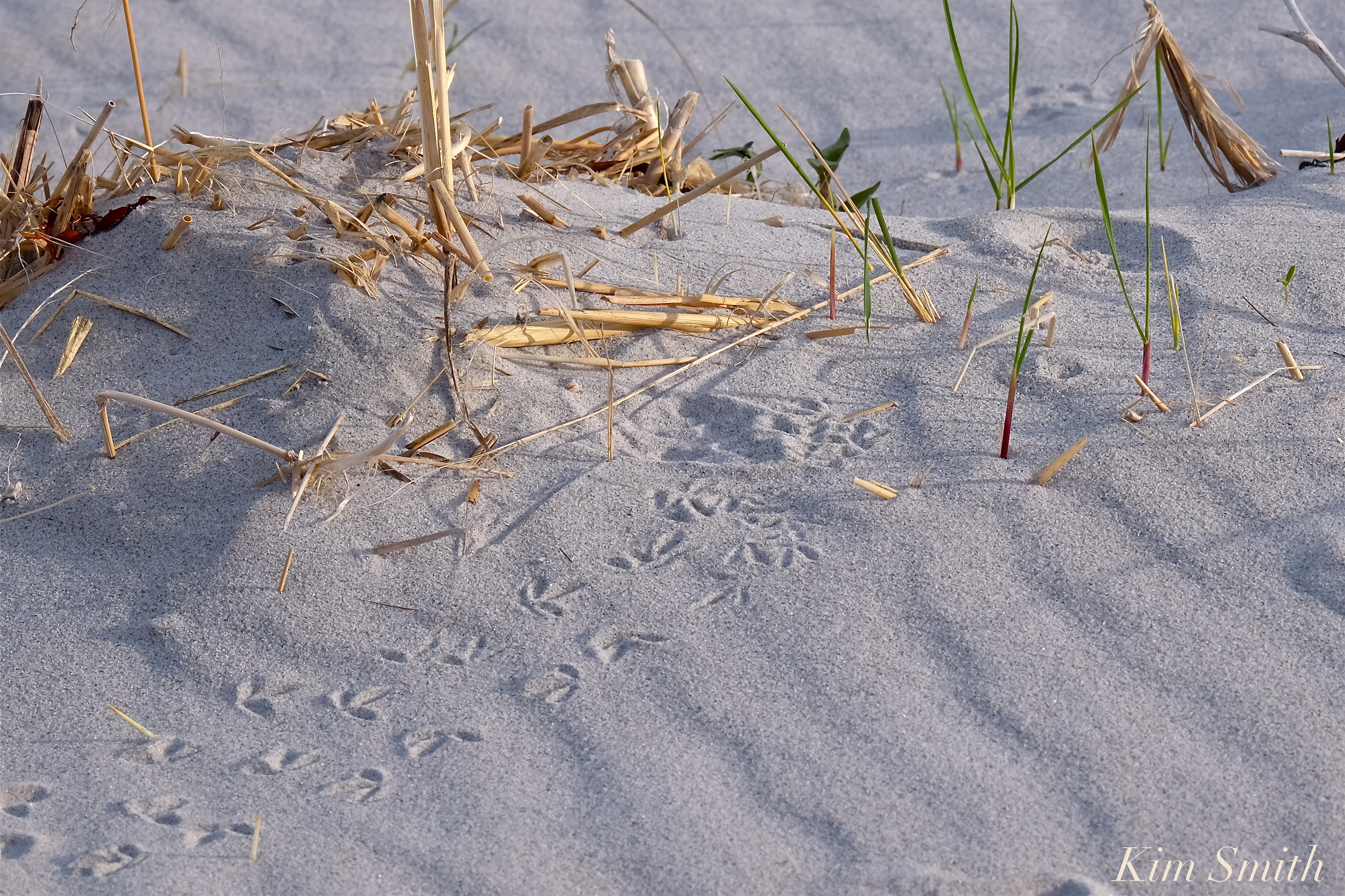
My favorite tracks to find are (no mystery here) Piping Plover tracks, which are wonderfully shaped, like a diminutive fleur de lis.

Piping Plover tracks showing courtship activity

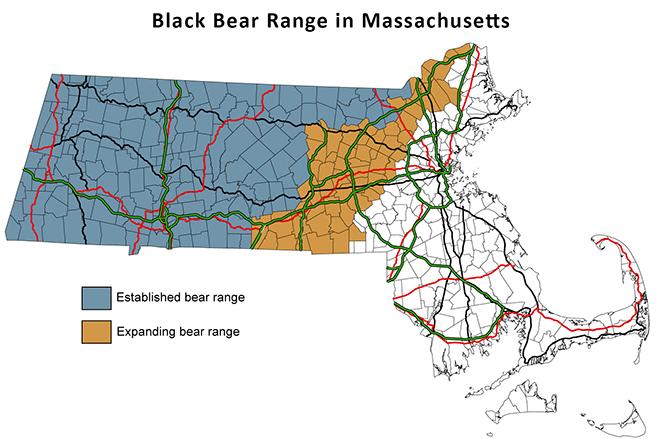
I am waiting to see Black Bear tracks. Just kidding, although, the range of the Black Bear is expanding from western Massachusetts eastward. I imagine that within ten years Black Bears will, at the very least be frequent visitors to Cape Ann, or will be living in our midst. Just the thing Joey will be thrilled to know 🙂

Learn more about Black Bears here.


The Black Bears expanding range in Massachusetts.

Black Bear Cubs

Photo courtesy wikicommons media

DEBUNKING PIPING PLOVER MYTH #1

Debunking Piping Plover Myth #1

“Because of those gosh darn *&%$@# Piping Plovers, Gloucester is going to lose tens of thousands of dollars in parking revenue.”

Not true.

Here is why. The Piping Plovers will be out of the parking lot, before the summer season begins and before school is out!

The one thing the parking lot PiPl have going for them is that they laid their eggs relatively early in the season. If the nest is left undisturbed, by the time the chicks hatch, we will be in the second week of June. It may take a day or two for them to make the epic journey to the beach, where they will much prefer to spend the summer. At the very latest, the chicks will be out of the parking lot by the third week of June.

So to be completely clear: the Good Harbor Beach parking lot is not closing and we will have ample parking during the summer months.

I hope this quells the rumors circulating. Look for more PiPl myths debunked this week in upcoming posts 🙂 Please share this post to help folks understand more about our Good Harbor Beach parking lot Plovers.
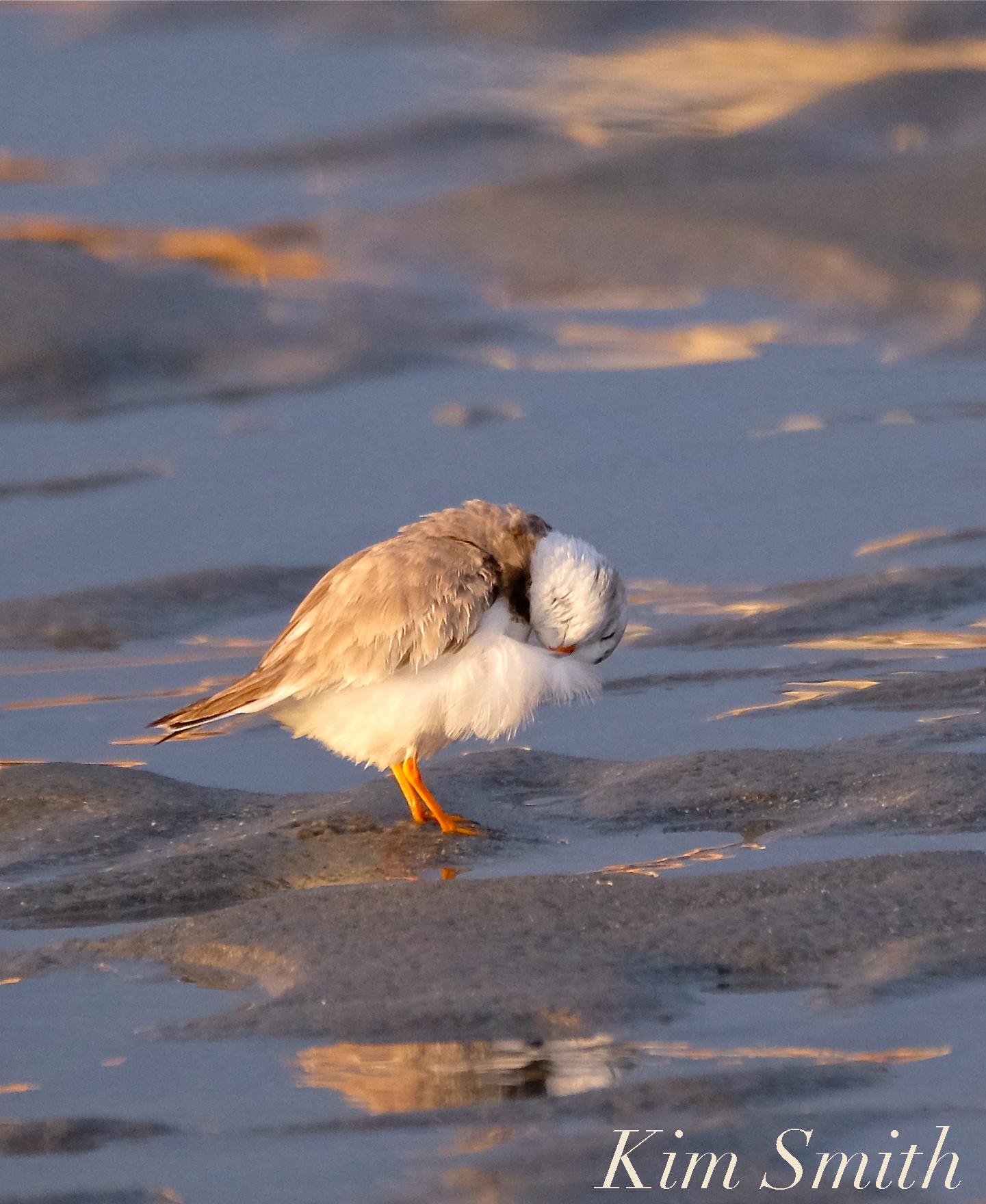
Fluffing and puffing – morning bath for Mama Plover.